
- Home
- »
- Next Generation Technologies
- »
-
Generative AI In Financial Services Market Report, 2033GVR Report cover

Generative AI In Financial Services Market (2026 - 2033)
Size, Share & Trends Analysis Report By Application (Risk Management, Fraud Detection, Credit Scoring, Forecasting & Reporting), By Deployment (Cloud & On-Premises), End Use, By Region, And Segment Forecasts
Market Size, 2025
$3.0BMarket Estimate, 2026
$4.0BMarket Forecast, 2033
$15.4BCAGR, 2026–2033
30.3%Generative AI in Financial Services Market Summary
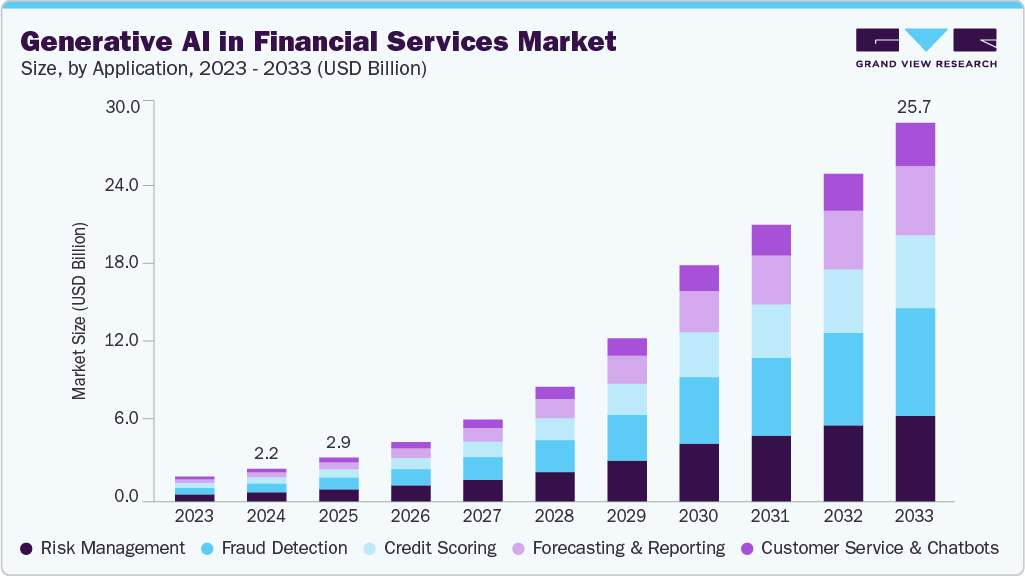
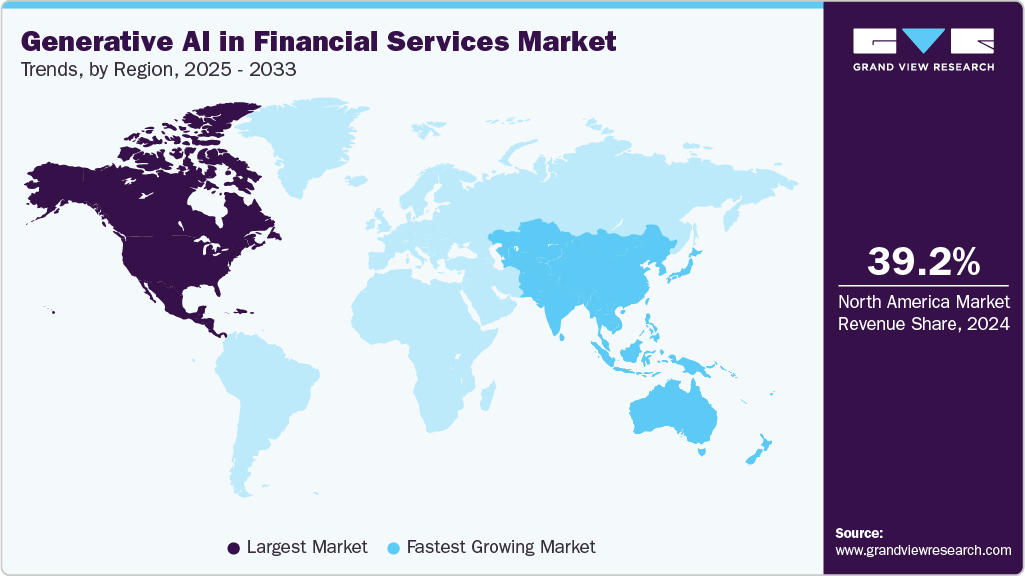
The global generative AI in financial services market size was estimated at USD 3.0 billion in 2025 and is projected to grow from USD 4.0 billion in 2026 to USD 15.4 billion by 2033, growing at a CAGR of 30.3% from 2026 to 2033. North America dominated the global GenAI in Financial Services Market with the largest revenue share of 38.7% in 2025. The region's leadership is driven by the rapid adoption of generative AI technologies across banking, insurance, asset management, and financial advisory services.
 Source: Grand View Research, IR Documents, Primary Interviews, Paid DatabasesTo learn more about this report,
 Download Free Sample Report
 Key Market Trends & Insights
- By application: Fraud Detection segment led the market and held the largest revenue share of over 27.6% in 2025.
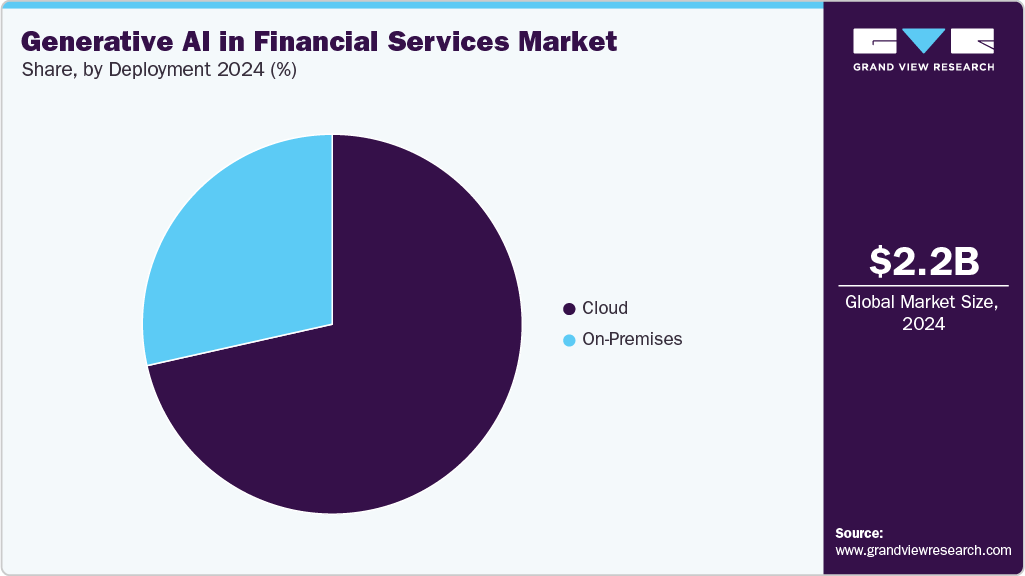
- By deployment: Cloud segment led the market and held the largest revenue share of over 71.9% in 2025.
- By end use: Investment Firms segment is the fastest growing segment with CAGR 31.6% during the forecast period 2026 to 2033.
Regional Highlights
- Largest regional market: North America (38.7% revenue share, 2025)
- Fastest regional market: Asia Pacific (Highest CAGR,2025)
- By country: The U.S. held the largest market share in 2025
Market Size & Forecast
- 2025 Market Size: USD 3.0 Billion
- 2026 Market Size: USD 4.0 Billion
- 2033 Projected Market Size: USD 25.7 Billion
- CAGR (2026-2033): 30.3%
Three ways to get this report
Buy it, customize it, or ask a question.Ask an Analyst
Analyst response in 1 business day
- AccessReport author, directly
- Reply timeWithin 1 working day
- No sales callDirect answer only
- FormatEmail reply
- CostFree, no cost
Get the Full Report
What the study covers
- FormatsPDF · Excel · Dashboard
- Timeline2026–2033 annual, 2025 base
- Coverage20+ countries, 5 regions
- Companies10+ key players profiled
Customize the Report
20% free customization
- IncludeCountries, segments, points
- TailorTo your product definition
- ExtendDeeper competitor detail
- OrA fully bespoke study
- Turnaround5–10 working days
Financial institutions in the U.S. and Canada are increasingly leveraging GenAI for fraud detection, risk assessment, customer service automation, personalized financial recommendations, and regulatory compliance. The strong presence of major technology providers, AI startups, and leading financial institutions, coupled with substantial investments in digital transformation and cloud infrastructure, continues to accelerate GenAI deployment across the financial services ecosystem.One of the key drivers for the adoption of generative AI in financial services is the need for hyper-personalized customer engagement. Banks and fintech firms are leveraging AI-driven chatbots, virtual assistants, and recommendation engines to provide context-aware interactions and real-time financial advice. These tools analyze customer behavior, transaction patterns, and preferences to generate personalized investment insights, loan recommendations, or risk alerts. This enhances customer satisfaction and retention and enables cross-selling and upselling opportunities. Moreover, the growing consumer expectation for seamless, AI-powered digital banking experiences is compelling institutions to invest heavily in generative AI tools for improving customer acquisition and service automation.
 To learn more about this report, Download Free Sample Report
 The growing emphasis on risk management and fraud prevention is another essential factor propelling market growth. Generative AI models can simulate complex financial scenarios, identify anomalies, and generate synthetic datasets to train predictive models without exposing sensitive information. This capability helps institutions detect fraudulent patterns, evaluate credit risks, and comply with stringent regulatory frameworks such as Basel III and GDPR. In addition, AI-driven generative modeling supports financial forecasting and stress testing by generating realistic and varied datasets, improving risk resilience. As financial ecosystems expand digitally, the integration of GenAI for adaptive risk intelligence and compliance automation is becoming a strategic priority for global financial institutions.
The rise in AI-driven innovation and ecosystem partnerships is also fueling market expansion. Numerous technology providers and financial institutions are collaborating to co-develop GenAI platforms tailored for trading strategies, portfolio optimization, and document automation. For instance, AI-powered tools are now generating financial reports, investment summaries, and regulatory filings with improved accuracy and reduced turnaround time. Furthermore, the proliferation of cloud computing and API-based architectures enables seamless deployment and scalability of GenAI applications across diverse financial operations. Due to continuous advancements in foundation models and multimodal AI, the financial services industry is witnessing a paradigm shift toward data-driven, predictive, and generative decision-making frameworks that enhance productivity and innovation.
Market Dynamics
The GenAI in Financial Services Market is experiencing significant growth, driven by the increasing adoption of artificial intelligence technologies to enhance customer engagement, automate financial operations, and improve decision-making processes across banking, insurance, and investment sectors. Financial institutions are increasingly deploying generative AI solutions to deliver personalized financial advice, automate customer support, streamline regulatory compliance, and strengthen fraud detection capabilities. The growing volume of financial data, rising demand for digital banking services, and increasing investments in AI-powered innovation are further accelerating market expansion. However, concerns related to data privacy, cybersecurity risks, regulatory compliance requirements, and the accuracy of AI-generated outputs remain key challenges. Despite these constraints, the expanding use of generative AI in wealth management, risk assessment, credit analysis, and intelligent financial advisory services is expected to create substantial growth opportunities for the market during the forecast period.
The GenAI in Financial Services Market is experiencing robust growth due to the increasing demand for intelligent automation, enhanced customer engagement, and operational efficiency across financial institutions. Banks, insurance providers, wealth management firms, and fintech companies are leveraging generative AI to automate customer service, streamline loan processing, generate financial reports, and provide personalized financial recommendations. The growing volume of financial data, coupled with the need for real-time decision-making and improved customer experiences, is accelerating the adoption of GenAI solutions. Furthermore, advancements in large language models (LLMs), natural language processing (NLP), and cloud-based AI platforms are enabling financial organizations to improve productivity, reduce costs, and enhance service delivery.
Despite significant growth potential, the GenAI in Financial Services Market faces challenges related to data privacy, cybersecurity, and regulatory compliance. Financial institutions handle highly sensitive customer and transactional data, making them vulnerable to data breaches, model misuse, and unauthorized access. Additionally, evolving regulations surrounding AI governance, transparency, explainability, and data protection require organizations to implement stringent compliance frameworks. Concerns regarding AI-generated inaccuracies, bias in decision-making, and regulatory scrutiny can increase implementation complexity and operational costs, potentially slowing adoption among risk-averse financial institutions.
The growing demand for personalized banking, digital financial advisory services, and intelligent risk management is creating substantial opportunities for the GenAI in Financial Services Market. Financial institutions are increasingly utilizing generative AI to develop virtual financial assistants, automate investment research, enhance fraud detection, and support credit risk assessment. The integration of GenAI with predictive analytics, machine learning, and real-time data processing enables organizations to deliver tailored financial products and proactive customer support. Moreover, rising investments in digital transformation initiatives, open banking ecosystems, and AI-enabled fintech innovations are expected to create lucrative growth opportunities for market participants throughout the forecast period.
Market Concentration & Characteristics
The GenAI in Financial Services Market is moderately concentrated, characterized by the presence of leading cloud service providers, enterprise software companies, AI innovators, consulting firms, and financial technology providers competing on the basis of AI model performance, scalability, data security, regulatory compliance, and industry-specific financial solutions. Market participants are increasingly investing in large language models (LLMs), generative AI platforms, intelligent automation, cloud-based AI infrastructure, and responsible AI frameworks to enhance customer experience, streamline financial operations, strengthen risk management, and improve decision-making. Strategic partnerships, product innovations, cloud deployments, and advancements in AI governance and financial analytics are key factors shaping the competitive landscape.
 To learn more about this report, Download Free Sample Report
 Key market participants include AlphaSense Inc., Amazon Web Services, Inc., Ernst & Young Global Limited, Google LLC, HCL Technologies Limited, IBM Corporation, Intel Corporation, Mastercard, Microsoft, Narrative Science, OpenAI, Salesforce, Inc., and SAP SE. These companies are focusing on expanding generative AI capabilities, integrating AI into banking and financial workflows, strengthening cloud-based AI platforms, enhancing fraud detection and compliance solutions, and developing intelligent financial assistants and analytics tools to improve operational efficiency, customer engagement, and business performance across the financial services industry.
Analyst Perspective
The GenAI in Financial Services Market is becoming a critical enabler of digital transformation across banking, insurance, capital markets, and fintech, driven by the growing need for intelligent automation, personalized financial services, and data-driven decision-making. Financial institutions are increasingly adopting generative AI to streamline operations, enhance customer engagement, strengthen fraud detection, improve risk management, and accelerate regulatory compliance. The market is benefiting from continuous advancements in large language models (LLMs), natural language processing (NLP), machine learning, and cloud-based AI platforms, enabling faster financial analysis, automated content generation, intelligent virtual assistants, and real-time business insights. As organizations continue investing in responsible AI, secure data management, and scalable AI infrastructure, the adoption of generative AI is expected to accelerate, transforming financial service delivery and creating significant opportunities for innovation and long-term market growth.
Application Insights
Based on application, the Fraud Detection segment led the market with the largest revenue share of 27.6% in 2025. The fraud detection application segment in the Generative AI in Financial Services Market is driven by the increasing sophistication and frequency of financial fraud, cyberattacks, identity theft, and payment-related crimes across digital banking and financial platforms. The rapid growth of online transactions, digital payments, and mobile banking has significantly increased the volume of transaction data, creating a strong demand for AI-powered fraud detection solutions capable of identifying suspicious activities in real time. Generative AI enhances fraud prevention by analyzing complex transaction patterns, detecting anomalies, generating synthetic fraud scenarios for model training, and continuously adapting to evolving fraud techniques.
The forecasting & reporting segment is expected to register the fastest CAGR over the forecast period. Financial institutions are under growing pressure to navigate increasingly volatile markets and regulatory landscapes; generative AI enables advanced pattern-recognition across massive datasets, delivering more accurate forecasts and automated reporting at scale. Moreover, the demand for real-time insights and dynamic decision-making is rising, banks and investment firms are embracing generative models to optimize resource allocation, predict customer behavior, and streamline internal disclosures. Collectively, these drivers accelerate adoption of forecasting & reporting tools, reinforcing this segment as a major growth engine within the overall market.
Deployment Insights
Based on deployment, the cloud segment led the market with the largest revenue share of 71.9% in 2025. The increasing demand for secure and compliant cloud-based solutions is driving cloud providers to invest heavily in advanced security measures, making generative AI applications more robust. These enhanced security protocols enable financial institutions to safeguard sensitive data and adhere to industry regulations such as GDPR and PCI DSS. By leveraging cloud-based AI, organizations can also improve their data management practices, allowing for effective monitoring, auditing, and control of data access. The integration of AI with cloud security features is essential for financial institutions to maintain trust and compliance in an increasingly complex regulatory environment. As these technologies evolve, they are likely to play a crucial role in ensuring that financial services can operate securely and efficiently while meeting stringent compliance requirements.
The on-premises segment is expected to register a significant CAGR over the forecast period. The on-premises deployment segment is being propelled primarily by stringent data-security, regulatory compliance and infrastructure control imperatives within financial institutions. Many banks, insurers and asset-managers favour on-premises solutions because they enable full sovereignty over sensitive data, mitigate risks of third-party cloud exposure and align with jurisdictional data-residency mandates. Concurrently, the need for high-performance, low-latency computing, in latency-sensitive use cases such as algorithmic trading and real-time fraud detection reinforces this preference. Furthermore, established IT ecosystems and legacy infrastructure in large financial firms make on-premises deployment economically and operationally viable, thereby sustaining its growth trajectory.
End Use Insights
Based on end use, the Retail Banking segment led the market with the largest revenue share of 34.7% in 2025. The increasing demand for faster and more efficient loan processing is driving the adoption of generative AI in retail banking. AI models are streamlining the underwriting and approval process by automating key aspects of the loan processing experience. By analyzing a wide range of data points, from credit scores to alternative data sources such as social media activity, AI can quickly assess creditworthiness and make informed lending decisions. This efficiency enhances customer experience by reducing the time it takes to approve loans and allows banks to process more loan applications with greater accuracy. The use of AI in loan processing is becoming a competitive advantage in the retail banking sector, where speed and precision are critical to staying ahead in a rapidly evolving market. As technology continues to advance, the integration of generative AI will be essential for banks looking to meet the growing expectations of their customers and maintain a strong position in the industry.
 To learn more about this report, Download Free Sample Report
 Investment firms’ segment is expected to register the fastest CAGR over the forecast period. The exponential growth in alternative data from market sentiment, news flows, to unstructured text and the consequent demand for advanced analytics made generative AI tools indispensable for delivering real-time insights and predictive capability. Moreover, investment firms are under intense pressure to streamline operations. Generative AI enables automation of research workflows, rapid scenario modelling and personalized investment narratives, thus cutting costs and accelerating decision-making. These twin forces data proliferation and the need for operational/strategic efficiency underpin the accelerating deployment of generative AI in the investment segment.
Regional Insights
North America dominated the generative AI in Financial Services Market with the largest revenue share of 38.7% in 2025. A prominent trend in North America is the automation of compliance and reporting processes through generative AI. Financial institutions are leveraging AI systems to monitor regulatory changes and assess their implications on business operations, significantly reducing the time and effort required for manual compliance tasks.
 To learn more about this report, Download Free Sample Report
 U.S. Generative AI in Financial Services Market Trends
The GenAI in Financial Services Market in the U.S. held the largest share in the North America region in 2025. The growing advancement of financial fraud is driving the adoption of Generative AI for advanced fraud detection in the U.S. financial sector. AI systems are leveraging machine learning algorithms to analyze transaction patterns and identify anomalies in real time. This capability enables financial institutions to detect and prevent fraudulent activities more effectively, reducing potential losses and maintaining customer trust. The increasing complexity of fraud schemes is pushing firms to invest in AI-driven solutions for robust fraud prevention.
Europe Generative AI in Financial Services Market Trends
Generative AI in Financial Services market in Europe is expected to grow significantly over the forecast period driven by the thriving fintech landscape, with Generative AI playing a pivotal role in driving innovation. Financial institutions are leveraging AI to develop new products and services, such as personalized financial advice, automated trading platforms, and advanced fraud detection systems. The region's strong fintech ecosystem, supported by favorable regulations and a culture of innovation, is accelerating the integration of AI into mainstream financial services, enhancing competitiveness and customer experiences.
Asia Pacific Generative AI in Financial Services Market Trends
Generative AI in Financial Services industry in the Asia Pacific region is anticipated to be at the fastest CAGR over the forecast period. Generative AI is playing a crucial role in strengthening fraud prevention measures across the Asia Pacific financial sector. AI systems analyze vast amounts of transaction data to detect and prevent fraudulent activities in real time. This advanced capability is particularly important in the region, where rapid digital transformation and increasing financial transactions are creating new opportunities for fraud. The implementation of AI for fraud detection is helping institutions safeguard their assets and maintain customer trust.
Key Generative AI in Financial Services Company Insights
Some key companies in the Generative AI in Financial Services market areOpenAI and AlphaSense Inc.
-
OpenAI is an artificial intelligence research and deployment company, operating a hybrid structure of a nonprofit arm and a capped-profit for-profit entity. It offers products such as the GPT-series large-language models, DALL-E image-generation, Codex code assistant, and enterprise API access. OpenAI provides models and APIs that enable automation of document processing, research summarization, knowledge-retrieval for advisors, risk analysis and client-service applications, helping banks and investment firms accelerate workflows while maintaining data security and regulatory control.
-
AlphaSense Inc. is a market intelligence and research platform provider specializing in AI and NLP-driven insights for financial services, corporates, and investment firms. Its products include Generative Search, Deep Research, and Generative Grid, which leverage generative AI to summarize, analyze, and extract insights from filings, earnings transcripts, and research reports. Through its cloud-based, subscription-driven distribution model, AlphaSense Inc. integrates structured financial data with unstructured content, enabling faster and more accurate decision-making. It enhances investment research, risk assessment, and strategy formulation with domain-specific, secure, and explainable AI tools.
Key Generative AI in Financial Services Companies
The following key companies have been profiled for this study on the generative AI in financial services market.
-
AlphaSense Inc.
-
Amazon Web Services, Inc.
-
Ernst & Young Global Limited
-
Google LLC
-
HCL Technologies Limited
-
IBM Corporation
-
Intel Corporation
-
Mastercard
-
Microsoft
-
Narrative Science
-
OpenAI
-
Salesforce, Inc.
-
SAP SE
Competitive Benchmarking
Category
Operating Strategies
Competitive Edge
Weakness
Established Players: Amazon Web Services, Inc.; Ernst & Young Global Limited; Google LLC; HCL Technologies Limited; IBM Corporation; Intel Corporation; Mastercard; Microsoft; Salesforce, Inc.; SAP SE
- Focus on expanding enterprise-grade generative AI platforms, cloud AI infrastructure, financial AI solutions, AI governance, regulatory compliance, cybersecurity, and intelligent automation. Emphasize strategic partnerships with financial institutions, investments in large language models (LLMs), cloud-native AI services, and responsible AI frameworks to accelerate digital transformation across banking, insurance, and capital markets.
- Strong global presence, extensive enterprise customer base, advanced AI and cloud capabilities, significant R&D investments, comprehensive technology portfolios, established partner ecosystems, and deep expertise in enterprise software and financial services.
- High implementation and integration costs, complex legacy system integration, evolving AI regulations, data privacy and security challenges, and increasing competition from specialized AI solution providers and emerging GenAI startups.
Emerging Players: AlphaSense Inc.; Narrative Science; OpenAI
- Focus on developing specialized generative AI applications for financial research, intelligent search, automated content generation, conversational AI, financial analytics, and decision support. Invest in foundation models, domain-specific AI capabilities, and strategic collaborations with financial institutions and enterprise technology providers to expand market adoption.
- Strong innovation capabilities, expertise in generative AI and natural language processing, rapid product development, specialized financial intelligence solutions, and the ability to deliver advanced AI-driven insights and automation.
- Limited enterprise scale compared with large technology vendors, dependence on strategic partnerships and cloud infrastructure providers, evolving monetization models, regulatory scrutiny surrounding AI adoption, and challenges in expanding global enterprise reach.
Recent Developments
-
In October 2025, Amazon Web Services, Inc. (AWS) collaborated with Biz2X, a financial-technology company, to launch an Agentic AI Digital Lending Solution built on AWS’s Amazon Bedrock, targeting banks, NBFCs, and fintech lenders and accelerating SME loan origination and servicing. The platform is designed to streamline application workflows, enable conversational AI engagements with borrowers and deliver real-time decision-making, positioning lenders to boost volumes and cut approval times within the SME credit segment.
-
In October 2025, AlphaSense Inc. launched Financial Data, a new product combining structured quantitative datasets with qualitative insights in one GenAI-enabled workflow, aimed squarely at hedge funds, investment banks, asset managers, and PE/VC firms. The launch enhances AlphaSense, Inc.’s market intelligence platform by integrating financial fundamentals, consensus estimates, and ownership data, enabling users to generate faster, data-driven investment insights and improve decision-making efficiency.
-
In May 2025, Google LLC announced a Memorandum of Understanding with UniCredit, a pan-European commercial bank, to accelerate UniCredit’s digital transformation across 13 core markets, using Google Cloud’s infrastructure, AI and data analytics. The ten-year partnership will enable UniCredit to migrate key applications to the cloud, modernize its IT architecture and deploy advanced AI workloads, including the Vertex AI platform and Gemini models, to enhance service offerings, operational efficiency and customer experience. The collaboration also encompasses a group-wide digital skill training Programme to build internal capabilities and support future growth initiatives.
Generative AI in Financial Services Market Report Scope
Report Attribute
Details
Market size in 2025
USD 3.0 billion
Estimated market size in 2026
USD 4.0 billion
Projected market size by 2033
USD 25.7 billion
Growth rate
CAGR of 30.3% from 2026 to 2033
Base year for estimation
2025
Historical data
2021 - 2024
Forecast period
2026 - 2033
Quantitative units
Revenue in USD billion/billion and CAGR from 2026 to 2033
Report coverage
Revenue forecast, company ranking, competitive landscape, growth factors, and trends
Segments covered
Application, deployment, end use, and region
Regional scope
North America; Europe; Asia Pacific; Latin America; MEA
Country scope
U.S.; Canada; Mexico; UK; Germany; France; China; Japan; India; South Korea; Australia; Brazil; KSA; UAE; South Africa
Key companies profiled
AlphaSense Inc.; Amazon Web Services, Inc.; Ernst & Young Global Limited; Google LLC; HCL Technologies Limited; IBM Corporation; Intel Corporation; Mastercard; Microsoft; Narrative Science; OpenAI; Salesforce, Inc.; SAP SE
Customization scope
Free report customization (equivalent up to 8 analysts' working days) with purchase. Addition or alteration to country, regional & segment scope.
Pricing and purchase options
Avail customized purchase options to meet your exact research needs. Explore purchase options
Global Generative AI in Financial Services Market Report Segmentation
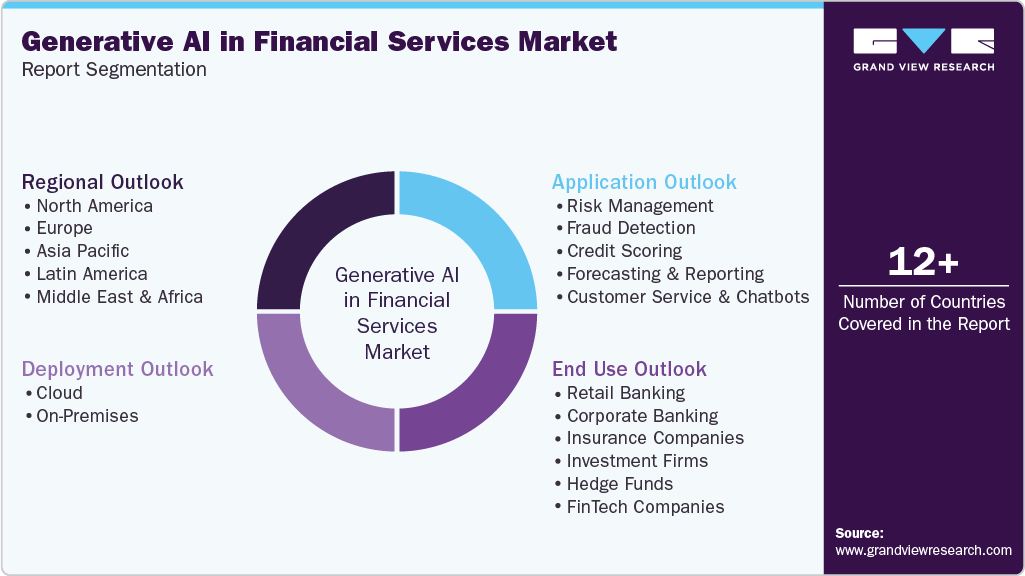
This report forecasts revenue growth at global, regional, and country levels and provides an analysis of the latest industry trends in each of the sub-segments from 2021 to 2033. For this study, Grand View Research has segmented global Generative AI in Financial Services market report based on application, deployment, end use, and region.
 To learn more about this report, Download Free Sample Report
 -
Application Outlook (Revenue, USD Billion, 2021 - 2033)
-
Risk Management
-
Fraud Detection
-
Credit Scoring
-
Forecasting & Reporting
-
Customer Service and Chatbots
-
-
Deployment Outlook (Revenue, USD Billion, 2021 - 2033)
-
Cloud
-
On-Premises
-
-
End Use Outlook (Revenue, USD Billion, 2021 - 2033)
-
Retail Banking
-
Corporate Banking
-
Insurance Companies
-
Investment Firms
-
Hedge Funds
-
FinTech Companies
-
-
Regional Outlook (Revenue, USD Billion, 2021 - 2033)
-
North America
-
U.S.
-
Canada
-
Mexico
-
-
Europe
-
Germany
-
UK
-
France
-
-
Asia Pacific
-
China
-
Japan
-
India
-
South Korea
-
Australia
-
-
Latin America
-
Brazil
-
-
Middle East and Africa (MEA)
-
UAE
-
KSA
-
South Africa
-
-
Research Methodology
The generative AI in financial services market figures in this report are based on a proven research process that combines executive interviews with secondary research from proprietary databases, company filings, and recognized regulatory and institutional sources. Market size is built through value-chain sizing - reconciling supply-side and demand-side estimates - and triangulated with bottom-up and top-down approaches. Every estimate passes multiple levels of expert validation before publication, with each generative AI in financial services segment quantified using the revenue-capture definitions in the table below.
Segment Definition
Segment -Application
Revenue capture definition
Risk Management
Revenue in this segment is generated through the development & deployment of generative AI solutions designed to identify, assess, monitor, and mitigate financial, operational, compliance, and cybersecurity risks across banking, insurance, capital markets, and other financial institutions. These solutions leverage AI-powered analytics, predictive modeling, anomaly detection, and automated risk assessment to enhance decision-making, strengthen regulatory compliance, improve fraud detection, and support enterprise risk management.
Fraud Detection
Revenue in this segment is generated through the management of generative AI solutions designed to detect, prevent, and investigate fraudulent activities across banking, insurance, payments, and other financial services. These solutions leverage AI-powered pattern recognition, anomaly detection, transaction monitoring, and behavioral analytics to identify suspicious activities in real time, reduce financial losses, strengthen regulatory compliance, and enhance fraud prevention capabilities.
Credit Scoring
Revenue in this segment is generated through the development, deployment, and management of generative AI solutions designed to evaluate borrower creditworthiness and automate credit risk assessment across banking, lending, and other financial services. These solutions leverage AI-powered predictive analytics, alternative data analysis, and intelligent decision-making models to improve the accuracy of credit evaluations, accelerate loan approvals, reduce default risks, and support responsible lending practices
Forecasting & Reporting
Revenue in this segment is generated through the development of generative AI solutions designed to automate financial forecasting, reporting, and business performance analysis across banking, insurance, asset management, and other financial services. These solutions leverage AI-powered predictive analytics, natural language generation, and data visualization to generate financial reports, forecast market trends, support strategic decision-making, and improve the accuracy and efficiency of financial planning and reporting processes.
Customer Service and Chatbots
Revenue in this segment is generated through the, deployment, and management of generative AI-powered customer service and chatbot solutions designed to automate customer interactions across banking, insurance, wealth management, and other financial services. These solutions leverage natural language processing (NLP), large language models (LLMs), and conversational AI to provide 24/7 customer support, handle account inquiries, assist with financial transactions, deliver personalized financial guidance, and enhance customer experience while reducing operational costs.
Segment -Deployment
Revenue capture definition
Cloud
Revenue in this segment is generated through the deployment and delivery of generative AI solutions via cloud-based infrastructure and platforms for financial services organizations. Cloud deployment enables banks, insurers, and other financial institutions to access scalable AI models, high-performance computing resources, and secure data processing capabilities without significant on-premises infrastructure investments.
On-Premises
Revenue in this segment is generated through the deployment and management of generative AI solutions within the internal IT infrastructure of banks, insurance companies, and other financial institutions. On-premises deployment provides organizations with greater control over sensitive financial data, security, regulatory compliance, and system customization.
Segment -End Use
Revenue capture definition
Retail Banking
Revenue in this segment is generated through the deployment and use of generative AI solutions across retail banking operations to enhance customer engagement, automate routine processes, and improve financial decision-making. These solutions support applications such as virtual banking assistants, personalized financial recommendations, loan processing, fraud detection, customer service, and account management, enabling banks to improve operational efficiency, deliver personalized customer experiences, and strengthen risk management.
Corporate Banking
Revenue in this segment is generated through the deployment and use of generative AI solutions across corporate banking operations to streamline financial services, automate complex workflows, and enhance decision-making for business clients. These solutions support applications such as credit analysis, risk assessment, trade finance, cash flow management, regulatory compliance, relationship management, and financial reporting, enabling banks to improve operational efficiency, accelerate service delivery, and provide personalized solutions to corporate customers
Insurance Companies
Revenue in this segment is generated through the deployment and use of generative AI solutions across insurance operations to automate underwriting, claims processing, fraud detection, customer service, and risk assessment. These solutions leverage AI-powered analytics, natural language processing, and predictive modeling to improve policy management, accelerate claims settlement, personalize insurance offerings, enhance customer engagement, and strengthen operational efficiency and regulatory compliance.
Investment Firms
Revenue in this segment is generated through the deployment and use of generative AI solutions across investment management and capital markets to enhance research, portfolio management, financial forecasting, and investment decision-making. These solutions leverage AI-powered analytics, natural language processing, and predictive modeling to automate market analysis, generate investment insights, assess portfolio risks, optimize asset allocation, and improve operational efficiency while supporting informed investment strategies.
Hedge Funds
Revenue in this segment is generated through the deployment and use of generative AI solutions across hedge fund operations to enhance investment research, quantitative analysis, portfolio optimization, algorithmic trading, and risk management. These solutions leverage AI-powered predictive analytics, natural language processing, and real-time market intelligence to identify investment opportunities, automate financial analysis, optimize trading strategies, and improve portfolio performance while supporting faster and more informed investment decisions.
FinTech Companies
Revenue in this segment is generated through the deployment and use of generative AI solutions across fintech operations to enhance digital financial services, automate business processes, and improve customer engagement. These solutions support applications such as intelligent virtual assistants, fraud detection, credit scoring, payment processing, regulatory compliance, and personalized financial recommendations. By leveraging AI-powered analytics, natural language processing, and automation, fintech companies improve operational efficiency, accelerate innovation, and deliver secure, scalable, and customer-centric financial solutions.
Estimation Model
Layer Name
Key Question
Description
Addressable End-user Base Layer
Which financial institutions generate demand for GenAI solutions?
Identify the global addressable base of organizations adopting generative AI across the financial services ecosystem. Include retail banks, corporate & investment banks, insurance companies, asset management firms, hedge funds, wealth management firms, payment service providers, credit unions, fintech companies, and other financial institutions seeking to improve operational efficiency, customer engagement, risk management, and decision-making through AI.
GenAI Application Layer
Which business use cases drive GenAI adoption in financial services?
Assess demand across key applications including customer service & chatbots, fraud detection, risk management, credit scoring, financial forecasting & reporting, regulatory compliance, document processing, portfolio management, underwriting, claims automation, and personalized financial advisory services.
Technology Adoption Layer
How extensively are GenAI technologies utilized?
Estimate technology adoption based on the deployment of large language models (LLMs), natural language processing (NLP), machine learning, predictive analytics, intelligent document processing, conversational AI, AI copilots, cloud-based AI platforms, and generative AI foundation models across banking, insurance, investment, and fintech organizations.
Revenue Generation Layer
How much revenue is generated?
Calculate market revenue by assessing spending on generative AI software, platforms, cloud services, APIs, and associated professional services deployed across financial institutions. Revenue is generated through software licensing, SaaS subscriptions, cloud-based AI platforms, AI model access, implementation, system integration, consulting, customization, training, maintenance, and managed AI services supporting fraud detection, customer engagement, risk management, financial analytics, and regulatory compliance.
Delivered Customizations
This report has been delivered with the following In-depth customizations
Client Request
Customization Delivered
Value Adds
Competitive Intelligence & Market Positioning Assessment
Performed an in-depth evaluation of major generative AI solution providers, cloud service providers, enterprise software vendors, consulting firms, and financial technology companies. Assessed market positioning, AI capabilities, financial services offerings, strategic partnerships, product innovations, acquisitions, regional presence, and recent developments across the GenAI in Financial Services ecosystem.
Enables stakeholders to identify key market participants, benchmark competitive positioning, evaluate AI capabilities, explore partnership and acquisition opportunities, and gain strategic insights into the evolving competitive landscape of the GenAI in Financial Services Market.
End-user Demand Patterns & Application-Specific Analysis
Analyzed adoption trends across key applications including customer service & chatbots, fraud detection, risk management, credit scoring, financial forecasting & reporting, regulatory compliance, investment research, and personalized financial advisory. Evaluated AI adoption patterns, investment priorities, digital transformation initiatives, and growth drivers across retail banking, corporate banking, insurance companies, investment firms, hedge funds, and fintech companies.
Provides actionable insights into end-user demand, application-specific adoption trends, high-growth opportunities, and investment priorities, supporting informed decisions related to market entry, product development, business expansion, and AI implementation strategies.
Technology Advancements & Future Growth Potential Evaluation
Assessed the impact of large language models (LLMs), natural language processing (NLP), intelligent automation, AI copilots, predictive analytics, cloud-based AI platforms, responsible AI frameworks, and AI governance technologies on market development. Identified emerging innovation areas, evolving use cases, and high-growth opportunities across the financial services value chain.
Supports long-term strategic planning by identifying attractive investment opportunities, prioritizing technology innovation initiatives, uncovering future revenue streams, and understanding the key trends driving the evolution of the GenAI in Financial Services Market.
Frequently Asked Questions About This Report
Fraud Detection leads the application segment with revenue share of 27.6% in 2025, While Forecasting & Reporting is the fastest growing segment in the market
Cloud leads the deployment segment with revenue share of 71.9% in 2025 & is the fastest growing segment in the market.
Retail Banking leads the end use segment with revenue share of 34.7% in 2025, While Investment Firms is the fastest growing segment in the market
Asia Pacific is the fastest growing region growing with CAGR 32.2% during the forecast period of 2026 to 2033 in the market.
North America dominated the generative AI in financial services market with a share of 38.7% in 2025. A prominent trend in North America is the automation of compliance and reporting processes through generative AI. Financial institutions are leveraging AI systems to monitor regulatory changes and assess their implications on business operations, significantly reducing the time and effort required for manual compliance tasks.
The global generative AI in financial services market size was valued at USD 3.0 billion in 2025 and is estimated at USD 4.0 billion for 2026.
The global generative AI in financial services market is expected to grow at a CAGR of 30.3% from 2026 to 2033, reaching USD 15.4 billion by 2033.
Some key players operating in the generative AI in financial services market include AlphaSense Inc.; Amazon Web Services, Inc.; Ernst & Young Global Limited; Google LLC; HCL Technologies Limited; IBM Corporation; Intel Corporation; Mastercard; Microsoft; Narrative Science; OpenAI; Salesforce, Inc.; and SAP SE.
Key factors driving market growth include cost reduction through automation and resource optimization, a data explosion driving AI integration, and enhanced predictive capabilities through advanced machine learning algorithms.
About the Author(s)
Next Generation Technologies Research Team
Technology · Next Generation TechnologiesThis report was authored by the next generation technologies research team at Grand View Research - comprising two research analysts, one senior research analyst, and one industry expert - with specialized expertise in the next generation technologies segment of the technology industry. All findings are based on proprietary technology databases, executive interviews, and regulatory analysis, subject to internal peer review prior to publication.
Last Updated:
Speak to Analyst

Customize this report to your needs - add regions, segments, or data points, with 20% free customization.
Or view our licence options:


ISO 9001:2015 & 27001:2022 Certified
We are GDPR and CCPA compliant! Your transaction & personal information is safe and secure. For more details, please read our privacy policy.


