
- Home
- »
- Agrochemicals & Fertilizers
- »
-
Genetically Modified Seeds Market Size, Share Report, 2035GVR Report cover
![Genetically Modified Seeds Market (2026 - 2035)Report]()
Genetically Modified Seeds Market (2026 - 2035)
Size, Share & Trends Analysis Report By Crop Type (Corn, Soybean), By Trait (Insect Resistance (Bt), Stacked Traits), By Technology (Transgenic Technology, CRISPR & Gene Editing), By Region, And Segment Forecasts
Market Size, 2025
$30.1BMarket Estimate, 2026
$32.3BMarket Forecast, 2035
$60.4BCAGR, 2026–2035
7.2%Genetically Modified Seeds Market Summary
The global genetically modified seeds market size was valued at USD 30.1 billion in 2025 and is projected to grow from USD 32.3 billion in 2026 to USD 60.4 billion in 2035, at a CAGR of 7.2% from 2026 to 2035. North America dominated the global market, accounting for the largest revenue share in 2025. The increasing need to improve agricultural productivity while addressing climate change and food security challenges is a significant market driver.
Key Market Trends & Insights
- By crop: The corn segment held the largest market share in 2025.
- By trait: The herbicide tolerance segment accounted for the largest market share in 2025.
- By technology: The transgenic technology segment held the largest market share in 2025.
Regional Highlights
- Largest regional market: North America
- Fastest-growing regional market: Asia Pacific (highest CAGR, 2026-2035)
Market Size & Forecast
- Market size in 2025: USD 30.1 Billion
- Estimated market size in 2026: USD 32.3 Billion
- Projected market size by 2035: USD 60.4 Billion
- CAGR (2026-2035): 7.2%
Farmers are increasingly adopting genetically modified seeds that offer insect resistance, herbicide tolerance, and, in some cases, improved stress tolerance to enhance crop performance and reduce production losses. Advances in biotechnology, precision breeding, and digital agriculture are further accelerating the development of improved crop varieties that perform under diverse environmental conditions.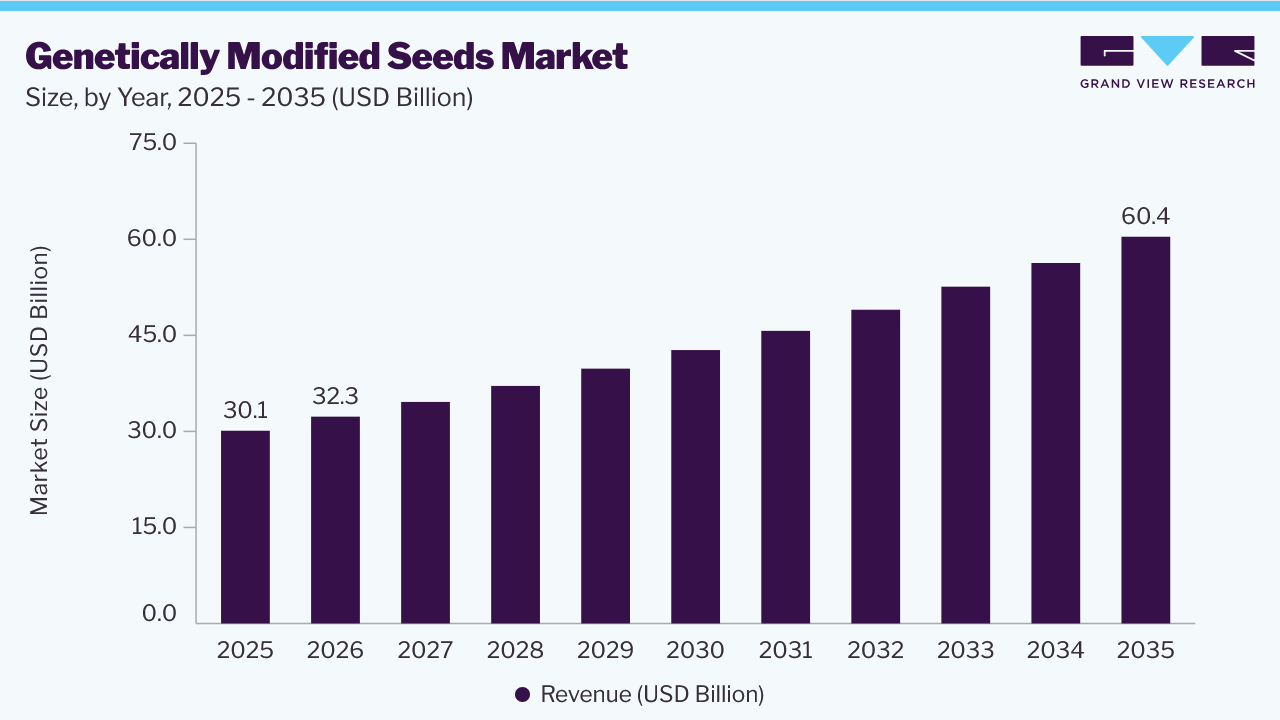
Despite strong technological progress, the market continues to face challenges stemming from stringent regulatory approval processes, varying government policies, and public concerns about genetically modified crops. Commercialization timelines can remain lengthy as new seed traits require extensive biosafety testing and regulatory evaluations before market approval. In addition, import restrictions and differing regulatory frameworks across countries continue to influence international seed trade and adoption rates.
The market presents significant opportunities through next-generation biotechnology platforms and expanded commercialization of advanced crop traits. For instance, in March 2025, Bayer inaugurated an approximately USD 34.0 million maize seed production facility in Zambia, significantly increasing its capacity to supply high-yielding maize seed across Sub-Saharan Africa and supporting regional food security initiatives. In addition, seed developers continue to invest in gene-editing technologies, stacked-trait platforms, and climate-resilient crop varieties, creating new opportunities for sustainable agricultural production and long-term market expansion.
Analyst Perspective
The market continues to expand as farmers increasingly adopt advanced seed technologies to improve crop productivity, pest resistance, herbicide tolerance, and climate resilience. Growing concerns about food security, shrinking arable land, and changing climatic conditions are encouraging the adoption of genetically modified crops that deliver higher yields while reducing crop losses. Seed developers are investing heavily in next-generation traits that provide multiple herbicide tolerance, enhanced insect protection, and improved tolerance to environmental stress. In addition, advances in biotechnology and gene-editing platforms are accelerating the development of new crop varieties with improved agronomic performance. Although regulatory approvals, public acceptance, and trade restrictions remain important challenges in several regions, continued innovation and increasing demand for sustainable agricultural productivity are expected to support long-term market growth.
Crop Type Insights
The corn segment accounted for the largest revenue share of the global genetically modified (GM) seeds market in 2025 and is expected to maintain its dominant position throughout the forecast period. GM corn has achieved widespread commercial adoption due to its ability to deliver higher yields, improved pest resistance, enhanced weed management, and greater tolerance to environmental stress. Farmers increasingly rely on genetically modified corn varieties containing herbicide-tolerant and insect-resistant traits to reduce crop losses, improve productivity, and lower overall production costs.
The growing global demand for corn across food processing, livestock feed, ethanol production, and industrial applications continues to support strong demand for genetically modified corn seeds. In addition, rising pressure on agricultural land and increasing climate variability have encouraged growers to adopt high-performance seed technologies that improve yield stability under changing environmental conditions. Continuous investment in biotechnology research is also leading to the development of corn hybrids with multiple stacked traits, enabling farmers to manage pests and weeds more efficiently while maximizing returns.
The soybean segment is expected to register the fastest CAGR during the forecast period. Increasing global demand for soybean meal, edible oils, and renewable biofuels is encouraging farmers to adopt genetically modified soybean varieties that provide superior herbicide tolerance and improved yield potential. Growing consumption of plant-based proteins and expanding exports from major soybean-producing countries are expected to further strengthen demand throughout the forecast period.
Trait Insights
The herbicide tolerance segment held the largest revenue share in 2025. Herbicide-tolerant crops have transformed modern agriculture by enabling farmers to control weeds more effectively, reduce crop damage, and simplify field management. These traits enable the use of selective herbicides that eliminate competing weeds without affecting the crop itself, resulting in improved yield, reduced labor requirements, and lower production costs.
The emergence of herbicide-resistant weeds has also spurred biotechnology companies to develop improved herbicide-tolerant technologies that offer broader weed-control options and support sustainable farming practices. Farmers increasingly adopt herbicide-tolerant corn, soybean, cotton, and canola varieties to improve operational efficiency while maintaining high crop productivity.
The stacked traits segment is projected to witness the fastest growth during the forecast period. Stacked trait seeds combine multiple genetic characteristics, such as herbicide tolerance, insect resistance, and stress tolerance, within a single variety, enabling comprehensive crop protection and improved field performance. As growers seek higher productivity with fewer inputs, demand for multi-trait seed technologies continues to increase rapidly.
In February 2025, Syngenta received U.S. Environmental Protection Agency (EPA) approval for its Durastak corn trait stack, which combines three distinct modes of action to enhance protection against corn rootworm while providing control of above- and below-ground insect pests. The new stacked trait technology is designed to improve yield potential and help delay insect resistance, supporting the industry's shift toward more advanced and durable genetically modified seed solutions. Syngenta plans to make Durastak available in hybrids for the 2027 season.
Technology Insights
The transgenic technology segment accounted for the largest revenue share in 2025. Transgenic technology remains the foundation of commercial genetically modified crop production because it enables the introduction of beneficial genes that provide resistance to insects, herbicides, and certain environmental stresses. Large commercial adoption, extensive regulatory approvals, and proven agronomic performance have established transgenic crops as an essential component of modern agriculture in many countries.
Leading agricultural biotechnology companies are investing in advanced transgenic breeding programs to improve crop productivity while addressing evolving pest pressures and climate challenges. For instance, in March 2025, Bayer introduced Vyconic soybeans at Commodity Classic in the U.S. The new biotech trait confers tolerance to five herbicides: dicamba, glufosinate, mesotrione, 2,4-D, and glyphosate, giving growers broader weed-management options.
The gene editing segment is expected to experience significant growth over the forecast period. Technologies such as CRISPR enable scientists to make highly precise genetic modifications without introducing foreign DNA, creating opportunities to develop crops with improved disease resistance, drought tolerance, nutritional quality, and yield potential. Regulatory acceptance of gene-edited crops is gradually expanding across several countries, encouraging significant investments in research and commercial product development.
Regional Insights
North America genetically modified seeds market accounted for the largest revenue share in 2025 and is expected to maintain its leadership throughout the forecast period. The region benefits from high adoption of genetically modified crops, advanced agricultural infrastructure, supportive regulatory frameworks, and the presence of major biotechnology companies. The U.S. and Canada continue to cultivate large areas of genetically modified corn, soybeans, cotton, canola, and sugar beets, supported by strong farmer acceptance and ongoing innovation in seed technologies.
The presence of leading agricultural biotechnology companies such as Bayer, Corteva Agriscience, BASF SE, and Syngenta continues to drive research into next-generation crop traits that improve productivity, sustainability, and climate resilience. Increasing demand for biofuels, livestock feed, and food ingredients further supports the region's leadership in GM seed adoption.
Asia Pacific Genetically Modified Seeds Market Trends
The genetically modified seeds market in the Asia Pacific is expected to register the fastest CAGR during the forecast period. Countries including China, India, Australia, the Philippines, and Vietnam are expanding investments in agricultural biotechnology to improve crop productivity and strengthen food security. Governments and research institutions are increasingly evaluating advanced breeding technologies, including gene editing and genetically modified crops, to address climate-related production challenges and rising food demand.
Companies are collaborating with research institutions and growers across Asia to develop advanced seed technologies that improve crop productivity and sustainability under diverse farming conditions. Rising investment in biotechnology research, increasing commercialization of improved crop varieties, and expanding adoption of precision agriculture are supporting the market growth. For instance, in June 2025, ICRISAT, IFFCO, and Bhartiya Beej Sahkari Samiti Limited signed an agreement to establish the Beej Anusandhan Kendra in Gujarat, India. The planned research center will focus on seed innovation and sustainable agriculture, combining crop research with seed-sector expertise to develop solutions suited to local farming conditions.
Key Genetically Modified Seeds Company Insights
The market is highly consolidated, with a few multinational agricultural biotechnology companies accounting for a significant share of global sales. These companies compete through continuous investments in biotechnology research, advanced gene-editing technologies, stacked trait development, and strategic collaborations with seed producers and research institutions. The market is driven by increasing demand for high-yielding, pest-resistant, herbicide-tolerant, and climate-resilient crop varieties that help improve agricultural productivity and sustainability.
Key Genetically Modified Seeds Companies
The following key companies have been profiled for this study on the genetically modified seeds market:
-
Bayer AG
-
Corteva Agriscience
-
Syngenta Group
-
BASF SE
-
KWS SAAT SE & Co. KGaA
-
Limagrain
-
DLF Seeds
-
Advanta Seeds
-
Seed Co Limited
-
JK Agri Genetics Ltd.
Recent Developments
- In June 2024, Bayer highlighted its latest Crop Science R&D pipeline, including next-generation seed and trait technologies such as fourth- and fifth-generation soybean herbicide-tolerance traits, fourth-generation corn rootworm protection, and the biotech version of the Preceon Smart Corn System. These innovations are intended to improve crop productivity, pest protection, and resilience while supporting more sustainable agricultural production. Bayer expects the biotech version of the Preceon Smart Corn System to be available in 2027.
- In December 2024, China's Ministry of Agriculture and Rural Affairs approved safety certificates for 12 genetically modified soybean, corn, and cotton varieties, along with five gene-edited crop varieties, as part of efforts to increase domestic crop production, strengthen food security, and reduce reliance on imports.
Genetically Modified Seeds Market Report Scope
Report Attribute
Details
Market size in 2025
USD 30.1 billion
Estimated market size in 2026
USD 32.3 billion
Projected market size by 2035
USD 60.4 billion
Growth rate
CAGR of 7.2% from 2026 to 2035
Historical data
2021 - 2025
Forecast period
2026 - 2035
Quantitative units
Revenue in USD billion, and CAGR from 2026 to 2035
Report coverage
Revenue forecast, company ranking, competitive landscape, growth factors, and trends
Segments covered
Crop, trait, technology, region
Regional scope
North America; Europe; Asia Pacific; CSA; MEA
Country scope
U.S.; Canada; Mexico; UK; Germany; France; Italy; Spain; China; Japan; India; Australia; South Korea; Brazil; Argentina; South Africa; Saudi Arabia; UAE
Key companies profiled
Bayer AG; Corteva Agriscience; Syngenta Group; BASF SE; KWS SAAT SE & Co. KGaA; Limagrain; DLF Seeds; Advanta Seeds; Seed Co Limited; JK Agri Genetics Ltd.
Customization scope
Free report customization (equivalent to 8 analyst working days) with purchase. Addition or alteration to country, regional & segment scope.
Pricing and purchase options
Avail of customized purchase options to meet your exact research needs. Explore purchase options
Global Genetically Modified Seeds Market Report Segmentation
This report forecasts revenue growth at the global, regional, and country levels and provides an analysis of the latest industry trends and opportunities across each sub-segment from 2021 to 2035. For this study, Grand View Research has segmented the global genetically modified seeds market report based on crop, trait, technology, and region:
-
Crop Type Outlook (Revenue, USD Billion, 2021–2035)
-
Corn
-
Soybean
-
Cotton
-
Canola
-
Sugar Beet
-
Alfalfa
-
Others
-
-
Trait Outlook (Revenue, USD Billion, 2021–2035)
-
Herbicide Tolerance
-
Insect Resistance (Bt)
-
Stacked Traits
-
Disease Resistance
-
Drought Tolerance
-
Others
-
-
Technology Outlook (Revenue, USD Billion, 2021–2035)
-
Transgenic Technology
-
CRISPR & Gene Editing
-
RNA Interference (RNAi)
-
Marker-Assisted Selection (MAS)
-
Others
-
-
Regional Outlook (Revenue, USD Billion, 2021 - 2035)
-
North America
-
U.S.
-
Canada
-
Mexico
-
-
Europe
-
UK
-
Germany
-
France
-
Italy
-
Spain
-
-
Asia Pacific
-
China
-
Japan
-
India
-
Australia
-
South Korea
-
-
Central & South America
-
Brazil
-
Argentina
-
-
Middle East and Africa (MEA)
-
South Africa
-
Saudi Arabia
-
UAE
-
-
Frequently Asked Questions About This Report
The global genetically modified seeds market size was valued at USD 30.1 billion in 2025 and is estimated at USD 32.3 billion for 2026.
The global genetically modified seeds market is expected to grow at a CAGR of 7.2% from 2026 to 2035, reaching USD 60.4 billion.
The corn segment accounted for the largest revenue share in 2025.
North America dominated with the largest revenue share in 2025.
Key players in the market include Bayer AG, Corteva Agriscience, Syngenta Group, BASF SE, KWS SAAT SE & Co. KGaA, Limagrain, DLF Seeds, Advanta Seeds, Seed Co Limited., JK Agri Genetics Ltd., and others.
About the Author(s)
Agrochemicals & Fertilizers Research Team
Bulk Chemicals · Agrochemicals & FertilizersThis report was authored by the agrochemicals & fertilizers research team at Grand View Research - comprising two research analysts, one senior research analyst, and one industry expert - with specialized expertise in the agrochemicals & fertilizers segment of the bulk chemicals industry. All findings are based on proprietary bulk chemicals databases, executive interviews, and regulatory analysis, subject to internal peer review prior to publication.
Last Updated:
Speak to Analyst


Customize this report to your needs — add regions, segments, or data points, with 20% free customization.
Or view our licence options:


ISO 9001:2015 & 27001:2022 Certified
We are GDPR and CCPA compliant! Your transaction & personal information is safe and secure. For more details, please read our privacy policy.


