
- Home
- »
- Advanced Interior Materials
- »
-
Global Geotextiles Market Size & Share Analysis Report, 2030GVR Report cover

Geotextiles Market (2023 - 2030) Size, Share & Trends Analysis Report By Material (Natural, Synthetic), Product (Woven, Non-woven), By Application (Erosion Control, Reinforcement), By Region, And Segment Forecasts
Market Size, 2022
$7.1BMarket Estimate, 2026
$7.5BMarket Forecast, 2030
$11.8BCAGR, 2023–2030
6.6%Geotextiles Market Summary
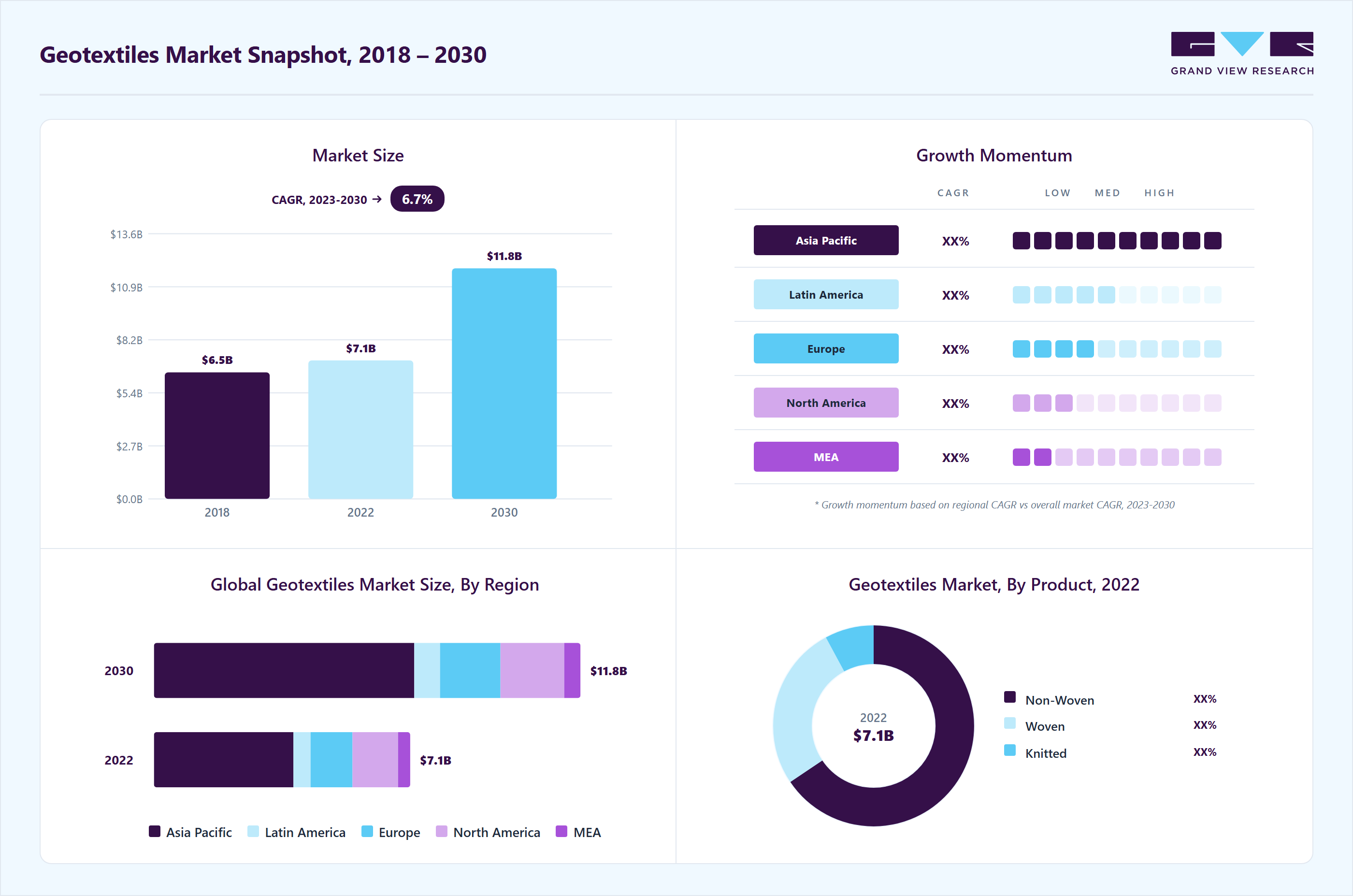
The geotextiles market size was valued at USD 7.10 billion in 2022 and is expected to grow at a compound annual growth rate (CAGR) of 6.6% from 2023 to 2030. The market is expected to be driven by rising civil engineering activities due to rapid urbanization and industrialization in developing countries.
 Source: Grand View Research, IR Documents, Primary Interviews, Paid DatabasesTo learn more about this report,
 Download Free Sample Report
 Key Market Trends & Insights
- Asia Pacific dominated the market and accounted for about 54.4% share of the revenue share in 2022.
- By material, the synthetic material segment dominated the market with a revenue share of 91.5% in 2022.
- By product, nonwoven geotextiles led the market and accounted for about 65.5% share of the revenue in 2022.
- By application, the asphalt overlays segment led the market and accounted for the highest revenue share of 24.1% in 2022.
Market Size & Forecast
- 2022 Market Size: USD 7.10 Billion
- 2030 Projected Market Size: USD 11.82 Billion
- CAGR (2023-2030): 6.6%
- Asia Pacific: Largest market in 2022
Three ways to get this report
Buy it, customize it, or ask a question.Ask an Analyst
Analyst response in 1 business day
- AccessReport author, directly
- Reply timeWithin 1 working day
- No sales callDirect answer only
- FormatEmail reply
- CostFree, no cost
Get the Full Report
What the study covers
- FormatsPDF · Excel · Dashboard
- Timeline2023–2030 annual, 2022 base
- Coverage20+ countries, 5 regions
- Companies10+ key players profiled
Customize the Report
20% free customization
- IncludeCountries, segments, points
- TailorTo your product definition
- ExtendDeeper competitor detail
- OrA fully bespoke study
- Turnaround5–10 working days
Cost-effectiveness and longer lifespan of geotextiles, as compared to other materials, and the growing environmental concerns regarding soil erosion are projected to drive product demand across the globe. The increase in the usage of geotextiles in a wide range of construction applications in the U.S. such as drainage structures, harbors roads, and landfills to enhance soil stabilization. In addition, the rise in adoption of the product owing to the extended lifespan and cost-effectiveness accelerates the market growth.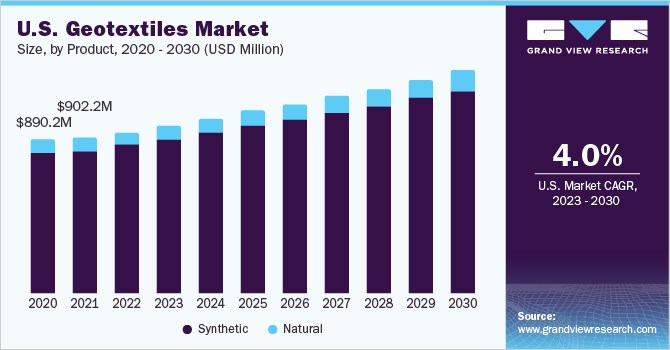 To learn more about this report, Download Free Sample Report
 Woven geotextiles are manufactured from individual threads including fibrillated yarns, monofilaments, or slit films that are woven together to provide high-load capacity for road construction applications. The long lifespan of these fabrics, coupled with their corrosion resistance, drives their use for long-term applications.
In European economies such as Germany and the U.K., manufacturers are required to comply with the stringent regulations established by governing bodies, which state the specific characteristics of the types of geotextiles and the applications they are most suitable for. The favorable regulatory framework for the application of these products, especially in erosion prevention applications, is likely to drive market growth.
The increased government spending on the One Belt, One Road (OBOR) project in China is likely to have a positive impact on the infrastructural development in the country. The ample availability of usable land is expected to increase infrastructural activities in the country. The Chinese government has made considerable investments in infrastructure projects, which would subsequently drive the demand for geotextiles in the country.
Market Dynamics
The growing investments in infrastructure development projects such as roads, railways, airports, landfills, ports, and drainage systems are significantly driving the demand for geotextiles globally. Geotextiles are widely used for soil stabilization, separation, filtration, reinforcement, and erosion control applications owing to their durability, permeability, and cost-effectiveness. Rapid urbanization and increasing government spending on transportation and public infrastructure projects are further supporting market growth across both developed and emerging economies.
In addition, rising focus on sustainable construction practices and efficient water management systems is accelerating the adoption of geotextiles in civil engineering and environmental applications. The increasing use of geotextiles in coastal protection, slope stabilization, mining, agriculture, and waste management projects is driving market expansion. Technological advancements in woven, nonwoven, and biodegradable geotextile materials are also improving product performance and widening application scope across infrastructure and environmental engineering sectors.
The geotextile market faces challenges due to fluctuations in raw material prices, particularly polypropylene and polyester, which significantly impact manufacturing costs and profit margins. In addition, environmental concerns associated with the disposal and long-term degradation of synthetic geotextiles may limit adoption in certain regions with strict environmental regulations. Competition from alternative soil stabilization materials and varying awareness levels regarding geotextile applications in developing economies may also restrain market growth.
Material Insights
Based on material, the geotextiles industry is categorized into natural and synthetic materials. The synthetic material segment dominated the market with a revenue share of 91.5% in 2022. The demand for synthetic materials is further expected to grow at a CAGR of 6.6% over the forecast period.
The synthetic materials used to produce geotextiles majorly include polyester, polypropylene, and polyethylene. Geotextiles made from materials such as polypropylene and polyester offer excellent water flow rates and are mainly used for the filtration of soil fines, wrapping of perforated pipes, and erosion protection. Geotextiles offer several performance advantages such as better longevity and cost savings over traditional building materials such as layers of soil, rock aggregates, and concrete.
The high-heat resistance offered by polyethylene fibers is likely to fuel their demand for polyethylene-based geotextiles in the construction industry in areas with high-heat applications. The demand for high-density polyethylene (HDPE) in a wide range of industrial applications is expected to limit its availability as fiber for the textile industry, thereby impacting industry trends.
Product Insights
Nonwoven geotextiles led the market and accounted for about 65.5% share of the revenue in 2022. The segment dominated the segment on account of its high adoption in a wide range of applications such as construction, furniture, hygiene products, automobiles, medical products, agriculture, and packaging.
Nonwoven geotextiles are witnessing a significant demand for transport infrastructure projects on account of their high tensile strength and low cost. Furthermore, infrastructural developments in Asia Pacific economies such as China and India are expected to drive the demand for nonwoven geotextiles in the region over the forecast period.
Woven geotextiles are anticipated to witness a CAGR of over 6.3% from 2023 to 2030 in terms of revenue. Increasing product penetration in erosion prevention applications owing to their favorable characteristics such as excellent filtration and high tensile strength are expected to fuel their demand over the forecast period.
Woven geotextiles are widely used in the construction of roads for soil separation to ensure the functioning of each soil layer individually by preventing dissimilar soil mixtures. These products are woven from high-modulus, durable polypropylene yarns into strong and dimensionally stable geotextiles.
Application Insights
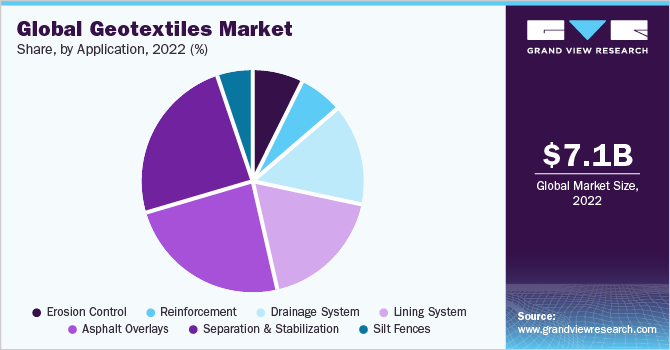
The asphalt overlays segment led the market and accounted for the highest revenue share of 24.1% in 2022. As construction activities continue to increase, especially in the Asia Pacific region, thanks to the rising construction activities in developing countries such as China and India. The National Green Highway mission in India is expected to drive the demand for geotextiles in the country owing to the product’s properties of soil retention.
Non-woven geotextiles are increasingly being employed in the construction of roads, and drainages, and for the prevention of erosion on account of their function to provide an avenue for water flow. Furthermore, increasing product demand for infrastructure developments including roadways, railways, and bridges is expected to drive the demand over the forecast period.
Geotextiles help prevent soil erosion as they are used for reinforcing soil. The product helps hold soil particles together and promote vegetation growth, which reduces erosion in the long run. In addition, clogging due to the washing away of soil is one of the major problems in drainage systems. The use of geotextiles in drainage systems helps create a channel for the consistent flow of water.
 To learn more about this report, Download Free Sample Report
 Drainage geotextiles are mainly used in the developed regions of Europe and North America to improve the efficiency of drainage systems and increase their life span. Infrastructural development in developing countries includes the development of drainage systems. Thus, the demand for geotextiles is witnessing significant growth in these countries.
Regional Insights
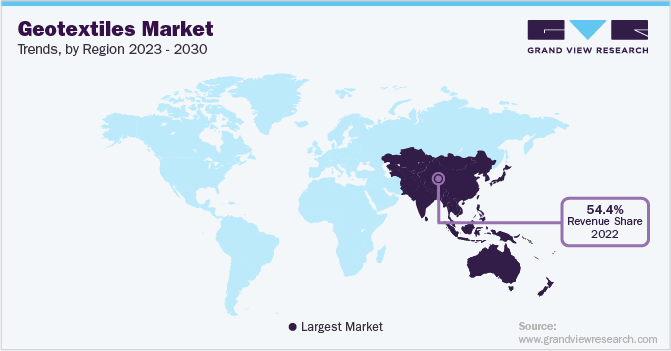
Asia Pacific dominated the market and accounted for about 54.4% share of the revenue share in 2022. The increased foreign investments in the emerging economies of the region including China and India are anticipated to have a positive impact on economic growth. Furthermore, the rising megacities in China and India are expected to drive the demand for geotextiles.
The presence of numerous riverbeds and other water bodies in Europe has resulted in soil erosion and encroachment of water into landmasses. Some of these water bodies pass through large cities and erosion of the shorelines of these rivers impacts the overall infrastructural integrity around the area. Therefore, to protect landmasses, knitted geotextiles are used to prevent corrosion.
 To learn more about this report, Download Free Sample Report
 In the Middle East and Africa, geotextiles are widely used in road construction to increase tensile strength in the earth's mass, which aids in improved water permeability of constructed infrastructures. Increasing product demand for improving groundwater levels and reducing the risk of road damage is expected to drive market growth.
Increasing foreign investments in the industrial sector of Asian economies such as China, India, Thailand, and Indonesia are expected to impact the market positively. Furthermore, increasing megacities in China and India, coupled with robust infrastructure development, are expected to drive product demand over the forecast period.
Key Companies & Market Share Insights
Major players in the market are entering into agreements with emerging and small-scale players to expand their distribution capacities and increase the market reach of their products. Furthermore, manufacturers are focusing on new efficient and effective distribution channels, to ensure that buyers have timely access to products.
Prominent market players have been benchmarked based on their geographical reach, distribution networks, product portfolio, innovation, strategic developments, operational capabilities, and the market presence of their brands. Some prominent players in the global geotextiles market include:
-
Koninklijke Ten Cate B.V.
-
GSE Holdings, Inc.
-
NAUE GmbH & Co. KG
-
Officine Maccaferri S.p.A.
-
Low and Bonar PLC
-
Propex Operating Company, LLC
-
Fibertex Nonwovens A/S
-
TENAX Group
-
AGRU America
-
Global Synthetics
-
HUESKER Group
-
TYPAR
-
Machina-TST
-
Gayatri Polymers & Geo-synthetics
Competitive Benchmarking
Operating Strategies
Competitive Edge
Weakness
Mature Players: Koninklijke Ten Cate B.V.; NAUE GmbH & Co. KG; HUESKER Group
- Focus on large-scale geosynthetic production and long-term infrastructure projects.
- Continuous investment in product innovation, sustainability, and global expansion.
- Strong global distribution network and established presence in civil engineering projects.
- Broad product portfolio and advanced technical expertise in geotextile solutions.
- High operational and raw material costs.
- Slower adaptability toward low-cost regional market competition.
Emerging Players: Machina-TST; Gayatri Polymers & Geo-synthetics
- Focus on cost-effective geotextile products and regional infrastructure applications.
- Emphasis on flexible manufacturing and customized project solutions.
- Competitive pricing and strong regional customer relationships.
- Higher flexibility in serving niche and small-scale infrastructure projects.
- Limited global presence and lower production capacity.
- Challenges in competing with established international brands and advanced technologies.
Geotextiles Market Report Scope
Report Attribute
Details
Market size value in 2023
USD 7.52 billion
Revenue forecast in 2030
USD 11.82 billion
Growth rate
CAGR of 6.6% from 2023 to 2030
Base year for estimation
2022
Historical data
2018 - 2021
Forecast period
2023 - 2030
Quantitative units
Volume in million square meters, revenue in USD million, CAGR from 2023 to 2030
Report coverage
Revenue forecast, competitive landscape, growth factors, trends
Segments covered
Material, product, application, region
Regional scope
North America; Europe; Asia Pacific; Middle East & Africa; Central & South America
Country scope
U.S.; Canada; Mexico; Germany; France; Italy; U.K.; Netherlands; Poland; China; Japan; Australia; Indonesia; Malaysia; Philippines; Brazil
Key companies profiled
Koninklijke Ten Cate B.V.; GSE Holdings, Inc.; NAUE GmbH & Co. KG; Officine Maccaferri S.p.A.; Low and Bonar PLC; Propex Operating Company, LLC; Fibertex Nonwovens A/S; TENAX Group; AGRU America; Global Synthetics; HUESKER Group; TYPAR; Machina-TST; Gayatri Polymers & Geo-synthetics
Customization scope
Free report customization (equivalent up to 8 analysts’ working days) with purchase. Addition or alteration to country, regional & segment scope.
Pricing and purchase options
Avail customized purchase options to meet your exact research needs. Explore purchase options
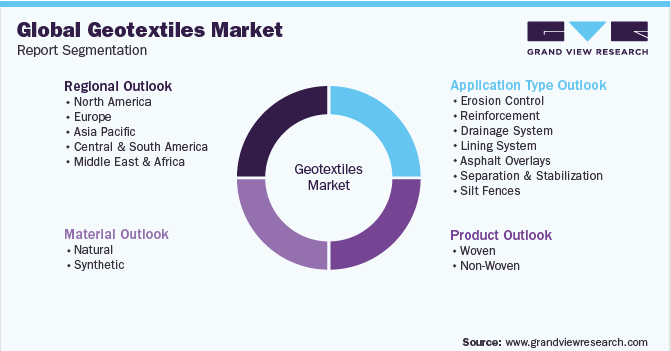
Global Geotextiles Market Report Segmentation
This report forecasts volume & revenue growth at global, regional & country levels and provides an analysis of the latest industry trends in each of the segments from 2018 to 2030. For the purpose of this study, Grand View Research has segmented the global geotextiles market report based on material, product, application, and region:
 To learn more about this report, Download Free Sample Report
 -
Material Outlook (Volume, Million Square Meters; Revenue, USD Million, 2018 - 2030)
-
Natural
-
Jute
-
Others
-
-
Synthetic
-
Polypropylene
-
Polyester
-
Polyethylene
-
-
-
Product Outlook (Volume, Million Square Meters; Revenue, USD Million, 2018 - 2030)
-
Woven
-
Slit Tape Woven
-
High Strength Woven
-
-
Non-Woven
-
Light Weight
-
Medium Weight
-
Heavy Weight
-
Paving Fabrics
-
-
Knitted
-
-
Application Type Outlook (Volume, Million Square Meters; Revenue, USD Million, 2018 - 2030)
-
Erosion Control
-
Reinforcement
-
Drainage System
-
Lining System
-
Asphalt Overlays
-
Separation & Stabilization
-
Silt Fences
-
-
Regional Outlook (Volume, Million Square Meters; Revenue, USD Million, 2018 - 2030)
-
North America
-
U.S.
-
Canada
-
Mexico
-
-
Europe
-
France
-
Germany
-
U.K.
-
Italy
-
Spain
-
-
Asia Pacific
-
China
-
India
-
Japan
-
New Zealand
-
Australia
-
Malaysia
-
Thailand
-
-
Central & South America
-
Brazil
-
-
Middle East & Africa
-
Saudi Arabia
-
UAE
-
South Africa
-
-
Delivered Customizations
This report has been delivered with the following In-depth customizations
Client Request
Customization Delivered
Value Adds
Pricing Analysis
Analysis of pricing dynamics in the geotextile market covering raw material costs, manufacturing expenses, regional price variations, historical pricing trends, and pricing comparison across woven and nonwoven geotextile products.
Enable understanding of cost structures and pricing trends across geotextile products. Support procurement planning, pricing strategy development, and cost optimization initiatives.
Opportunity Assessment
Evaluation of growth opportunities across geotextile types, applications, and end-use sectors, including transportation infrastructure, erosion control, drainage systems, waste management, mining, and agriculture.
Identify high-growth applications and emerging demand areas. Support market entry, product development, and expansion strategies across infrastructure and environmental applications.
Sustainability Assessment
Assessment of sustainability trends in the geotextile market, including the adoption of recyclable and biodegradable materials, environmental regulations, circular economy initiatives, and sustainable infrastructure development practices.
Enable understanding of sustainability-driven market opportunities and regulatory trends. Support the development of environmentally compliant and sustainable geotextile solutions.
Frequently Asked Questions About This Report
The global geotextiles market size was estimated at USD 7.10 billion in 2022 and is expected to reach USD 7.52 billion in 2023.
The global geotextiles market is expected to grow at a compound annual growth rate a CAGR of 6.6% from 2023 to 2030 to reach USD 11.82 billion by 2030.
The U.S. geotextiles market accounted for the largest revenue share in 2022 and this is attributed to the growing applications of geotextiles in infrastructural development projects in the country.
Some key players operating in the geotextiles market include Koninklijke Ten Cate B.V., GSE Holdings, Inc., NAUE GmbH & Co. KG, Officine Maccaferri S.p.A., Low and Bonar PLC, Propex Operating Company, LLC, Fibertex Nonwovens A/S, TENAX Group, AGRU America, Global Synthetics, HUESKER Group, TYPAR, Machina-TST, and Gayatri Polymers & Geo-synthetics.
The growing infrastructural development around the world is triggering the demand for geotextiles in the global market. Innovation backed by government initiatives and other regulatory bodies is another major factor that is positively contributing to market growth.
About the Author(s)
Advanced Interior Materials Research Team
Advanced Materials · Advanced Interior MaterialsThis report was authored by the advanced interior materials research team at Grand View Research - comprising two research analysts, one senior research analyst, and one industry expert - with specialized expertise in the advanced interior materials segment of the advanced materials industry. All findings are based on proprietary advanced materials databases, executive interviews, and regulatory analysis, subject to internal peer review prior to publication.
Last Updated:
Speak to Analyst

Customize this report to your needs - add regions, segments, or data points, with 20% free customization.
Or view our licence options:


ISO 9001:2015 & 27001:2022 Certified
We are GDPR and CCPA compliant! Your transaction & personal information is safe and secure. For more details, please read our privacy policy.


