Market Size & Trends
The Germany energy drinks market size was estimated at USD 4.09 billion in 2024 and is expected to grow at a CAGR of 6.8% from 2025 to 2030. due to increasing consumer demand for healthier and more functional beverage options. Rising health awareness has driven manufacturers to innovate by introducing sugar-free, natural, and vitamin-fortified energy drinks that appeal to fitness enthusiasts and working professionals seeking sustained energy without excess calories. For instance, the launch of calorie-free canned energy drinks by local influencers in partnership with major retailers has successfully captured the attention of younger consumers focused on wellness and convenience.

Product innovation and diversified distribution channels also contribute significantly to market growth. Companies are expanding their offerings to include energy shots, organic variants, and beverages enhanced with herbal extracts like guarana and ginseng. The growing presence of energy drinks in supermarkets, convenience stores, and e-commerce platforms ensures wide accessibility. In addition, strategic marketing efforts, including sponsorships of sports events and digital campaigns, enhance brand visibility and consumer engagement, helping companies maintain competitive advantage in a crowded market.
Regulatory frameworks in Germany, aligned with EU standards, enforce strict labeling of caffeine content and health claims, ensuring consumer safety and building trust. The government’s emphasis on sustainability has encouraged manufacturers to adopt eco-friendly packaging, which resonates with environmentally conscious consumers. Despite challenges such as health concerns over caffeine intake, the market’s ability to innovate and meet evolving consumer preferences positions Germany’s energy drinks sector for steady growth through 2030.
Product Insights
The energy drinks market accounted for a revenue share of 93.1% of the market in 2024, primarily due to strong consumer preference for functional beverages that provide immediate energy and cognitive enhancement. The market is driven by younger consumers, including college students and working professionals, who seek products containing caffeine, vitamins, and natural stimulants like guarana and ginseng to support busy lifestyles and mental alertness. In addition, Germany’s well-developed retail infrastructure, including supermarkets and convenience stores, ensures wide accessibility, while increasing demand for sugar-free and organic variants caters to health-aware consumers.
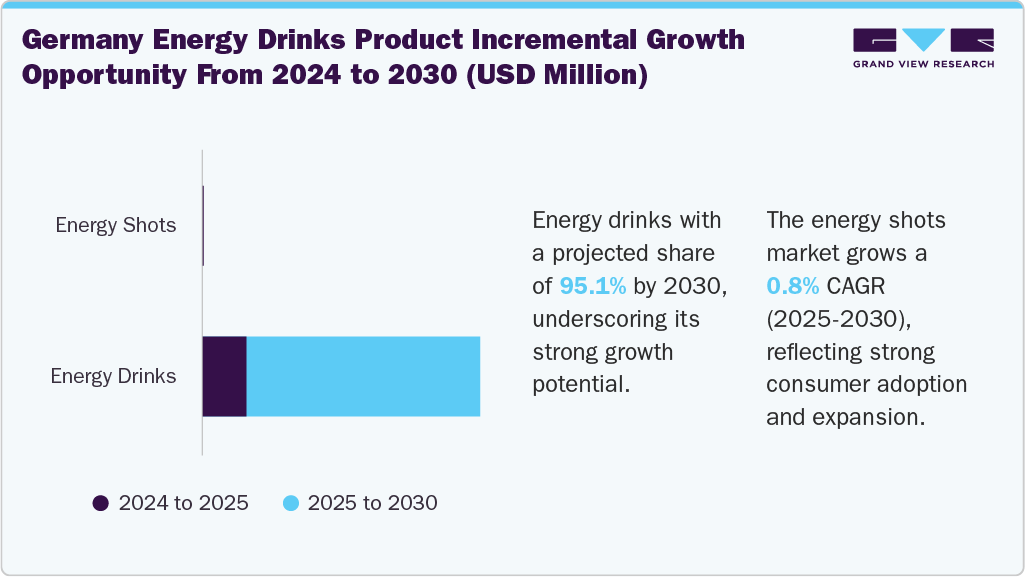
The energy shots market is projected to grow at a CAGR of 0.8% from 2025 to 2030, due to its niche appeal as a quick, concentrated energy source for consumers needing immediate alertness in a compact format. Energy shots offer convenience and portability, fitting busy lifestyles where a fast energy boost is required without consuming a full-sized beverage.
Type Insights
The conventional energy drinks market accounted for a share of 90.9% of the market in 2024, as these products have established strong consumer trust and brand loyalty through consistent delivery of immediate energy and mental alertness benefits. The conventional segment’s formulations, typically containing caffeine, taurine, and sugar, effectively meet the demands of younger consumers, including students and working professionals, who seek quick stimulation to manage busy lifestyles and stress. For instance, major brands have expanded flavor varieties and introduced mineral fortification, catering to evolving taste preferences while maintaining the classic energy boost. Germany’s robust retail infrastructure, including supermarkets like Lidl and Aldi, ensures wide availability, supporting high sales volumes.
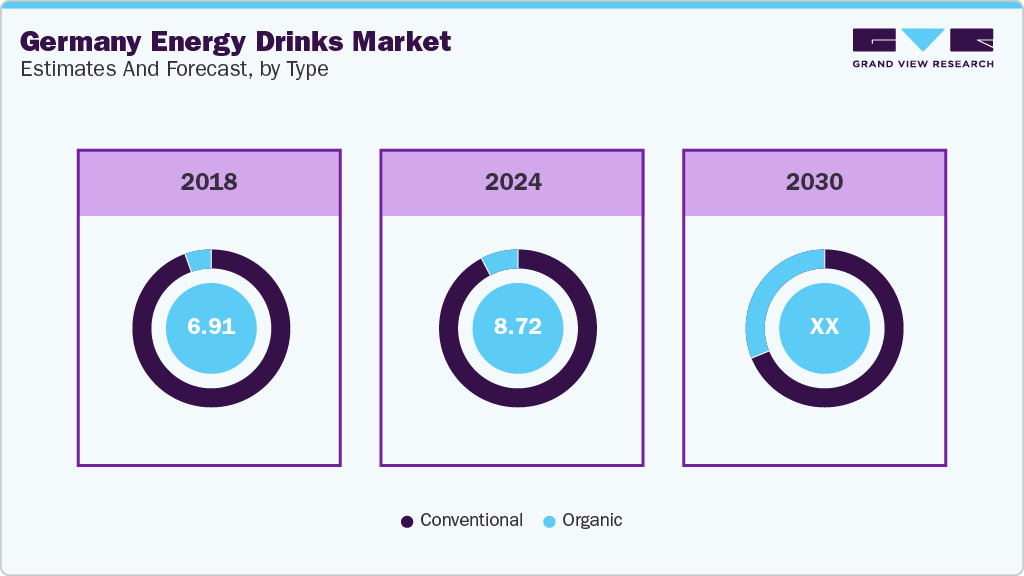
The organic energy drinks market is projected to grow at a CAGR of 10.2% from 2025 to 2030, due to increasing consumer demand for healthier, natural beverages free from artificial ingredients, pesticides, and GMOs. Health-conscious consumers are shifting away from conventional energy drinks, concerned about high sugar levels and synthetic additives, and preferring organic options that offer cleaner, minimally processed formulations. In addition, rising awareness about sustainability and environmental impact encourages consumers to choose products made from responsibly sourced organic ingredients. The growing preference for clean-label products combined with an expanding fitness culture and demand for functional beverages supports the rapid growth of organic energy drinks, positioning them as a favored alternative to traditional energy drinks in global markets.
Packaging Insights
Cans energy drinks market accounted for a revenue share of 90.6% of the market in 2024, due to its focus on convenience, sustainability, and product preservation. Aluminum cans offer excellent protection against light and oxygen, which preserves the flavor, carbonation, and shelf life of energy drinks, ensuring consistent quality. Their lightweight and portable nature suits the on-the-go consumption habits of younger consumers, a major demographic for energy drinks. For instance, major brands have adopted slim, sleek can designs that appeal to urban consumers seeking both style and functionality. Sustainability is a crucial driver, as aluminum cans are infinitely recyclable and align with Germany’s strong recycling infrastructure and government policies promoting circular economy practices.
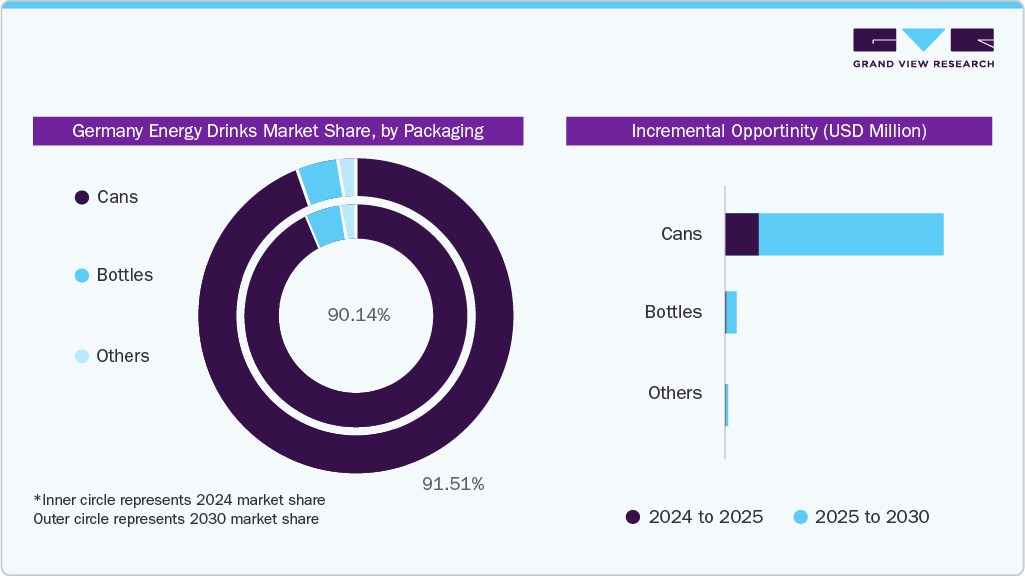
The bottles energy drink segment is projected to grow at a CAGR of 4.5% from 2025 to 2030, due to increasing consumer demand for convenient, portable, and resealable packaging that supports on-the-go consumption and portion control. Plastic bottles, especially PET, are favored for their lightweight, durability, and ease of use, allowing consumers to drink over time rather than all at once. The versatility of bottle designs also allows brands to differentiate their products and cater to niche markets, such as organic or vitamin-fortified energy drinks. Growing distribution through supermarkets, convenience stores, and e-commerce channels further supports the segment’s steady expansion despite the dominance of cans in the market.
Distribution Channel Insights
The sales of energy drinks through off-trade accounted for a revenue share of around 85.1% of the market in 2024. It offers broad accessibility and convenience through supermarkets, convenience stores, and online platforms where consumers can easily purchase a wide variety of products. These outlets provide competitive pricing, frequent promotions, and multipack offers that encourage bulk buying and repeat purchases. In addition, the rise of e-commerce in Germany, with growing online sales and subscription models, allows busy consumers to order energy drinks from home, increasing reach beyond urban centers. The ability to physically inspect products in-store or read detailed descriptions online builds consumer trust and supports informed purchasing decisions.
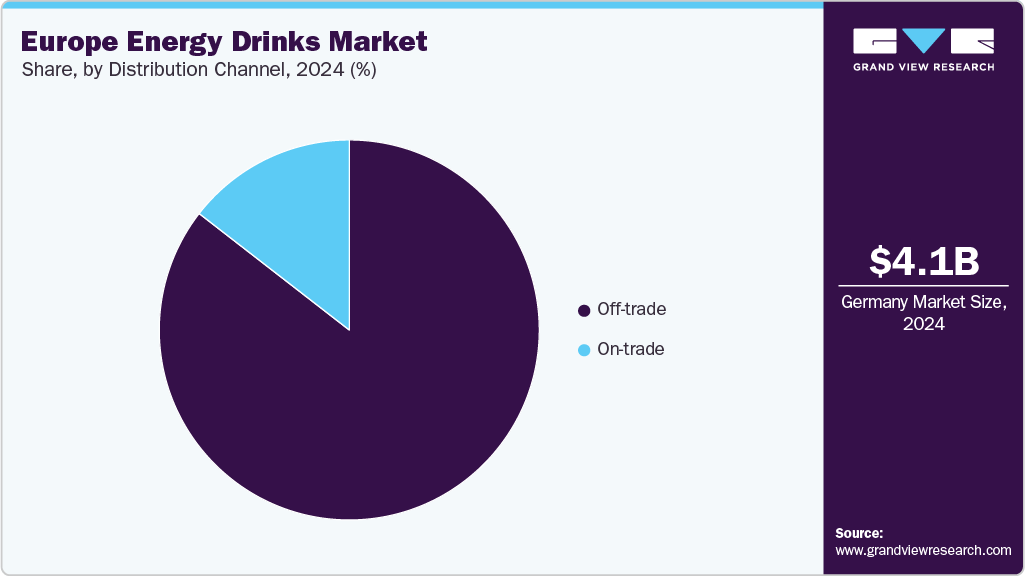
Energy drinks sales through on-trade are projected to grow at a CAGR of 5.6% from 2025 to 2030, due to increasing consumer demand for immediate consumption experiences in social and entertainment venues such as bars, clubs, restaurants, and cafes. In addition, the growing nightlife culture and rising interest in energy drink mixes with alcoholic beverages boost on-trade consumption. On-trade venues also serve as key platforms for experiential marketing, allowing brands to build stronger emotional connections with younger consumers. These factors, combined with premium pricing and social consumption trends, drive steady growth in on-trade energy drink sales.
Key Germany Energy Drinks Company Insights
Key companies in the Germany energy drink market maintain a competitive edge by focusing on continuous product innovation, including the development of sugar-free, natural, and functional beverages enriched with vitamins and herbal extracts to meet evolving consumer health preferences. They leverage extensive distribution networks across supermarkets, convenience stores, and online platforms to ensure broad market reach. Strategic marketing efforts, such as sports sponsorships and digital campaigns, enhance brand visibility and consumer engagement. In addition, these companies emphasize sustainable packaging and ingredient transparency to align with increasing environmental awareness and regulatory requirements, supporting steady growth in a highly competitive and dynamic market.
Key Germany Energy Drinks Companies:
- Red Bull GmbH
- Suntory Holdings Limited
- PepsiCo, Inc.
- Monster Beverage Corporation
- Lucozade Ribena Suntory Limited
- The Coca-Cola Company
- Amway Corp
- Keurig Dr. Pepper, Inc
- Vitamin Well AB
- Congo Brands
Recent Developments
-
In November 2024, Koawach, an organic cocoa and guarana specialist, launched Koalimo, claimed to be the world’s first caffeinated energy drink made with cocoa fruit juice, in Germany. The beverage was introduced in three flavor varieties: Sun Burst (grapefruit), Citrus Wave (lime), and Tropic Ocean (passionfruit). Koawach collaborated with Koa, a Swiss-Ghanaian startup that upcycles cocoa fruit pulp, to create this innovative drink. Each flavor was lightly sweetened with upcycled cocoa fruit juice, providing additional income for small-scale Ghanaian farmers and promoting sustainability in the cocoa industry.
Germany Energy Drinks Market Report Scope
|
Report Attribute
|
Details
|
|
Market size value in 2025
|
USD 4.35 billion
|
|
Revenue forecast in 2030
|
USD 6.04 billion
|
|
Growth rate
|
CAGR of 6.8% from 2025 to 2030
|
|
Actual data
|
2018 - 2024
|
|
Forecast period
|
2025 - 2030
|
|
Quantitative units
|
Revenue in USD million/billion, CAGR from 2025 to 2030
|
|
Report coverage
|
Revenue forecast, company ranking, competitive landscape, growth factors, and trends
|
|
Segments covered
|
Product, type, packaging, and distribution channel
|
|
Country scope
|
Germany
|
|
Key companies profiled
|
Red Bull GmbH; Suntory Holdings Limited; PepsiCo, Inc.; Monster Beverage Corporation; Lucozade Ribena Suntory Limited; The Coca-Cola Company; Amway Corp; Keurig Dr. Pepper, Inc ; Vitamin Well AB ; Congo Brands
|
|
Customization scope
|
Free report customization (equivalent up to 8 analysts’ working days) with purchase. Addition or alteration to country, regional & segment scope.
|
|
Pricing and purchase options
|
Avail customized purchase options to meet your exact research needs. Explore purchase options |
Germany Energy Drinks Market Report Segmentation
This report forecasts revenue growth at the country level and provides an analysis of the latest industry trends in each of the sub-segments from 2018 to 2030. For this study, Grand View Research has segmented the Germany energy drinks market report based on product, type, packaging, and distribution channel:
-
Product Outlook (Revenue, USD Million, 2018 - 2030)
-
Energy Drinks
-
Energy Shots
-
Type Outlook (Revenue, USD Million, 2018 - 2030)
-
Packaging Outlook (Revenue, USD Million, 2018 - 2030)
-
Distribution Channel Outlook (Revenue, USD Million, 2018 - 2030)
Frequently Asked Questions About This Report
b. Key factors that are driving the market growth include to increasing consumer demand for healthier and more functional beverage options. Rising health awareness has driven manufacturers to innovate by introducing sugar-free, natural, and vitamin-fortified energy drinks that appeal to fitness enthusiasts and working professionals seeking sustained energy without excess calories.
b. The Germany energy drinks market size was estimated at USD 4.09 billion in 2024 and is expected to reach USD 4.35 billion in 2025.
b. The Germany energy drinks market is expected to grow at a compounded growth rate of 6.8% from 2025 to 2030 to reach USD 6.04 billion by 2030.
b. The energy drinks market accounted for a share of 93.1% of the Germany revenue in 2024, primarily due to strong consumer preference for functional beverages that provide immediate energy and cognitive enhancement.
b. Some key players operating in the Germany energy drinks market include Red Bull GmbH; Suntory Holdings Limited; PepsiCo, Inc.; Monster Beverage Corporation; Lucozade Ribena Suntory Limited; The Coca-Cola Company; Amway Corp; Keurig Dr. Pepper, Inc ; Vitamin Well AB ; Congo Brands and others

 Download Sample Report