
- Home
- »
- Electronic & Electrical
- »
-
Germany Household Kitchen Appliances Market Report, 2033GVR Report cover

Germany Household Kitchen Appliances Market (2025 - 2033) Size, Share, & Trends Analysis Report By Product (Refrigerator, Cooking Appliances), By Technology, And Segment Forecasts
Germany Household Kitchen Appliances Market Summary
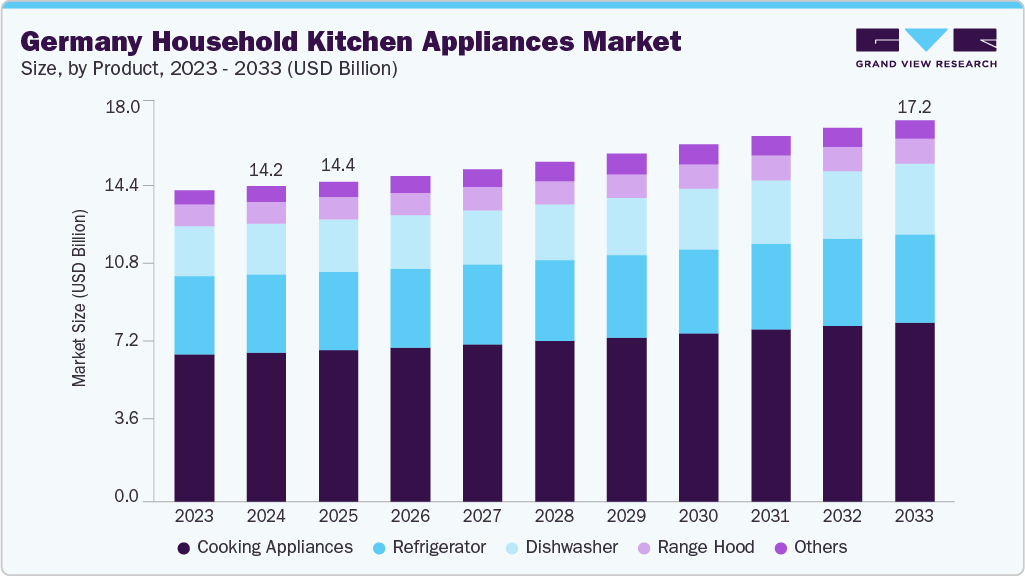
The Germany household kitchen appliances market size was estimated at USD 14.22 billion in 2024 and is projected to reach USD 17.19 billion by 2033, growing at a CAGR of 2.2% from 2025 to 2033. The growth of the Germany household kitchen appliances industry is primarily fueled by continuous product innovation and the integration of advanced technologies and features.
Key Market Trends & Insights
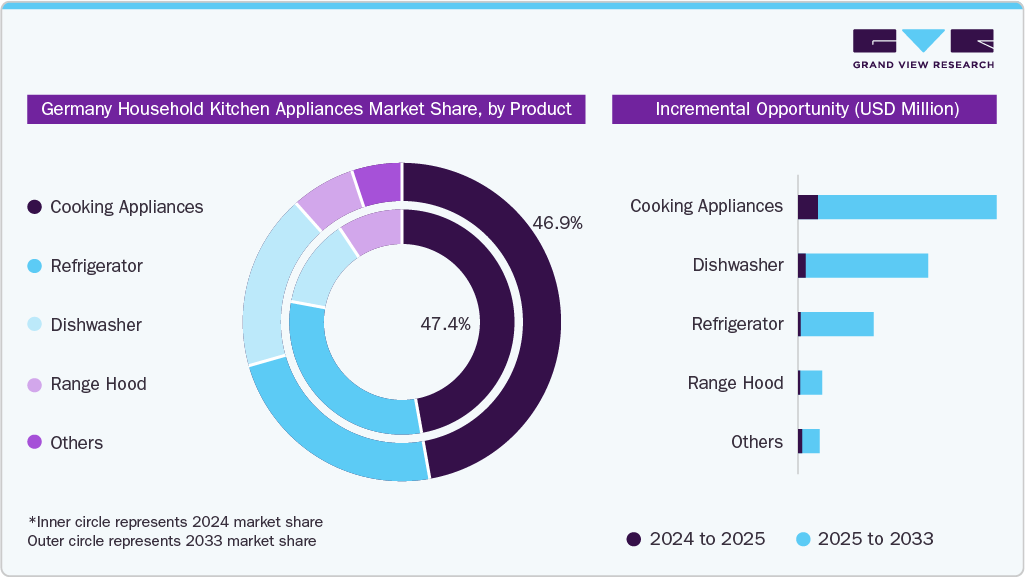
- By product, the cooking appliances segment held the largest market share of 47.4% in 2024.
- By technology, the conventional segment held the largest market share in 2024.
Market Size & Forecast
- 2024 Market Size: USD 14.22 Billion
- 2033 Projected Market Size: USD 17.19 Billion
- CAGR (2025-2033): 2.2%
Three ways to get this report
Buy it, customize it, or ask a question.Ask an Analyst
Analyst response in 1 business day
- AccessReport author, directly
- Reply timeWithin 1 working day
- No sales callDirect answer only
- FormatEmail reply
- CostFree, no cost
Get the Full Report
What the study covers
- FormatsPDF · Excel · Dashboard
- Timeline2025–2033 annual, 2024 base
- Coverage20+ countries, 5 regions
- Companies10+ key players profiled
Customize the Report
20% free customization
- IncludeCountries, segments, points
- TailorTo your product definition
- ExtendDeeper competitor detail
- OrA fully bespoke study
- Turnaround5–10 working days
Consumers across the region are increasingly adopting appliances with innovative functionalities that offer convenience and time-saving benefits. With a high national disposable income, consumers have more purchasing power to invest in modern, premium kitchen appliances. This economic strength supports a higher demand for durable and technologically advanced products that enhance convenience in daily life.Technological advancements and the rise in smart appliance adoption are major growth catalysts. German consumers increasingly prefer IoT-enabled, AI-powered, and voice-controlled kitchen appliances such as smart dishwashers, ovens, and coffee machines. These innovations offer improved functionality, energy efficiency, and connectivity, aligning with the growing trend of smart homes. Manufacturers such as Bosch and Siemens are actively launching products integrated with smart home ecosystems, further stimulating market demand.
 Source: Grand View Research, IR Documents, Primary Interviews, Paid DatabasesTo learn more about this report,
 Download Free Sample Report
 Changing consumer lifestyles and urbanization contribute significantly to market growth. The rise in nuclear families, busier schedules, and evolving eating habits increase the need for efficient, time-saving kitchen solutions. In addition, urban living often involves space constraints, encouraging the purchase of compact, multifunctional appliances that fit modern kitchens.
Consumer Insights
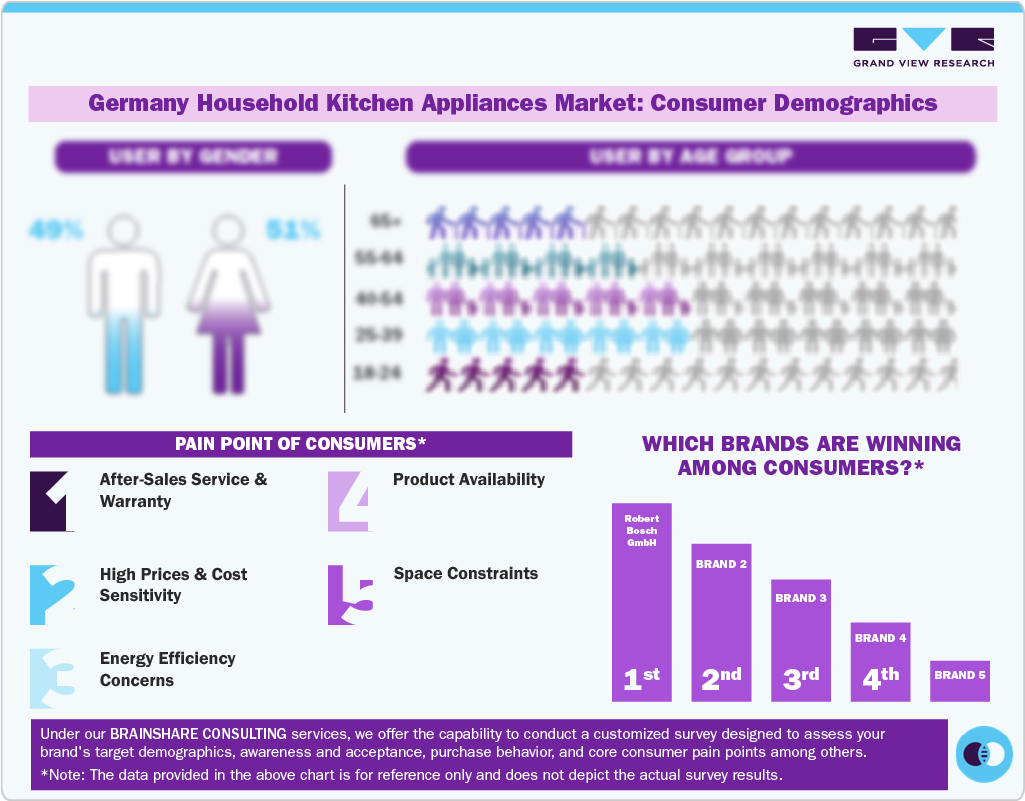
Germany’s household kitchen appliance market is characterized by a mature consumer base that prioritizes energy efficiency, durability, and minimalist design. Most buyers are from middle- to upper-income urban households, favoring functionality over luxury. Sustainability plays a key role in purchasing decisions, with an increasing number of consumers opting for energy-efficient and repairable appliances.
 To learn more about this report, Download Free Sample Report
 Women continue to play a leading role in selecting appliances, especially everyday items such as blenders, coffee machines, and ovens. However, purchasing decisions for higher-priced appliances such as dishwashers and smart refrigerators are increasingly made jointly in dual-income households. Younger couples aged 30 to 45 with children represent a key market segment for kitchen appliance upgrades, prioritizing time-saving features such as automation, Wi-Fi control, and eco-friendly wash cycles. This group also shows a strong interest in smart-home integration, often influenced by online reviews and brands’ transparency regarding sustainability. In
Pricing Analysis
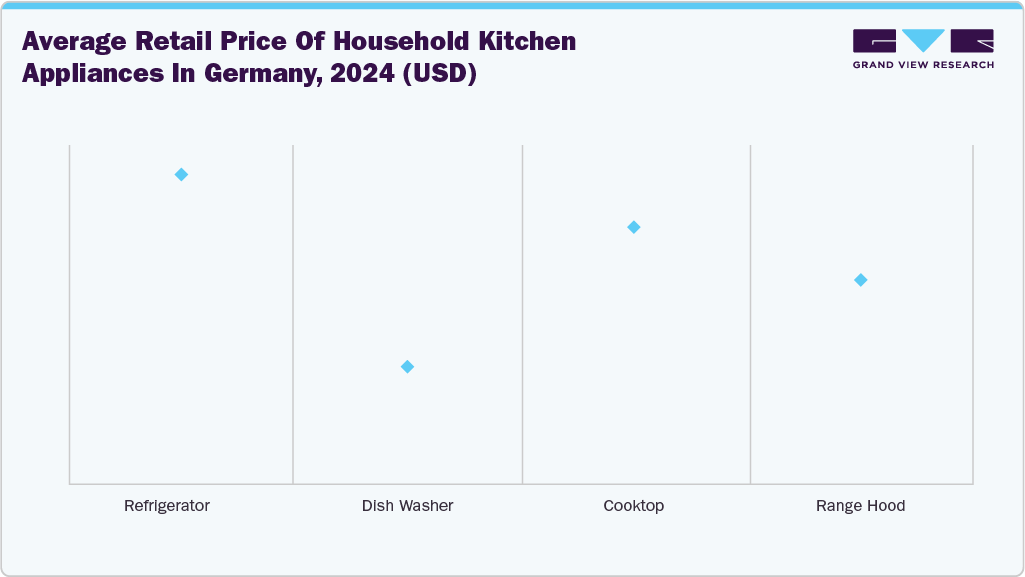
Pricing for the Germany household kitchen appliances industry is influenced by several factors, including brand positioning, energy efficiency ratings, smart features, size, and build quality. German consumers strongly emphasize energy consumption and durability, resulting in higher prices of appliances with A-class EU energy ratings, Eco-design compliance, and extended warranty coverage. Leading global brands such as Bosch, Miele, LG, and Samsung offer product ranges targeting both premium and mid-range markets. In contrast, brands such as Beko and Hisense cater to budget-conscious buyers by focusing on essential features and compact designs.
 To learn more about this report, Download Free Sample Report
 Appliances featuring AI-enhanced automation, inverter motors, touchscreens, voice assistant compatibility, or Wi-Fi app control are positioned at the higher end of the price range. These advanced products are particularly popular among urban households looking for smart home integration. In contrast, entry-level or freestanding models with mechanical controls, manual cleaning, and basic cooling or heating functions are more affordable, catering to renters, students, or those upgrading from older appliances. Compact kitchen appliances such as countertop ovens, stick blenders, and mini dishwashers are offered at accessible prices. At the same time, full-size built-in units and premium side-by-side refrigerators command significantly higher costs. Pricing varies considerably across key categories such as refrigerators, ovens, cooktops, and dishwashers. Robert Bosch Home Appliances GmbH provides a Series8 Fully Integrated Dishwasher at USD 1,877.55 and a Series2 Freestanding Compact Dishwasher at USD 644.66
Product Insights
The cooking appliances segment accounted for the largest revenue share of 47.4% in 2024. Changing consumer lifestyles, including a growing preference for home cooking, have increased demand for efficient and versatile cooking appliances. Post-pandemic trends show more people cooking at home, boosting sales of products such as induction cooktops, multi-function ovens, and air fryers. Moreover, technological advancements, such as smart and energy-efficient models, attract consumers seeking convenience and sustainability
 To learn more about this report, Download Free Sample Report
 The dishwasher segment is projected to experience the fastest CAGR of 3.8% from 2025 to 2033, driven by growing consumer demand for convenience, time-saving solutions, and water-efficient appliances. As busy lifestyles become more common, households increasingly opt for dishwashers to reduce manual workload. In addition, advancements in energy and water-efficient models and government incentives promoting sustainable home appliances further encourage market adoption.
Technology Insights
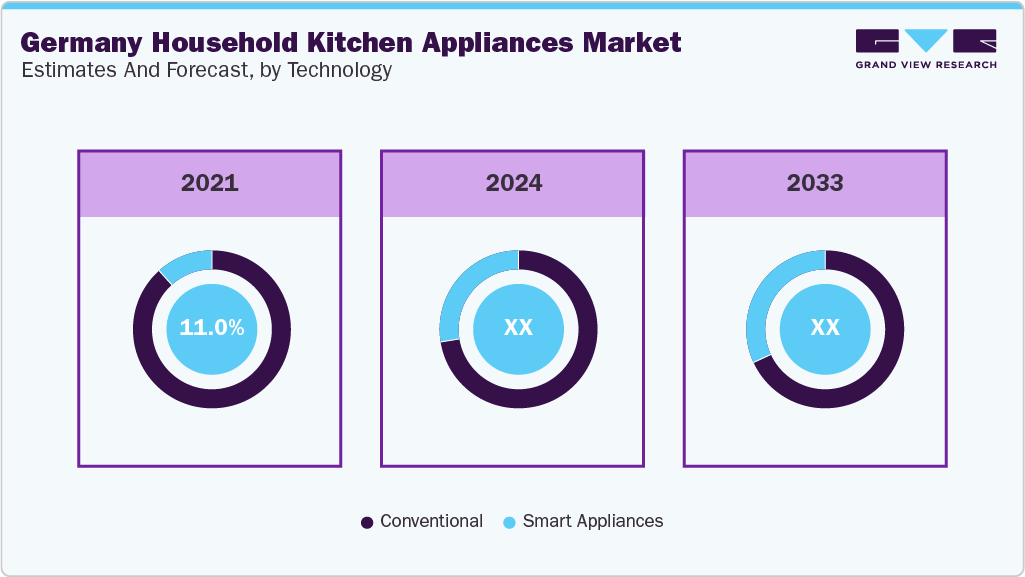
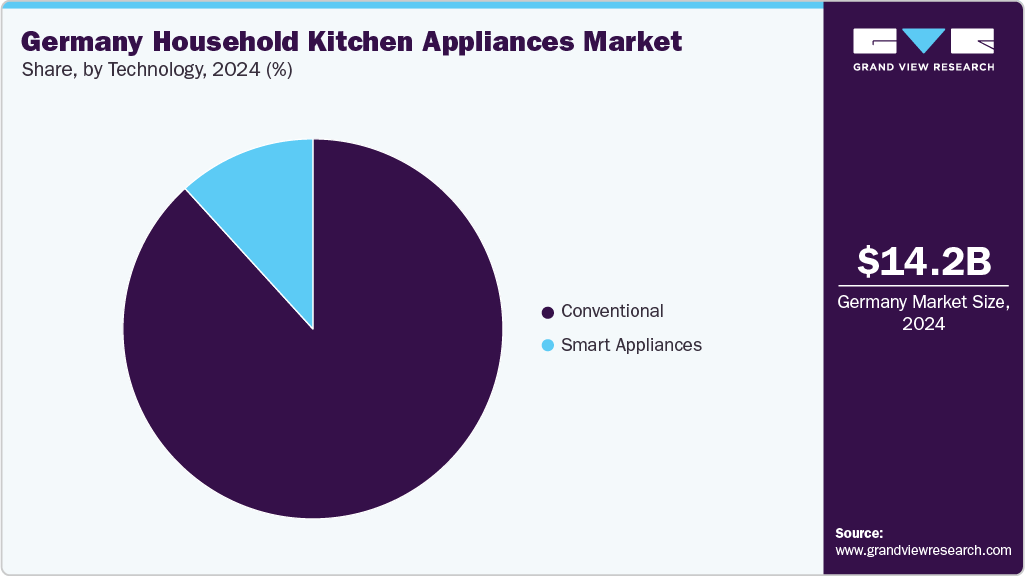
The conventional household kitchen appliances market accounted for the largest revenue share in 2024. This is driven by the strong adoption of conventional appliances by single-person households, seniors, and landlords outfitting rental units.
 To learn more about this report, Download Free Sample Report
 The smart kitchen appliances market is anticipated to experience the fastest CAGR from 2025 to 2033, driven by high digital adoption and a growing demand for sustainable, connected living. These devices offer Wi-Fi connectivity, voice assistant compatibility, AI-powered features, and usage monitoring through mobile apps.
 To learn more about this report, Download Free Sample Report
 Growing awareness of energy consumption and carbon footprint has made app-based monitoring attractive to eco-conscious consumers. At the same time, integration with voice assistants such as Alexa and Google Assistant has become a key factor for urban tech adopters. In July 2024, at IFA Berlin, Haier Europe unveiled its new hOn-connected oven and refrigerator range, featuring AI-based food recognition and remote temperature control.
Key Companies & Market Share Insights
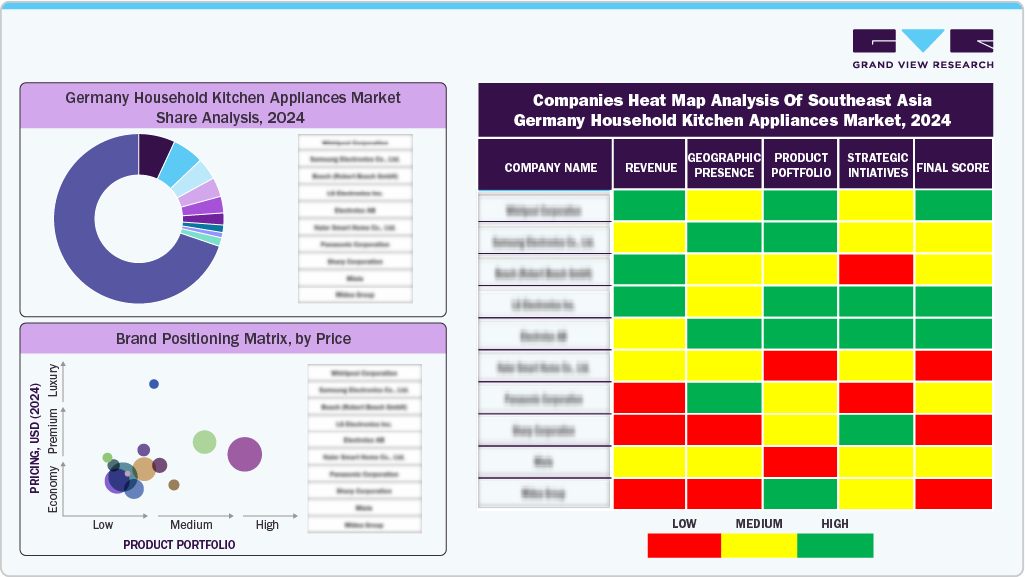
Some of the key players in the Germany household kitchen appliances industry include Whirlpool Corporation, AB Electrolux, LG Electronics, Robert Bosch GmbH, and others.
 To learn more about this report, Download Free Sample Report
 -
Robert Bosch GmbH is a global engineering and technology company that operates across multiple sectors, including mobility solutions, industrial technology, energy and building technology, and consumer goods.
Key Germany household kitchen appliances Companies:
- Whirlpool Corporation
- AB Electrolux
- LG Electronics
- Robert Bosch GmbH
Germany Household Kitchen Appliances Market Report Scope
Report Attribute
Details
Market size value in 2025
USD 14.44 billion
Revenue forecast in 2033
USD 17.19 billion
Growth rate
CAGR of 2.2% from 2025 to 2033
Actuals
2021 - 2024
Forecast period
2025 - 2033
Quantitative units
Revenue in USD million and CAGR from 2025 to 2033
Report coverage
Revenue forecast, company ranking, competitive landscape, growth factors, trends
Segments covered
Product, technology
Key companies profiled
Whirlpool Corporation; AB Electrolux; LG Electronics; Robert Bosch GmbH
Customization scope
Free report customization (equivalent up to 8 analysts working days) with purchase. Addition or alteration to segment scope.
Pricing and purchase options
Avail customized purchase options to meet your exact research needs. Explore purchase options
Germany Household Kitchen Appliances Market Report Segmentation
This report forecasts revenue growth at the country level and provides an analysis of the latest industry trends in each of the sub-segments from 2021 to 2033. For this study, Grand View Research has segmented the Germany household kitchen appliances market report based on product AND technology:
-
Product Outlook (Revenue, USD Million, 2021 - 2033)
-
Refrigerator
-
Cooking Appliances
-
Cooktops & cooking range
-
Ovens
-
Others
-
-
Dishwasher
-
Range Hood
-
Others
-
-
Technology Outlook (Revenue, USD Million, USD Million, 2021 - 2033)
-
Conventional
-
Smart Appliances
-
About the Author(s)
Electronic & Electrical Research Team
Consumer Goods · Electronic & ElectricalThis report was authored by the electronic & electrical research team at Grand View Research - comprising two research analysts, one senior research analyst, and one industry expert - with specialized expertise in the electronic & electrical segment of the consumer goods industry. All findings are based on proprietary consumer goods databases, executive interviews, and regulatory analysis, subject to internal peer review prior to publication.
Last Updated:
Speak to Analyst

Customize this report to your needs - add regions, segments, or data points, with 20% free customization.
Or view our licence options:


ISO 9001:2015 & 27001:2022 Certified
We are GDPR and CCPA compliant! Your transaction & personal information is safe and secure. For more details, please read our privacy policy.


