
- Home
- »
- Advanced Interior Materials
- »
-
Glass Manufacturing Market Size, Share Report, 2026-2033GVR Report cover

Glass Manufacturing Market (2026 - 2033)
Size, Share & Trends Analysis Report By Material (Container Glass, Flat Glass, Fiber Glass), By Application (Packaging, Construction, Transportation), By Region, And Segment Forecasts
Market Size, 2025
$127.4BMarket Estimate, 2026
$134.0BMarket Forecast, 2033
$202.8BCAGR, 2026–2033
6.1%Glass Manufacturing Market Summary
The global glass manufacturing market size was valued at USD 127.4 billion in 2025 and is projected to grow from USD 134.0 billion in 2026 to USD 202.8 billion by 2033, at a CAGR of 6.1% from 2026 to 2033. North America dominated the global market with the largest revenue share of 26.6% in 2025. This growth is attributed to the rising demand from the construction sector for energy-efficient and sustainable glass products is significant, fueled by urbanization and infrastructure development, particularly in emerging economies.
 Source: Grand View Research, IR Documents, Primary Interviews, Paid DatabasesTo learn more about this report,
 Download Free Sample Report
 Key Market Trends & Insights
- By material: Container glass segment dominated the market with the largest revenue share of 46.9% in 2025.
- By application: Packaging segment captured the largest revenue share of 36.8% in 2025.
Regional Highlights
- Largest regional market: North America (26.6% revenue share, 2025)
- Fastest-growing regional market: Asia Pacific (highest CAGR, 2026-2033)
- By country: The U.S. held the largest market share in 2025.
Market Size & Forecast
- Market size in 2025: USD 127.4 Billion
- Estimated market size in 2026: USD 134.0 Billion
- Projected market size by 2033: USD 202.8 Billion
- CAGR (2026-2033): 6.1%
Three ways to get this report
Buy it, customize it, or ask a question.Ask an Analyst
Analyst response in 1 business day
- AccessReport author, directly
- Reply timeWithin 1 working day
- No sales callDirect answer only
- FormatEmail reply
- CostFree, no cost
Get the Full Report
What the study covers
- FormatsPDF · Excel · Dashboard
- Timeline2026–2033 annual, 2025 base
- Coverage20+ countries, 5 regions
- Companies10+ key players profiled
Customize the Report
20% free customization
- IncludeCountries, segments, points
- TailorTo your product definition
- ExtendDeeper competitor detail
- OrA fully bespoke study
- Turnaround5–10 working days
In addition, the automotive industry's shift towards lighter, advanced glass materials for safety and efficiency is boosting production. Furthermore, innovations in smart glass technology and increased recycling efforts are also contributing to market expansion, as consumers and industries prioritize sustainability and energy efficiency in their choices.Glass manufacturing refers to the process of producing glass products through the melting of raw materials such as silica, soda ash, and limestone, followed by shaping and cooling. The growth of the glass manufacturing market is significantly influenced by the increasing sales of electronic display devices, including smartphones, tablets, and televisions. As these devices require high-quality glass for their displays, the rising demand for improved resolution, durability, and scratch resistance is prompting manufacturers to innovate with ultra-thin and flexible glass options.
 To learn more about this report, Download Free Sample Report
 In addition, advancements in technology, particularly with the advent of 5G, artificial intelligence, and virtual reality, are further propelling the need for high-quality displays in electronic devices. This trend indicates a sustained increase in demand for glass products within the electronics sector. Furthermore, investments in new manufacturing facilities are becoming a notable trend as companies seek to enhance production efficiency and sustainability to meet growing consumer needs.
The market is also benefiting from an uptick in smartphone production and a decrease in consumer electronics costs. Moreover, infrastructure development and construction activities are expected to drive demand for glass in various applications. Governments are increasingly advocating for the use of biodegradable materials over non-biodegradable alternatives, boosting glass's appeal as an environmentally friendly option, thereby reinforcing its significance in the global glass manufacturing industry.
Market Dynamics
The global glass manufacturing market is driven by rising demand from the construction, packaging, automotive, electronics, and telecommunications sectors, supported by urbanization, infrastructure development, and increasing adoption of energy-efficient and sustainable materials. Growth in solar installations, electric vehicles, and fiber-optic networks is further boosting demand for specialty glass products. However, the industry faces challenges from high energy costs, raw material price volatility, and stringent environmental regulations. To remain competitive, manufacturers are increasingly investing in energy-efficient production technologies, furnace modernization, and recycled glass utilization.
The increasing focus on raw material security and recycling advancements is emerging as a significant growth driver for the global glass manufacturing market. Glass production relies heavily on key raw materials such as silica sand, soda ash, limestone, and cullet (recycled glass), making stable access to these inputs essential for maintaining production continuity and cost competitiveness. As manufacturers face growing pressure from raw material price volatility and supply chain disruptions, investments in long-term sourcing strategies, localized supply networks, and resource-efficient production models are helping improve operational resilience and support sustainable market growth.
At the same time, advancements in glass recycling technologies are enabling manufacturers to increase the use of cullet in production processes. Higher cullet utilization reduces the consumption of virgin raw materials while lowering energy requirements during melting, resulting in reduced production costs and improved furnace efficiency. The use of recycled glass helps manufacturers meet increasingly stringent environmental and carbon reduction targets, further enhancing the economic attractiveness of glass products. As governments and industry stakeholders continue to promote circular economy initiatives and recycling infrastructure development, the growing availability of high-quality recycled glass is expected to strengthen raw material security and improve profitability across the glass manufacturing value chain.
High manufacturing costs remain a significant restraint for the global glass manufacturing market. Glass production is an energy-intensive process that requires continuous operation of high-temperature furnaces, often exceeding 1,500°C, resulting in substantial consumption of natural gas, electricity, and other energy sources. Fluctuations in energy prices can significantly impact operating expenses and profit margins, particularly for manufacturers operating in regions with high utility costs or limited access to affordable energy resources.
In addition to energy expenditures, manufacturers face rising costs associated with raw materials, labor, transportation, furnace maintenance, and environmental compliance. The capital-intensive nature of the industry requires substantial investments in production facilities, furnace upgrades, emission control systems, and automation technologies to maintain product quality and operational efficiency. The increasingly stringent environmental regulations aimed at reducing carbon emissions are compelling manufacturers to invest in cleaner production technologies and sustainability initiatives, further increasing overall production costs. These factors can limit profitability, create pressure on pricing, and pose challenges for smaller manufacturers seeking to compete in an increasingly competitive global market.
The increasing focus on energy efficiency and sustainable building practices is creating significant growth opportunities for the global glass manufacturing market. Rising adoption of green building standards and stricter energy-efficiency regulations is driving demand for advanced glazing solutions such as Low-E, solar control, and insulated glass, which help reduce energy consumption and improve building performance. Growing construction activity in commercial and residential sectors is further supporting the uptake of these high-performance glass products.
The rising deployment of smart glass technologies, including electrochromic and thermochromic glass, is expanding the application scope of glass in modern infrastructure. These solutions enable dynamic control of light and heat transmission, enhancing occupant comfort while improving energy efficiency. As smart buildings, sustainable construction, and carbon reduction initiatives continue to gain momentum worldwide, demand for energy-efficient and smart glass is expected to accelerate, creating attractive growth opportunities for manufacturers.
Analyst Perspective
The global glass manufacturing market is undergoing a significant transformation, driven by rising demand from construction, packaging, transportation, electronics, and telecommunications industries. Growth in energy-efficient buildings, renewable energy projects, electric vehicles, and fiber-optic infrastructure is accelerating the adoption of advanced glass products. Manufacturers are increasingly investing in automation, furnace modernization, and recycling technologies to improve efficiency and sustainability. Although high energy costs, raw material price volatility, and environmental regulations continue to pose challenges, they are also encouraging innovation in low-carbon and resource-efficient manufacturing. Companies that effectively balance operational efficiency, product innovation, and sustainability are expected to strengthen their market position and capture long-term growth opportunities.
Material Insights
Based on material, the container glass segment dominated the market with the largest revenue share of 46.9% in 2025. This growth is attributed to the increasing demand from the food and beverage industry, where glass is favored for its durability, recyclability, and ability to preserve product integrity. Furthermore, rising environmental awareness is prompting a shift towards sustainable packaging solutions, further boosting container glass usage. Moreover, the pharmaceutical sector's reliance on glass for vials and ampoules due to its chemical inertness also significantly contributes to market expansion.
Fiber glass market is expected to grow at the fastest CAGR of 6.4% over the forecast period, owing to its extensive applications across various industries, including construction, automotive, and aerospace. In addition, the lightweight and high-strength properties of fiber glass make it an ideal material for enhancing energy efficiency and reducing emissions in vehicles. Furthermore, advancements in manufacturing technologies are enabling the production of more durable and versatile fiber glass products. Moreover, the increasing focus on sustainability and energy conservation in construction projects is also driving demand for fiber glass insulation materials, contributing to the overall growth of this segment in the glass manufacturing market.
Application Insights
Based on application, the packaging segment captured the largest revenue share of 36.8% in 2025, primarily driven by the increasing demand for sustainable and eco-friendly packaging solutions. In addition, glass is favored for its recyclability and ability to preserve product integrity, making it a preferred choice in the food, beverage, and pharmaceutical industries. Furthermore, as consumer awareness regarding environmental issues rises, brands are shifting towards glass packaging to enhance their sustainability credentials, driving innovation and expansion in this sector.
 To learn more about this report, Download Free Sample Report
 Telecommunication segment is expected to grow at a CAGR of 6.6% from 2025 to 2030, owing to the rising demand for advanced electronic devices that utilize high-quality glass components. In addition, the proliferation of smartphones, tablets, and other communication devices necessitates durable and high-performance glass for displays. Furthermore, the advent of new technologies such as 5G is increasing the need for enhanced optical fibers and glass materials that support faster data transmission.
Regional Insights
North America dominated the glass manufacturing market with the largest revenue share of 26.6% in 2025. This growth is attributed to the rapid industrialization and robust infrastructure development in countries such as China and India. In addition, the increasing urban population drives demand for various glass products, particularly in construction and automotive sectors. Furthermore, rising disposable incomes lead to a preference for high-quality glass items, enhancing consumption across multiple applications, including consumer electronics and home appliances, thereby solidifying the region's position as a leader in glass manufacturing.
 To learn more about this report, Download Free Sample Report
 The China glass manufacturing market led the Asia Pacific market and accounted for the largest revenue share in 2024, driven by its booming economy and ongoing urbanization. As one of the largest producers of flat glass globally, China benefits from abundant raw materials and advanced manufacturing technologies. Furthermore, the government's focus on sustainable construction practices and energy-efficient buildings further propels demand for glass products, particularly in the construction and automotive industries, ensuring continued growth in this sector.
Middle East & Africa Glass Manufacturing Market Trends
The Middle East and Africa glass manufacturing market is expected to grow at a CAGR of 4.9% over the forecast period, owing to increasing investments in infrastructure projects and urban development. The demand for container glass is rising as the region's food and beverage industry expands. Furthermore, growing awareness of environmental sustainability is driving a shift towards recyclable glass packaging solutions. Moreover, the construction sector's expansion also fuels demand for architectural glass products, enhancing the overall market landscape in this region.
North America Glass Manufacturing Market Trends
The North Americaglass manufacturing market is expected to grow significantly over the forecast period, primarily driven by increased investments in construction and infrastructure development. In addition, the rise in demand for eco-friendly packaging solutions is also significant, as consumers become more aware of their environmental impact. Furthermore, major manufacturers are expanding production capacities to meet this demand, particularly in the food and beverage sectors, while innovations in smart glass technology are opening new avenues for growth across various applications.
U.S. Glass Manufacturing Market Trends
The glass manufacturing market in the U.S. held the largest share in the North America region in 2025, owing to a strong focus on sustainability and innovative packaging solutions. The construction sector's recovery post-pandemic is contributing to increased spending on glass products for residential and commercial buildings. Furthermore, the growing trend towards environmentally friendly materials encourages manufacturers to invest in advanced production techniques that minimize waste and enhance recyclability, supporting overall market expansion.
Europe Glass Manufacturing Market Trends
The glass manufacturing market in Europe generated a significant revenue share in 2024, driven by stringent regulations promoting sustainability and recycling initiatives. In addition, the increasing demand for high-quality packaging solutions in the food and beverage industry significantly boosts container glass production. Furthermore, advancements in technology are leading to innovations in flat and specialty glass products, catering to diverse applications such as automotive and construction.
The growth of the Germany glass manufacturing market is expected to be driven by strong technological advancements and a commitment to sustainability. Furthermore, the country's emphasis on energy-efficient building practices drives demand for high-performance architectural glass products. Moreover, Germany's robust automotive industry relies heavily on specialized glass components, further fueling market growth.
Key Glass Manufacturing Company Insights
Key companies in the global glass manufacturing industry include AGC Inc., Saint-Gobain, AGI glaspac, and others. These players employ various strategies to enhance their competitive edge. These strategies include mergers and acquisitions, that are utilized to expand market reach and consolidate resources. In addition, strategic alliances with technology firms facilitate innovation in product development. Furthermore, new product launches are adopted by the companies to focus on sustainability and advanced features to meet evolving consumer demands.
-
Guardian Industries specializes in the production of high-performance float glass and value-added glass products. The company operates primarily through its Guardian Glass division, which supplies a wide range of glass solutions for architectural, residential, automotive, and technical applications. In addition to glass manufacturing, the company also focuses on fiberglass insulation and building materials, catering to diverse industries and enhancing its position in the global market.
-
Saint-Gobain company operates across various segments, including flat glass for construction, automotive glass, and specialized glass solutions for industrial applications. By integrating advanced technologies into its manufacturing processes, the company continues to meet the evolving demands of customers in both residential and commercial markets worldwide.
Key Glass Manufacturing Companies:
The following are the leading companies in the glass manufacturing market.
-
AGC Inc.
-
Fuyao Glass Industry Group Co. Ltd.
-
Guardian Industries
-
Saint-Gobain
-
O-I Glass Inc.
-
AGI glaspac
-
Nihon Yamaura Glass Co., Ltd.
-
Vitro
-
3B- the fiberglass company
Competitive Benchmarking
Category
Operating Strategies
Competitive Edge
Weakness
Established Players (AGC Inc.; Saint-Gobain; Guardian Industries; O-I Glass, Inc.; Vitro; Fuyao Glass Industry Group Co., Ltd.)
- Invest heavily in furnace modernization, automation, and energy-efficient manufacturing technologies.
- Focus on long-term contracts with construction firms, automotive OEMs, packaging companies, and industrial customers.
- Expand global manufacturing footprints through capacity additions, acquisitions, and strategic partnerships.
- Develop high-value products such as coated glass, smart glass, specialty glass, and advanced automotive glazing solutions.
- Strong global brand recognition and diversified product portfolios.
- Extensive manufacturing capacities and established distribution networks.
- Significant R&D capabilities and access to advanced production technologies.
- Strong relationships with major end-use industries.
- High capital and operating costs associated with large-scale manufacturing facilities.
- Exposure to fluctuations in energy and raw material prices.
- Significant regulatory and environmental compliance costs.
- Longer investment cycles and operational complexity.
Emerging Players (AGI glaspac; Nihon Yamaura Glass Co., Ltd.; 3B - The Fibreglass Company; regional specialty glass manufacturers)
- Focus on niche applications such as specialty glass, fiberglass products, pharmaceutical packaging, and customized solutions.
- Compete through operational flexibility, customer-specific product development, and regional market expertise.
- Expand presence through targeted investments in high-growth end-use sectors.
- Emphasize product differentiation and specialized manufacturing capabilities.
- Greater flexibility in addressing evolving customer requirements.
- Faster decision-making and shorter product development cycles.
- Strong positioning in niche and specialized market segments.
- Lower organizational complexity and overhead costs.
- Limited production capacity and geographic reach compared to industry leaders.
- Lower bargaining power with suppliers and customers.
- Limited financial resources for large-scale expansion and R&D investments.
- Greater vulnerability to market fluctuations and competitive pricing pressures.
Recent Developments
-
In January 2025, AGC Glass Europe is set to invest a significant amount in a new production line at its Lodelinsart facility in Belgium for FINEO ultra-thin insulating vacuum glass. This initiative aims to enhance glass manufacturing capabilities, responding to increasing customer demand for innovative solutions. Set to begin operations in mid-2026, the line is expected to boost production of FINEO.
-
In June 2023, Saint-Gobain India has launched the production of India's first low-carbon glass, aiming to meet the growing demand for sustainable building materials in the construction industry. This innovative glass manufacturing process is expected to reduce carbon emissions by approximately 40% compared to existing products, utilizing two-thirds recycled content and renewable energy sources. The new glass is expected to maintain the quality and aesthetic appeal of traditional glass while contributing to significant reductions in both embodied and operational carbon footprints.
Glass Manufacturing Market Report Scope
Report Attribute
Details
Market size in 2025
USD 127.4 billion
Estimated market size in 2026
USD 134.0 billion
Projected market size by 2033
USD 202.8 billion
Growth rate
CAGR of 6.1% from 2026 to 2033
Base year for estimation
2025
Historical data
2021 - 2024
Forecast period
2026 - 2033
Quantitative units
Revenue in USD Million, Volume in Kilotons, and CAGR from 2026 to 2033
Report coverage
Revenue forecast, volume forecast, company ranking, competitive landscape, growth factors, and trends
Segments covered
Material, application, region
Regional scope
North America; Europe; Asia Pacific; Latin America; MEA
Country scope
U.S.; Canada; Mexico; Germany; France; Italy; UK; China; India; Japan; South Korea; Brazil, Qatar
Key companies profiled
AGC Inc., Fuyao Glass Industry Group Co. Ltd., Guardian Industries, Saint-Gobain, O-I Glass Inc., AGI glaspac, Nihon Yamaura Glass Co., Ltd., Vitro, 3B- the fiberglass company
Customization scope
Free report customization (equivalent up to 8 analysts' working days) with purchase. Addition or alteration to country, regional & segment scope.
Pricing and purchase options
Avail customized purchase options to meet your exact research needs. Explore purchase options
Global Glass Manufacturing Market Report Segmentation
This report forecasts revenue growth at global, regional, and country levels and analyzes the latest industry trends in each sub-segment from 2021 to 2033. For this study, Grand View Research has segmented the global glass manufacturing market report based on material, application, and region.
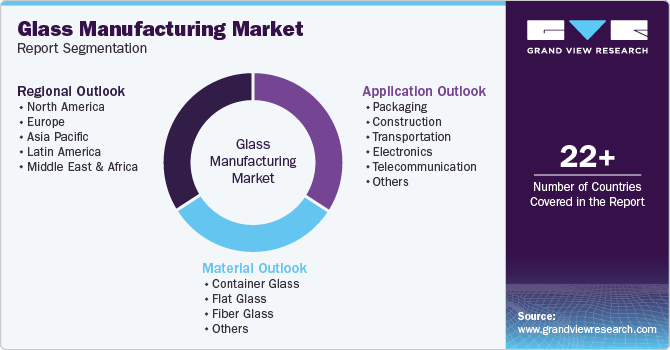 To learn more about this report, Download Free Sample Report
 -
Material Outlook (Volume, Kilotons; Revenue, USD Million, 2021 - 2033)
-
Container Glass
-
Flat Glass
-
Fiber Glass
-
Others
-
-
Application Outlook (Volume, Kilotons; Revenue, USD Million, 2021 - 2033)
-
Packaging
-
Construction
-
Transportation
-
Electronics
-
Telecommunication
-
Others
-
-
Regional Outlook (Volume, Kilotons; Revenue, USD Million, 2021 - 2033)
-
North America
-
U.S.
-
Canada
-
Mexico
-
-
Europe
-
Germany
-
Italy
-
France
-
UK
-
-
Asia Pacific
-
China
-
India
-
Japan
-
South Korea
-
-
Latin America
-
Brazil
-
-
Middle East and Africa
-
Qatar
-
-
Research Methodology
Segment Definition
Segment - Material
Revenue capture definition
Container Glass
Revenue is generated from the sale of glass containers, including bottles, jars, vials, and other packaging products used across food & beverages, pharmaceuticals, cosmetics, and consumer goods industries.
Flat Glass
Revenue is generated from the sale of flat glass products, including float glass, tempered glass, laminated glass, coated glass, and insulated glass units used in construction, automotive, solar energy, and architectural applications.
Fiber Glass
Revenue is generated from the sale of fiberglass products, including continuous filaments, chopped strands, glass wool, and reinforcement materials used in composites, insulation, wind energy, transportation, and industrial applications.
Others
Revenue is generated from the sale of specialty glass products, including optical glass, laboratory glass, glass ceramics, borosilicate glass, and other advanced glass materials used in healthcare, aerospace, electronics, and scientific applications.
Segment - Application
Revenue capture definition
Packaging
Revenue is generated from the sale of glass products used for packaging applications, including bottles, jars, containers, ampoules, and vials for food & beverages, pharmaceuticals, cosmetics, and consumer products.
Construction
Revenue is generated from the sale of glass products used in residential, commercial, and industrial buildings, including windows, façades, curtain walls, skylights, partitions, and energy-efficient glazing systems.
Transportation
Revenue is generated from the sale of glass products used in automotive, rail, marine, and aerospace applications, including windshields, side windows, rear windows, sunroofs, and specialty glazing solutions.
Electronics
Revenue is generated from the sale of glass products used in consumer electronics and electronic components, including display panels, smartphone screens, touchscreens, semiconductor manufacturing equipment, and protective glass materials.
Telecommunication
Revenue is generated from the sale of glass products used in communication infrastructure, primarily fiber-optic cables and associated components that support broadband, data transmission, data centers, and telecommunications networks.
Others
Revenue is generated from the sale of glass products used in various applications, including healthcare, renewable energy, defense, laboratory equipment, household products, and other specialized industrial uses.
Estimation Model
Layer Name
Key Question
Description
End-Use Industry Analysis
Where does demand originate?
This stage evaluates glass consumption across major end-use industries, including construction, packaging, transportation, electronics, telecommunications, and others. Industry growth trends, infrastructure investments, manufacturing output, consumer demand, and technology adoption are analyzed to identify the primary sources of demand for glass products. The assessment helps establish the total addressable market for glass manufacturing.
Glass Product Demand Assessment
Which glass products are required?
This stage identifies the major glass products utilized across end-use sectors, including flat glass, container glass, fiberglass, and specialty glass products. Demand is evaluated based on application-specific requirements such as architectural glazing, packaging containers, automotive glass, insulation materials, display panels, and fiber-optic infrastructure. Product demand is mapped to respective end-use industries to estimate total glass consumption.
Material Volume Analysis
How much glass is consumed?
The estimated demand for glass products is translated into glass consumption volumes across container glass, flat glass, fiberglass, and other specialty glass categories. Consumption patterns are analyzed based on production output, replacement demand, construction activity, packaging requirements, and industrial utilization. This step quantifies total glass volume demand by material type and application segment.
Revenue Estimation
How much market revenue is generated?
The calculated glass consumption volumes are converted into market revenue using average selling prices across different glass categories and applications. Pricing analysis incorporates factors such as product type, manufacturing complexity, coating technologies, value-added processing, quality specifications, and regional supply-demand dynamics. The aggregated revenue estimates are used to determine the overall market size and forecast growth.
Delivered Customizations
This report has been delivered with the following In-depth customizations
Client Request
Customization Delivered
Value Adds
Raw Material Pricing Analysis
Conducted a detailed assessment of key raw materials used in glass manufacturing, including silica sand, soda ash, limestone, dolomite, feldspar, and recycled glass (cullet), covering price trends, supply-demand dynamics, trade flows, regional availability, and sourcing risks across major markets.
Helps stakeholders understand production cost drivers, evaluate procurement risks, optimize sourcing strategies, and improve supply chain resilience.
Growth Opportunity Assessment
Conducted a comprehensive assessment of emerging growth opportunities across energy-efficient buildings, smart glass, solar energy, electric vehicles, consumer electronics, fiber-optic infrastructure, and sustainable packaging applications. The analysis included demand outlook, technology adoption trends, investment activity, and regional attractiveness.
Helps stakeholders identify high-growth application areas, prioritize strategic investments, and capitalize on emerging demand trends.
Global Trade Flow & Import-Export Analysis
Evaluated international trade patterns for glass products and raw materials, including import-export volumes, key producing and consuming countries, tariff structures, trade regulations, supply chain dependencies, and regional manufacturing competitiveness.
Enables stakeholders to understand global trade dynamics, assess supply chain risks, identify export opportunities, and support market expansion strategies.
Frequently Asked Questions About This Report
The glass manufacturing market size was estimated at USD 127.4 billion in 2025 and is expected to reach USD 134.0 billion in 2026.
The glass manufacturing market is expected to grow at a compound annual growth rate of 6.1% from 2026 to 2033 to reach USD 202.8 billion by 2033.
Based on application, packaging accounted for largest revenue share of 36.8% in 2025.
The key players operating in the glass manufacturing market are AGC Inc., Fuyao Glass Industry Group Co. Ltd., Guardian Industries, Saint-Gobain, O-I Glass Inc., AGI glaspac, Nihon Yamaura Glass Co., Ltd., Vitro, 3B- the fiberglass company.
The glass manufacturing market is primarily driven by increasing demand from the construction, packaging, transportation, electronics, and telecommunications sectors, supported by rapid urbanization, infrastructure development, and industrial expansion. Growing adoption of energy-efficient buildings, renewable energy systems, sustainable packaging solutions, and advanced glass technologies is further accelerating market growth.
North America dominated the market with revenue share of 26.6% in 2025.
The U.S. dominated the North American market with revenue share of 72.2% in 2025.
Asia Pacific is anticipated to register the fastest CAGR of 7.5% from 2026 to 2033.
Based on material, container glass accounted for largest revenue share of 46.9% in 2025.
About the Author(s)
Advanced Interior Materials Research Team
Advanced Materials · Advanced Interior MaterialsThis report was authored by the advanced interior materials research team at Grand View Research - comprising two research analysts, one senior research analyst, and one industry expert - with specialized expertise in the advanced interior materials segment of the advanced materials industry. All findings are based on proprietary advanced materials databases, executive interviews, and regulatory analysis, subject to internal peer review prior to publication.
Last Updated:
Speak to Analyst

Customize this report to your needs - add regions, segments, or data points, with 20% free customization.
Or view our licence options:


ISO 9001:2015 & 27001:2022 Certified
We are GDPR and CCPA compliant! Your transaction & personal information is safe and secure. For more details, please read our privacy policy.


