
- Home
- »
- Renewable Chemicals
- »
-
Glycidyl Methacrylate Market Size, Share Report, 2026-2033GVR Report cover

Glycidyl Methacrylate Market (2026 - 2033)
Size, Share & Trends Analysis Report By Application (Coatings, Adhesives, Electrical Laminates, Plastics), By Region (North America, Europe, Asia Pacific Latin America, Middle East & Africa), And Segment Forecasts
Market Size, 2025
$247.3MMarket Estimate, 2026
$265.2MMarket Forecast, 2033
$449.0MCAGR, 2026–2033
7.8%Glycidyl Methacrylate Market Summary
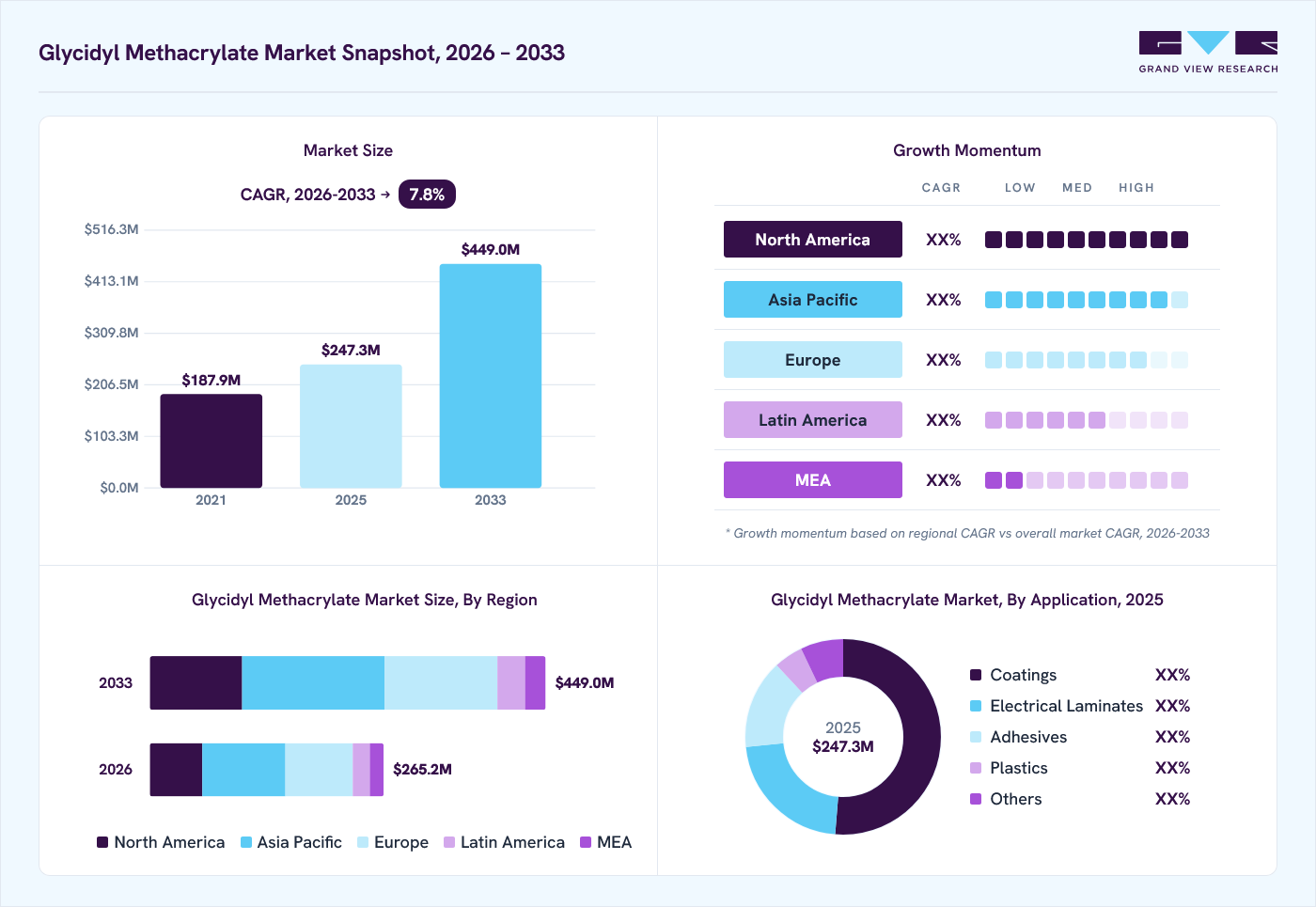
The global glycidyl methacrylate market size was valued at USD 247.3 million in 2025 and is projected to grow from USD 265.2 million in 2026 to USD 449.0 million by 2033, at a CAGR of 7.8% from 2026 to 2033. Asia Pacific dominated the market, accounting for a revenue share of 35.4% in 2025. The market is poised for substantial growth, driven by increasing demand for polymers across key industries such as consumer goods, electronics, and building and construction.
 Source: Grand View Research, IR Documents, Primary Interviews, Paid DatabasesTo learn more about this report,
 Download Free Sample Report
Key Market Trends & Insights
- By application: Coatings segment held the largest market share of 51.3% in 2025.
Regional Highlights
- Largest regional market: Asia Pacific (35.4% revenue share, 2025)
- By country: China held the largest market share in 2025.
Market Size & Forecast
- Market size in 2025: USD 247.3 Million
- Estimated market size in 2026: USD 265.2 Million
- Projected market size by 2033: USD 449.0 Million
- CAGR (2026-2033): 7.8%
Prism AI by Grand View Research Free to tryAsk a question about the glycidyl methacrylate marketTry asking✓Every figure cited from GVR research Prefer the report? Download free sample →
The market is set to expand, with global polymer production exhibiting significant growth potential. Glycidyl methacrylate is commonly used with other monomers to produce polymers with high hardness, strength, and resistance to water, solvents, and heat. The rising demand for biobased plastics, fueled by growing environmental consciousness and a booming medical devices sector, further expands the market.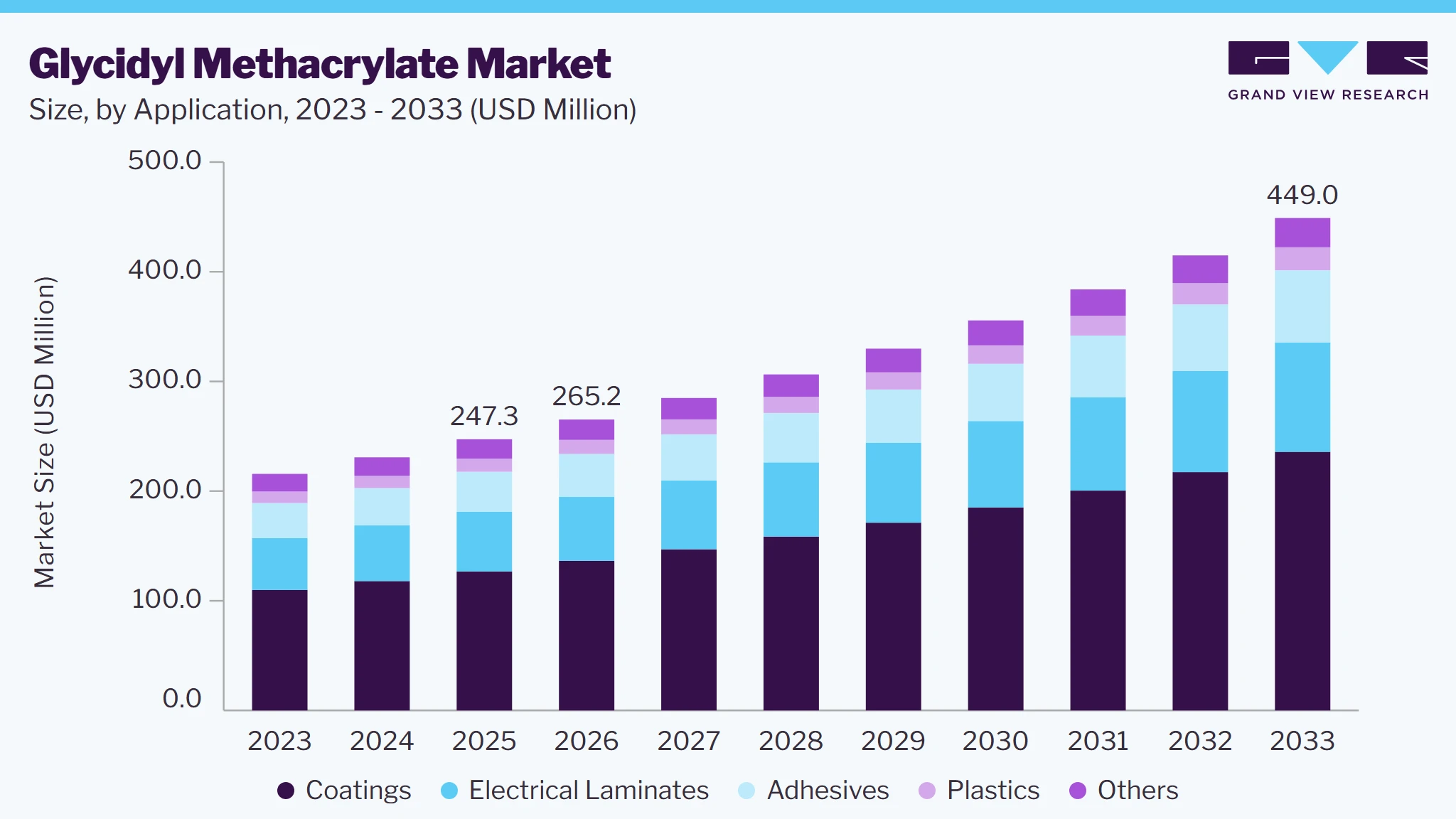 To learn more about this report, Download Free Sample Report
Moreover, the market's growth is bolstered by the increasing demand for adhesives and sealants, essential for meeting the evolving packaging needs of the food & beverage and e-commerce industries. The global adhesives & sealants sector is projected to experience robust growth potential. Glycidyl methacrylate plays a crucial role in enhancing the adhesiveness of hot melt adhesives, making it ideal for bonding materials such as leather and rubber. The growing preference for lightweight materials in the automotive and aerospace sectors, coupled with innovations in green adhesives, is expected to drive further growth in the market.
Market Dynamics
The glycidyl methacrylate market is witnessing steady growth driven by increasing demand from the plastics, coatings, adhesives, composites, and electronics industries. Glycidyl methacrylate is a versatile functional monomer containing both epoxy and methacrylate groups, making it highly valuable in polymer modification and resin manufacturing applications. It is widely used to enhance adhesion, impact resistance, chemical resistance, and compatibility in various polymer systems. Growing demand for lightweight automotive materials, high-performance coatings, advanced adhesives, and engineered plastics is supporting market expansion.
The glycidyl methacrylate market is experiencing steady growth due to increasing demand for high-performance polymers, specialty coatings, adhesives, and composite materials across multiple industries. Glycidyl methacrylate is widely used as a reactive monomer because it contains both epoxy and methacrylate functional groups, enabling excellent adhesion, chemical resistance, impact strength, and compatibility with various polymer systems.
The expanding use of engineered plastics, automotive lightweight materials, advanced coatings, and high-performance adhesives is driving consumption of GMA-based formulations. In addition, growing investments in infrastructure, automotive manufacturing, electronics, and packaging industries are increasing demand for functional polymers and resin modification technologies. As manufacturers seek materials with enhanced durability, flexibility, and performance characteristics, the adoption of glycidyl methacrylate is expected to continue growing throughout the forecast period.
Fluctuations in the prices of petrochemical feedstocks used for glycidyl methacrylate production present a significant challenge for market participants. Variations in crude oil prices, supply chain disruptions, and geopolitical uncertainties can affect manufacturing costs and profitability.
Stringent environmental, health, and occupational safety regulations related to the handling, storage, and use of methacrylate-based chemicals may increase compliance requirements for manufacturers. Exposure concerns associated with certain reactive monomers require adherence to strict workplace safety standards and environmental regulations. These factors can increase operational costs and create barriers for market expansion, particularly in regions with stringent chemical regulatory frameworks.
The increasing demand for advanced composite materials and sustainable polymer solutions is creating substantial growth opportunities for the glycidyl methacrylate market. GMA is increasingly used as a compatibilizer, impact modifier, and functionalization agent in engineering plastics, recycled polymers, and composite materials.
Growing emphasis on circular economy initiatives and plastic recycling is driving the use of GMA in polymer modification applications, where it improves compatibility between different polymer types and enhances the performance of recycled materials. Expanding applications in renewable energy components, electric vehicles, high-performance coatings, and specialty adhesives are generating new avenues for market growth. Companies investing in innovative polymer technologies, sustainable materials development, and advanced manufacturing applications are expected to strengthen their competitive position in the global glycidyl methacrylate market.
Analyst Perspective
The global glycidyl methacrylate market is positioned for steady growth, driven by increasing demand for high-performance polymers, specialty coatings, adhesives, and advanced composite materials across diverse industries. Glycidyl methacrylate is widely utilized as a functional monomer and polymer modification agent due to its unique epoxy and methacrylate functionalities, which enhance adhesion, impact resistance, chemical resistance, and compatibility in polymer systems. Growing demand from the automotive, electronics, construction, packaging, and industrial manufacturing sectors continues to support market expansion.
Application Insights
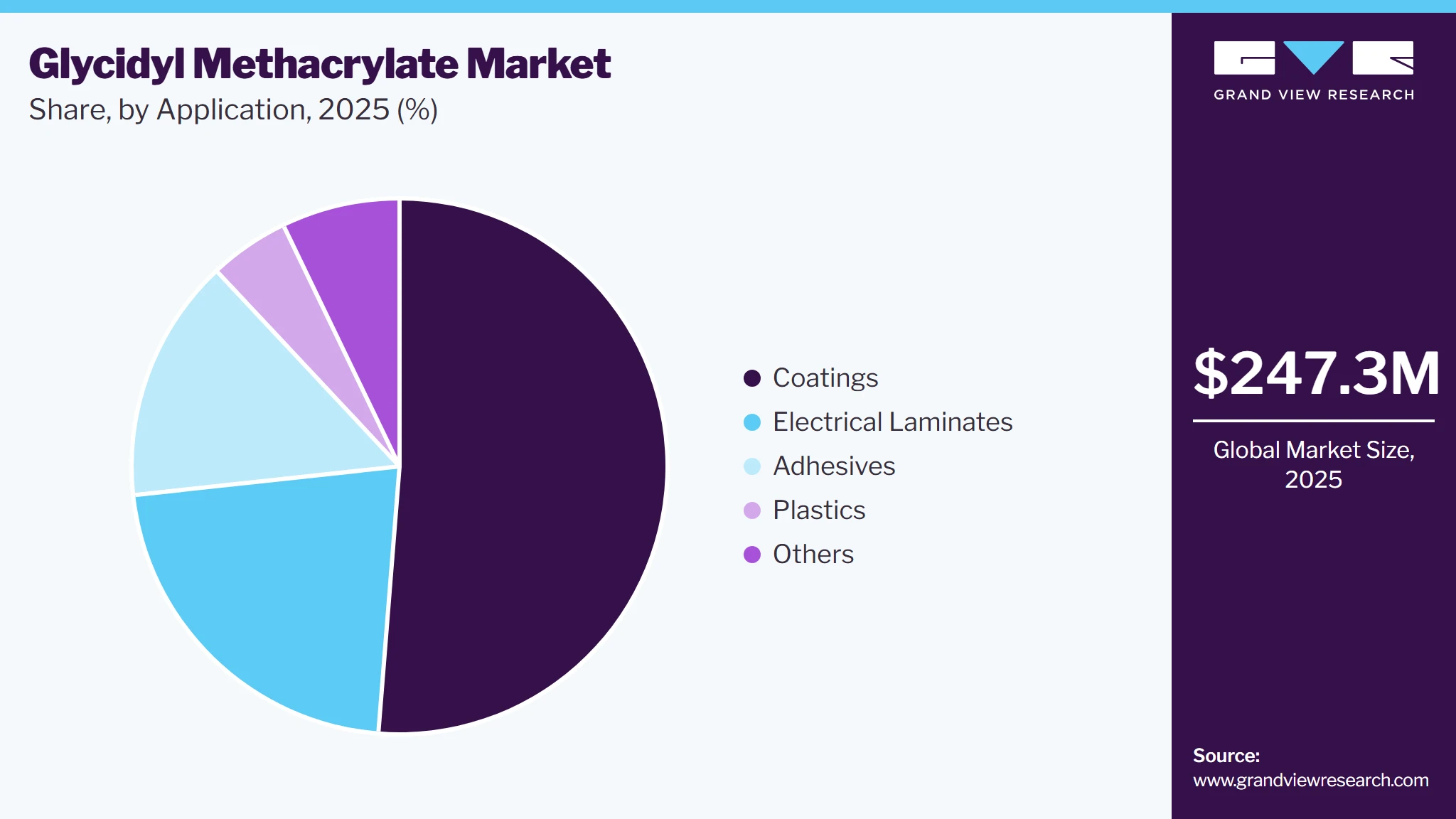
Coatings dominated the application type segment at a revenue share of 51.3% in 2025, during the forecast period. Rising construction and architectural activities in Latin America are increasing the demand for coatings and adhesives, which is growing the glycidyl methacrylate market. In North America, the growth is primarily due to the rising demand for coatings for industrial purposes. Europe will also see growth in the glycidyl methacrylate market due to the growing demand for glycidyl methacrylate in the automotive, electronics, and other sectors.
 To learn more about this report, Download Free Sample Report
The increasing demand for high-performance adhesives across industries such as construction, automotive, and electronics directly drives the demand for Glycidyl methacrylate (GMA), as GMA's unique properties enhance adhesive strength, durability, and chemical resistance, making it a crucial component in producing advanced bonding solutions.
Regional Insights
The region's focus on high-performance coatings, especially for industrial applications, increases GMA usage. Stringent environmental regulations push for durable and long-lasting coatings, favoring GMA-based solutions. The expanding aerospace and automotive sectors demand specialized adhesives and coatings, boosting GMA consumption. Infrastructure repair and construction activities consistently need GMA-enhanced sealants and adhesives-the rise of advanced composite materials requiring GMA for bonding further fuels demand.
U.S. Glycidyl Methacrylate Market Trends
The U.S. sees growing demand for Glycidyl methacrylate (GMA) due to its robust industrial base and infrastructure needs. The aerospace and automotive sectors' focus on high-performance materials drives GMA use in advanced coatings and adhesives. Infrastructure maintenance and construction require durable sealants and coatings, boosting GMA demand. Stringent environmental regulations favor GMA-based solutions for their longevity and resistance. The growing composites industry, crucial for various applications, relies on GMA for bonding and strength. The U.S. focus on advanced manufacturing and technological innovation increases the need for GMA in specialized applications. The demand for durable and long-lasting coatings in industrial settings also contributes to the increased use of GMA.
Asia Pacific Glycidyl Methacrylate Market Trends
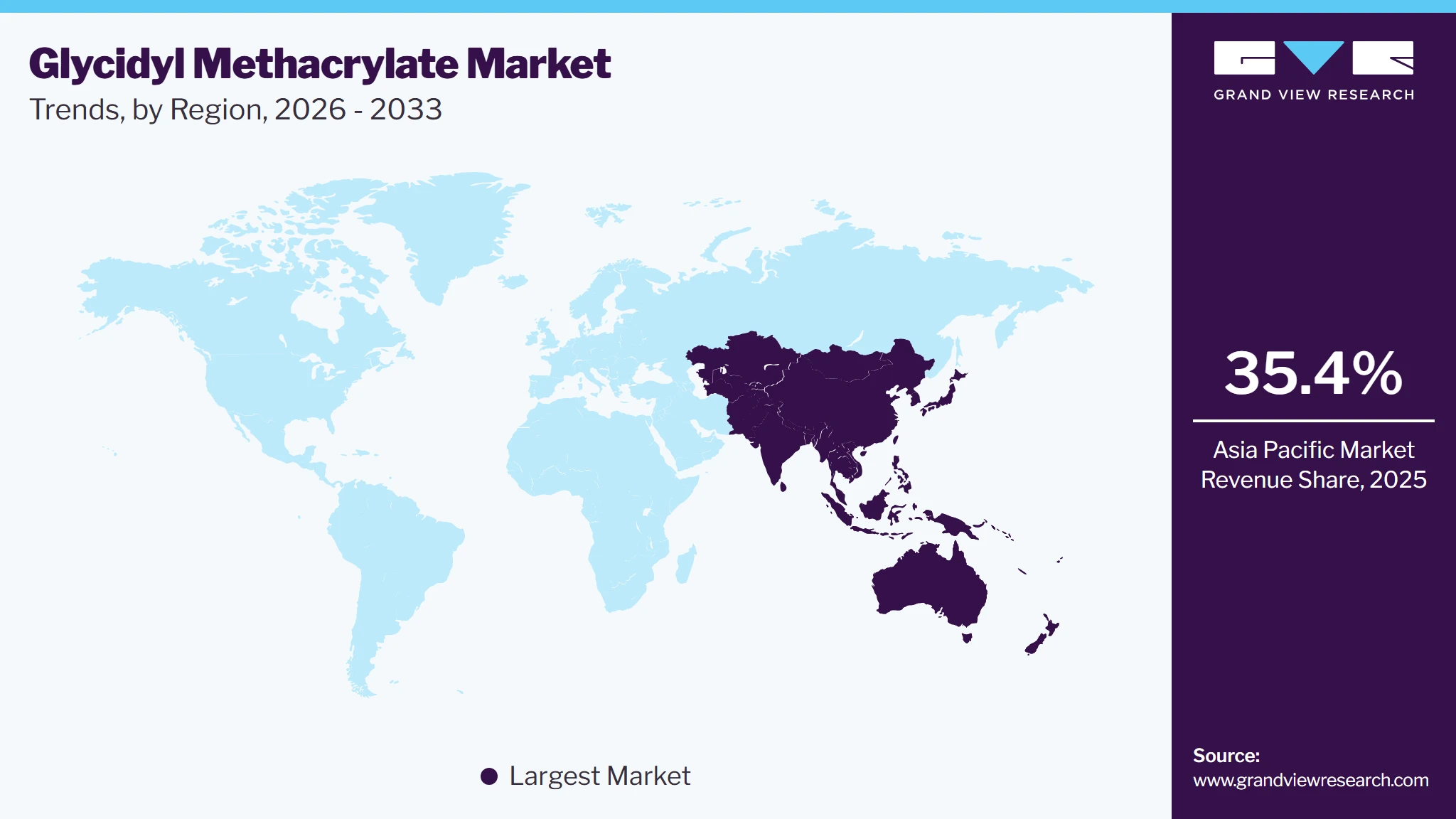
Asia Pacific accounted for 35.4% of the glycidyl methacrylate market revenue in 2025, making it the largest regional market. Growth in the automotive, electronics and construction sectors significantly increased GMA usage. Rising demand for high-performance adhesives and coatings, crucial in these industries, drives GMA consumption. The region's expanding electronics manufacturing hub necessitates GMA for components and coatings. A construction boom across Asia Pacific boosts GMA use in adhesives and sealants. The automotive sector's growth further elevates GMA demand for coatings and adhesives.
 To learn more about this report, Download Free Sample Report
China held the highest market revenue share in Asia Pacific in 2025. China's robust industrial sector drives a significant demand for Glycidyl methacrylate (GMA). The nation's massive manufacturing base, particularly electronics and automotive, heavily relies on GMA for coatings and adhesives. Rapid expansion in the construction industry boosts GMA usage in sealants and structural adhesives. China's growing automotive production requires GMA for durable coatings and bonding solutions. The burgeoning electronics sector utilizes GMA for specialized coatings and component manufacturing. Increased infrastructure development across China creates a continuous need for GMA-based construction materials.
Europe Glycidyl Methacrylate Market Trends
The automotive industry's push for lightweight and durable materials increases GMA usage in coatings and adhesives. Growing demand for high-performance coatings in the industrial and construction sectors boosts GMA consumption. The region's emphasis on advanced manufacturing and innovation creates a need for specialized GMA applications. Infrastructure maintenance and renovation projects require durable sealants and coatings, fueling GMA demand. The expanding composites industry, crucial for various applications, relies on GMA for bonding and strength.
Latin America Glycidyl Methacrylate Market Trends
Latin America's expanding construction and infrastructure projects drive increased demand for Glycidyl methacrylate (GMA). The growing automotive sector in the region requires GMA for durable coatings and adhesives. Rising demand for high-performance coatings in industrial and architectural applications boosts GMA usage. Increased infrastructure development necessitates durable sealants and adhesives, contributing to GMA consumption. The region's developing manufacturing sector is gradually increasing its use of GMA in various applications. Growing demand for adhesives used in packaging, especially in the food and beverage sector, also plays a role. The need for weather-resistant coatings, due to the region's diverse climates, further fuels GMA demand.
Middle East & Africa Glycidyl Methacrylate Market Trends
The Middle East & Africa region's rapid infrastructure development and construction boom drive increased Glycidyl methacrylate (GMA) demand. The expanding oil and gas industry requires GMA for corrosion-resistant coatings and specialized adhesives. Growing urbanization and housing projects boost demand for GMA-based sealants and construction materials. The automotive sector's gradual expansion in certain areas contributes to increased GMA usage. Rising demand for durable coatings in harsh environmental conditions, like extreme heat and salinity, fuels GMA consumption. The region's developing manufacturing sector is slowly increasing its use of specialized chemicals like GMA. Increased investment in infrastructure projects and industrial facilities necessitates using high-performance materials such as GMA.
Key Glycidyl Methacrylate Company Insights
Some of the key players operating in the market include Dow and Mitsubishi Chemical Company.
-
Dow manufactures chemicals, agrochemicals, rubber, specialty chemicals, and plastic materials. The company serves its products globally to several industries, including agriculture, infrastructure, packaging, and consumer care. It is in all regions, including North America, Europe, Asia Pacific, Latin America, and Middle East & Africa. Its primary markets include North America and Asia Pacific. The company had 106 manufacturing sites: 19 manufacturing sites in 10 Asia Pacific countries, 37 sites in 15 European, Middle Eastern, African, and Indian (EMEAI) countries, 15 in 4 Latin American countries, and 35 in the U.S. and Canada.
-
Mitsubishi Gas Chemical Company (MGC) is a Japanese chemical company that produces various basic and functional chemicals. They are known for their expertise in methanol, xylene, related derivatives, specialty chemicals, and plastics. MGC focuses on developing advanced technologies and products for various industries, including automotive, electronics, and healthcare. They emphasize innovation and sustainable solutions in their business operations.
Key Glycidyl Methacrylate Companies:
The following key companies have been profiled for this study on the glycidyl methacrylate market.
-
Dow
-
Estron Chemical Inc.
-
Haihang Industry Co. Ltd.
-
Mitsubishi Gas Chemical Company
-
Sumitomo Chemicals
-
Lianyungang Ningkang Chemical Co., Ltd.
-
Jin Dun Chemical
-
Hubei Xian Shen Biotechnology Co. Ltd.
-
Kowa American Corporation
-
Oswal Udhyog
Competitive Benchmarking
Category
Operating Strategies
Competitive Edge
Weakness
Established Players (Dow; Mitsubishi Gas Chemical Company; Sumitomo Chemical; Kowa American Corporation)
- Expand glycidyl methacrylate and specialty methacrylate monomer production capacity to serve coatings, adhesives, plastics, and electronics industries.
- Invest in process optimization, product quality enhancement, and advanced chemical manufacturing technologies.
- Strengthen supply agreements with resin manufacturers, polymer producers, and specialty chemical formulators.
- Focus on high-purity grades and value-added applications requiring stringent performance specifications.
- Strong manufacturing infrastructure and global distribution networks.
- Extensive expertise in specialty chemicals and performance materials.
- Established customer relationships across automotive, electronics, construction, and industrial sectors.
- Ability to comply with international quality, safety, and environmental standards.
- Exposure to fluctuations in petrochemical feedstock prices.
- High capital requirements for production expansion and regulatory compliance.
- Operational complexity is associated with managing global supply chains.
- Competitive pressure from lower-cost regional manufacturers.
Emerging & Regional Players (Estron Chemical Inc.; Haihang Industry Co. Ltd.; Lianyungang Ningkang Chemical Co., Ltd.; Jin Dun Chemical; Hubei Xian Shen Biotechnology Co. Ltd.; Oswal Udhyog)
- Focus on cost-competitive production and regional supply of glycidyl methacrylate and related intermediates.
- Develop customized grades and flexible order volumes for small and mid-sized customers.
- Expand export activities through distributors and specialty chemical trading networks.
- Target emerging applications in polymer modification, composites, adhesives, and specialty coatings.
- Greater operational flexibility and faster response to customer-specific requirements.
- Competitive pricing strategies in regional markets.
- Ability to serve niche applications and specialized customer segments.
- Lower overhead costs compared with multinational competitors.
- Limited global brand recognition and distribution reach.
- Smaller production capacities and fewer economies of scale.
- Dependence on external distribution channels in international markets.
- Greater sensitivity to raw material price volatility and market fluctuations.
Recent Developments
-
In 2023, Mitsubishi, the chemical company, announced its plant in Niigata to increase production.
-
In the year 2022, Dow Chemical Company announced that to increase the production of glycidyl methacrylate, it would complete its project at Freeport, Texas
Glycidyl Methacrylate Market Report Scope
Report Attribute
Details
Market size in 2025
USD 247.3 million
Estimated market size in 2026
USD 265.2 million
Projected market size by 2033
USD 449.0 million
Growth rate
CAGR of 7.8% from 2026 to 2033
Base year for estimation
2025
Historical data
2021 - 2024
Forecast period
2026 - 2033
Quantitative units
Revenue in USD million/billion and CAGR from 2026 to 2033
Report coverage
Revenue forecast, company ranking, competitive landscape, growth factors, and trends
Segments covered
Application, region
Regional scope
North America; Europe; Asia Pacific; Latin America; MEA
Country scope
U.S.; Canada; Mexico; Germany; UK; France; Italy; Spain; China; India; Japan; South Korea; Brazil; Argentina; Saudi Arabia; South Africa
Key companies profiled
Dow; Estron Chemical Inc.; Haihang Industry Co. Ltd.; Mitsubishi Gas Chemical Company; Sumitomo Chemicals; Lianyungang Ningkang Chemical Co., Ltd.; Jin Dun Chemical; Hubei Xian Shen Biotechnology Co. Ltd.; Kowa American Corporation; Oswal Udhyog
Customization scope
Free report customization (equivalent up to 8 analysts' working days) with purchase. Addition or alteration to country, regional & segment scope.
Pricing and purchase options
Avail customized purchase options to meet your exact research needs. Explore purchase options
Glycidyl Methacrylate Market Report Segmentation
This report forecasts revenue and volume growth at global, regional, and country levels and provides an analysis of the latest industry trends in each of the sub-segments from 2021 to 2033. For the purpose of this study, Grand View Research has segmented the global Glycidyl Methacrylate market report based on application and region.
 To learn more about this report, Download Free Sample Report
-
Application Outlook (Revenue, USD Million, 2021 - 2033)
-
Coatings
-
Adhesives
-
Electrical Laminates
-
Plastics
-
Others
-
-
Regional Outlook (Revenue, USD Million, 2021 - 2033)
-
North America
-
U.S.
-
Canada
-
Mexico
-
-
Europe
-
Germany
-
UK
-
France
-
Italy
-
Spain
-
-
Asia Pacific
-
China
-
India
-
Japan
-
South Korea
-
-
Latin America
-
Brazil
-
Argentina
-
-
Middle East & Africa
-
Saudi Arabia
-
South Africa
-
-
Research Methodology
The glycidyl methacrylate market figures in this report are based on a proven research process that combines executive interviews with secondary research from proprietary databases, company filings, and recognized regulatory and institutional sources. Market size is built through value-chain sizing - reconciling supply-side and demand-side estimates - and triangulated with bottom-up and top-down approaches. Every estimate passes multiple levels of expert validation before publication, with each glycidyl methacrylate segment quantified using the revenue-capture definitions in the table below.
Segment Definition
Segment - Application
Revenue capture definition
Coatings
Market value derived from glycidyl methacrylate consumption in industrial, automotive, marine, protective, and architectural coating formulations that require enhanced adhesion, chemical resistance, and durability.
Adhesives
Income contribution associated with the incorporation of glycidyl methacrylate in structural, construction, automotive, and specialty adhesive systems to improve bonding performance and substrate compatibility.
Electrical Laminates
Demand generated using glycidyl methacrylate in printed circuit boards, electrical laminates, and insulation materials where superior thermal and dielectric properties are required.
Plastics
Market earnings are linked to the application of glycidyl methacrylate as a compatibilizer, impact modifier, and functional monomer in engineering plastics, thermoplastics, recycled polymers, and composite materials.
Other Applications
Value captured from diverse end uses such as textiles, inks, sealants, packaging materials, medical products, specialty resins, and advanced composite systems utilizing glycidyl methacrylate-based functionality.
Estimation Model
Layer Name
Key Question
Description
Glycidyl Methacrylate Production Layer
What forms is the supply base?
Identify global glycidyl methacrylate production capacity based on the availability of petrochemical feedstocks such as methacrylic acid, epichlorohydrin, and related intermediates, along with synthesis technologies, purification capabilities, quality standards, manufacturing infrastructure, and regional production hubs. This layer establishes the foundational supply base serving coatings, adhesives, plastics, electrical laminates, and specialty chemical applications worldwide.
Application Adoption Layer
Where is glycidyl methacrylate utilized?
Estimate the proportion of glycidyl methacrylate consumed across coatings, adhesives, plastics, electrical laminates, composites, and other specialty applications based on product performance requirements, industrial demand, technological developments, and regional consumption patterns.
Consumption Intensity Layer
How much is glycidyl methacrylate used?
Analyze application-specific incorporation rates, resin production volumes, polymer modification requirements, adhesive formulations, coating manufacturing activity, and industrial adoption trends to determine annual glycidyl methacrylate demand across key end-use industries and geographic markets.
Revenue Layer
How is market revenue generated?
Market revenue is generated through the sale of glycidyl methacrylate monomers and GMA-based intermediates supplied to manufacturers of coatings, adhesives, engineering plastics, electrical laminates, composite materials, specialty polymers, and other industrial products. Revenue growth is influenced by demand for high-performance materials, polymer modification technologies, and advanced manufacturing applications worldwide.
Delivered Customizations
This report has been delivered with the following In-depth customizations
Client Request
Customization Delivered
Value Adds
Cross-Segmentation Analysis
Detailed cross-segmentation assessment evaluating the relationship between applications, and glycidyl methacrylate consumption patterns. Analysis identifies usage intensity, formulation requirements, performance characteristics, functional benefits, and revenue contribution across intersecting segments such as glycidyl methacrylate in coatings, adhesives, plastics, electrical laminates, and specialty polymer modification applications.
Supports product portfolio optimization and market prioritization by identifying the most attractive product-application combinations, enabling improved resource allocation, sales targeting, product development strategies, and long-term growth planning across the glycidyl methacrylate value chain.
Competitive Benchmarking
Comprehensive evaluation of leading glycidyl methacrylate manufacturers based on product portfolio breadth, feedstock integration, geographic presence, technological expertise and sustainability initiatives. The assessment also incorporates publicly available information on production capacities, manufacturing facilities, and expansion activities where disclosed.
Assists competitive intelligence, partnership evaluation, and supplier assessment by providing deeper visibility into market positioning, technological strengths, differentiation strategies, innovation capabilities, operational efficiency, and areas of competitive advantage.
Opportunity Assessment
Comprehensive assessment of emerging opportunities associated with advanced polymer modification, high-performance coatings, specialty adhesives, engineering plastics, composite materials, electronics applications, sustainable materials development, and growing demand for functional monomers across global markets.
Helps identify high-growth investment areas, emerging application opportunities, technology development priorities, and market expansion strategies, supporting long-term revenue growth and competitive positioning across the glycidyl methacrylate value chain.
Frequently Asked Questions About This Report
The global glycidyl methacrylate market size was estimated at USD 247.3 million in 2025 and is expected to reach USD 265.2 million in 2026.
The global glycidyl methacrylate market is expected to grow at a compound annual growth rate of 7.8% from 2025 to 2030 to reach USD 449.0 million by 2033.
Some key players operating in the glycidyl methacrylate market include Dow, Estron Chemical Inc., Haihang Industry Co. Ltd., Mitsubishi Gas Chemical Company, Sumitomo Chemicals, Lianyungang Ningkang Chemical Co., Ltd., Jin Dun Chemical, Hubei Xian Shen Biotechnology Co. Ltd., Kowa American Corporation, Oswal Udhyog
Key factors that are driving the market growth include increasing demand for polymers across key industries such as consumer goods, electronics, and building and construction
Coatings dominated the market in 2025, accounting for 51.3% of total revenue. The segment's leadership was driven by extensive use of glycidyl methacrylate in industrial, automotive, protective, and specialty coatings, where it enhances adhesion, durability, chemical resistance, and crosslinking performance.
Asia Pacific dominated with a 35.4% revenue share in 2025.
About the Author(s)
Renewable Chemicals Research Team
Specialty & Chemicals · Renewable ChemicalsThis report was authored by the renewable chemicals research team at Grand View Research - comprising two research analysts, one senior research analyst, and one industry expert - with specialized expertise in the renewable chemicals segment of the specialty & chemicals industry. All findings are based on proprietary specialty & chemicals databases, executive interviews, and regulatory analysis, subject to internal peer review prior to publication.
Last Updated:
Speak to Analyst

Customize this report to your needs - add regions, segments, or data points, with 20% free customization.
Or view our licence options:


ISO 9001:2015 & 27001:2022 Certified
We are GDPR and CCPA compliant! Your transaction & personal information is safe and secure. For more details, please read our privacy policy.


