
- Home
- »
- Advanced Interior Materials
- »
-
Grain Storage Silos Market Size & Share Report, 2026-2033GVR Report cover

Grain Storage Silos Market (2026 - 2033)
Size, Share & Trends Analysis Report By Silo Type (Flat Bottom Silos, Hopper Silos, Grain Bins), By Storage Capacity (Up To 1,000 Tons, 1,000 To 5,000 Tons), By Material, By End Use, By Operation Type, By Region, And Segment Forecasts
Market Size, 2025
$1.8BMarket Estimate, 2026
$1.9BMarket Forecast, 2033
$2.7BCAGR, 2026–2033
4.9%Grain Storage Silos Market Summary
The global grain storage silos market size was valued at USD 1.8 billion in 2025 and is projected to grow from USD 1.9 billion in 2026 to USD 2.7 billion by 2033, growing at a CAGR of 4.9% from 2026 to 2033. Asia Pacific dominated the market with the largest revenue share of 38.2% in 2025. The global grain storage silos market is primarily driven by the need to minimize post-harvest losses and preserve grain quality.
 Source: Grand View Research, IR Documents, Primary Interviews, Paid DatabasesTo learn more about this report,
 Download Free Sample Report
 Key Market Trends & Insights
- By silo type : Flat bottom silos segment led the market with the largest revenue share of 44.1% in 2025.
- By storage capacity : 1,000 to 5,000 tons segment led the market with the largest revenue share of 41.4% in 2025.
- By material: Steel segment led the market and accounted for a share of 67.3% in 2025.
- By operation type: Semi-automatic segment dominated the market with a revenue share of over 41.0% in 2025.
- By end use: Farming / primary producers (on-farm) segment accounted for the largest revenue share of 51.5% in 2025.
Regional Highlights
- Largest regional market: Asia Pacific (38.2% revenue share, 2025)
- By country: China held the largest market share in 2025
Market Size & Forecast
- Market size in 2025: USD 1.8 Billion
- Estimated market size in 2026: USD 1.9 Billion
- Projected market size by 2033: USD 2.7 Billion
- CAGR (2026-2033): 4.9%
Three ways to get this report
Buy it, customize it, or ask a question.Ask an Analyst
Analyst response in 1 business day
- AccessReport author, directly
- Reply timeWithin 1 working day
- No sales callDirect answer only
- FormatEmail reply
- CostFree, no cost
Get the Full Report
What the study covers
- FormatsPDF · Excel · Dashboard
- Timeline2026–2033 annual, 2025 base
- Coverage20+ countries, 5 regions
- Companies10+ key players profiled
Customize the Report
20% free customization
- IncludeCountries, segments, points
- TailorTo your product definition
- ExtendDeeper competitor detail
- OrA fully bespoke study
- Turnaround5–10 working days
As agricultural production expands worldwide, efficient storage solutions are essential for managing large harvest volumes, preventing spoilage, and maintaining the nutritional and functional properties of grains. Both on-farm and commercial storage systems are increasingly being adopted to ensure continuity in domestic supply chains and support export-oriented operations. Rising demand from food processing, feed, and biofuel industries is another significant driver. These sectors require reliable and well-managed storage infrastructure to maintain a consistent supply of raw materials. Grain silos equipped with advanced technologies such as aeration, temperature monitoring, and humidity control help ensure that the quality of grains is maintained throughout storage, thereby supporting industrial requirements and reducing operational risks.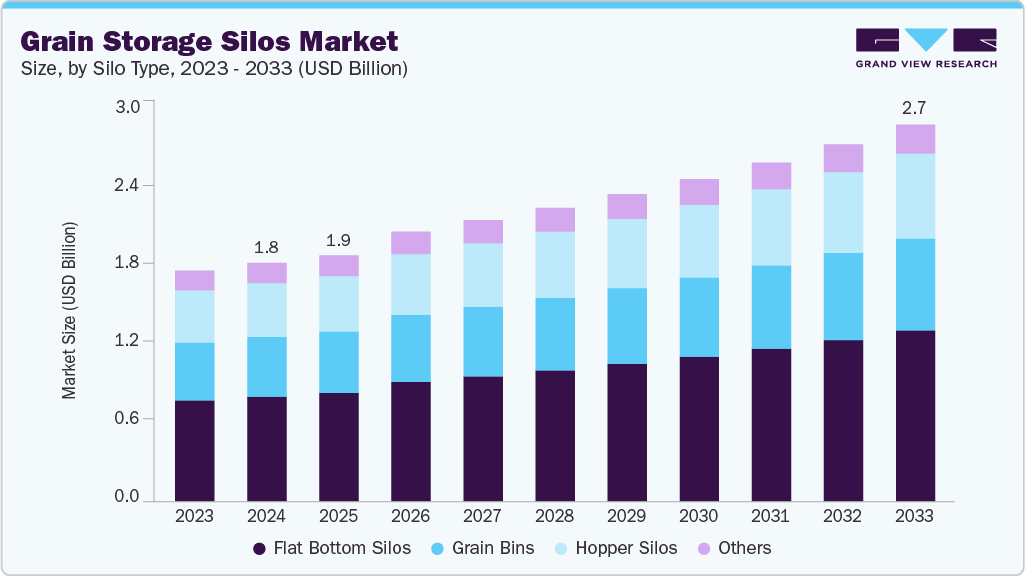 To learn more about this report, Download Free Sample Report
 Market Dynamics
The grain storage silos market is experiencing steady growth due to the increasing global demand for food grains, rising agricultural production, and the need to minimize post-harvest losses. Growing concerns about food security, coupled with expanding grain trade, are encouraging farmers, cooperatives, and agribusiness companies to invest in advanced grain storage infrastructure. The adoption of modern silos equipped with aeration, temperature monitoring, and automated handling systems is improving grain preservation and operational efficiency. Additionally, government initiatives supporting agricultural modernization, strategic grain reserves, and rural infrastructure development are further contributing to market expansion across both developed and emerging economies.
The continuous increase in global grain production is one of the primary factors driving demand for grain storage silos. Population growth, changing dietary patterns, and rising consumption of cereals, animal feed, and biofuel feedstocks are encouraging farmers and agricultural enterprises to maximize crop yields. As grain output rises, the need for efficient storage solutions becomes critical to ensure product quality and maintain supply chain stability. Grain storage silos provide controlled environments that protect harvested crops from moisture, pests, fungal contamination, and adverse weather conditions, thereby preserving grain quality for longer periods.
In many agricultural economies, post-harvest losses remain a significant challenge due to inadequate storage infrastructure. Governments and private stakeholders are increasingly investing in modern silo systems to strengthen food security and improve agricultural productivity. Large-scale grain handling facilities, strategic reserves, and commercial storage terminals are being developed to accommodate growing harvest volumes and facilitate efficient grain distribution. The ability of modern silos to reduce spoilage, enhance inventory management, and support year-round grain availability is accelerating their adoption across farming, processing, and export sectors.
The high capital expenditure associated with the installation of grain storage silos remains a key restraint for market growth. The construction of silo facilities entails substantial costs for land acquisition, civil works, steel structures, material-handling equipment, automation systems, and maintenance infrastructure. Small and medium-scale farmers, particularly in developing regions, often face financial constraints that limit their ability to invest in advanced storage solutions. Additionally, the requirements for a reliable power supply, transportation connectivity, and technical expertise further increase operational complexity. These factors can delay project implementation and restrict the widespread adoption of modern grain storage silos in cost-sensitive agricultural markets.
The increasing integration of digital technologies into agricultural operations presents a significant growth opportunity for the grain storage silos market. Operators are increasingly adopting smart silo systems equipped with Internet of Things (IoT) sensors, automated aeration controls, temperature and humidity monitoring, remote surveillance, and predictive maintenance capabilities. These technologies enable real-time grain condition monitoring, reduce storage losses, improve operational efficiency, and optimize inventory management. As large-scale farms, grain cooperatives, and commercial storage operators focus on data-driven decision-making and automation, demand for technologically advanced silo solutions is expected to rise.
Market Concentration & Characteristics
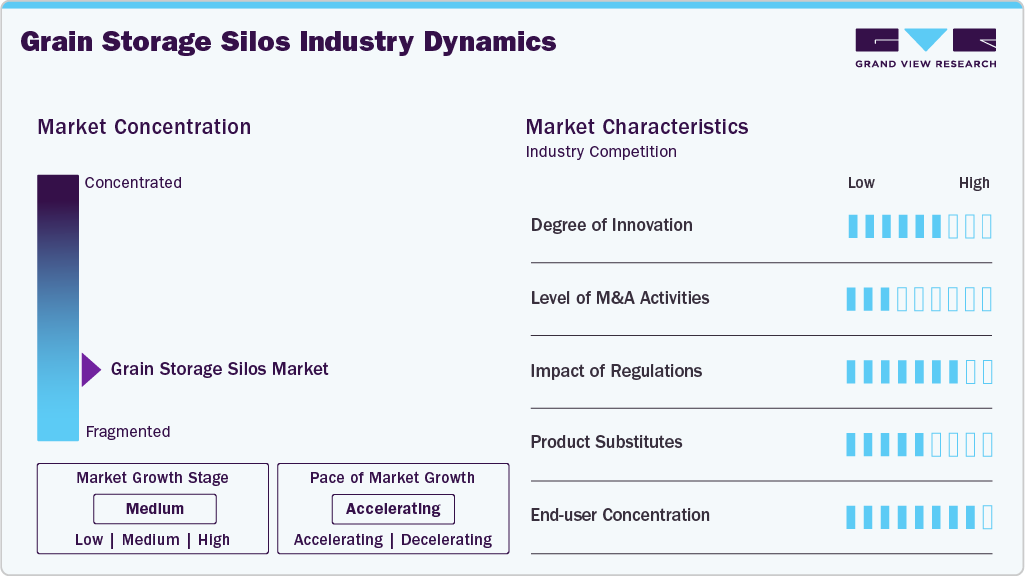
The global grain storage silos market exhibits a moderately fragmented structure. The market is currently in a medium-growth stage with accelerating momentum, reflecting rising demand for storage solutions driven by agricultural expansion, modernization efforts, and infrastructure investments.
The market demonstrates a high degree of innovation, with companies adopting advanced silo designs, automation, and monitoring systems. M&A activity is moderate, indicating selective consolidation and strategic partnerships to expand capacity and technological capabilities. Regulatory impacts are also notable, shaping design standards and operational safety requirements. Substitutes for product offerings remain limited, as modern silos are increasingly critical for preserving grain quality. End-user concentration is moderately high, with large commercial operators, port terminals, and industrial grain processors representing key buyers, while smaller on-farm users rely on modular or localized solutions.
 To learn more about this report, Download Free Sample Report
 Moreover, the competitive landscape of the global grain storage silos market is influenced by regional dynamics and supply chain efficiencies. Companies with strong distribution networks and localized manufacturing capabilities are better positioned to respond to fluctuating agricultural outputs and seasonal demand. Investment in digital solutions, such as predictive maintenance and IoT-enabled monitoring, further differentiates market players, allowing them to offer value-added services that enhance operational efficiency. This focus on technology, coupled with strategic collaborations and selective expansions, continues to shape market positioning and long-term growth prospects.
Analyst Perspective
The grain storage silos market is poised for steady growth, driven by increasing global grain production, rising food security concerns, and the need to reduce post-harvest losses across agricultural value chains. Demand is being supported by government investments in modern storage infrastructure, particularly in emerging economies where storage capacity gaps remain significant. Large-capacity steel silos are gaining traction due to their ability to improve grain preservation, automate handling operations, and enhance supply chain efficiency. Additionally, the growing commercialization of agriculture, expansion of grain processing facilities, and increasing focus on strategic grain reserves are expected to accelerate silo deployments worldwide. Asia Pacific is expected to remain a key growth engine, supported by agricultural modernization initiatives and expanding storage infrastructure investments.
Drivers, Opportunities & Restraints
Government initiatives and policy frameworks promoting food security, agricultural modernization, and infrastructure development are also stimulating market growth. Many countries are investing in expanding storage capacity, upgrading existing facilities, and incentivizing private sector participation through public-private partnerships. These measures not only strengthen national food reserves but also enhance the efficiency and sustainability of grain storage operations.
Significant growth opportunities exist in the global grain storage silos market, driven by rising global food demand and the need for efficient post-harvest storage solutions. Expanding agricultural mechanization and modernization programs in emerging economies create a strong demand for technologically advanced silos, including automated and IoT-enabled systems.
High initial capital investment and operational costs for large-scale silo installations can be prohibitive, particularly for small- and medium-sized agricultural operators. Additionally, the market is sensitive to fluctuations in raw material prices, including steel and other construction materials, which can affect project feasibility. Environmental concerns and stringent regulatory requirements for safety, emissions, and storage practices also pose compliance challenges, while limited awareness or adoption of advanced storage technologies in certain regions slows overall market penetration.
Silo Type Insights
Based on silo type, the flat-bottom silos segment led the market with the largest revenue share of 44.1% in 2025. This is attributable to their suitability for large-scale storage and the versatility in handling multiple grain types. These silos are preferred by both commercial operators and large farms because they allow efficient unloading through conveyors and augers. Their modular construction and high durability make them a cost-effective choice for regions with high grain production.
The hopper silos segment’s growth is supported by their rising adoption for short-term storage and easy grain discharge. Hopper silos offer advantages such as natural grain flow, reduced need for mechanical unloading equipment, and lower maintenance costs, making them highly suitable for smaller farms, seed storage, and facilities with frequent inventory turnover. In addition, hopper silos are increasingly preferred in developing markets where farmers and cooperatives seek cost-effective, flexible storage options.
Storage Capacity Insights
Based on storage capacity, the 1,000 to 5,000 tons segment led the market with the largest revenue share of 41.4% in 2025, driven by the growing demand for medium-scale storage solutions among commercial farms, feed mills, and regional grain processors. The silos in this capacity range are often compatible with semi-automatic and automatic handling systems, enabling better grain quality management, reducing post-harvest losses, and supporting efficient supply chain operations, thereby reinforcing their market dominance.
The demand for grain storage silos above 5,000 tons is driven by the increasing need for large-scale storage solutions in commercial farming and grain trading operations. As global grain production continues to rise, particularly in emerging economies, large silos are becoming essential for handling bulk harvests efficiently and reducing post-harvest losses. The ability of these silos to lower per-unit storage costs and support advanced automation and monitoring technologies further strengthens their adoption, justifying the robust growth outlook.
Material Insights
Based on material, the steel segment led the market with the largest revenue share of 67.3% in 2025. Steel silos, offering high durability, structural strength, and cost-effectiveness, are widely preferred for both large-scale commercial and on-farm storage, as they can withstand harsh environmental conditions and provide a long service life with minimal maintenance.
Aluminum silos are gaining traction as end users increasingly value their corrosion resistance, lightweight construction, and ease of installation. These features make them especially suitable for regions with high humidity or coastal climates where steel structures are prone to faster wear. Their long service life, lower maintenance requirements, and recyclability also align with the industry’s shift toward sustainable and cost-efficient storage solutions. As a result, adoption is expected to expand steadily over the forecast period, supporting healthy revenue growth for this material type.
End Use Insights
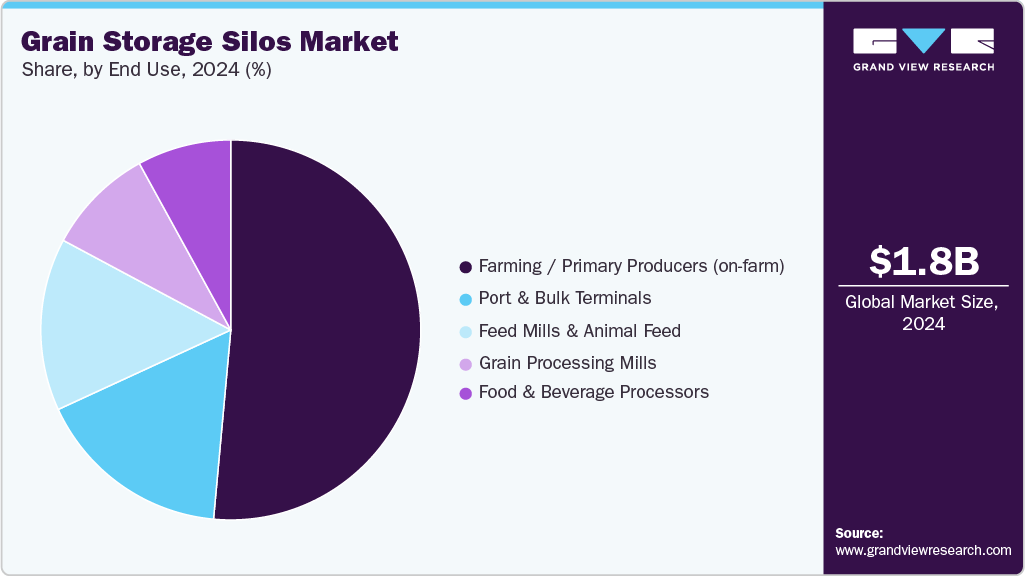
Based on end use, the farming/primary producers (on-farm) segment led the market, with the largest revenue share of 51.5% in 2025. This is attributable to the growing need for self-sufficient grain storage at the farm level. Farmers increasingly invest in silos to reduce post-harvest losses, maintain grain quality, and manage supply for both domestic use and commercial sales.
 To learn more about this report, Download Free Sample Report
 The port & bulk terminals segment is expanding due to the rising volume of international grain trade, necessitating efficient bulk-handling and storage infrastructure at ports. Large-capacity silos at terminals enable quicker loading and unloading, reduced turnaround times, and better preservation of grain quality during transit. Furthermore, increasing investments in port modernization and logistics hubs across emerging economies are driving demand for silo installations at bulk terminals.
Operation Type Insights
Based on operation type, the semi-automatic segment led the market with the largest revenue share of 41.0% in 2025. Semi-automatic silos offer an optimal balance between cost and operational efficiency and allow users to reduce manual labor while benefiting from partial automation in grain handling, aeration, and monitoring, making them ideal for medium- and large-scale farms, feed mills, and food processors. The widespread adoption of semi-automatic systems is also supported by their compatibility with modular steel and aluminum silos, ease of installation, and ability to maintain grain quality and reduce post-harvest losses.
Automation in grain storage silos is becoming increasingly attractive as operators seek to minimize labor dependency and improve operational efficiency. Features such as automated grain loading, aeration, temperature monitoring, and discharge systems help reduce spoilage and optimize inventory management, making them highly valuable for large-scale storage facilities. Rising labor costs, the need for precision in bulk handling, and growing adoption of digital technologies in agriculture are further accelerating the shift toward automated systems.
Regional Insights
The North America grain storage silos market is expected to expand at a CAGR of 4.0% over the forecast period, driven by fluctuations in staple crop production, which create a consistent need for reliable on-farm and commercial storage solutions to safeguard grain quality and reduce post-harvest losses. Expanding operations at elevators, feed mills, and port terminals further strengthen demand for high-capacity silos that support bulk handling for exports and domestic supply chains. The grain storage silos market in Mexico is expanding in line with the country’s rising corn production and the need to balance domestic supply with import requirements for wheat, rice, and sorghum. Increasing demand for staple grains in food and feed applications is driving farmers, cooperatives, and commercial operators to invest in reliable storage infrastructure to prevent post-harvest losses and ensure year-round availability.
U.S. Grain Storage Silos Market Trends
The U.S. grain storage silos market is strongly influenced by fluctuations in corn planting, with acreage shifts directly impacting production volumes and storage needs. Rising output drives investments in additional on-farm and commercial silos to manage larger harvests and reduce post-harvest losses, while even in years of contraction, reliable storage remains vital to preserve grain quality.
Asia Pacific Grain Storage Silos Market Trends
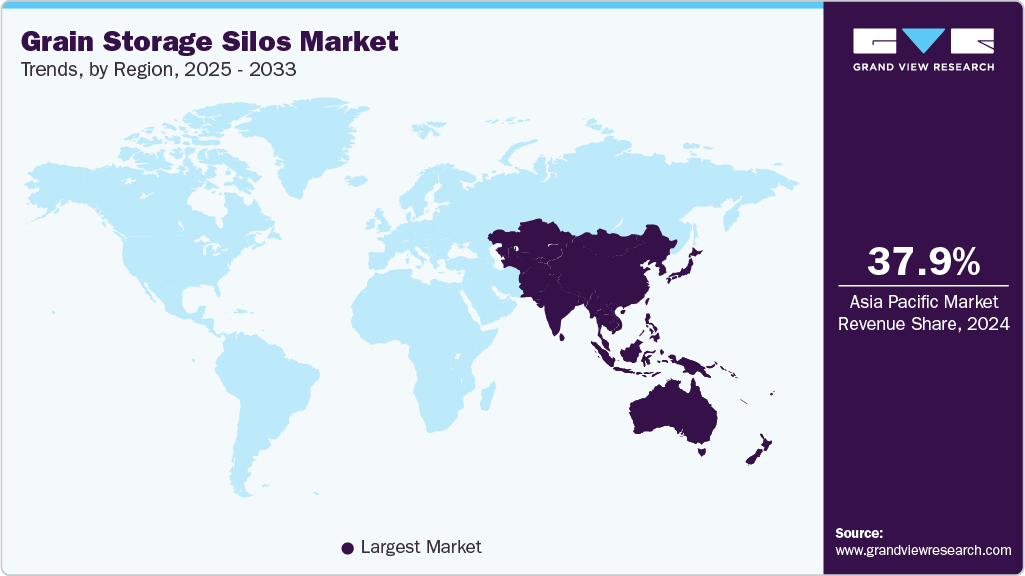
Asia Pacific dominated the grain storage silos market with the largest revenue share of 38.2% in 2025. This is significantly attributed to the region’s large-scale agricultural production and rapidly growing grain consumption. Countries such as China, India, and Australia are investing heavily in both on-farm and commercial storage infrastructure to manage rising production and reduce post-harvest losses. The India grain storage silos market is undergoing rapid expansion, driven by the government’s “World’s Largest Grain Storage Plan in Cooperative Sector,” which aims to add 70 million tonnes of capacity over five years. This initiative addresses a significant storage shortfall, reduces post-harvest losses, strengthens food security, and enables farmers to achieve better prices for their crops by replacing open-air storage with modern silo-based systems.
 To learn more about this report, Download Free Sample Report
 China Grain Storage Silos Market Trends
The grain storage silos market in the China held the largest share in the Asia Pacific region in 2025. Substantial investments during the 14th Five-Year Plan have added millions of tonnes of storage capacity, while outdated storage methods have been replaced with mechanized, monitored, and climate-controlled facilities.
Europe Grain Storage Silos Market Trends
Europe’s grain storage silos market is expanding as producers in countries like Germany, the UK, France, Italy, and Spain invest in modern infrastructure to safeguard harvest quality, reduce losses, and support both domestic consumption and exports. Climate variability and rising harvest volumes are driving the adoption of advanced silos equipped with aeration, temperature control, and automated handling to maintain nutritional value and ensure supply chain stability.
The Germany grain storage silos market remains strong, driven by the need to manage large and variable harvests under challenging weather conditions, including droughts and heavy rains. Efficient storage systems, ranging from on-farm silos to large commercial facilities, are essential for preserving grain quality through controlled aeration, moisture management, and temperature monitoring. Modern infrastructure also helps mitigate climate-related risks, support consistent supply chains, and optimize post-harvest handling, with automated and semi-automated systems increasingly adopted by larger operations.
The Spain grain storage silos market has grown rapidly due to agricultural modernization, privatization of the former state-run network, and the need to reduce post-harvest losses under hot, dry conditions. Investments in galvanized steel silos with automated aeration and real-time monitoring help safeguard grain quality and comply with EU standards.
Middle East & Africa Grain Storage Silos Market Trends
The grain storage silos market in the Middle East and Africa is expanding steadily, driven by population growth, reliance on grain imports, and the need to strengthen food security. Harsh environmental conditions in the region make modern silos essential for maintaining strategic reserves and stabilizing supply, while large-scale facilities near ports enhance handling, processing, and re-export capabilities.
Saudi Arabia is strengthening its grain storage infrastructure to enhance food security, supply chain resilience, and agricultural self-sufficiency, addressing climate constraints and reliance on imports. The establishment of SABIL under SALIC centralizes management of strategic reserves and logistics, while multiple silo branches and modern facilities improve operational efficiency.
Latin America Grain Storage Silos Market Trends
The grain storage silos market in Latin America is steadily growing, fueled by rising agricultural production and increasing export demands, particularly for soybeans, corn, and wheat. Expanding harvest volumes and overlapping crop cycles are creating logistical pressures, highlighting the need for modern, efficient storage and handling solutions.
Brazil’s grain sector is experiencing significant growth, driven by strong production of soybeans, corn, and rice supported by expanded cultivation and improved farming practices. This growth is placing pressure on existing storage infrastructure, with overlapping harvests, increased drying needs, and competition from ethanol production, highlighting the need for efficient silos and handling facilities.
Key Grain Storage Silos Company Insights
Some of the key players operating in the market include AGI and Mysilo
-
AGI designs and manufactures equipment for grain storage, handling, and conditioning. Their product line includes grain bins, augers, and dryers. AGI’s innovative solutions support efficient grain management for farms and commercial facilities worldwide, with a commitment to quality, durability, and advanced technology.
-
Mysilo specializes in grain storage solutions, including steel silos and related equipment. They focus on providing safe and reliable storage options that maintain grain quality and protect against environmental factors. Mysilo’s products serve farmers and grain storage facilities that require efficient, long-term handling and storage systems.
Key Grain Storage Silos Companies:
The following key companies have been profiled for this study on the grain storage silos market.
-
Ecosphere India Pvt. Ltd
-
Silos Córdoba
-
PRADO SILOS
-
Hoffmann, Inc.
-
Symaga S.A.U.
-
Silos Metálicos Zaragoza S.L.U. (SIMEZA)
-
Bentall Rowlands Silo Storage Ltd
-
Mysilo
-
Sukup Manufacturing Co.
-
CST Industries
-
Sioux Steel Company
-
Chief Agri/Industrial Group
-
Grain & Protein Technologies
-
Brock Grain Systems
-
Ag Growth International Inc. (AGI)
Competitive Benchmarking
Category
Operating Strategies
Competitive Edge
Weakness
Established Players (e.g., Ag Growth International Inc. (AGI), CST Industries, Sukup Manufacturing Co., Brock Grain Systems, Chief Agri/Industrial Group, Grain & Protein Technologies)
Focus on providing integrated grain storage, handling, and processing solutions through comprehensive product portfolios.
Invest heavily in automation, digital monitoring, and global expansion through acquisitions and strategic partnerships.
Strong global brand presence supported by extensive distribution and after-sales service networks.
Advanced engineering expertise, large manufacturing capacities, and the ability to execute large-scale projects.
Higher capital and operating costs compared to regional competitors.
Greater dependence on agricultural investment cycles and large infrastructure spending.
Emerging & Regional Players (e.g., Symaga S.A.U., Silos Córdoba, Mysilo, Bentall Rowlands Silo Storage Ltd, Ecosphere India Pvt. Ltd., Hoffmann, Inc.)
Emphasize customized and cost-effective silo solutions tailored to regional market requirements.
Expand market share through local partnerships, export activities, and specialized product offerings.
Greater flexibility in project execution and faster response to customer-specific requirements.
Strong regional market knowledge and competitive pricing strategies.
Limited international presence and smaller distribution networks.
Lower financial resources for large-scale R&D, automation development, and capacity expansion.
Recent Developments
-
In February 2026, Chief Agri partnered with Nebraska-based RealmFive to introduce Chief Red Connect Smart Bin technology, integrating CO₂ monitoring, odor sensing, inventory visibility, and automated aeration controls into grain-storage systems. The solution is designed to identify grain quality and spoilage risks earlier, automate aeration based on storage conditions, and enable remote monitoring and control, thereby strengthening Chief Agri's smart grain storage capabilities.
-
In September 2025, AGI partnered with Live to Farm and RIPCO Systems to showcase the realities of farming in a televised series. Together, they built a new AGI grain bin on a farm, featuring AGI’s BinManager technology and highlighting advanced grain storage and management solutions in real-world agricultural settings.
Grain Storage Silos Market Report Scope
Report Attribute
Details
Market size value in 2025
USD 1.8 billion
Market size value in 2026
USD 1.9 billion
Revenue forecast in 2033
USD 2.7 billion
Growth rate
CAGR of 4.9% from 2026 to 2033
Base year for estimation
2025
Historical data
2021 - 2024
Forecast period
2026 - 2033
Quantitative units
Revenue in USD million and CAGR from 2026 to 2033
Report coverage
Revenue forecast, company ranking, competitive landscape, growth factors, and trends
Segments covered
Silo type, storage capacity, material, end use, operation type, region
Regional scope
North America; Europe; Asia Pacific; Latin America; Middle East & Africa
Country scope
U.S.; Canada; Mexico; UK; Germany; France; Spain; Italy; China; Japan; India ; South Korea; Australia; Brazil; Argentina; Saudi Arabia; UAE; South Africa
Key companies profiled
Ecosphere India Pvt. Ltd; Silos Córdoba; PRADO SILOS; Hoffmann, Inc.; Symaga S.A.U.; Silos Metálicos Zaragoza S.L.U. (SIMEZA); Bentall Rowlands Silo Storage Ltd; Mysilo; Sukup Manufacturing Co.; CST Industries; Sioux Steel Company; Chief Agri/Industrial Group; Grain & Protein Technologies; Brock Grain Systems; Ag Growth International Inc. (AGI)
Customization scope
Free report customization (equivalent up to 8 analysts' working days) with purchase. Addition or alteration to country, regional & segment scope.
Pricing and purchase options
Avail customized purchase options to meet your exact research needs. Explore purchase options
Global Grain Storage Silos Market Report Segmentation
This report forecasts revenue growth at the global, regional, and country levels and provides an analysis of the latest industry trends across sub-segments from 2021 to 2033. For this study, Grand View Research has segmented the global grain storage silos market report based on silo type, capacity, material, end use, operation type, and region:
-
Silo Type Outlook (Revenue, USD Million; 2021 - 2033)
-
Flat Bottom Silos
-
Hopper Silos
-
Grain Bins
-
Others
-
-
Storage Capacity Outlook (Revenue, USD Million; 2021 - 2033)
-
Up to 1,000 tons
-
1,000 to 5,000 tons
-
Above 5,000 tons
-
-
Material Outlook (Revenue, USD Million; 2021 - 2033)
-
Steel
-
Aluminum
-
Wood
-
Others
-
-
End Use Outlook (Revenue, USD Million; 2021 - 2033)
-
Farming / Primary Producers (on-farm)
-
Feed Mills & Animal Feed
-
Grain Processing Mills
-
Port & Bulk Terminals
-
Food & Beverage Processors
-
-
Operation Type Outlook (Revenue, USD Million; 2021 - 2033)
-
Manual
-
Semi-Automatic
-
Automatic
-
-
Regional Outlook (Revenue, USD Million, 2021 - 2033)
-
North America
-
U.S.
-
Canada
-
Mexico
-
-
Europe
-
Germany
-
UK
-
France
-
Italy
-
Spain
-
-
Asia Pacific
-
China
-
India
-
Japan
-
Australia
-
South Korea
-
-
Latin America
-
Brazil
-
Argentina
-
-
Middle East and Africa
-
Saudi Arabia
-
UAE
-
South Africa
-
-
Research Methodology
Segment Definition
Silo Type
Revenue Capture Definition
Flat Bottom Silos
Revenue generated from the sale of flat-bottom silos designed for long-term storage of large grain volumes in commercial grain handling facilities, processing plants, and bulk storage terminals.
Hopper Silos
Revenue derived from hopper-bottom silos used for efficient grain storage and gravity-assisted discharge in farms, feed mills, seed storage facilities, and commercial grain operations.
Grain Bins
Revenue generated from grain bins utilized for on-farm and small-scale commercial grain storage, including associated aeration, drying, monitoring, and unloading systems.
Others
Revenue generated from concrete tower silos, subterranean underground silos, modular prefabricated composite silos, bulk storage domes, and other customized grain storage structures designed for specialized agricultural, industrial, or strategic storage applications.
Storage Capacity
Revenue Capture Definition
Up to 1,000 tons
Revenue generated from grain storage systems with capacities of up to 1,000 tons, primarily serving small farms, local grain collection centers, and agricultural cooperatives.
1,000 to 5,000 tons
Revenue derived from medium-capacity grain storage silos used by commercial farms, regional grain aggregators, feed producers, and processing facilities.
Above 5,000 tons
Revenue generated from large-capacity silo installations utilized by grain traders, government grain reserve agencies, export terminals, and large-scale grain processors.
Material
Revenue Capture Definition
Steel
Revenue generated from grain storage silos manufactured using galvanized steel, stainless steel, and related steel components.
Aluminum
Revenue derived from aluminum-based grain storage structures that offer lightweight construction, corrosion resistance, and durability for specific storage applications.
Wood
Revenue generated from wooden grain storage bins and structures used in niche agricultural applications and smaller-scale storage operations.
Others
Revenue generated from grain storage silos and storage systems constructed using reinforced or precast concrete, fiberglass and composite materials, polymer-based modular systems, and hybrid constructions that combine multiple materials to enhance durability, insulation, or storage performance.
End Use
Revenue Capture Definition
Farming / Primary Producers (on farm)
Revenue generated from grain storage silos installed and operated by farmers and agricultural producers for preserving harvested crops and managing farm inventories.
Feed Mills & Animal Feed
Revenue derived from storage silos used for handling grains, feedstock, and feed ingredients within animal feed manufacturing and livestock production facilities.
Grain Processing Mills
Revenue generated from grain storage infrastructure deployed in flour mills, rice mills, oilseed processors, corn processing plants, and other grain processing facilities.
Port & Bulk Terminals
Revenue derived from large-scale grain storage silos installed at ports, export hubs, inland terminals, and bulk handling facilities for logistics and trade operations.
Food & Beverage Processors
Revenue generated from grain storage systems used by food and beverage manufacturers to store raw agricultural inputs prior to processing and production activities.
Operation Type
Revenue Capture Definition
Manual
Revenue generated from manually operated grain storage silos that require direct human intervention for loading, unloading, monitoring, and grain management functions.
Semi-Automatic
Revenue derived from grain storage silos incorporating a combination of manual operations and automated features such as aeration control, grain movement systems, and environmental monitoring.
Automatic
Revenue generated from fully automated grain storage silos equipped with integrated control systems, IoT-based monitoring, automated grain handling, environmental management, and inventory tracking technologies.
Estimation Model
Grain Production & Storage Need Layer
Silo Adoption & Infrastructure Layer
Equipment Demand Layer
Revenue Layer
Who potentially requires grain storage infrastructure?
The estimation begins by analyzing global grain production volumes across key crops such as wheat, corn, rice, soybeans, and barley. Farmers, cooperatives, grain traders, and government reserve agencies form the primary demand base requiring efficient storage solutions to preserve grain quality and reduce post-harvest losses.Which facilities utilize grain storage silos?
The potential storage demand is refined by evaluating the adoption of grain silos across farms, feed mills, grain processing facilities, food manufacturers, and port terminals. Regions with advanced agricultural infrastructure and large-scale commercial farming typically exhibit higher silo penetration rates and storage capacity requirements.Who actively purchases and expands silo systems?
Annual demand is estimated based on new silo installations, storage capacity expansions, replacement of aging infrastructure, and modernization projects. Increasing grain production, food security initiatives, and investments in automated storage technologies are key factors influencing equipment demand.How much market revenue is generated?
Market revenue is calculated by aggregating sales generated from silo systems, storage infrastructure, automation technologies, installation services, and maintenance activities. Revenue contributions are assessed across different silo types, capacities, materials, and end-use industries to determine the overall market size.Delivered Customizations
This report has been delivered with the following In-depth customizations
Client Request
Customization Delivered
Value Adds
Growth Opportunity Assessment
Conducted a comprehensive assessment of market growth opportunities across key geographies, storage capacities, silo types, and end-user industries.
Enabled stakeholders to identify high-growth market segments, prioritize investment opportunities, and align expansion strategies with evolving industry demand and regional growth potential.
Competitive & Technology Landscape
Developed a detailed evaluation of the competitive environment, covering leading global manufacturers, regional participants, technological advancements, and automation trends. The study assessed strategic initiatives such as product innovation, smart silo integration, capacity expansion, and international market penetration to understand how companies are strengthening their market positions.
Provided valuable benchmarking insights, highlighted competitive differentiators, and helped stakeholders understand evolving technology trends that are shaping future market competitiveness.
Strategic Market Intelligence & Industry Outlook
Analyzed the broader industry ecosystem, including agricultural output trends, global grain trade dynamics, government support programs, storage infrastructure investments, and sustainability considerations. The assessment also examined key market drivers, restraints, opportunities, and potential risks influencing long-term industry development and adoption of grain storage solutions.
Supported informed decision-making by providing a forward-looking view of market evolution, helping stakeholders anticipate industry shifts, mitigate risks, and develop sustainable long-term growth strategies.
Frequently Asked Questions About This Report
Some of the key players operating in the grain storage silos market include Ecosphere India Pvt. Ltd, Silos Córdoba, PRADO SILOS, Hoffmann, Inc., Symaga S.A.U., Silos Metálicos Zaragoza S.L.U. (SIMEZA), Bentall Rowlands Silo Storage Ltd, Mysilo, Sukup Manufacturing Co., CST Industries, Sioux Steel Company, Chief Agri/Industrial Group, Grain & Protein Technologies, Brock Grain Systems, and Ag Growth International Inc. (AGI).
The global grain storage silos market size was estimated at USD 1.8 billion in 2025 and is expected to be USD 1.9 billion in 2026.
The global grain storage silos market, in terms of revenue, is expected to grow at a compound annual growth rate of 4.9% from 2026 to 2033 to reach USD 2.7 billion by 2033.
Key factors driving the grain storage silos market include increasing global food demand, agricultural modernization, and the need for efficient post-harvest storage. Rising adoption of advanced silo technologies and automated systems also supports market growth.
The Asia Pacific market dominated the global market in 2025 holding 38.2% of the revenue share, driven by rapid agricultural expansion, government modernization initiatives, and rising demand for efficient post-harvest storage solutions. Increasing adoption of advanced silo technologies and mechanized farming practices further supports market expansion across the region.
Asia Pacific is anticipated to be one of the fastest-growing regional markets over the forecast period, driven by agricultural modernization initiatives, rising food security concerns, and increasing storage infrastructure investments.
The flat bottom silos segment led the market with the largest revenue share of 44.1% in 2025.
The steel segment led the market with the largest revenue share of 67.3% in 2025, owing to its durability, strength, and suitability for large-scale grain storage applications.
The farming / primary producers (on farm) segment accounted for the largest revenue share of 51.5% in 2025.
About the Author(s)
Advanced Interior Materials Research Team
Advanced Materials · Advanced Interior MaterialsThis report was authored by the advanced interior materials research team at Grand View Research - comprising two research analysts, one senior research analyst, and one industry expert - with specialized expertise in the advanced interior materials segment of the advanced materials industry. All findings are based on proprietary advanced materials databases, executive interviews, and regulatory analysis, subject to internal peer review prior to publication.
Last Updated:
Speak to Analyst

Customize this report to your needs - add regions, segments, or data points, with 20% free customization.
Or view our licence options:


ISO 9001:2015 & 27001:2022 Certified
We are GDPR and CCPA compliant! Your transaction & personal information is safe and secure. For more details, please read our privacy policy.


