
- Home
- »
- IT Services & Applications
- »
-
Grant Management Software Market Size Report, 2026-2033GVR Report cover

Grant Management Software Market (2026 - 2033)
Size, Share & Trends Analysis Report By Component (Solution, Services), By Deployment Mode, By Function (Application Tracking, Collaboration), By Platform, By Organization, By End-use, By Region, And Segment Forecasts
Market Size, 2025
$2.9BMarket Estimate, 2026
$3.1BMarket Forecast, 2033
$6.2BCAGR, 2026–2033
10.2%Grant Management Software Market Summary
The global grant management software market size was valued at USD 2.9 billion in 2025 and is projected to grow from USD 3.1 billion in 2026 to USD 6.2 billion by 2033, at a CAGR of 10.2% from 2026 to 2033. The market in North America dominated with a revenue share of 34.4% in 2025. This growth is driven by increasing government digitization initiatives, expanding nonprofit funding programs, and rising adoption of cloud-based grant management platforms.
 Source: Grand View Research, IR Documents, Primary Interviews, Paid DatabasesTo learn more about this report,
 Download Free Sample Report
Key Market Trends & Insights
- By component: Solution segment dominated the market, with a revenue share of 60.1% in 2025
- By Function: Application tracking segment dominated the market, with a revenue share of 22.4% in 2025.
- By deployment mode: On-premise segment dominated the market, with a revenue share of 55.7% in 2025
- By platform: Web segment dominated the market, with a revenue share of 57.3% in 2025
- By end-use: Educational institutes segment held the largest revenue share in 2025
Regional Highlights
- Largest regional market: North America (34.4% revenue share, 2025)
- Fastest-growing regional market: Asia Pacific (highest CAGR, 2026-2033)
- By country: The U.S. held the largest market share in 2025.
Market Size & Forecast
- Market size in 2025: USD 2.9 Billion
- Estimated market size in 2026: USD 3.1 Billion
- Projected market size by 2033: USD 6.2 Billion
- CAGR (2026-2033): 10.2%
Three ways to get this report
Buy it, customize it, or ask a question.Ask an Analyst
Analyst response in 1 business day
- AccessReport author, directly
- Reply timeWithin 1 working day
- No sales callDirect answer only
- FormatEmail reply
- CostFree, no cost
Get the Full Report
What the study covers
- FormatsPDF · Excel · Dashboard
- Timeline2026–2033 annual, 2025 base
- Coverage20+ countries, 5 regions
- Companies10+ key players profiled
Customize the Report
20% free customization
- IncludeCountries, segments, points
- TailorTo your product definition
- ExtendDeeper competitor detail
- OrA fully bespoke study
- Turnaround5–10 working days
Grant management software provides a centralized system that ensures documentation, audit trails, and financial reporting are accurate and easily accessible. This feature is especially critical for nonprofits and educational institutions that must comply with strict donor or government regulations.
The ongoing digital transformation trend across nonprofit organizations, universities, research institutions, and public agencies is also a significant driver. These entities are seeking to replace manual, spreadsheet-based processes with automated, cloud-based solutions. Grant management software helps reduce administrative burden, improve collaboration between stakeholders, and enhance data-driven decision-making, leading to increased operational efficiency.
 To learn more about this report, Download Free Sample Report
The shift toward cloud-based grant management solutions is accelerating due to their scalability, lower upfront costs, and remote accessibility. Cloud-based platforms also offer easier integration with other enterprise systems like finance, HR, and CRM tools, enabling seamless workflows and data sharing. This flexibility is attractive to both large and small organizations looking for tailored and scalable grant management ecosystems. For instance, in July 2024, Euna Solutions, a U.S.-based provider of cloud solutions for the public sector, joined the AWS Partner Network as a Public Sector Partner.
The adoption of AI-driven automation and predictive analytics is expected to improve the efficiency of grant management by handling repetitive tasks, enhancing decision-making, and delivering real-time insights into funding outcomes. Tools such as AI chatbots and virtual assistants will simplify communication with applicants, easing the administrative load. Moreover, blockchain technology is poised to boost transparency and security in grant processes by creating tamper-proof transaction records, reducing fraud, and strengthening accountability. The growing use of cloud-based, mobile-first platforms will further support remote collaboration and ensure accessible, cross-device functionality for a distributed workforce.
Market Dynamics
The global grant management software market is experiencing strong growth as governments, nonprofit organizations, educational institutions, healthcare organizations, foundations, and corporate social responsibility (CSR) programs increasingly adopt digital platforms to streamline grant administration and improve funding transparency. Grant management software enables organizations to automate the entire grant lifecycle, including grant discovery, application management, proposal evaluation, budgeting, award distribution, compliance monitoring, reporting, and performance tracking. Modern grant management platforms leverage artificial intelligence (AI), machine learning (ML), workflow automation, cloud computing, data analytics, document management, and configurable dashboards to improve operational efficiency, ensure regulatory compliance, reduce administrative burden, and enhance collaboration among grantmakers and applicants.
The increasing digitalization of grant administration, coupled with the growing need for transparent and efficient funding management, is a significant driver of the global grant management software market. Governments, nonprofit organizations, research institutions, universities, healthcare agencies, and philanthropic foundations are replacing manual, paper-based grant processes with centralized digital platforms to improve application processing, automate workflows, enhance collaboration, and ensure regulatory compliance. The growing volume of grants, increasing reporting requirements, and demand for real-time visibility into funding utilization are driving organizations to adopt cloud-based grant management software that supports automated application reviews, document management, budget tracking, compliance monitoring, and impact measurement. AI-enabled capabilities such as intelligent application screening, document classification, predictive analytics, and automated reporting further improve decision-making while reducing administrative workloads. For instance, in March 2026, Benevity introduced AI-powered Grant Summaries and Grant Application Management capabilities to automate grant reviews, streamline application management, and improve funding administration across enterprise and nonprofit grant programs.
The complexity of implementing grant management platforms and integrating them with existing enterprise systems remains a significant restraint for the global Grant Management Software Market. Many organizations continue to rely on legacy financial management systems, enterprise resource planning (ERP), customer relationship management (CRM), document repositories, and spreadsheet-based workflows that require extensive customization during software deployment. Migrating historical grant data, configuring workflows, training personnel, and ensuring compliance with diverse funding regulations can increase implementation timelines and overall project costs. Small and medium-sized nonprofit organizations and local government agencies often face budget limitations, limited IT resources, and skill shortages, slowing adoption of advanced grant management solutions. Additionally, concerns regarding data migration, interoperability, cybersecurity, and organizational change management may further delay software modernization initiatives.
The rapid advancement of AI-powered grant lifecycle automation, cloud-native grant management platforms, and data-driven funding governance presents a significant growth opportunity for the global grant management software market. Organizations are increasingly investing in AI, machine learning, natural language processing (NLP), predictive analytics, and workflow automation to automate application screening, eligibility assessment, risk evaluation, compliance monitoring, grant reporting, and impact measurement. Growing adoption of cloud-based grant management solutions is enabling scalable deployments, remote collaboration, seamless integration with financial systems, and lower infrastructure costs. Furthermore, increasing investments in digital government initiatives, outcome-based funding models, ESG programs, research funding, and philanthropic grant making are expanding market opportunities across government agencies, nonprofit organizations, educational institutions, healthcare organizations, and corporate foundations.
Analyst Perspective
The grant management software market is positioned at the intersection of digital government transformation, cloud adoption, and AI-driven funding administration. Governments, nonprofit organizations, educational institutions, healthcare organizations, corporations, and philanthropic foundations are increasingly deploying grant management software to streamline the entire grant lifecycle, improve funding transparency, strengthen regulatory compliance, and enhance collaboration among grantmakers and applicants. Unlike traditional manual or spreadsheet-based grant administration, modern grant management platforms integrate AI, workflow automation, document management, analytics, and cloud-native capabilities to automate application reviews, fund allocation, compliance monitoring, reporting, and performance measurement, enabling organizations to improve operational efficiency, optimize funding outcomes, and support data-driven decision-making.
Component Insights
Based on component, the solution segment led the market with the largest revenue share of 60.1% in 2025. Compliance with evolving government regulations, donor guidelines, and international standards is becoming more complex. Grant recipients and grant-makers face increasing pressure to maintain transparent audit trails and provide detailed reports on fund usage. The solution segment is growing as software providers embed powerful compliance tracking, real-time reporting, audit-ready documentation, and role-based access features into their platforms. These capabilities are crucial in sectors like education, public health, and research, where grant misuse can lead to legal and reputational risks
The services segment is anticipated to grow at a significant CAGR during the forecast period. Many grant-receiving organizations such as smaller nonprofits or academic institutions lack in-house technical expertise to use new software effectively. This has created significant demand for training services that cover system navigation, reporting tools, compliance features, and administrative functions. Vendors are responding with on-site workshops, virtual training programs, and certification modules to improve user adoption and productivity.
Function Insights
Based on function, the application tracking segment led the market with the largest revenue share of 22.4% in 2025. Grant administrators and program managers increasingly require real-time visibility into the application pipeline. Application tracking tools with dashboard analytics and workflow visualization features are helping organizations gain operational clarity, allocate review resources effectively, and shorten approval cycles, thus enhancing the overall efficiency of the grant process.
The reporting segment is expected to grow at a significant CAGR over the forecast period, driven by the growing need for transparency in how grants are used. Donors, funding agencies, and regulatory bodies increasingly require detailed reports outlining how funds were allocated, spent, and what outcomes were achieved. Grant Management Software with robust reporting modules enables grant recipients and administrators to generate accurate, real-time reports that enhance credibility and ensure continued funding, making reporting capabilities a central component in software adoption.
Deployment Insights
Based on deployment mode, the on-premise segment led the market with the largest revenue share of 55.7% in 2025 due to its ability to offer customized features and meet strict regulatory requirements. Government bodies, nonprofits, and large organizations often have unique audit, reporting, and security needs that demand tailored systems. On-premise setups enable full control over workflows, security settings, and compliance with standards like GDPR, HIPAA, and financial regulations. Universities and research institutions also prefer on-premise solutions, valuing their secure data storage, audit trail capabilities, and integration with legacy systems. These features support long-term data retention and regulatory compliance, essential for managing complex and sensitive research funding.
The cloud segment is expected to grow at a significant CAGR over the forecast period. Cloud-based grant management solutions provide real-time, remote access, allowing smooth collaboration between grant managers, funders, and applicants, suitable for organizations with dispersed teams or global programs. These platforms also deliver automatic updates, security enhancements, and new features without relying on internal IT teams, helping organizations stay current with technology and compliance standards while boosting efficiency and minimizing downtime.
Platform Insights
Based on platform, the web segment led the market with the largest revenue share of 57.3% in 2025. Web-based grant management solutions eliminate the need for extensive IT support, hardware installations, or complex updates. Software providers can deploy updates, security patches, and new features directly through the web interface without user-side disruption. For many nonprofits, academic institutions, and public sector organizations operating under tight budgets, this low-maintenance, subscription-based model is both economical and efficient, supporting demand for web platform-based solutions.
The mobile segment is expected to grow at a significant CAGR during the forecast period. NGOs, educational institutions, and small organizations operating in remote or underdeveloped areas often rely heavily on mobile internet connectivity. To support these users, grant management software vendors are developing responsive mobile interfaces and dedicated apps. This rising smartphone penetration, particularly in Asia, Africa, and Latin America, is fueling the adoption of mobile-first grant management software platforms tailored to low-bandwidth environments and multilingual access.
Organization Insights
Based on organization, the large enterprises segment led the market with the largest revenue share of 66.3% in 2025. Large organizations are increasingly adopting AI-powered grant management platforms to improve fund distribution, application review, and fraud prevention. These solutions automate manual tasks, enhance data accuracy, and use predictive analytics to support informed decision-making. Integration with ERP, CRM, and financial systems further streamlines workflows, ensures real-time tracking of funding, and supports regulatory compliance. By combining AI with enterprise system integration, organizations can optimize grant operations, boost transparency, and reduce the risks of fraud and mismanagement.
The SMEs segment is expected to grow at a significant CAGR during the forecast period. SMEs often working within tight budgets benefit from cost-effective and scalable grant management solutions. Cloud-based platforms with subscription-based pricing reduce initial costs and offer flexibility as funding needs evolve. With growing support from government and private grant programs targeting startups and innovative projects, SMEs need efficient tools to manage applications, maintain compliance, and enhance their chances of securing funding through streamlined processes.
End Use Insights
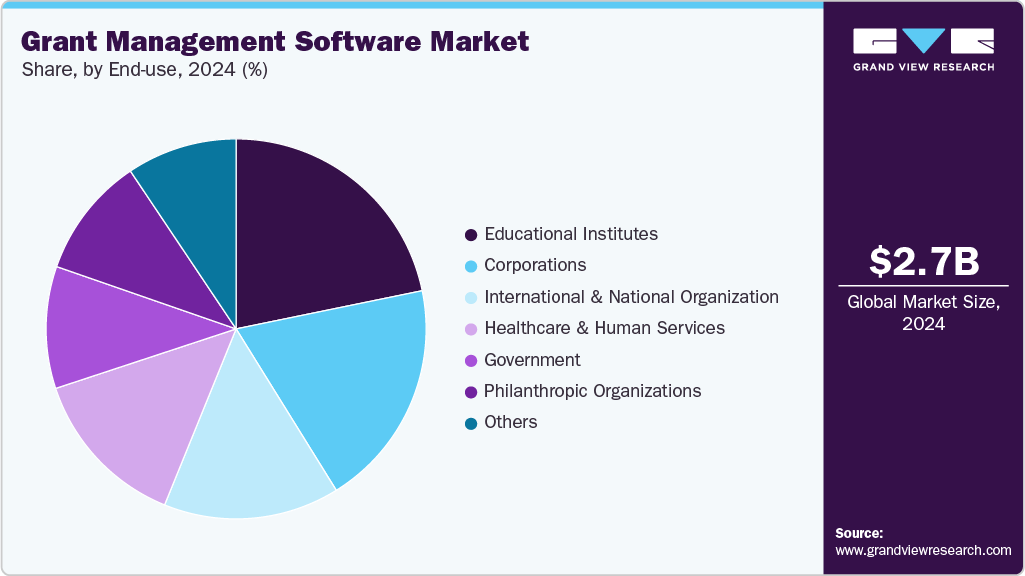
Based on end-use, the educational institutes segment led the market with the largest revenue share of 21.7% in 2025. Educational institutions, particularly universities and research colleges, receive significant funding from government agencies, philanthropic foundations, and private industry for research, scholarships, and innovation programs. As the volume and complexity of these grants increase, managing them through manual systems becomes inefficient and error-prone. This drives the adoption of specialized grant management software that helps institutions streamline application tracking, fund allocation, and compliance reporting.
 To learn more about this report, Download Free Sample Report
The corporations segment is expected to grow at a significant CAGR over the forecast period. Corporations worldwide are expanding their Corporate Social Responsibility (CSR) and Environmental, Social, and Governance (ESG) initiatives, many of which involve grant-making and funding community projects, education programs, and sustainability efforts. As these programs grow in complexity and scale, companies require grant management software to track applications, ensure transparency, and measure the impact of their investments. GMS platforms help corporate foundations and CSR departments automate workflows, standardize application reviews, and improve stakeholder engagement-making them a valuable tool for mission-driven corporate giving
Regional Insights
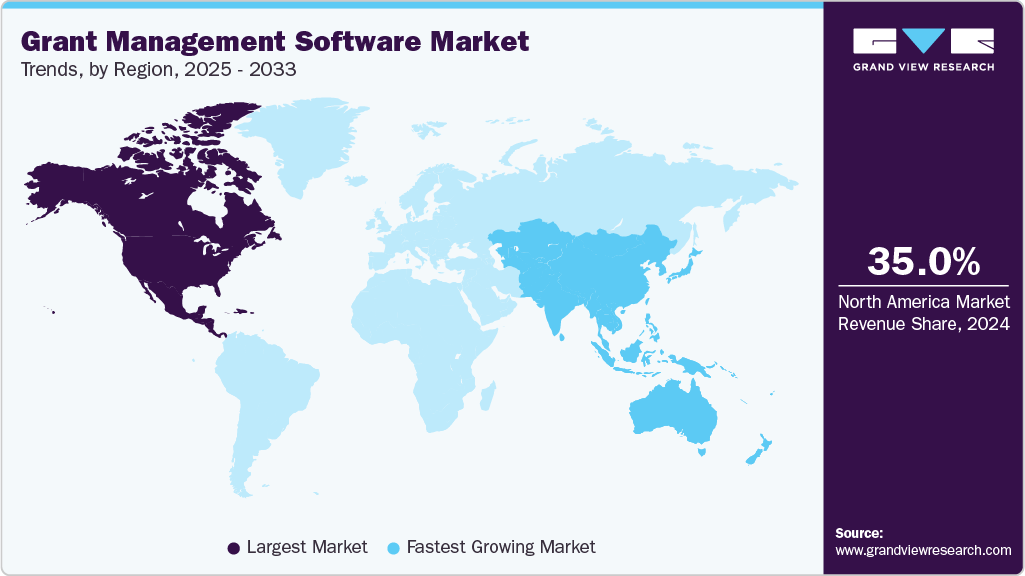
North America dominated the global grant management software market with the largest revenue share of 34.4% in 2025, driven by the widespread adoption of digital technologies by nonprofit organizations and federal agencies aiming to enhance transparency, automate workflows, and reduce grant-related fraud. The region benefits from mature infrastructure and high R&D investments in sectors like healthcare and education, which require robust grant lifecycle management solutions.
 To learn more about this report, Download Free Sample Report
U.S. Grant Management Software Market Trends
The grant management software market in the U.S. held the largest share in the North America region in 2025 due to a large volume of federal and state-level grant disbursements under initiatives such as NIH, NSF, and Department of Education programs. These agencies mandate compliance with strict reporting and audit requirements, which is pushing organizations to adopt advanced GMS platforms with built-in compliance, document control, and budget management functionalities.
Europe Grant Management Software Market Trends
The grant management software market in Europe is anticipated to register considerable growth over the forecast period, due to increasing cross-border funding programs, such as Horizon Europe and EU Cohesion Policy Funds, which demand standardized, multilingual, and interoperable grant management tools. The focus on sustainability, social innovation, and public-private partnerships also amplifies the need for collaborative grant platforms that support complex stakeholder ecosystems.
The UK grant management software market is expected to grow rapidly in the coming years, owing to the restructuring of funding sources and greater independence in setting domestic grant agendas, which has increased the demand for flexible GMS tools. The growth is supported by strong philanthropic networks and government-backed research grants, especially in areas such as AI, net-zero initiatives, and higher education, requiring performance tracking and outcome reporting
The Germany grant management software market held a substantial market share in 2024, driven by research institutions and industrial innovation programs backed by both federal and EU-level grants. The need for software that can handle multilingual, multicurrency, and multi-project grant environments while ensuring strict GDPR compliance drives adoption among research bodies and foundations.
Asia Pacific Grant Management Software Market Trends
Asia Pacific held a significant share in the global market in 2025, due to increasing government focus on rural development, education, and public health programs. Countries across the region are investing in modernizing their grant allocation systems to ensure transparency and reduce corruption, encouraging the adoption of cloud-based GMS with mobile access and multilingual interfaces suitable for diverse populations.
The Japan grant management software market is expected to grow rapidly in the coming years driven by the need to manage government-backed innovation and technology grants in sectors such as robotics, green energy, and healthcare. The country’s push toward administrative digitization and e-governance is increasing the adoption of automated systems that enable efficient grant tracking and inter-agency coordination.
The China grant management software market held a substantial market share in 2025, due to rapid digital transformation in the public sector and an increasing number of state-sponsored grants for science, technology, rural revitalization, and education are spurring GMS adoption. Emphasis on real-time tracking, fraud prevention, and centralized grant allocation in a tightly regulated environment is driving local governments and institutions toward domestic and customized GMS solutions.
Key Grant Management Software Company Insights
Key players operating in the grant management software industry are Blackbaud, Inc., Benevity, Oracle, Salesforce, Inc., and Salesforce, Inc., among others. The companies are focusing on various strategic initiatives, including new product development, partnerships & collaborations, and agreements to gain a competitive advantage over their rivals. The following are some instances of such initiatives.
-
In August 2024, Submittable announced its acquisition of WizeHive, a U.S.-based company that provides a cloud-based platform. This move follows WizeHive’s recent acquisitions of Bright Funds and WeHero, bringing together four prominent social impact brands. The combined entity aims to deliver best-in-class grants management software, strengthen corporate social responsibility (CSR) offerings, and help organizations drive greater social change.
-
In June 2024, Euna Solutions announced a strategic partnership with Funkhouser & Associates (F&A), a U.S.-based consulting firm. Specializing in strategic planning for state and local governments, F&A worked with Euna Solutions to combine its expertise with Euna’s advanced budgeting software. This collaboration aims to help local governments create data-driven, sustainable budgets and strategic plans to serve their communities.
Key Grant Management Software Companies:
The following key companies have been profiled for this study on the grant management software market.
- Altum, Inc.
- AmpliFund
- Benevity
- Blackbaud, Inc.
- Bonterra
- Euna Solutions
- Fluxx
- Foundant Technologies, Inc.
- Fundingportal
- Goodstack
- Oracle
- Salesforce, Inc.
- SmartSimple Software Inc.
- Submittable
- SurveyMonkey
Competitive Benchmarking
Category
Operating Strategies
Competitive Edge
Weakness
Established Players (Oracle, Salesforce, Inc., Blackbaud, Inc., SmartSimple Software Inc., Bonterra, Benevity)
- Established players focus on delivering comprehensive grant management platforms that integrate grant lifecycle management, application processing, fund disbursement, compliance monitoring, reporting, workflow automation, AI-powered analytics, and stakeholder collaboration.
- Their strategies emphasize continuous product innovation, cloud-native deployment, generative AI integration, strategic acquisitions, ecosystem partnerships, and seamless integration with ERP, CRM, financial management, and nonprofit management platforms to improve funding transparency and operational efficiency.
- Established players benefit from extensive global customer bases, mature product portfolios, significant R&D investments, strong partner ecosystems, and broad enterprise software capabilities. Their trusted brands, scalable cloud infrastructure, advanced security and compliance features, AI-enabled automation, and seamless integration with enterprise applications enable them to support large government agencies, nonprofit organizations, educational institutions, corporations, and philanthropic foundations managing complex grant programs. Strong financial resources also support continuous innovation, acquisitions, and international expansion.
- These companies face challenges associated with complex product portfolios, lengthy implementation cycles, high deployment and subscription costs, and integration complexities across diverse enterprise environments.
- Enterprise-focused platforms may be costly for small nonprofits and local government agencies, while increasing competition from cloud-native grant management vendors, evolving regulatory requirements, rapid AI innovation, and demand for simplified, low-cost SaaS solutions may pressure growth and profitability.
Emerging Players (Submittable, Fluxx, Foundant Technologies, Inc., AmpliFund, Euna Solutions, Goodstack)
- Emerging players focus on delivering cloud-first, AI-enabled, and purpose-built grant management platforms that simplify grant applications, review workflows, funding administration, compliance monitoring, reporting, and impact measurement.
- Their strategies emphasize SaaS delivery, rapid product innovation, workflow automation, low-code configuration, API-driven integrations, strategic partnerships, and expansion into nonprofit, government, education, and corporate philanthropy markets.
- Emerging players offer agile product development, intuitive user experiences, faster deployment, flexible subscription pricing, and strong specialization in grant administration and funding management.
- Their cloud-native architectures, AI-driven automation capabilities, configurable workflows, and ability to rapidly introduce innovative features enable organizations to improve operational efficiency, reduce administrative workloads, and enhance funding transparency.
- Limited global market presence, smaller partner ecosystems, lower brand recognition, and comparatively fewer financial resources can restrict expansion into large multinational enterprises and government contracts.
- They also face challenges in competing with integrated enterprise software suites offered by larger vendors, while maintaining continuous investment in AI innovation, cybersecurity, regulatory compliance, and international market expansion may strain resources.
Grant Management Software Market Report Scope
Report Attribute
Details
Market size value in 2025
USD 2.9 billion
Market size value in 2026
USD 3.1 billion
Revenue forecast in 2033
USD 6.2 billion
Growth rate
CAGR of 10.2% from 2026 to 2033
Base year for estimation
2025
Historical data
2021 - 2024
Forecast period
2026 - 2033
Quantitative units
Revenue in USD million/billion, and CAGR from 2026 to 2033
Report coverage
Revenue forecast, company market share analysis, competitive landscape, growth factors, and trends
Segments covered
Component, function, deployment mode, platform, organization, end-use, region
Regional scope
North America; Europe; Asia Pacific; Latin America; MEA
Country scope
U.S.; Canada; Mexico; Germany; UK; France; China; Japan; India; South Korea; Australia; Brazil; Saudi Arabia; South Africa; UAE
Key companies profiled
Altum, Inc.; AmpliFund; Benevity; Blackbaud, Inc.; Bonterra; Euna Solutions; Fluxx; Foundant Technologies, Inc.; Fundingportal; Goodstack; Oracle; Salesforce, Inc.; SmartSimple Software Inc.; Submittable; SurveyMonkey
Customization scope
Free report customization (equivalent up to 8 analysts' working days) with purchase. Addition or alteration to country, regional & segment scope.
Pricing and purchase options
Avail customized purchase options to meet your exact research needs. Explore purchase options
Global Grant Management Software Market Report Segmentation
This report forecasts revenue growth at global, regional, and country levels and provides an analysis of the latest industry trends in each of the sub-segments from 2021 to 2033. For this study, Grand View Research has segmented the grant management software market report based on component, function, deployment mode, platform, organization, end use, and region:
-
Component Outlook (Revenue, USD Billion, 2021 - 2033)
-
Solution
-
Services
-
-
Function Outlook (Revenue, USD Billion, 2021 - 2033)
-
Performance and Outcomes Measurement
-
Application Tracking
-
Collaboration
-
Document Management
-
Reporting
-
Others
-
-
Deployment Mode Outlook (Revenue, USD Billion, 2021 - 2033)
-
Cloud
-
On-premise
-
-
Platform Outlook (Revenue, USD Billion, 2021 - 2033)
-
Web
-
Mobile
-
-
Organization Outlook (Revenue, USD Billion, 2021 - 2033)
-
Large Enterprises
-
SMEs
-
-
End Use Outlook (Revenue, USD Billion, 2021 - 2033)
-
Government
-
Healthcare and Human Services
-
Educational Institutes
-
Corporations
-
International and National Organization
-
Philanthropic Organizations
-
Others
-
-
Regional Outlook (Revenue, USD Billion, 2021 - 2033)
-
North America
-
U.S.
-
Canada
-
Mexico
-
-
Europe
-
UK
-
Germany
-
France
-
-
Asia Pacific
-
China
-
India
-
Japan
-
South Korea
-
Australia
-
-
Latin America
-
Brazil
-
-
Middle East & Africa
-
UAE
-
Saudi Arabia
-
South Africa
-
-
Research Methodology
The grant management software market figures in this report are based on a proven research process that combines executive interviews with secondary research from proprietary databases, company filings, and recognized regulatory and institutional sources. Market size is built through value-chain sizing - reconciling supply-side and demand-side estimates - and triangulated with bottom-up and top-down approaches. Every estimate passes multiple levels of expert validation before publication, with each Ggrant management software segment quantified using the revenue-capture definitions in the table below.
Segment Definition
Segment - Component
Revenue capture definition
Solution
Revenue is generated from the licensing, subscription, and sale of grant management software that enables organizations to manage the complete grant lifecycle, including grant discovery, application management, proposal review, award administration, budgeting, compliance monitoring, reporting, fund disbursement, and performance tracking. This includes cloud-based and on-premise grant management platforms with workflow automation, document management, analytics, collaboration, and AI-enabled grant administration capabilities.
Services
Revenue is generated from professional and managed services associated with grant management software, including consulting, implementation, customization, system integration, data migration, user training, technical support, software maintenance, upgrades, cloud hosting, and managed application services.
Segment - Function
Revenue capture definition
Performance and Outcomes Measurement
Revenue is generated from software modules that monitor grant performance, measure program outcomes, evaluate funding impact, track KPIs, and support evidence-based decision-making.
Application Tracking
Revenue is generated from software used to manage grant applications, applicant eligibility verification, proposal submission, review workflows, scoring, approvals, and communication throughout the grant lifecycle.
Collaboration
Revenue is generated from collaboration tools that enable communication and coordination among grantmakers, reviewers, applicants, funding agencies, and stakeholders through shared workspaces, notifications, and workflow management.
Document Management
Revenue is generated from document management capabilities supporting secure storage, version control, electronic document submission, contract management, records management, and regulatory documentation throughout the grant lifecycle.
Reporting
Revenue is generated from reporting and analytics modules that automate financial reporting, compliance reporting, audit preparation, grant utilization tracking, dashboards, and regulatory disclosures.
Others
Revenue is generated from additional functionalities such as budgeting, fund allocation, payment management, compliance monitoring, AI-powered analytics, risk assessment, applicant portals, and workflow automation.
Segment - Deployment
Revenue capture definition
Cloud
Revenue is generated from cloud-based grant management software delivered through Software-as-a-Service (SaaS) platforms, providing remote access, scalability, automatic updates, collaboration, and subscription-based licensing.
On-premise
Revenue is generated from grant management software deployed within an organization's own IT infrastructure, providing greater control over data security, customization, and regulatory compliance.
Segment - Platform
Revenue capture definition
Web
Revenue is generated from browser-based grant management platforms accessible through desktop and web applications for grant administration, collaboration, reporting, and workflow management.
Mobile
Revenue is generated from mobile applications and mobile-enabled grant management platforms that support grant reviews, approvals, applicant communication, document access, and reporting through smartphones and tablets.
Segment - Organization Size
Revenue capture definition
Small & Medium Enterprises
The SMEs segment, with respect to the number of employees, generally includes organizations employing between 10 and 999 employees.
Large Enterprise
The large enterprises segment, with respect to the number of employees, typically comprises organizations employing more than 1,000 employees for multinational corporations.
Segment - End Use
Revenue capture definition
Government
Revenue is generated from grant management software deployed by federal, state, provincial, and local government agencies to administer public funding programs, monitor compliance, and manage grant distribution.
Healthcare and Human Services
Revenue is generated from software used by healthcare organizations, hospitals, public health agencies, and human service providers to manage healthcare grants, research funding, community programs, and compliance reporting.
Educational Institutes
Revenue is generated from grant management software used by universities, colleges, schools, and research institutions to administer research grants, scholarships, academic funding, and sponsored programs.
Corporations
Revenue is generated from software adopted by corporations to manage corporate social responsibility (CSR) initiatives, ESG funding, employee giving programs, philanthropic grants, and community investment programs.
International and National Organization
Revenue is generated from grant management software used by multilateral organizations, development agencies, NGOs, and national institutions to administer international aid, humanitarian funding, development programs, and donor-funded initiatives.
Philanthropic Organizations
Revenue is generated from software deployed by charitable foundations, trusts, nonprofit organizations, and philanthropic institutions to manage grant applications, funding decisions, donor reporting, and impact measurement.
Others
Revenue is generated from grant management software adopted by research organizations, cultural institutions, environmental organizations, religious institutions, community organizations, and other entities administering grants and funding programs.
Estimation Model
Layer
Question
Analysis
Grant Administration & Funding Ecosystem Layer
Who can benefit from grant management software?
Identify organizations that administer, distribute, monitor, or receive grants across government, nonprofit, education, healthcare, corporate, and international development sectors. These include government agencies, philanthropic foundations, educational institutions, healthcare organizations, research institutes, NGOs, corporations, and international organizations requiring efficient grant lifecycle management, compliance, fund allocation, reporting, and performance monitoring.
Digital Maturity & Funding Governance Layer
Who can adopt grant management software?
Evaluate organizations based on their digital transformation initiatives, funding administration complexity, regulatory compliance requirements, cloud adoption, workflow automation, reporting obligations, collaboration needs, and integration with financial management, ERP, CRM, HRM, and document management systems. Organizations modernizing grant administration processes and improving funding transparency possess the operational readiness to adopt grant management software.
Adoption & Grant Lifecycle Management Layer
Who actively deploys grant management software?
Analyze grant management software deployment across government agencies, nonprofit organizations, educational institutions, healthcare providers, philanthropic foundations, corporations, and international organizations implementing application management, grant review, fund disbursement, document management, collaboration, compliance monitoring, reporting, and performance measurement. Active users leverage these platforms to automate grant workflows, improve funding oversight, strengthen compliance, reduce administrative burden, and measure program outcomes.
Monetization Layer
How much revenue is generated?
Assess revenue generated through software licenses, SaaS subscriptions, cloud-based grant management platforms, on-premise deployments, implementation and system integration services, consulting, customization, data migration, user training, managed services, maintenance and technical support contracts, AI-powered application review, compliance management, reporting and analytics modules, document management capabilities, and other value-added grant administration services.
Delivered Customizations
This report has been delivered with the following In-depth customizations
Client Request
Customization Delivered
Value Adds
Grant Management Vendor Competitive Benchmarking
Assessed leading grant management software vendors based on AI capabilities, grant lifecycle management, workflow automation, cloud deployment, compliance management, reporting and analytics, integration capabilities, pricing strategies, product roadmaps, partnerships, and industry presence.
Enables stakeholders to benchmark competitors, identify technology gaps, evaluate product differentiation, and formulate competitive product development and go-to-market strategies.
Regional Grant Digitalization & Funding Management Forecast
Evaluated regional digital government initiatives, nonprofit digital transformation, research funding programs, cloud adoption, regulatory compliance requirements, philanthropic funding trends, and grant management software demand across Latin America and the Middle East & Africa.
Provides actionable insights into regional demand hotspots, technology adoption trends, competitive landscapes, investment priorities, and long-term growth opportunities across emerging grant management software markets.
Cloud-based Grant Management & AI-powered Funding Automation Opportunity Assessment
Assessed cloud-based grant management adoption, SaaS deployment models, AI-powered application screening, workflow automation, compliance monitoring, predictive analytics, reporting capabilities, and competitive positioning of leading grant management software providers.
Helps identify high-growth opportunities in cloud-native grant management platforms, optimize product strategies, evaluate customer adoption trends, and capitalize on emerging AI-driven funding administration and grant lifecycle automation opportunities.
Frequently Asked Questions About This Report
The global grant management software market size was valued at USD 2.9 billion in 2025 and is estimated at USD 3.1 billion in 2026.
The global grant management software market is expected to grow at a compound annual growth rate of 10.2% from 2026 to 2033 to reach USD 6.2 billion by 2033.
The solution segment led with a 60.1% revenue share in 2025, while the services segment is the fastest-growing segment.
The application tracking segment led with a 22.4% revenue share in 2025, while the reporting segment is the fastest-growing segment.
The On-premise segment held the largest share (over 55.0%) in 2025, while the cloud segment is the fastest-growing segment.
Key players operating in the grant management software market include Altum, Inc.; AmpliFund; Benevity; Blackbaud, Inc.; Bonterra; Euna Solutions; Fluxx; Foundant Technologies, Inc.; Fundingportal; Goodstack; Oracle; Salesforce, Inc.; SmartSimple Software Inc.; Submittable; SurveyMonkey
Key factors include governments, nonprofit organizations, educational institutions, healthcare organizations, foundations, and corporate social responsibility (CSR) programs, which are increasingly adopting digital platforms to streamline grant administration and improve funding transparency.
North America dominated with 34.4% revenue share in 2025.
Asia Pacific is the fastest-growing region over the forecast period.
About the Author(s)
IT Services & Applications Research Team
Technology · IT Services & ApplicationsThis report was authored by the it services & applications research team at Grand View Research - comprising two research analysts, one senior research analyst, and one industry expert - with specialized expertise in the it services & applications segment of the technology industry. All findings are based on proprietary technology databases, executive interviews, and regulatory analysis, subject to internal peer review prior to publication.
Last Updated:
Speak to Analyst

Customize this report to your needs - add regions, segments, or data points, with 20% free customization.
Or view our licence options:


ISO 9001:2015 & 27001:2022 Certified
We are GDPR and CCPA compliant! Your transaction & personal information is safe and secure. For more details, please read our privacy policy.


