
- Home
- »
- Plastics, Polymers & Resins
- »
-
Graphene-enhanced Plastics Market Size, Growth Report, 2026-2033GVR Report cover
![Graphene-enhanced Plastics Market (2026 - 2033)Report]()
Graphene-enhanced Plastics Market (2026 - 2033)
Size, Share & Trends Analysis Report By Polymer (Polypropylene (PP), Polyethylene (PE)), By End Use (Automotive, Aerospace & Defense, Electronics, Energy Storage & Generation), By Region, And Segment Forecasts
Market Size, 2025
$35.3BMarket Estimate, 2026
$42.2BMarket Forecast, 2033
$154.1BCAGR, 2026–2033
20.3%Graphene-enhanced Plastics Market Summary
The global graphene-enhanced plastics market size was valued at USD 35.3 billion in 2025 and is projected to grow from USD 42.2 billion in 2026 to USD 154.1 billion by 2033, at a CAGR of 20.3% from 2026 to 2033. Asia Pacific dominated the global market, accounting for the largest revenue share of 41.7% in 2025.. Improved mechanical and thermal properties from adding graphene make plastics more suitable for demanding industrial applications.

Key Market Trends & Insights
- By polymer: PP segment is expected to grow at a 20.4% CAGR in revenue from 2026 to 2033 in the polymer segment.
- By end use: Aerospace & defense segment is expected to grow at a CAGR of 22.3% from 2026 to 2033 in terms of revenue.
Regional Highlights
- Largest regional market: Asia Pacific (41.7% revenue share, 2025)
- By country: The India graphene-enhanced plastics industry is a major contributor to the global market.
Market Size & Forecast
- Market size in 2025: USD 35.3 Billion
- Estimated market size in 2026: USD 42.2 Billion
- Projected market size by 2033: USD 154.1 Billion
- CAGR (2026-2033): 20.3%
This is driving interest from sectors like automotive and aerospace, where performance and durability are key. A significant trend shaping the graphene-enhanced plastics industry is the rising demand for multifunctional, lightweight materials across advanced manufacturing industries, especially automotive, aerospace, and electronics. These sectors focus on materials that offer a balance of mechanical strength, thermal conductivity, and electrical performance while also reducing weight and improving fuel or energy efficiency. Integrating graphene into thermoplastics and thermosets is changing conventional plastic formulations, enabling manufacturers to customize properties at the nano level.

The emergence of hybrid composites, where graphene is combined with other nanomaterials to amplify performance, is further driving research collaboration between material scientists and OEMs, making material customization a key differentiator in the competitive landscape.
Drivers, Opportunities & Restraints
A critical driver for the graphene-enhanced plastics industry is the growing push toward sustainability and circular economy mandates across major global economies. Graphene not only improves the recyclability of plastic composites by reducing the need for multiple material blends but also extends the lifecycle of plastic components due to enhanced durability, UV resistance, and thermal stability.
In sectors like automotive and construction, where the transition to eco-efficient solutions is being legislatively and commercially incentivized, graphene's ability to replace heavier or less sustainable additives is compelling. This material advantage aligns with regulatory frameworks in the EU, U.S., and parts of Asia, where lifecycle performance, recyclability, and carbon footprint are becoming procurement benchmarks.
A notable opportunity lies in the integration of graphene-enhanced plastics within next-generation flexible and wearable electronics. As the consumer electronics sector aggressively explores miniaturization and form factor innovation, the demand for substrates that combine flexibility with superior electrical conductivity is rising. Graphene-reinforced polymers can serve as enablers for conductive films, flexible sensors, and encapsulation materials. This opens up commercial pathways in IoT-enabled devices, smart textiles, and medical diagnostics, where robust yet pliable materials are essential.
Despite its potential, the market faces a significant restraint in the form of high production costs and scale-up inefficiencies. The quality, consistency, and dispersion of graphene within polymer matrices remain technical bottlenecks, particularly when targeting mass-market applications. Variability in graphene supply, coupled with the absence of universally accepted standards for purity, layer count, and functionalization, adds complexity to manufacturing.
Market Concentration & Characteristics
The market growth stage of the graphene-enhanced plastics industry is high, and the pace of growth is accelerating. The market exhibits a significant level of market concentration, with key players dominating the industry landscape. Major companies like Gerdau Graphene, HydroGraph Clean Power, Haydale Graphene Industries, among others, play a significant role in shaping the market dynamics. These leading players often drive innovation within the market, introducing new products, technologies, and applications to meet evolving industry demands.
The graphene-enhanced plastics industry is characterized by a high degree of innovation, driven by rapid advancements in nanotechnology, surface functionalization, and dispersion techniques. Startups and research institutes are actively developing tailored graphene-polymer formulations that optimize conductivity, strength, and thermal properties for specific end use cases.
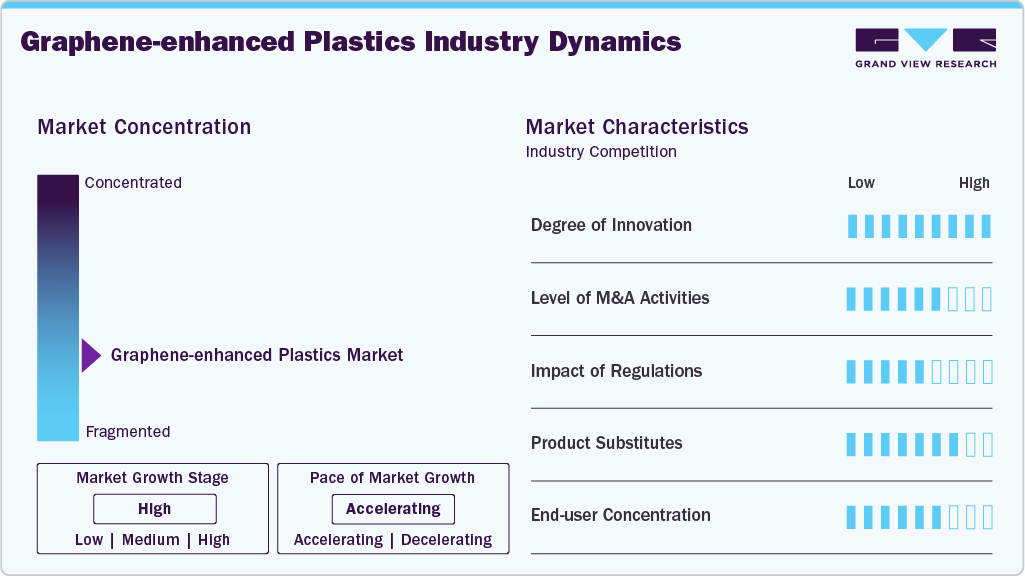
Innovations such as 3D printable graphene-infused thermoplastics and self-healing polymer composites are gaining commercial traction. Continuous funding from the government and private sectors in materials innovation is further fueling proprietary breakthroughs, making this segment highly dynamic and IP-intensive.
While carbon nanotubes (CNTs), glass fibers, and aramid-based reinforcements serve as key substitutes for graphene in plastic composites, they often fall short in delivering the same balance of strength, weight reduction, and multifunctionality. CNTs offer excellent conductivity but pose dispersion and cost challenges at scale, while traditional fillers like talc and silica lack the advanced thermal and mechanical properties offered by graphene.
Polymer Insights
Polypropylene (PP) dominated the polymer segment in the market, accounting for a revenue share of 44.8% in 2025. This strong outlook is attributed to its wide range of applications, cost-effectiveness, and well-balanced performance profile across industries such as packaging, automotive, and consumer goods. The incorporation of graphene, particularly graphene nanoplatelets, enhances key material properties such as tensile strength, stiffness, thermal stability, and barrier performance while maintaining lightweight characteristics and processability.
The Polyethylene (PE) segment is anticipated to grow at a substantial CAGR of 19.6% through the forecast period. It is a key polymer segment in the market due to its high global consumption, grade versatility (HDPE, LDPE, LLDPE), and compatibility with scalable processing methods. The addition of graphene enhances mechanical strength, impact resistance, thermal conductivity, and chemical stability while retaining PE’s lightweight and flexible nature. Besides, it improves resistance to environmental stress cracking and UV degradation, extending product durability. PE’s compatibility with masterbatch-based compounding enables efficient graphene integration at low loading levels, supporting cost-effective manufacturing.
End Use Insights
Automotive dominated the market across the end use segmentation in terms of revenue, accounting for a market share of 45.7% in 2025. The growing need to balance electrification targets with weight reduction strategies is driving the use of graphene-enhanced plastics. These materials offer excellent conductivity for battery components and EMI shielding, along with mechanical resilience for interior and under-the-hood parts.
Automakers are increasingly exploring graphene-polymer formulations as replacements for metal parts to improve fuel economy and EV range. The expansion of electric vehicle production, coupled with regulatory CO₂ reduction goals, is reinforcing the shift toward multifunctional lightweight composites.

The aerospace and defense segment is projected to witness a substantial CAGR of 22.3% through the forecast period. The exceptional strength-to-weight ratio and thermal conductivity of graphene-infused composites support critical structural applications, including fuselage sections, radomes, and heat shields.
These materials also contribute to reducing component fatigue and increasing operational lifespan, which aligns with long-term cost efficiency mandates in military and commercial fleets. The sector’s strong focus on material innovation for mission-critical performance is accelerating strategic collaborations with nanomaterial firms and defense contractors.
Regional Insights
North America graphene-enhanced plastics industry dominated the global market and accounted for the largest revenue share of 41.7% in 2025. In North America, the surge in demand for lightweight, conductive materials in the EV and battery manufacturing sector is a significant growth driver for graphene-enhanced plastics. With expanding electric vehicle production hubs in states like Michigan and Tennessee, automotive OEMs are increasingly integrating graphene-infused polymers for EMI shielding, battery enclosures, and thermal management. Supportive federal funding under the Inflation Reduction Act is further accelerating domestic innovation in advanced materials.

The region's robust aerospace and defense ecosystem, particularly in the U.S. and Canada, is pushing the adoption of graphene-based plastic composites to improve aircraft performance and reduce lifecycle costs. Aerospace primes and defense contractors are collaborating with nanomaterial companies to develop graphene-enhanced polymers that offer improved fatigue resistance, flame retardancy, and weight reduction for structural and electronic components in aircraft and defense systems.
U.S. Graphene-enhanced Plastics Market Trends
The graphene-enhanced plastics industry in the U.S. is driven by the strong emphasis on reshoring semiconductor and electronics manufacturing, which is catalyzing the uptake of graphene-enhanced plastics in high-performance electronic housings and circuit components. These materials help achieve better thermal dissipation and miniaturization of components, which is critical for next-gen computing and IoT infrastructure. The CHIPS Act and strategic partnerships with nanomaterial innovators are creating favorable conditions for adoption at the industrial scale.
Europe Graphene-enhanced Plastics Market Trends
Europe’s graphene-enhanced plastics industry is driven by European region’ push toward circular economy goals and material sustainability, which is driving the integration of graphene-enhanced plastics in packaging, construction, and consumer goods. Graphene’s ability to extend product lifespan and enhance polymer recyclability aligns with the EU Green Deal and new eco-design regulations. Countries like Germany and the Netherlands are leading in funding graphene applications that promote low-carbon material innovation, particularly within automotive interiors and building insulation.
Asia Pacific Graphene-enhanced Plastics Market Trends
The graphene-enhanced plastics industry in the Asia Pacific region is driven by the rapid industrialization and leadership in electronics manufacturing, particularly in China, South Korea, and Japan, are fueling demand for graphene-enhanced plastics in flexible displays, thermal interface materials, and wearables. These countries are also investing heavily in domestic graphene production and application-specific R&D to gain a competitive advantage. The region's dominance in polymer processing and cost-efficient manufacturing infrastructure further supports scalable integration into electronics and automotive components.
Graphene-enhanced Plastics Company Insights
The Graphene-enhanced plastics industry is highly competitive, with several key players dominating the landscape. Major companies include Gerdau Graphene, HydroGraph Clean Power, Haydale Graphene Industries, among others. The market is characterized by a competitive landscape, with several key players driving innovation and market growth. Major companies in this sector are investing heavily in research and development to enhance the performance, cost-effectiveness, and sustainability of their products.
Key Graphene-enhanced Plastics Companies:
The following key companies have been profiled for this study on the graphene-enhanced plastics market.
- Gerdau Graphene
- HydroGraph Clean Power
- Haydale Graphene Industries
- Graphene Composites Ltd
- Directa Plus
- Black Swan Graphene
Recent Developments
-
In March 2026, Graphmatech, a Swedish graphene materials innovator, launched a portfolio of graphene-enhanced FDM filaments and SLS powders under its Aros Graphene platform, enabling conductive, ESD-safe, and structurally reinforced 3D printing materials. These materials target industrial applications in aerospace, telecom, and automotive for EMI shielding, thermal management, and lightweight parts with controlled conductivity.
-
In October 2025, NanoXplore revealed its next-generation graphene-enhanced plastic solutions, featuring advanced high-surface-area GrapheneBlack grades intended to boost performance in polymer composites. These innovative materials are designed to improve mechanical strength, conductivity, and ease of processing, while also lowering overall material costs, facilitating the wider use of graphene in plastic applications.
Graphene-enhanced Plastics Market Report Scope
Report Attribute
Details
Market size in 2025
USD 35.3 billion
Estimated Market size in 2026
USD 42.2 billion
Projected Market size by 2033
USD 154.1 billion
Growth rate
CAGR of 20.3% from 2026 to 2033
Historical data
2021 - 2024
Forecast period
2026 - 2033
Quantitative units
Revenue in USD million/billion, Volume in Kilotons, and CAGR from 2026 to 2033
Report coverage
Revenue forecast, competitive landscape, growth factors, and trends
Segments covered
Polymer, end use, region
Regional scope
North America; Europe; Asia Pacific; Latin America; Middle East & Africa
Country Scope
U.S., Canada; Mexico; Germany; UK; France; Italy; Spain, China; India; Japan; South Korea, Australia Brazil; Argentina, Saudi Arabia, South Africa, UAE
Key companies profiled
Gerdau Graphene; HydroGraph Clean Power; Haydale Graphene Industries; Graphene Composites Ltd; Directa Plus; Black Swan Graphene
Customization scope
Free report customization (equivalent up to 8 analyst’s working days) with purchase. Addition or alteration to country, regional & segment scope
Pricing and purchase options
Avail customized purchase options to meet your exact research needs. Explore purchase options
Global Graphene-enhanced Plastics Market Report Segmentation
This report forecasts revenue growth at the global, regional, and country levels and provides an analysis of the latest industry trends in each of the sub-segments from 2021 to 2033. For this study, Grand View Research has segmented the Graphene-enhanced plastics market report based on polymer, end use, and region:

-
Polymer Outlook (Volume, Kilotons; Revenue, USD Million, 2021 - 2033)
-
PP
-
PE
-
Other polymers
-
-
End Use Outlook (Volume, Kilotons; Revenue, USD Million, 2021 - 2033)
-
Automotive
-
Aerospace & Defense
-
Electronics
-
Energy Storage & Generation
-
Building & Construction
-
Sports & Wearable Goods
-
Other End Uses
-
-
Regional Outlook (Volume, Kilotons; Revenue, USD Million, 2021 - 2033)
-
North America
-
U.S.
-
Canada
-
Mexico
-
-
Europe
-
Germany
-
UK
-
France
-
Italy
-
Spain
-
-
Asia Pacific
-
China
-
India
-
Japan
-
South Korea
-
Australia
-
-
Latin America
-
Brazil
-
Argentina
-
-
Middle East & Africa
-
Saudi Arabia
-
South Africa
-
UAE
-
-
Frequently Asked Questions About This Report
Improved mechanical and thermal properties from adding graphene make plastics more suitable for demanding industrial applications. This is driving interest from sectors like automotive and aerospace, where performance and durability are key.
The global graphene-enhanced plastics market size was valued at USD 35.3 billion in 2025 and is estimated at USD 42.2 billion for 2026.
The global graphene-enhanced plastics market is expected to grow at a CAGR of 20.3% from 2026 to 2033, reaching USD 154.1 billion by 2033.
Polypropylene (PP) dominated the polymer type segment in the graphene-enhanced plastics market, accounting for a revenue share of 44.8% in 2025. This strong outlook is attributed to its wide range of applications, cost-effectiveness, and well-balanced performance profile across industries such as packaging, automotive, and consumer goods.
Key players include Gerdau Graphene; HydroGraph Clean Power; Haydale Graphene Industries; Graphene Composites Ltd; Directa Plus; Black Swan Graphene.
Asia Pacific dominated with a 41.7% revenue share in 2025.
The automotive segment dominated the market and accounted for the largest revenue share of 45.7% in 2025.
About the Author(s)
Plastics, Polymers & Resins Research Team
Bulk Chemicals · Plastics, Polymers & ResinsThis report was authored by the plastics, polymers & resins research team at Grand View Research - comprising two research analysts, one senior research analyst, and one industry expert - with specialized expertise in the plastics, polymers & resins segment of the bulk chemicals industry. All findings are based on proprietary bulk chemicals databases, executive interviews, and regulatory analysis, subject to internal peer review prior to publication.
Last Updated:
Speak to Analyst


Customize this report to your needs — add regions, segments, or data points, with 20% free customization.
Or view our licence options:


ISO 9001:2015 & 27001:2022 Certified
We are GDPR and CCPA compliant! Your transaction & personal information is safe and secure. For more details, please read our privacy policy.


