
- Home
- »
- Next Generation Technologies
- »
-
Green Aerospace Technology Market Size Report, 2026-2033GVR Report cover

Green Aerospace Technology Market (2026 - 2033)
Size, Share & Trends Analysis Report By Technology Type (Sustainable Aviation Fuels, Green Propulsion Systems, Aircraft Electrification & Power Systems), By Platform, By System Integration, By End Use, By Region, And Segment Forecasts
Market Size, 2025
$29.5BMarket Estimate, 2026
$36.1BMarket Forecast, 2033
$152.7BCAGR, 2026–2033
22.9%Green Aerospace Technology Market Summary
The global green aerospace technology market size was valued at USD 29.5 billion in 2025 and is projected to grow from USD 36.1 billion in 2026 to USD 152.7 billion by 2033, at a CAGR of 22.9% from 2026 to 2033. The market in North America dominated with a revenue share of 37.8% in 2025. The industry is expanding steadily, driven by increasing regulatory pressure to reduce aviation emissions and improve fuel efficiency across the aviation industry, while aligning with broader trends in the green technology market.
 Source: Grand View Research, IR Documents, Primary Interviews, Paid DatabasesTo learn more about this report,
 Download Free Sample Report
 Key Market Trends & Insights
- By technology type: Sustainable aviation fuels (SAF) segment held the largest market share of 30.1% in 2025.
- By platform: Commercial Fixed-Wing aircraft segment held the largest market share in 2025.
- By system integration: Component-level technologies segment held the largest market share in 2025.
- By end use: Commercial airlines segment held the largest market share in 2025.
Regional Highlights
- Largest regional market: North America (37.8% revenue share, 2025)
- By country: U.S. held the largest market share in 2025
Market Size & Forecast
- Market size in 2025: USD 29.5 Billion
- Estimated market size in 2026: USD 36.1 Billion
- Projected market size by 2033: USD 152.7 Billion
- CAGR (2026-2033): 22.9%
Three ways to get this report
Buy it, customize it, or ask a question.Ask an Analyst
A direct answer, usually in 1 working day
- AccessReport author, directly
- Reply timeWithin 1 working day
- No sales callDirect answer only
- FormatEmail reply
- CostFree, no cost
Get the Full Report
What the study covers
- FormatsPDF · Excel · Dashboard
- Timeline2026–2033 annual, 2025 base
- Coverage20+ countries, 5 regions
- Companies10+ key players profiled
Customize the Report
20% free customization
- IncludeCountries, segments, points
- TailorTo your product definition
- ExtendDeeper competitor detail
- OrA fully bespoke study
- Turnaround5–10 working days
Rapid adoption of sustainable aviation fuels (SAF), aircraft electrification, and lightweight materials is accelerating across both commercial aviation and defense aviation sectors. Continuous investment in next-generation aircraft programs, advanced propulsion systems, and system-level innovations is strengthening long-term growth in the green aviation market and the green aviation technology market.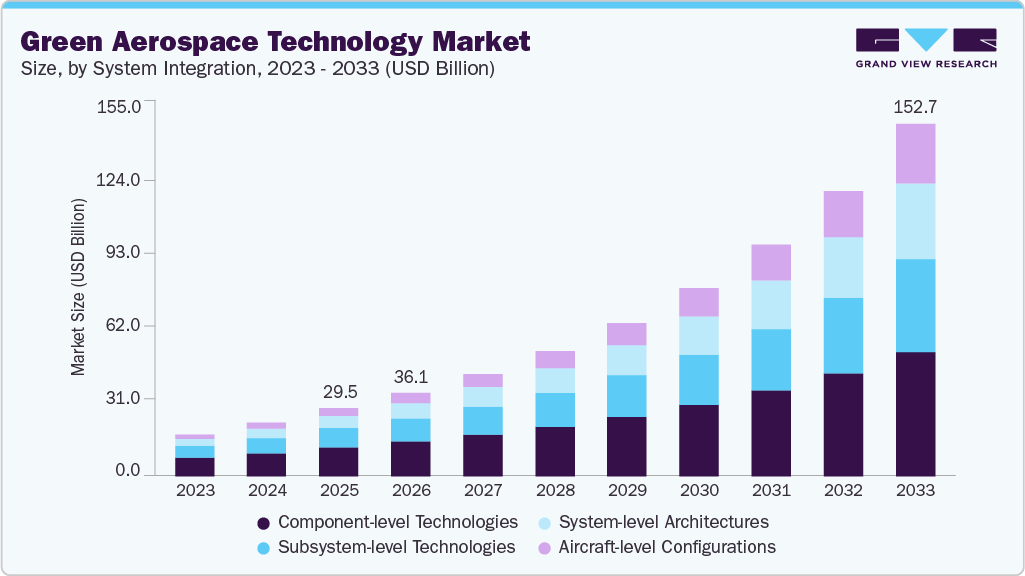 To learn more about this report, Download Free Sample Report
 The industry is experiencing a significant shift toward next-generation propulsion systems with multi-fuel compatibility, driven by increasing demand for sustainable aviation and reduced carbon emissions. Advanced aircraft engine technologies are improving fuel efficiency, enabling low-emission aviation, and enhancing overall aircraft performance across commercial and defense platforms. The integration of hybrid-electric propulsion systems is accelerating the transition toward electric aircraft while improving energy efficiency across critical aircraft operations. Growing adoption of sustainable aviation fuels (SAF) and hydrogen-powered aircraft is supporting long-term aviation decarbonization and net-zero aviation targets. This transformation reflects a broader industry movement toward clean-sheet aircraft development, system-level innovation, and scalable solutions within the green aviation technology industry. For instance, in 2025 February, Honeywell International Inc. and AM Green signed an MoU to evaluate the feasibility of producing sustainable aviation fuel, green methanol, and green hydrogen using carbon capture and low-emission technologies. The collaboration aims to support aviation decarbonization, reduce crude oil dependence, and strengthen India’s position as a global hub for alternative fuel production.
Growing focus on hybrid-electric and fully electric aircraft is driving significant improvements in energy efficiency across aviation platforms within the industry. These technologies are reducing dependence on conventional jet fuel and lowering overall operating costs. Aircraft manufacturers are investing in advanced battery systems and power electronics to enhance performance and range. Integration of electric propulsion is improving efficiency across multiple onboard systems and flight operations. Hybrid-electric architectures are enabling a gradual transition while maintaining operational flexibility for airlines. Increasing regulatory pressure is encouraging the adoption of low-emission aircraft technologies. Advancements in energy storage and thermal management systems are supporting wider deployment. Urban air mobility and short-haul routes are emerging as early adoption areas for electric aircraft. Partnerships between aerospace and energy companies are accelerating innovation in this space. This trend is supporting the shift toward sustainable and low-emission aviation ecosystems within the green aviation industry.
Rising focus on hydrogen-powered aircraft is accelerating the development of zero-emission aviation technologies within the green aerospace technology market. Hydrogen is gaining attention as a viable alternative to conventional aviation fuels due to its high energy potential. Aerospace companies are developing new aircraft designs compatible with hydrogen propulsion systems. Significant funding is being directed toward hydrogen storage, distribution, and infrastructure development. Governments and regulatory bodies are supporting research initiatives to advance hydrogen aviation technologies. Challenges related to storage, safety, and fuel logistics are being actively addressed through innovation. Hydrogen fuel cells and combustion-based systems are being explored for aviation applications. Long-haul and large aircraft segments are expected to benefit from hydrogen adoption over time. Collaborations across the aerospace and energy sectors are strengthening the hydrogen value chain. This trend is supporting long-term aviation decarbonization and enabling the transition toward zero-emission air transport.
Technology Type Insights
The Sustainable Aviation Fuels (SAF) segment led the market and accounted for 30.1% of the global revenue in 2025. Sustainable Aviation Fuels (SAF) dominate the industry due to their immediate compatibility with existing aircraft engines and infrastructure. Airlines are increasingly adopting SAF to reduce lifecycle carbon emissions without requiring major fleet modifications. Strong regulatory support and government incentives are accelerating SAF production and adoption globally. Fuel producers are expanding capacity to meet rising demand from commercial aviation operators. SAF provides a practical near-term solution for achieving aviation decarbonization targets. This trend is strengthening SAF’s position as a key component in sustainable aviation strategies.
Aircraft Electrification & Power Systems are driven by increasing focus on energy efficiency and low-emission aircraft technologies. Advancements in battery technology and power electronics are supporting the development of electric propulsion systems. Electrification is enabling improved efficiency across various aircraft functions and onboard systems. Rising investments from aerospace companies are accelerating innovation in electric aircraft platforms. Short-haul and urban air mobility applications are emerging as key adoption areas. This growth is supporting the transition toward next-generation sustainable aviation solutions.
Platform Insights
Commercial Fixed-Wing Aircraft dominated the market in 2025, due to widespread adoption across global airline fleets. High passenger traffic and frequent flight operations are increasing the need for fuel-efficient and low-emission technologies. Airlines are integrating sustainable aviation fuels to reduce lifecycle carbon emissions. Continuous advancements in aircraft design are improving fuel efficiency and operational performance. Regulatory pressure is encouraging airlines to adopt greener technologies. This dominance is expected to continue with ongoing investments in sustainable aviation solutions.
Space Launch Systems and Spacecraft are expanding due to increasing investments in sustainable space technologies. The rising number of satellite launches and space missions is driving demand for efficient propulsion systems. Companies are focusing on reusable launch vehicles to reduce environmental impact and operational costs. Adoption of green propellants and advanced materials is gaining traction in spacecraft development. Government and private sector funding are supporting innovation in this area. This growth is contributing to the expansion of sustainable space exploration technologies.
System Integration Insights
Component-level Technologies dominated the market in 2025, due to their critical role in enhancing performance, efficiency, and emissions reduction across existing aircraft platforms. These technologies include advanced materials, efficient engines, and digital optimization systems that can be integrated without major design changes. Widespread applicability across both new and legacy aircraft is supporting their strong adoption. Manufacturers are focusing on incremental improvements to meet regulatory and sustainability targets. Continuous innovation at the component level is enabling cost-effective decarbonization strategies. This dominance is expected to continue as airlines prioritize scalable and practical solutions.
Aircraft-level Configurations are growing due to increasing focus on next-generation aircraft designs and clean-sheet development approaches. These configurations include fully electric, hybrid-electric, and hydrogen-powered aircraft architecture. Rising investments in new aircraft platforms are supporting long-term sustainability goals. Aerospace companies are exploring integrated design approaches to optimize overall system efficiency. Regulatory pressure and net-zero targets are accelerating the adoption of advanced configurations. This growth is contributing to the transition toward fully sustainable aviation ecosystems.
End Use Insights
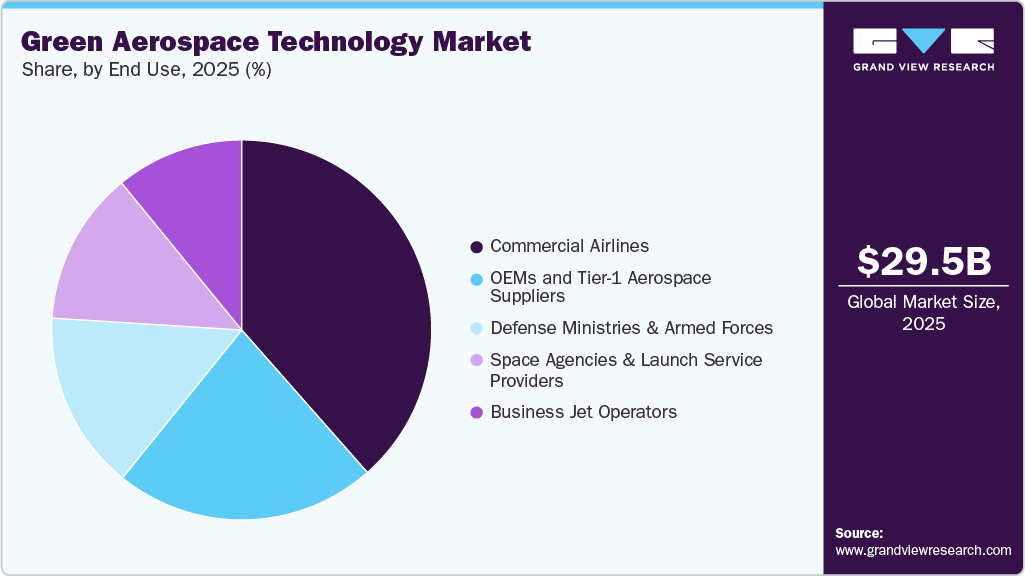
The Commercial Airlines segment accounted for the largest revenue share in 2025 due to a high fleet size and continuous demand for fuel-efficient and low-emission operations. Increasing passenger traffic is driving the need for sustainable aviation solutions across major airline operators. Airlines are actively adopting sustainable aviation fuels to reduce carbon emissions. Ongoing fleet modernization is supporting the integration of advanced propulsion and efficient technologies. Regulatory pressure is encouraging airlines to meet strict emission reduction targets. This dominance is expected to continue with sustained investment in green aviation technologies.
 To learn more about this report, Download Free Sample Report
 Space Agencies and Launch Service Providers are driven by increasing investments in sustainable space exploration and launch technologies. The rising number of satellite deployments and space missions is supporting demand for advanced propulsion systems. Organizations are focusing on reusable launch vehicles to improve efficiency and reduce environmental impact. Adoption of green propellants and lightweight materials is gaining traction in this area. Government and private sector funding are accelerating innovation in space technologies. This growth is contributing to the expansion of sustainable and efficient space operations.
Regional Insights
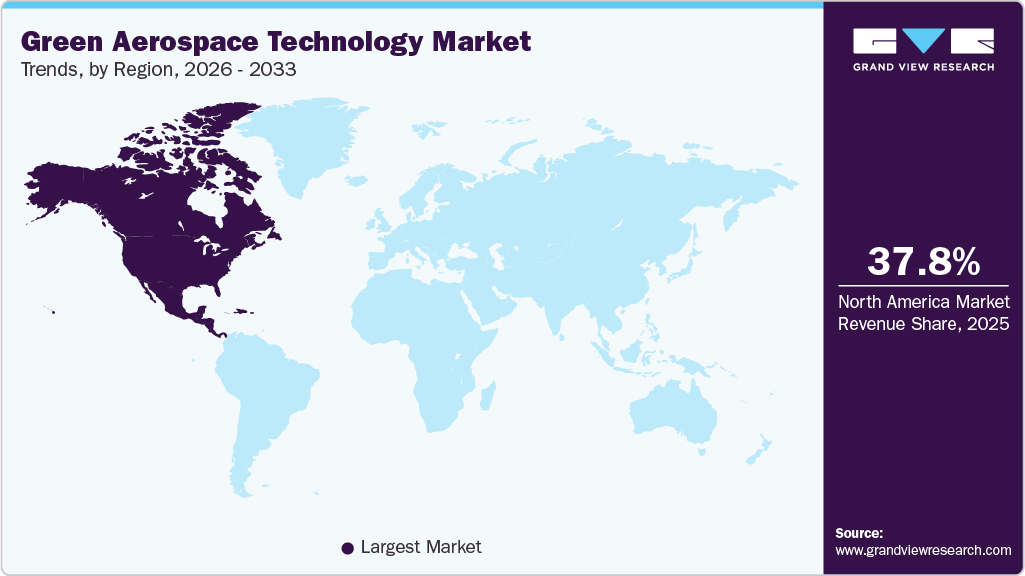
North America dominated the market, accounting for 37.8% of revenue share in 2025. The region benefits from the strong presence of major aerospace manufacturers and technology developers within the green aerospace technology market. High funding toward sustainable aviation and advanced propulsion systems is supporting market growth. Government regulations and emission reduction targets are encouraging the adoption of green technologies. Continuous innovation and financial support are strengthening the region’s position in the green aviation market.
 To learn more about this report, Download Free Sample Report
 U.S. Green Aerospace Technology Market Trends
The green aerospace technology market in the U.S. is driven by strong federal funding, regulatory support, and continuous innovation in sustainable aviation solutions. High adoption of sustainable aviation fuels (SAF) and increasing focus on hybrid-electric and electric aircraft are accelerating market growth. The presence of major aerospace companies supports advancements in low-emission engines, advanced materials, and propulsion systems. Ongoing development of domestic supply chains for hydrogen, batteries, and key components is strengthening long-term expansion in the market.
Europe Green Aerospace Technology Market Trends
The green aerospace technology market in Europe is supported by a strong industrial base and a clear focus on sustainable manufacturing practices. Companies are increasingly using design optimization tools to reduce material usage and comply with stringent environmental regulations. Advanced engineering capabilities and precision manufacturing are enabling the adoption of green technologies in complex system integrations. Strong collaboration between industry players and research institutions is accelerating innovation and technology development.
Asia Pacific Green Aerospace Technology Market Trends
The green aerospace technology market in Asia Pacific is expanding due to increasing air passenger traffic and rising demand for fuel-efficient aircraft across emerging economies. Governments are supporting sustainable aviation through policy initiatives, funding, and infrastructure development. Aerospace companies are adopting sustainable aviation fuels (SAF) and exploring electric and hybrid propulsion technologies. Growing domestic manufacturing capabilities are strengthening regional supply chains and production capacity. This trend is supporting the gradual transition toward low-emission and energy-efficient aviation systems.
Key Green Aerospace Technology Company Insights
Some key companies in the green aerospace technology industry are Airbus, Boeing, GE Aerospace, Gevo, and Honeywell Aerospace
-
Boeing is advancing green aerospace technology through the development of sustainable aviation fuels (SAF) compatibility across its aircraft portfolio. The company is focusing on improving fuel efficiency through aerodynamic enhancements and lightweight materials. It is investing in digital technologies to optimize flight operations and reduce emissions. Boeing is also exploring partnerships to support hydrogen and electric propulsion research. These efforts are supporting long-term aviation decarbonization and sustainable aircraft development.
-
GE Aerospace is developing green aerospace technologies through advancements in next-generation engine efficiency and low-emission propulsion systems. The company is focusing on hybrid-electric propulsion and open fan engine architectures to improve fuel efficiency. It is expanding the use of sustainable aviation fuels (SAF) across its engine platforms. Continuous innovation in materials and thermal efficiency is enhancing engine performance. These developments are supporting the transition toward low-emission and energy-efficient aviation systems.
Key Green Aerospace Technology Companies:
The following key companies have been profiled for this study on the green aerospace technology market.
- Airbus
- Boeing
- GE Aerospace
- Gevo
- Honeywell Aerospace
- Neste
- Rolls-Royce
- Safran
- TotalEnergies
- World Energy
- ZeroAvia, Inc.
Recent Developments
-
In December 2025, GE Aerospace secured a NASA contract for Phase 2 of the HyTEC program to advance next-generation engine core technologies aimed at improving fuel efficiency and reducing emissions. The collaboration also focuses on hybrid-electric propulsion integration and 100% sustainable aviation fuel (SAF) testing to support future low-emission aircraft development.
-
In October 2025, Deutsche Aircraft, along with Indian partners such as Cyient, Dynamatic Technologies, and SASMOS HET, announced strategic collaboration outcomes to advance regional aviation and support ‘Make in India’ manufacturing initiatives. The collaboration focuses on the D328eco aircraft, featuring 100% SAF compatibility, localized production, and improved connectivity under India’s regional aviation growth programs.
Green Aerospace Technology Market Report Scope
Report Attribute
Details
Market size in 2025
USD 29.5 billion
Estimated market size in 2026
USD 36.1 billion
Projected market size by 2033
USD 152.7 billion
Growth rate
CAGR of 22.9% from 2026 to 2033
Base year for estimation
2025
Actual data
2021 - 2024
Forecast period
2026 - 2033
Quantitative units
Revenue in USD million/billion and CAGR from 2026 to 2033
Report coverage
Revenue forecast, company ranking, competitive landscape, growth factors, and trends
Segments covered
Technology type, platform, system integration, end use region
Regional scope
North America; Europe; Asia Pacific; Latin America; MEA
Country scope
U.S.; Canada; Europe; UK; Germany; France; China; Japan; India; South Korea; Australia; Brazil; KSA; UAE; South Africa
Key companies profiled
Airbus; Boeing; GE Aerospace; Gevo; Honeywell Aerospace; Neste; Rolls-Royce; Safran; TotalEnergies; World Energy; ZeroAvia, Inc.
Customization scope
Free report customization (equivalent up to 8 analysts working days) with purchase. Addition or alteration to country, regional & segment scope.
Pricing and purchase options
Avail customized purchase options to meet your exact research needs. Explore purchase options
Global Green Aerospace Technology Market Report Segmentation
This report forecasts revenue growth at global, regional, and country levels and provides an analysis of the latest industry trends in each of the sub-segments from 2021 to 2033. For this study, Grand View Research has segmented the global green aerospace technology market report based on technology type, platform, system integration, end use, and region:
-
Technology Type Outlook (Revenue, USD Billion, 2021 - 2033)
-
Sustainable Aviation Fuels (SAF)
-
Green Propulsion Systems
-
Aircraft Electrification & Power Systems
-
Low-Emission Engines
-
Lightweight Structures & Advanced Materials
-
Aerodynamic & Aircraft Efficiency Technologies
-
Digital & Software-Enabled Sustainability
-
-
Platform Outlook (Revenue, USD Billion, 2021 - 2033)
-
Commercial Fixed-Wing Aircraft
-
Urban Air Mobility (UAM) & eVTOL Platforms
-
Uncrewed Aerial Systems (UAS)
-
Business and General Aviation
-
Military Aircraft (Non-Combat)
-
Space Launch Systems and Spacecraft
-
-
System Integration Outlook (Revenue, USD Billion, 2021 - 2033)
-
Component-level Technologies
-
Subsystem-level Technologies
-
System-level Architectures
-
Aircraft-level Configurations
-
-
End Use Outlook (Revenue, USD Billion, 2021 - 2033)
-
Commercial Airlines
-
OEMs and Tier-1 Aerospace Suppliers
-
Business Jet Operators
-
Defense Ministries and Armed Forces
-
Space Agencies and Launch Service Providers
-
-
Regional Outlook (Revenue, USD Billion, 2021 - 2033)
-
North America
-
U.S.
-
Canada
-
Mexico
-
-
Europe
-
UK
-
Germany
-
France
-
-
Asia Pacific
-
China
-
Japan
-
India
-
South Korea
-
Australia
-
-
Latin America
-
Brazil
-
-
Middle East and Africa (MEA)
-
KSA
-
UAE
-
South Africa
-
-
Frequently Asked Questions About This Report
The sustainable aviation fuels (SAF) segment led with a 30.1% revenue share in 2025.
The commercial Fixed-Wing aircraft segment held the largest revenue share in 2025.
The component-level technologies segment held the largest revenue share in 2025.
Commercial airlines segment held the largest share in 2025.
The global green aerospace technology market size was valued at USD 29.5 billion in 2025 and is estimated at USD 36.1 billion for 2026.
The global green aerospace technology market is expected to grow at a CAGR of 22.9% from 2026 to 2033, reaching USD 152.7 billion by 2033.
North America dominated with a 37.8% revenue share in 2025.
Key players include Airbus; Boeing; GE Aerospace; Gevo; Honeywell Aerospace; Neste; Rolls-Royce; Safran; TotalEnergies; World Energy; ZeroAvia, Inc.
Key factors that are driving the market growth include increasing demand for real-time data processing, rising adoption of AI-enabled defense systems, growing deployment of autonomous platforms, and the need for secure and low-latency computing in mission-critical environments.
About the Author(s)
Next Generation Technologies Research Team
Technology · Next Generation TechnologiesThis report was authored by the next generation technologies research team at Grand View Research - comprising two research analysts, one senior research analyst, and one industry expert - with specialized expertise in the next generation technologies segment of the technology industry. All findings are based on proprietary technology databases, executive interviews, and regulatory analysis, subject to internal peer review prior to publication.
Last Updated:
Speak to Analyst

Customize this report to your needs - add regions, segments, or data points, with 20% free customization.
Or view our licence options:


ISO 9001:2015 & 27001:2022 Certified
We are GDPR and CCPA compliant! Your transaction & personal information is safe and secure. For more details, please read our privacy policy.


