
- Home
- »
- Electronic Devices
- »
-
Grid Connected PV System Market Size Report, 2026-2033GVR Report cover
![Grid Connected PV System Market (2026 - 2033)Report]()
Grid Connected PV System Market (2026 - 2033)
Size, Share, & Trend Analysis By System (Distributed PV Systems, Centralized/Utility-Scale PV Systems), By Component (Solar Modules, Grid Connection Equipment), By PV Module Type, By End Use, By Region, And Segment Forecasts
Market Size, 2025
$73.4BMarket Estimate, 2026
$81.5BMarket Forecast, 2033
$183.6BCAGR, 2026–2033
12.3%Grid Connected PV System Market Summary
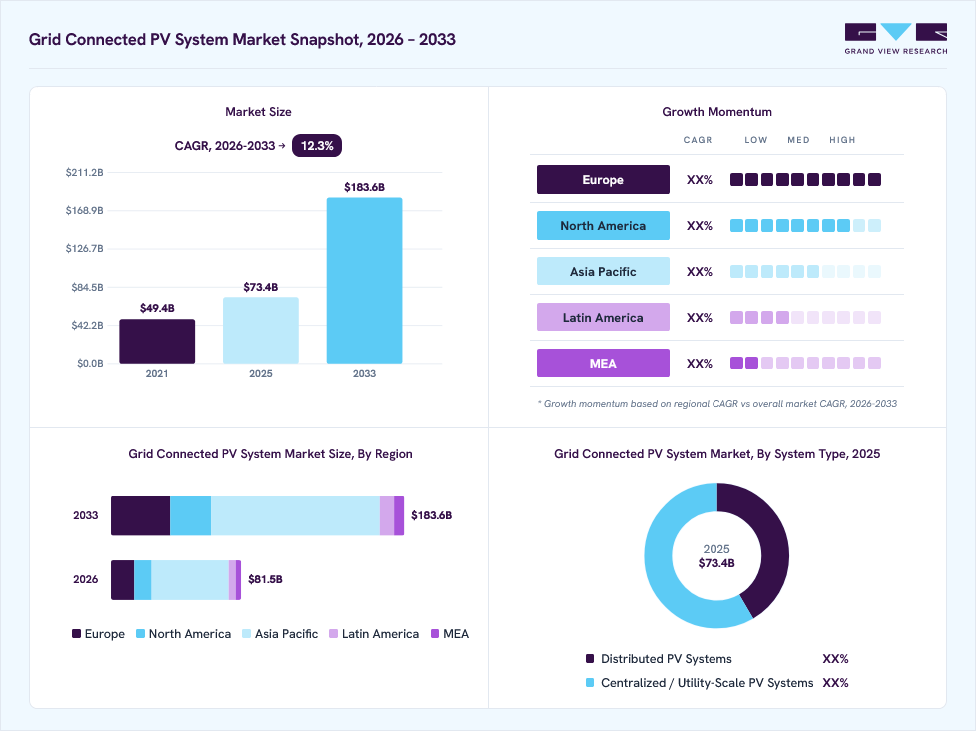
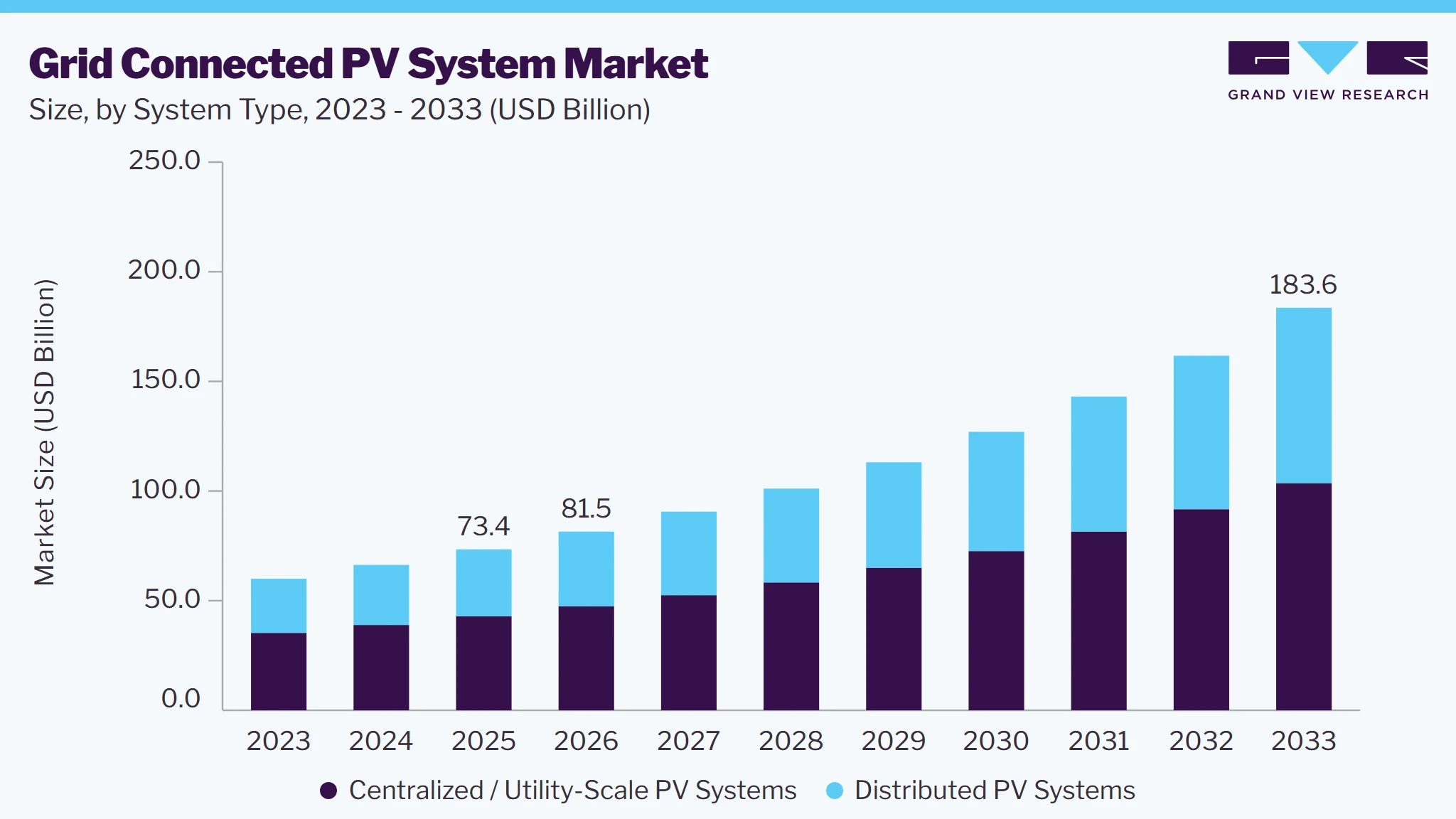
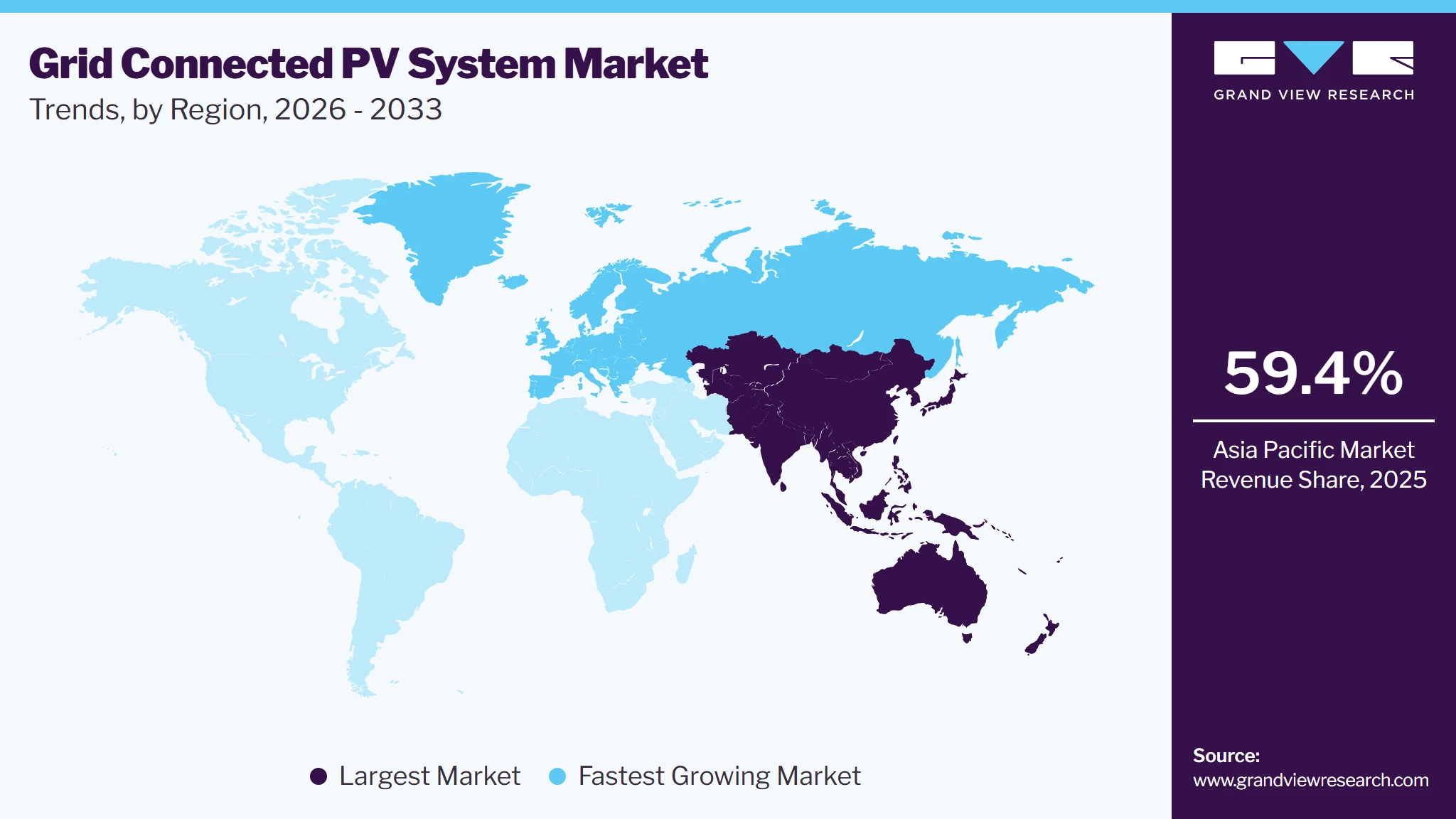
The global grid connected PV system market size was valued at USD 73.4 billion in 2025 and is projected to grow from USD 81.5 billion in 2026 to USD 183.6 billion by 2033, at a CAGR of 12.3% from 2026 to 2033. Asia Pacific dominated the market, accounting for a revenue share of 59.4% in 2025. Government policies across the Asia-Pacific region, including renewable energy targets, subsidies, auctions, and rooftop solar programs, are accelerating solar PV adoption by reducing costs and attracting investment.
Key Market Trends & Insights
- By system: Centralized/utility-scale PV systems segment held the largest market share of 58.4% in 2025.
- By end use: Utility-scale segment held the largest market share of 56.5% in 2025.
- By component: Solar modules segment held the largest market share of 51.2% in 2025.
- By PV module type: Monocrystalline segment held the largest revenue share of 80.9% in 2025.
Regional Highlights
- Largest regional market: Asia Pacific (59.4% revenue share, 2025)
- Fastest-growing regional market: Europe (highest CAGR, 2026-2033)
- By country: China held the largest market share in 2025.
Market Size & Forecast
- Market size in 2025: USD 73.4 Billion
- Estimated market size in 2026: USD 81.5 Billion
- Projected market size by 2033: USD 183.6 Billion
- CAGR (2026-2033): 12.3%
Three ways to get this report
Buy it, customize it, or ask a question.Ask an Analyst
A direct answer, usually in 1 working day
- AccessReport author, directly
- Reply timeWithin 1 working day
- No sales callDirect answer only
- FormatEmail reply
- CostFree, no cost
Get the Full Report
What the study covers
- FormatsPDF · Excel · Dashboard
- Timeline2026–2033 annual, 2025 base
- Coverage20+ countries, 5 regions
- Companies10+ key players profiled
Customize the Report
20% free customization
- IncludeCountries, segments, points
- TailorTo your product definition
- ExtendDeeper competitor detail
- OrA fully bespoke study
- Turnaround5–10 working days
Falling costs of solar PV modules, inverters, mounting structures, and other balance-of-system components are improving the economic attractiveness of utility-scale and grid-connected solar projects. Technological advancements, manufacturing scale, supply-chain efficiencies, and intense competition among PV manufacturers have contributed to lower equipment prices.
Higher-efficiency and higher-power modules also enable greater electricity generation from the same project footprint, improving overall project economics. Lower upfront capital expenditure reduces the levelized cost of electricity (LCOE), making solar increasingly competitive with conventional power sources such as coal and natural gas. As project returns improve and payback periods shorten, utilities, independent power producers, and commercial investors are more willing to develop new grid-connected PV capacity.
Market Dynamics
The grid connected PV market is experiencing growing demand as governments, utilities, independent power producers, commercial organizations, and households seek to expand renewable electricity generation and reduce dependence on fossil-fuel-based power. Grid-connected photovoltaic systems supply solar electricity directly to the grid, supporting large-scale utility generation as well as residential, commercial, and industrial applications. The growing global emphasis on decarbonization, net-zero targets, renewable-energy deployment, and energy security is significantly accelerating PV adoption worldwide. Furthermore, declining solar module, inverter, and balance-of-system costs, coupled with improvements in module efficiency, bifacial technology, tracking systems, and power-conversion technologies, are improving project economics and reducing the levelized cost of electricity. The increasing integration of battery energy storage, smart inverters, digital monitoring, and advanced grid management technologies is also enabling greater penetration of variable solar generation. Growing corporate renewable-energy procurement, expansion of utility-scale solar parks, development of distributed rooftop PV, and increasing investments in transmission and grid modernization are further supporting market growth.
The growing focus on renewable energy targets and decarbonization initiatives is a major driver of the global market, as governments worldwide seek to expand solar power generation and reduce dependence on fossil fuels. Countries are introducing renewable-energy auctions, feed-in tariffs, tax incentives, subsidies, net-metering programs, and long-term power purchase agreements to encourage grid-connected PV deployment. Furthermore, national net-zero commitments and policies aimed at improving energy security are accelerating investments in utility-scale and distributed solar projects. The increasing electricity demand from industrialization, urbanization, electrification, and data centers is further driving the need for additional renewable generation capacity. These supportive policies and growing electricity requirements are expected to accelerate global grid-connected PV installations.
Grid integration challenges and the intermittent nature of solar power remain significant constraints on the global market. Solar PV generation varies with sunlight availability, leading to fluctuations in electricity supply and increasing the need for grid balancing, forecasting, and flexible generation. High PV penetration can also pose challenges for voltage regulation, frequency stability, transmission congestion, and power curtailment, particularly in regions with limited grid infrastructure. Furthermore, integrating large-scale solar projects often requires substantial investments in transmission networks, substations, smart-grid technologies, and energy storage systems. These additional infrastructure requirements can increase project costs and extend development timelines. Grid constraints and permitting complexities may therefore slow PV deployment in markets with inadequate electricity infrastructure.
The increasing adoption of battery energy storage, smart inverters, and digital grid management technologies presents a significant opportunity for the grid-connected PV industry. Integrating battery storage with PV systems enables excess solar electricity to be stored during periods of high generation and dispatched during peak-demand periods, reducing curtailment and improving grid reliability. Advanced smart inverters can provide voltage regulation, reactive power support, and other grid support functions, enabling higher levels of solar penetration. Furthermore, digital monitoring, AI-based generation forecasting, energy management platforms, and automated grid control technologies can improve system performance and operational efficiency. As utilities and renewable-energy developers increasingly invest in flexible and resilient power systems, the adoption of PV-plus-storage and smart-grid-enabled solar projects is expected to create substantial growth opportunities.
Market Concentration & Characteristics
The grid-connected PV system market is moderately fragmented, with competition among global solar module manufacturers, inverter suppliers, electrical equipment companies, renewable energy developers, and integrated solar-system providers. Major participants include JinkoSolar, LONGi, Trina Solar, JA Solar, Canadian Solar, First Solar, Sungrow, Huawei, SMA Solar Technology, Enphase Energy, and Schneider Electric, as well as numerous regional and specialized providers. Entry barriers are moderate to high because competitive offerings require photovoltaic technology, power-conversion and inverter capabilities, grid-integration expertise, compliance with electrical and grid standards, supply-chain scale, project execution capabilities, and established relationships with utilities, developers, and commercial and industrial customers.
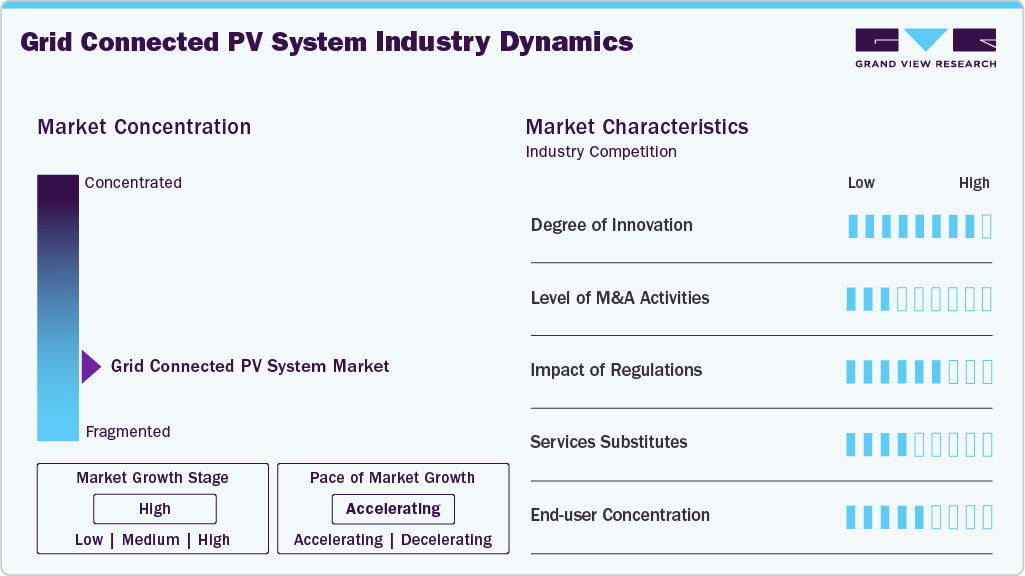
The market is in a rapid expansion phase, supported by the increasing deployment of utility-scale, commercial, and residential solar PV systems to meet rising renewable energy targets and reduce dependence on conventional power generation. Adoption is shifting from standalone solar installations to integrated, grid-connected systems that incorporate advanced inverters, energy management, battery storage, smart grid technologies, and monitoring platforms. Competitive differentiation is increasingly shifting from basic PV generation capabilities toward higher conversion efficiency, grid stability and support functions, intelligent energy management, advanced monitoring, cybersecurity, storage integration, power-quality management, and grid-forming capabilities.
Analyst Perspective
The grid-connected PV market is a key enabler of the global energy transition, driven by rising renewable energy adoption, falling solar PV costs, supportive policies, and increasing electrification. Utilities, commercial and industrial users, households, and renewable energy developers are investing in grid-connected PV systems to lower energy costs, enhance energy security, and achieve decarbonization goals. Market growth is further supported by utility-scale solar projects, rooftop installations, distributed generation, and hybrid solar-plus-storage systems. Advances in PV module efficiency, inverters, grid integration, and digital monitoring continue to improve system performance. Competitive advantage will increasingly depend on the ability to deliver integrated solutions combining high-efficiency PV modules, intelligent energy management, grid-stability capabilities, predictive maintenance, and battery storage integration. Vendors offering reliable, scalable, cost-effective, and grid-responsive solutions are expected to lead the market over the long term.
System Insights
The centralized/utility-scale PV systems segment led the market with the largest revenue share of 58.4% in 2025. Declining costs of solar modules, inverters, mounting structures, trackers, and other balance-of-system components are improving the economic attractiveness of utility-scale PV projects. Technological advancements, economies of scale, manufacturing efficiencies, and increasing competition among solar equipment suppliers have contributed to lower system costs. Higher-efficiency modules and advanced tracking technologies also enable greater electricity generation from the same land area, improving project returns. Reduced upfront investment improves project economics, enabling solar projects to achieve more attractive returns and accelerating new capacity additions by utilities and independent power producers.
The distributed PV systems segment is anticipated to grow at the fastest CAGR during the forecast period. Increasing retail electricity tariffs are improving the financial attractiveness of distributed and rooftop PV systems. As grid electricity becomes more expensive, households and businesses can reduce their electricity bills by generating and consuming solar power onsite. Higher tariffs increase the savings from self-consumption and can shorten PV system payback periods. Therefore, the rising electricity costs are encouraging residential, commercial, and industrial customers to invest in grid-connected rooftop solar installations.
Component Insights
The solar modules segment led the market with the largest revenue share of 51.2% in 2025 and is anticipated to grow at the fastest CAGR during the forecast period. The adoption of larger wafer sizes and higher-power solar modules is improving the economics of grid-connected PV projects. Larger modules can deliver greater power output per unit, reducing the number of modules required to achieve a specific project capacity. This can lower requirements for mounting structures, cables, connectors, and installation labor. Consequently, developers can reduce balance-of-system costs, simplify installation, improve land utilization, and lower overall project costs, particularly for large utility-scale solar installations.
The PCU/Inverters segment is anticipated to grow at a significant CAGR during the forecast period. The expansion of utility-scale solar farms is increasing demand for high-capacity inverter solutions. Large PV projects require inverters capable of converting substantial amounts of DC electricity generated by thousands of solar modules into grid-compatible AC electricity. Central and high-power string inverters enable efficient power conversion while supporting grid management and monitoring.
PV Module Type Insights
The monocrystalline segment accounted for the largest market revenue share of 80.9% in 2025 and is anticipated to grow at the fastest CAGR during the forecast period. Monocrystalline modules offer higher power output per unit area than lower-efficiency PV technologies. This makes them particularly valuable where available rooftop or land space is limited. Residential buildings, commercial facilities, and urban industrial sites can generate more electricity without requiring larger installation areas. Similarly, utility-scale developers can maximize energy generation from constrained land parcels. Higher power density also reduces the number of modules, mounting structures, cables, and installation components required for a given capacity, helping improve overall system economics and project efficiency.
The polycrystalline segment is expected to grow at a significant CAGR during the forecast period. Polycrystalline solar cells are manufactured by melting silicon and casting it into blocks, which are then sliced into wafers. This process is generally simpler and involves fewer processing steps than producing high-purity monocrystalline wafers. Lower manufacturing complexity can reduce equipment, energy, and production costs. Subsequently, polycrystalline modules can remain attractive in price-sensitive markets and solar projects where minimizing upfront investment is more important than achieving the highest possible efficiency.
End Use Insights
The utility-scale segment led the market with the largest revenue share of 56.5% in 2025, owing to the increasing integration of advanced grid-support capabilities in large solar power projects. Utility-scale PV installations increasingly require inverters with reactive power control, voltage and frequency regulation, power factor management, and remote monitoring capabilities to comply with evolving grid interconnection requirements. These capabilities enable large solar plants to maintain grid stability while managing variable renewable power generation, supporting the adoption of sophisticated inverter systems across utility-scale projects.
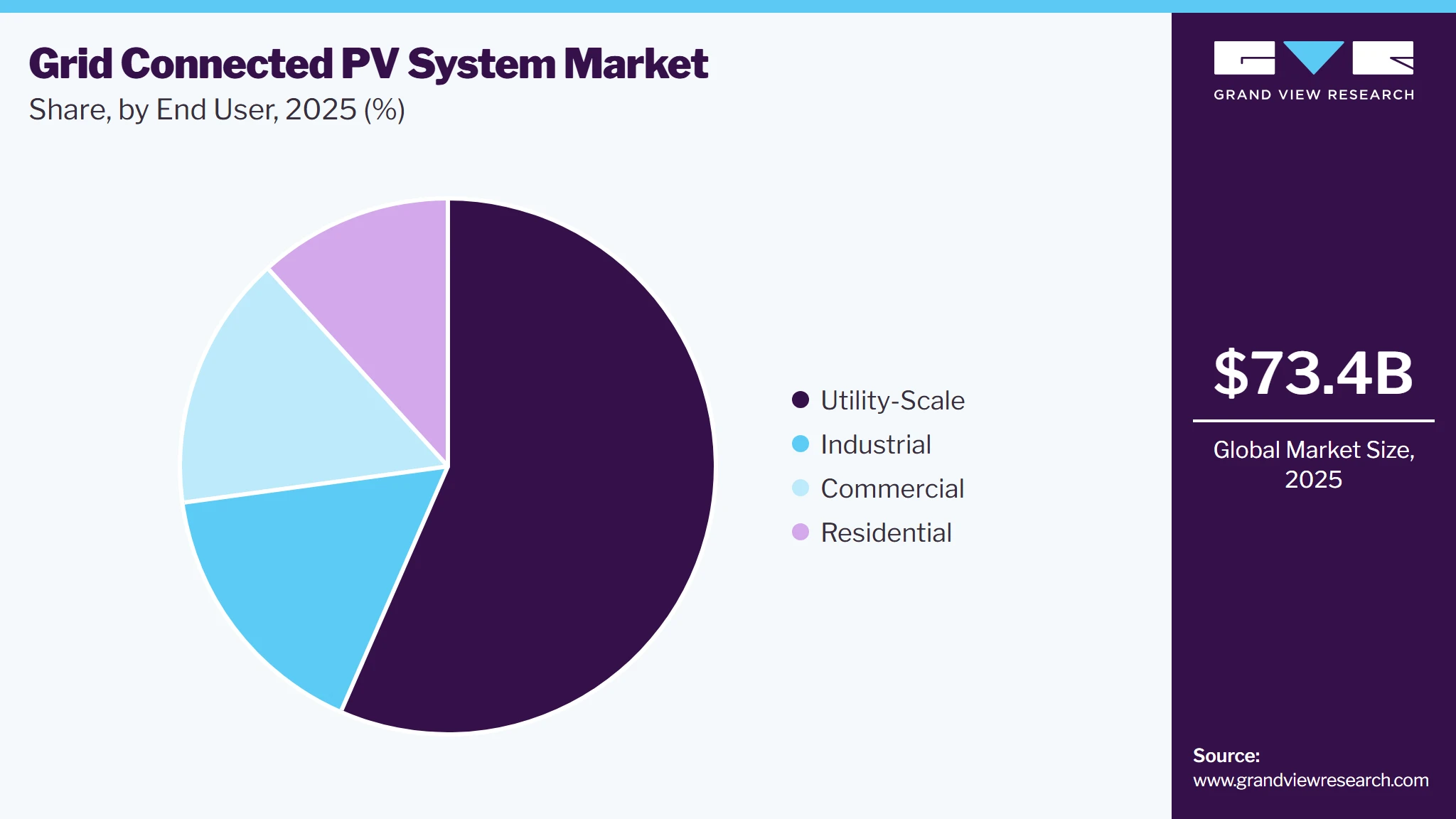
The industrial segment is expected to grow at a significant CAGR during the forecast period. Manufacturing, processing, and heavy industries require large amounts of electricity to operate machinery, production lines, heating systems, refrigeration, and other energy-intensive equipment. Rising power requirements increase operating costs and exposure to electricity price fluctuations. Grid-connected and onsite PV systems enable industrial facilities to generate renewable electricity and directly offset grid consumption. This can reduce electricity costs, improve energy cost predictability, and support corporate sustainability objectives, thereby encouraging greater adoption of industrial solar PV systems.
Regional Insights
The grid connected PV system market in North America held a significant share in the global market in 2025. Rising electricity demand from AI-enabled data centers, manufacturing facilities, electric vehicles, cooling systems, and broader electrification is increasing the need for new power-generation capacity. Data centers, in particular, require reliable, continuous electricity, encouraging technology companies and operators to secure additional renewable power through long-term PPAs, supporting new grid-connected solar projects.
U.S. Grid Connected PV System Market Trends
The grid connected PV system market in the U.S. is expected to grow at a significant CAGR of 12.3% from 2026 to 2033. The U.S. is expanding domestic solar PV manufacturing to strengthen supply chain resilience, reduce reliance on imported components, and support energy security objectives. Policy incentives and investments in domestic production are encouraging manufacturers to establish or expand module and component facilities. As a result, U.S. solar module manufacturing capacity is expected to reach approximately 40 GW by 2026.
Europe Grid Connected PV System Market Trends
The grid connected PV system market in Europe is anticipated to grow at the fastest CAGR during the forecast period. The revised EU Renewable Energy Directive strengthens Europe's commitment to renewable energy by requiring renewable sources to account for at least 42.5% of energy consumption by 2030, with an ambition to reach 45%. This policy encourages member states to accelerate solar PV deployment, increase renewable energy investments, streamline project development, and reduce dependence on fossil fuels.
The UK grid connected PV system market is expected to grow rapidly in the coming years. The UK’s Clean Power 2030 objective is to accelerate the deployment of renewable energy to create a predominantly clean electricity system. Solar PV is expected to expand to 45-47 GW by 2030, requiring substantial additions to utility-scale and distributed generation capacity. This target is encouraging investment in new grid-connected PV projects, supporting market growth.
The grid connected PV system market in Germany held a substantial market share in Europe in 2025. Germany’s large industrial sector is increasingly electrifying production processes to reduce carbon emissions and meet climate targets. Industries such as automotive, chemicals, metals, and machinery require substantial amounts of reliable, low-carbon electricity. This is encouraging companies to adopt renewable power sources, including grid-connected solar PV, to reduce emissions, manage energy costs, and support sustainable manufacturing.
Asia Pacific Grid Connected PV System Market Trends
The Asia Pacific grid connected PV system market held the largest revenue share of 59.4% in 2025. The development of large-scale solar farms across the Asia-Pacific region is accelerating as countries seek to meet rapidly rising electricity demand while reducing reliance on coal and other fossil fuels. China and India are leading regional deployment, supported by ambitious renewable-energy targets, government initiatives, abundant solar resources, and declining PV system costs, driving utility-scale capacity additions.
The grid connected PV system market in Japan is expected to grow rapidly during the forecast period. Japan's limited land availability and mountainous terrain restrict opportunities for large ground-mounted solar projects. As a result, rooftops provide an efficient alternative for expanding PV capacity without requiring additional land. Residential homes, commercial buildings, factories, warehouses, and public facilities offer substantial rooftop space, supporting the growth of distributed grid-connected solar installations.
The China grid connected PV system market accounted for the largest revenue share in the Asia Pacific in 2025. China’s continued expansion of renewable electricity capacity is driving strong demand for grid-connected solar PV systems. Government targets, large-scale renewable energy projects, and rising electricity consumption are encouraging investment in utility-scale solar farms, commercial and industrial installations, and rooftop PV. This capacity expansion is creating sustained opportunities for solar developers, equipment manufacturers, and grid infrastructure providers.
Key Grid Connected PV System Company Insight
Key players operating in the global industry are JinkoSolar, LONGi Green Energy Technology, JA Solar, Trina Solar, Canadian Solar, Tongwei, Astronergy, First Solar, Sungrow, and Huawei Technologies. The companies are focusing on various strategic initiatives, including new product development, partnerships & collaborations, and agreements to gain a competitive advantage over their rivals
Key Grid Connected PV System Companies
The following key companies have been profiled for this study on the grid connected PV system market
-
JinkoSolar
-
LONGi Green Energy Technology
-
JA Solar
-
Trina Solar
-
Canadian Solar
-
Tongwei
-
Astronergy
-
First Solar
-
Sungrow
-
Huawei Technologies
Competitive Benchmarking
Category
Operating Strategies
Competitive Edge
Weakness
Established Players (JinkoSolar, LONGi, JA Solar, Trina Solar, Canadian Solar, First Solar)
- Established players focus on large-scale manufacturing, broad PV product portfolios, technological innovation, and global project development. Their strategies emphasize high-efficiency modules, vertically integrated supply chains, utility-scale project execution, long-term customer relationships, geographic expansion, and the increasing integration of energy storage and digital energy management solutions. Companies are also investing in advanced technologies such as TOPCon, HJT, thin-film, high-power modules, and large-format wafers to improve system-level economics.
- Established players benefit from significant manufacturing capacity, strong global brands, extensive distribution networks, mature supplier ecosystems, and established relationships with utilities, EPC contractors, developers, and large commercial customers. Their scale enables lower production costs, while substantial R&D capabilities support continuous improvements in module efficiency, power density, reliability, and energy yield.
- High manufacturing capacity and intense competition can create exposure to oversupply, pricing pressure, and declining module ASPs. Large-scale manufacturing facilities require significant capital investment, while maintaining technological competitiveness requires continuous R&D expenditure. Companies are also exposed to fluctuations in raw material prices, trade restrictions, tariffs, supply chain disruptions, and changing government policies across major markets.
Emerging Players (Astronergy, Tongwei, Sungrow, Huawei FusionSolar)
- Emerging and fast-growing players focus on differentiated technologies, high-efficiency PV modules, advanced inverters, energy storage, and integrated solar solutions. Their strategies emphasize rapid technology development, expansion into international markets, strategic partnerships, and solutions combining PV generation, storage, power conversion, monitoring, and energy management. Several players are also expanding beyond individual components toward integrated renewable-energy ecosystems.
- These companies benefit from rapid product innovation, competitive manufacturing economics, specialized technology expertise, and flexibility in addressing emerging applications. Their focus on high-efficiency modules, advanced inverters, battery storage, and digital energy management systems enables them to capture demand driven by the transition toward PV + storage + smart grid solutions.
- Some players have comparatively lower brand recognition or geographic diversification in certain markets, while others face dependence on specific product categories or regions. International expansion can also be constrained by trade barriers, certification requirements, geopolitical tensions, and competition from established global suppliers. Rapid capacity expansion may further increase exposure to oversupply and pricing pressure.
Recent Developments
-
In August 2026, Saatvik Green Energy’s material subsidiary, Saatvik Solar Industries, secured a ₹190 crore order from a domestic independent power producer/EPC player to supply solar PV modules. The order is scheduled for execution by March 2027. The development highlights strong demand for domestically manufactured PV modules and provides additional revenue visibility for the company.
-
In August 2026, LONGi launched LONGi ONE in Egypt, an integrated solar and energy-storage solution combining high-efficiency PV, battery storage, digital intelligence, and lifecycle services. The platform targets utility-scale, commercial, and industrial applications, helping to improve energy utilization, grid flexibility, safety, and reliability while supporting Egypt’s renewable energy transition.
-
In May 2026, Astronergy unveiled the ASTRO N7S 3.0, its latest residential solar module, at Intersolar Europe 2026. Based on TOPCon 5.0 technology, the module features larger wafers, half-cut cells, and high-density encapsulation, delivering higher energy output, improved reliability, and an all-black aesthetic. It also offers lightweight installation and long-term performance warranties.
Grid Connected PV System Market Report Scope Table
Report Attribute
Details
Market size in 2025
USD 73.4 billion
Estimated market size in 2026
USD 81.5 billion
Projected market size by 2033
USD 183.6 billion
Growth rate
CAGR of 12.3% from 2026 to 2033
Base year for estimation
2025
Historical data
2021 - 2024
Forecast period
2026 - 2033
Quantitative units
Revenue in USD billion and CAGR from 2026 to 2033
Report coverage
Revenue forecast, company ranking, competitive landscape, growth factors, and trends
Segments covered
System type, component, PV module type, end use, region
Regional scope
North America; Europe; Asia Pacific; Latin America; MEA
Country scope
U.S.; Canada; Mexico; Germany; UK; France; China; Japan; India; South Korea; Australia; Brazil; Saudi Arabia; South Africa; UAE
Key companies profiled
JinkoSolar; LONGi Green Energy Technology; JA Solar; Trina Solar; Canadian Solar; Tongwei; Astronergy; First Solar; Sungrow; Huawei Technologies
Customization scope
Free report customization (equivalent up to 8 analysts' working days) with purchase. Addition or alteration to country, regional & segment scope.
Pricing and purchase options
Avail customized purchase options to meet your exact research needs. Explore purchase options
Global Grid Connected PV System Market Report Segmentation
This report forecasts revenue growth at the global, regional, and country levels and provides an analysis of the latest industry trends in each of the sub-segments from 2021 to 2033. For this study, Grand View Research has segmented the global grid connected PV system market report based on the system, component, PV module type, end use, and region.
-
System Outlook (Revenue, USD Billion, 2021 - 2033)
-
Distributed PV Systems
-
Centralized / Utility-Scale PV Systems
-
-
Component Outlook (Revenue, USD Billion, 2021 - 2033)
-
Solar Modules
-
PCU / Inverters
-
Grid Connection Equipment
-
Others
-
-
PV Module Type Outlook (Revenue, USD Billion, 2021 - 2033)
-
Monocrystalline
-
Polycrystalline
-
Thin-Film
-
Others
-
-
End Use Outlook (Revenue, USD Billion, 2021 - 2033)
-
Residential
-
Commercial
-
Industrial
-
Utility-Scale
-
-
Regional Outlook (Revenue, USD Billion, 2021 - 2033)
-
North America
-
U.S.
-
Canada
-
Mexico
-
Europe
-
UK
-
Germany
-
France
-
Asia Pacific
-
China
-
India
-
Japan
-
South Korea
-
Australia
-
Latin America
-
Brazil
-
Middle East & Africa
-
UAE
-
Saudi Arabia
-
South Africa
-
Research Methodology
The grid connected PV system marketfigures in this report are based on a proven research process that combines executive interviews with secondary research from proprietary databases, company filings, and recognized regulatory and institutional sources. Market size is built through value-chain sizing—reconciling supply-side and demand-side estimates—and triangulated with bottom-up and top-down approaches. Every estimate passes multiple levels of expert validation before publication, with each grid connected PV system segment quantified using the revenue-capture definitions in the table below.
Segment Definition
System
Revenue capture definition
Distributed PV Systems
Solar PV systems are installed close to electricity consumption points, such as homes, commercial buildings, and industrial facilities, with electricity supplied directly to the premises and/or the grid.
Centralized / Utility-Scale PV Systems
Large-scale solar PV installations that generate electricity primarily for supply to the electricity grid. These projects typically consist of numerous PV modules connected to high-capacity inverters and grid infrastructure.
End Use
Revenue capture definition
Residential
Grid-connected PV systems installed at homes or residential properties to generate electricity for household consumption, with excess power potentially exported to the grid.
Commercial
PV systems installed at offices, retail stores, hotels, warehouses, institutions, and other commercial facilities to reduce grid electricity consumption and operating costs.
Industrial
PV systems deployed at factories, manufacturing plants, processing facilities, and other industrial sites to provide renewable electricity for energy-intensive operations and reduce dependence on grid electricity.
Utility-Scale
Large PV power plants developed primarily to generate electricity for wholesale or grid supply. These projects are generally owned or operated by utilities, independent power producers, or large energy companies.
Component
Revenue capture definition
Solar Modules
Photovoltaic panels contain interconnected solar cells that convert sunlight directly into DC electricity.
Power Conditioning Unit (PCU)
Equipment that conditions and manages the electrical power generated by PV modules, including functions such as DC power regulation, conversion, and system protection. In many PV systems, these functions are integrated into the inverter or associated power electronics equipment.
Grid Connection Equipment
Electrical equipment required to safely connect a PV system to the electricity grid, including transformers, switchgear, circuit breakers, protection devices, meters, and related connection infrastructure.
Inverters
Power-electronic devices that convert DC electricity generated by PV modules into AC electricity compatible with the grid and electrical loads. Advanced inverters can also provide grid-support, monitoring, and power-management functions.
Others
Other components required for grid-connected PV installation and operation, including mounting structures, cables, connectors, monitoring systems, junction boxes, combiner boxes, and related balance-of-system components.
PV Module Type
Revenue capture definition
Monocrystalline
PV modules manufactured using monocrystalline silicon wafers, which consist of a single crystal structure. They generally offer high efficiency and power density, making them suitable for residential, commercial, and utility-scale applications.
Polycrystalline
PV modules manufactured using silicon wafers composed of multiple crystal structures. They typically have a simpler manufacturing process and can offer cost advantages in price-sensitive applications, although their efficiency is generally lower than that of monocrystalline modules.
Thin-Film
PV modules manufactured by depositing one or more thin layers of photovoltaic semiconductor material onto substrates such as glass, metal, or flexible surfaces. They can be lightweight and suitable for applications where flexibility, low weight, or specialized form factors are important.
Others
Includes emerging or specialized PV module technologies not classified as monocrystalline, polycrystalline, or thin-film, such as perovskite, tandem, and other advanced photovoltaic technologies.
Estimation Model
Layer
Question
Analysis
Solar Resource & Addressable Capacity Layer
Who can benefit from Grid-Connected PV Systems?
Identify countries, regions, utilities, independent power producers (IPPs), commercial & industrial facilities, residential consumers, and other electricity users with suitable solar resources and grid access. Assess solar irradiation, available land/rooftop area, electricity demand, grid connectivity, and renewable-energy targets to define the theoretical and addressable PV capacity.
PV Deployment & Generation Layer
Where is demand for Grid Connected PV generated?
Evaluate PV deployment across distributed and centralized/utility-scale systems by analyzing installed capacity, annual additions, solar irradiation, electricity demand, renewable-energy targets, government auctions, rooftop programs, and utility procurement. Assess deployment across residential, commercial, industrial, and utility-scale applications to determine the operationally reachable market.
Technology & System Adoption Layer
Who actively adopts Grid Connected PV Systems?
Analyze the adoption of solar modules, PCUs/inverters, grid connection equipment, and other balance-of-system components across systems and end users. Assess technology preferences, including monocrystalline, polycrystalline, and thin-film modules, as well as central, string, and hybrid inverter configurations, to identify active PV system demand and capacity deployment.
Revenue & Market Value Layer
How is revenue generated?
Assess revenue generated through PV module sales, inverter/PCU sales, EPC and installation services, grid connection equipment, system integration, operation & maintenance, and project development. Apply capacity additions, average system prices, component costs, and technology mix to estimate the total Grid Connected PV market value.
Delivered Customizations
This report has been delivered with the following In-depth customizations
Client Request
Customization Delivered
Value Adds
Grid-Connected PV Technology & System Architecture Assessment
Assessed demand for utility-scale, commercial & industrial, and residential grid-connected PV systems, including PV modules, inverters, mounting systems, grid-interconnection equipment, monitoring solutions, and solar-plus-storage configurations, along with technology efficiency trends, system architectures, and implementation challenges.
Supports technology selection and investment strategies by identifying high-growth PV system configurations, evaluating technology maturity, assessing efficiency and cost competitiveness, and uncovering opportunities in advanced inverter, module, and grid-integration technologies.
Regional Solar Deployment & Grid-Connected PV Demand Forecast
Evaluated solar irradiation potential, installed PV capacity, renewable energy targets, electricity demand, utility-scale project pipelines, rooftop PV adoption, grid infrastructure development, government incentives, auctions, and procurement trends across major solar markets globally.
Provides actionable insights into regional demand hotspots, capacity expansion opportunities, policy-driven growth areas, competitive landscapes, and investment priorities across established and emerging grid-connected PV markets.
Solar PV Module Technology & Cost Competitiveness Analysis
Benchmarked crystalline silicon technologies, including TOPCon, HJT, and back-contact architectures, based on module efficiency, power output, degradation rates, manufacturing scale, technology maturity, and cost trends.
Helps manufacturers and buyers understand technology differentiation, identify commercially attractive module technologies, optimize procurement strategies, and anticipate future shifts in PV technology adoption.
Frequently Asked Questions About This Report
The global grid connected PV system market size was valued at USD 73.4 billion in 2025 and is estimated at USD 81.5 billion in 2026.
The global grid connected PV system market is expected to grow at a CAGR of 12.3% from 2026 to 2033, reaching USD 183.6 billion by 2033.
Asia Pacific dominated with 59.4% revenue share in 2025.
Europe is the fastest-growing region over the forecast period.
Falling costs of solar PV modules, inverters, mounting structures, and other balance-of-system components are improving the economic attractiveness of utility-scale and grid-connected solar projects.
The centralized/utility-scale PV systems segment dominated with a 58.4% revenue share in 2025, while the distributed PV systems segment is the fastest-growing segment
The utility-scale segment held the largest share (Above 54.0%)in 2025, while the residential segment is the fastetst-growing segment.
Key players operating in the Grid Connected PV System industry are JinkoSolar, LONGi Green Energy Technology, JA Solar, Trina Solar, Canadian Solar, Tongwei, Astronergy, First Solar, Sungrow, Huawei Technologies
The solar modules segment led with a 51.2% revenue share in 2025.
About the Author(s)
Electronic Devices Research Team
Semiconductors & Electronics · Electronic DevicesThis report was authored by the electronic devices research team at Grand View Research - comprising two research analysts, one senior research analyst, and one industry expert - with specialized expertise in the electronic devices segment of the semiconductors & electronics industry. All findings are based on proprietary semiconductors & electronics databases, executive interviews, and regulatory analysis, subject to internal peer review prior to publication.
Last Updated:
Speak to Analyst


Customize this report to your needs - add regions, segments, or data points, with 20% free customization.
Or view our licence options:


ISO 9001:2015 & 27001:2022 Certified
We are GDPR and CCPA compliant! Your transaction & personal information is safe and secure. For more details, please read our privacy policy.


