
- Home
- »
- Advanced Interior Materials
- »
-
Ground Penetrating Radar Market Size & Share Report, 2033GVR Report cover

Ground Penetrating Radar Market (2026 - 2033)
Size, Share & Trends Analysis Report By Product (Cart-Based, Handheld, Vehicle-mounted), By End-use (Bridge Inspection, Concrete Inspection), By Frequency Range (Below 500 MHz, 500 MHz–1 GHz), By Region, And Segment Forecasts
Market Size, 2025
$531.0MMarket Estimate, 2026
$577.5MMarket Forecast, 2033
$1,079.4MCAGR, 2026–2033
9.3%Ground Penetrating Radar Market Summary
The global ground penetrating radar market size was valued at USD 531.0 million in 2025 and is projected to grow from USD 577.5 million in 2026 to USD 1,079.4 million by 2033, at a CAGR of 9.3% from 2026 to 2033. North America dominated the market, accounting for a revenue share of 31.5% in 2025. The increasing investment in transportation infrastructure, modernization, and underground utility mapping is a major factor driving market growth.
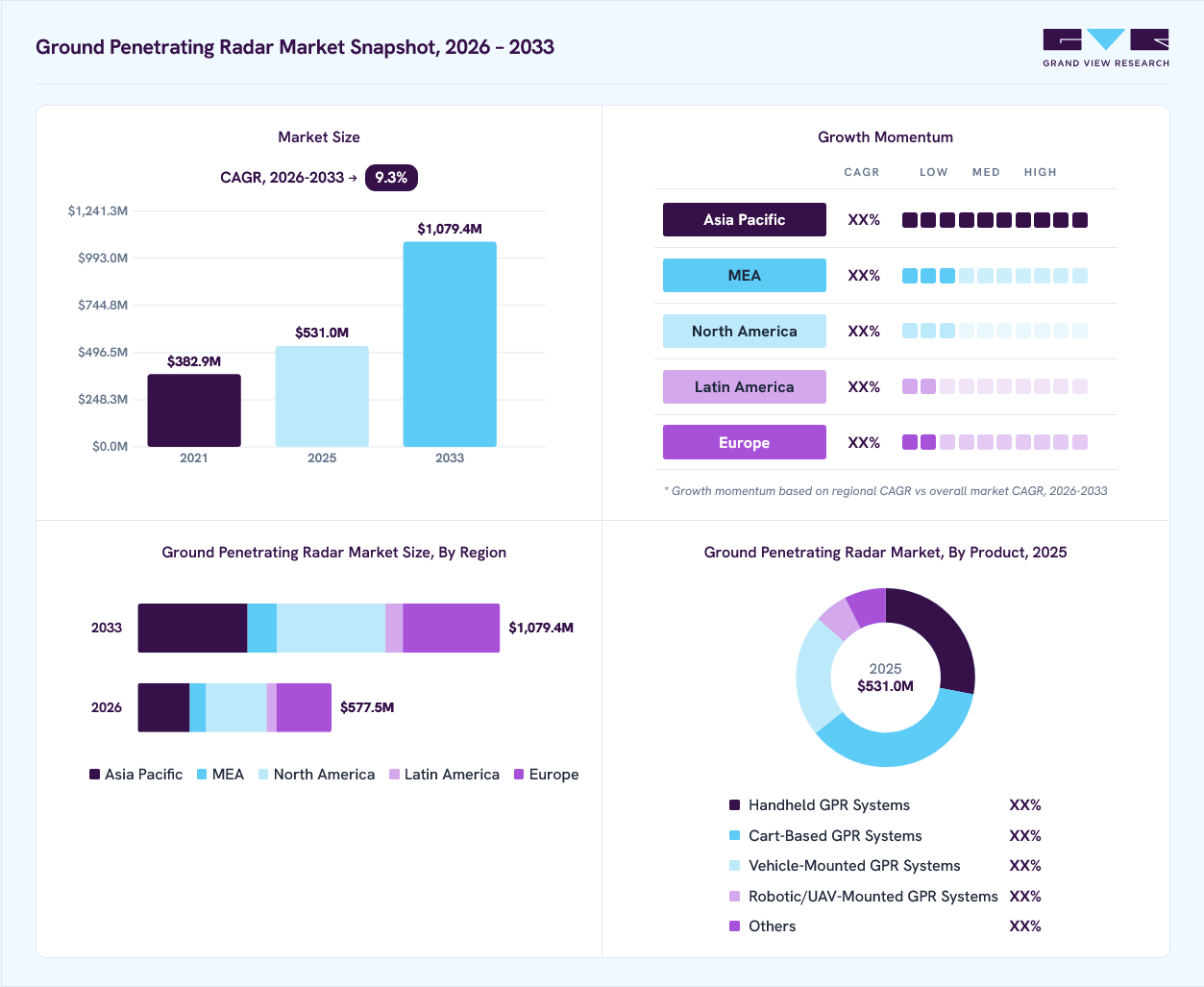 Source: Grand View Research, IR Documents, Primary Interviews, Paid DatabasesTo learn more about this report,
 Download Free Sample Report
Key Market Trends & Insights
- By product: Cart-based GPR systems segment led the market with the largest revenue share of 36.3% in 2025.
- By frequency range: The 500 MHz-1 GHz segment led the market with the largest revenue share of 41.5% in 2025.
- By end-use: The utility detection & mapping segment led the market with the largest revenue share of 26.2% in 2025.
Regional Highlights
- Largest regional market: North America (31.5% revenue share, 2025)
- Fastest-growing regional market: Asia Pacific (highest CAGR, 2026-2033)
- By country: The U.S. held the largest market share in 2025.
Market Size & Forecast
- Market size in 2025: USD 531.0 Million
- Estimated market size in 2026: USD 577.5 Million
- Projected market size by 2033: USD 1,079.4 Million
- CAGR (2025-2033): 9.3%
Prism AI by Grand View Research Free to tryAsk a question about the ground penetrating radar market✓Every figure cited from GVR research Prefer the report? Download free sample →
Governments and infrastructure agencies are prioritizing the maintenance and rehabilitation of aging roads, bridges, tunnels, railways, and airports, creating strong demand for non-destructive inspection technologies. GPR enables rapid assessment of pavement thickness, subsurface voids, moisture intrusion, and structural defects without disrupting traffic or damaging existing infrastructure. Technological advancements in GPR hardware and software, along with expanding applications across multiple industries, are further accelerating market growth.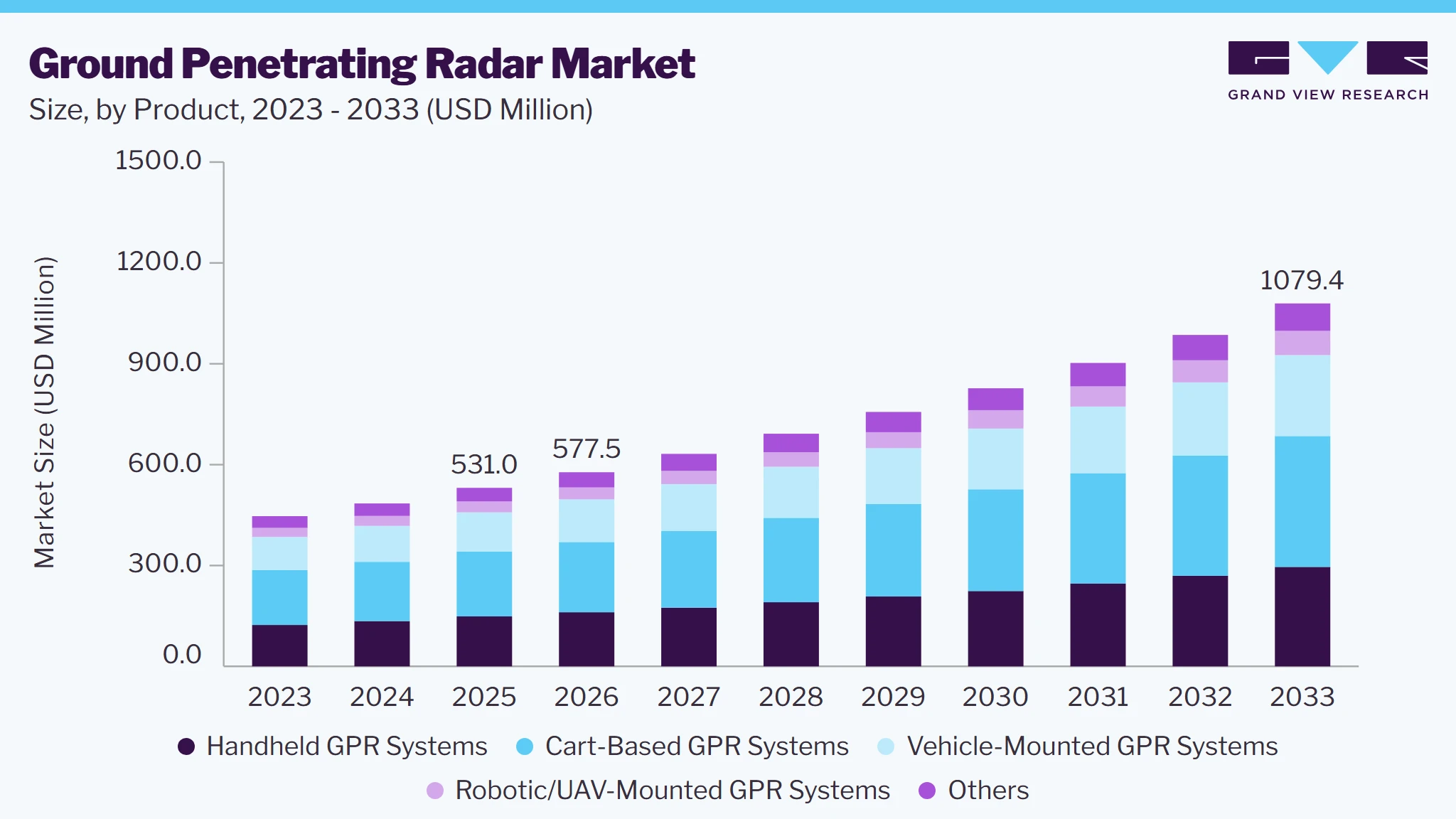 To learn more about this report, Download Free Sample Report
Modern GPR systems offer higher-resolution imaging, multi-channel data acquisition, 3D subsurface visualization, GPS integration, cloud-based data management, and AI-assisted signal interpretation, making surveys faster and more accurate. These innovations are encouraging adoption in sectors such as mining, environmental assessment, archaeology, defense, forensic investigations, and concrete inspection. The growing emphasis on preventive infrastructure maintenance, stricter safety regulations for excavation activities, and the increasing preference for non-invasive testing methods are also supporting the widespread deployment of GPR systems across developed and emerging economies.
Market Dynamics
The market is experiencing steady growth due to increasing investments in infrastructure modernization, expansion of underground utility networks, and the growing adoption of non-destructive testing (NDT) technologies. Governments and private organizations are focusing on preventive maintenance of transportation assets, utility mapping, and structural health monitoring to improve safety and reduce maintenance costs. At the same time, advancements in multi-channel GPR systems, AI-powered data analysis, 3D subsurface imaging, and integration with GIS and drone platforms are expanding the technology's applications across construction, mining, defense, environmental monitoring, and forensic investigations.
The growing need to inspect and maintain aging infrastructure is a major driver of the market. Roads, bridges, tunnels, railways, and airports require regular condition assessments to detect subsurface defects before they become critical failures. GPR enables engineers to evaluate pavement thickness, identify voids, locate reinforcing steel, and assess structural integrity without damaging existing infrastructure. As governments increase spending on transportation modernization and smart infrastructure projects, demand for fast, accurate, and non-destructive inspection technologies continues to rise.
In addition, rapid urbanization and the expansion of underground utility networks are increasing the need for accurate subsurface mapping prior to excavation and construction. Utility companies and contractors use GPR to locate buried water pipelines, gas lines, electrical cables, telecommunications infrastructure, and sewer systems, reducing the risk of accidental utility strikes and costly project delays. The technology improves worker safety, enhances project planning, and supports compliance with excavation safety regulations, making it an essential tool for modern infrastructure development.
Despite its advantages, the effectiveness of Ground Penetrating Radar can be limited by certain soil and environmental conditions. Highly conductive materials such as clay-rich soils, saline water, and wet ground can significantly reduce radar signal penetration and degrade image quality, making it difficult to accurately detect deep underground objects. These limitations often require the use of complementary geophysical methods, increasing project complexity and operational costs, particularly in regions with unfavorable geological conditions.
The integration of artificial intelligence, machine learning, and autonomous surveying platforms presents a significant market growth opportunity. AI-enabled software can automate data interpretation, improve anomaly detection, and reduce the time required to analyze complex subsurface information. Meanwhile, the deployment of GPR systems on drones, robotic platforms, and autonomous vehicles enables safer and more efficient inspections in hazardous, inaccessible, or large-scale environments. These technological advancements are expected to accelerate GPR adoption across infrastructure management, mining, environmental monitoring, and defense applications while improving operational efficiency and decision-making.
Market Concentration & Characteristics
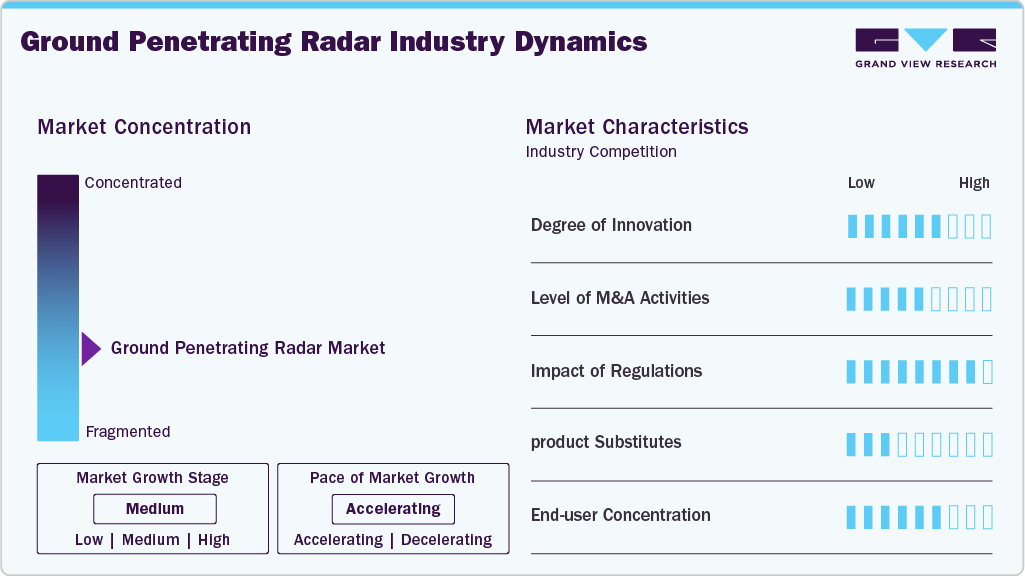
The ground penetrating radar industry is fragmented, with several established global manufacturers alongside regional and niche technology providers serving specialized applications. Leading companies such as Geophysical Survey Systems, Inc. (GSSI), IDS GeoRadar (Hexagon), Guideline Geo AB, Sensors & Software Inc., and ImpulseRadar compete through product innovation, advanced imaging capabilities, software integration, and application-specific solutions. While these companies hold significant market positions in infrastructure inspection, utility mapping, and geophysical surveys, numerous regional players serve local construction, mining, environmental, and defense needs.
The ground penetrating radar (GPR) industry exhibits a high degree of innovation, driven by continuous advancements in antenna design, signal processing, imaging software, and artificial intelligence. Manufacturers are developing multi-channel GPR systems, real-time 3D visualization, cloud-based data management, and AI-assisted interpretation tools that improve survey accuracy and reduce analysis time. Integration with GPS, GIS, autonomous vehicles, drones, and robotics is further expanding the technology's capabilities, enabling faster and more efficient subsurface inspections across infrastructure, utilities, mining, and defense applications.
 To learn more about this report, Download Free Sample Report
The GPR market is significantly influenced by regulations governing infrastructure safety, utility damage prevention, transportation asset management, and occupational health and safety. Governments and regulatory bodies increasingly require non-destructive testing (NDT) and accurate underground utility mapping prior to excavation, construction, and maintenance activities to minimize accidents and service disruptions. Compliance with standards governing road inspections, bridge assessments, building safety, and defense operations is encouraging wider adoption of GPR systems, while spectrum regulations for radar equipment also shape product design and deployment across different regions.
The end-user base for ground penetrating radar systems is moderately diversified, with demand distributed across construction, transportation, utilities, mining, defense, environmental consulting, and public infrastructure sectors. Government agencies, utility companies, engineering consultants, and infrastructure inspection firms account for a substantial share of demand, driven by ongoing investments in asset maintenance and underground utility management. Meanwhile, growing adoption by forensic investigators, archaeological organizations, research institutions, and industrial inspection service providers is broadening the customer base and reducing reliance on any single end-use industry.
Analyst Perspective
The market is expected to witness steady growth over the forecast period, driven by increasing investments in transportation infrastructure, underground utility mapping, and non-destructive testing across developed and emerging economies. Rising demand for accurate subsurface imaging, coupled with stricter regulations on infrastructure maintenance and asset management, is accelerating the adoption of advanced GPR systems. Technological advancements such as AI-powered data interpretation, GNSS integration, 3D visualization, and robotic or UAV-mounted platforms are further enhancing survey efficiency and expanding application areas. As governments and private organizations continue to prioritize smart infrastructure, public safety, and sustainable construction practices, market participants are expected to focus on product innovation, strategic collaborations, and geographic expansion to strengthen their competitive position and capitalize on long-term growth opportunities.
Product Insights
Cart-based GPR systems dominated the market with the largest revenue share of 36.3% in 2025 due to their versatility, ease of operation, and ability to efficiently survey medium- to large-sized areas. These systems are extensively used for road and highway inspections, bridge deck assessments, utility mapping, archaeological investigations, and municipal infrastructure projects. Their ability to deliver high-resolution subsurface imaging while maintaining portability and operational efficiency makes them a preferred choice for engineering consultants, utility companies, and transportation agencies undertaking routine infrastructure inspections.
Robotic/UAV-mounted GPR systems are expected to experience the fastest growth during the forecast period, with a CAGR of 10.7%, driven by increasing demand for autonomous inspection solutions in hazardous, remote, and difficult-to-access environments. The integration of GPR with unmanned aerial vehicles (UAVs), unmanned ground vehicles (UGVs), and robotic platforms enables safer and faster data collection for applications such as mining exploration, military reconnaissance, disaster response, and large-scale infrastructure monitoring. Continuous advancements in automation, AI-based data processing, and autonomous navigation are further accelerating the adoption of robotic and UAV-mounted GPR systems across commercial and government sectors.
Frequency Range Insights
The 500 MHz-1 GHz segment dominated the market with the largest revenue share of 41.5% in 2025, owing to its optimal balance between penetration depth and imaging resolution. This frequency range is widely used for underground utility detection, road and pavement inspections, bridge assessments, and archaeological surveys, where both accurate target identification and moderate subsurface penetration are required. Its versatility across diverse soil conditions and infrastructure applications has made it the preferred choice for engineering firms, utility providers, transportation agencies, and construction contractors.
The below 500 MHz segment is expected to register the fastest growth at a CAGR of 9.8% during the forecast period, driven by increasing demand for deeper subsurface investigations in geological exploration, mining, environmental studies, and large-scale infrastructure projects. Lower-frequency GPR systems offer greater penetration depth, enabling detection of deep underground utilities, geological formations, voids, and groundwater features that are not effectively detected with higher-frequency antennas. Rising investment in mining exploration, geotechnical investigations, and underground infrastructure development is expected to further accelerate the adoption of below-500-MHz GPR systems.
End-use Insights
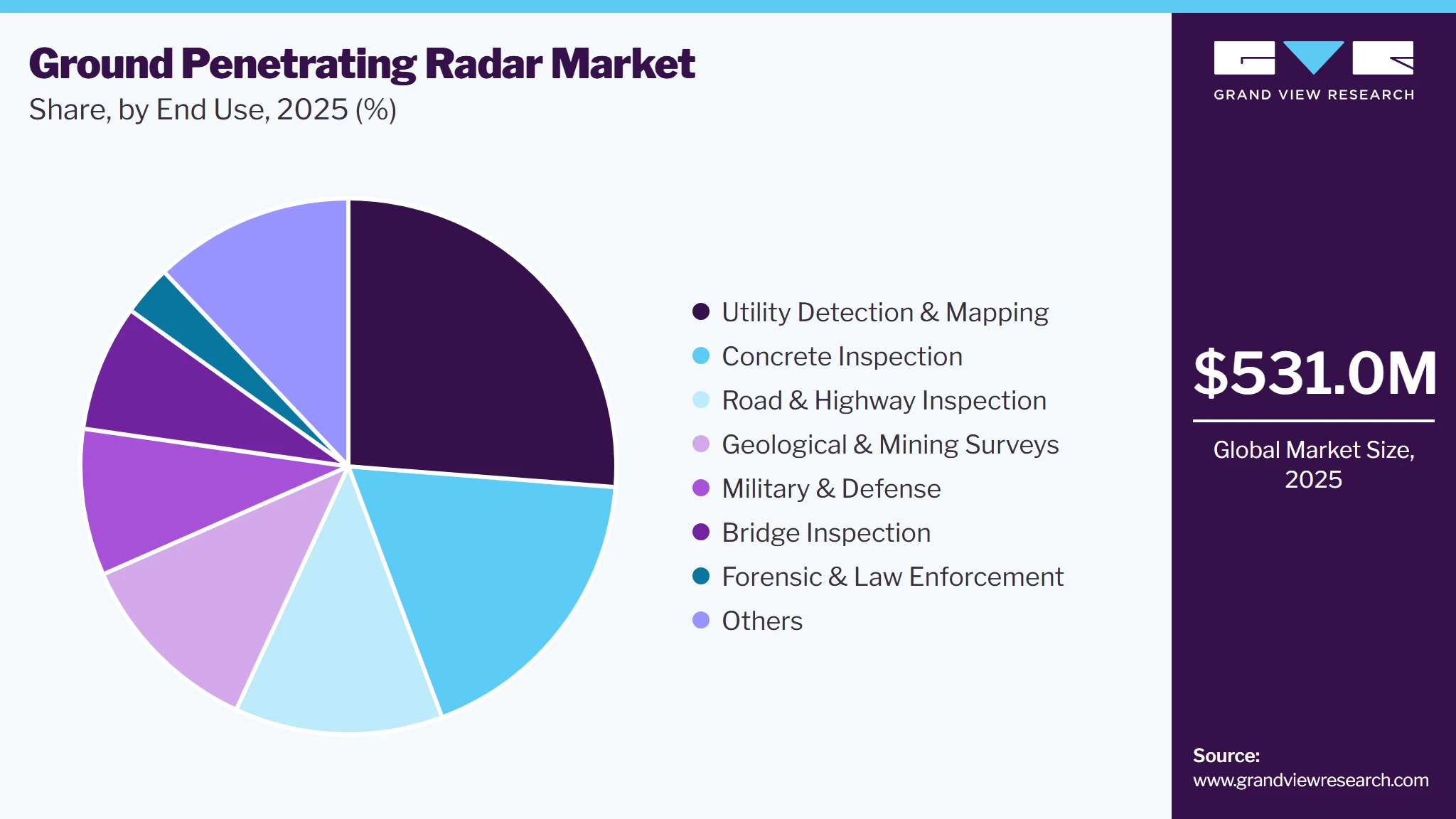
Utility detection & mapping dominated the market, holding the largest revenue share of 26.2% in 2025, driven by the growing need to accurately locate underground infrastructure prior to excavation and construction activities. GPR systems are widely used to identify buried water pipelines, gas lines, electrical cables, telecommunications networks, and sewer systems, helping prevent utility strikes and costly project delays. Growing investments in smart city development, urban infrastructure expansion, and underground utility modernization have further strengthened municipalities', utility providers', and engineering contractors' adoption of GPR for utility mapping.
 To learn more about this report, Download Free Sample Report
Road & highway inspection is expected to witness the fastest growth at a CAGR of 10.6% during the forecast period, driven by rising investments in transportation infrastructure, maintenance, and asset management. Transportation agencies are increasingly adopting GPR to assess pavement thickness, detect subsurface voids, identify moisture intrusion, and evaluate structural deterioration without disrupting traffic flow. The growing emphasis on predictive maintenance, improved road safety, and cost-effective infrastructure rehabilitation, along with government funding for highway modernization projects, is expected to accelerate the demand for GPR systems in road and highway inspection applications.
Regional Insights
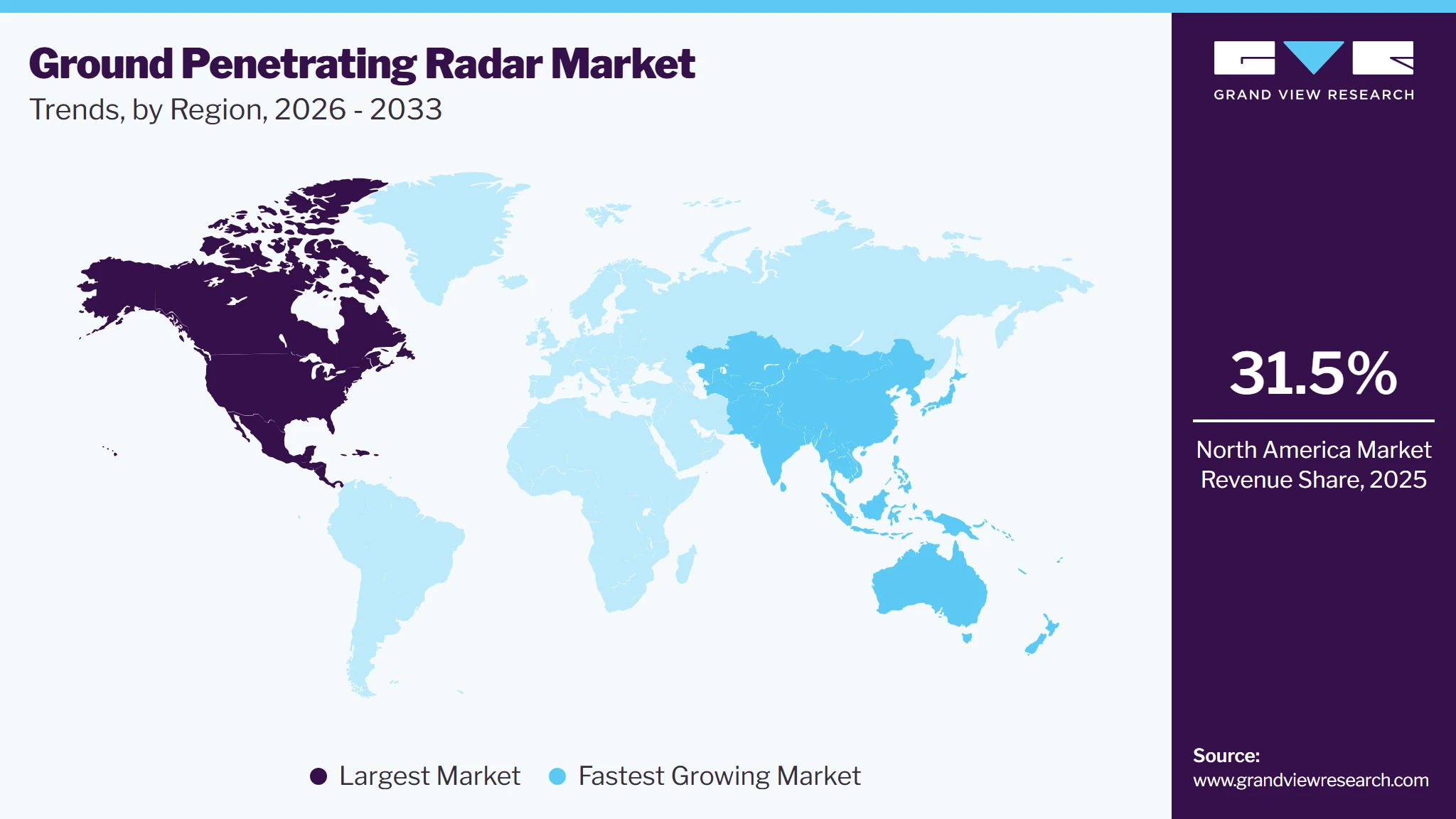
North America dominated the ground penetrating radar market with the largest revenue share of 31.5% in 2025, supported by substantial investments in transportation infrastructure rehabilitation, utility network modernization, and advanced non-destructive testing technologies. The U.S. and Canada have widely adopted GPR systems for road and bridge inspections, underground utility mapping, airport runway assessments, and concrete evaluation. Strong regulatory emphasis on excavation safety, the presence of leading GPR manufacturers, and increasing spending on smart infrastructure projects continue to strengthen the region's market leadership.
 To learn more about this report, Download Free Sample Report
U.S. Ground Penetrating Radar Market Trends
The ground penetrating radar market in the U.S. dominated North America in 2025, supported by extensive investments in transportation infrastructure, underground utility modernization, and public asset management. The country has one of the world's largest networks of roads, bridges, railways, airports, and utility corridors, creating sustained demand for non-destructive subsurface inspection technologies. The Infrastructure Investment and Jobs Act (IIJA) continues to drive infrastructure upgrades, with approximately USD 350 billion allocated for federal highway programs during FY2022-FY2026, while the bridge investment program provides more than USD 15 billion for bridge rehabilitation and replacement. These initiatives are accelerating the deployment of GPR systems for pavement evaluation, bridge deck inspections, utility mapping, and airport runway assessments.
Canada ground penetrating radar market is expected to witness steady growth during the forecast period, driven by increasing investments in transportation infrastructure, mining exploration, and municipal utility upgrades. Federal and provincial governments are expanding road rehabilitation programs, public transit projects, and water infrastructure improvements, creating greater demand for underground utility detection and structural assessment technologies. Canada's strong mining sector also supports the adoption of lower-frequency GPR systems for geological investigations and resource exploration.
Europe Ground Penetrating Radar Market Trends
The ground penetrating radar market in Europe is significant, driven by a strong focus on preserving aging infrastructure and improving transportation asset management. GPR systems are widely used for bridge inspections, tunnel assessments, railway maintenance, and archaeological investigations in countries including Germany, the UK, France, and Italy. The region's emphasis on sustainable infrastructure management, strict construction quality standards, and continuous investments in digital surveying technologies supports steady market growth.
Germany ground penetrating radar market dominated Europe in 2025, supported by its extensive transportation infrastructure and ongoing investments in infrastructure modernization. According to the Federal Statistical Office of Germany (Destatis), the country has approximately 229,500 km of higher-order roads, including about 13,200 km of Autobahn. Furthermore, the German Federal Ministry of Finance has established a USD 581.3 billion special fund for infrastructure and climate neutrality (2025-2036) to modernize transportation, digital, and public infrastructure, creating significant opportunities for GPR deployment in road, bridge, railway, and underground utility inspections.
The ground penetrating radar market in France is expected to grow steadily during the forecast period, supported by continued investments in transportation infrastructure, urban redevelopment, and utility modernization. The country is increasingly using ground-penetrating radar for highway maintenance, railway inspections, tunnel assessments, underground utility detection, and heritage preservation projects. Growing emphasis on preventive infrastructure maintenance, expansion of public transit networks, and adoption of non-destructive testing technologies by engineering consultants and public authorities are expected to drive demand for GPR systems.
Asia Pacific Ground Penetrating Radar Market Trends
The ground penetrating radar market in the Asia Pacific is expected to register the fastest growth during the forecast period due to rapid urbanization, expanding construction activities, and large-scale investments in transportation, energy, and smart city infrastructure. Countries such as China, India, Japan, South Korea, and Australia are increasingly deploying GPR systems for utility detection, railway development, highway expansion, mining exploration, and disaster management. Rising government expenditure on infrastructure development and growing awareness of non-destructive inspection technologies are accelerating market adoption across the region.
China ground penetrating radar market dominated the Asia Pacific in 2025, driven by its large-scale investments in transportation infrastructure, urban development, high-speed rail expansion, and underground utility networks. The country extensively utilizes GPR systems for highway and railway inspections, tunnel construction, metro projects, bridge monitoring, and utility detection to support its rapidly expanding infrastructure. Strong government investment in smart city initiatives, digital infrastructure, and advanced non-destructive testing technologies, coupled with a robust domestic construction industry, continues to reinforce China's leadership in the regional market.
The ground penetrating radar market in India is projected to grow strongly during the forecast period, driven by rising investments in transport infrastructure, urban development, and utility modernization. According to the Ministry of Road Transport and Highways (MoRTH), the country's National Highway network has expanded to nearly 146,560 km, making it one of the largest in the world. In addition, under the Bharatmala Pariyojana, 26,425 km of highway projects have been awarded, with more than 21,500 km completed by late 2025. These large-scale infrastructure programs are increasing demand for Ground-Penetrating Radar systems to support underground utility detection, pavement condition assessment, bridge inspections, and geotechnical investigations. Growing implementation of initiatives such as PM Gati Shakti and the Smart Cities Mission is further encouraging the adoption of advanced subsurface imaging technologies for efficient planning and maintenance of critical infrastructure.
Middle East & Africa Ground Penetrating Radar Market Trends
The ground penetrating radar market in MEA is expanding steadily, supported by ongoing investments in large-scale construction projects, oil and gas infrastructure, and transportation development. GPR systems are increasingly used for underground utility detection, pipeline mapping, airport infrastructure inspections, and geotechnical investigations in countries such as Saudi Arabia, the UAE, and South Africa. Rising infrastructure diversification initiatives, combined with the need for accurate subsurface imaging in challenging environments, are expected to drive continued adoption of GPR solutions across the region.
Saudi Arabia ground penetrating radar market dominated MEA, supported by large-scale infrastructure development, urban expansion, and transportation modernization initiatives under Vision 2030. The country is increasingly using ground-penetrating radar for underground utility mapping, highway and railway inspections, airport expansion projects, pipeline detection, and geotechnical investigations. Rising investments in smart cities, including NEOM and other giga projects, are driving the adoption of advanced subsurface imaging technologies to improve construction efficiency and reduce excavation risks.
Latin America Ground Penetrating Radar Market Trends
The ground penetrating radar market in Latin America is witnessing steady growth as governments increase investments in transportation networks, mining operations, and urban infrastructure development. Countries such as Brazil, Mexico, and Chile are adopting GPR solutions for utility mapping, road maintenance, geological surveys, and environmental assessments. Growing demand for efficient subsurface investigations and improved project planning is encouraging the wider use of GPR technology across public- and private-sector infrastructure projects.
Brazil ground penetrating radar market dominated in 2025, driven by continued investments in transportation infrastructure, urban development, and natural resource exploration. The country is increasingly adopting Ground Penetrating Radar for highway and railway maintenance, underground utility mapping, bridge inspections, geotechnical investigations, and mining applications. Growing emphasis on modernizing public infrastructure, improving asset management practices, and reducing excavation risks is encouraging the use of advanced non-destructive testing technologies.
Key Ground Penetrating Radar Company Insights
Some of the key players operating in the market include GSSI Geophysical Survey Systems, Inc., IDS GeoRadar (Hexagon AB), and Guideline Geo.
-
Geophysical Survey Systems, Inc. (GSSI) is one of the pioneers in ground penetrating radar technology. Founded in 1970 and headquartered in Nashua, New Hampshire, the company introduced the world's first commercial GPR system and has since developed a broad portfolio of GPR and electromagnetic induction solutions. GSSI serves applications including utility locating, concrete inspection, transportation infrastructure assessment, geotechnical investigations, archaeology, mining, and environmental studies. The company operates through a global network of distributors and support partners, providing advanced subsurface imaging solutions to customers across construction, engineering, and infrastructure sectors.
-
IDS GeoRadar, a subsidiary of Hexagon AB, specializes in developing advanced GPR and radar-based monitoring solutions for infrastructure, geoscience, mining, transportation, and public safety applications. The company offers a comprehensive range of GPR systems and software designed for underground utility mapping, road and bridge inspections, railway assessments, structural investigations, and environmental surveys. With a strong focus on innovation and digital technologies, IDS GeoRadar combines advanced sensing capabilities with data analytics to improve the accuracy and efficiency of subsurface investigations. Supported by Hexagon's global network, the company serves customers across Europe, North America, the Asia Pacific, and other international markets.
Key Ground Penetrating Radar Companies
The following key companies have been profiled for this study on the ground penetrating radar market.
-
GSSI Geophysical Survey Systems, Inc.
-
IDS GeoRadar (Hexagon AB)
-
Guideline Geo
-
MALA Ground Penetrating Radar
-
Sensors & Software Inc.
-
US Radar
-
ImpulseRadar Sweden AB
-
Screening Eagle Technologies
-
Leica Geosystems AG
-
Radarteam Sweden AB
-
Groundradar
-
Utsi Electronics Ltd
-
Penetradar
-
GeoModel, Inc.
-
Novatest Srl
Competitive Benchmarking
Category
Operating Strategies
Competitive Edge
Weakness
Established Players (e.g., GSSI Geophysical Survey Systems, Inc.; IDS GeoRadar (Hexagon AB); Guideline Geo; Sensors & Software Inc.; Leica Geosystems AG)
- Invest in advanced GPR technologies, including AI-enabled analytics, 3D imaging, and GNSS integration.
- Expand market presence through strategic partnerships, acquisitions, and extensive global distribution networks.
- Focus on high-value applications such as infrastructure inspection, utility mapping, transportation, and defense.
- Strong global brand recognition with comprehensive product portfolios.
- Advanced imaging capabilities supported by integrated software and data management platforms.
- Well-established customer base and extensive technical support worldwide.
- Higher product prices compared to regional competitors.
- Greater dependence on public infrastructure and government-funded projects.
- Longer product development and commercialization cycles.
Emerging & Regional Players (e.g., ImpulseRadar Sweden AB; US Radar; Radarteam Sweden AB; Groundradar; Novatest Srl.)
- Focus on niche applications and customized solutions for regional customers.
- Compete through cost-effective products and flexible deployment options.
- Strengthen market reach through local distributors and engineering partnerships.
- Competitive pricing and quicker response to customer requirements.
- High flexibility in product customization and project-specific solutions.
- Strong regional relationships with contractors, surveyors, and engineering firms.
- Limited global brand recognition and geographic presence.
- Smaller product portfolios and lower R&D investment.
- Less established distribution and after-sales support networks compared to leading players.
Recent Developments
-
In March 2026, GSSI announced a strategic collaboration with Topcon Positioning Systems to integrate its Ground Penetrating Radar (GPR) technology with Topcon's GNSS receivers, correction services, and data workflow software. The combined solution is designed to deliver accurate subsurface mapping with precise geospatial positioning, improving infrastructure and construction project workflows.
-
In March 2025, Sensors & Software, a Radiodetection company, introduced GPR-SG, a plug-and-play GNSS positioning solution for its LMX, Noggin, and pulseEKKO Ground Penetrating Radar systems. The solution enables seamless integration of high-accuracy positioning with GPR surveys, improving underground utility mapping and subsurface asset documentation.
Ground Penetrating Radar Market Report Scope
Report Attribute
Details
Market size in 2025
USD 531.0 million
Estimated market size in 2026
USD 577.5 million
Projected market size by 2033
USD 1,079.4 million
Growth rate
CAGR of 9.3% from 2026 to 2033
Historical data
2021 - 2025
Forecast period
2026 - 2033
Quantitative units
Revenue in USD million and CAGR from 2026 to 2033
Report coverage
Revenue forecast, company ranking, competitive landscape, growth factors, and trends
Segments covered
Product, frequency range, end-use, region
Regional scope
North America; Europe; Asia Pacific; Latin America; MEA
Country scope
U.S.; Canada; Mexico; UK; Germany; France; Spain; Italy; China; Japan; India; Australia; South Korea; Brazil; Argentina; Saudi Arabia; UAE; South Africa
Key companies profiled
GSSI Geophysical Survey Systems, Inc.; IDS GeoRadar (Hexagon AB); Guideline Geo; MALÅ Ground Penetrating Radar; Sensors & Software Inc.; US Radar; ImpulseRadar Sweden AB; Screening Eagle Technologies; Leica Geosystems AG; Radarteam Sweden AB; Groundradar; Utsi Electronics Ltd; Penetradar; GeoModel, Inc.; Novatest Srl.
Customization scope
Free report customization (equivalent up to 8 analysts working days) with purchase. Addition or alteration to country, regional & segment scope.
Pricing and purchase options
Avail customized purchase options to meet your exact research needs. Explore purchase options
Global Ground Penetrating Radar Market Report Segmentation
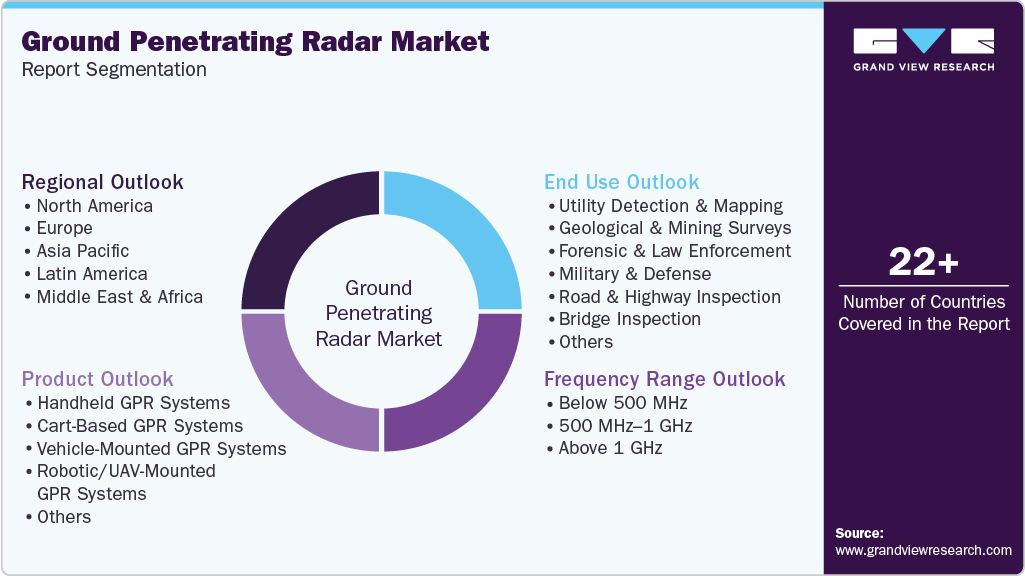
This report forecasts revenue growth at global, regional, and country levels and provides an analysis of the latest industry trends in each of the sub-segments from 2021 to 2033. For this study, Grand View Research has segmented the global ground penetrating radar market report based on product, frequency range, end-use, and region:
 To learn more about this report, Download Free Sample Report
-
Product Outlook (Revenue, USD Million, 2021 - 2033)
-
Handheld GPR Systems
-
Cart-Based GPR Systems
-
Vehicle-Mounted GPR Systems
-
Robotic/UAV-Mounted GPR Systems
-
Others
-
-
Frequency Range Outlook (Revenue, USD Million, 2021 - 2033)
-
Below 500 MHz
-
500 MHz-1 GHz
-
Above 1 GHz
-
-
End-use Outlook (Revenue, USD Million, 2021 - 2033)
-
Utility Detection & Mapping
-
Geological & Mining Surveys
-
Forensic & Law Enforcement
-
Military & Defense
-
Road & Highway Inspection
-
Bridge Inspection
-
Concrete Inspection
-
Others
-
-
Regional Outlook (Revenue, USD Million, 2021 - 2033)
-
North America
-
U.S.
-
Canada
-
Mexico
-
-
Europe
-
Germany
-
France
-
Italy
-
Spain
-
UK
-
-
Asia Pacific
-
China
-
India
-
Japan
-
South Korea
-
Australia
-
-
Latin America
-
Brazil
-
Argentina
-
-
Middle East & Africa
-
Saudi Arabia
-
UAE
-
South Africa
-
-
Research Methodology
The ground penetrating radar market figures in this report are based on a proven research process that combines executive interviews with secondary research from proprietary databases, company filings, and recognized regulatory and institutional sources. Market size is built through value-chain sizing-reconciling supply-side and demand-side estimates-and triangulated with bottom-up and top-down approaches. Every estimate passes multiple levels of expert validation before publication, with each ground penetrating radar segment quantified using the revenue-capture definitions in the table below.
Segment Definition
Product
Revenue Capture Definition
Handheld GPR Systems
Revenue generated from the sale of portable radar systems designed for rapid subsurface inspections, utility locating, concrete scanning, and forensic investigations.
Cart-Based GPR Systems
Revenue generated from the sale of cart-mounted radar systems used for high-speed ground surveys, utility mapping, road inspections, and large-area subsurface imaging.
Vehicle-Mounted GPR Systems
Revenue generated from the sale of vehicle-integrated radar systems deployed for highway assessments, pavement evaluation, railway inspections, and large-scale infrastructure surveys.
Robotic/UAV-Mounted GPR Systems
Revenue generated from the sale of radar systems integrated with robotic platforms or unmanned aerial vehicles for automated, remote, and hazardous-area subsurface inspections.
Others
Revenue generated from the sale of specialized radar systems and customized configurations designed for niche subsurface investigation applications.
Frequency Range
Revenue Capture Definition
Below 500 MHz
Revenue generated from the sale of low-frequency radar systems designed for deep subsurface penetration in geotechnical, mining, geological, and environmental investigations.
500 MHz–1 GHz
Revenue generated from the sale of medium-frequency radar systems used for underground utility detection, road inspections, concrete evaluation, and general-purpose subsurface mapping.
Above 1 GHz
Revenue generated from the sale of high-frequency radar systems intended for high-resolution imaging of shallow subsurface features, concrete structures, and rebar inspections.
End Use
Revenue Capture Definition
Utility Detection & Mapping
Revenue generated from the sale of radar systems used for locating, identifying, and mapping underground utilities such as pipelines, cables, conduits, and drainage networks.
Geological & Mining Surveys
Revenue generated from the sale of radar systems used for geological investigations, mineral exploration, rock characterization, and subsurface mapping in mining operations.
Forensic & Law Enforcement
Revenue generated from the sale of radar systems used for forensic investigations, crime scene analysis, buried evidence detection, and search operations.
Military & Defense
Revenue generated from the sale of radar systems used for military engineering, unexploded ordnance detection, battlefield reconnaissance, infrastructure assessment, and security applications.
Road & Highway Inspection
Revenue generated from the sale of radar systems used for pavement condition assessment, layer thickness measurement, void detection, and roadway maintenance planning.
Bridge Inspection
Revenue generated from the sale of radar systems used for evaluating bridge structures, detecting internal defects, assessing deck conditions, and supporting structural health monitoring.
Concrete Inspection
Revenue generated from the sale of radar systems used for locating reinforcement, measuring slab thickness, detecting voids, and identifying embedded objects within concrete structures.
Others
Revenue generated from the sale of radar systems used for applications including archaeology, environmental investigations, academic research, agriculture, and other specialized subsurface surveys.
Estimation Model
Layer Name
Key Question
Description
End-Use Industry Assessment
Which industries are driving demand for Ground Penetrating Radar systems?
Evaluates demand across utility detection & mapping, geological & mining surveys, forensic & law enforcement, military & defense, road & highway inspection, bridge inspection, concrete inspection, and other applications.
Product & Technology Penetration
Which GPR products and frequency ranges are most widely adopted?
Assesses the adoption of handheld, cart-based, vehicle-mounted, and robotic/UAV-mounted GPR systems, along with different operating frequencies across end-use applications and regions.
Regional & Company-Level Analysis
Which regions and manufacturers contribute the highest market sales?
Estimates market size based on regional demand, infrastructure investments, company sales, product launches, distribution networks, and competitive positioning of key GPR manufacturers.
Revenue Estimation
What is the total revenue generated by the Ground Penetrating Radar industry?
Calculates total market revenue by aggregating sales of GPR systems across all product types, operating frequencies, end-use industries, and geographic regions using primary and secondary research inputs.
Delivered Customizations
This report has been delivered with the following In-depth customizations
Client Request
Customization Delivered
Value Adds
Regional Segmentation
Delivered a comprehensive regional analysis covering North America, Europe, Asia Pacific, Latin America, and Middle East & Africa, along with country-level insights for the U.S., Canada, Germany, France, China, India, Brazil, and Saudi Arabia. The report highlights market size drivers, infrastructure investments, utility mapping trends, and region-specific growth opportunities.
Enables clients to identify high-growth regional markets, prioritize country-level expansion strategies, evaluate investment opportunities, and support market entry decisions using localized demand and competitive insights.
Competitive Benchmarking
Delivered an in-depth assessment of leading Ground Penetrating Radar manufacturers, including company profiles, product benchmarking, recent developments, competitive positioning, market participant categorization, operating strategies, competitive advantages, and key challenges across established and emerging players.
Helps clients benchmark competitors, understand technology leadership, evaluate product differentiation, identify partnership or acquisition opportunities, and strengthen competitive positioning through actionable market intelligence.
Opportunity Assessment
Delivered a detailed evaluation of emerging growth opportunities across advanced GPR technologies, AI-enabled data interpretation, GNSS integration, robotic and UAV-mounted systems, infrastructure modernization projects, underground utility mapping, and expanding adoption across transportation, mining, defense, and forensic applications.
Assists clients in identifying future revenue opportunities, aligning product development with evolving market trends, prioritizing high-growth application areas, and developing long-term business expansion and investment strategies.
Frequently Asked Questions About This Report
The global ground penetrating radar market size was valued at USD 531.0 million in 2025 and is expected to be USD 577.5 million in 2026.
Utility detection & mapping dominated the market, holding the largest revenue share of 26.2% in 2025, while road & highway inspection is the fastest-growing segment.
Asia Pacific is the fastest-growing region over the forecast period.
North America was the largest regional market, accounting for 31.5% of the global market revenue in 2025, driven by strong infrastructure inspection activities and advanced technology adoption.
The global ground penetrating radar market is primarily driven by increasing investments in transportation infrastructure, growing demand for underground utility detection and mapping, and rising adoption of non-destructive testing (NDT) technologies.
Some of the key players operating in the global ground penetrating radar market include GSSI Geophysical Survey Systems, Inc.; IDS GeoRadar (Hexagon AB); Guideline Geo; MALÅ Ground Penetrating Radar; Sensors & Software Inc.; US Radar; ImpulseRadar Sweden AB; Screening Eagle Technologies; Leica Geosystems AG; Radarteam Sweden AB; Groundradar; Utsi Electronics Ltd; Penetradar; GeoModel, Inc.; Novatest Srl.
The 500 MHz–1 GHz segment dominated the market with the largest revenue share of 41.5% in 2025, while the below 500 MHz segment is the fastest-growing segment.
The global ground penetrating radar market is expected to grow at a CAGR of 9.3% from 2026 to 2033 to reach USD 1,079.4 million by 2033.
Cart-based GPR systems dominated the market with the largest revenue share of 36.3% in 2025, while the robotic/UAV-mounted GPR systems segment is the fastest-growing segment.
About the Author(s)
Advanced Interior Materials Research Team
Advanced Materials · Advanced Interior MaterialsThis report was authored by the advanced interior materials research team at Grand View Research - comprising two research analysts, one senior research analyst, and one industry expert - with specialized expertise in the advanced interior materials segment of the advanced materials industry. All findings are based on proprietary advanced materials databases, executive interviews, and regulatory analysis, subject to internal peer review prior to publication.
Last Updated:
Speak to Analyst

Customize this report to your needs - add regions, segments, or data points, with 20% free customization.
Or view our licence options:


ISO 9001:2015 & 27001:2022 Certified
We are GDPR and CCPA compliant! Your transaction & personal information is safe and secure. For more details, please read our privacy policy.


