
- Home
- »
- Automotive & Transportation
- »
-
Heavy-duty Electric Trucks Market Size Report, 2026-2033GVR Report cover

Heavy-duty Electric Trucks Market (2026 - 2033)
Size, Share & Trends Analysis Report By Vehicle Class (Class 7, Class 8), By Propulsion Type (BEV, PHEV), By Application (Logistics and Delivery, Construction, Waste Management), By Region, and Segment Forecasts
Market Size, 2025
$1.9BMarket Estimate, 2026
$2.4BMarket Forecast, 2033
$6.4BCAGR, 2026–2033
15.1%Heavy-duty Electric Trucks Market Summary
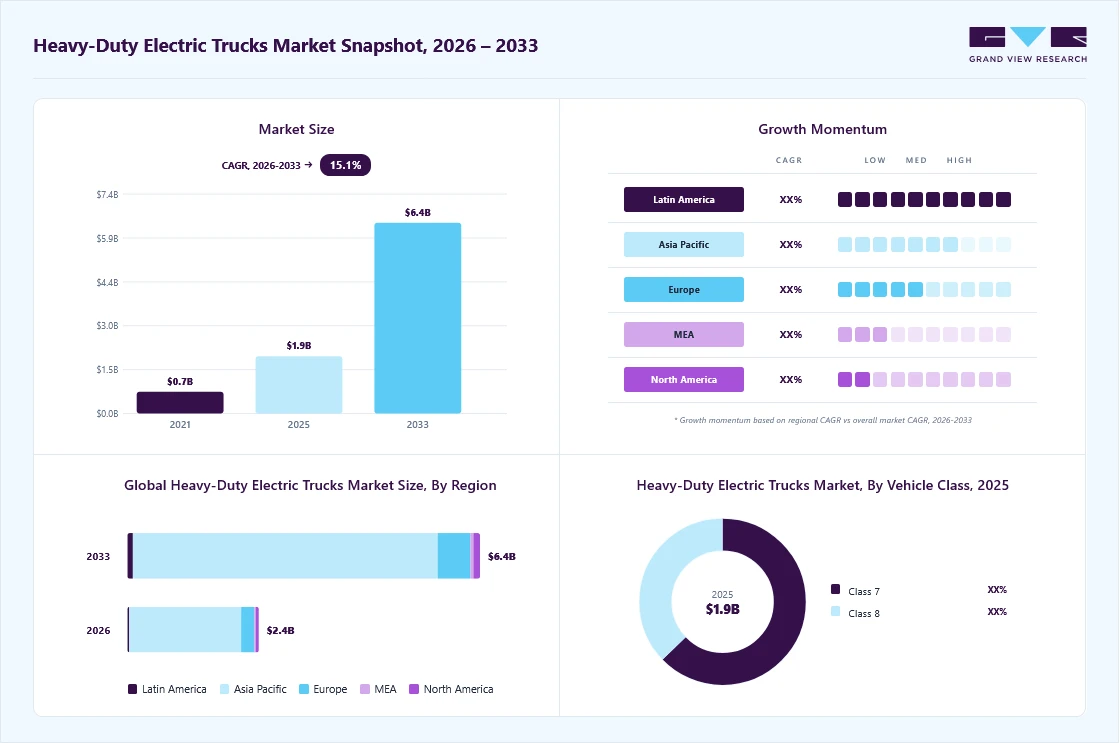
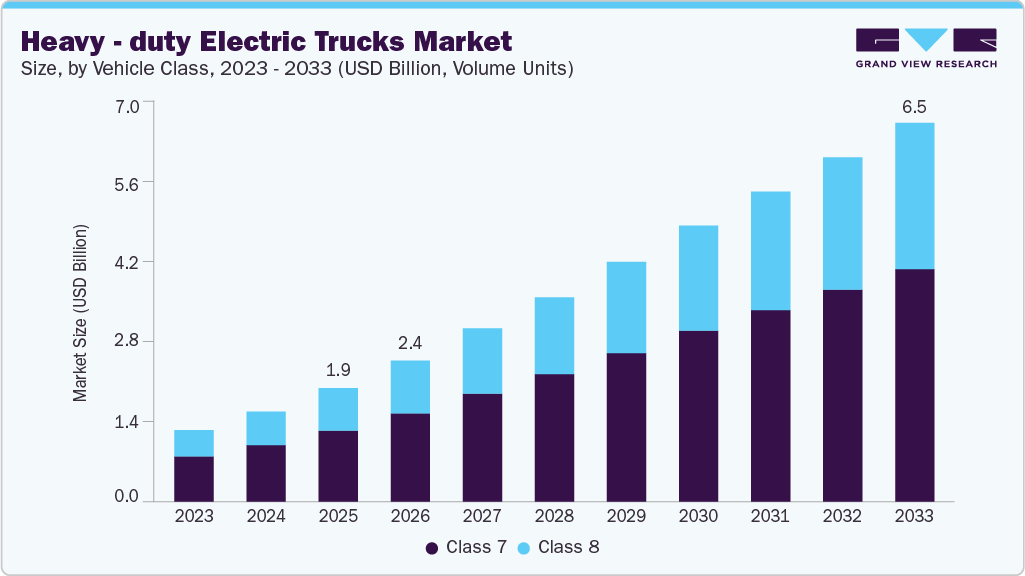
The global heavy-duty electric trucks market size was valued at USD 1.9 billion in 2025 and is projected to grow from USD 2.4 billion in 2026 to USD 6.4 billion by 2033, at a CAGR of 15.1% from 2026 to 2033. The market in Asia Pacific dominated with a revenue share of 85.1% in 2025. Heavy-duty electric trucks are designed for hauling heavy loads. They are the electric counterparts of conventional diesel-powered trucks used for long-distance freight hauling and construction and mining dump trucks.
 Source: Grand View Research, IR Documents, Primary Interviews, Paid DatabasesTo learn more about this report,
 Download Free Sample Report
 Key Market Trends & Insights
- By vehicle class: Class 7 segment held the largest market share of 62.7% in 2025.
- By propulsion type: Hybrid electric vehicle segment held the largest market share in 2025.
- By application: Logistics segment held the largest market share in 2025.
Regional Highlights
- Largest regional market: Asia Pacific (85.1% revenue share, 2025)
- By country: U.S. held the largest market share in 2025
Market Size & Forecast
- Market size in 2025: USD 1.9 Billion
- Estimated market size in 2026: USD 2.4 Billion
- Projected market size by 2033: USD 6.4 Billion
- CAGR (2026-2033): 15.1%
Three ways to get this report
Buy it, customize it, or ask a question.Ask an Analyst
Analyst response in 1 business day
- AccessReport author, directly
- Reply timeWithin 1 working day
- No sales callDirect answer only
- FormatEmail reply
- CostFree, no cost
Get the Full Report
What the study covers
- FormatsPDF · Excel · Dashboard
- Timeline2026–2033 annual, 2025 base
- Coverage20+ countries, 5 regions
- Companies10+ key players profiled
Customize the Report
20% free customization
- IncludeCountries, segments, points
- TailorTo your product definition
- ExtendDeeper competitor detail
- OrA fully bespoke study
- Turnaround5–10 working days
With the growing emphasis on sustainable and eco-friendly practices, heavy-duty electric trucks are becoming increasingly prevalent in the freight, logistics, construction, and transport industries, providing a modern approach to meeting the demands of cargo transportation.Heavy-duty electric trucks are transforming the transportation industry with their numerous benefits. Some of the benefits include reduced carbon footprint, enhanced performance, operational efficiency, quieter operations, economic advantages, and reduced maintenance needs. Heavy-duty electric trucks make a substantial impact on reducing CO2 emissions, thereby contributing to a cleaner environment. They provide a smoother driving experience with superior torque and acceleration compared to diesel trucks. In urban settings, particularly with frequent stops, heavy-duty electric trucks provide greater efficiency than their diesel counterparts. Their minimal noise levels enable operation with less disturbance, making them suitable for noise-sensitive areas and nighttime operations. Such benefits of heavy-duty electric trucks are expected to improve market growth.
 To learn more about this report, Download Free Sample Report
 Furthermore, governments worldwide provide incentives for purchasing heavy-duty electric trucks, such as tax credits, rebates, and grants, aimed at lowering the initial acquisition costs of these vehicles. For instance, the Inflation Reduction Act established a tax credit to incentivize the adoption of electric medium-duty and heavy-duty commercial vehicles. The Qualified Commercial Clean Vehicle tax credit provides up to USD 40,000 in tax credits for the purchase of eligible electric trucks and other large commercial vehicles acquired and placed into service on or after January 1, 2023. Thus, rising government support to promote the adoption of electric heavy-duty vehicles, such as electric trucks, is further propelling market growth.
The sales of heavy-duty vehicles, including all medium- and heavy-duty trucks, are gradually increasing across the globe. According to the International Energy Agency (IEA), electric truck sales saw a 35% increase in 2023 compared to 2022. China remains the major market, accounting for 70% of global sales in 2023, down from 85% in 2022. In Europe, electric truck sales nearly tripled in 2023, surpassing 10,000 units. The U.S. also experienced a threefold increase in electric truck sales, reaching 1,200 units. Thus, the growing production and sales of electric trucks across the globe are expected to contribute to market growth.
Despite the various benefits of heavy-duty electric trucks, high upfront costs, limited daily range, and higher operating costs under certain conditions could hamper market growth. Highway driving impacts the heavy-duty electric truck's battery, often necessitating frequent battery replacements. In addition, heavy-duty electric trucks have a limited range, demanding regular recharging of their batteries. This limitation can pose challenges for long-haul trucking operations that require prolonged periods of driving without access to charging stations. However, with ongoing advancements in heavy-duty electric trucks technology, the growth of the market is expected to increase from 2026 to 2033.
Vehicle Class Insights
The class 7 segment dominated the market in 2025 and accounted for a 62.72% share of the global revenue. Class 7 heavy-duty electric trucks have a gross vehicle weight rating (GVWR) between 26,001 pounds and 33,000 pounds. Rising government initiatives to increase the adoption of class 7 electric vehicles can be attributed to the segment’s growth. In April 2024, the US Environmental Protection Agency (EPA) launched the 2024 Clean Heavy-Duty Vehicles Grant Program, which aims to support the transition of Class 7 and Class 6 vehicles to zero emissions. This program will provide nearly USD 1 billion to support the replacement of certain heavy-duty vehicles that are non-zero-emission with zero-emission vehicles, and to support zero-emission vehicle fueling infrastructure and workforce training and development. Thus, increasing government initiatives to tackle climate change and reduce air pollution are boosting the segment’s growth.
The class 8 segment is projected to witness significant growth from 2026 to 2033. Class 8 heavy-duty electric trucks have a GVWR of 33,001 pounds or over. Increasing adoption of class 8 electric trucks for applications such as long-haul freight transportation, construction material hauling, and mining operations can be attributed to the segment’s growth. In addition, the vast availability of class 8 electric trucks in the global market is further fueling the segment’s growth. For instance, company such as AB Volvo and Kenworth Truck Company offers class 8 electric truck models such as VNR Electric and T680E, respectively.
Propulsion Type Insights
The Hybrid Electric Vehicle (HEV) segment dominated the market in 2025. Hybrid heavy-duty trucks combine the advantages of both electric powertrains and traditional combustion engine powertrains, offering a versatile vehicle capable of operating emission-free when required. These trucks retain the ability to achieve an extended range when running on HVO or Biodiesel, providing flexibility and sustainability in various operating conditions. The increased development of hybrid heavy-duty trucks by several prominent companies can be attributed to the segment’s growth. For instance, in June 2023, FAMCO launched the first-ever heavy-duty electric truck in the Middle East, strengthening its position as an industry pioneer and its commitment to sustainable transportation solutions.
The Battery Electric Vehicle (BEV) segment is projected to witness significant growth from 2026 to 2033. Increasing adoption of battery-powered heavy-duty trucks for applications such as deliveries for retailers and logistics companies and hauling materials to and from construction sites is driving the growth of the segment. In addition, the growing demand for battery-powered heavy-duty trucks from automotive manufacturers to transport vehicles between ports, manufacturing facilities, and distribution warehouses is driving the expansion of the segment. In February 2023, Nissan Corporation started the use of two heavy-duty BEV Class 8 trucks to transport vehicles from the Port of Los Angeles to the Los Angeles region’s dealerships. The two major manufacturers of electric heavy-duty trucks involved in this program are Nikola Corporation and Kenworth Truck Company, with each providing trucks to pull traditional car haulers for this transportation endeavor. Such initiatives are expected to bode well for market growth.
Application Insights
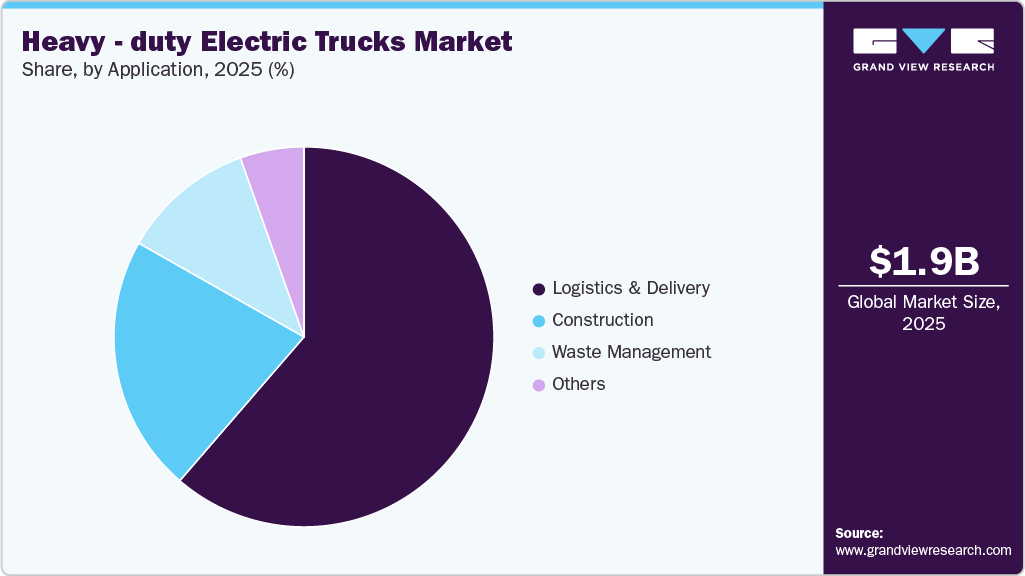
The logistics and delivery segment dominated the market in 2025. The shift towards electric trucks in the transportation industry aims to enhance the efficiency of goods deliveries. Advancements in battery technology and the emergence of next-generation motors are poised to promote the utilization of electric vehicles in urban logistics. Various logistics and delivery companies, as well as e-commerce companies, are adopting heavy-duty electric trucks for delivery across the first, middle, and last mile. For instance, in May 2024, Amazon expanded its fleet of heavy-duty electric trucks in California, U.S., with plans to deploy nearly 50 Volvo VNR Electric trucks across its Southern California operations. This initiative marks a crucial milestone in Amazon’s efforts to eliminate carbon emissions throughout all stages of the delivery process, encompassing first, middle, and last mile operations. Such initiatives are expected to improve the growth of the segment.
 To learn more about this report, Download Free Sample Report
 The construction segment is projected to witness significant growth from 2026 to 2033. The construction industry’s need for heavy-duty electric transportation is on the rise, driven primarily by the establishment of zero-emission zones in urban areas and the imperative for construction companies to align with climate targets. Furthermore, in February 2023, Volvo Trucks, a truck manufacturing division of AB Volvo, introduced a range of heavy electric trucks tailored specifically for the construction industry. By utilizing electric trucks, companies can now fulfill the growing demand for vehicles with zero exhaust emissions and reduced noise levels in and around urban construction sites. Thus, several manufacturers are developing heavy-duty electric trucks, enabling customers in the construction sector to transition towards more sustainable transportation, which in turn boosts the segment’s growth.
Regional Insights
The heavy-duty electric trucks market in North America is expected to witness notable growth from 2026 to 2033. Factors such as increasing government incentives to promote the adoption of zero-emission heavy-duty vehicles and growing technological advancements can be attributed to market growth.
U.S. Heavy-duty Electric Trucks Market Trends
The heavy-duty electric trucks market in the U.S. is expected to grow at the highest CAGR of 11.6% from 2026 to 2033. The electrification of heavy-duty vehicles is accelerating in the U.S., driven by major manufacturers' commitments to mass-produce zero-emission vehicles (ZEVs) as early as 2030. State policies like California's Advanced Clean Trucks rule, federal incentives from the Inflation Reduction Act, and the U.S. joining the Global Commercial Drive to Zero (aiming for 100% ZEV sales by 2040) have all contributed to increased adoption of zero-emission technologies in the heavy-duty vehicle sector in the country.
Canada heavy-duty electric trucks market is expected to grow at a notable CAGR from 2026 to 2033. In July 2022, to encourage the adoption of zero-emission medium- and heavy-duty vehicles by Canadian businesses, the Government of Canada introduced the Incentives for Medium- and Heavy-Duty Zero-Emission Vehicles (iMHZEV). This initiative provides incentives of up to CAD 200,000 (USD 146,112) per vehicle to help offset the higher upfront costs of zero-emission trucks and buses. Such government initiatives are expected to contribute to the market growth in Canada.
Asia Pacific Heavy-duty Electric Trucks Market Trends
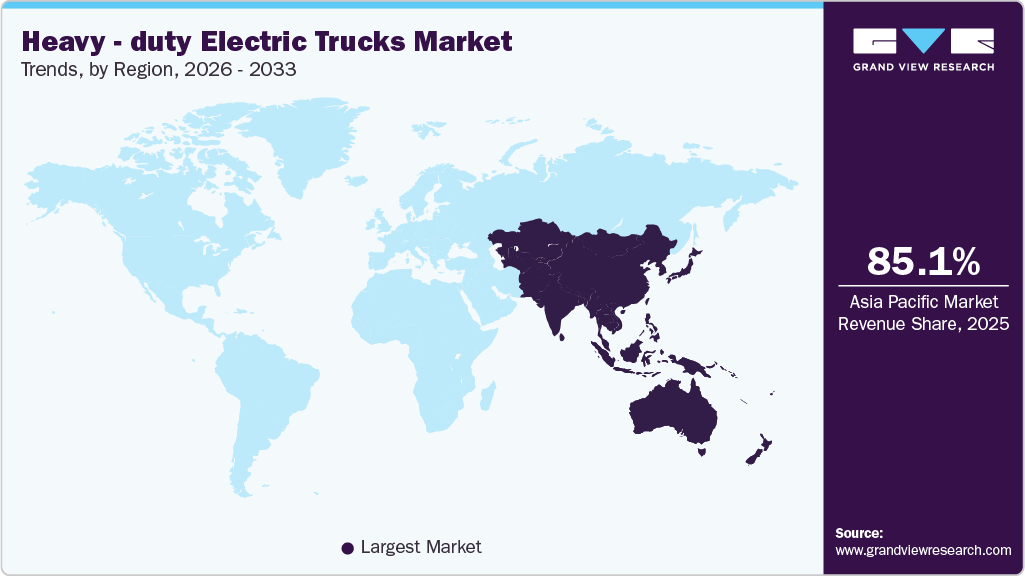
Asia Pacific dominated the heavy-duty electric trucks industry and accounted for a share of 85.1% in 2025. The heavy-duty electric trucks market in the Asia Pacific regiondominated the global market in 2025. Governments in countries like China, Japan, India, and South Korea are promoting the adoption of EVs, including heavy-duty trucks, through subsidies, tax incentives, and supportive regulatory frameworks. In addition, there’s a significant focus on advancing battery technology, charging infrastructure, and vehicle efficiency to improve the range and performance of heavy-duty electric trucks. Such factors are expected to contribute to the market’s growth in the region.
 To learn more about this report, Download Free Sample Report
 China heavy-duty electric trucks market is expected to witness a steady growth rate from 2026 to 2033. There is increasing demand for heavy-duty electric trucks in China, particularly in the logistics and construction sectors. Companies are transitioning fleets to electric models to meet environmental regulations and operational efficiency goals.
The heavy-duty electric trucks market in India is anticipated to grow at a significant CAGR from 2026 to 2033. Factors such as supportive government policies, advancements in EV infrastructure, and the increasing emphasis on sustainable transportation are expected to contribute to the market’s growth in the country.
Japan heavy-duty electric trucks market is expected to grow at the highest CAGR from 2026 to 2033. There is a growing demand for eco-friendly transportation solutions among Japanese consumers and businesses. This demand is pushing logistics and transportation companies to adopt electric trucks to align with the increasing emphasis on sustainability.
Europe Heavy-duty Electric Trucks Market Trends
The heavy-duty electric trucks market in Europe is expected to grow at a moderate CAGR from 2026 to 2033. The growth of the market in Europe can be primarily attributed to the prominent presence and proactive initiatives of major companies such as AB Volvo, Daimler Truck AG, Scania, Tevva Motors Limited, and DAF Trucks. These companies are actively engaging in collaborations and partnerships and new product launches to accelerate the transition to heavy-duty electric trucks, fostering a robust market expansion in the region.
The UK heavy-duty electric trucks market is expected to grow at a notable CAGR from 2026 to 2033. In October 2023, the UK government invested GBP 200 million (approximately USD 253 million) to accelerate the deployment of zero-emission trucks across the country. This funding will support the rollout of up to 370 zero-emission vehicles across the country. Thus, increasing government investment in increasing the adoption of zero-emission heavy-duty vehicles is driving market growth.
The heavy-duty electric trucks market in Germany is expected to grow at the highest CAGR from 2026 to 2033. Germany, being a leading market in Europe, is set to witness substantial growth in the heavy-duty electric truck sector. Factors such as stringent emission regulations and the transition towards zero-emission vehicles are driving the market’s growth.
MEA Heavy-duty Electric Trucks Market Trends
The heavy-duty electric trucks market in MEA is anticipated to grow at a steady CAGR from 2026 to 2033. In October 2023, Emirates Global Motor Electric signed an agreement with the Chinese multinational heavy machinery and truck manufacturer SANY Group, becoming the exclusive distributor of SANY Group’s light and heavy-duty electric trucks in the UAE. Such initiatives are expected to bode well for the market’s growth.
The KSA heavy-duty electric trucks market is expected to witness the highest growth rate from 2026 to 2033. Saudi Arabia's efforts to diversify its economy away from oil dependence include significant investments in infrastructure. This development fosters increased demand for heavy-duty electric trucks, particularly in logistics and construction sectors.
Key Heavy-duty Electric Trucks Company Insights
Some of the key companies operating in the market include AB Volvo, Scania, BYD Motors Inc., and Daimler Truck AG.
-
AB Volvo is a global leader in the manufacture of trucks, buses, construction equipment, and marine and industrial engines. The company also offers comprehensive financing and service solutions, catering to the diverse needs of its customers worldwide.
-
Daimler Truck AG is one of the world’s prominent manufacturers of commercial vehicles. The company’s truck product range includes light, medium, and heavy-duty trucks for distribution, construction, and long-haul applications, specialized vehicles primarily used in the municipal sector, and industrial engines. The company operates significant production facilities in Germany, France, Japan, India, Brazil, Turkey, Mexico, and the U.S., and locations across most countries worldwide.
Key Heavy-duty Electric Trucks Companies:
The following are the leading companies in the heavy-duty electric trucks market. These companies collectively hold the largest market share and dictate industry trends.
- AB Volvo
- BYD Motors Inc.
- Nikola Corporation
- Daimler Truck AG
- Navistar, Inc.
- Scania
- Tevva Motors Limited
- Kenworth Truck Company
- DAF Trucks
- SAIC HONGYAN Automotive Co., Ltd.
Recent Developments
-
In December 2025, Volvo Trucks launched a new 14-tonne entry-level Volvo FL Electric, designed specifically for inner-city transport and door-to-door deliveries with zero tailpipe emissions and low noise. The truck features a new battery configuration with 145 kWh usable energy, offering a range of up to 200 km depending on operating conditions. A 180 kW electric motor powers it and is available in multiple wheelbases, axle setups, and battery options, allowing customers to tailor the vehicle to their needs. The compact design, including a vehicle width down to 2.4 meters, improves agility in narrow city streets without compromising body-building flexibility.
-
In May 2024, Volvo Financial Services and Volvo Trucks North America partnered to launch Volvo on Demand, an innovative initiative aimed at revolutionizing the Truck-as-a-Service (TaaS) industry model. Utilizing a fleet of 25 Class 8 Volvo VNR electric trucks, Volvo on Demand offers an accessible solution for acquiring battery-electric vehicles, reducing the need for significant upfront investments.
-
In May 2024, BAE Systems and Eaton Corporation expanded their partnership to encompass EV solutions designed for heavy-duty trucks. This collaboration aims to provide original equipment manufacturers and commercial vehicle modifiers with a comprehensive, efficient, advanced, and adaptable EV system suitable for various zero-emission platforms.
Heavy-duty Electric Trucks Market Report Scope
Report Attribute
Details
Market size in 2025
USD 1.9 billion
Estimated market size in 2026
USD 2.4 billion
Projected market size by 2033
USD 6.4 billion
Growth rate
CAGR of 15.1% from 2026 to 2033
Actual data
2021 - 2025
Forecast period
2026 - 2033
Quantitative units
Revenue in USD million/billion, volume in units, and CAGR from 2026 to 2033
Report coverage
Revenue forecast, company market share, competitive landscape, growth factors, and trends
Segments covered
Vehicle class, propulsion type, application, region
Regional scope
North America; Europe; Asia Pacific; Latin America; MEA
Country scope
U.S.; Canada; Mexico; UK; Germany; France; China; India; Japan; South Korea; Australia; Brazil; Kingdom of Saudi Arabia (KSA); UAE; South Africa
Key companies profiled
AB Volvo; BYD Motors Inc.; Nikola Corporation; Daimler Truck AG; Navistar, Inc.; Scania; Tevva Motors Limited; Kenworth Truck Company; DAF Trucks; SAIC HONGYAN Automotive Co., Ltd.
Customization scope
Free report customization (equivalent to up to 8 analysts working days) with purchase. Addition or alteration to the country, regional, and segment scope
Pricing and purchase options
Avail customized purchase options to meet your exact research needs. Explore purchase options
Global Heavy-duty Electric Trucks Market Report Segmentation
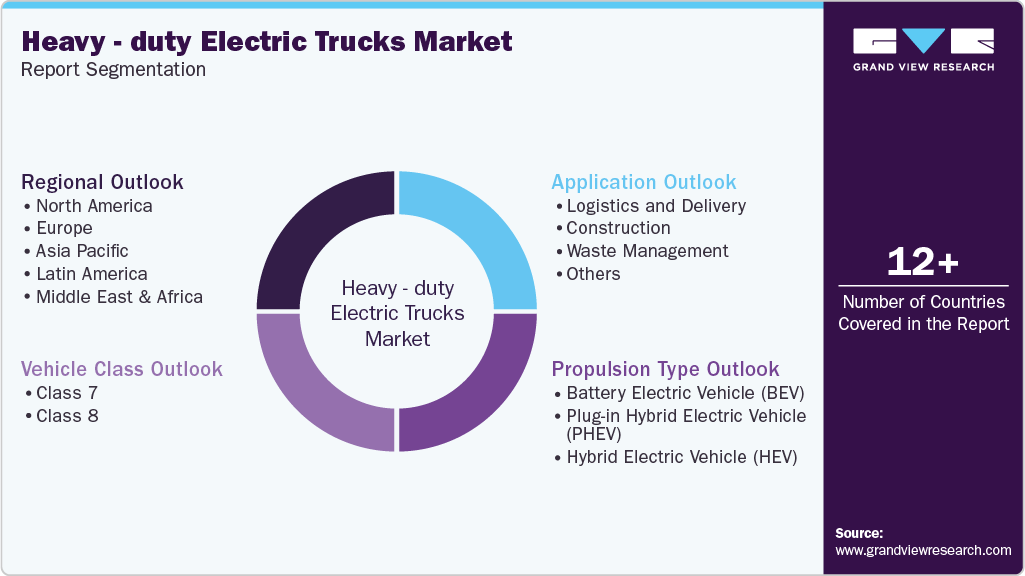
The report forecasts revenue growth at global, regional, and country levels and provides an analysis of the latest industry trends in each of the sub-segments from 2021 to 2033. For this study, Grand View Research has segmented the heavy-duty electric trucks market based on vehicle class, propulsion type, application, and region:
 To learn more about this report, Download Free Sample Report
 -
Vehicle Class Outlook (Volume, Units; Revenue, USD Million, 2021 - 2033)
-
Class 7
-
Class 8
-
-
Propulsion Type Outlook (Volume, Units; Revenue, USD Million, 2021 - 2033)
-
Battery Electric Vehicle (BEV)
-
Plug-in Hybrid Electric Vehicle (PHEV)
-
Hybrid Electric Vehicle (HEV)
-
-
Application Outlook (Volume, Units; Revenue, USD Million, 2021 - 2033)
-
Logistics and Delivery
-
Construction
-
Waste Management
-
Others
-
-
Regional Outlook (Volume, Units; Revenue, USD Million, 2021 - 2033)
-
North America
-
U.S.
-
Canada
-
Mexico
-
-
Europe
-
Germany
-
UK
-
France
-
-
Asia Pacific
-
China
-
India
-
Japan
-
Australia
-
South Korea
-
-
Latin America
-
Brazil
-
-
Middle East & Africa
-
UAE
-
Kingdom of Saudi Arabia
-
South Africa
-
-
Frequently Asked Questions About This Report
Key players include AB Volvo, Scania, BYD Motors Inc., Daimler Truck AG, Nikola Corporation, Navistar, Inc., Kenworth Truck Company, DAF Trucks, and SAIC HONGYAN Automotive Co.,Ltd., and Tevva Motors Limited
With the growing emphasis on sustainable and eco-friendly practices, heavy-duty electric trucks are becoming increasingly prevalent in the freight, logistics, construction, and transport industries, providing a modern approach to meeting the demands of cargo transportation.
Hybrid electric vehicle held the largest revenue share in 2025.
Logistics held the largest revenue share in 2025.
Asia Pacific dominated with a 85.1% revenue share in 2025.
The global heavy-duty electric trucks market size was valued at USD 1.9 billion in 2025 and is estimated at USD 2.4 billion for 2026.
The global heavy-duty electric trucks market is expected to grow at a CAGR of 15.1% from 2026 to 2033, reaching USD 6.4 billion.
Class 7 segment led with a 62.7% revenue share in 2025.
About the Author(s)
Automotive & Transportation Research Team
Technology · Automotive & TransportationThis report was authored by the automotive & transportation research team at Grand View Research - comprising two research analysts, one senior research analyst, and one industry expert - with specialized expertise in the automotive & transportation segment of the technology industry. All findings are based on proprietary technology databases, executive interviews, and regulatory analysis, subject to internal peer review prior to publication.
Last Updated:
Speak to Analyst

Customize this report to your needs - add regions, segments, or data points, with 20% free customization.
Or view our licence options:


ISO 9001:2015 & 27001:2022 Certified
We are GDPR and CCPA compliant! Your transaction & personal information is safe and secure. For more details, please read our privacy policy.


