
- Home
- »
- Medical Devices
- »
-
Helium-free MRI Systems Market Size Report, 2026-2033GVR Report cover

Helium-free MRI Systems Market (2026 - 2033)
Size, Share & Trends Analysis Report By Field Strength (0.55T, 1.5T), By Application (Neurology, Cardiovascular, Oncology), By End-use (Hospitals, Diagnostic Centers), By Region, And Segment Forecasts
Market Size, 2025
$1.7BMarket Estimate, 2026
$1.8BMarket Forecast, 2033
$3.3BCAGR, 2026–2033
8.9%Helium free MRI Systems Market Summary
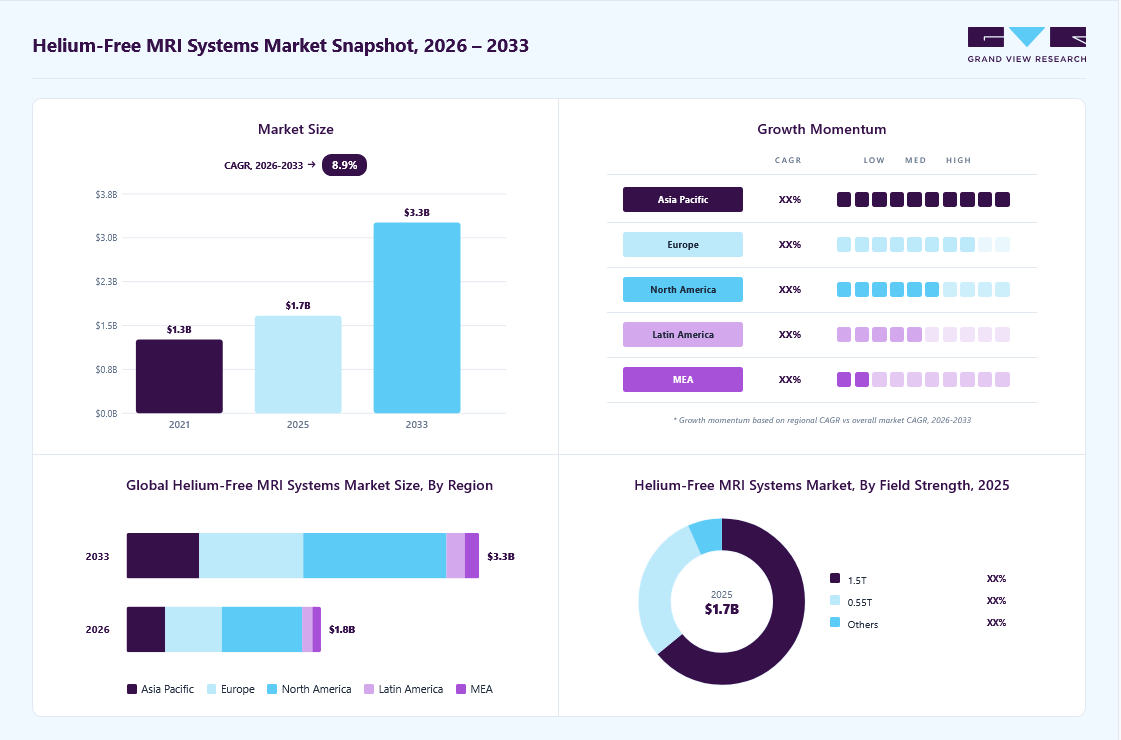
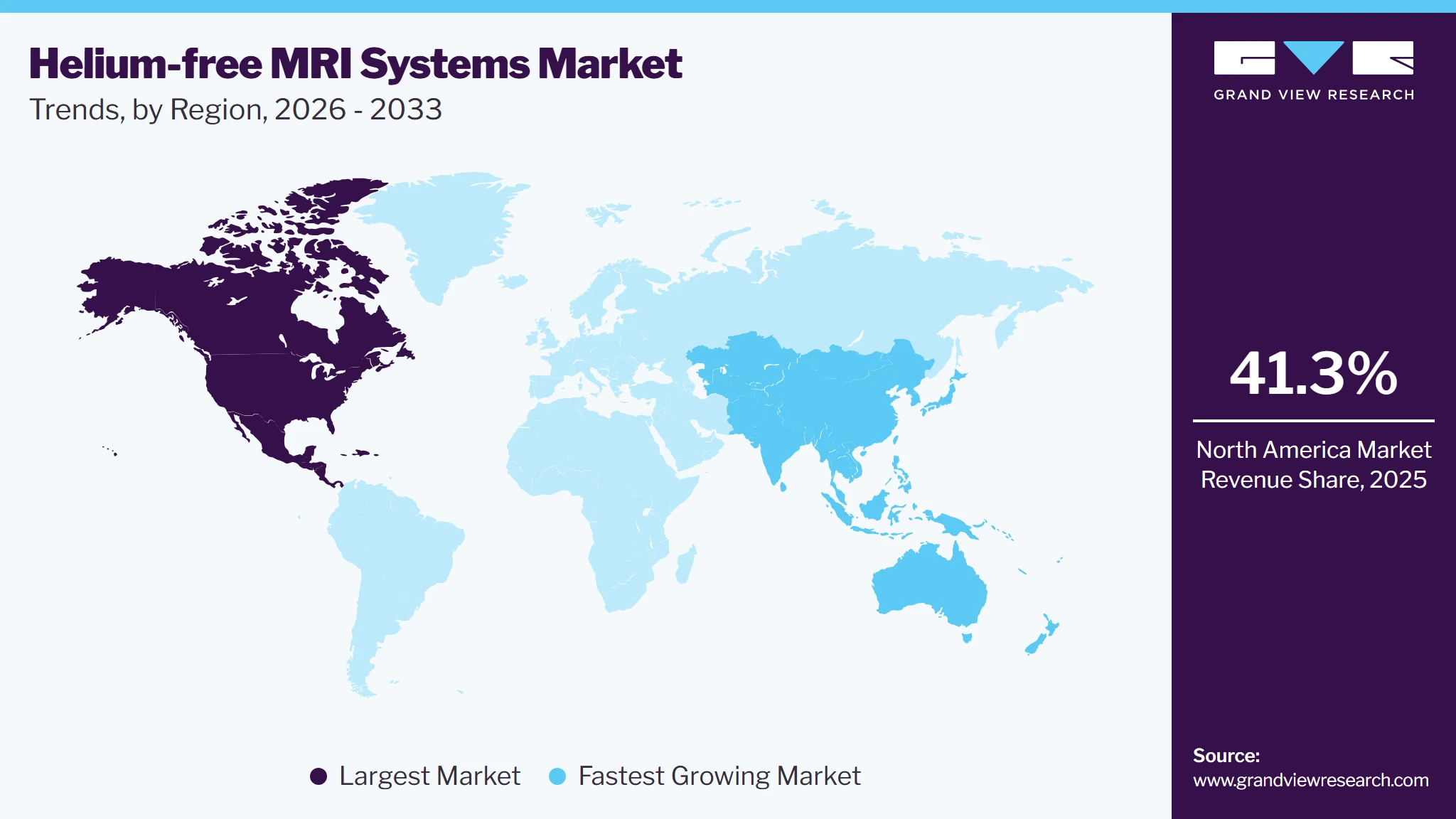
The global helium-free MRI systems market size was valued at USD 1.7 billion in 2025 and is projected to grow from USD 1.8 billion in 2026 to USD 3.3 billion by 2033, at a CAGR of 8.9% from 2026 to 2033. North America dominated the market, accounting for a revenue share of 41.3% in 2025. Growing demand for improved diagnostic imaging technologies, growing concerns regarding helium supply restrictions, and the need to reduce MRI installation and maintenance costs. By implementing sealed-magnet technology, healthcare providers can eliminate their need for liquid helium refills, streamline infrastructure, and improve operational efficiency.
 Source: Grand View Research, IR Documents, Primary Interviews, Paid DatabasesTo learn more about this report,
 Download Free Sample Report
Key Market Trends & Insights
- By field strength: The 1.5T segment held the highest market share of 64.0% in 2025.
- By application: The neurology segment held the highest market share of 30.5% in 2025.
- By end use: The hospitals segment held a leading market share of 65.0% in 2025.
Regional Insights
- Largest Region: North America (41.3% revenue share, 2025)
- Fastest-growing Region: Asia Pacific (highest, 9.4% CAGR, 2026-2033)
Market Size & Forecast
- Market Size in 2025: USD 1.7 Billion
- Estimated Market Size in 2026: USD 1.8 Billion
- Projected Market Size by 2033: USD 3.3 Billion
- CAGR (2026-2033): 8.9%
Prism AI by Grand View Research Free to tryAsk a question about the helium-free MRI systems marketTry asking✓Every figure cited from GVR research Prefer the report? Download free sample →Magnet engineering, software, and tiny MRI configurations are evolving and broadening the range of possible applications for these systems in neurology, cardiology, musculoskeletal, and cancer imaging. The helium-free MRI systems market experiences technological innovation with the creation of cryogen-free magnet structures, sealed cooling systems, and smaller MRI systems to minimize reliance on liquid helium. The innovations aim to simplify installation, decrease the need for helium infrastructure and increase the operating flexibility of MRI systems in hospitals and diagnostic institutes. Innovation is focused also on enabling many clinical applications while reducing overall cost and complexity of MRI operation while retaining great picture quality.
 To learn more about this report, Download Free Sample Report
One promising area is the development of cryogen-free superconducting magnets, which use alternative cooling approaches to maintain the temperatures required for superconductivity without relying on conventional liquid-helium cooling. These systems can reduce dependence on helium supply chains and may simplify certain installation and maintenance requirements. However, cryogen-free magnet technologies should be distinguished from sealed-magnet MRI systems that retain a small quantity of helium in a closed circuit.
A research paper was published in September 2025 in IEEE Transactions on Applied Superconductivity. The paper was entitled “Development of a Helium-Free 1.5 T Extremity MRI Magnet.” Researchers present the design, construction and testing of a 1.5T superconducting magnet cooled purely by conduction, without liquid helium. The magnet generated a 1.5T field strength and had a magnetic field homogeneity appropriate for the development of extremities MRI. These studies show the promise of a small, helium-free MRI system for targeted anatomy, but more system-level testing and clinical evaluation are required before any claims can be made about commercial viability.
Another useful development is a review published in September 2026, in Insights into Imaging, titled “Helium-free MRI systems: What does that mean for a radiology decision maker?” The article examines the practical differences between conventional liquid-helium MRI and modern sealed or conduction-cooled magnet designs. It highlights the potential benefits of reducing helium requirements, simplifying installation, and lowering infrastructure costs, while also identifying considerations such as cooling resilience, recovery after a quench, and total cost of ownership. The review emphasizes that purchasers should evaluate the magnet's actual helium requirements and operational performance rather than relying solely on the term “helium-free.”
Market Dynamics
The helium-free MRI systems market is driven by the growing demand for advanced diagnostic imaging technologies, concerns regarding liquid helium availability, and the need to simplify MRI installation and operation. Helium-free and sealed-magnet technologies can reduce or eliminate routine dependence on liquid helium replenishment, helping healthcare facilities address helium supply risks and infrastructure requirements. Demand is further supported by the increasing use of MRI in neurology, cardiovascular, musculoskeletal, and oncology imaging, alongside investments in diagnostic infrastructure. Technology development focuses on advanced magnet engineering, helium-independent or low-helium designs, AI-enabled imaging, improved image quality, and compact system configurations that enhance operational efficiency and expand access to MRI services.
The growing need to reduce reliance on helium is a major driver of the helium-free MRI systems market. Conventional MRI systems use helium to cool superconducting magnets, which creates a need for special infrastructure, careful helium management and sometimes regular replenishment. Sealed‑magnet and helium-independent technologies can cut these needs helping hospitals and diagnostic centers handle supply limits, operational complexity and long‑term costs. Adoption of helium- free MRI systems is also helped by new investments in diagnostic imaging infrastructure and the desire to make MRI more available in hospitals and diagnostic centers. Further progress in magnet design and imaging technology is expected to create opportunities, for helium-free MRI systems that use less liquid helium while keeping clinical performance high.
High equipment purchase costs and technology development expenses continue to be challenges for the helium-free MRI systems market. These systems need magnet design, special parts, careful manufacturing and thorough testing to make sure they work properly and provide clear images. Medical facilities also have to think about installation setting up the space, maintenance training employees and connecting the system with old imaging equipment. Changing from MRI systems can take a lot of money which might stop smaller hospitals and testing centers with limited funds from using them. Also makers need to show that systems that use helium or no helium at all work just as well, in medical situations. These money and skill issues can make it harder for people to buy the systems in places.
Market Conecntration & Characteristics
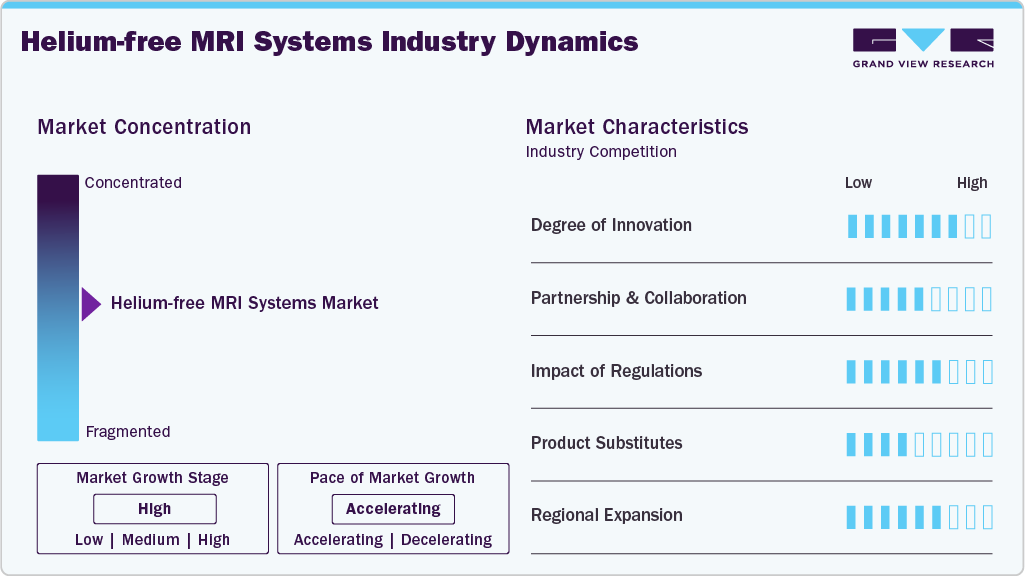
The helium-free MRI systems market is characterized by competition among established medical imaging manufacturers and emerging technology developers seeking to reduce reliance on liquid helium while maintaining diagnostic image quality, system reliability, and clinical performance. Competitive positioning depends on magnet design, field strength, imaging capabilities, installation requirements, operating costs, and access to hospital and diagnostic-center networks. Manufacturers are pursuing advances in compact MRI configurations, cryogen management, superconducting magnet engineering, and software-enabled imaging. However, the market requires careful differentiation between systems that eliminate the need for liquid helium, systems that use small quantities of helium in sealed magnets, and conventional MRI systems that reduce helium loss through zero-boil-off technologies.
The helium-free MRI systems market is characterized by a high degree of technological innovation, particularly in magnet engineering, cryogenic cooling, system miniaturization, and AI-enabled image reconstruction. Manufacturers are developing technologies that reduce or eliminate dependence on liquid helium while maintaining image quality and supporting a broad range of clinical applications. Innovation is also focused on reducing energy consumption, eliminating the need for quench pipes, simplifying site preparation, and expanding MRI access to facilities with space or infrastructure constraints.
 To learn more about this report, Download Free Sample Report
A notable example occurred in January 2026, when Siemens Healthineers announced U.S. FDA clearance for its MAGNETOM Flow 1.5T MRI platform with DryCool technology. The 70 cm-bore system uses a closed helium circuit and does not require a quench pipe. Siemens also highlighted AI-based image reconstruction and reduced annual energy consumption compared with its previous-generation scanners. This development illustrates how magnet technology and software are being combined to improve installation flexibility and operational efficiency.
Another example is Magnetica, which is developing a compact helium-free 3T extremity MRI system for imaging areas such as the hands, wrists, knees, and ankles. According to HT Group's 2026 results announcement, the system is intended to reduce the size and infrastructure requirements associated with conventional full-body MRI scanners. The company also reported that its U.S. FDA submission timeline remained under review, highlighting the technical and regulatory challenges involved in commercializing new MRI architectures.
Partnerships and collaborations are important in the helium-free MRI systems market because magnet development requires specialized expertise in superconductivity, cryogenic engineering, cooling systems, and imaging-system integration. Collaboration can help manufacturers develop proprietary magnet technologies, strengthen manufacturing capabilities, and reduce dependence on external suppliers. Partnerships with hospitals and research institutions also help validate clinical performance and identify applications for compact or specialized MRI systems.
A relevant example occurred in May 2025, when Mediso announced the completion of the first phase of a technology-transfer agreement with Superconducting Systems Inc. (SSI), a subsidiary of IMRIS. The collaboration supports Mediso's efforts to strengthen its in-house MRI magnet capabilities. Mediso stated that it had used SSI's fully cryogen-free superconducting magnets in its preclinical nanoScan 3T and 7T MRI systems and was expanding European magnet manufacturing capabilities. Although these are preclinical MRI systems rather than general-purpose clinical scanners, the agreement demonstrates how technology transfer can support cryogen-free magnet development and manufacturing.
Regulatory requirements have a significant impact on the helium-free MRI systems market because new magnet designs and imaging platforms must demonstrate safety, performance, and compliance with applicable medical-device requirements. In the U.S., the FDA's 510(k) clearance process may apply when a device is seeking clearance based on substantial equivalence to a legally marketed predicate device. Depending on the system and its characteristics, manufacturers may need to provide evidence concerning image quality, electrical and mechanical safety, electromagnetic compatibility, software performance, and intended clinical use.
The helium-free MRI systems market faces substitution from conventional liquid-helium MRI scanners, zero-boil-off MRI systems, CT scanners, ultrasound systems, and other diagnostic imaging technologies. Conventional MRI systems remain an important alternative because they are widely installed and offer established clinical capabilities across neurology, cardiovascular, musculoskeletal, and oncology applications. Zero-boil-off systems can reduce helium losses but generally continue to rely on liquid helium, differentiating them from systems designed to operate without routine helium replenishment or without liquid helium altogether.
CT and ultrasound may substitute for MRI in selected diagnostic applications, depending on the clinical indication, required image contrast, anatomical region, availability, and cost. However, they cannot fully replace MRI where detailed soft-tissue visualization or specific MRI-based diagnostic protocols are required. The competitive position of helium-free systems therefore depends on their acquisition costs, image quality, clinical versatility, installation requirements, service support, and total cost of ownership.
Regional expansion is an important strategy as manufacturers seek to improve access to MRI technology, strengthen local manufacturing, and serve healthcare systems with different infrastructure and affordability requirements. Markets with growing diagnostic imaging demand may offer opportunities for compact, energy-efficient, and helium-independent systems, particularly where conventional MRI installation requirements create operational challenges. Local manufacturing, distribution partnerships, and regulatory approvals can help manufacturers expand their reach and improve product availability.
A notable development occurred in February 2026, when Wipro GE HealthCare announced the launch of its SIGNA Prime Elite MRI system in India. Manufactured at the company's production facility in India, the system incorporates AI-enabled imaging technologies and intelligent magnet technology designed to reduce helium consumption. Although it should not automatically be classified as completely helium-free, the product illustrates how local manufacturing and helium-reduction technologies are being incorporated into MRI platforms for the Indian market.
Another India-focused development was the launch of the QUIN and MICA helium-free 1.5T MRI platforms at IRIA 2026, as reported by Fischer Medical Ventures in its 2025-2026 annual report. The company described the platforms as having received CDSCO certification. The development reflects efforts to build domestic capabilities in helium-free MRI technology and broaden the availability of locally developed imaging systems.
Analyst Perspective
The helium-free MRI systems market is transitioning toward sealed, low-helium magnet technologies that reduce dependence on conventional liquid-helium supplies, simplify installation, and lower infrastructure and lifecycle operating requirements. Major manufacturers, including Philips, Siemens Healthineers, and GE HealthCare, are strengthening competition through closed-circuit magnet designs and AI-enabled imaging capabilities. Philips’ BlueSeal platform demonstrates commercial adoption, while Siemens’ MAGNETOM Flow and GE’s Freelium technology expand the competitive landscape. However, high acquisition costs, long equipment replacement cycles, and the need to maintain clinical performance remain important barriers. Future growth will depend on lifecycle savings and broader hospital adoption.
Field Strength Insights
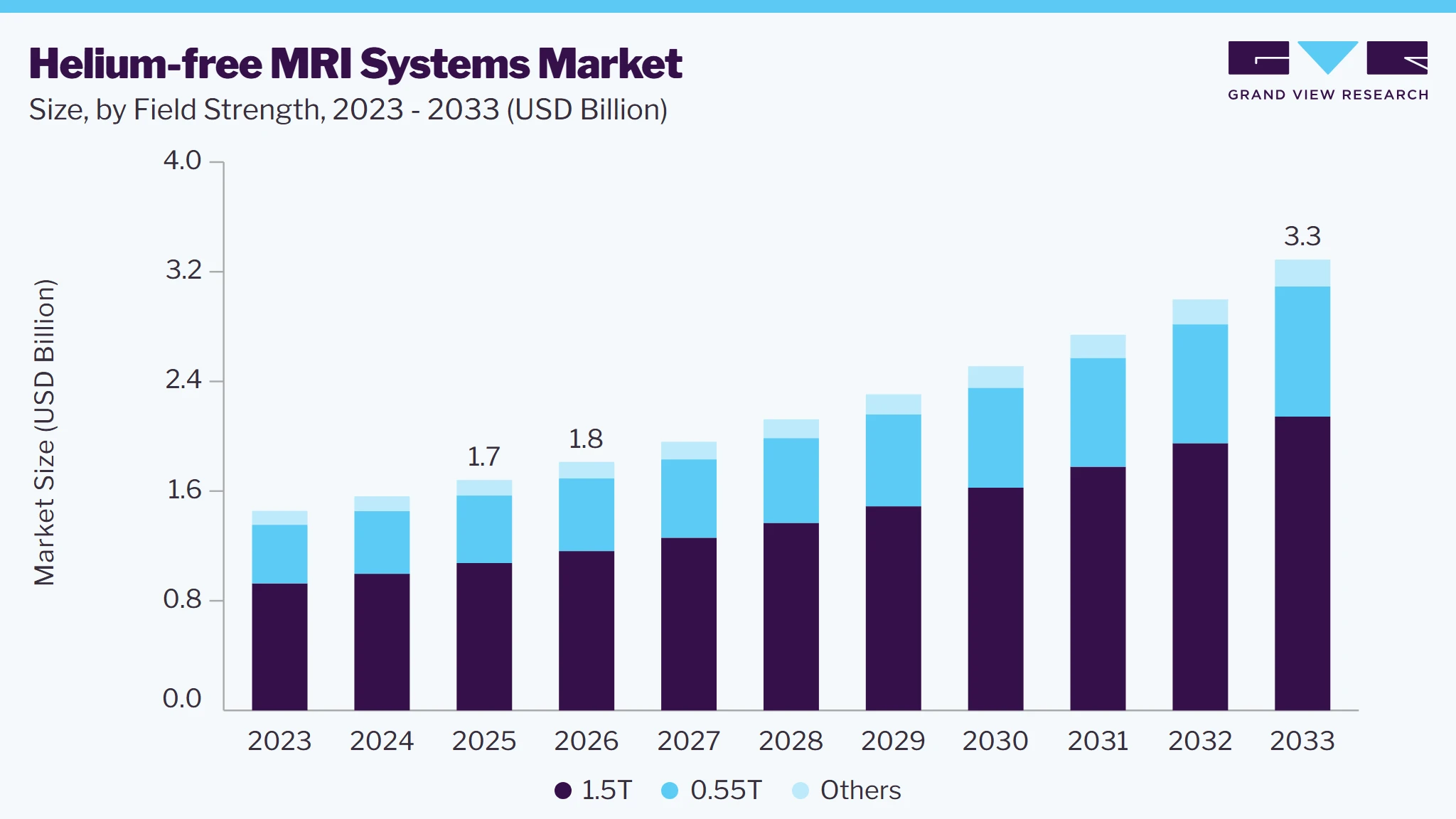
The 1.5T segment dominated the helium-free MRI systems market in 2025, accounting for approximately 64.0% of the overall market revenue. Its leading position is primarily attributed to its established clinical acceptance, broad application across routine diagnostic imaging, and relatively favorable balance between image quality, system cost, and operational efficiency. Growing adoption of helium-free 1.5T systems among hospitals and diagnostic imaging centers is further supporting segment growth. In addition, advancements in magnet design, superconducting technology, and compact cooling systems are improving system reliability and reducing dependence on conventional helium-based infrastructure, strengthening demand for this segment.
The 0.55T segment is expected to witness a significant CAGR over the forecast period, driven by increasing demand for compact, cost-effective MRI systems and growing adoption in outpatient imaging centers, smaller hospitals, and resource-constrained healthcare settings. Its lower infrastructure requirements, reduced installation complexity, and potential for helium-free operation are enhancing its appeal. Furthermore, continuous improvements in image quality, workflow efficiency, and accessibility are expected to support broader clinical adoption across diverse healthcare environments.
Application Insights
The neurology segment dominated the helium-free MRI systems market in 2025, accounting for the largest share of overall revenue. Its leading position is primarily attributed to the widespread use of MRI in diagnosing and monitoring neurological conditions, including brain tumors, stroke, multiple sclerosis, and neurodegenerative disorders. Growing demand for advanced neuroimaging, coupled with the increasing prevalence of neurological diseases and an aging population, is supporting segment growth. Furthermore, advancements in helium-free magnet technology, improved system reliability, and reduced dependence on conventional helium infrastructure are encouraging healthcare facilities to adopt these systems for routine neurological examinations and specialized diagnostic applications.
The cardiovascular segment is expected to witness the fastest CAGR over the forecast period, driven by the increasing prevalence of cardiovascular diseases and rising demand for advanced, non-invasive diagnostic imaging. MRI plays an important role in evaluating cardiac structure, function, tissue characteristics, and myocardial abnormalities. Growing awareness of early disease detection, improvements in cardiac MRI techniques, and increasing investments in advanced diagnostic infrastructure are expected to support segment expansion. Additionally, the development of helium-free MRI systems with simplified installation and reduced dependence on helium-based cooling infrastructure may improve accessibility across hospitals and diagnostic centers, further encouraging adoption for cardiovascular imaging applications.
End Use Insights
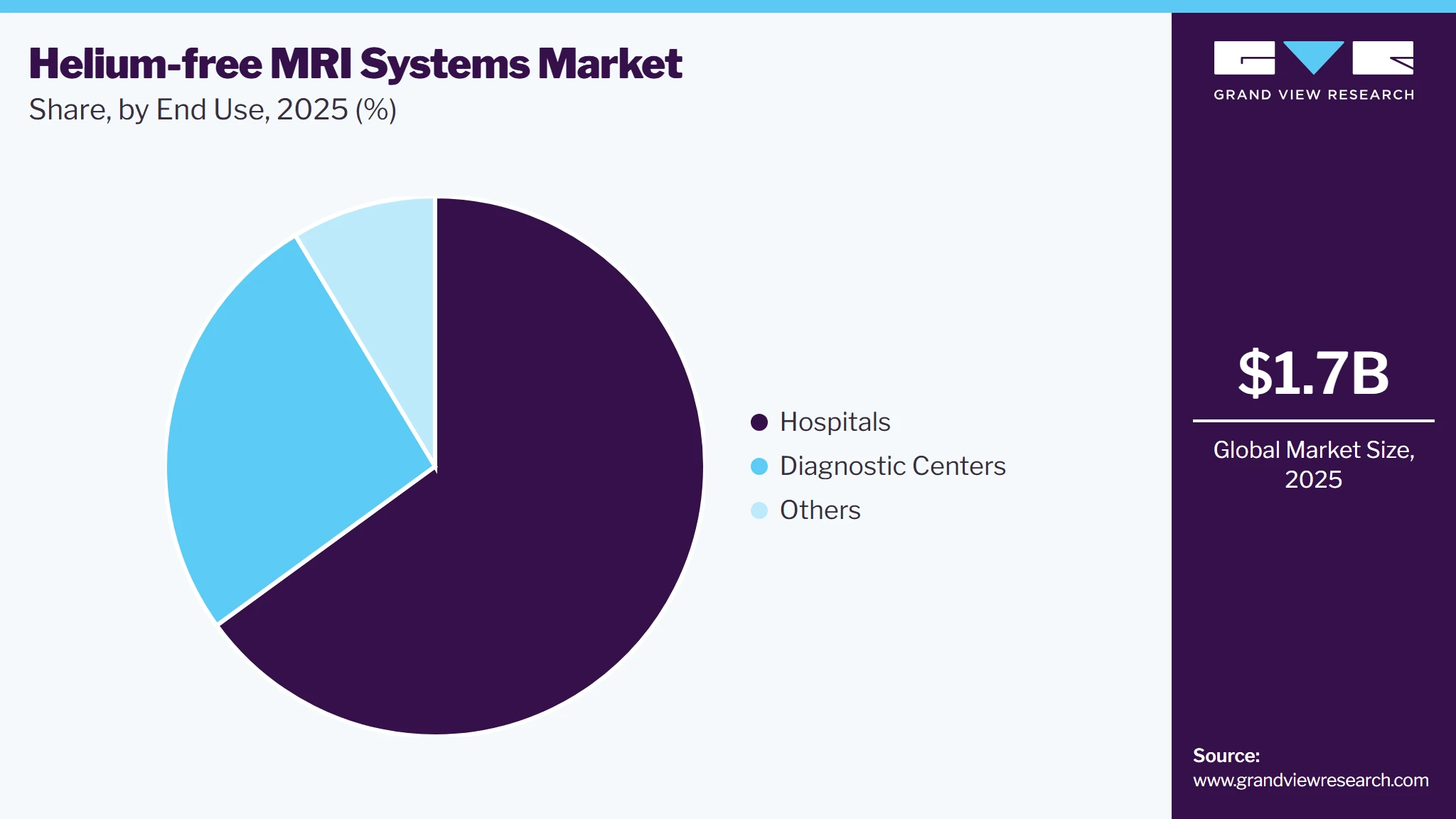
The hospitals segment held the largest revenue share in the helium-free MRI systems market in 2025, driven by the high volume of diagnostic imaging procedures and the availability of advanced healthcare infrastructure. Hospitals require MRI systems for a wide range of clinical applications, including neurology, oncology, musculoskeletal imaging, and cardiovascular diagnostics. Increasing patient admissions, growing demand for early disease detection, and investments in modern medical imaging technologies are further supporting segment growth. Moreover, helium-free MRI systems offer potential advantages, including reduced helium dependency, simplified installation requirements, and improved operational flexibility, encouraging hospitals to consider these systems for expanding diagnostic capabilities and managing infrastructure costs.
 To learn more about this report, Download Free Sample Report
The diagnostic centers segment is expected to witness the fastest CAGR over the forecast period, driven by the increasing demand for accessible and cost-effective diagnostic imaging services. The growing preference for outpatient care, rising patient volumes, and expansion of independent diagnostic facilities are supporting segment growth. Diagnostic centers are increasingly investing in advanced imaging technologies to improve diagnostic accuracy, operational efficiency, and patient throughput. Additionally, shorter appointment waiting times and the convenience of specialized imaging services are encouraging patients to choose these facilities. The adoption of helium-free MRI systems may further support growth by reducing helium dependency and simplifying infrastructure requirements.
Regional Insights
The North America helium-free MRI systems market is supported by advanced healthcare infrastructure, substantial diagnostic imaging expenditure, and demand for MRI technologies that reduce helium dependency and installation constraints. Hospitals and imaging providers are increasingly evaluating sealed-magnet platforms to improve operational resilience and expand scanner placement options. In September 2025, Canada's Southlake Health selected Philips Ambition X MR with BlueSeal technology, demonstrating regional demand for helium-free 1.5T imaging systems.
 To learn more about this report, Download Free Sample Report
U.S. Helium-free MRI Systems Market Trends
The U.S. helium-free MRI systems market is supported by demand for advanced imaging, healthcare facility modernization, and technologies that reduce reliance on helium refills and specialized installation infrastructure. GE HealthCare's Freelium technology represents a significant product-development initiative, while Philips continues to expand its BlueSeal portfolio. These systems are designed to reduce helium-related operational requirements and simplify installation, creating opportunities for hospitals and diagnostic centers seeking improved resilience and lifecycle efficiency. Commercial adoption will depend on system availability, procurement budgets, clinical performance, and the relative economics of helium-free versus conventional MRI platforms.
Europe Helium-free MRI Systems Market Trends
The Europe helium-free MRI systems market is supported by established diagnostic imaging infrastructure, sustainability initiatives, and efforts to improve access to MRI services while reducing dependence on liquid helium. Manufacturers are introducing sealed-magnet technologies that can reduce infrastructure requirements and support installation in space-constrained facilities. In November 2025, Philips unveiled BlueSeal Horizon, which it described as the world's first helium-free 3.0T MRI platform, at RSNA 2025. Earlier, in February 2025, GE HealthCare introduced Freelium at the European Congress of Radiology. These developments highlight continuing innovation in helium-independent MRI technology across the European imaging industry.
The UK helium-free MRI systems market is supported by NHS diagnostic capacity initiatives, investment in community imaging, and demand for systems that can be installed in facilities with limited space. In February 2025, Philips reported its 50th UK BlueSeal installation at St George's Health and Wellbeing Hub in Hornchurch, operated by Barking, Havering and Redbridge University Hospitals NHS Trust. The installation illustrates how helium-free MRI can support community diagnostic infrastructure while avoiding conventional quench-pipe requirements. The expansion of community diagnostic services may provide further opportunities for compact MRI platforms, subject to procurement decisions and clinical suitability.
The Spain helium-free MRI systems market is supported by established healthcare infrastructure, diagnostic imaging demand, and opportunities to improve MRI installation flexibility. Philips' BlueSeal technology is designed to eliminate the need for routine helium refills and conventional quench-pipe infrastructure. The company's European technology materials also feature Hospitales San Roque in Spain as an example of BlueSeal implementation. Such deployments illustrate the potential value of helium-independent operations for hospitals seeking to modernize imaging infrastructure and reduce helium-related operational requirements.
Asia Pacific Helium-free MRI Systems Market Trends
The Asia Pacific helium-free MRI systems market is supported by expanding healthcare infrastructure, rising demand for diagnostic imaging, and growing interest in MRI platforms that reduce dependence on helium supplies and specialized installation infrastructure. Japan, China, South Korea, and India represent important markets for evaluating adoption opportunities, although commercial availability varies by manufacturer and country. In January 2025, Philips India reported more than 1,500 installations of its helium-free-operating 1.5T wide-bore MRI systems worldwide, highlighting the expansion of this technology beyond early deployments. Growing investment in diagnostic capacity and hospital modernization may create additional opportunities for helium-independent MRI systems across the region.
The China helium-free MRI systems market is influenced by expanding diagnostic imaging capacity, domestic medical equipment development, and demand for advanced imaging across large hospital networks. Local manufacturers, including United Imaging and Wandong Medical, participate in the broader MRI market, while international manufacturers continue to develop sealed-magnet technologies. However, participation in the general MRI market does not establish that a manufacturer offers a commercially available helium-free system. Growth opportunities will depend on the availability of qualifying products, hospital procurement preferences, clinical performance, pricing, and domestic regulatory requirements.
The South Korea helium-free MRI systems market is supported by advanced hospital infrastructure, established medical technology capabilities, and demand for reliable diagnostic imaging equipment. Helium-independent MRI platforms may appeal to facilities seeking to reduce helium-related maintenance requirements and improve installation flexibility. Nevertheless, market development depends on country-specific product availability, local regulatory clearance, and evidence of hospital procurement. Manufacturer announcements and local installation records should be reviewed before attributing specific helium-free MRI sales to South Korea.
Latin America Dual Chamber Drug Delivery Systems Market Trends
The Latin America helium-free MRI systems market is supported by increasing demand for diagnostic imaging, modernization of hospital infrastructure, and opportunities to extend MRI access to facilities facing space or infrastructure constraints. Adoption is likely to vary across countries according to healthcare expenditure, access to advanced equipment, financing availability, and service-network coverage. In May 2024, Philips announced the installation of its 1,111th BlueSeal magnet at Vida Imaging & Breast Center in Puerto Rico. The company highlighted the value of helium-free operations in improving resilience to disruptions associated with natural disasters and helium availability.
The Brazil helium-free MRI systems market is influenced by demand for advanced diagnostic imaging, expansion of private healthcare facilities, and modernization of hospital equipment. Helium-independent MRI systems could offer benefits where installation flexibility, helium supply continuity, and maintenance requirements are important purchasing considerations. However, specific evidence of commercial helium-free MRI installations in Brazil should be established before citing a local deployment as a market milestone. Market growth will depend on equipment affordability, import and regulatory requirements, financing conditions, and the availability of manufacturer service networks.
Middle East & Africa Helium-Free MRI Systems Market Trends
The Middle East & Africa (MEA) helium-free MRI systems market is supported by healthcare infrastructure investment, hospital modernization, and demand for advanced diagnostic imaging technologies. Adoption opportunities are likely to be concentrated in countries investing in tertiary hospitals, specialist imaging centers, and modern diagnostic facilities. Helium-independent MRI platforms may help reduce dependence on helium refills and simplify installation in suitable facilities. Nevertheless, adoption across MEA will vary according to healthcare budgets, equipment procurement cycles, service availability, and the commercial presence of qualifying MRI platforms.
The Saudi Arabia helium-free MRI systems market is influenced by healthcare modernization, investment in advanced diagnostic capabilities, and the development of specialized hospital infrastructure. Helium-independent MRI systems may appeal to providers seeking improved operational resilience and reduced dependence on helium-related maintenance. However, specific market-size or adoption claims require evidence of local product availability, procurement contracts, or completed installations. Saudi Arabia's wider healthcare investment activity provides relevant market context but should not be treated as direct evidence of helium-free MRI system sales.
Key Helium-free MRI Systems Company Insights
The helium-free MRI systems market is moderately competitive, with companies such as Siemens Healthineers, Koninklijke Philips N.V., GE HealthCare, Fujifilm, United Imaging, and Esaote competing across MRI systems with different field strengths, magnet technologies, and clinical applications. Competition focuses on image quality, helium consumption, system reliability, installation requirements, lifecycle costs, and clinical performance. Players are advancing magnet engineering, imaging software, and compact system designs while expanding product portfolios and strengthening healthcare provider relationships. Demand for accessible diagnostic imaging and reduced dependence on helium infrastructure is encouraging the development of innovative MRI platforms. Market competition varies by field strength, technology, and geographic presence, making product-level differentiation and verified helium-free capabilities important factors in competitive positioning.
Key Helium-free MRI Systems Companies
The following key companies have been profiled for this study on the helium free MRI systems market.
-
Siemens Healthineers
-
Koninklijke Philips N.V.
-
GE HealthCare
-
Fujifilm
-
United Imaging
-
Wandong Medical
-
Maya Medical Equipment
-
Esaote
-
Time Medical
-
Xingaoyi Medical Equipment Co., Ltd.
Competitive Benchmarking
Category
Operating Strategies
Competitive Edge
Weakness
Established Global Players (Siemens Healthineers, Koninklijke Philips N.V., GE HealthCare)
- Focus on developing and commercializing advanced MRI platforms with reduced or eliminated dependence on liquid helium, including sealed magnet designs, low-helium technologies, and helium-independent systems where commercially available. Invest in magnet engineering, imaging software, AI-enabled workflows, clinical performance, and service infrastructure. Strengthen relationships with hospitals and diagnostic centers through integrated imaging solutions, equipment financing, installation support, and long-term service agreements.
- Strong global distribution networks, established hospital relationships, extensive clinical validation capabilities, broad MRI portfolios, and substantial research and development resources. Established service networks and integrated imaging ecosystems support equipment reliability, customer retention, and adoption of advanced MRI technologies.
- High research and development expenditure, complex manufacturing requirements, and substantial system acquisition costs can constrain adoption. Transitioning to helium-independent technologies requires engineering validation and clinical performance assessment. Dependence on hospital capital budgets, procurement cycles, and regulatory approvals may delay commercialization and market penetration.
Specialized and Emerging MRI Manufacturers (Maya Medical Equipment, Esaote, Time Medical, Xingaoyi Medical Equipment Co., Ltd.)
- Focus on specialized MRI platforms, compact system configurations, lower-field-strength imaging, and applications suited to facilities with space, infrastructure, or budget constraints. Invest in magnet design, system portability where applicable, imaging software, and application-specific solutions. Develop distributor relationships and regional partnerships to expand access to hospitals, diagnostic centers, and specialty imaging facilities.
- Specialized imaging expertise, potentially lower infrastructure requirements for selected systems, and the ability to target underserved facilities or specific clinical applications. Focused product portfolios and regional market knowledge can support differentiated positioning in segments where conventional high-field MRI infrastructure is less practical.
- Smaller scale or narrower portfolios may limit research investment, global service coverage, and clinical validation resources. Product availability, installed-base evidence, and specific helium-free magnet configurations require verification. Adoption may be constrained by regulatory requirements, physician familiarity, reimbursement conditions, and competition from larger MRI manufacturers.
Recent Developments
-
In February 2026, GE HealthCare announced FDA 510(k) clearance for its SIGNA Sprint with Freelium, a 1.5T MRI system designed to operate with less than 1% of the helium used in conventional magnet technology. Its ventless magnet, power-outage resilience, and AI-enabled imaging workflow are designed to simplify installation and support wider access to MRI services.
-
In February 2026, FUJIFILM Healthcare Europe announced a showcase of its ECHELON ZeroHelium 1.5T MRI technology at the House of FUJIFILM experience during ECR 2026. The system is designed to operate without liquid helium, using a copper-based cooling mechanism to maintain superconductivity. Deep-learning-based image processing and adjustable cooling capacity are intended to support image quality, shorter examinations, and energy management.
Helium-free MRI Systems Market Report Scope
Report Attribute
Details
Market size in 2025
USD 1.7 billion
Estimated market size in 2026
USD 1.8 billion
Projected market size by 2033
USD 3.3 billion
Growth rate
CAGR of 8.9% from 2026 to 2033
Base year for estimation
2025
Historical data
2021 - 2024
Forecast period
2026 - 2033
Quantitative units
Revenue in USD million/billion and CAGR from 2026 to 2033
Report coverage
Revenue forecast, company ranking, competitive landscape, growth factors, and trends
Segments covered
Field strength, application, end use, region
Regional scope
North America; Europe; Asia Pacific; Latin America; MEA
Country scope
U.S.; Canada; Mexico; UK; Germany; France; Italy; Spain; Denmark; Sweden; Norway; Japan; China; India; Australia; Thailand; South Korea; Brazil; Argentina; South Africa; Saudi Arabia; UAE; Kuwait
Key companies profiled
Siemens Healthineers; Koninklijke Philips N.V.; GE HealthCare; Fujifilm; United Imaging; Wandong Medical; Maya Medical Equipment; Esaote; Time Medical; Xingaoyi Medical Equipment Co., Ltd.
Customization scope
Free report customization (equivalent up to 8 analyst’s working days) with purchase. Addition or alteration to country, regional, and segment scope
Pricing and purchase options
Avail customized purchase options to meet your exact research needs. Explore purchase options
Global Helium-free MRI Systems Market Report Segmentation
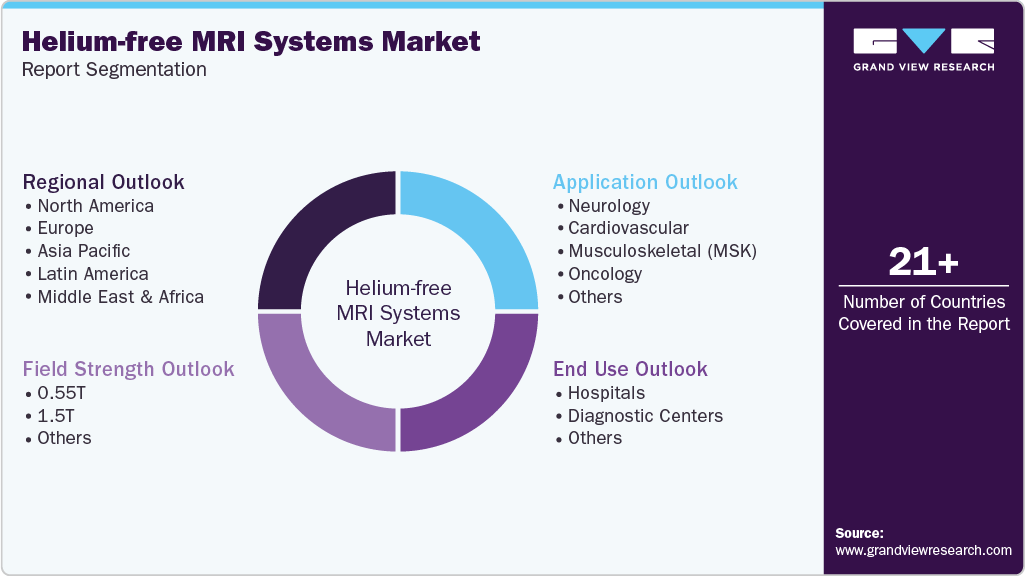
This report forecasts revenue growth at global, regional, and country levels and provides an analysis of the latest industry trends in each of the sub-segments from 2021 to 2033. For this study, Grand View Research has segmented the global helium free MRI systems market report based on field strength, application, end use, and region:
 To learn more about this report, Download Free Sample Report
-
Field Strength Outlook (Revenue, USD Million, 2021 - 2033)
-
0.55T
-
1.5T
-
Others
-
-
Application Outlook (Revenue, USD Million, 2021 - 2033)
-
Neurology
-
Cardiovascular
-
Musculoskeletal (MSK)
-
Oncology
-
Others
-
-
End Use Outlook (Revenue, USD Million, 2021 - 2033)
-
Hospitals
-
Diagnostic Centers
-
Others
-
-
Region Outlook (Revenue, USD Million, 2021 - 2033)
-
North America
-
U.S.
-
Canada
-
Mexico
-
-
Europe
-
UK
-
Germany
-
France
-
Italy
-
Spain
-
Norway
-
Denmark
-
Sweden
-
-
Asia Pacific
-
China
-
Japan
-
South Korea
-
Thailand
-
Australia
-
India
-
-
Latin America
-
Brazil
-
Argentina
-
-
MEA
-
South Africa
-
Saudi Arabia
-
UAE
-
Kuwait
-
-
Research Methodology
The helium-free MRI systems market figures in this report are based on a proven research process that combines executive interviews with secondary research from proprietary databases, company filings, and recognized regulatory and institutional sources. Market size is built through value-chain sizing - reconciling supply-side and demand-side estimates - and triangulated with bottom-up and top-down approaches. Every estimate passes multiple levels of expert validation before publication, with each helium-free MRI systems segment quantified using the revenue-capture definitions in the table below.
Segment Definition
Segment - Field Strength
Revenue capture definition
0.55T
Captures revenue from low-field 0.55-tesla MRI systems, including scanner hardware, integrated gradients, radiofrequency coils, software, and associated system components sold for clinical diagnostic imaging applications.
1.5T
Captures revenue from 1.5-tesla MRI systems, including scanner hardware, magnets, gradient systems, radiofrequency coils, imaging software, and integrated components supplied for routine and specialized clinical diagnostic imaging procedures.
Others
Captures revenue from MRI systems operating at field strengths other than 0.55T and 1.5T, including qualifying low-field, 3T, and other specialized clinical MRI platforms and configurations.
Segment - Application
Revenue capture definition
Neurology
Captures revenue attributable to MRI systems and associated imaging capabilities used to diagnose and monitor brain, spinal cord, cerebrovascular, neurodegenerative, and other neurological conditions across clinical care settings.
Cardiovascular
Captures revenue attributable to MRI systems and associated imaging capabilities used for cardiac structure, function, myocardial tissue characterization, vascular assessment, and diagnosis or monitoring of cardiovascular diseases.
Musculoskeletal (MSK)
Captures revenue attributable to MRI systems and associated imaging capabilities used to examine bones, joints, muscles, ligaments, tendons, and soft tissues for injury assessment and musculoskeletal disease diagnosis.
Oncology
Captures revenue attributable to MRI systems and associated imaging capabilities used for tumor detection, characterization, staging, treatment planning, response assessment, and follow-up monitoring across different cancer types.
Others
Captures revenue attributable to MRI systems and associated imaging capabilities used for abdominal, pelvic, breast, and other diagnostic applications not classified under neurology, cardiovascular, musculoskeletal, or oncology.
Segment - End Use
Revenue capture definition
Hospitals
Captures revenue from MRI systems purchased or leased by public and private hospitals for inpatient, outpatient, emergency, surgical planning, and specialized diagnostic imaging services across clinical departments.
Diagnostic Centers
Captures revenue from MRI systems purchased or leased by independent diagnostic imaging centers and outpatient imaging providers delivering scheduled scans, specialist referrals, and diagnostic imaging services to patients.
Others
Captures revenue from MRI systems purchased or leased by research institutions, academic medical centers, specialty clinics, and other eligible facilities not classified as hospitals or diagnostic centers.
Estimation Model
Step
Stage
Key Question
Process Steps
Data Sources
01
Scope Definition
What exactly is included in the helium-free MRI systems market?
1. Define the market scope to include MRI systems designed to operate
2. Segment the market by field strength, including 0.55T, 1.5T, and other qualifying field strengths.
3. Define application categories, including neurology, cardiovascular, musculoskeletal (MSK), oncology, and other diagnostic applications.
4. Establish geographic and temporal scope, including historical, base-year, and forecast periods.
Russian Ministry of Health, Federal Customs Service, National Association of Aesthetic Medicine, professional cosmetology associations.
02
Build the Product Base
How many helium-free MRI systems are installed, and what is the addressable demand for new installations?
1. Estimate the installed base of MRI systems across key countries, distinguishing helium-free systems from conventional liquid-helium-based systems.
2. Identify hospitals, diagnostic imaging centers, and other healthcare facilities requiring new MRI installations or replacement of existing scanners.
3. Estimate annual procurement volumes based on MRI installation trends, replacement cycles, healthcare infrastructure expansion, and diagnostic imaging demand.
4. Allocate potential system demand across 0.55T, 1.5T, and other field strengths based on clinical requirements, manufacturer portfolios, and purchasing preferences.
Roszdravnadzor product registry, Federal Customs Service import data, Ministry of Industry and Trade, distributor/importer price lists
03
Estimate Penetration
How many MRI installations are captured by helium-free technologies?
1. Estimate the proportion of new MRI installations adopting helium-free or qualifying low-helium technologies relative to conventional MRI systems.
2. Assess adoption across hospitals, diagnostic centers, and other end users.
3. Evaluate field-strength and application preferences across neurology, cardiovascular, musculoskeletal, oncology, and other diagnostic procedures.
4. Assess technology adoption driven by helium supply constraints, reduced dependence on helium infrastructure, advances in magnet design, and manufacturers' product launches.
Primary interviews with dermatologists, plastic surgeons, aesthetic physicians, clinic operators
04
Revenue Conversion
How does helium-free MRI system installation volume translate into market revenue?
1. Collect average selling prices for qualifying helium-free MRI systems by field strength, manufacturer, configuration, and geographic market.
2. Calculate revenue per system using estimated installation volumes and applicable system prices.
3. Include qualifying software, coils, installation, and service revenues only where they fall within the defined market scope and are not already included in system selling prices.
4. Apply system-specific pricing and annual installation volumes to derive total market revenue.
Clinic price lists, distributor pricing catalogs, Federal Customs Service data, market research on out-of-pocket aesthetic spending in Russia
Delivered Customizations
This report has been delivered with the following In-depth customizations
Client Request
Customization Delivered
Value Adds
Porter Analysis
Conducted a comprehensive Porter’s Five Forces analysis of the helium-free MRI systems market, evaluating the threat of new entrants, supplier power, buyer power, threat of substitutes, and competitive rivalry. The analysis considered MRI technology development, superconducting magnet innovations, helium-free magnet designs, manufacturing complexity, regulatory approvals, component supplier dependencies, hospital procurement decisions, conventional helium-based MRI alternatives, pricing pressures, and strategic partnerships.
Enables stakeholders to understand competitive intensity, technological entry barriers, supplier dependencies, and customer purchasing dynamics. Supports strategic decisions related to technology investments, supplier diversification, pricing strategies, partnerships, product differentiation, and market entry.
Competitive Landscape
Conducted a detailed competitive landscape assessment of the helium-free MRI systems market, comparing key players based on product portfolios, field strengths, magnet technologies, helium-free or zero-boil-off capabilities, imaging performance, clinical applications, manufacturing expertise, regulatory clearances, and commercialization strategies. The assessment covered companies such as Philips, Siemens Healthineers, GE HealthCare, United Imaging Healthcare, and other relevant MRI manufacturers, evaluating their product innovations, competitive positioning, and technology development initiatives.
Enables stakeholders to benchmark leading manufacturers, assess technological differentiation, identify portfolio gaps, and evaluate partnership opportunities. Supports decisions related to product development, research investments, technology adoption, strategic collaborations, and competitive positioning in helium-free MRI systems.
Geographic Analysis
Conducted a comprehensive geographic assessment of the helium-free MRI systems market across North America, Europe, Asia Pacific, Latin America, and the Middle East & Africa. The analysis evaluated healthcare infrastructure, MRI installation base, diagnostic imaging demand, healthcare expenditure, regulatory requirements, hospital modernization, availability of specialized technical personnel, and adoption of helium-independent magnet technologies. It also assessed regional procurement trends, healthcare access initiatives, and opportunities for market expansion.
Enables stakeholders to identify high-potential regions, emerging demand centers, and opportunities for technology adoption. Supports strategic decisions related to geographic prioritization, distributor selection, regulatory planning, market entry, hospital partnerships, and investment allocation.
Frequently Asked Questions About This Report
The global helium-free MRI systems market size was valued at USD 1.7 billion in 2025 and is estimated at USD 1.8 billion for 2026.
The global helium-free MRI systems market is expected to grow at a CAGR of 8.9% from 2026 to 2033, reaching USD 3.3 billion by 2033.
By field strength, the 1.5T segment held the highest market share of 64.0% in 2025.
North America helium-free MRI systems market held the largest share of 41.3% of the global market in 2025.
Key factors driving the helium-free MRI systems market include rising demand for cost-efficient imaging, helium supply constraints, advancements in magnet technology, lower operating costs, and growing adoption of sustainable healthcare infrastructure.
Some key players operating in the helium-free MRI systems market include Siemens Healthineers, Koninklijke Philips N.V., GE HealthCare, Fujifilm, United Imaging, Wandong Medical, Maya Medical Equipment, Esaote, Time Medical, Xingaoyi Medical Equipment Co., Ltd.
Asia Pacific is the fastest-growing region over the forecast period.
By end use, the hospitals segment held a leading market share of 65.0% in 2025.
About the Author(s)
Medical Devices Research Team
Healthcare · Medical DevicesThis report was authored by the medical devices research team at Grand View Research - comprising two research analysts, one senior research analyst, and one industry expert - with specialized expertise in the medical devices segment of the healthcare industry. All findings are based on proprietary healthcare databases, executive interviews, and regulatory analysis, subject to internal peer review prior to publication.
Last Updated:
Speak to Analyst

Customize this report to your needs - add regions, segments, or data points, with 20% free customization.
Or view our licence options:


ISO 9001:2015 & 27001:2022 Certified
We are GDPR and CCPA compliant! Your transaction & personal information is safe and secure. For more details, please read our privacy policy.


