
- Home
- »
- Advanced Interior Materials
- »
-
High-Entropy Alloys Market Size & Share Report, 2026-2033GVR Report cover

High-Entropy Alloys Market (2026 - 2033)
Size, Share & Trends Analysis Report By Alloy Type (Single-phase, Multi-phase), By End-use (Energy & Power, Aerospace & Defense, Industrial/Tooling), By Region, And Segment Forecasts
Market Size, 2025
$1.1BMarket Estimate, 2026
$1.2BMarket Forecast, 2033
$2.5BCAGR, 2026–2033
10.4%High-Entropy Alloys Market Summary
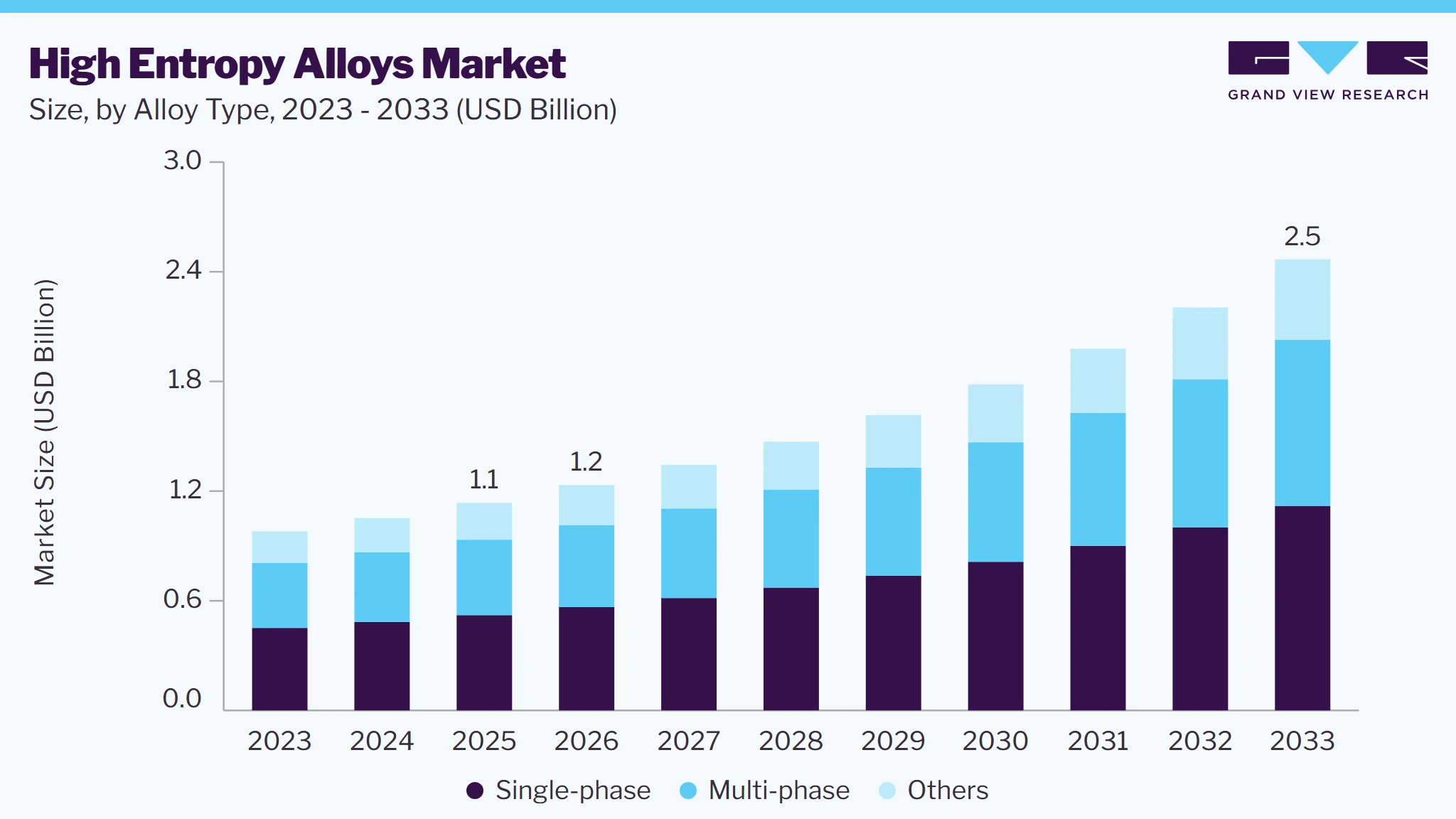
The global high-entropy alloys market size was valued at USD 1.1 billion in 2025 and is projected to grow from USD 1.2 billion in 2026 to USD 2.5 billion by 2033, at a CAGR of 10.4% from 2026 to 2033. North America market dominated, with a revenue share of 37.8% in 2025. The rising demand for high-performance materials with superior strength, corrosion resistance, and thermal stability across aerospace, defense, and energy sectors drives the market growth.
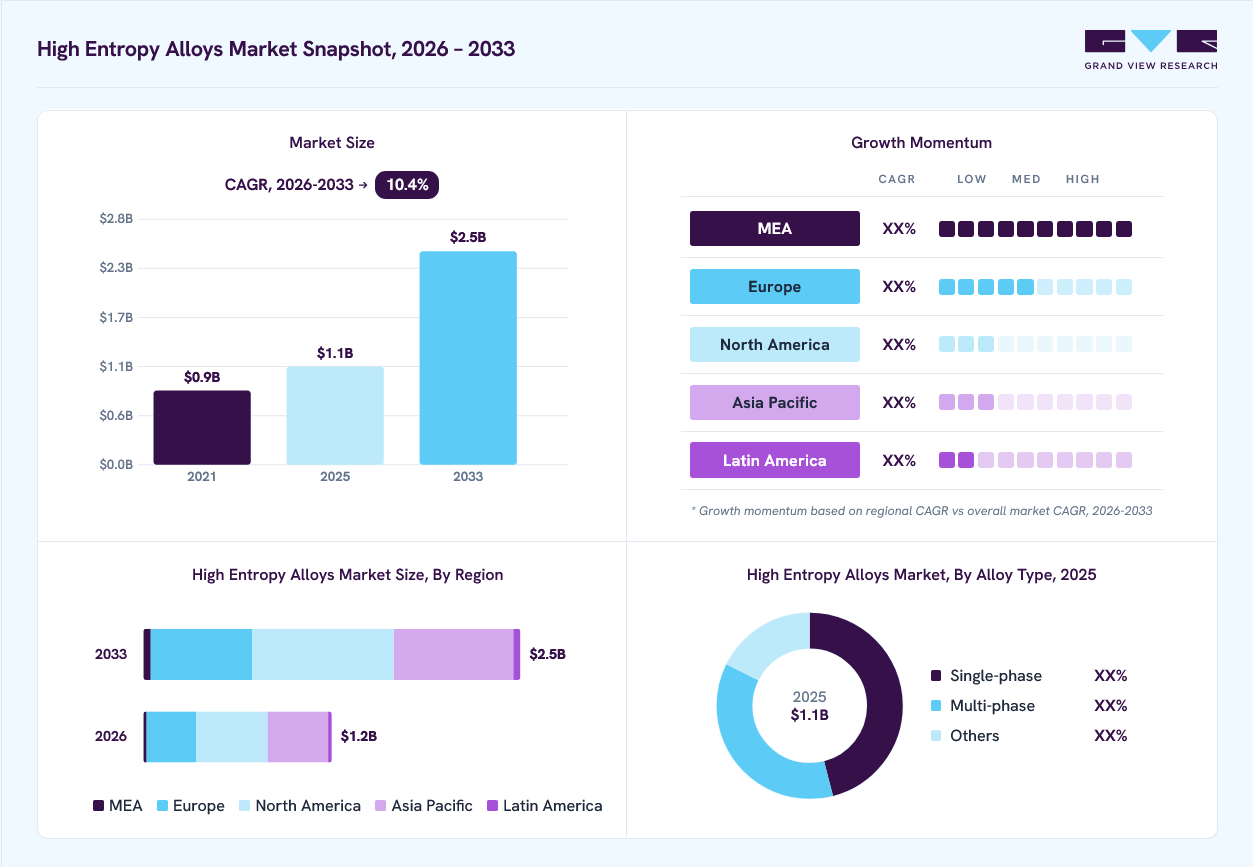 Source: Grand View Research, IR Documents, Primary Interviews, Paid DatabasesTo learn more about this report,
 Download Free Sample Report
Key Market Trends & Insights
- By type: Single-phase high-entropy alloys segment led the market with the largest revenue share of 45.7% in 2025.
- By end-use: Aerospace & defense segment led the market with the largest revenue share of 42.2% in 2025.
Regional Highlights
- Largest regional market: North America (37.8% revenue share, 2025)
- By country: The U.S. held the largest market share in 2025.
Market Size & Forecast
- Market size in 2025: USD 1.1 Billion
- Estimated market size in 2026: USD 1.2 Billion
- Projected market size by 2033: USD 2.5 Billion
- CAGR (2026-2033): 10.4%
Prism AI by Grand View Research Free to tryAsk a question about the High-Entropy alloys marketTry asking✓Every figure cited from GVR research Prefer the report? Download free sample →Increasing research in lightweight and refractory high-entropy alloys (HEAs) and advancements in additive manufacturing and sustainable alloy processing technologies further support HEAs market expansion. Sustainability is becoming central to the HEAs market, with companies and governments emphasizing energy-efficient production, ethical sourcing, and transparent supply chains to minimize environmental impact. Integrating recycled and secondary materials into alloy manufacturing reduces dependence on virgin ores, enhances resource efficiency, and aligns industry practices with global Environmental, Social, and Governance (ESG) goals. These initiatives position HEAs as a sustainable solution within the advanced materials landscape.
 To learn more about this report, Download Free Sample Report
Technological innovations are transforming the HEAs market, improving process efficiency, lowering operational costs, and enabling the recovery of valuable metals from industrial and mining waste. Advancements in electrochemical and additive manufacturing techniques are expanding alloy design possibilities while reducing emissions and material waste. Supportive government policies aimed at securing critical minerals and promoting low-carbon technologies are driving adoption across major regions such as the Asia Pacific, North America, and Latin America. As the global energy transition accelerates, HEAs emerge as a vital enabler of sustainable, high-performance metal applications.
Market Dynamics
The high-entropy alloys (HEAs) market is witnessing strong growth owing to increasing demand for advanced engineering materials capable of operating under extreme mechanical, thermal, and corrosive environments. HEAs are multi-principal element alloys that offer exceptional combinations of high strength, fracture toughness, wear resistance, oxidation resistance, and thermal stability, making them suitable for high-performance applications across aerospace, defense, energy, automotive, electronics, and industrial manufacturing. Advancements in alloy design using computational materials engineering, additive manufacturing technologies, and growing investments in next-generation materials research are further accelerating commercial adoption.
The growing need for materials that can withstand extreme operating environments is a major factor driving the market. Industries such as aerospace, defense, power generation, and nuclear energy require structural materials that retain their mechanical strength, corrosion resistance, and thermal stability under high temperatures, pressure, and cyclic loading conditions. Compared with conventional alloys, HEAs exhibit superior combinations of strength, ductility, wear resistance, and oxidation resistance, making them well-suited for critical applications, including turbine blades, jet engine components, rocket propulsion systems, heat exchangers, and nuclear reactor parts.
In addition, continuous investments in advanced materials research and next-generation manufacturing technologies are accelerating the commercialization of HEAs. Research institutions and industrial manufacturers are leveraging computational alloy design, artificial intelligence, and additive manufacturing to develop customized alloy compositions with enhanced functional properties while reducing development time. Growing government funding for defense modernization, space exploration, and clean energy initiatives is further encouraging the adoption of high-performance alloys.
The widespread commercialization of high-entropy alloys is constrained by their complex manufacturing processes and high production costs. Producing HEAs requires precise control over multi-element compositions, specialized melting techniques such as vacuum arc remelting and induction melting, and advanced powder metallurgy or additive manufacturing processes. The use of expensive alloying elements, including cobalt, nickel, tantalum, hafnium, and niobium, further increases material costs. Additionally, limited industrial-scale production capacity, lack of standardized processing routes, and insufficient long-term performance data restrict adoption in cost-sensitive industries and delay large-scale commercialization.
The rapid advancement of additive manufacturing and computational materials science is creating substantial growth opportunities for the market. Metal 3D printing enables the fabrication of complex HEA components with minimal material waste while allowing rapid prototyping and customized part production for aerospace, medical, and industrial applications. At the same time, artificial intelligence, machine learning, and Integrated Computational Materials Engineering (ICME) are significantly accelerating the discovery and optimization of novel HEA compositions with tailored mechanical and functional properties.
Analyst Perspective
The global high-entropy alloys (HEAs) market is poised for robust growth, supported by rising demand for advanced materials with superior mechanical strength, thermal stability, and corrosion resistance. Increasing adoption across aerospace, defense, energy, and advanced manufacturing, coupled with ongoing advancements in alloy design and additive manufacturing, is expected to accelerate commercialization and expand the application scope of high-entropy alloys over the forecast period.
Alloy Type Insights
Based on type, the single-phase high-entropy alloys segment led the market with the largest revenue share of 45.7% in 2025, owing to its uniform microstructure, superior mechanical strength, and excellent thermal and corrosion resistance. These alloys are easier to process and integrate into industrial applications, making them the preferred choice for large-scale production. Advances in powder metallurgy and additive manufacturing have further enhanced the scalability and cost-efficiency of single-phase HEAs, reinforcing their leading position in the market.
Multi-phase HEAs and alloys in the other categories, including nanostructured or composite variants, occupy a smaller market share due to more complex processing and higher production costs. However, these alloys are gaining attention in research and niche applications where tailored properties such as enhanced hardness, wear resistance, or specialized thermal performance are required. Ongoing R&D and improvements in manufacturing techniques are expected to gradually increase the adoption of multi-phase and novel HEAs in high-performance sectors.
End Use Insights
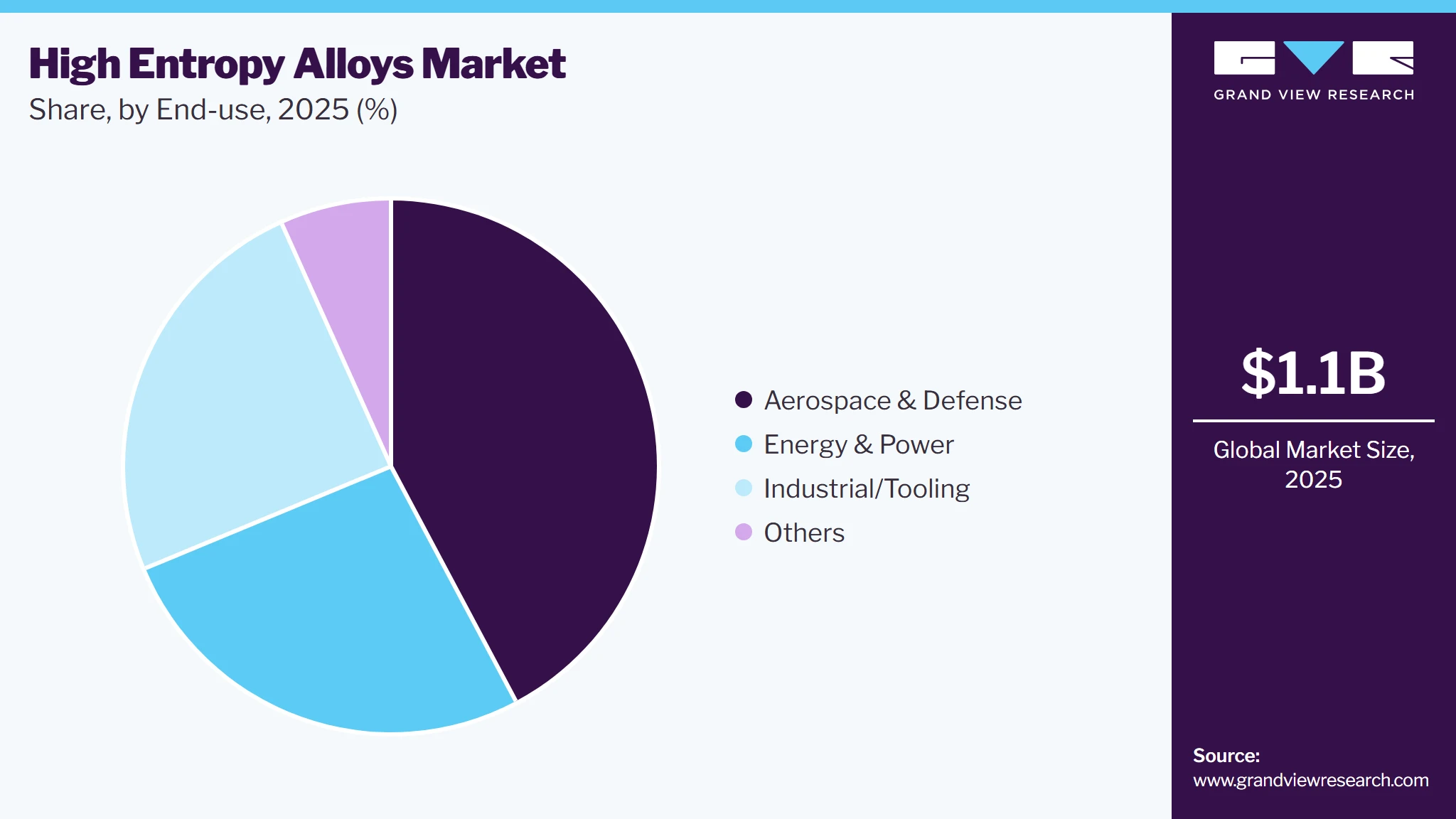
Based on end-use, the aerospace & defense segment led the market with the largest revenue share of 42.2% in 2025, driven by the need for materials that can withstand extreme temperatures, high stress, and corrosive environments. HEAs offer superior strength-to-weight ratios, thermal stability, and wear resistance, making them ideal for turbine engines, aircraft structures, and defense equipment. This segment accounts for the largest share of revenue, supported by significant investments in advanced materials by government and defense agencies.
 To learn more about this report, Download Free Sample Report
The energy & power segment represents a growing portion of the market, leveraging HEAs for applications in power generation, nuclear reactors, and renewable energy systems. These alloys provide excellent high-temperature performance and corrosion resistance in extreme operational conditions. The adoption of HEAs in this segment is increasing as industries seek reliable materials to improve the efficiency and longevity of critical energy infrastructure.
The industrial/tooling and other segments utilize HEAs for specialized applications requiring high wear resistance, toughness, and chemical stability. While these segments currently hold a smaller market share than Aerospace & Defense, their adoption is rising due to advancements in manufacturing techniques and the development of alloys tailored for cutting tools, molds, and niche industrial equipment. Ongoing research is expected to expand the use of HEAs in these sectors over the coming years.
Regional Insights
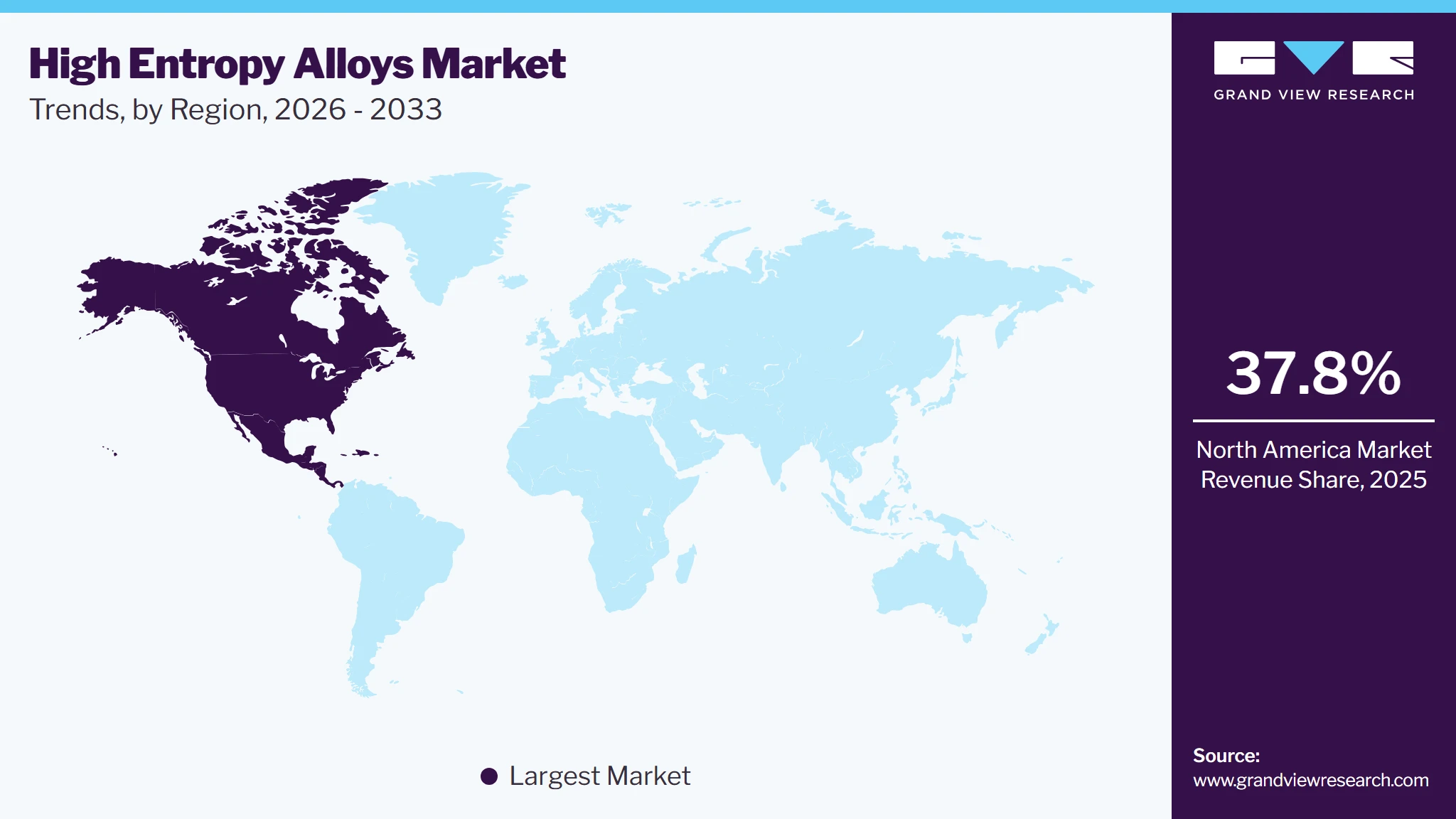
North America dominated the high-entropy alloys market with the largest revenue share of 37.8% in 2025, driven by strong demand from aerospace, defense, and energy sectors seeking advanced materials for high-temperature and corrosion-resistant applications. The U.S. and Canada heavily invest in research and development to commercialize HEAs through partnerships between universities, national laboratories, and private manufacturers. The increasing adoption of additive manufacturing and the integration of AI-driven alloy design tools are accelerating regional innovation. Government initiatives such as the U.S. Department of Energy’s programs for critical material sustainability are further supporting the use of HEAs in next-generation clean energy technologies and advanced manufacturing.
 To learn more about this report, Download Free Sample Report
U.S. High-Entropy Alloys Market Trends
The high-entropy alloys market in the U.S. held the largest share in the North America region in 2025. The U.S. continues to dominate the North American HEA market, supported by robust industrial infrastructure, defense modernization programs, and cutting-edge research in materials science. Due to their exceptional strength-to-weight ratio and oxidation resistance, major institutions such as NASA, the Department of Defense, and national laboratories are actively developing HEAs for turbine engines, nuclear reactors, and space applications.
Asia Pacific High-Entropy Alloys Market Trends
Asia Pacific dominates the global high-entropy alloys (HEAs) market, driven by rapid industrialization, expanding aerospace and automotive manufacturing, and government-backed investments in advanced materials research. Countries such as China, Japan, South Korea, and India are leading in HEA production and R&D, focusing on applications in defense, energy systems, and high-temperature components. China’s growing emphasis on self-sufficiency in high-performance materials and Japan’s innovative lightweight HEAs for EVs and aircraft strengthen the region’s leadership. However, rising production costs and raw material price fluctuations are prompting regional players to explore more energy-efficient and cost-effective alloy processing technologies.
Europe High-Entropy Alloys Market Trends
Europe is accelerating HEA research and commercialization to support its transition toward sustainable, low-carbon manufacturing. The European Union’s strategic materials programs and research initiatives, particularly in Germany, France, and the UK, promote the use of HEAs in renewable energy, automotive, and aerospace sectors. Collaborative projects between research institutes and industry leaders are advancing HEA design through computational modeling and additive manufacturing.
Middle East & Africa High-Entropy Alloys Market Trends
The Middle East and Africa region is gradually entering the HEA value chain through investments in advanced materials and processing of critical minerals. Countries such as Saudi Arabia, the United Arab Emirates, and South Africa prioritize technology partnerships to develop high-strength and corrosion-resistant alloys for energy and industrial applications. Growing adoption of sustainable mining and electrochemical processing technologies improves local metal recovery and refining efficiency. Moreover, government-led initiatives to diversify economies and strengthen industrial R&D capabilities are expected to position the region as an emerging hub for specialty alloys and high-value materials in the coming decade.
Key High-Entropy Alloys Company Insights
Some of the key players operating in the market include Allegheny Technologies Incorporated, Carpenter Technology Corporation, Haynes International, Inc., and others.
-
Allegheny Technologies Incorporated (ATI), established in 1996, is a leading producer of specialty alloys and high-performance materials. ATI focuses on developing advanced metallic solutions, including High-Entropy Alloys, for aerospace, defense, and energy sectors. The company emphasizes sustainable production, research-driven alloy innovation, and additive manufacturing to enhance material performance and operational efficiency.
-
Carpenter Technology Corporation, founded in 1889, is a global manufacturer of high-performance alloys and engineered materials. Carpenter specializes in High-Entropy Alloys and other specialty metals for aerospace, medical, and industrial applications. The company invests in advanced alloy design, additive manufacturing, and sustainable processing technologies to deliver corrosion-resistant and high-strength materials.
-
Haynes International, Inc., established in 1912, is a global provider of corrosion- and heat-resistant alloys. The company produces advanced materials for aerospace, chemical processing, and energy industries, including High-Entropy Alloys. Haynes emphasizes research and development, sustainable metal production, and process innovations to improve alloy performance and reduce environmental impact.
Key High-Entropy Alloys Companies:
The following key companies have been profiled for this study on the high-entropy alloys market.
-
Allegheny Technologies Incorporated
-
Aperam S.A.
-
Carpenter Technology Corporation
-
Haynes International, Inc.
-
Hitachi Metals Ltd.
-
Oerlikon Management AG
-
Plansee SE
-
Sandvik AB
-
Special Metals Corporation
-
VDM Metals Holding GmbH
Competitive Benchmarking
Category
Operating Strategies
Competitive Edge
Weakness
Established Players (e.g., Allegheny Technologies Incorporated (ATI), Carpenter Technology Corporation, Haynes International, Inc., Sandvik AB, Special Metals Corporation)
- Prioritize continuous innovation by developing proprietary HEA grades for mission-critical applications.
- Enhance manufacturing capabilities through investments in precision melting, powder processing, and advanced forming technologies.
- Secure long-term business by working closely with aerospace, defense, energy, and industrial OEMs on material qualification programs.
- Strong metallurgical expertise and decades of experience in specialty alloy manufacturing enable the production of highly engineered materials.
- Well-established customer relationships and global production infrastructure strengthen market reach and customer retention.
- Robust financial resources support sustained investments in product development, capacity expansion, and advanced processing technologies.
- Commercialization requires substantial investment in R&D and specialized manufacturing infrastructure.
- Revenue growth is often constrained by lengthy certification and approval procedures for critical applications.
- Fluctuations in the availability and pricing of strategic alloying metals can adversely impact production economics.
Emerging & Regional Players (e.g., Aperam S.A., Hitachi Metals, Ltd., Oerlikon Management AG, Plansee SE, VDM Metals Holding GmbH)
- Concentrate on high-value niche applications where the performance advantages of HEAs justify premium pricing.
- Differentiate offerings through application-specific alloy development and rapid prototyping using additive manufacturing technologies.
- Build market presence by participating in collaborative research programs and strategic partnerships with industrial end users.
- Greater organizational flexibility enables faster response to evolving customer requirements and emerging application opportunities.
- Specialized technical capabilities facilitate the development of customized alloy compositions for demanding operating environments.
- Strong focus on innovation allows companies to establish an early position in emerging commercial applications of HEAs.
- Limited manufacturing scale can restrict participation in large-volume commercial contracts.
- Lower brand recognition in the global specialty alloys market may slow customer acquisition.
- Expansion depends heavily on successful technology validation and broader industrial acceptance of high-entropy alloys.
Recent Developments
-
In early 2025, Carpenter Technology Corporation announced the expansion of its additive manufacturing capabilities to produce high-entropy alloys for aerospace and defense applications. The company has invested in advanced 3D printing technologies to enable the production of complex HEA components with enhanced mechanical properties. This initiative aims to meet the growing demand for lightweight and high-strength materials in critical applications.
-
In mid-2024, Haynes International, Inc. introduced a new series of high-entropy alloys explicitly designed for high-temperature aerospace applications. These alloys exhibit superior oxidation resistance and thermal stability, making them suitable for turbine engine components and other critical aerospace parts. The development underscores Haynes' commitment to advancing materials science in the aerospace sector.
-
In late 2024, Allegheny Technologies Incorporated (ATI) announced a significant investment in sustainable production methods for high-entropy alloys. The company is focusing on reducing the environmental impact of alloy manufacturing by implementing energy-efficient processes and increasing the use of recycled materials. This move aligns with ATI's commitment to sustainability and meeting the growing demand for eco-friendly materials in various industries.
High-Entropy Alloys Market Report Scope
Report Attribute
Details
Market definition
Market size represents the total revenue generated from the sale of HEAs for industrial use.
Market size in 2025
USD 1.1 billion
Projected market size by 2033
USD 1.2 billion
Revenue forecast in 2033
USD 2.5 billion
Growth rate
CAGR of 10.4% from 2026 to 2033
Base year for estimation
2025
Historical data
2021 - 2024
Forecast period
2026 - 2033
Quantitative units
Revenue in USD million, volume in kilotons and CAGR from 2026 to 2033
Report coverage
Revenue forecast, volume forecast, company ranking, competitive landscape, growth factors, and trends
Segments covered
Type, end-use, region
Regional scope
North America; Europe; Asia Pacific; Latin America; Middle East & Africa
Country scope
U.S.; Canada; Mexico; Germany; France; UK.; Italy; China; India; Japan; South Korea; Brazil
Key companies profiled
Allegheny Technologies Incorporated (ATI); Aperam S.A.; Carpenter Technology Corporation; Haynes International, Inc.; Hitachi Metals, Ltd.; Oerlikon Management AG; Plansee SE; Sandvik AB; Special Metals Corporation; VDM Metals Holding GmbH
Customization scope
Free report customization (equivalent up to 8 analysts' working days) with purchase addition or alteration to country, regional & segment scope.
Pricing and purchase options
Avail customized purchase options to meet your exact research needs. Explore purchase options
Global High-Entropy Alloys Market Report Segmentation
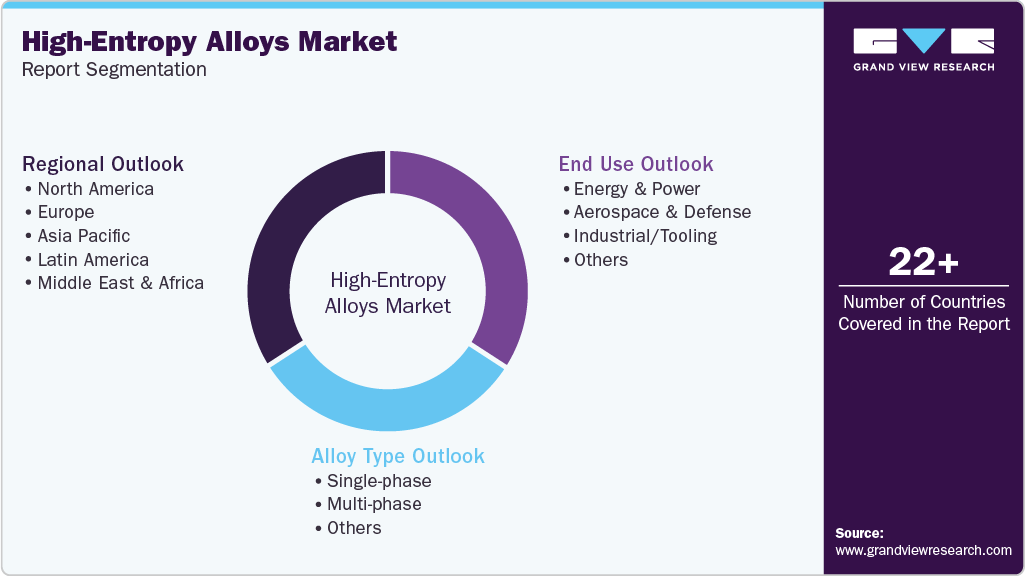
This report forecasts global, country, and regional revenue growth and analyzes the latest trends in each sub-segment from 2021 to 2033. For this study, Grand View Research has segmented the global high-entropy alloys market report by alloy type, end use, and region.
 To learn more about this report, Download Free Sample Report
-
Alloy Type Outlook (Revenue, USD Million, 2021 - 2033)
-
Single-phase
-
Multi-phase
-
Others
-
-
End Use Outlook (Revenue, USD Million; 2021 - 2033)
-
Energy & Power
-
Aerospace & Defense
-
Industrial/Tooling
-
Others
-
-
Regional Outlook (Revenue, USD Million; 2021 - 2033)
-
North America
-
U.S.
-
Canada
-
Mexico
-
-
Europe
-
Germany
-
France
-
UK
-
Italy
-
-
Asia Pacific
-
China
-
India
-
Japan
-
South Korea
-
-
Latin America
-
Brazil
-
-
Middle East & Africa
-
South Africa
-
-
Research Methodology
The high-entropy alloys market figures in this report are based on a proven research process that combines executive interviews with secondary research from proprietary databases, company filings, and recognized regulatory and institutional sources. Market size is built through value-chain sizing-reconciling supply-side and demand-side estimates-and triangulated with bottom-up and top-down approaches. Every estimate passes multiple levels of expert validation before publication, with each high-entropy alloys segment quantified using the revenue-capture definitions in the table below.
Segment Definition
Type
Revenue Capture Definition
Single-phase
Revenue is generated from the sale of single-phase high-entropy alloys used in aerospace, defense, energy, and industrial applications requiring high strength, ductility, and corrosion resistance.
Multi-phase
Revenue is generated from the commercialization of multi-phase high-entropy alloys for applications requiring superior wear resistance, thermal stability, and mechanical performance, including turbines, tooling, and power systems.
Others
Revenue is generated from the sale of specialized high-entropy alloys, including lightweight, refractory, eutectic, and composite HEAs, for advanced industrial, biomedical, electronics, and research applications.
End Use
Revenue Capture Definition
Energy & Power
This segment includes high-entropy alloys utilized in gas turbines, nuclear reactors, hydrogen production systems, heat exchangers, and other energy infrastructure requiring exceptional thermal stability, oxidation resistance, and mechanical reliability. Revenue is generated from supplying HEAs for high-temperature and corrosion-resistant energy applications.
Aerospace & Defense
This segment comprises high-entropy alloys used in aircraft engines, aerospace structures, hypersonic systems, rocket propulsion, defense equipment, and protective components. Revenue is generated from the sale of HEAs to manufacturers developing lightweight, high-strength, and high-temperature-resistant components for critical aerospace and defense applications.
Industrial/Tooling
This segment includes high-entropy alloys used in cutting tools, molds, dies, industrial machinery, wear-resistant coatings, mining equipment, and heavy engineering components. Revenue is generated from supplying HEAs that enhance durability, wear resistance, and operational performance in demanding industrial environments.
Others
This segment comprises high-entropy alloys supplied for medical implants, marine equipment, electronics, chemical processing, semiconductor manufacturing, and research & development activities. Revenue is generated from the commercialization of HEAs for specialized applications requiring unique combinations of mechanical, functional, and corrosion-resistant properties.
Estimation Model
Layer Name
Key Question
Description
End-use Industry Demand Layer
Which industries are generating demand for high-entropy alloys?
Market demand is quantified by assessing the adoption of high-entropy alloys across industries requiring superior mechanical performance and environmental resistance. The analysis considers the production of aerospace components, defense systems, power generation equipment, medical implants, automotive parts, industrial machinery, and electronic devices, along with the pace of material substitution from conventional alloys to HEAs.
Material & Manufacturing Layer
What factors influence the supply of high-entropy alloys?
Supply-side assessment focuses on the availability of alloying elements, manufacturing infrastructure, and processing technologies used to produce HEAs. The evaluation includes specialty metal supply chains, vacuum melting, powder metallurgy, additive manufacturing, casting, and heat treatment capabilities, together with the production capacities of alloy manufacturers and regional supply ecosystems.
Technology Adoption Layer
How are high-entropy alloys being commercialized across applications?
This layer evaluates the commercialization of HEAs by examining their penetration into high-performance applications were conventional alloys face performance limitations. The assessment considers material qualification, product development activities, prototype-to-commercial transitions, industry acceptance, and application-specific performance requirements across aerospace, energy, healthcare, automotive, and industrial sectors.
Market Value Layer
How is the market revenue estimated?
The market size is calculated by analyzing revenues generated from the commercial sale of high-entropy alloys across various alloy systems, product forms, and end-use industries. Revenue estimation incorporates production volumes, average selling prices, application mix, manufacturing complexity, raw material costs, technological advancements, and the expanding adoption of advanced engineering materials in high-value industries.
Delivered Customizations
This report has been delivered with the following In-depth customizations
CLIENT REQUEST
CUSTOMIZATION DELIVERED
VALUE ADDS
Application-wise Demand Assessment
Detailed evaluation of high-entropy alloy demand across aerospace & defense, energy, automotive, medical, industrial equipment, electronics, and research applications, including country-level adoption trends and future demand potential.
Enabled identification of high-growth application segments, emerging end-use industries, and long-term revenue opportunities.
Production Cost Benchmarking
Comparative assessment of HEA manufacturing costs across major producing countries based on alloying element prices, melting technology, powder metallurgy, additive manufacturing, labor, energy, and processing expenses.
Supported manufacturing strategy, investment planning, cost competitiveness analysis, and production location evaluation.
Pricing & Profitability Analysis
Analysis of regional pricing trends for high-entropy alloys by alloy system, product form (ingots, powders, bars, sheets), manufacturing process, and end-use application, along with evaluation of raw material costs, processing complexity, and producer margins.
Facilitated pricing strategy development, procurement optimization, profitability assessment, and competitive benchmarking across the high-entropy alloys value chain.
Frequently Asked Questions About This Report
The high-entropy alloys market size was valued at USD 1.1 billion in 2025 and is estimated at USD 1.2 billion in 2026.
The high-entropy alloys market is expected to grow at a CAGR of 10.4% from 2026 to 2033 to reach USD 2.5 billion by 2033.
Aerospace & defense segment led the market with the largest revenue share of 42.2% in 2025.
Single-phase high-entropy alloys segment led the market with the largest revenue share of 45.7% in 2025.
North America market dominated, with a revenue share of 37.8% in 2025.
Increasing demand for high-performance, lightweight, and corrosion- and heat-resistant materials across aerospace, defense, energy, and advanced manufacturing industries is the primary factor driving the growth of the high-entropy alloys market.
The Middle East & Africa is anticipated to register the fastest CAGR of 12.2% over the forecast period.
The key players operating in the high-entropy alloys market are Allegheny Technologies Incorporated (ATI), Aperam S.A., Carpenter Technology Corporation, Haynes International, Inc., Hitachi Metals, Ltd., Oerlikon Management AG, Plansee SE, Sandvik AB, Special Metals Corporation, and VDM Metals Holding GmbH, among others.
About the Author(s)
Advanced Interior Materials Research Team
Advanced Materials · Advanced Interior MaterialsThis report was authored by the advanced interior materials research team at Grand View Research - comprising two research analysts, one senior research analyst, and one industry expert - with specialized expertise in the advanced interior materials segment of the advanced materials industry. All findings are based on proprietary advanced materials databases, executive interviews, and regulatory analysis, subject to internal peer review prior to publication.
Last Updated:
Speak to Analyst

Customize this report to your needs - add regions, segments, or data points, with 20% free customization.
Or view our licence options:


ISO 9001:2015 & 27001:2022 Certified
We are GDPR and CCPA compliant! Your transaction & personal information is safe and secure. For more details, please read our privacy policy.


