
- Home
- »
- Next Generation Technologies
- »
-
3D Printing Market Size, Share & Growth Report, 2026-2033GVR Report cover
![3D Printing Market (2026 - 2033)Report]()
3D Printing Market (2026 - 2033)
Size, Share & Trends Analysis Report By Component (Hardware, Software), By Printer Type (Desktop 3D Printer, Industrial 3D Printer), By Technology, By Software, By Application, By Vertical, By Material, By Region, And Segment Forecasts
Market Size, 2025
$30.5BMarket Estimate, 2026
$37.6BMarket Forecast, 2033
$168.9BCAGR, 2026–2033
23.9%3D Printing Market Summary
The global 3D printing market size was valued at USD 30.5 billion in 2025 and is projected to grow from USD 37.6 billion in 2026 to USD 168.9 billion by 2033, at a CAGR of 23.9% from 2026 to 2033. North America dominated the global market, with a revenue share of 32.8% in 2025. Strong investments in research and development in three-dimensional printing technologies, coupled with rising demand for prototyping applications across various industry verticals, particularly healthcare, automotive, and aerospace & defense, are expected to drive market growth.
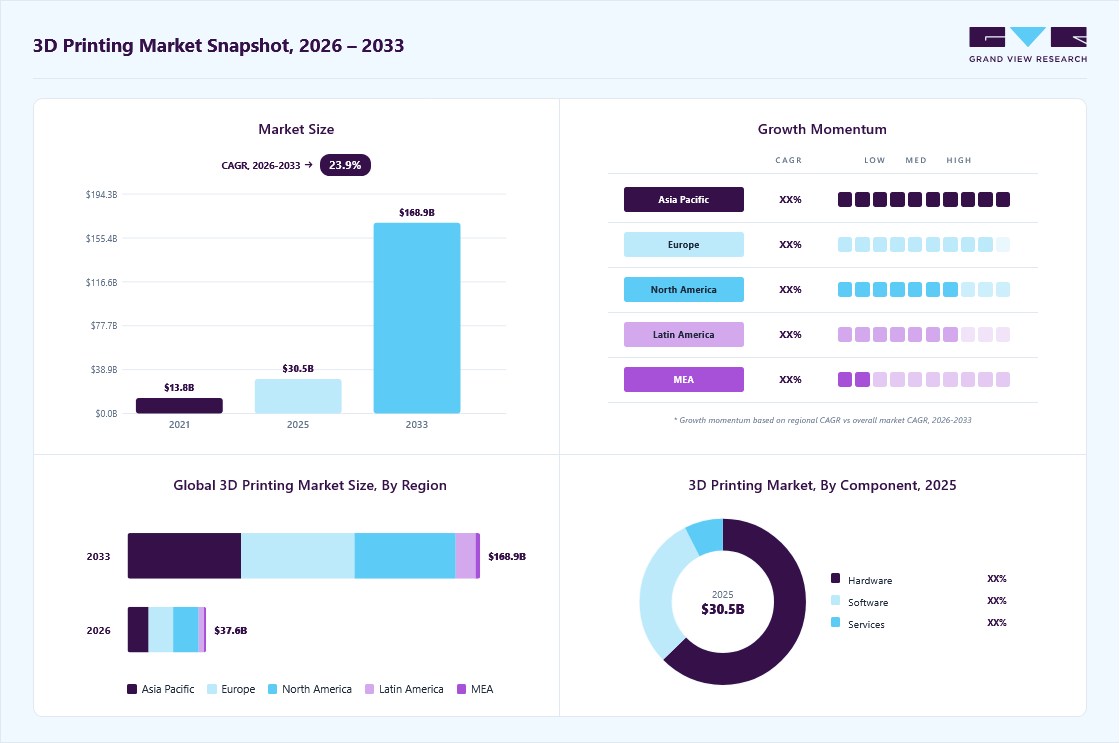
Key Market Trends & Insights
- By component: Hardware segment held the largest market share of 62.6% in 2025.
- By application: Prototyping segment held the largest market share of 47.2% in 2025.
- By material: Metal segment held the largest market share of 59.2% in 2025.
- By printer type: Industrial printers held the largest market share of 75.0% within the hardware segment in 2025.
- By software: Design software segment held the largest share of 36.5% within the software category in 2025.
- By technology: Stereolithography (SLA) segment held the largest revenue share of 10.9% in 2025.
- By vertical: Automotive segment held the largest revenue share in 2025
Regional Highlights
- Largest regional market: North America (32.8% revenue share, 2025)
- Fastest-growing regional market: Asia Pacific (fastest CAGR, 2026-2033)
Market Size & Forecast
- Market size in 2025: USD 30.5 Billion
- Estimated market size in 2026: USD 37.6 Billion
- Projected market size by 2033: USD 168.9 Billion
- CAGR (2026-2033): 23.9%
Three ways to get this report
Buy it, customize it, or ask a question.Ask an Analyst
A direct answer, usually in 1 working day
- AccessReport author, directly
- Reply timeWithin 1 working day
- No sales callDirect answer only
- FormatEmail reply
- CostFree, no cost
Get the Full Report
What the study covers
- FormatsPDF · Excel · Dashboard
- Timeline2026–2033 annual, 2025 base
- Coverage20+ countries, 5 regions
- Companies10+ key players profiled
Customize the Report
20% free customization
- IncludeCountries, segments, points
- TailorTo your product definition
- ExtendDeeper competitor detail
- OrA fully bespoke study
- Turnaround5–10 working days
The technology enables highly customized production while reducing the cost and time associated with conventional manufacturing methods. Manufacturers can rapidly design and produce customized components, prototypes, and end-use products based on specific customer requirements. This growing emphasis on personalization is encouraging organizations to integrate additive manufacturing more extensively into their production strategies.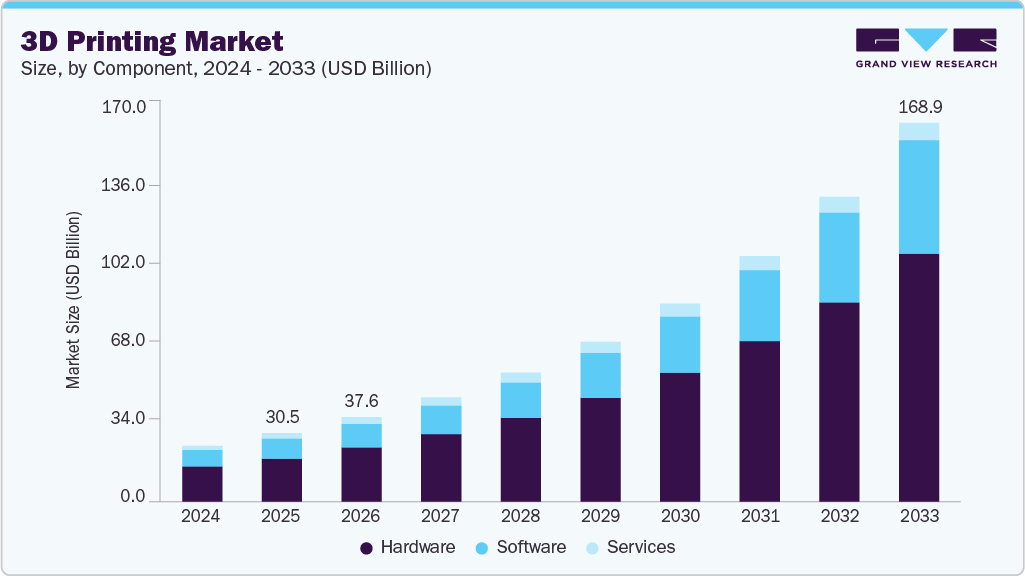
The growing need for rapid prototyping and shorter product development cycles is another key factor supporting market growth. 3D printing enables manufacturers to quickly produce prototypes, evaluate designs, and implement modifications without the need for expensive tooling or lengthy production cycles. This accelerates product development, reduces associated costs, and enables companies to respond more quickly to changing market requirements. As a result, additive manufacturing is becoming increasingly attractive to industries that prioritize innovation, design flexibility, and faster product launches.
Continuous advancements in 3D printing materials and technologies are further expanding the scope of additive manufacturing applications. Innovations in materials, including metal alloys, composites, ceramics, and biocompatible polymers, are enabling the production of stronger, more durable, and functionally advanced components. Concurrently, advancements in printing technologies, such as selective laser sintering, stereolithography, and metal additive manufacturing, are improving the ability to produce high-quality components for industrial applications. These developments are enhancing the efficiency, precision, and reliability of 3D printing systems, thereby supporting market expansion.
Industries are increasingly integrating 3D printing into production workflows for applications such as rapid prototyping, tooling, and mass customization. Key sectors, including aerospace, automotive, and industrial machinery, are adopting additive manufacturing to accelerate product development and shorten manufacturing cycles. The technology provides greater design flexibility and can reduce material usage and production costs compared with conventional manufacturing processes. Furthermore, the ability to produce complex geometries, lightweight structures, and consolidated components provides manufacturers with greater design freedom and performance advantages, encouraging deeper integration of 3D printing across industrial workflows.
However, the high initial investment required for advanced 3D printers, specialized materials, and skilled personnel remains one of the key restraints of the market growth. Small and medium-sized enterprises, in particular, face challenges in justifying the capital expenditure required to transition from conventional manufacturing processes to additive manufacturing. In addition, limitations related to material availability, variability in product quality for certain applications, and relatively slower production speeds compared with conventional mass-production methods can restrict adoption in high-volume manufacturing.
Market Dynamics
The 3D printing market is transitioning from a prototyping-oriented technology toward a broader manufacturing solution, supported by growing adoption for customized, low-volume, and complex components. Advancements in materials, printing technologies, and process capabilities are expanding their applicability across aerospace, healthcare, automotive, and industrial manufacturing. At the same time, the lack of standardized qualification protocols, process consistency, and interoperability continues to constrain adoption, particularly for safety-critical applications. The increasing integration of AI, machine learning, and in-process monitoring presents a significant opportunity to improve process optimization, defect detection, quality assurance, and production efficiency. Recent research highlights AI-enabled process control and monitoring as important areas for advancing the scalability and reliability of additive manufacturing.
The growing adoption of 3D printing for low-volume and customized manufacturing is creating favorable growth prospects for the market. Conventional manufacturing methods often require dedicated molds, tooling, and substantial setup costs, making them less economical for customized products and small production batches. 3D printing eliminates or reduces the need for such tooling, allowing manufacturers to produce complex and customized components with relatively limited setup requirements. This capability is particularly valuable for industries such as aerospace, automotive, healthcare, and industrial machinery, where production often involves specialized components, replacement parts, and products with varying specifications. The technology also supports on-demand manufacturing, enabling companies to produce parts closer to the point and time of use while reducing inventory requirements and storage costs. As manufacturers increasingly seek flexible production models and more efficient approaches to low-volume manufacturing, the application of 3D printing is expected to expand across industrial and commercial sectors.
The lack of standardized processes and qualification protocols for 3D-printed components remains a significant constraint on market expansion. Unlike conventional manufacturing, additive manufacturing outcomes can vary depending on machine configuration, material characteristics, printing parameters, and post-processing techniques. Such variations can affect dimensional accuracy, mechanical properties, surface quality, and overall component performance. The absence of universally accepted standards for materials, processes, testing, and certification can make it difficult for manufacturers to establish consistent production quality and obtain approvals for critical applications. These challenges are particularly relevant in aerospace, defense, healthcare, and automotive applications, where components must meet stringent safety and performance standards. Qualification and validation processes can also involve extensive testing and documentation, thereby increasing development costs and extending commercialization timelines. As a result, manufacturers may remain cautious about transitioning critical components from conventional production methods to additive manufacturing, particularly for applications requiring high reliability and regulatory compliance.
The integration of artificial intelligence (AI), machine learning, sensors, and in-process monitoring technologies presents a significant opportunity for the 3D printing market. Conventional printing processes can exhibit defects due to variations in temperature, material deposition, laser parameters, or other operating conditions, necessitating inspection and, in some cases, reprinting components. AI-enabled systems can analyze data generated during the printing process to identify anomalies, optimize operating parameters, and support real-time process control. In-process monitoring can further enable manufacturers to detect defects during production rather than after completion, potentially improving yield and reducing material waste. The combination of AI and monitoring technologies can also support predictive maintenance, automated quality control, and greater process consistency. As manufacturers increasingly seek to improve productivity and reliability while reducing production costs, the integration of intelligent technologies into 3D printing equipment is expected to create new opportunities for equipment manufacturers, software providers, and additive manufacturing service companies.
Analyst Perspective
3D printing is entering a commercialization phase in which production applications, rather than prototyping alone, will increasingly shape market growth. Adoption is expected to be strongest where customization, complex geometries, low production volumes, and shorter lead times provide clear economic benefits. In parallel, AI-enabled process monitoring and automated quality control could address some of the technology's current challenges with consistency and qualification. However, broader penetration into high-volume and highly regulated manufacturing will remain dependent on improvements in production speed, material availability, standardization, and certification. The convergence of additive manufacturing with AI, digital twins, and data-driven process control is therefore expected to be a key differentiator for next-generation 3D printing systems.
Component Insights
The hardware segment dominated the 3D printing industry in 2025, accounting for 62.6% of revenue. The segment's large share can be attributed to the continued adoption of 3D printers and related equipment for prototyping, tooling, and production applications across industrial and commercial sectors. Increasing investments in advanced manufacturing capabilities across automotive, aerospace & defense, healthcare, electronics, and industrial manufacturing are supporting demand for industrial-grade printing systems. In addition, advancements in printing speed, build volume, resolution, automation, and multi-material processing are improving the suitability of 3D printing hardware for production-oriented applications. The increasing integration of automated material handling, process monitoring, and quality-control capabilities is further enhancing the functionality of advanced printing systems.
The software segment is expected to grow at the fastest CAGR over the forecast period. Growth is supported by the increasing need for software solutions that optimize design, process planning, simulation, inspection, and production workflows. As additive manufacturing systems become more complex, manufacturers increasingly rely on CAD/CAM, slicing, topology optimization, build preparation, simulation, and real-time monitoring software to improve productivity and part quality. The integration of artificial intelligence and machine learning is further expanding software capabilities by enabling automated parameter optimization, defect detection, predictive analytics, and process control.
Software Insights
The revenue contribution of design software was the highest in the 3D printing software segment, accounting for 36.5% of revenue in 2025. Design software plays a fundamental role in converting product concepts into digital models suitable for additive manufacturing and is widely used across automotive, aerospace & defense, healthcare, construction, and industrial applications. Increasing adoption of topology optimization, generative design, lattice structures, and design-for-additive-manufacturing tools is expanding the functionality of design platforms.
The scanning software segment is expected to grow at a CAGR of 24.5% over the forecast period. Growing adoption of 3D scanning for reverse engineering, inspection, quality control, and digital archiving is supporting demand for scanning software. These solutions enable physical objects to be converted into digital models that can subsequently be analyzed, modified, or reproduced using 3D printing technologies. Integration with inspection and metrology workflows is further expanding the role of scanning software in industrial manufacturing. The growing use of digital twins and digital inventories is also creating opportunities for scanning technologies, particularly for replacement parts and legacy components for which original CAD files may not be available.
Printer Type Insights
The revenue contribution of industrial printers was the highest, accounting for 75.0% of hardware revenue in 2025. Industrial 3D printers are increasingly deployed across automotive, aerospace & defense, healthcare, electronics, and industrial manufacturing for prototyping, tooling, production aids, and end-use components. Compared with desktop systems, industrial platforms generally offer larger build volumes, higher throughput, greater material compatibility, and enhanced process monitoring and automation capabilities. These characteristics make them better suited to demanding production environments and repeatable manufacturing applications. The increasing development of qualification standards for industrial additive manufacturing processes and production sites is further supporting the transition from experimental use toward controlled production environments.

The desktop 3D printer segment is expected to grow at a CAGR of 24.7% over the forecast period. Desktop printers, initially concentrated among hobbyists, makers, and small businesses, are increasingly being adopted in educational institutions, laboratories, design studios, dental applications, and small-scale manufacturing environments. Their relatively lower cost, compact form factor, ease of operation, and improving print quality are expanding their addressable user base. Educational institutions are using desktop printers to provide hands-on training in engineering, design, and additive manufacturing, while small businesses are adopting systems for prototyping, customized products, and on-demand production. The development of specialized desktop systems and materials is also widening their application scope.
Material Insights
The metal segment dominated the 3D printing market, accounting for 59.2% revenue share in 2025. Increasing adoption of metal additive manufacturing for high-performance and end-use applications is supporting the segment's leading position. Materials such as titanium, stainless steel, aluminum, nickel alloys, and other metal powders are widely used in aerospace, automotive, healthcare, energy, and industrial applications because of their strength, durability, thermal performance, and corrosion resistance. Metal additive manufacturing enables the production of complex geometries, lightweight structures, internal channels, and consolidated components that are difficult to manufacture with conventional processes. The development of dedicated standards for metal powder characterization, powder-bed fusion, post-processing, inspection, and qualification is further supporting the industrialization of metal AM.
The polymer segment is expected to register strong growth over the forecast period. Polymer materials remain widely used because of their comparatively lower cost, broad material availability, ease of processing, and compatibility with technologies such as material extrusion, stereolithography, and selective laser sintering. The development of engineering-grade and high-performance polymers with improved mechanical strength, flexibility, chemical resistance, and temperature performance is expanding their use beyond basic prototyping. Polymer 3D printing is increasingly being used for functional prototypes, tooling, customized components, and selected end-use parts.
Technology Insights
The stereolithography (SLA) segment accounted for 10.9% of revenue in 2025. SLA remains one of the most established vat photopolymerization technologies and is widely used where high-dimensional accuracy, fine detail, and smooth surface finishes are required. Its established position across prototyping, dental, medical, jewelry, and consumer applications supports continued adoption. At the same time, ongoing technological development across photopolymerization technologies is expanding the range of applications available to manufacturers. Improvements in resin formulations, printing speed, automation, and process control are increasing the applicability of resin-based 3D printing beyond traditional prototyping.
The digital light processing (DLP) segment is expected to grow at a CAGR of 25.3% over the forecast period. DLP offers high-resolution printing and rapid layer curing by projecting an entire layer of digital images onto photopolymer resin, allowing multiple features to be cured simultaneously. This capability can provide higher throughput than point-based laser curing in applications requiring fine features and intricate geometries. DLP is gaining traction in dental applications, jewelry, medical devices, and other applications requiring precision and consistent surface quality. Improvements in photopolymer materials, automated workflows, and printer productivity are further expanding the commercial applications of photopolymer printers.
Application Insights
The prototyping segment accounted for 47.2% of the global 3D printing industry in 2025, supported by extensive adoption of 3D printing for product development and design validation across automotive, aerospace & defense, healthcare, consumer products, and industrial manufacturing. 3D printing enables manufacturers to produce physical prototypes directly from digital designs, allowing engineers to evaluate form, fit, functionality, and manufacturability before committing to conventional production tooling. The ability to modify designs rapidly and produce multiple iterations can shorten development cycles and reduce the cost associated with prototype development. The increasing use of additive manufacturing for complex geometries and application-specific components is further supporting its role in product development. Consequently, prototyping is expected to remain an important application throughout the forecast period, although increasing adoption of 3D printing for production-grade components is expected to gradually expand the contribution of other applications.
The functional parts segment is expected to grow at the fastest CAGR over the forecast period. Functional parts comprise components intended for actual use in machinery, equipment, vehicles, medical devices, and other end-use applications rather than solely for design validation. Advances in metal and high-performance polymer printing are improving the ability to produce durable components with complex geometries, lightweight structures, and application-specific properties. This is particularly relevant to aerospace, automotive, healthcare, and industrial manufacturing, where component consolidation, weight reduction, customization, and performance optimization can provide significant advantages.
Vertical Insights
The automotive segment dominated the market in 2025. The vertical segmentation includes automotive, aerospace & defense, healthcare, consumer electronics, industrial, power & energy, and others for industrial 3D printing, while desktop 3D printing covers applications such as education, fashion, jewelry, objects, dental, food, and others. Within industrial applications, automotive manufacturers are increasingly using 3D printing for prototyping, tooling, fixtures, spare parts, and selected end-use components. Technology enables manufacturers to accelerate product development, customize components, consolidate parts, and produce complex geometries that can be difficult or costly to manufacture using conventional processes. The development of application-specific qualification frameworks is further supporting industrial adoption.
Aerospace & defense and healthcare are also expected to remain significant contributors to industrial additive manufacturing. Aerospace applications benefit from the ability to produce lightweight structures and geometrically complex components, while healthcare applications include patient-specific implants, prosthetics, surgical models, and other customized medical products. The increasing development of standards specific to aerospace additive manufacturing is supporting the qualification of AM equipment and processes for critical applications.
Regional Insights
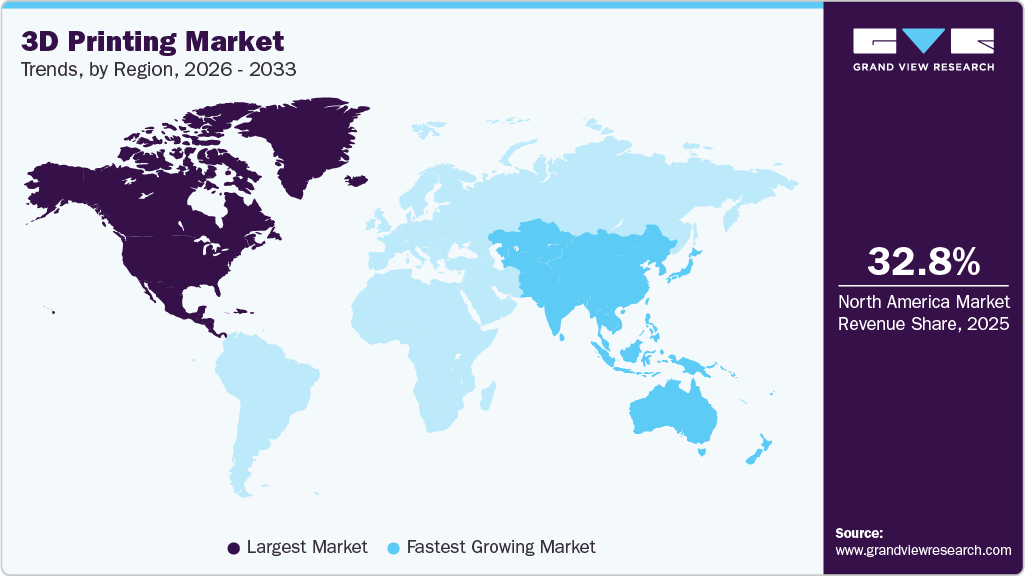
North America dominated the global 3D printing market, accounting for 32.8% of revenue in 2025. The region's leadership is supported by the early adoption of additive manufacturing across aerospace & defense, automotive, healthcare, industrial manufacturing, and consumer applications, as well as by the presence of established technology providers, specialized service bureaus, and research institutions. The U.S. continues to serve as a major center for industrial additive manufacturing, supported by investments in advanced manufacturing capabilities and growing demand for domestically produced, customized, and high-performance components. Recent industry developments further demonstrate the region's expanding production capacity. In January 2025, EOS announced the installation of its 5,000th industrial 3D printer at Keselowski Advanced Manufacturing in North Carolina.
The U.S. 3D printing market accounted for around 65.0% revenue share of North America in 2025. The market growth is supported by the country's advanced manufacturing ecosystem, strong aerospace & defense industry, extensive automotive and healthcare sectors, and significant investments in additive manufacturing technologies. Aerospace and defense applications are becoming increasingly important as manufacturers seek shorter production lead times, lightweight components, supply chain resilience, and localized production capabilities. In September 2025, Ursa Major expanded its EOS-powered metal AM fleet to six systems to scale hypersonics production, highlighting the growing use of industrial AM for advanced defense manufacturing.
Asia Pacific 3D Printing Market Trends
The Asia Pacific 3D printing industry is expected to grow at the fastest CAGR of 27.2% from 2026 to 2033. The growth is supported by the region's extensive manufacturing base, expanding automotive and electronics industries, rising healthcare expenditure, and increasing investment in advanced manufacturing technologies. China, Japan, South Korea, and India are strengthening their additive manufacturing capabilities as manufacturers seek greater production flexibility, customization, localized supply chains, and shorter development cycles. The region's large-scale electronics and automotive manufacturing ecosystems provide a substantial application base for both prototyping and production-oriented 3D printing. Increasing investments in aerospace, defense, medical devices, and industrial machinery are further expanding the addressable market for industrial AM.
The growth in the 3D printing market in China is supported by the country's large manufacturing base, expanding aerospace and automotive industries, electronics production capabilities, and increasing emphasis on advanced manufacturing and industrial automation. The availability of a large domestic manufacturing ecosystem is supporting the development and deployment of both industrial and desktop 3D printing technologies.
Europe 3D Printing Market Trends
Europe was the second-largest 3D printing industry, accounting for around 31.0% of the global share in 2025. The region benefits from a strong industrial and engineering base, established automotive and aerospace industries, extensive research capabilities, and increasing collaboration between manufacturers, technology providers, universities, and government institutions. European manufacturers are increasingly shifting additive manufacturing from prototyping toward serial production, supported by improvements in process reliability, automation, materials, and qualifications. Government and industry initiatives are also strengthening the regional AM ecosystem. In April 2025, Siemens and several industrial, academic, and government organizations established the Bavaria Makes initiative to promote the industrialization of additive manufacturing in Bavaria, with significant support from the Bavarian state government. The initiative covers applications spanning automotive, aerospace, medical technology, defense, semiconductor manufacturing, and energy.
Key 3D Printing Company Insights
The global 3D printing market is moderately fragmented, with established players competing alongside specialized technology providers, software companies, materials suppliers, and regional manufacturers. Competition is increasingly shifting from standalone printer sales toward integrated additive manufacturing ecosystems encompassing hardware, materials, software, process monitoring, post-processing, and application engineering. Product innovation remains a key competitive strategy. Companies are investing in higher productivity, larger build volumes, multi-laser systems, advanced materials, automation, and real-time process monitoring to improve production economics and reliability.
Key 3D Printing Companies
The following key companies have been profiled for this study on the 3D printing market.
-
3D Systems, Inc.
-
Stratasys Ltd.
-
Proto Labs, Inc.
-
Materialise NV
-
Nano Dimension Ltd.
-
Shapeways, Inc.
-
EOS (Electro Optical Systems) GmbH
-
Colibrium Additive (formerly GE Additive)
-
HP Inc.
-
Voxeljet AG
Recent Developments
-
In August 2026, 3D Systems announced a USD 9 million contract from the U.S. Air Force for an advanced large-format metal 3D printing system. In July 2026, its Saudi Arabian joint venture NAMI, obtained a military manufacturing license for local defense hardware production. The company also announced in August 2026 a partnership with Savannah River National Laboratory to advance 3D printing for advanced energy and national security applications.
-
In September 2026, Toyota and Rivian adopted Stratasys' new F870 3D printer to accelerate factory-floor manufacturing applications at scale. Stratasys also secured funding from America Makes and the U.S. Department of Defense (DoD) in August 2026 to scale production-ready additive manufacturing.
3D Printing Market Report Scope
Report Attribute
Details
Market size in 2025
USD 30.5 billion
Estimated market size in 2026
USD 37.6 billion
Projected market size by 2033
USD 168.9 billion
Growth rate
CAGR of 23.9% from 2026 to 2033
Base year for estimation
2025
Historical data
2021 - 2024
Forecast period
2026 - 2033
Quantitative units
Revenue in USD billion and CAGR from 2026 to 2033
Report coverage
Revenue forecast, company ranking, competitive landscape, growth factors, and trends
Segments covered
Component, printer type, technology, software, application, vertical, material, region
Regional scope
North America; Europe; Asia Pacific; Latin America; MEA
Country scope
U.S.; Canada; Mexico; Germany; UK; France; Spain; Italy; China; Japan; India; South Korea; Singapore; Australia; Brazil; KSA; UAE; South Africa
Key companies profiled
3D Systems, Inc.; Stratasys Ltd.; Proto Labs, Inc.; Materialise NV; Nano Dimension Ltd.; Shapeways, Inc.; EOS (Electro Optical Systems) GmbH; Colibrium Additive (formerly GE Additive); HP Inc.; Voxeljet AG.
Customization scope
Free report customization (equivalent up to 8 analysts working days) with purchase. Addition or alteration to country, regional & segment scope.
Pricing and purchase options
Avail customized purchase options to meet your exact research needs. Explore purchase options
Global 3D Printing Market Report Segmentation
This report offers revenue growth forecasts at the global, regional & country levels and provides an analysis of the latest industry trends across each sub-segment from 2021 to 2033. For this study, Grand View Research has segmented the global 3D printing market report based on component, printer type, technology, software, application, vertical, material, and region:
-
Component Outlook (Revenue, USD Million/Billion, 2021 - 2033)
-
Hardware
-
Software
-
Services
-
-
Printer Type Outlook (Revenue, USD Million/Billion, 2021 - 2033)
-
Desktop 3D Printer
-
Industrial 3D Printer
-
-
Software Outlook (Revenue, USD Million/Billion, 2021 - 2033)
-
Design Software
-
Inspection Software
-
Printer Software
-
Scanning Software
-
-
Technology Outlook (Revenue, USD Million/Billion, 2021 - 2033)
-
Stereolithography
-
Fused Deposition Modeling
-
Selective Laser Sintering
-
Direct Metal Laser Sintering
-
Polyjet Printing
-
Inkjet printing
-
Electron Beam Melting
-
Laser Metal Deposition
-
Digital Light Processing
-
Laminated Object Manufacturing
-
Others
-
-
Application Outlook (Revenue, USD Million/Billion, 2021 - 2033)
-
Prototyping
-
Tooling
-
Functional Parts
-
-
Vertical Outlook (Revenue, USD Million/Billion, 2021 - 2033)
-
Industrial 3D Printing
-
Automotive
-
Aerospace & Defense
-
Healthcare
-
Consumer Electronics
-
Power & Energy
-
Others
-
-
Desktop 3D Printing
-
Educational Purpose
-
Fashion & Jewelry
-
Objects
-
Dental
-
Food
-
Others
-
-
-
Material Outlook (Revenue, USD Million/Billion, 2021 - 2033)
-
Polymer
-
Metal
-
Ceramic
-
-
Regional Outlook (Revenue, USD Million/Billion, 2021 - 2033)
-
North America
-
U.S.
-
Canada
-
Mexico
-
-
Europe
-
Germany
-
UK
-
France
-
Spain
-
Italy
-
-
Asia Pacific
-
China
-
Japan
-
India
-
South Korea
-
Singapore
-
Australia
-
-
Latin America
-
Brazil
-
-
Middle East and Africa (MEA)
-
KSA
-
UAE
-
South Africa
-
-
Frequently Asked Questions About This Report
The global 3d printing market size was valued at USD 30.5 billion in 2025 and is estimated at USD 37.6 billion for 2026.
The global 3d printing market is expected to grow at a CAGR of 23.9% from 2026 to 2033, reaching USD 168.9 billion by 2033.
The aggressive research & development in three-dimensional printing and the growing demand for prototyping applications from various industry verticals, particularly healthcare, automotive, and aerospace & defense, are expected to drive the growth of the market.
North America dominated with a 32.8% revenue share in 2025.
Asia Pacific is the fastest-growing region over the forecast period.
The industrial printer segment led with a 75.0% revenue share in 2025.
The hardware segment led with a 62.6% revenue share in 2025, while software is the fastest-growing component.
The prototyping segment dominated the market and accounted for the largest revenue share of 27.2% in 2025.
The metal segment dominated the market in 2025. The metal material segment is experiencing strong growth in the 3D printing market as industries increasingly adopt metal additive manufacturing for high-performance and end-use applications.
Key players include 3D Systems, Inc.; Stratasys Ltd.; Proto Labs, Inc.; Materialise NV; Nano Dimension Ltd.; Shapeways, Inc.; EOS (Electro Optical Systems) GmbH; GE Additive; HP Inc.; Voxeljet AG.
About the Author(s)
Next Generation Technologies Research Team
Technology · Next Generation TechnologiesThis report was authored by the next generation technologies research team at Grand View Research - comprising two research analysts, one senior research analyst, and one industry expert - with specialized expertise in the next generation technologies segment of the technology industry. All findings are based on proprietary technology databases, executive interviews, and regulatory analysis, subject to internal peer review prior to publication.
Last Updated:
Speak to Analyst


Customize this report to your needs - add regions, segments, or data points, with 20% free customization.
Or view our licence options:


ISO 9001:2015 & 27001:2022 Certified
We are GDPR and CCPA compliant! Your transaction & personal information is safe and secure. For more details, please read our privacy policy.


