
- Home
- »
- Clothing, Footwear & Accessories
- »
-
Hiking Gear And Equipment Market Size Report, 2026-2033GVR Report cover

Hiking Gear And Equipment Market (2026 - 2033)
Size, Share & Trends Analysis Report By Product (Clothes, Footwear, Bag packs), By Distribution Channel (Specialty Stores, Retail Stores, Online), By Distribution Channel, By Region, And Segment Forecasts
Market Size, 2025
$6.4BMarket Estimate, 2026
$6.8BMarket Forecast, 2033
$10.9BCAGR, 2026–2033
6.9%Hiking Gear & Equipment Market Summary
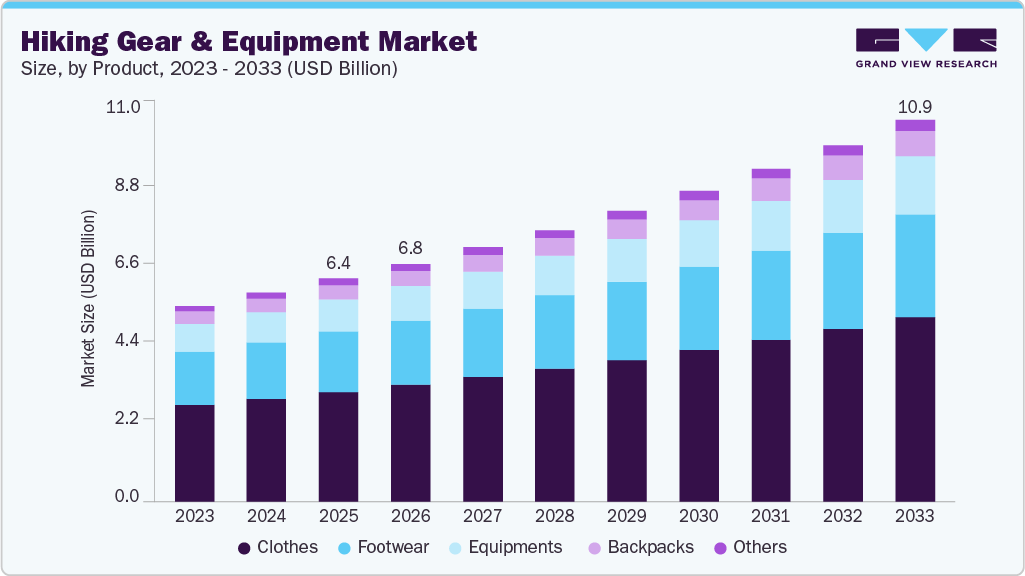
The global hiking gear and equipment market size was valued at USD 6.4 billion in 2025 and is projected to grow from USD 6.8 billion in 2026 to USD 10.9 billion by 2033, at a CAGR of 6.9% from 2026 to 2033. The market in North America dominated with a revenue share of 62.5% in 2025. The market is growing steadily as more people take part in hiking, trekking, and other outdoor activities across both developed and emerging regions.
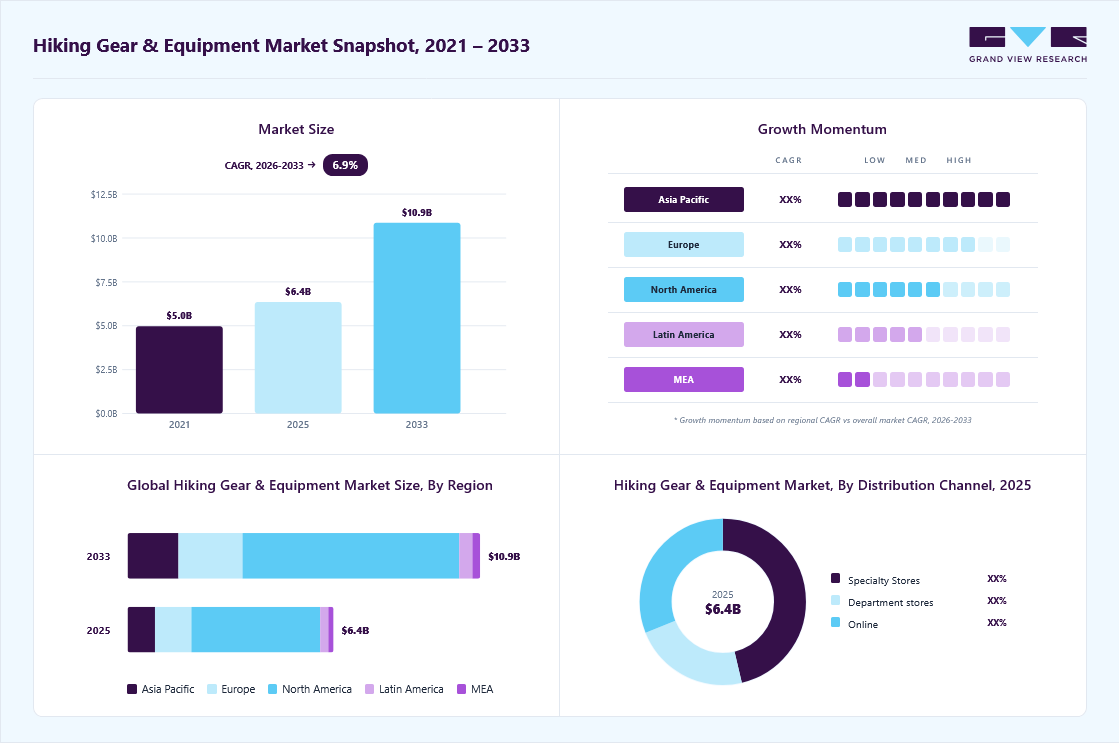 Source: Grand View Research, IR Documents, Primary Interviews, Paid DatabasesTo learn more about this report,
 Download Free Sample Report
Key Market Trends & Insights
- By product: Clothes segment held the largest market share of 49.4% in 2025.
- By distribution channel: Specialty stores segment held the largest market share of 46.3% in 2025.
Regional Highlights
- Largest regional market: North America (62.5% revenue share, 2025)
- Fastest-growing regional market: Asia Pacific (highest CAGR, 2026-2033)
- By country: U.S. held the largest market share in 2025
Market Size & Forecast
- Market size in 2025: USD 6.4 Billion
- Estimated market size in 2026: USD 6.8 Billion
- Projected market size by 2033: USD 10.9 Billion
- CAGR (2026-2033): 6.9%
Three ways to get this report
Buy it, customize it, or ask a question.Ask an Analyst
Analyst response in 1 business day
- AccessReport author, directly
- Reply timeWithin 1 working day
- No sales callDirect answer only
- FormatEmail reply
- CostFree, no cost
Get the Full Report
What the study covers
- FormatsPDF · Excel · Dashboard
- Timeline2026–2033 annual, 2025 base
- Coverage20+ countries, 5 regions
- Companies10+ key players profiled
Customize the Report
20% free customization
- IncludeCountries, segments, points
- TailorTo your product definition
- ExtendDeeper competitor detail
- OrA fully bespoke study
- Turnaround5–10 working days
This growth is mainly driven by increasing awareness of health and wellness, with consumers choosing outdoor activities to stay active and reduce stress. In addition, the rise of adventure tourism and the influence of social media are encouraging more people, especially younger consumers, to explore hiking. Improved access to travel destinations and better outdoor infrastructure are also supporting market growth. Consumer buying behavior is becoming more practical and informed, with a strong focus on product quality, durability, and ease of use. Customers prefer gear that offers good performance and can be used for multiple purposes. In response, companies are focusing on product improvements such as lightweight materials, comfortable designs, weather protection, and the use of sustainable materials. From a market positioning perspective, leading brands focus on high-quality and performance-driven products, while new and smaller players compete by offering affordable options and strong online presence. Packaging trends are also changing, with companies using simple, recyclable, and eco-friendly materials. At the same time, buying patterns show that consumers often purchase hiking gear based on planned trips or activities, along with repeat purchases as they upgrade or replace older equipment.
The market for hiking gear & equipment is experiencing steady growth, supported by rising participation in outdoor and wellness-oriented activities. Clothing continues to account for the largest share, driven by strong consumer demand for performance apparel that provides comfort, protection, and adaptability across varying weather conditions. Frequent usage and replacement cycles further strengthen this segment. Footwear remains a critical category, with consumers prioritizing durability, grip, and terrain-specific performance to enhance safety and endurance. At the same time, backpacks are witnessing sustained demand, particularly for lightweight, ergonomic, and high-capacity designs that support both day hikes and extended trips.
 To learn more about this report, Download Free Sample Report
From a trend perspective, the market is evolving toward lightweight, multifunctional, and user-friendly products that enhance overall outdoor experience. Equipment, including tents, sleeping systems, and trekking tools, is emerging as a high-growth segment as consumers increasingly engage in multi-day and experience-driven activities. Innovation across categories is focused on improving portability, durability, and ease of use, while also incorporating modular and space-efficient designs. The others category, which includes accessories such as hydration systems, lighting, and protective gear, is benefiting from growing awareness of safety, preparedness, and convenience, contributing to incremental and repeat purchases.
Consumer demand across all product segments is becoming more informed and value-driven, with a strong preference for high-quality, versatile, and long-lasting gear. Buyers are increasingly researching products through digital platforms, relying on reviews, comparisons, and expert recommendations before making purchasing decisions. There is also a noticeable shift toward premiumization, with consumers willing to invest in advanced and performance-oriented products that enhance safety and overall experience. Seasonal and experience-based purchasing patterns are becoming more prominent, with demand often linked to planned travel, outdoor events, and recreational activities.
Emerging material and ingredient innovations are playing a crucial role in shaping product development across the market. Manufacturers are increasingly adopting advanced synthetic fabrics, recycled polyester, and bio-based materials to improve durability while reducing environmental impact. Innovations such as moisture-wicking textiles, waterproof and breathable membranes, and lightweight insulation are enhancing product functionality across clothing and footwear. In equipment and backpacks, the use of high-strength polymers, coated fabrics, and ultralight composites is improving strength-to-weight ratios and overall performance. In addition, the shift toward sustainable and low-impact materials, including PFC-free coatings and recyclable components, reflects growing consumer and regulatory focus on environmental responsibility, supporting long-term market evolution.
Brand Market Share Insights
 To learn more about this report, Download Free Sample Report
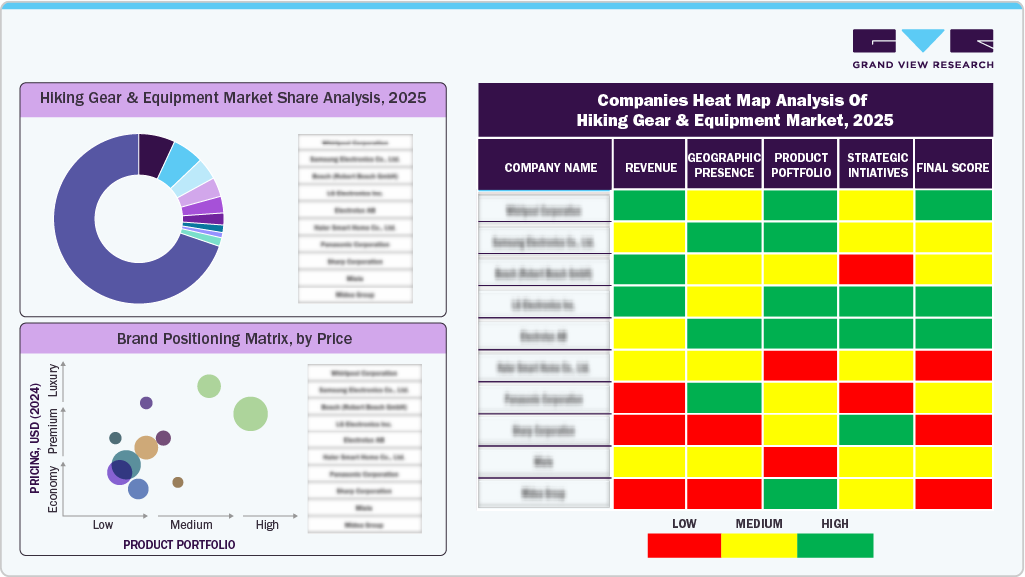
The hiking gear and equipment industry is characterized by a fragmented yet brand-driven competitive landscape, where no single player dominates globally, but a cluster of well-established outdoor specialists and diversified sporting goods companies collectively hold meaningful share. Premium and performance-focused brands such as The North Face, Columbia Sportswear, and Arc'teryx command strong positions due to their technical expertise, innovation in materials, and strong brand equity among serious hikers and outdoor enthusiasts. These players typically lead in high-value segments such as technical apparel, backpacks, and alpine equipment. Meanwhile, brands like Patagonia and Mammut maintain loyal customer bases, driven by sustainability positioning and premium quality, though with relatively smaller global shares.
Consumer Insights
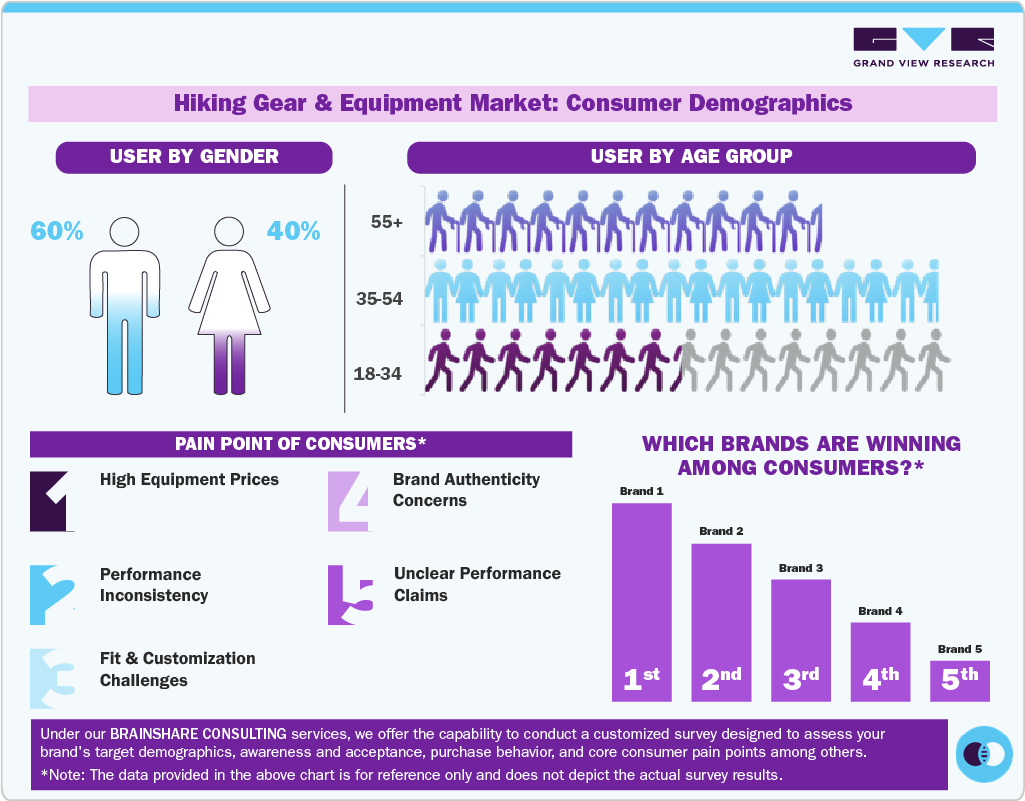
The market for hiking gear & equipment is witnessing a shift in consumer behavior, driven by growing interest in health, wellness, and experience-led lifestyles. Hiking is increasingly viewed as both a recreational and fitness activity, leading to higher participation across diverse consumer groups, including younger and urban populations. This shift is expanding demand beyond basic gear to products that enhance overall outdoor experience, comfort, and convenience. Consumers are also becoming more value-conscious and research-driven, showing a strong preference for durable, high-quality, and multifunctional products that can be used across different environments and activities.
This evolving demand is further shaping product expectations, with consumers prioritizing lightweight, compact, and easy-to-use gear that supports flexibility and mobility during outdoor activities. There is also a growing inclination toward sustainable consumption, with increased interest in products made from recycled materials, eco-friendly fabrics, and responsibly sourced components. Brand transparency and environmental responsibility are becoming important decision-making factors, particularly among younger consumers. In addition, digital platforms are playing a critical role in influencing purchase behavior, as consumers rely on online reviews, expert opinions, and social media content to evaluate product performance and reliability. The rising popularity of direct-to-consumer channels and personalized marketing strategies is further strengthening customer engagement and repeat purchases.
 To learn more about this report, Download Free Sample Report
At the same time, key trends such as lightweight design, portability, and sustainability are shaping purchasing decisions. There is rising demand for compact and easy-to-carry equipment, along with products made from recycled and eco-friendly materials. Digital influence plays a critical role, with consumers relying on online platforms for product discovery, reviews, and comparisons. E-commerce growth, combined with targeted digital marketing and social media engagement, is further accelerating market expansion. In addition, a gradual shift toward premiumization is evident, as consumers are increasingly willing to invest in performance-driven and technologically advanced gear, supporting innovation and long-term market growth.
Product Insights
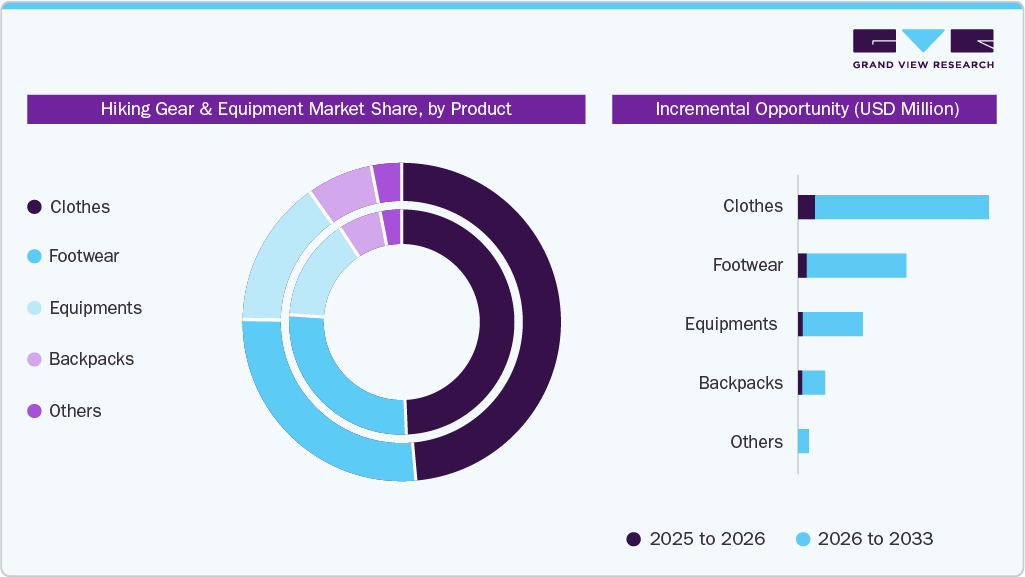
The clothes segment held the largest revenue share of 49.4% in 2025. The segment leads due to its essential role in ensuring comfort, protection, and performance across varying environmental conditions. Demand is driven by rising participation in outdoor activities and increasing need for weather-resistant, breathable, and moisture-wicking apparel. Consumers show a strong preference for performance-driven clothing that can adapt to different climates, leading to frequent replacement and repeat purchases. Innovation in this segment is focused on advanced fabric technologies such as lightweight insulation,UV protection, and multi-layer systems, further strengthening its dominant market position.
 To learn more about this report, Download Free Sample Report
The equipment segment is expected to grow at the fastest CAGR of 7.7% from 2026 to 2033 due to increased participation in outdoor activities and advancements in product technology. There is a rising demand for high-quality equipment to enhance safety and performance as more people engage in hiking and adventure tourism. Innovations such as lightweight tents, durable sleeping bags, and ergonomic hiking poles are attracting consumers who prioritize functionality and comfort during their outdoor experiences. For instance, brands such as MSR have developed ultralight tents that offer easy setup and weather resistance, appealing to both casual hikers and serious trekkers.
Distribution Channel Insights
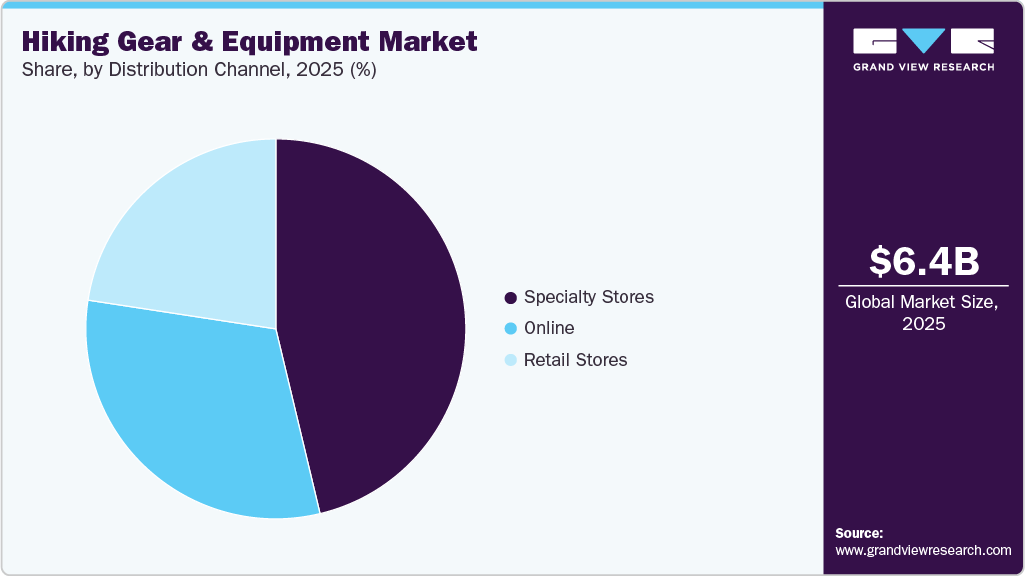
The specialty stores segment held the largest revenue share of 46.3% in 2025, primarily due to the ability of these stores to offer a curated selection of high-quality products and personalized customer service. These stores cater specifically to outdoor enthusiasts, providing expert advice and detailed product knowledge that enhances the shopping experience. Customers often prefer specialty retailers for their focused inventory, which includes specialized gear that may not be available in general retail outlets. In addition, specialty stores often host community events and workshops that foster a sense of belonging among outdoor enthusiasts, further driving customer loyalty and repeat purchases.
 To learn more about this report, Download Free Sample Report
The online segment is expected to grow at the fastest CAGR of 7.3% from 2026 to 2033 due to convenience, accessibility, and growing preference for digital shopping among consumers. As more people turn to e-commerce for shopping, online platforms provide a seamless experience and allow customers to browse a wide range of products from the comfort of their homes. This shift is expected to particularly appeal to younger demographics, who value comparing prices, reading reviews, and accessing exclusive online deals. For example, retailers, including Backcountry.com, offer an extensive selection of hiking gear with detailed product descriptions and customer feedback, enhancing informed purchasing decisions. Social media marketing and influencer endorsements have increased the visibility of hiking products online, which is further expected to significantly drive consumer interest and sales through digital channels over the forecast period.
Regional Insights
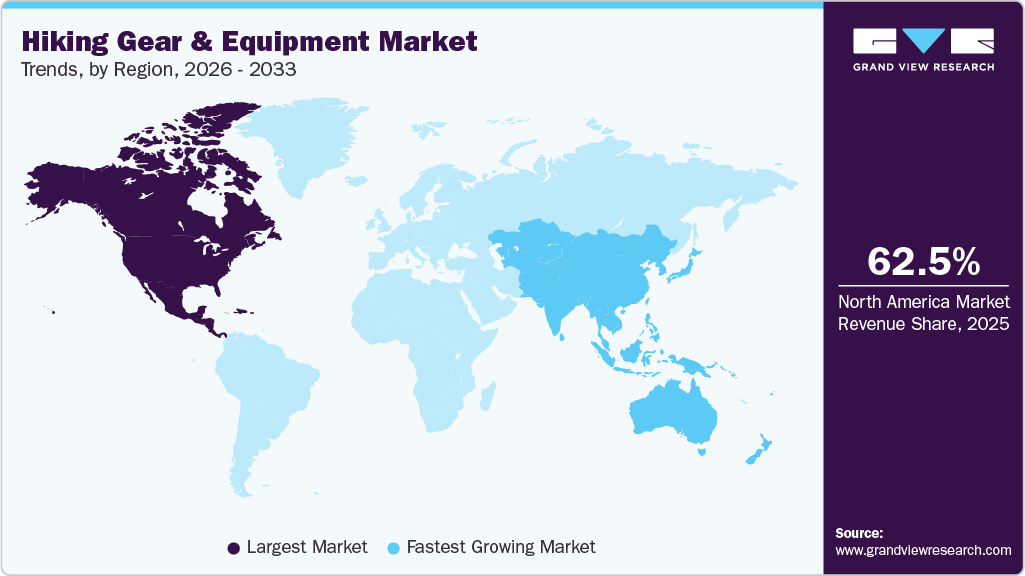
The North American hiking gear & equipment industry accounted for the largest share of 62.5% in 2025, driven by a deeply established outdoor culture and high participation rates, with over 57 million hikers in the region. Consumer demand is strongly oriented toward premium, performance-driven products, reflecting high disposable incomes and a willingness to invest in advanced gear. Product innovation in the region is centered on smart and technical equipment, including GPS-enabled devices, weather-adaptive apparel, and ultralight materials. From an “ingredient” perspective, there is growing use of advanced synthetic fabrics such as Gore-Tex, high-performance polymers, and carbon-fiber components to enhance durability and functionality. Packaging trends emphasize sustainable materials and reduce plastic usage, while consumption dynamics are characterized by frequent upgrades and brand loyalty, supported by a mature retail and e-commerce ecosystem.
 To learn more about this report, Download Free Sample Report
U.S. Hiking Gear & Equipment Market Trends
The hiking gear & equipment industry in the U.S. accounted for a revenue share of around 90.9% of the North America market in 2025. The market is driven by a strong outdoor recreation culture, rising health and wellness awareness, and high consumer spending on premium and technical products. Consumers increasingly seek durable, high-performance gear with sustainability features, while the growth of national parks visitation and adventure travel continues to support demand. Direct-to-consumer channels and brand-led innovation in lightweight and multifunctional equipment are further accelerating market expansion..
Canada hiking gear & equipment industry is expected to grow at a significant CAGR from 2026 to 2033. Canada’s hiking gear market growth is supported by widespread access to natural landscapes and a well-established outdoor lifestyle. Demand is driven by seasonal hiking and camping activities, with consumers prioritizing weather-resistant, durable, and versatile gear suited for diverse climatic conditions. Sustainability and eco-conscious purchasing behavior are also gaining traction, alongside steady growth in e-commerce and specialty outdoor retail.
Europe Hiking Gear & Equipment Market Trends
Europe hiking gear & equipment industry accounted for a revenue share of 17.68% fo the global market in 2025. Europe represents a mature and well-established market, supported by a strong hiking tradition and an extensive network of trails across the region. Consumer demand is characterized by a clear preference for high-quality, durable, and environmentally sustainable products, reflecting strong awareness of environmental impact. Product innovation is largely driven by sustainability, with manufacturers focusing on eco-friendly materials, biodegradable fabrics, and low-impact production processes. The region places significant emphasis on circular economy principles, including repairable, reusable, and recyclable gear. Material usage centers around organic textiles, recycled polyester, and PFC-free waterproof coatings that reduce environmental harm. Packaging trends continue to shift toward minimal, recyclable, and low-waste formats in line with regulatory and consumer expectations. Consumption patterns are balanced between tourism-driven demand and regular local participation, supporting stable, year-round market activity.
UK hiking gear & equipment industry is expected to grow at a CAGR of 7.3% from 2026 to 2033. The market is influenced by increasing participation in hiking, trekking, and countryside tourism. Demand is particularly strong for functional, lightweight, and waterproof gear due to variable weather conditions. In addition, the rise of casual outdoor activities and “weekend adventure” trends is expanding the consumer base beyond core enthusiasts, supporting steady growth in mid-range and lifestyle-oriented products.
Asia Pacific Hiking Gear & Equipment Market Trends
The Asia Pacific hiking gear & equipment industry is expected to grow at a CAGR of 8.1% from 2026 to 2033. Asia Pacific is an emerging and fast-growing market for hiking gear and equipment, supported by rising participation in outdoor activities and increasing interest in wellness-oriented lifestyles. Consumer demand is expanding rapidly among urban populations, particularly younger consumers who view hiking as both a recreational and social activity. The region is also benefiting from growing eco-tourism initiatives and improved access to natural destinations, which are encouraging first-time and occasional hikers. Demand is largely driven by value-oriented consumers seeking affordable, functional, and easy-to-use products.
Product innovation in the region is focused on lightweight, compact, and multifunctional gear suited to diverse environments, including tropical, mountainous, and mixed terrains. Manufacturers are emphasizing cost-effective materials such as durable synthetics and breathable fabrics that offer a balance between performance and affordability. There is also increasing interest in digitally integrated products, including smart accessories and app-connected gear, reflecting the region’s strong digital adoption. Packaging trends are evolving toward compact, visually appealing, and e-commerce-friendly formats to support online sales. Consumption patterns are influenced by short-duration trips, group activities, and seasonal travel, with a strong shift toward online purchasing channels and growing brand awareness.
The hiking gear & equipment industry in China accounted for a revenue share of around 63.64% of the Asia Pacific market in 2025, due to rising disposable incomes, expanding domestic tourism, and increasing interest in outdoor and fitness activities among younger consumers. Government support for outdoor infrastructure and eco-tourism is further boosting participation. Consumers are showing growing interest in both international premium brands and affordable domestic alternatives, with strong traction in online retail channels.
The Japan hiking gear & equipment industry is expected to grow at a CAGR of 7.8% from 2026 to 2033. In Japan, demand is supported by a mature outdoor culture and a strong preference for high-quality, compact, and lightweight gear. An aging yet active population is driving demand for ergonomic and easy-to-use products, while domestic tourism and mountain hiking remain popular. Innovation in space-efficient and multifunctional equipment continues to be a key growth driver.
Central & South America Hiking Gear & Equipment Market Trends
The Central & South America hiking gear & equipment industry is expected to grow at a significant CAGR over the forecast period. In addition, the hiking gear & equipment industry in Brazil is expected to grow at a CAGR of 6.2% from 2026 to 2033. In Brazil, the market is growing steadily due to increasing interest in eco-tourism and outdoor recreation, particularly in regions with natural attractions. Rising urbanization and a growing middle class are encouraging participation in weekend and leisure hiking activities. Demand is largely concentrated in affordable and mid-range products, with gradual adoption of more specialized gear.
Middle East & Africa Hiking Gear & Equipment Market Trends
The Middle East & Africa hiking gear & equipment industry is expected to grow at a significant CAGR over the forecast period. In addition, the hiking gear & equipment industry in South Africa is expected to grow at a CAGR of 5.2% from 2026 to 2033. In South Africa, growth is driven by the country’s strong tourism sector and abundant natural landscapes that promote hiking and outdoor exploration. Both domestic and international tourists contribute to demand for reliable and durable gear. Price sensitivity remains a key factor, but there is increasing interest in quality and performance-oriented products, particularly among experienced hikers and adventure travelers.
Key Hiking Gear & Equipment Companies:
The following key companies have been profiled for this study on the hiking gear & equipment market.
- VF Corporation
- Columbia Sportswear Company
- Amer Sports
- Johnson Outdoors Inc.
- Newell Brands Inc.
- Snow Peak Inc.
- Adidas AG
- Nike, Inc.
- Dometic Group AB
- Solo Brands Inc.
Recent Developments
-
In April 2026, VF Corporation, through The North Face, launched the Universal Collection—an inclusive line of hiking gear developed with adaptive athletes. Featuring user-friendly elements like magnetic closures and simplified setup, the collection highlights a growing focus on accessibility and inclusive design, helping expand the consumer base and drive differentiation in the hiking gear market.
-
In March 2026, HAY, in collaboration with Jasper Morrison, launched the Outdoor Market Collection—an aesthetically driven range of outdoor products that blends traditional hiking gear with modern, lifestyle-oriented design. Featuring lightweight, portable, and multi-functional items such as foldable furniture, hammocks, and cooking accessories, the collection reflects a growing shift toward design-led and everyday-use outdoor products. This approach is helping attract urban and casual consumers, positioning hiking gear beyond technical use and driving broader market adoption.
-
In 2026, La Sportiva expanded into technical hiking equipment with a new line of high-performance backpacks and duffel bags. Designed using ultralight, durable, and waterproof materials, the collection features modular configurations for multiple outdoor activities while incorporating recycled materials for sustainability. This move reflects rising demand for multifunctional and performance-driven gear, strengthening the brand’s positioning and supporting premiumization and broader consumer adoption in the hiking equipment market.
Hiking Gear & Equipment Market Report Scope
Report Attribute
Details
Market size in 2025
USD 6.4 billion
Estimated market size in 2026
USD 6.8 billion
Projected market size by 2033
USD 10.9 billion
Growth rate
CAGR of 6.9% from 2026 to 2033
Base year for estimation
2025
Historical data
2021 - 2024
Forecast period
2026 - 2033
Quantitative units
Revenue in USD million and CAGR from 2026 to 2033
Report coverage
Revenue forecast, company ranking, competitive landscape, growth factors, and trends
Segments covered
Product, distribution channel, region
Regional scope
North America; Europe; Asia Pacific; Central & South America; Middle East & Africa
Country scope
U.S.; Canada; Mexico; UK; Germany; France; Italy; Spain;; China; India; Japan; South Korea; Australia & New Zealand; Brazil; South Africa;
Key companies profiled
VF Corporation; Columbia Sportswear Company; Amer Sports; Johnson Outdoors Inc.; Newell Brands Inc.; Snow Peak Inc.; Adidas AG; Nike, Inc.; Dometic Group AB; Solo Brands Inc.
Customization scope
Free report customization (equivalent up to 8 analysts working days) with purchase. Addition or alteration to country, regional & segment scope.
Pricing and purchase options
Avail customized purchase options to meet your exact research needs. Explore purchase options
Global Hiking Gear & Equipment Market Report Segmentation
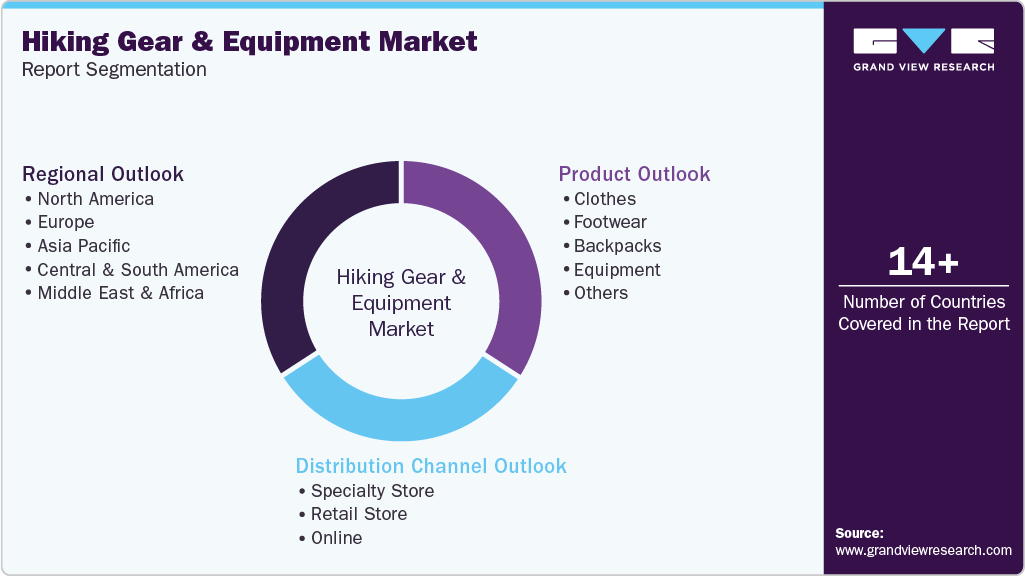
This report forecasts revenue growth at global, regional & country levels and provides an analysis of the latest trends and opportunities in each of the sub-segments from 2021 to 2033. For this study, Grand View Research has segmented the hiking gear & equipment market report based on product, distribution channel, and region.
 To learn more about this report, Download Free Sample Report
-
Product Outlook (Revenue, USD Million, 2021 - 2033)
-
Clothes
-
Footwear
-
Backpacks
-
Equipment
-
Others
-
-
Distribution Channel Outlook (Revenue, USD Million, 2021 - 2033)
-
Specialty Store
-
Retail Store
-
Online
-
-
Regional Outlook (Revenue, USD Million, 2021 - 2033)
-
North America
-
U.S.
-
Canada
-
Mexico
-
-
Europe
-
UK
-
Germany
-
France
-
Italy
-
Spain
-
-
Asia Pacific
-
China
-
India
-
Japan
-
South Korea
-
Australia & New Zealand
-
-
Central & South America
-
Brazil
-
-
Middle East & Africa
-
South Africa
-
-
Frequently Asked Questions About This Report
Some key players operating in the hiking gear and equipment market include The North Face, Mountain Hardwear, Black Diamond Equipment, Ltd., Marmot Mountain LLC, Amer Sports, Equinox Ltd., TATONKA, mont-bell Co., Ltd., AMG-Group and Sierra Designs.
Key factors that are driving the market growth include rising demand for sporting activities among the younger population, particularly millennials, along with increasing consumer inclination towards fitness regime, short recreational activities, and healthy lifestyles.
Asia Pacific is the fastest-growing region over the forecast period.
The clothes segment led with a 49.4% revenue share in 2025.
The specialty stores segment led with a 46.3% revenue share in 2025, while the online segment is the fastest-growing.
The global hiking gear and equipment market size was estimated at USD 6.4 billion in 2025 and is expected to reach USD 6.8 billion by 2026.
The global hiking gear and equipment market is expected to grow at a compound annual growth rate of 7.0% from 2026 to 2033 to reach USD 10.9 billion by 2033.
North America dominated the hiking gear and equipment market with a share of 62.5% in 2025. This is attributable to more consumers seeking places for outdoor recreation in order to connect to nature as well as practice healthy exercise.
About the Author(s)
Clothing, Footwear & Accessories Research Team
Consumer Goods · Clothing, Footwear & AccessoriesThis report was authored by the clothing, footwear & accessories research team at Grand View Research - comprising two research analysts, one senior research analyst, and one industry expert - with specialized expertise in the clothing, footwear & accessories segment of the consumer goods industry. All findings are based on proprietary consumer goods databases, executive interviews, and regulatory analysis, subject to internal peer review prior to publication.
Last Updated:
Speak to Analyst

Customize this report to your needs - add regions, segments, or data points, with 20% free customization.
Or view our licence options:


ISO 9001:2015 & 27001:2022 Certified
We are GDPR and CCPA compliant! Your transaction & personal information is safe and secure. For more details, please read our privacy policy.


