
- Home
- »
- Advanced Interior Materials
- »
-
Hot Briquetted Iron Market Size, Industry Report, 2033GVR Report cover
![Hot Briquetted Iron Market Size, Share & Trends Report]()
Hot Briquetted Iron Market (2025 - 2033) Size, Share & Trends Analysis Report By Route (Electric Arc Furnaces, Blast Furnaces/Basic Oxygen Furnaces), By End Use (Automotive, Construction, Industrial Machinery), By Region, And Segment Forecasts
- Report ID: GVR-4-68040-822-4
- Number of Report Pages: 100
- Format: PDF
- Historical Range: 2021 - 2023
- Forecast Period: 2025 - 2033
- Industry: Advanced Materials
- Report Summary
- Table of Contents
- Segmentation
- Methodology
- Download FREE Sample
-
 Download Sample Report
Hot Briquetted Iron Market Summary
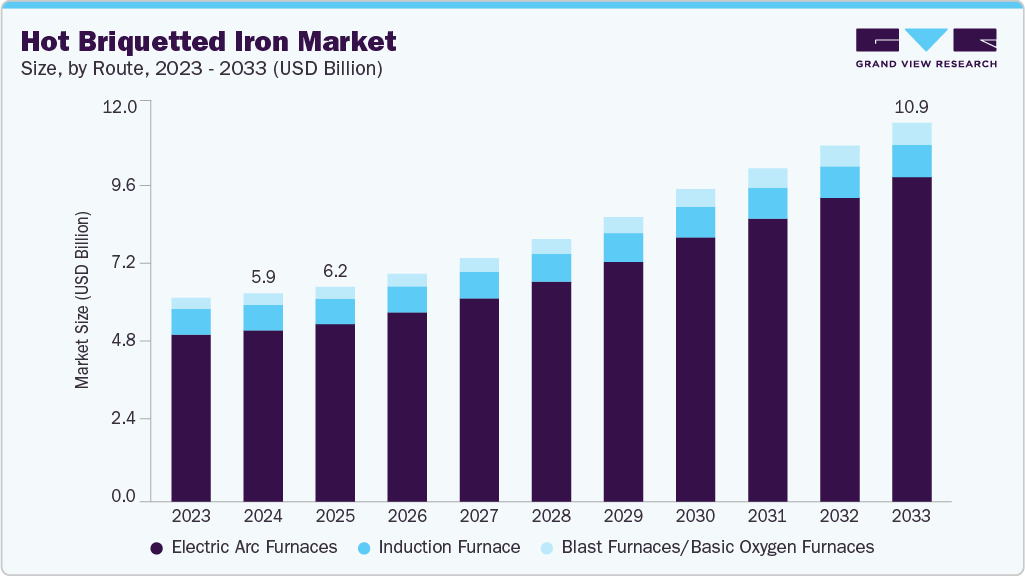
The global hot briquetted iron market size was estimated at USD 5.99 billion in 2024 and is projected to reach USD 10.90 billion by 2033, growing at a CAGR of 7.4% from 2025 to 2033. The Hot Briquetted Iron (HBI) market is gaining momentum as steelmakers worldwide strive for higher-quality metallic inputs that enable cleaner and more consistent production routes.
Key Market Trends & Insights
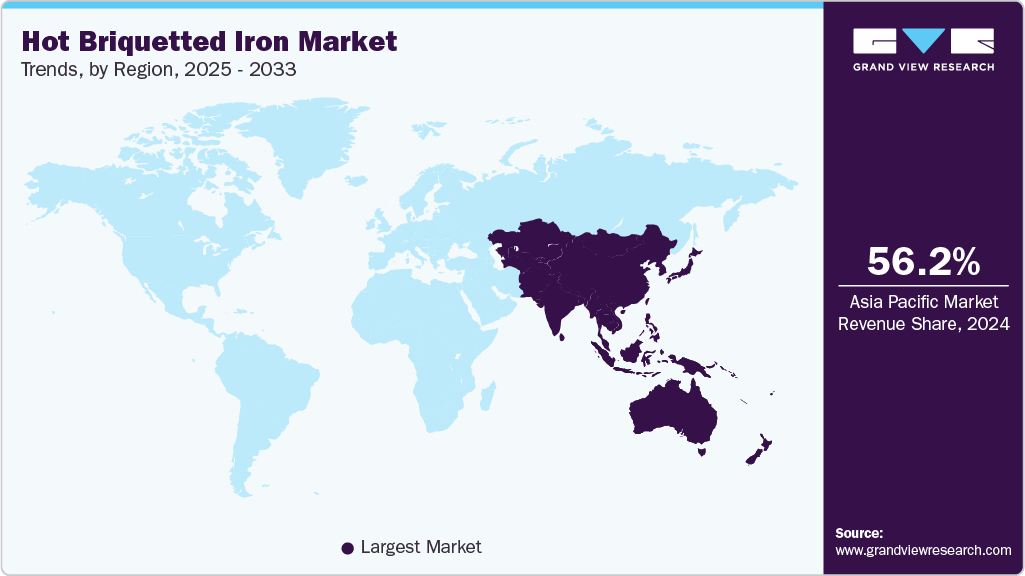
- Asia Pacific dominated the hot briquetted iron market with the largest revenue share of 56.2% in 2024.
- By route, electric arc furnaces accounted for the largest market revenue share of over 82.0% in 2024.
- By end use, the construction segment accounted for the largest market revenue share of over 52.0% in 2024.
Market Size & Forecast
- 2024 Market Size: USD 5.99 Billion
- 2033 Projected Market Size: USD 10.90 Billion
- CAGR (2025-2033): 7.4%
- Asia Pacific: Largest Market Region in 2024
HBI offers a stable chemical composition, along with very low gangue, and this reliability is becoming increasingly important as mills strive to optimize furnace efficiency. In regions where variability in scrap quality causes operational issues, HBI is emerging as a dependable feedstock that supports predictable output.One of the strongest demand boosters for the hot briquetted iron industry is the global shift toward electric arc furnace steelmaking. EAF capacity additions in Asia, the Middle East, Europe, and parts of Latin America are fueling a structural rise in metallics consumption. Since EAFs function best with a balance of scrap and premium metallics, HBI is becoming a strategic ingredient that helps reduce impurities and maintain mechanical properties in the final steel. Many new EAF projects are being designed with metallic-heavy charge mixes, which automatically strengthen HBI demand.
Decarbonization targets are reshaping investment decisions across the steel value chain, prompting buyers to seek lower-emission raw materials. HBI, produced mainly through natural gas-based direct reduction processes, offers a significantly cleaner profile compared to coal-based ironmaking routes. As more countries implement carbon pricing and emission penalties, steel producers are actively switching to DR grade materials, which help them meet mandated sustainability thresholds, adding a major tailwind for HBI.
Another strong growth pillar is the widening regional mismatch between the availability of prime scrap and rising steel demand. Mature markets are facing stagnating scrap generation, while emerging regions have strong steel output targets but inadequate scrap reservoirs. This imbalance is pushing mills to secure metallic substitutes that ensure consistency and availability. HBI, with its high density and superior transportability compared to sponge iron, is shaping up as a globally traded solution that bridges this gap.
Moreover, the expansion of DR plant infrastructure across the Middle East, North Africa, and parts of the Americas is making HBI supply more accessible and better priced. Countries with abundant natural gas resources are scaling up DR capacity and exporting more briquetted iron to high-demand zones. This broadening supply network is improving logistical flexibility for buyers and encouraging long-term procurement agreements. As more DR facilities come online, HBI continues to evolve from a niche product into a mainstream pillar of the global metallics market.
Drivers, Opportunities & Restraints
The growth of the hot briquetted iron market is driven by several strong structural forces. The rising adoption of electric arc furnaces is a major driver, as these units operate most effectively when paired with premium metallics that enhance purity and ensure melt consistency. Steelmakers are also pursuing cleaner iron inputs as they face tighter emission standards, and HBI aligns well with carbon reduction goals because its gas-based production route offers lower emissions compared to traditional coal-dependent processes. Growing concerns about inconsistent scrap quality add further weight to the use of HBI, especially in regions where scrap supply is volatile.
The market is opening up attractive opportunities as new DR plants come online in gas-rich regions, expanding supply availability and improving price competitiveness. Countries in the Middle East, North Africa, and the Americas are accelerating HBI capacity development to serve both domestic steelmakers and long-haul export routes. There is also a growing interest from mills that plan to use heavy charge mixes with metallics to enhance product quality, which creates opportunities for long-term supply contracts and deeper involvement from traders, port operators, and logistics providers.
The hot briquetted iron industry still faces restraints that shape investment decisions. Limited gas availability in certain regions slows down DR plant expansion, resulting in production being concentrated in specific supply clusters. Transportation costs for long-distance shipments can be substantial because HBI is a dense and high-value cargo, and freight volatility often affects trade flows. Price swings in natural gas and iron ore also impact HBI economics by affecting production costs. Together, these frictions create a market where demand fundamentals remain strong, but supply-side constraints and logistical challenges continue to define competitive dynamics.
Route Insights
The Electric Arc Furnace (EAF) segment is expanding as steelmakers shift toward production methods that allow flexible raw material use and faster heat cycles. EAFs can melt a wide range of metallic inputs, and this adaptability gives producers the freedom to optimize costs based on market conditions. Many mills are investing in modern EAF units that provide higher energy efficiency and improved control systems, which strengthens the appeal of this route compared to older blast furnace setups.
The blast furnace and basic oxygen furnace route continues to hold a solid presence because it delivers large-scale output with steady productivity, which is valuable for regions with strong demand for long-run flat and long steel products. This route efficiently handles high volumes of iron ore and coke, providing mills with predictable yields that support integrated steelmaking setups. Many producers are upgrading their BF-BOF lines with enhanced automation, gas recovery systems, and energy optimization tools that keep operating costs in check and extend the life of existing assets..
End Use Insights
The construction segment remains a major driver of demand for steel, as urban expansion, infrastructure renewal, and large-scale public works continue to require significant volumes of long and flat products. Rising investments in highways, metro networks, airports, data centers, and industrial parks are pushing builders to secure reliable steel supplies with consistent mechanical strength. Many developing regions are launching housing programs and smart city projects that increase year-round steel consumption.
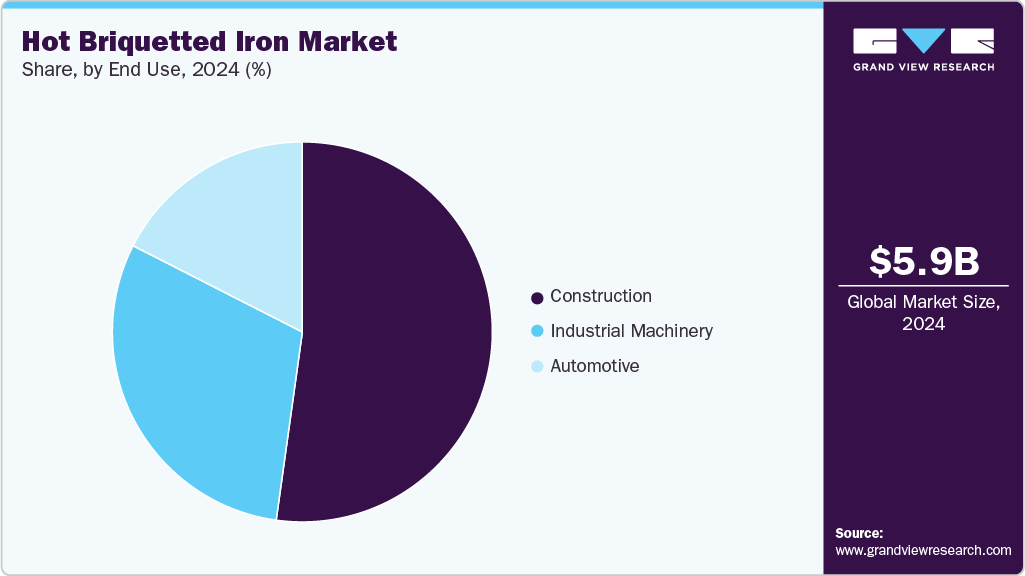
The automotive segment of the hot briquetted iron industry is driving steady steel consumption, as manufacturers seek materials that deliver strength, formability, and safety while maintaining vehicle weight control. Carmakers are expanding production of passenger cars, commercial vehicles, and EV platforms, which lifts demand for high-quality flat steel used in body panels, chassis parts, and structural components. The rising adoption of advanced manufacturing methods, along with stricter safety norms, is encouraging the use of steels that offer reliable performance under stress.
Regional Insights
The Asia Pacific hot briquetted iron market is gaining strong momentum as steelmakers in the region expand their electric arc furnace capacities and seek higher-quality metallics to improve melt consistency. Countries such as China, India, Vietnam, and Indonesia are witnessing rapid growth in the construction, automotive, and engineering sectors, which pushes mills to secure premium iron inputs that help maintain product quality. Scrap availability varies widely across the region, prompting producers to seek stable substitutes that ensure predictable furnace performance.
North America Hot Briquetted Iron Market Trends
The HBI market in North America is growing steadily as steelmakers continue to shift toward electric arc furnace production and seek metallics that enhance purity and consistency. The region has a strong demand for high-grade flat products used in the automotive, machinery, and construction industries, and producers are increasingly blending HBI into their charge mix to enhance metallurgical performance.
U.S. Hot Briquetted Iron Market Trends
The United States is experiencing strong growth in HBI consumption as the country increasingly relies on electric arc furnace steelmaking. New EAF mills are coming online across states such as Texas, Arkansas, Alabama, and Ohio, and each of these facilities requires high-quality metallics to deliver consistent outputs. Even though the U.S. benefits from abundant scrap availability, residual elements in scrap often limit its use in premium flat products.
Europe Hot Briquetted Iron Market Trends
Europe is witnessing a rising demand for HBI as steelmakers accelerate their transition from traditional blast furnace routes to electric arc furnace-based production. The region faces a tight supply of scrap, and the quality of scrap often varies, which prompts mills to rely on metallics that offer consistent purity. HBI helps European producers meet the increasingly stringent requirements of automotive, machinery, and engineering industries, where clean chemistry is essential. With several EAF projects planned across Germany, Italy, Spain, and Eastern Europe, the need for premium metallics continues to rise.
Latin America Hot Briquetted Iron Market Trends
Latin America is experiencing growing interest in hot briquetted iron as steelmakers in the region expand their EAF capacities and look for metallics that enhance melt quality. Countries such as Mexico and Brazil are increasing flat steel production for automotive, appliance, and construction applications, which raises the need for consistent, premium feedstock.
Middle East & Africa Hot Briquetted Iron Market Trends
The Middle East is emerging as one of the strongest pillars of HBI production, as the region benefits from abundant natural gas reserves that support efficient and cost-effective direct reduction processes. Countries such as the UAE, Saudi Arabia, and Qatar continue to invest in large-scale DR plants that supply both domestic mills and major export markets. This expanding production base is pushing regional trade volumes upward and solidifying the Middle East as a central hub in global metallics supply chains.
Key Hot Briquetted Iron Company Insights
Some of the key players operating in the market include ArcelorMittal and Kobe Steel Ltd.
-
ArcelorMittal is one of the world's largest steel producers, with a presence spanning Europe, the Americas, Africa, and Asia. The company operates integrated mills, electric arc furnace units, and value-added downstream facilities that serve automotive, construction, energy equipment, machinery, and packaging industries. ArcelorMittal has been focusing on efficiency improvements, the development of high-performance steels, and decarbonization initiatives that align with the long-term transformation of the industry.
-
Kobe Steel Ltd is a diversified Japanese industrial group with a strong presence in steel, machinery, engineering, and advanced materials. The company is recognized for its high-quality steel products, which serve the automotive, construction, shipbuilding, and machinery sectors, supported by a strong research and development culture. Kobe Steel has built a reputation for reliability in specialty steels and precision-engineered components, operating across Japan, the Americas, Asia, and Europe through a network of mills and technology centers that provide it with a global footprint.
Key Hot Briquetted Iron Companies:
The following are the leading companies in the hot briquetted iron market. These companies collectively hold the largest market share and dictate industry trends.
- AM/NS India
- ArcelorMittal
- Ghadir Iron and Steel Company
- Jindal Shadeed Iron & Steel LLC
- Khorasan Steel II
- Kobe Steel Ltd
- Midrex Technologies Inc.
- NUCOR
- Tosyali Algeria A.S.
- Welspun Group
Recent Development
-
In October 2025, Eurasian Resources Group (ERG) announced a strategic plan to build Kazakhstan’s first HBI plant in Rudny, with an investment exceeding USD 1.2 billion. The plant, equipped with a MIDREX Flex direct reduction system, will produce 2 million tons of HBI annually, featuring a metallization degree of 93.5% and around 90% iron content.
Hot Briquetted Iron Market Report Scope
Report Attribute
Details
Market Definition
The market size represents the total revenue generated globally from the sale of hot briquetted iron (HBI) within a specific year.
Market size value in 2025
USD 6.18 billion
Revenue forecast in 2033
USD 10.90 billion
Growth rate
CAGR of 7.4% from 2025 to 2033
Base year for estimation
2024
Historical data
2021 - 2023
Forecast period
2025 - 2033
Quantitative Units
Revenue in USD million, volume in kilotons, and CAGR from 2025 to 2033
Report coverage
Revenue forecast, volume forecast, competitive landscape, growth factors, and trends
Segments covered
Route, end use, region
Regional scope
North America; Europe; Asia Pacific; Latin America; Middle East & Africa
Country scope
U.S.; Canada; Mexico; Germany; UK; France; China; India; Japan; Brazil
Key companies profiled
AM/NS India; ArcelorMittal; Ghadir Iron and Steel Company; Jindal Shadeed Iron & Steel LLC; Khorasan Steel II; Kobe Steel Ltd; Midrex Technologies Inc.; NUCOR; Tosyali Algeria A.S.; Welspun Group
Customization scope
Free report customization (equivalent up to 8 analysts working days) with purchase. Addition or alteration to country, regional & segment scope.
Pricing and purchase options
Avail customized purchase options to meet your exact research needs. Explore purchase options
Global Hot Briquetted Iron Market Report Segmentation
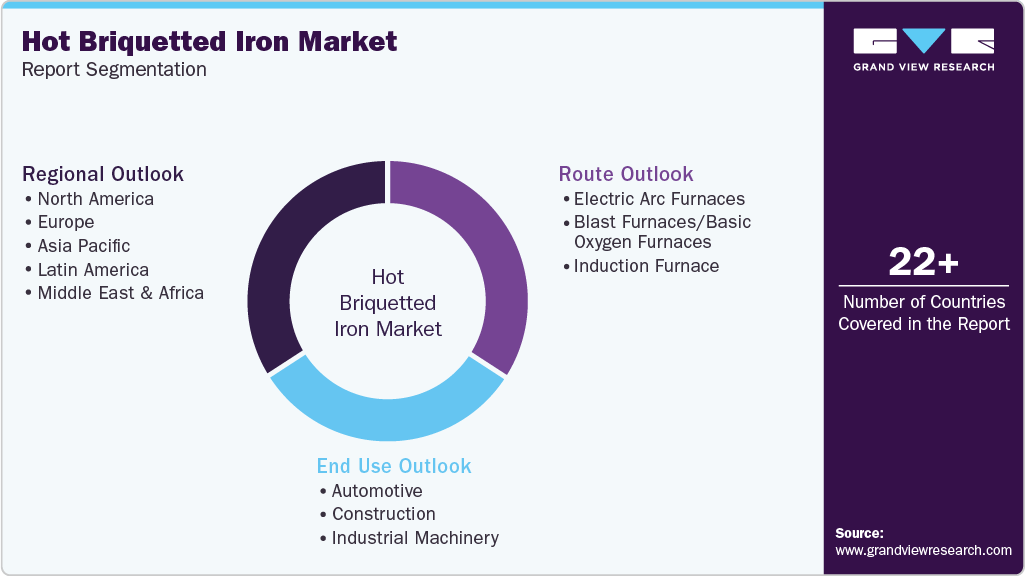
This report forecasts revenue and volume growth at the global, regional, and country levels and provides an analysis of the latest industry trends in each of the sub-segments from 2021 to 2033. For this study, Grand View Research has segmented the global hot briquetted iron market report based on end use, route, and region:
-
Route Outlook (Volume, Kilotons; Revenue, USD Million; 2021 - 2033)
-
Electric Arc Furnaces
-
Blast Furnaces/Basic Oxygen Furnaces
-
Induction Furnace
-
-
End Use Outlook (Volume, Kilotons; Revenue, USD Million; 2021 - 2033)
-
Automotive
-
Construction
-
Industrial Machinery
-
-
Regional Outlook (Volume, Kilotons; Revenue, USD Million; 2021 - 2033)
-
North America
-
U.S.
-
Canada
-
Mexico
-
-
Europe
-
Germany
-
UK
-
France
-
-
Asia Pacific
-
China
-
India
-
Japan
-
-
Latin America
-
Brazil
-
-
Middle East & Africa
-
Frequently Asked Questions About This Report
b. The global hot briquetted iron market size was estimated at USD 5.99 billion in 2024 and is expected to reach USD 6.18 billion in 2025.
b. The global hot briquetted iron market is expected to grow at a compound annual growth rate of 7.4% from 2025 to 2033 to reach USD 10.90 billion by 2033.
b. The construction segment dominated the market with a revenue share of 52.2% in 2024.
b. Some of the key players of the global hot briquetted iron market are Kobe Steel Ltd; ArcelorMittal; NUCOR; Midrex Technologies Inc.; Welspun Group; Jindal Shadeed Iron & Steel LLC; AM/NS India; Tosyali Algeria A.S., and others.
b. The key factor driving the growth of the global hot briquetted iron market is the increasing demand for high-quality, low-impurity metallic feedstock among steelmakers seeking to improve furnace efficiency, reduce emissions, and stabilize production costs in both integrated and mini-mill operations.


Share this report with your colleague or friend.
Need a Tailored Report?
Customize this report to your needs — add regions, segments, or data points, with 20% free customization.


ISO 9001:2015 & 27001:2022 Certified
We are GDPR and CCPA compliant! Your transaction & personal information is safe and secure. For more details, please read our privacy policy.
Trusted market insights - try a free sample
See how our reports are structured and why industry leaders rely on Grand View Research. Get a free sample or ask us to tailor this report to your needs.













