
- Home
- »
- Advanced Interior Materials
- »
-
Hot Isostatic Pressing Market Size, Share Report, 2026-2033GVR Report cover

Hot Isostatic Pressing Market (2026 - 2033)
Size, Share & Trends Analysis Report By Material (Metal & Alloys), By Application (Aerospace & Defense, Medical, Automotive, Oil & Gas), By Region (North America, Europe, Latin America), And Segment Forecasts
Market Size, 2025
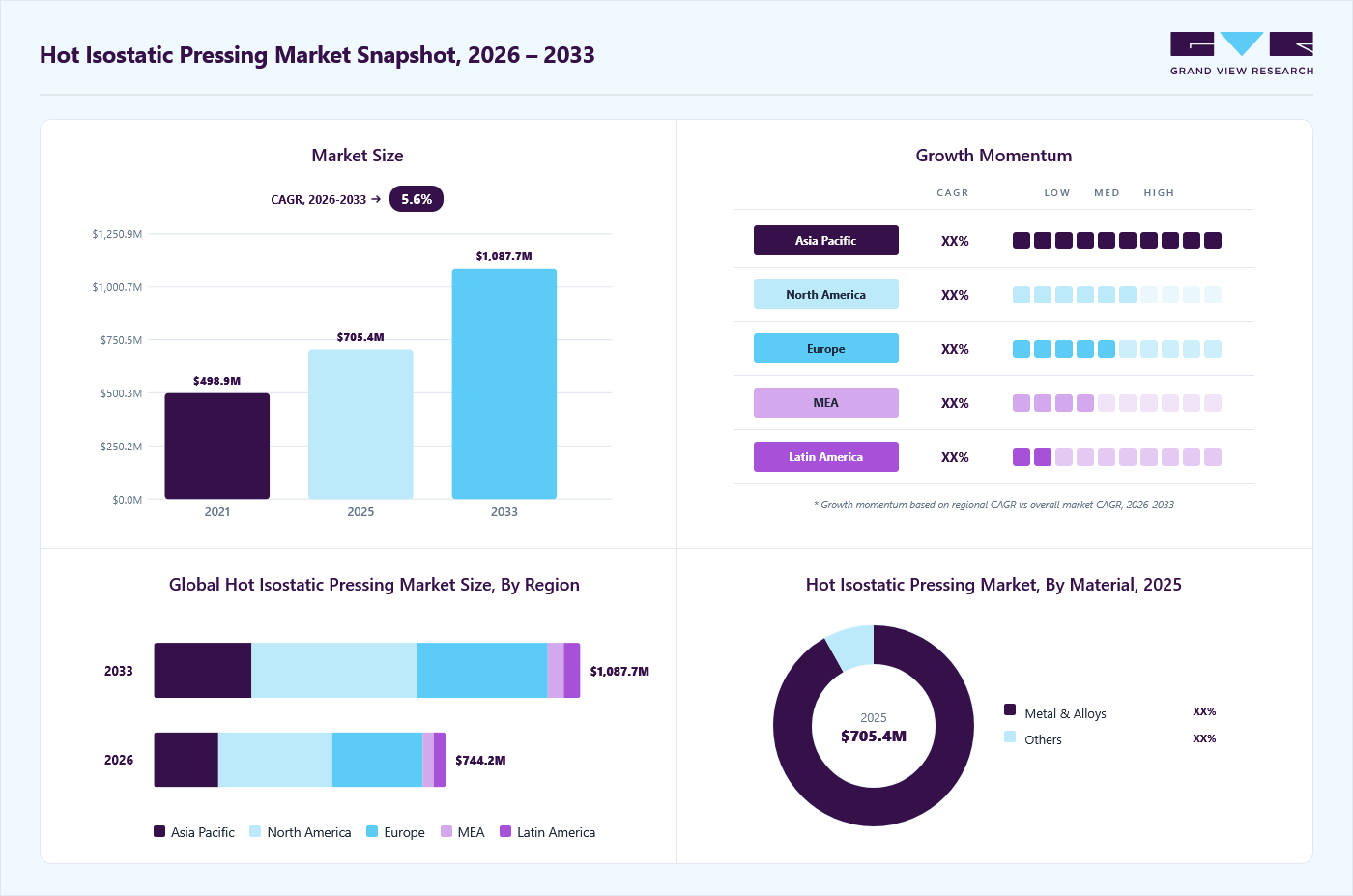
$705.4MMarket Estimate, 2026
$744.2MMarket Forecast, 2033
$1,087.7MCAGR, 2026–2033
5.6%Hot Isostatic Pressing Market Summary
The global hot isostatic pressing market size was valued at USD 705.4 million in 2025 and is projected to grow from USD 744.2 million in 2026 to USD 1,087.7 million by 2033, at a CAGR of 5.6% from 2026 to 2033. North America held the largest global revenue share of 39.1% in 2025. The global market growth is driven by rising demand for high-performance components across aerospace and defense, automotive, medical, and energy industries, increasing adoption of additive manufacturing technologies, and the growing need for defect-free, high-density materials with enhanced mechanical properties and durability.
 Source: Grand View Research, IR Documents, Primary Interviews, Paid DatabasesTo learn more about this report,
 Download Free Sample Report
 Key Market Trends & Insights
- By material: Metal & alloys held the largest revenue share of 91.8% in 2025.
- By application: Aerospace & defense held the largest revenue share of 37.0% in 2025.
Regional Highlights
- Largest regional market: North America (39.1% revenue share, 2025)
- Fastest-growing regional market: Asia Pacific (highest CAGR, 2026-2033)
- By country: The U.S. held the largest market share in 2025.
Market Size & Forecast
- Market size in 2025: USD 705.4 Million
- Estimated market size in 2026: USD 744.2 Million
- Projected market size by 2033: USD 1,087.7 Million
- CAGR (2026-2033): 5.6%
Three ways to get this report
Buy it, customize it, or ask a question.Ask an Analyst
Analyst response in 1 business day
- AccessReport author, directly
- Reply timeWithin 1 working day
- No sales callDirect answer only
- FormatEmail reply
- CostFree, no cost
Get the Full Report
What the study covers
- FormatsPDF · Excel · Dashboard
- Timeline2026–2033 annual, 2025 base
- Coverage20+ countries, 5 regions
- Companies10+ key players profiled
Customize the Report
20% free customization
- IncludeCountries, segments, points
- TailorTo your product definition
- ExtendDeeper competitor detail
- OrA fully bespoke study
- Turnaround5–10 working days
The hot isostatic pressing industry is witnessing significant growth, driven by increasing demand for high-performance metal powder-based components across aerospace & defense, medical implants, energy, automotive, and additive manufacturing applications. Hot isostatic pressing (HIP) technology is widely used to densify metal-powder components, eliminate internal porosity, and improve fatigue strength, mechanical reliability, and structural integrity. The growing adoption of powder-based additive manufacturing and advanced metallurgy technologies is significantly strengthening the utilization of HIP processes in critical industrial applications.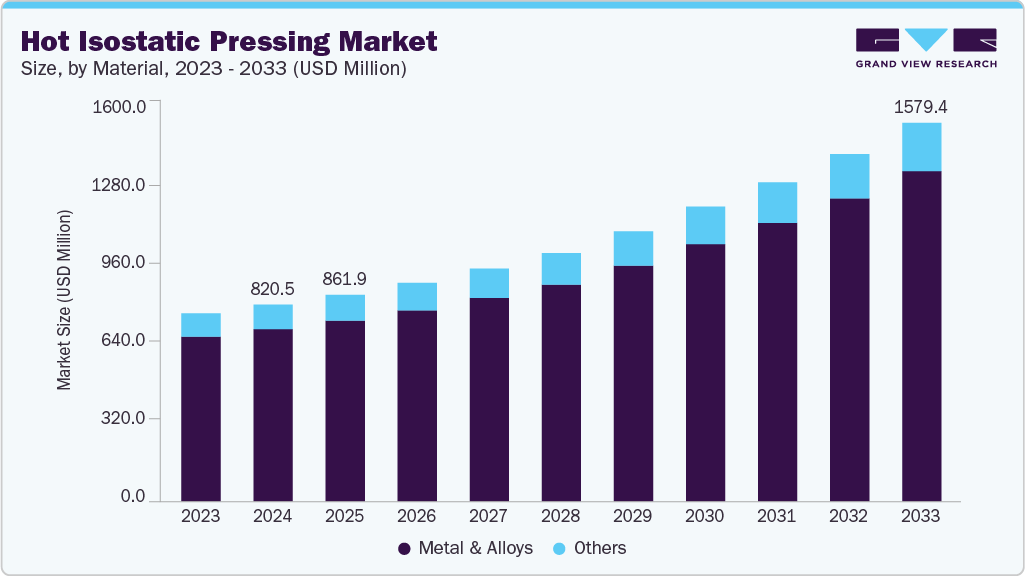 To learn more about this report, Download Free Sample Report
 The medical industry is also witnessing rising adoption of HIP-treated titanium implants and surgical devices due to superior biocompatibility, corrosion resistance, and mechanical strength. In addition, the rapid expansion of additive manufacturing is supporting market growth, as HIP has become an important post-processing technology for improving the density and fatigue performance of 3D-printed metal components.
Market Dynamics
The aerospace and defense sector is a primary structural demand driver for the HIP market, as long-term aircraft fleet expansion directly translates into sustained production of high-performance components that require densification and defect elimination. HIP is widely used for metal powder-based and additive-manufactured parts, such as turbine components, structural housings, and engine systems, where eliminating internal porosity is critical to meeting stringent safety and performance standards.
The Airbus and Boeing forecasts indicate strong long-term aviation expansion, with the global aircraft fleet projected to nearly double by 2043. Airbus projects fleet growth from 22,681 aircraft in 2019 to 48,230 aircraft by 2043, reflecting an increase of approximately 113%, while Boeing forecasts growth from 26,750 aircraft in 2023 to 50,170 aircraft by 2043, representing growth of nearly 88%. Asia-Pacific is expected to record the largest absolute increase of 19,500-20,000 aircraft, reinforcing its dominance in future aviation demand, while Europe and CIS are projected to grow by nearly 68% according to Boeing forecasts.
Fluctuations in raw material prices act as a key restraint for the HIP market due to its strong dependence on high-performance metal powders used in powder metallurgy and additive manufacturing routes. HIP is widely applied to titanium, nickel, cobalt-chrome, stainless steel, and copper-based powders, where feedstock cost directly determines overall process economics. Since these powders are essential inputs for HIP-processed components, any volatility in their pricing immediately raises production costs and reduces price stability across end-use applications, directly impacting the competitiveness of HIP-based manufacturing versus conventional forming technologies.
The growing adoption of additive manufacturing (AM) across aerospace, medical, energy, and defense sectors presents a significant opportunity for the Hot Isostatic Pressing (HIP) market. HIP is increasingly used as a critical post-processing technology for additively manufactured metal components, helping eliminate internal porosity, improve density, enhance fatigue resistance, and ensure consistent mechanical properties. As industries continue to expand the use of complex, lightweight, and high-value metal parts produced through 3D printing, the demand for HIP is expected to rise in parallel. The increasing commercialization of metal additive manufacturing, particularly for titanium, nickel-based superalloys, and stainless-steel components, is creating substantial growth prospects for HIP service providers and equipment manufacturers by enabling the production of defect-free, high-performance parts that meet stringent industry certification requirements.
Analyst Perspective
HIP has quietly evolved from a niche "fix-it" process for castings into an essential backbone for advanced manufacturing, especially as the final step for metal 3D printing, turning fragile printed parts into dense, reliable components for jet engines, medical implants, and EV drivetrains. Yes, volatile titanium and nickel prices squeeze margins, and high entry barriers keep this a deep‑pocketed game for players like Bodycote and Quintus. But once you see HIP used for space hardware, nuclear components, and fighter‑jet brake discs, it’s clear this technology has moved from specialty to mainstream.
Material Insights
The metal & alloys segment dominated the hot isostatic pressing market, accounting for the largest revenue share of 91.8% in 2025, due to its extensive use in HIP for eliminating internal porosity, improving fatigue resistance, and enhancing the mechanical performance of high-value components manufactured from titanium, nickel-based superalloys, stainless steel, and cobalt-chrome alloys used across aerospace, medical implant, automotive, and energy applications.
The expansion of the others segment is further supported by increasing adoption of advanced ceramic materials in biomedical and aerospace applications, where HIP is used to achieve full densification and eliminate micro-porosity in non-metal powder systems.
Application Insights
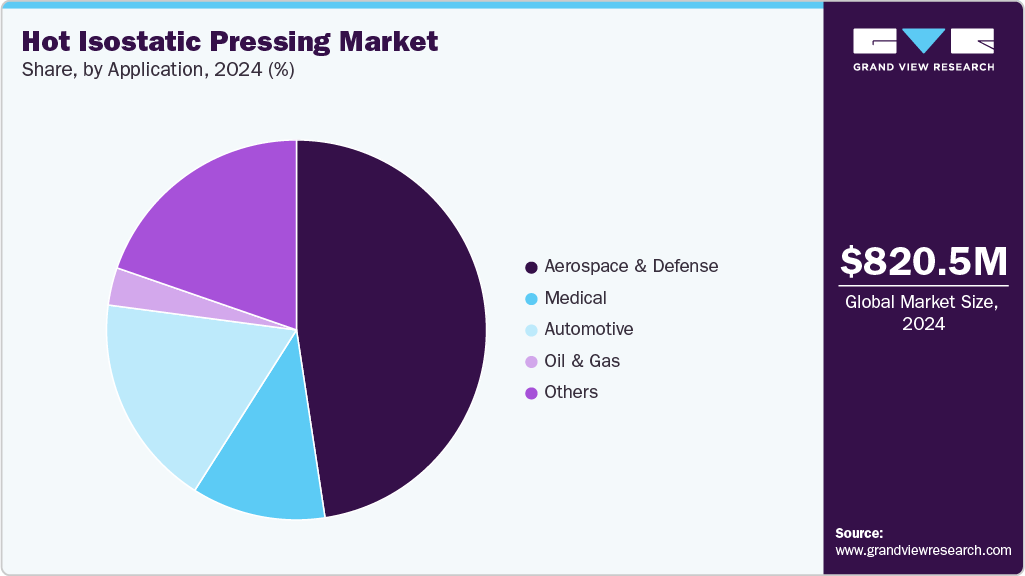
The aerospace & defense segment dominated the hot isostatic pressing industry, accounting for the largest share of 37.0% in 2025, driven by increasing demand for high-performance and defect-free components such as turbine blades, structural engine parts, and additively manufactured metal components, where HIP is used to reduce internal porosity and improve fatigue strength, creep resistance, and reliability under extreme operating conditions.
 To learn more about this report, Download Free Sample Report
 The medical segment is emerging as a major growth area for the HIP market, driven by increasing global demand for orthopedic implants, dental implants, prosthetics, and advanced surgical devices. Medical components require high mechanical strength, corrosion resistance, and long operational life because they are implanted in the human body and are continuously subjected to stress. HIP improves material density and eliminates internal porosity in titanium and cobalt-chromium implants, enhancing fatigue strength and overall structural performance.
Regional Insights
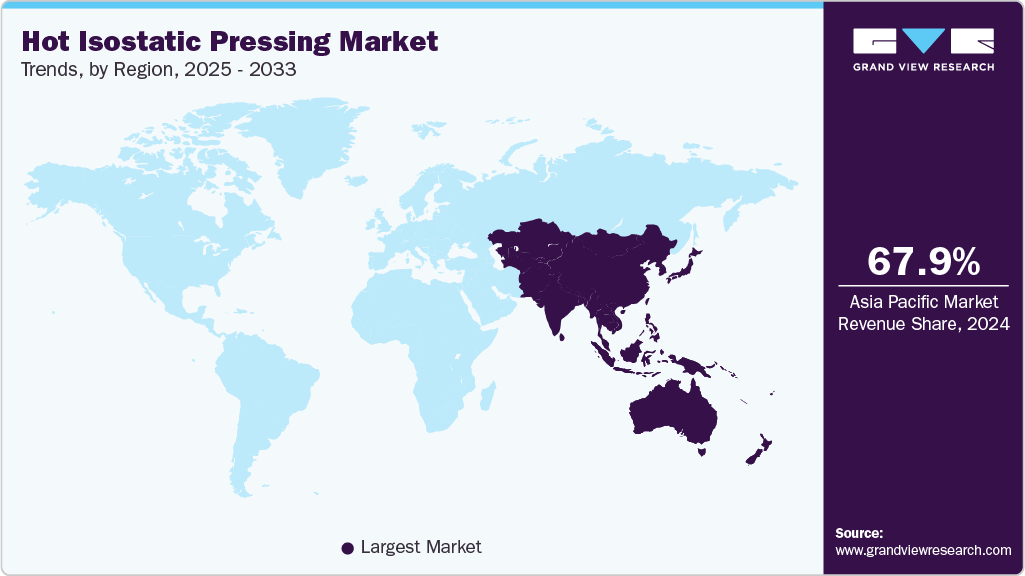
The North America hot isostatic pressing industry accounted for the largest revenue share of 39.1% in 2025. The expansion of North America's aerospace and defense industries is a major growth driver for the hot isostatic pressing market, as demand for high-performance, defect-free components continues to increase across commercial aviation and defense platforms. Manufacturers increasingly rely on HIP to eliminate internal porosity and improve fatigue resistance in critical engine and structural parts made from titanium and superalloys that operate under extreme conditions. This trend is reinforced by rising aircraft manufacturing activity from Boeing, which plans to increase 737 MAX production from 42 to 47 per month in 2026 as it moves toward higher production levels to address strong order backlogs and growing airline demand.
 To learn more about this report, Download Free Sample Report
 U.S. Hot Isostatic Pressing Market Trends
The U.S. hot isostatic pressing industry is experiencing strong expansion, propelled by robust demand from the aerospace and defense sector. Manufacturers are increasingly turning to HIP to eliminate internal porosity in critical engine and structural parts made from superalloys and titanium, ensuring the structural integrity needed for extreme operational environments.
Europe Hot Isostatic Pressing Market Trends
The rapid adoption of additive manufacturing across Europe is creating strong demand for HIP services. Aerospace, medical device, and industrial equipment manufacturers are increasingly using titanium- and nickel-based alloy parts manufactured via additive routes, where HIP improves material uniformity, eliminates internal porosity, and enhances structural performance. For instance, in May 2026, Wallwork Group doubled its aerospace-focused HIP capacity by commissioning a second Quintus Technologies QIH 173L M URC-type at its Bury, UK, HIP Center, supporting rising demand for void elimination and property enhancement treatments on castings and additively manufactured components.
Asia Pacific Hot Isostatic Pressing Market Trends
The hot isostatic pressing industry in the Asia Pacific is anticipated to grow at the fastest CAGR from 2026 to 2033, strongly supported by the rapid expansion of aerospace manufacturing and the increasing production of high-performance components across countries such as China, Japan, India, and South Korea. Aircraft engines, turbine components, and structural aerospace parts require superior density and defect-free material properties, making HIP an essential post-processing technology.
Latin America Hot Isostatic Pressing Market Trends
The growth of the Latin America hot isostatic pressing industry is strongly supported by the expansion of the regional aerospace industry, particularly in Brazil, as it remains one of the largest aerospace manufacturing hubs in the region through the activities of Embraer and its supplier ecosystem, which increasingly uses high-performance titanium and nickel alloy components requiring defect elimination and enhanced fatigue resistance. HIP plays a critical role in improving the structural integrity of cast and powder metallurgy components used in aircraft systems.
Middle East & Africa Hot Isostatic Pressing Market Trends
The expansion of aerospace and defense manufacturing activities across the Middle East is emerging as a major driver for the hot isostatic pressing industry. Countries such as Saudi Arabia and the UAE are increasing investments in local aerospace production, maintenance, and advanced materials manufacturing as part of industrial diversification initiatives, including Vision 2030 programs. For instance, in February 2026, Vertical Aerospace signed a strategic three-party Memorandum of Understanding (MoU) with AHQ Group (Abdel Hadi Abdullah Al Qahtani & Sons Group of Companies) and the Saudi National Industrial Development Center (NIDC) to accelerate Advanced Air Mobility (AAM) in Saudi Arabia.
Key Hot Isostatic Pressing Company Insights
Some of the key players operating in the market include Höganäs AB and Sandvik.
-
Höganäs AB is one of the world's largest producers of metal powders and a leading supplier of materials for powder metallurgy, additive manufacturing, and hot isostatic pressing (HIP) applications. Headquartered in Sweden, the company offers a broad portfolio of stainless steel, tool steel, nickel-based alloy, and customized HIP powders serving aerospace, energy, medical, and industrial markets. Its extensive metallurgical expertise and vertically integrated production capabilities have positioned it as a key global supplier of high-performance powder materials.
-
Sandvik is a Sweden-based engineering and materials technology company with a strong presence in advanced metal powders through its powder solutions business. The company supplies gas-atomized stainless steel, nickel-based superalloy, tool steel, and specialty alloy powders for HIP, additive manufacturing, and other advanced manufacturing processes. Leveraging decades of materials science expertise and the Osprey powder production technology, Sandvik serves demanding industries such as aerospace, energy, medical, and tooling applications worldwide.
Key Hot Isostatic Pressing Companies
The following key companies have been profiled for this study on the hot isostatic pressing market.
-
AP&C
-
ATI Specialty Materials
-
DAIDO STEEL
-
EOS GmbH
-
GKN Powder Metallurgy
-
Höganäs AB
-
KENNAMETAL
-
Praxair Surface Technologies
-
Sandvik
-
Carpenter Technology
Competitive Benchmarking
Operating Strategies
Competitive Edge
Considerations
Mature Players: Höganäs AB; Sandvik; Carpenter Technology; ATI Specialty Materials; GKN Powder Metallurgy
- Established market participants leverage integrated manufacturing ecosystems encompassing alloy design, powder production, testing, certification, and customer support. Their strategic focus is centered on capacity optimization, development of advanced alloy grades, strengthening long-term supply partnerships, and maintaining compliance with stringent aerospace, energy, medical, and industrial specifications.
- Their strategies focus on supplying high-performance powders for aerospace, energy, medical, defense, and industrial HIP applications while maintaining long-term relationships with OEMs and Tier suppliers.
- These companies emphasize continuous investment in advanced alloy development, production capacity expansion, quality assurance, and global distribution networks to support stringent customer requirements and qualification programs.
- Mature players benefit from extensive qualification records, diversified product portfolios, global production networks, and strong relationships with OEMs and Tier suppliers. Their scale, technical expertise, and proven supply reliability position them favorably in specification-driven applications where quality assurance and consistency are critical purchasing criteria.
- Their strategies focus on supplying high-performance powders for aerospace, energy, medical, defense, and industrial HIP applications while maintaining long-term relationships with OEMs and Tier suppliers.
- These companies benefit from strong technical support capabilities, proven manufacturing reliability, and deep engagement with aerospace, medical, and energy customers, enabling them to participate in highly regulated and specification-driven markets.
- Sustaining growth requires continuous investment in production technologies, environmental compliance, and quality management systems. Additionally, exposure to fluctuations in raw material and energy costs, evolving regulatory frameworks, and increasing customer expectations regarding supply chain security may influence operating margins and long-term strategic planning.
- Their strategies focus on supplying high-performance powders for aerospace, energy, medical, defense, and industrial HIP applications while maintaining long-term relationships with OEMs and Tier suppliers.
- Additionally, exposure to fluctuations in raw material prices, evolving sustainability requirements, and increasing customer expectations regarding supply chain resilience can influence profitability and operational planning.
Growing / Specialized Players: AP&C; Praxair Surface Technologies; EOS GmbH; Daido Steel; Kennametal
- Specialized participants in the HIP powder market focus on high-value alloy powders, application-specific materials, and niche industrial requirements.
- Their strategies emphasize powder quality, particle consistency, material innovation, and close collaboration with customers involved in aerospace, medical implants, tooling, additive manufacturing, and advanced engineering applications.
- These companies often pursue targeted growth through technical specialization, development of premium powder grades, and expansion within selected end-use industries where performance requirements are critical.
- Competitive strengths include deep expertise in specific material systems such as titanium alloys, nickel superalloys, cobalt-based alloys, and wear-resistant materials.
- Their focused operating models enable rapid product development, customized material solutions, and strong technical engagement with customers.
- Leaner organizational structures and specialized production capabilities often support greater flexibility in addressing evolving application requirements and emerging HIP-related opportunities.
- Compared with larger integrated powder manufacturers, specialized players generally operate with a narrower product portfolio and a more focused customer base.
- Their growth is often tied to specific industries such as aerospace, medical devices, or advanced manufacturing technologies.
- Capacity expansion, global market penetration, and diversification of end-use exposure may remain important priorities as these companies seek to strengthen their competitive position and reduce dependence on a limited number of high-specification sectors.
Recent Developments
-
In May 2026, Wallwork Group is doubling its HIP capacity by adding a second Quintus Technologies system at its UK facility to better serve aerospace demand, improve component integrity, and support parts made by casting and additive manufacturing. The expansion adds to Wallwork’s existing thermal processing services, including vacuum heat treatment, plasma nitriding, and vacuum brazing, and the company says the extra capacity will help it offer a more integrated, single-source solution for aerospace manufacturers.
-
In February 2025, TAG announced it had doubled the production capacity of its HIP department by adding a second hot isostatic pressing system at its Cremella, Italy, plant, a move intended to boost output, improve service, and strengthen continuity during maintenance or downtime. The new unit features a molybdenum thermal chamber that can reach 1,400 C and 175 MPa and is positioned as part of TAG’s broader expansion in heat treatment and special processes.
-
In October 2025, Bodycote and Blykalla announced a strategic collaboration to advance nuclear component manufacturing by using HIP technology for reactor components made from Blykalla’s proprietary materials. The partnership aims to qualify production methods capable of withstanding the demanding lead-cooled reactor environments of next-generation small modular reactors (SMRs).
Hot Isostatic Pressing Report Scope
Report Attribute
Details
Market definition
The hot isostatic pressing market size represents the total value of metal powders and specialty materials consumed in the manufacturing of HIP-produced and HIP-densified components globally.
Market size in 2025
USD 705.4 million
Estimated market size in 2026
USD 744.2 million
Projected market size by 2033
USD 1,087.7 million
Growth rate
CAGR of 5.6% from 2026 to 2033
Base year for estimation
2025
Historical data
2021 - 2024
Forecast period
2026 - 2033
Quantitative Units
Revenue in USD million and CAGR from 2026 to 2033
Report coverage
Revenue forecast, competitive landscape, growth factors, and trends
Segments covered
Application, material, region
Regional scope
North America; Europe; Asia Pacific; Latin America; Middle East & Africa
Country scope
U.S.; Canada; Mexico; Germany; UK; France; China; India; Japan; Brazil
Key companies profiled
AP&C; ATI Specialty Materials; DAIDO STEEL; EOS GmbH; GKN Powder Metallurgy; Höganäs AB; Praxair Surface Technologies; Sandvik; Carpenter Technology
Customization scope
Free report customization (equivalent up to 8 analysts working days) with purchase. Addition or alteration to country, regional & segment scope.
Pricing and purchase options
Avail customized purchase options to meet your exact research needs. Explore purchase options
Global Hot Isostatic Pressing Market Report Segmentation
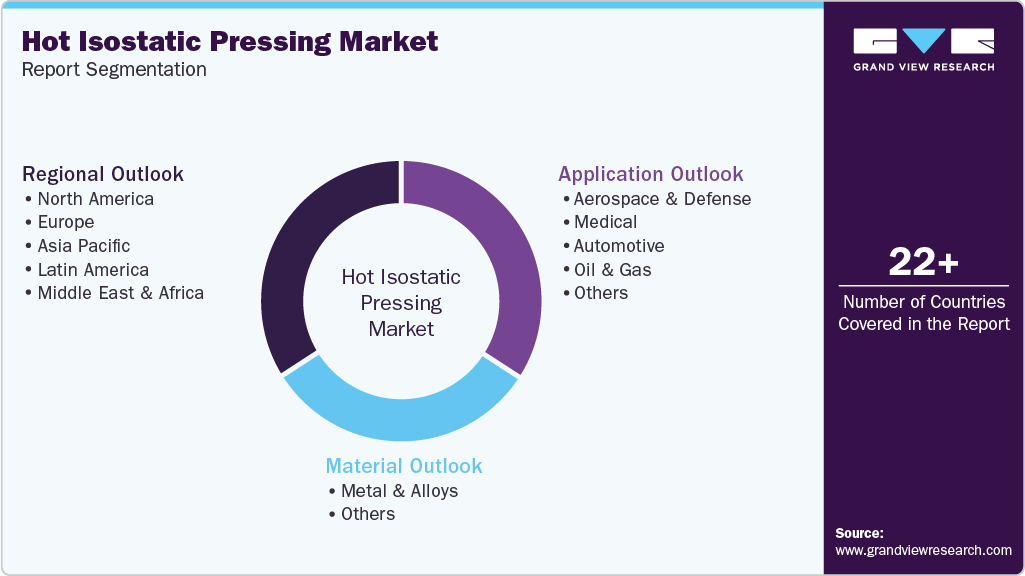
This report forecasts revenue growth at the global, regional, and country levels and provides an analysis of the latest industry trends in each of the sub-segments from 2021 to 2033. For this study, Grand View Research has segmented the global hot isostatic pressing market report based on application, material, and region:
 To learn more about this report, Download Free Sample Report
 -
Material Outlook (Revenue, USD Million, 2021 - 2033)
-
Metal & Alloys
-
Others
-
-
Application Outlook (Revenue, USD Million, 2021 - 2033)
-
Aerospace & Defense
-
Medical
-
Automotive
-
Oil & Gas
-
Others
-
-
Regional Outlook (Revenue, USD Million, 2021 - 2033)
-
North America
-
U.S.
-
Canada
-
Mexico
-
-
Europe
-
Germany
-
UK
-
France
-
-
Asia Pacific
-
China
-
India
-
Japan
-
-
Latin America
-
Brazil
-
-
Middle East & Africa
-
Research Methodology
Segment Definition
Segment - Material
Revenue capture definition
Metals & Alloys
Includes metal powders and alloys used to manufacture HIP-processed components, such as nickel alloys, titanium alloys, stainless steel, cobalt-chrome alloys, and other specialty metals. These materials are widely used in aerospace, medical, automotive, oil & gas, and industrial applications.
Others
Includes non-metallic and advanced materials processed through HIP, such as ceramics, carbides, cermets, intermetallics, and other specialty materials used in tooling, wear-resistant parts, and high-performance industrial applications.
Segment - Application
Revenue capture definition
Aerospace & Defense
Covers HIP-processed components used in aircraft, defense equipment, space systems, and gas turbine engines, including turbine parts, engine components, and structural aerospace parts.
Medical
Includes HIP-treated medical products such as orthopedic implants, spinal implants, dental implants, surgical instruments, and other biocompatible components.
Automotive
Covers HIP-manufactured components used in passenger and commercial vehicles, including drivetrain parts, turbocharger components, tooling inserts, and specialty powder metallurgy products.
Oil & Gas
Includes HIP-processed components used in oil & gas production, LNG facilities, power generation, and energy infrastructure, such as valves, subsea equipment, corrosion-resistant parts, and turbine components.
Others
Covers all other HIP applications, including industrial tooling, industrial turbines, wear-resistant components, additive manufacturing support parts, and other specialized engineering applications.
Estimation Model
Layer Name
Key Question
Description
Component Production Layer
Which components potentially require HIP?
Identify the production volume and value of components manufactured for industries where material integrity is critical, including aerospace, medical implants, power generation, oil & gas, automotive, and industrial machinery.
Material & Process Eligibility Layer
Which components are technically suitable for HIP?
Apply material-specific and process-specific filters to the component pool, focusing on castings, powder metallurgy parts, additive-manufactured components, superalloys, titanium alloys, stainless steels, and other high-performance materials that benefit from densification and defect elimination.
HIP Adoption Layer
Which eligible components undergo HIP?
Apply industry-specific HIP penetration rates based on quality requirements, certification standards, safety-critical applications, and end-user specifications.
Monetisation Layer
How much revenue is generated?
Multiply HIP-treated component volumes by average HIP processing revenue per component, batch, or kilogram, while incorporating value-added services such as heat treatment, inspection, testing, and post-processing.
Delivered Customizations
This report has been delivered with the following In-depth customizations
Client Request
Customization Delivered
Value Adds
Regional Segmentation
Detailed country- and region-level analysis covering aerospace manufacturing expansion, automotive lightweighting trends, medical implant production growth, additive manufacturing ecosystem development, industrial gas atomization capacity additions, powder metallurgy cluster expansion, and HIP equipment installation trends across North America, Europe, Asia Pacific, Latin America, and Middle East & Africa.
Help clients identify high-growth regional markets, evaluate industrial manufacturing trends, optimize geographic expansion strategies, and assess region-specific demand potential for HIP across critical end-use industries.
Pricing Analysis
Detailed pricing assessment covering metal powder cost trends, gas atomization and plasma atomization processing expenses, alloy-specific price variations, energy consumption impact, transportation costs, and regional pricing differences for titanium, nickel-based, stainless steel, cobalt-chrome, and specialty alloy powders used in HIP applications.
Help clients evaluate pricing structures, optimize procurement strategies, assess margin fluctuations, and understand the impact of raw material and energy cost volatility on overall market competitiveness.
Opportunity Assessment
Strategic evaluation of emerging growth opportunities across aerospace engine components, additive manufacturing post-processing, medical implants, high-performance automotive parts, defense applications, energy infrastructure, and next-generation industrial manufacturing requiring high-density and defect-free components produced using HIP.
Assists clients in identifying untapped revenue streams, evaluating future investment potential, understanding evolving industrial demand patterns, and prioritizing expansion opportunities in high-growth application sectors.
Frequently Asked Questions About This Report
North America dominated with a 39.1% revenue share in 2025 of the hot isostatic pressing market.
Asia Pacific is the fastest growing region, and is expected to register a CAGR of 6.1% over the forecast period.
The global hot isostatic pressing market size was estimated at USD 705.4 million in 2025 and is expected to reach USD 744.2 million in 2026.
The global hot isostatic pressing market is expected to grow at a compound annual growth rate of 5.6% from 2026 to 2033 to reach USD 1,087.7 million by 2033.
The aerospace & defense segment registered the largest market share of 37.0% in 2025, driven by increasing demand for high-performance and defect-free components such as turbine blades and structural engine parts.
Some of the key players of the global hot isostatic pressing market are AP&C, ATI Specialty Materials, DAIDO STEEL, EOS GmbH, GKN Powder Metallurgy, Höganäs AB, Kennametal, Praxair Surface Technologies, Sandvik, Carpenter Technology, and others.
The key factor driving the growth of the global hot isostatic pressing market is the increasing demand for high-performance and defect-free components with superior mechanical strength, fatigue resistance, and density across aerospace, automotive, medical, energy, and advanced manufacturing industries.
China accounted for 35.9% in 2025 of the Asia Pacific hot isostatic pressing market.
The metals and alloys segment registered the largest market share of 91.8% in 2025, driven by their extensive use in high-performance applications across aerospace, automotive, medical, energy, and industrial sectors.
About the Author(s)
Advanced Interior Materials Research Team
Advanced Materials · Advanced Interior MaterialsThis report was authored by the advanced interior materials research team at Grand View Research - comprising two research analysts, one senior research analyst, and one industry expert - with specialized expertise in the advanced interior materials segment of the advanced materials industry. All findings are based on proprietary advanced materials databases, executive interviews, and regulatory analysis, subject to internal peer review prior to publication.
Last Updated:
Speak to Analyst

Customize this report to your needs - add regions, segments, or data points, with 20% free customization.
Or view our licence options:


ISO 9001:2015 & 27001:2022 Certified
We are GDPR and CCPA compliant! Your transaction & personal information is safe and secure. For more details, please read our privacy policy.


