
- Home
- »
- Advanced Interior Materials
- »
-
HVAC Accessories Market Size, Share Report, 2026-2033GVR Report cover

HVAC Accessories Market (2026 - 2033)
Size, Share & Trends Analysis Report By Product (Thermostats, Sensors, Control Systems), By Application (Commercial, Residential, Industrial), By Distribution Channel, By End Users, By Deployment, By Region, And Segment Forecasts
Market Size, 2025
$25.3BMarket Estimate, 2026
$26.6BMarket Forecast, 2033
$38.1BCAGR, 2026–2033
5.2%HVAC Accessories Market Summary
The global HVAC accessories market size was valued at USD 24.0 billion in 2024 and is projected to grow from USD 26.6 billion in 2026 to USD 32.8 billion by 2033, at a CAGR of 5.4% from 2025 to 2033. North America dominated the market, accounting for a revenue share of 35.1% in 2024. North America dominated the market, accounting for a revenue share of 35.1% in 2024. The increasing demand for energy-efficient and environmentally friendly HVAC systems is a primary driver.
 Source: Grand View Research, IR Documents, Primary Interviews, Paid DatabasesTo learn more about this report,
 Download Free Sample Report
 Key Market Trends & Insights
- By product: Thermostats segment led the market with the largest revenue share of 19.0% in 2025.
- By application: commercial segment led the market with the largest revenue share of 47.1% in 2025.
- By distribution channel: retail stores segment led the market with the largest revenue share of 42.2% in 2025.
- By deployment: Replacement segment led the market with the largest revenue share of 50.4% in 2025.
- By end user: HVAC contractors segment led the market with the largest revenue share of 42.0% in 2025.
Regional Highlights
- Largest regional market: North America (35.2% revenue share, 2025)
- By country: The U.S. held the largest market share in 2025.
Market Size & Forecast
- Market size in 2025: USD 25.3 Billion
- Estimated market size in 2026: USD 26.6 Billion
- Projected market size by 2033: USD 38.1 Billion
- CAGR (2026-2033): 5.2%
Three ways to get this report
Buy it, customize it, or ask a question.Ask an Analyst
Analyst response in 1 business day
- AccessReport author, directly
- Reply timeWithin 1 working day
- No sales callDirect answer only
- FormatEmail reply
- CostFree, no cost
Get the Full Report
What the study covers
- FormatsPDF · Excel · Dashboard
- Timeline2026–2033 annual, 2025 base
- Coverage20+ countries, 5 regions
- Companies10+ key players profiled
Customize the Report
20% free customization
- IncludeCountries, segments, points
- TailorTo your product definition
- ExtendDeeper competitor detail
- OrA fully bespoke study
- Turnaround5–10 working days
As consumers and businesses seek to reduce energy consumption and minimize environmental impact, there is a growing need for accessories that enhance the efficiency and sustainability of HVAC systems.
 To learn more about this report, Download Free Sample Report
 Technological advancements in HVAC systems have also contributed to market growth. The integration of smart technologies, such as IoT-enabled devices, allows for improved control and automation of HVAC systems, leading to enhanced efficiency, comfort and convenience.
Market Dynamics
The global HVAC accessories market is shaped by increasing demand for advanced climate control solutions that enhance operational efficiency, occupant comfort, and air quality across residential, commercial, and industrial facilities. Growing investments in smart buildings, infrastructure modernization, and HVAC system upgrades are accelerating the adoption of accessories such as sensors, controls, dampers, filtration components, and monitoring devices that improve system functionality and energy management. Regulatory focus on sustainability, building performance, and emissions reduction continues to encourage the deployment of high-efficiency HVAC components. In addition, rising construction activity and retrofit projects across emerging and developed economies are creating sustained growth opportunities. However, installation costs, integration challenges with existing systems, and budget limitations in certain end-use sectors may hinder adoption. Despite these constraints, ongoing innovation in connected technologies, automated system management, and advanced air distribution and filtration solutions is expected to support market expansion over the forecast period.
The global HVAC accessories market is driven by the increasing shift toward smart, energy-efficient, and automated building environments across residential, commercial, and industrial sectors. Growing focus on reducing energy consumption and improving HVAC system efficiency is accelerating the adoption of advanced accessories such as sensors, controllers, dampers, valves, and integrated control solutions. The expansion of green buildings and energy-efficient construction practices is further supporting demand for technologies that enhance system performance and operational optimization.
In addition, the rapid penetration of building automation systems and IoT-enabled HVAC solutions is strengthening market growth. Integration of connected devices and centralized control platforms is enabling real-time monitoring, predictive regulation, and improved indoor environmental management. Rising emphasis on occupant comfort and indoor air quality is also contributing to the increased deployment of intelligent HVAC accessory solutions across new installations and infrastructure upgrades.
The HVAC accessories market faces constraints due to the relatively high upfront cost of advanced systems and components, which limits adoption in cost-sensitive markets and smaller facilities. Many end users continue to prioritize basic HVAC setups over advanced accessory integration due to budget limitations, which slows down penetration of technologically enhanced solutions. Additionally, fluctuations in construction activity and capital expenditure cycles can impact overall demand stability.
Another challenge is the complexity associated with integrating modern HVAC accessories into existing or legacy systems. Compatibility issues, installation requirements, and the need for skilled technical expertise can increase implementation time and overall project costs. These factors are particularly restrictive in retrofit applications, where system upgrades must be executed without disrupting ongoing building operations.
The increasing focus on building renovation and HVAC system modernization is creating strong growth opportunities for the HVAC accessories market. Aging commercial, institutional, and industrial infrastructure is being upgraded to improve energy efficiency, reduce operational costs, and comply with evolving sustainability standards. This is driving demand for advanced accessories such as intelligent controls, airflow management systems, filtration units, and monitoring devices that enhance system performance and lifecycle efficiency.
Furthermore, the rapid development of smart cities and digitally connected buildings is opening new avenues for advanced HVAC accessory solutions. The integration of IoT-based building management systems, predictive maintenance technologies, and data-driven energy optimization platforms is increasing the need for smart, connected components. Emerging economies are also contributing significantly to growth through large-scale urbanization, infrastructure expansion, and increased adoption of modern HVAC technologies.
Market Concentration & Characteristics
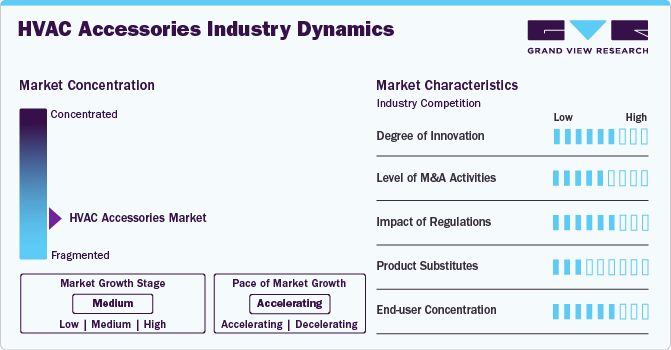
The global HVAC accessories market is moderately fragmented, with a mix of large multinational companies and regional players competing for market share. Leading manufacturers focus on producing efficient HVAC accessories like thermostats, sensors, air filters, and ventilation systems, driven by growing demand for energy efficiency and smart technologies. Innovations aim to improve system performance, indoor air quality, and integration with smart home or commercial building systems. As energy efficiency and environmental concerns grow, these innovations are key to market expansion.
Regulations from bodies like the International Energy Agency (IEA) and national governments shape the market by enforcing standards related to energy efficiency, emissions reduction, and safety. Manufacturers are developing products that meet these stringent requirements, contributing to sustainability efforts.
 To learn more about this report, Download Free Sample Report
 Regulations from bodies like the International Energy Agency (IEA) and national governments shape the market by enforcing standards related to energy efficiency, emissions reduction, and safety. Manufacturers are developing products that meet these stringent requirements, contributing to sustainability efforts. This trend presents new opportunities, although competition from alternative energy-efficient solutions poses challenges. Manufacturers must continue to innovate and adapt to regulatory changes to remain competitive in a rapidly evolving market.
Analyst Perspective
The global HVAC accessories market is being shaped by the increasing focus on building efficiency standards, regulatory compliance, and the optimization of indoor environmental performance across diverse end-use sectors. Growing integration of HVAC systems with advanced accessories such as sensors, thermostats, control systems, dampers, and air quality monitoring solutions is enhancing operational precision, energy management, and system automation. The market is further supported by the transition toward smart buildings and digital facility management, where connected infrastructure enables real-time monitoring, predictive control, and improved lifecycle efficiency. In addition, sustained investments in urban infrastructure development, commercial construction, and renovation of existing building stock are expanding the installed HVAC base, thereby driving accessory demand. Advancements in IoT-enabled technologies, automation, and data-driven building operations, combined with increasing emphasis on sustainability and occupant comfort, are expected to continue supporting steady market growth globally.
Drivers, Opportunities & Restraints
The rapid urbanization and industrialization in emerging economies have further fueled the demand for HVAC systems and their accessories. As infrastructure development accelerates in these regions, there is a heightened need for effective heating, ventilation, and air conditioning solutions, driving the market for related accessories.
Restraints of market growth include high initial installation costs, which can deter consumers from adopting advanced HVAC systems and their accessories. Additionally, the complexity of integrating new technologies into existing infrastructure can pose challenges.
Opportunities for growth lie in the development of smart HVAC accessories that offer enhanced control and energy efficiency, catering to the increasing consumer demand for intelligent home solutions. Moreover, expanding into emerging markets presents significant growth potential, as rising urbanization and industrialization in these regions drive the need for effective HVAC solutions.
Product Insights
Based on product, the thermostats segment led the market with the largest revenue share of 19.0% in 2025. The strong share is attributed to increasing demand for smart homes and energy-efficient solutions. Consumers and businesses are seeking systems that can be controlled remotely to improve energy consumption and comfort. Additionally, with the growing awareness about indoor air quality and temperature regulation, the need for precise sensors that monitor and optimize HVAC performance has led to an uptick in their demand.
Sensors play a crucial role in enhancing the performance of HVAC systems, especially in energy-saving applications. The growing integration of Internet of Things (IoT) technology in HVAC systems is driving demand for advanced sensors that provide real-time data, helping to optimize HVAC operations. As energy efficiency becomes more important, sensors that monitor air quality, temperature, and humidity are in increasing demand, as they contribute to energy savings and system longevity.
Application Insights
Based on application, the commercial segment led the market with the largest revenue share of 47.1% in 2025. driven by the need for energy-efficient solutions in office buildings, shopping malls, and other large spaces. Commercial properties often have larger-scale HVAC systems, which require advanced accessories like air purifiers, thermostats, and sensors to ensure efficient operation and air quality. The push toward green building certifications and regulations also fuels the growth of energy-efficient HVAC solutions in commercial applications.
 To learn more about this report, Download Free Sample Report
 In the industrial sector, the demand for HVAC accessories is driven by the need for efficient and reliable systems that support large-scale operations. Industrial facilities require specialized HVAC solutions to maintain optimal working conditions, improve air quality, and ensure employee comfort. As industries strive for energy efficiency and compliance with environmental regulations, there is a growing focus on integrating advanced HVAC accessories like energy-efficient air purification systems, control systems, and temperature sensors.
Distribution Channel Insights
Based on distribution channel, the retail stores segment led the market with the largest revenue share of 42.2% in 2025 of the overall market, as they offer consumers easy access to a variety of HVAC products. The increasing trend of DIY home improvement and renovations, combined with the growing awareness of energy efficiency, has led to more consumers purchasing HVAC accessories through retail channels. Moreover, these stores often provide an opportunity for customers to see and test products, contributing to the rise in demand for HVAC-related accessories in the consumer space.
The online segment of the HVAC accessories market is driven by the increasing preference for convenience, competitive pricing, and the ability to compare products easily. Consumers and businesses are increasingly turning to online platforms for HVAC accessory purchases due to the wide selection of brands and products, ease of access, and the ability to deliver directly to job sites or homes. The growing trend of e-commerce, especially in the post-pandemic era, is further accelerated as both DIY consumers and professional contractors seek efficiency in their purchasing processes.
End User Insights
Based on end use, the HVAC contractors segment led the market with the largest revenue share of 42.0% in 2025. driven by their central role in installing and maintaining HVAC systems. With increasing construction activity and demand for energy-efficient solutions, contractors require high-quality HVAC accessories such as thermostats, sensors, and air filtration devices to ensure optimal system performance. The growing trend of smart and connected HVAC systems has also spurred demand for advanced accessories among contractors.
HVAC distributors drive the market by facilitating the widespread availability of accessories through their established networks. They supply HVAC accessories to contractors, retailers, and other commercial buyers. With the rise of new technologies and energy-efficient products, distributors are increasingly focused on sourcing innovative HVAC accessories to meet growing consumer demand. Their role in delivering products in bulk also supports market expansion, particularly for large-scale commercial and residential projects.
Deployment Insights
Based on deployment, the replacement segment led the market with the largest revenue share of 50.4% in 2025 of the global market driven by the increasing number of residential and commercial construction projects is a key driver of the new installation segment. As the construction industry grows, there is a rising need for energy-efficient HVAC systems, which require advanced accessories for proper installation. With sustainability being a growing focus, new installations are often equipped with smart thermostats, air purifiers, and other energy-efficient components to reduce operating costs and improve system performance.
As older systems become inefficient or outdated, consumers and businesses are replacing components with newer, more efficient HVAC accessories. Additionally, the growing awareness of the importance of maintaining air quality and energy efficiency has led to higher demand for HVAC replacements, such as air filters, sensors, and thermostats, which help optimize system performance and reduce energy consumption.
Regional Insights
North America dominated the global HVAC accessories market with the largest revenue share of 35.2% in 2025. driven by growing consumer demand for energy-efficient solutions, with an increasing preference for smart technologies. Both the residential and commercial sectors in the region are adopting more sustainable systems due to government incentives and stricter environmental regulations, particularly in the U.S. Additionally, extreme seasonal temperature variations further emphasize the need for advanced heating and cooling solutions across the region.
 To learn more about this report, Download Free Sample Report
 U.S. HVAC Accessories Market Trends
The HVAC accessories market in the U.S. held the largest share in the North America region in 2025. driven by the demand for energy-efficient systems and innovations like smart thermostats, air purifiers, and humidity control devices. With the diverse climate across the country, both heating and cooling solutions are essential year-round. Increasing consumer awareness of indoor air quality, especially post-COVID, is another key driver pushing demand for accessories that improve air filtration and comfort.
Europe HVAC Accessories Market Trends
Europe HVAC accessories market benefits from stringent environmental standards, pushing the adoption of energy-efficient and low-emission systems. The region’s focus on sustainability and reducing carbon footprints is a key driver, especially in countries like Germany and the UK. High energy costs and increasing awareness of indoor air quality among consumers also contribute to the growing demand for HVAC accessories that enhance system efficiency and air purification.
The market in Italy is projected to expand at a CAGR of 6.7% over the forecast period. Italy’s market for HVAC accessories is shaped by strict energy efficiency regulations and environmental targets. The country’s commitment to reducing carbon emissions pushes both residential and commercial sectors to adopt sustainable HVAC solutions. Government incentives for energy-efficient upgrades, coupled with Germany’s technological innovation in HVAC systems, create a significant demand for advanced accessories.
The market in Spain is projected to expand at a CAGR of 5.6% over the forecast period. The country is seeing a growing demand for energy-efficient HVAC systems due to high energy costs and an increasing focus on sustainability. Stringent building regulations and the government's pledge to achieve net-zero emissions by 2050 are driving the adoption of advanced HVAC systems. The trend toward smart homes and automation is also fueling the demand for HVAC accessories like smart thermostats and air quality monitors.
Asia Pacific HVAC Accessories Market Trends
Asia Pacific HVAC accessories market is rapidly expanding, driven by urbanization and the growing construction industry, particularly in countries like China and India. With rising temperatures and increased industrial activities, the demand for both residential and commercial HVAC solutions is surging. Additionally, the push for smarter, more energy-efficient systems and a growing middle class is accelerating market growth in this region.
The market in China is projected to expand at a CAGR of 6.6% over the forecast period due to rapid urbanization and industrialization. The increasing demand for air conditioning in both residential and commercial spaces, particularly in large cities, is a key driver. The country’s focus on energy efficiency and environmental regulations also supports the adoption of more sustainable HVAC solutions, creating demand for high-performance accessories that improve energy use and air quality.
The market in India is expected to grow at a CAGR of 6.0% over the forecast period. The rising middle class and rapid urbanization are major drivers of market growth in the country. As infrastructure development accelerates, especially in residential and commercial sectors, the need for efficient heating and cooling systems is growing. Additionally, concerns about air pollution and extreme heat are pushing demand for air purifiers and cooling accessories, as well as more energy-efficient HVAC systems.
Middle East & Africa HVAC Accessories Market Trends
In the Middle East and Africa, the HVAC accessories market is primarily driven by the extreme heat in the region, which increases the demand for cooling systems and related accessories. In the GCC (Gulf Cooperation Council) countries, high temperatures and a booming construction sector contribute significantly to market growth. Additionally, there is a growing interest in energy-efficient solutions that can reduce long-term operating costs, particularly in new developments and commercial buildings.
The market in Saudi Arabia is expected to grow at a CAGR of 4.4% over the forecast period. The country experiences extreme summer temperatures leading to a strong demand for cooling systems, which boosts the need for HVAC accessories. Moreover, the growing construction and real estate sectors are fueling demand for efficient HVAC solutions in both commercial and residential buildings.
Latin America HVAC Accessories Market Trends
In Latin America, the HVAC accessories market is being driven by a combination of expanding construction activities, rising disposable income, and urbanization. As the middle class grows, more consumers seek to improve living standards with advanced HVAC solutions that offer better comfort and energy efficiency. Countries like Brazil are seeing rising demand for cooling and air filtration systems, particularly in urban areas with hot climates.
The market in Brazil is projected to expand at a CAGR of 4.9% over the forecast period. Brazil's HVAC accessories market is benefiting from increasing construction activities, particularly in residential and commercial sectors, as urbanization accelerates. Rising disposable income and a growing middle class are prompting more consumers to invest in energy-efficient HVAC solutions. The demand for better indoor air quality and more sustainable cooling systems is driving the market for HVAC accessories in Brazil, especially in hotter regions.
Key HVAC Accessories Company Insights
Some of the key players operating in the market include Munters and Carrier among Dampers.
-
Munters provides energy-efficient air treatment and climate solutions. The company offers its Functions to create the ideal environment for consumers in a wide range of sectors. It operates through four business units, namely Air Treatment, Data Centers, AgHort, and Mist Elimination. The company provides HVAC systems and accessories through its air treatment business unit.
-
Carrier is a global provider of heating, ventilation, air conditioning, and refrigeration systems. The company offers a wide range of products and services, including commercial and residential HVAC systems, refrigeration equipment, building automation systems, and aftermarket parts and services. Carrier is known for its innovative products and solutions and has a long history of technological advancements in the HVAC industry.
Key HVAC Accessories Companies
The following key companies have been profiled for this study on the HVAC accessories market.
-
DAIKIN INDUSTRIES, Ltd.
-
SCOTTFRIO (ZHENXIE GROUP)
-
Carrier
-
Munters
-
Condair Group
-
Aeroqual
-
Ocean Controls Limited
-
Thermorex
-
Lennox International Inc.
-
Trane
Competitive Benchmarking
Operating Strategies
Competitive Edge
Weaknesses
Established Players (e.g., Daikin Industries, Ltd.; Carrier; Trane Technologies; Lennox International Inc.)
- Focus on integrated HVAC systems with embedded accessory ecosystems (sensors, thermostats, controls, IAQ solutions.
- Invest in smart building integration, energy-efficient technologies, and digital HVAC platforms.
- Strengthen global presence through large-scale commercial, industrial, and infrastructure projects.
- Strong global brand recognition and established HVAC leadership.
- Extensive product portfolios with integrated system and accessory offerings.
- Robust R&D capabilities and global service/distribution networks.
- Higher product and system pricing limits penetration in cost-sensitive markets.
- Slower innovation cycles due to large organizational structure.
- Dependence on large commercial projects exposes demand to construction cycles.
Emerging & Regional Players (e.g., Tri-Mer Corporation, Bionomic Industries, regional players)
- Focus on niche HVAC accessory segments such as air quality monitoring, humidity control, sensors, and airflow components.
- Emphasize customized solutions and OEM partnerships for regional demand fulfillment.
- Expand through flexible manufacturing and targeted geographic penetration.
- Strong specialization in specific HVAC accessory categories and applications.
- Cost-effective and flexible product offerings suited for localized requirements.
- Faster response to customized and project-specific demands.
- Limited global manufacturing scale and distribution reach.
- Lower R&D investment compared to global OEMs.
- Reduced participation in large integrated HVAC system contracts and global projects.
Recent Developments
-
In January 2025, ecobee Ltd. introduced the Smart Thermostat Essential, a more affordable smart thermostat with a color touchscreen that offers significant energy savings (up to 23%) and convenience. It's easy to install and use, adapting to the household's routine to optimize energy use and maintain comfort.
-
In March 2024, Vaisala launched its latest air quality sensor, aiming to transform how cities pinpoint and manage their most pressing pollution problems. The sensor provides precise and dependable information and has been rated highly by the Norwegian Institute of Air Research.
HVAC Accessories Market Report Scope
Report Attribute
Details
Market size in 2025
USD 25.3 billion
Estimated Market size in 2026
USD 26.6 billion
Projected Market size by 2033
USD 38.1 billion
Growth rate
CAGR of 5.2% from 2026 to 2033
Base year for estimation
2025
Historical data
2021 – 2024
Forecast period
2026 - 2033
Quantitative units
Revenue in USD billion and CAGR from 2026 to 2033
Report coverage
Revenue forecast, company ranking, competitive landscape, growth factors, and trends
Segments covered
Product, application, distribution channel, end users, deployment, region
Regional scope
North America; Europe; Asia Pacific; Latin America; Middle East & Africa
Country scope
U.S.; Canada; Mexico; Germany; UK; France; Italy; Spain; Japan; China; India; Australia; South Korea; Brazil; Argentina; Saudi Arabia; South Africa; UAE; Russia
Key companies profiled
DAIKIN INDUSTRIES, Ltd.; SCOTTFRIO (ZHENXIE GROUP); Carrier; Munters; Condair Group; Aeroqual; Ocean Controls Limited; Thermorex; Lennox International Inc.; Trane
Customization scope
Free report customization (equivalent up to 8 analysts' working days) with purchase. Addition or alteration to country, regional & segment scope.
Pricing and purchase options
Avail customized purchase options to meet your exact research needs. Explore purchase options
Global HVAC Accessories Market Report Segmentation
This report forecasts revenue growth at global, regional & country levels and provides an analysis on the industry trends in each of the sub-segments from 2021 to 2033. For this study, Grand View Research has segmented the global HVAC Accessories Market on basis of product, application, distribution channel, end users, deployment, and region:
-
Product Outlook (Revenue, USD Million; 2021 - 2033)
-
Thermostats
-
Sensors
-
Control Systems
-
Vibration Isolators
-
Dampers
-
Air Quality Monitors
-
Dehumidifiers
-
Air Purification Systems
-
Dampers
-
-
Application Outlook (Revenue, USD Million; 2021 - 2033)
-
Commercial
-
Residential
-
Industrial
-
-
Distribution Channel Outlook (Revenue, USD Million; 2021 - 2033)
-
Online
-
Retail Stores
-
Wholesale Stores
-
Dampers
-
-
End Users Channel Outlook (Revenue, USD Million; 2021 - 2033)
-
HVAC Contractors
-
HVAC Distributors
-
OEM
-
-
Deployment Outlook (Revenue, USD Million; 2021 - 2033)
-
New Installation
-
Replacement
-
-
Regional Outlook (Revenue, USD Million; 2021 - 2033)
-
North America
-
U.S.
-
Canada
-
Mexico
-
-
Europe
-
UK
-
Germany
-
France
-
Italy
-
Spain
-
Russia
-
-
Asia Pacific
-
China
-
India
-
Japan
-
South Korea
-
Australia
-
-
Latin America
-
Brazil
-
Argentina
-
-
Middle East & Africa
-
South Africa
-
Saudi Arabia
-
UAE
-
-
Research Methodology
The hvac accessories market figures in this report are based on a proven research process that combines executive interviews with secondary research from proprietary databases, company filings, and recognized regulatory and institutional sources. Market size is built through value-chain sizing-reconciling supply-side and demand-side estimates-and triangulated with bottom-up and top-down approaches. Every estimate passes multiple levels of expert validation before publication, with each hvac accessories segment quantified using the revenue-capture definitions in the table below.
Segment Definition
Segment – Product
Revenue Capture Definition
Thermostats
Revenue from thermostats used for regulating indoor temperature conditions through manual or automated HVAC system control.
Sensors
Revenue derived from devices that detect and transmit key environmental and system parameters, such as temperature, humidity, pressure, occupancy, and air quality.
Control Systems:
Revenue from centralized and distributed HVAC control solutions that manage system performance, automation, scheduling, and energy optimization across building environments.
Vibration Isolators
Revenue from vibration isolation components used to reduce mechanical vibration and operational noise in HVAC equipment.
Dampers
Revenue from airflow control devices used to regulate, balance, and direct air distribution within HVAC duct systems for efficient ventilation performance.
Air Quality Monitors
Revenue derived from monitoring systems that measure indoor air quality indicators such as particulate matter, CO₂ concentration, VOC levels, and other pollutants for environmental compliance and safety.
Dehumidifiers
Revenue generated from systems and devices used to control and reduce indoor humidity levels, supporting comfort conditions and preventing moisture-related issues in enclosed spaces.
Air Purification Systems
Revenue from filtration and purification technologies designed to remove airborne contaminants, allergens, and pollutants to improve indoor air quality standards.
Others
Revenue from additional HVAC accessory components used for specialized, auxiliary, or other application-specific system requirements.
Segment – Application
Revenue Capture Definition
Commercial
Revenue from HVAC accessories deployed in commercial spaces such as offices, retail centers, hospitality facilities, healthcare institutions, and educational buildings where efficient HVAC performance and indoor air quality management are critical.
Residential
Revenue from HVAC accessories used in residential environments including single-family homes and multi-family housing units, focused on comfort regulation, energy efficiency, and indoor climate control.
Industrial
Revenue from HVAC accessories utilized in industrial facilities such as manufacturing plants, processing units, warehouses, and heavy-duty operational environments requiring robust environmental control systems.
Segment – Distribution Channel
Revenue Capture Definition
Online
Revenue generated from global HVAC accessories systems deployed across petroleum refining and petrochemical processing facilities. These systems control sulfur-bearing gases, acid gases, hydrocarbon emissions, and other pollutants generated during refining and chemical conversion processes
Retail Stores
Revenue generated from global HVAC accessories systems used in pulp and paper manufacturing operations. These systems are designed to remove sulfur compounds, odorous gases, particulate matter, and process exhaust emissions generated during pulping, bleaching, and recovery processes.
Wholesale Stores
Revenue from bulk distribution channels that supply HVAC accessories to contractors, developers, and large-scale project operators, ensuring cost efficiency and volume-based procurement.
Others
Revenue from alternative procurement routes including direct sales, institutional purchasing, and other specialized supply agreements outside traditional retail and wholesale structures.
Segment – End User Channel
Revenue Capture Definition
HVAC Contractors
Revenue derived from installation, maintenance, repair, and system integration activities where HVAC accessories are utilized to support project execution, system optimization, and operational servicing requirements.
HVAC Distributors
Revenue is generated through intermediary supply networks that procure HVAC accessories in bulk and distribute them to contractors, installers, and project developers across regional and national markets.
OEM (Original Equipment Manufacturers)
Revenue generated from HVAC accessories integrated into HVAC systems during manufacturing and assembly processes, where components are embedded as part of original equipment production and system configuration.
Segment – Deployment
Revenue Capture Definition
New Installation
Revenue from HVAC accessories deployed in newly constructed buildings and first-time HVAC system installations.
Replacement
Revenue from HVAC accessories deployed as replacement components and service-driven upgrades within installed HVAC systems during lifecycle.
Estimation Model
Layer Name
Key Question
Description
Building & Installed HVAC Base Layer
Which buildings and infrastructure represent the addressable market?
Quantifies installed HVAC base across residential, commercial, and industrial infrastructure, including key building types, floor space, and ongoing construction activity, forming the total addressable market for HVAC accessories.
System Applicability & Retrofit Layer
Which HVAC systems require accessory integration or upgrades?
Assesses share of HVAC systems requiring accessory deployment for efficiency improvement, compliance adherence, system enhancement, and retrofit-driven replacement demand across installed and new systems.
Technology Penetration Layer
What share of HVAC systems utilize advanced HVAC accessories?
Estimates penetration of HVAC accessories across installed systems based on geography, end-use, and technology adoption levels, including smart and conventional HVAC system mix.
Revenue Conversion Layer
How is market revenue generated from installed HVAC accessory demand?
Converts installed HVAC accessory base into market value using average pricing across product categories, system type, and application complexity. Revenue is further shaped by end-use industry, installation scope, technology level, and aftermarket streams including maintenance, replacement parts, and service contracts.
Delivered Customizations
This report has been delivered with the following In-depth customizations
Client Request
Customization Delivered
Value Adds
Competitive Benchmarking
Evaluated leading HVAC accessories manufacturers based on product portfolio strength, technology integration, R&D capabilities, application focus, geographic reach, and strategic positioning across global markets, including both established OEMs and emerging specialists.
Provided a structured view of the competitive landscape, enabling identification of positioning gaps, technology differentiation opportunities, and evolving competitive dynamics across HVAC accessories market.
Regional Segmentation
Assessed regional HVAC accessories demand by analyzing construction activity, HVAC penetration levels, energy efficiency regulations, smart building adoption, and retrofit intensity across North America, Europe, Asia Pacific, Middle East & Africa, and Latin America.
Enabled identification of high-growth geographies, regulatory-driven adoption hotspots, and region-specific investment priorities for market expansion and entry strategies.
Opportunity assessment
Analyzed growth opportunities across smart HVAC accessories, indoor air quality solutions, building automation integration, retrofit installations, and energy optimization-driven product adoption across end-use sectors.
Supported prioritization of high-value revenue opportunities by highlighting emerging demand pockets, technology-led adoption trends, and underpenetrated application areas in global HVAC accessories.
Frequently Asked Questions About This Report
Some of the key players operating in the HVAC Accessories Market are DAIKIN INDUSTRIES, Ltd., Kanomax USA, Inc., Carrier, Munters, Condair Group, Aeroqual, Ocean Controls Limited, Thermorex, Lennox International Inc.,ecobee Ltd, Awair Inc. and Trane.
The thermostats segment led the market with the largest revenue share of 19.0% in 2025.
The retail stores segment accounted for the largest revenue share of 42.2% in 2025.
The replacement segment led the market with the largest revenue share of 50.4% in 2025.
The HVAC contractors segment accounted for the largest revenue share of 42.0% in 2025.
North America dominated the global HVAC accessories market with the largest revenue share of 35.2% in 2025.
Key factors include increasing adoption of energy-efficient HVAC systems, growing commercial and residential construction activities, rising demand for smart thermostats and connected HVAC solutions, and increasing focus on indoor air quality and sustainability.
The global HVAC accessories market size was estimated at USD 25.3 billion in 2025 and is expected to be USD 26.6 billion in 2026.
The global HVAC accessories market, in terms of revenue, is expected to grow at a compound annual growth rate of 5.2% from 2026 to 2033 to reach USD 38.1 billion by 2033.
About the Author(s)
Advanced Interior Materials Research Team
Advanced Materials · Advanced Interior MaterialsThis report was authored by the advanced interior materials research team at Grand View Research - comprising two research analysts, one senior research analyst, and one industry expert - with specialized expertise in the advanced interior materials segment of the advanced materials industry. All findings are based on proprietary advanced materials databases, executive interviews, and regulatory analysis, subject to internal peer review prior to publication.
Last Updated:
Speak to Analyst

Customize this report to your needs - add regions, segments, or data points, with 20% free customization.
Or view our licence options:


ISO 9001:2015 & 27001:2022 Certified
We are GDPR and CCPA compliant! Your transaction & personal information is safe and secure. For more details, please read our privacy policy.


