
- Home
- »
- Advanced Interior Materials
- »
-
Hydraulic Workover Unit Market Size Report, 2026-2033GVR Report cover
![Hydraulic Workover Unit Market (2026 - 2033)Report]()
Hydraulic Workover Unit Market (2026 - 2033)
Size, Share & Trends Analysis Report By Service (Workover, Snubbing), By Installation, By Application, By Capacity (Below 150 Tons), By Region, And Segment Forecasts
Market Size, 2025
$6.6BMarket Estimate, 2026
$7.0BMarket Forecast, 2033
$11.7BCAGR, 2026–2033
7.7%Hydraulic Workover Unit Market Summary
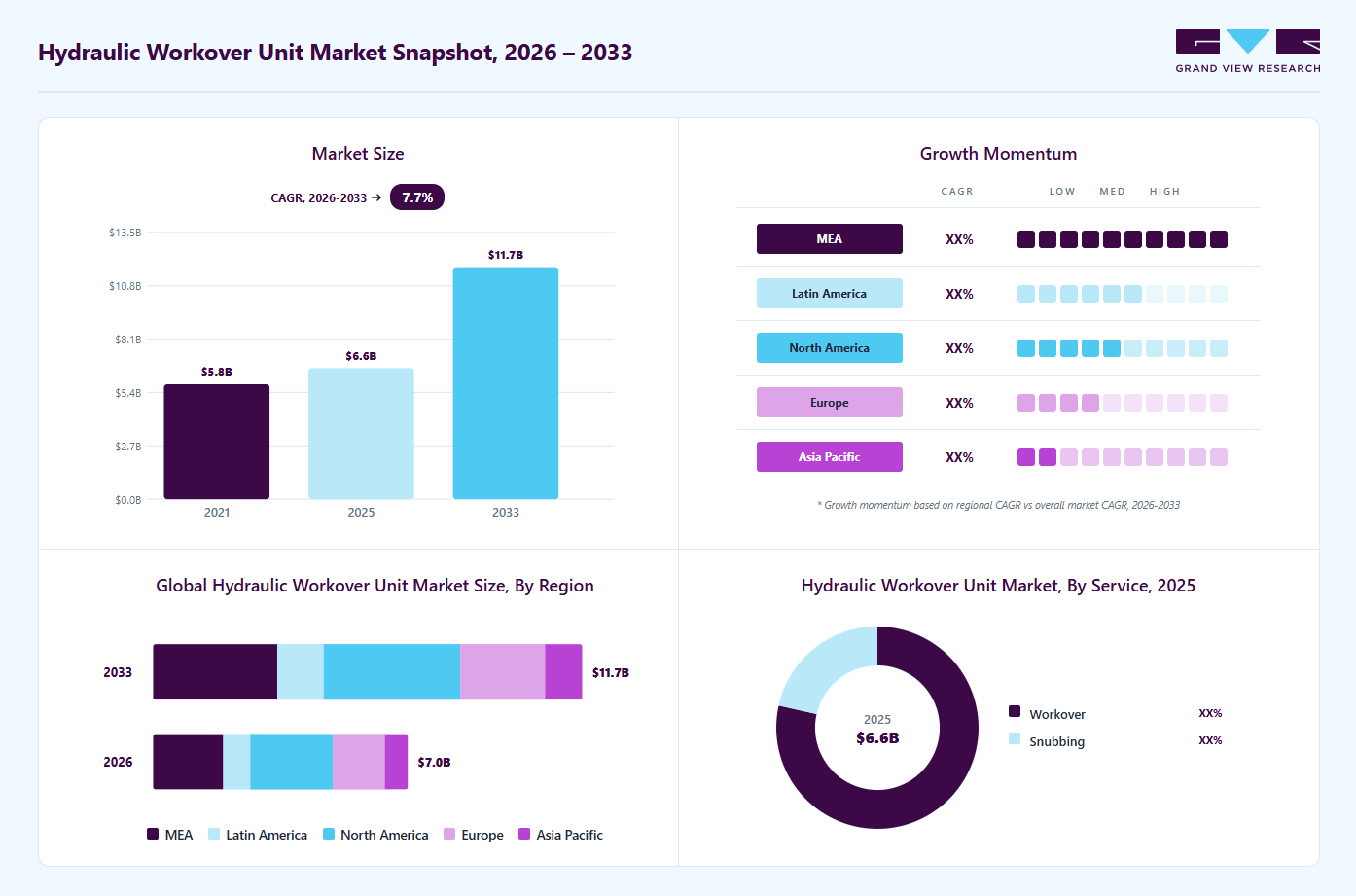
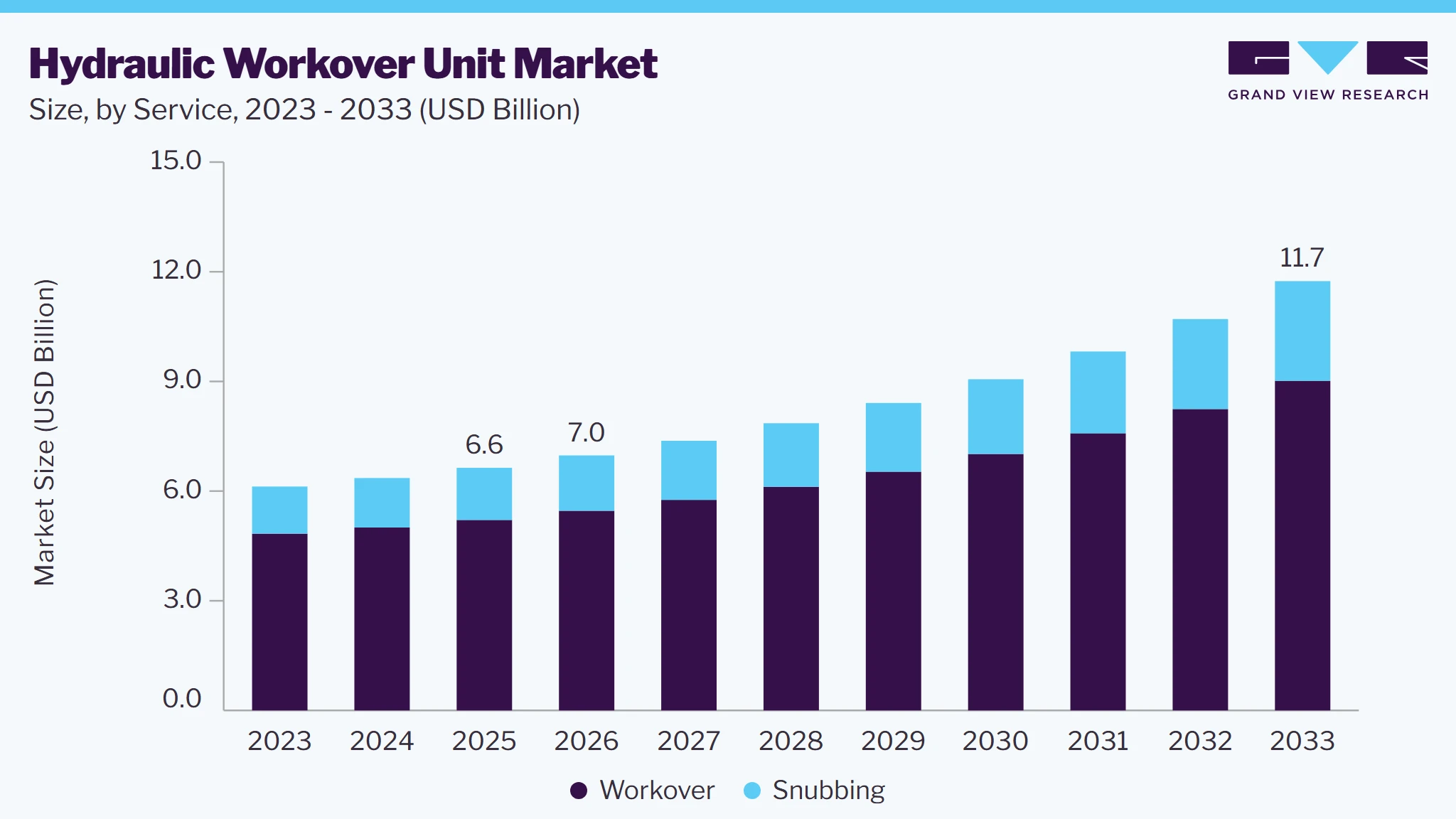
The global hydraulic workover unit market size was valued at USD 6.6 billion in 2025 and is projected to grow from USD 7.0 billion in 2026 to USD 11.7 billion by 2033, growing at a CAGR of 7.7% from 2026 to 2033. North America dominated the market with the largest revenue share of 32.6% in 2025. The hydraulic workover unit industry is driven primarily by the growing demand for efficient and cost-effective solutions in drilling, completing, and repairing wells, especially in the oil & gas industry.
Key Market Trends & Insights
- By service: Workover segment led the market with the largest revenue share of 78.5% in 2025.
- By installation: Skid mounted segment led the market with the largest revenue share of 60.4% in 2025.
- By capacity: Above 200 tons segment led the market with the largest revenue share of 58.6% in 2025.
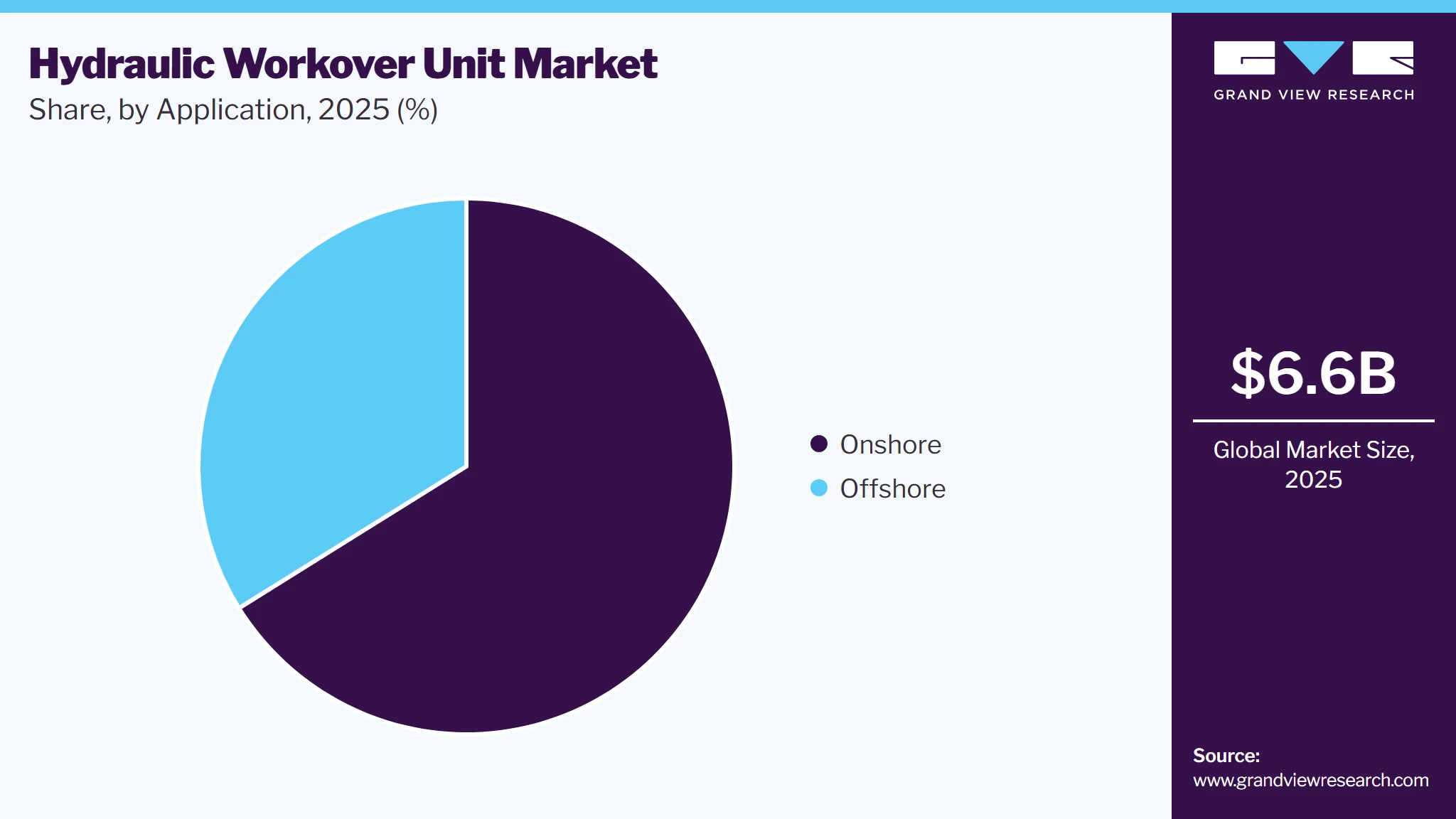
- By application: Onshore segment led the market with the largest revenue share of 66.1% in 2025.
Regional Highlights
- Largest regional market: North America (32.6% revenue share, 2025)
- By country: The U.S. held the largest market share in 2025.
Market Size & Forecast
- Market size in 2025: USD 6.6 Billion
- Estimated market size in 2026: USD 7.0 Billion
- Projected market size by 2033: USD 11.7 Billion
- CAGR (2026-2033): 7.7%
In addition, the integration of digital technologies, such as remote monitoring and automation, is improving operational efficiency and safety. The market is also witnessing a shift towards higher-capacity units, particularly in offshore applications, to meet the demands of deepwater drilling and complex well interventions. North America continues to be a leading market, with a significant share attributed to the proliferation of shale gas production and unconventional oil reserves.

Market Dynamics
The hydraulic workover unit (HWU) market is being driven by the growing need for cost-effective well intervention and maintenance operations across mature oil and gas fields. Operators are increasingly focusing on maximizing recovery from existing wells rather than investing solely in new drilling projects, creating sustained demand for hydraulic workover and snubbing services. The market is also benefiting from advancements in unit mobility, automation, and safety systems that enable efficient operations in both onshore and offshore environments. However, fluctuations in crude oil prices and capital spending cycles within the oil and gas industry continue to influence investment decisions and equipment utilization rates.
A significant portion of global oil and gas production comes from mature fields that require regular maintenance, recompletion, stimulation, and production enhancement activities to sustain output levels. Hydraulic workover units offer a cost-efficient alternative to conventional drilling rigs for performing these interventions, making them highly attractive to operators seeking to optimize field economics. As many producing wells age, the frequency of workover operations increases, directly contributing to demand for hydraulic workover services and equipment.
Furthermore, national oil companies and independent operators are increasingly prioritizing enhanced oil recovery and asset life-extension strategies to maximize returns from existing reservoirs. Hydraulic workover units facilitate tubing replacement, well repairs, zone isolation, and other critical interventions without requiring full-scale rig deployment. This capability reduces operational costs and downtime while improving well productivity, thereby strengthening market growth prospects.
The hydraulic workover unit market remains highly dependent on upstream oil and gas investment activity, which is significantly influenced by fluctuations in crude oil and natural gas prices. During periods of low commodity prices, operators often postpone non-essential maintenance, workover projects, and field redevelopment programs to preserve capital. Such spending reductions can lead to lower utilization rates for hydraulic workover units and create uncertainty for service providers and equipment manufacturers operating in the market.
Increasing focus on extending the productive life of offshore and marginal oil and gas fields presents a substantial opportunity for the hydraulic workover unit market. Many offshore assets require frequent intervention, well servicing, and production optimization activities to maintain economic viability. Hydraulic workover units provide a safer and more cost-effective solution for performing these operations compared to conventional rigs, particularly in space-constrained offshore environments. As operators seek to improve recovery rates from existing assets and reduce overall operating costs, demand for advanced hydraulic workover units with higher capacity and enhanced mobility is expected to increase significantly.
Analyst Perspective
The Hydraulic Workover Unit (HWU) market is witnessing steady growth driven by increasing well intervention activities, aging oil and gas infrastructure, and the need to enhance production from mature wells. Onshore applications continue to dominate due to the large number of active wells requiring maintenance and workover services, while offshore deployment is gaining traction with rising investments in offshore field redevelopment. Technological advancements in high-capacity and mobile hydraulic workover units are improving operational efficiency, safety, and cost-effectiveness, supporting market expansion across both conventional and unconventional hydrocarbon assets.
Service Insights
Based on service, workover segment led the market with the largest revenue share of 78.5% in 2025. The hydraulic workover unit industry for workover services has been witnessing notable growth, driven by the critical need for repair, maintenance, and enhancement of existing wells in the oil and gas sector. Workover services represent a significant segment of the market, given their essential role in extending the life of wells, increasing production, and ensuring operational safety and environmental compliance.
The snubbing services segment is anticipated to grow at the fastest CAGR during the forecast period, due to the rising demand for well intervention operations that require the handling of wellbore pressures. Snubbing services, a subset of workover operations involving the insertion or removal of tubing or tools from wells under pressure, increasingly rely on hydraulic workover units for their capability to safely and efficiently manage operations in live wells.
Installation Insights
Based on installation, skid mounted segment led the market with the largest revenue share of 60.4% in 2025. Skid-mounted hydraulic workover units are particularly valued for their ease of transportation and quick setup times, making them ideal for operations in remote or difficult-to-access locations. Their compact footprint allows for operations in limited space environments, which is a significant advantage in densely packed oil fields or when dealing with environmental and logistical constraints.
The hydraulic workover unit industry for trailer-mounted installations is experiencing substantial growth, which is primarily attributable to the mobility, versatility, and rapid deployment capabilities of these units. Trailer-mounted hydraulic workover units can be quickly transported to and from sites. These offer significant advantages for operations requiring swift responses, such as emergency well repairs, well deepening, and plug and abandonment activities.
Application Insights
Based on application, onshore segment led the market with the largest revenue share of 66.1% in 2025. The market is driven by the escalating demand for efficient and economical solutions for well maintenance, repair, and drilling operations in onshore oil & gas fields. This demand is further amplified by the continuous development of onshore resources and the need for sustainable production levels, especially in mature fields where enhancing the recovery of existing wells becomes crucial.
Hydraulic workover units, known for their versatility, mobility, and capability to operate under various well conditions, are increasingly preferred for onshore projects due to their ability to conduct operations quickly and safely, without the need for a full drilling rig setup. Their cost-effectiveness, combined with the ability to perform a wide range of workover and drilling tasks, makes them an attractive option for onshore operators looking to optimize production while adhering to stringent environmental and safety standards.
The hydraulic workover unit industry is experiencing robust growth in offshore applications, primarily fueled by the increasing complexity and depth of offshore oil and gas exploration and production activities. As offshore fields become more challenging, with operations often conducted in deeper waters and more demanding environments, the need for reliable, efficient, and flexible workover solutions has surged. Hydraulic workover units, with their compact size and capability to operate in a wide range of offshore platforms, including jack-ups, platforms, and floating production systems, offer a vital solution.
Capacity Insights
Based on capacity, above 200 tons segment led the market with the largest revenue share of 58.6% in 2025, primarily due to their optimal balance of power, versatility, and operational scope suited for a wide array of well intervention and workover applications. This capacity range is especially beneficial for medium to deep well operations, where more substantial lifting and pulling capabilities are required, but without the extensive footprint and logistics of larger units.
The below 150 tons segment is anticipated to grow at a significant CAGR during the forecast period, driven by their adaptability and efficiency in performing workovers, completions, and well interventions for shallow to medium-depth wells. These lighter units are particularly favored for their mobility, ease of transportation, and quick rig-up and rig-down capabilities, making them ideal for operations in constrained spaces and environments where a smaller operational footprint is required.
Regional Insights
North America dominated the hydraulic workover unit market with the largest revenue share of 32.6% in 2025. The North America market is experiencing robust growth, driven by the region's large oil & gas production, mainly in the U.S. and Canada. North America, home to some of the world's largest and most productive oil and gas fields, including the Permian Basin, Eagle Ford Shale, and the Western Canadian Sedimentary Basin, significantly contributes to the demand for hydraulic workover units. These units are crucial for well maintenance, completion, and intervention operations, catering to both conventional and unconventional resources.

U.S. Hydraulic Workover Unit Market
The hydraulic workover unit market in the U.S. held the largest share in the North America region in 2025. The U.S. remains a dominant player in the North America market, driven by extensive shale oil and gas production. Operators increasingly favor modular and high-capacity HWUs for efficient well interventions in unconventional reservoirs. Technological innovations, such as automation and digital monitoring, are enhancing operational efficiency and safety.
The Canada hydraulic workover unit market is expected to grow at a significant CAGR of 5.6% from 2026 to 2033. The Canada market is characterized by a strong emphasis on environmental sustainability and regulatory compliance. Operators are adopting eco-friendly and energy-efficient HWUs to align with stringent environmental standards.
Europe Hydraulic Workover Unit Market Trends
The hydraulic workover unit market in Europe is influenced by the need to enhance production from mature and aging oilfields. Operators are investing in advanced HWUs equipped with real-time monitoring systems and automation to optimize well interventions. Countries like Germany are leading in integrating eco-friendly technologies, ensuring compliance with the EU's stringent environmental regulations.
The Germany hydraulic workover unit marketis driven by technological innovation and a strong commitment to environmental sustainability. Operators are focusing on developing HWUs that are both efficient and environmentally friendly, incorporating advanced monitoring systems to enhance operational performance. The emphasis on reducing emissions and energy consumption aligns with Germany's stringent environmental policies.
The hydraulic workover unit market in the UK is driven by the need to maximize production from its North Sea oilfields. Operators are increasingly adopting high-capacity HWUs capable of handling complex well interventions. The focus is on enhancing operational efficiency and safety, with a growing trend towards automation and digitalization in workover operations.
Asia Pacific Hydraulic Workover Unit Market Trends
The hydraulic workover unit market in the Asia Pacific is anticipated to grow at a significant CAGR during the forecast period, fueled by increasing energy demand and expanding oil and gas exploration activities. Countries like China and India are investing in advanced HWUs to optimize production from mature and offshore oilfields. The adoption of modular and high-capacity units is on the rise, catering to the diverse operational needs of the region.
The China hydraulic workover unit market held a significant share in the Asia Pacific region. The market is driven by the country's focus on enhancing production from its offshore and onshore oilfields. Operators are investing in high-capacity HWUs capable of handling complex well interventions in high-pressure environments. The emphasis is on reducing reliance on imported equipment by developing indigenous manufacturing capabilities, aligning with the government's 'Made in China' initiative.
The hydraulic workover unit market in India is expected to grow at the fastest CAGR of 6.5% from 2025 to 2030. The India market is witnessing growth due to increased offshore exploration and production activities. Collaborations with foreign partners are enhancing technological capabilities, leading to the development of adaptable and efficient HWUs.
Middle East & Africa Hydraulic Workover Unit Market Trends
The hydraulic workover unit market in the Middle East & Africa is experiencing significant growth, driven by increasing production from mature oilfields and the need for enhanced oil recovery (EOR) techniques. Countries like Saudi Arabia are investing in high-capacity HWUs to optimize well interventions and maximize production. The market is characterized by a growing demand for modular and mobile units that offer flexibility and reduced rig-up times.
The Saudi Arabia hydraulic workover unit market is influenced by the country's vast oil reserves and ongoing exploration and production activities. Operators are focusing on deploying advanced HWUs capable of handling complex well interventions in both onshore and offshore fields. The emphasis is on enhancing operational efficiency and safety, with a growing trend towards automation and digitalization in workover operations.
Latin America Hydraulic Workover Unit Market Trends
The hydraulic workover unit market in Latin America is driven by the need to enhance production from mature oilfields and deepwater reserves. Countries like Brazil are investing in high-capacity HWUs to optimize well interventions in challenging offshore environments. The market is characterized by a growing demand for modular and mobile units that offer flexibility and reduced rig-up times.
The Brazil hydraulic workover unit market is expanding due to the country's focus on deepwater oil exploration and production. Operators are adopting advanced HWUs capable of handling complex well interventions in ultra-deepwater fields. The emphasis is on enhancing operational efficiency and safety, with a growing trend towards automation and digital monitoring in workover operations.
Key Hydraulic Workover Unit Market Company Insights
Some of the key players operating in the hydraulic workover unit industry include Halliburton, National Oilwell Varco, Archer, and Cudd Energy Services.
-
Halliburton is engaged in the business of providing products and services to the energy industry, with a significant presence in the hydraulic workover unit (HWU) industry. Hydraulic workover units offered by Halliburton are part of its Production Enhancement segment, showcasing the company's emphasis on improving operational efficiencies and reservoir performance. These units are designed to perform a wide range of operations, allowing for workover operations without the need for a conventional rig.
-
Cudd Energy Services, a leading service provider in the oil and gas industry, offers a broad range of specialized solutions, including hydraulic workover operations. As a division of RPC, Inc., Cudd Energy Services has established a strong presence in the hydraulic workover unit (HWU) market, serving clients across various geographical regions.
High Arctic Energy Services Inc., Basic Energy Services, and Superior Energy Services are some of the emerging market participants in the hydraulic workover unit industry.
-
High Arctic Energy Services Inc. is known for providing specialized oilfield equipment and services to the natural gas and oil industries. Established and having built a reputation over the years, High Arctic operates primarily in Canada and Papua New Guinea. In Canada, the company's services revolve around the provision of drilling support and production services, including snubbing services (a method of performing work on oil and gas wells), hydraulic workover, nitrogen services, and equipment rentals.
-
Basic Energy Services dedicated its operations to a broad spectrum of services critical to the daily functions and operational efficiency of oil and gas exploration and production. These services encompass well servicing, which includes maintenance, repair, and completion of wells, in addition to fluid services that ensure the appropriate transportation, storage, and disposal of the fluids used in or produced by drilling and completion processes.
Key Hydraulic Workover Unit Companies:
The following key companies have been profiled for this study on the hydraulic workover unit market.
-
Halliburton
-
National Oilwell Varco
-
Archer
-
Cudd Energy Services
-
Precision Drilling Corporation
-
High Arctic Energy Services Inc.
-
Basic Energy Services
-
Superior Energy Services
-
Velesto Energy
-
Canadian Energy Equipment Manufacturing FZE
-
PT Elnusa Tbk
-
Uzma Berhad
-
ZYT Petroleum Equipment Co., Ltd
Competitive Benchmarking
Category
Operating Strategies
Competitive Edge
Weakness
Established Players (e.g., Halliburton, National Oilwell Varco, Archer, Precision Drilling Corporation, Superior Energy Services, Velesto Energy)
- Focus on providing integrated hydraulic workover, snubbing, and well intervention services across major oil and gas producing regions.
- Invest in high-capacity hydraulic workover units, automation technologies, and digital monitoring systems to improve operational efficiency and safety.
- Strong global customer base and long-term relationships with national and international oil companies.
- Extensive equipment fleets, technical expertise, and ability to execute complex onshore and offshore well intervention projects.
- High capital expenditure and fleet maintenance costs can impact profitability during industry downturns.
- Significant dependence on upstream oil and gas investments, making revenues vulnerable to commodity price fluctuations.
Emerging & Regional Players (e.g., Cudd Energy Services, High Arctic Energy Services Inc., Basic Energy Services, Canadian Energy Equipment Manufacturing FZE, PT Elnusa Tbk, Uzma Berhad)
- Concentrate on regional markets and specialized well intervention services tailored to local operator requirements.
- Expand market presence through strategic partnerships, localized service networks, and cost-effective equipment offerings.
- Strong regional expertise and ability to respond quickly to customer needs in specific operating environments.
- Competitive pricing structures and flexible service models that appeal to independent and mid-sized oil and gas operators.
- Limited international footprint and smaller hydraulic workover fleets compared to established multinational competitors.
- Lower investment capacity for advanced technology development, large-scale expansion, and offshore project participation.
Recent Developments
-
In April 2025, Boots & Coots International Well Control signed a three-year contract, with a two-year extension option, with Algeria's Sonatrach to provide hydraulic workover/snubbing services. Worth USD 28 million, this contract adds to the company’s existing agreements in Algeria and includes deploying two additional 150K hydraulic workover units. Operations are expected to begin in Q4 2025.
-
In April 2024, PV Drilling signed a contract to purchase a new hydraulic workover unit (HWU), marking a key move for its business. This acquisition will enable PV Drilling to expand into workover and P&A programs while integrating additional services from its subsidiaries, including wireline, casing/tubing running, and coil tubing. The goal is to enhance the value chain, offering clients high-quality services at competitive prices.
-
In March 2023, EEST Energy Services (Thailand), a leading offshore contractor and service provider operating globally, has been awarded a contract valued at USD 9 million by Hibiscus Petroleum Berhad, Malaysia. The contract encompasses the delivery of services for well workover/replacement and well plugging and abandonment. These services will be carried out employing the EEST-502 hybrid hydraulic conversion unit, showcasing the innovative solutions EEST Energy Services brings to the industry.
Hydraulic Workover Unit Market Report Scope
Report Attribute
Details
Market size in 2025
USD 6.6 billion
Estimated market size in 2026
USD 7.0 billion
Projected market size by 2033
USD 11.7 billion
Growth rate
CAGR of 7.7% from 2026 to 2033
Base year for estimation
2025
Historical data
2021 - 2024
Forecast period
2026 - 2033
Quantitative units
Revenue in USD billion and CAGR from 2026 to 2033
Report coverage
Revenue forecast, company ranking, competitive landscape, growth factors, and trends
Segments covered
Service, installation, application, capacity, region.
Regional scope
North America; Europe; Asia Pacific; Latin America; Middle East & Africa
Country scope
U.S.; Canada; Mexico; Russia; Norway; UK; Netherlands; Germany; China; Japan; India; Indonesia; Brazil; Argentina; Kuwait; Saudi Arabia; UAE; Nigeria; Iraq; Qatar
Key companies profiled
Halliburton; National Oilwell Varco; Archer, Cudd Energy Services; Precision Drilling Corporation; High Arctic Energy Services Inc.; Basic Energy Services; Superior Energy Services; Velesto Energy; Canadian Energy Equipment Manufacturing FZE; PT Elnusa Tbk; Uzma Berhad; ZYT Petroleum Equipment Co., Ltd
Customization scope
Free report customization (equivalent up to 8 analysts' working days) with purchase. Addition or alteration to country, regional & segment scope.
Pricing and purchase options
Avail customized purchase options to meet your exact research needs. Explore purchase options
Global Hydraulic Workover Unit Market Report Segmentation
This report forecasts revenue growth at global, regional & country levels and provides an analysis on the industry trends in each of the sub-segments from 2021 to 2033. For this study, Grand View Research has segmented the global hydraulic workover unit market report based on the service, Installation, application, capacity, and region.
-
Service (Revenue, USD Million, 2021 - 2033)
-
Workover
-
Snubbing
-
-
Installation (Revenue, USD Million, 2021 - 2033)
-
Skid Mounted
-
Trailer Mounted
-
-
Application Outlook (Revenue, USD Million, 2021 - 2033)
-
Offshore
-
Onshore
-
-
Capacity (Revenue, USD Million, 2021 - 2033)
-
Below 150 Tons
-
151 - 200 Tons
-
Above 200 Tons
-
-
Regional Outlook (Revenue, USD Million, 2021 - 2033)
-
North America
-
U.S.
-
Canada
-
Mexico
-
-
Europe
-
Russia
-
Norway
-
UK
-
Netherlands
-
Germany
-
-
Asia Pacific
-
Japan
-
China
-
India
-
Indonesia
-
-
Latin America
-
Brazil
-
Argentina
-
-
Middle East & Africa
-
Kuwait
-
Saudi Arabia
-
UAE
-
Nigeria
-
Iraq
-
Qatar
-
-
Research Methodology
The hydraulic workover unit market figures in this report are based on a proven research process that combines executive interviews with secondary research from proprietary databases, company filings, and recognized regulatory and institutional sources. Market size is built through value-chain sizing - reconciling supply-side and demand-side estimates - and triangulated with bottom-up and top-down approaches. Every estimate passes multiple levels of expert validation before publication, with each hydraulic workover unit segment quantified using the revenue-capture definitions in the table below.
Segment Definition
Service
Revenue Capture Definition
Workover
Revenue generated from the sale of new hydraulic workover units designed to perform well maintenance, tubing installation and retrieval, well completion, recompletion, well repair, and production enhancement operations in oil and gas wells.
Snubbing
Revenue generated from the sale of new hydraulic snubbing units designed to run or pull tubulars under live well pressure conditions without killing the well, enabling safe intervention in pressurized wells.
Installation
Revenue Capture Definition
Skid Mounted
Revenue generated from the sale of new skid-mounted hydraulic workover units designed for fixed-location applications, offshore platforms, and locations requiring modular equipment configurations.
Trailer Mounted
Revenue generated from the sale of new trailer-mounted hydraulic workover units designed for enhanced mobility and rapid deployment across multiple onshore oil and gas well sites.
Application
Revenue Capture Definition
Offshore
Revenue generated from the sale of new hydraulic workover units intended for deployment on offshore oil and gas platforms, floating production facilities, and offshore well intervention operations.
Onshore
Revenue generated from the sale of new hydraulic workover units intended for use in land-based oil and gas fields, including conventional, unconventional, and mature well intervention applications.
Capacity
Revenue Capture Definition
Below 150 Tons
Revenue derived from hydraulic workover units with lifting and pulling capacities below 150 tons, primarily used for light-duty well servicing, maintenance, and intervention applications.
151 - 200 Tons
Revenue generated from medium-capacity hydraulic workover units with lifting capacities ranging from 151 to 200 tons, serving a broad range of workover and snubbing operations.
Above 200 Tons
Revenue captured from high-capacity hydraulic workover units exceeding 200 tons, utilized for complex, deep-well, high-pressure, and heavy-duty intervention operations in both onshore and offshore environments.
Estimation Model
Layer Name
Key Question
Description
Well Intervention Demand Assessment
How many oil and gas wells require workover, snubbing, and maintenance activities annually?
Estimates the addressable market by analyzing active wells, aging well inventories, mature field production, and intervention frequency across onshore and offshore assets.
Hydraulic Workover Unit Deployment Analysis
What proportion of intervention activities utilize hydraulic workover units?
Evaluates the penetration of hydraulic workover units based on well conditions, operational efficiency, safety requirements, and regional adoption trends.
Equipment Configuration & Capacity Adoption Layer
Which hydraulic workover unit configurations are being deployed?
Apply adoption rates based on well depth, pressure requirements, field maturity, mobility needs, and operating environment. Skid-mounted systems account for a significant share of deployments due to their operational flexibility in intervention projects.
Revenue Estimation & Market Validation
What is the total revenue generated by the hydraulic workover unit market?
Estimate annual hydraulic workover unit sales by capacity, configuration, and region. Quantify market revenues generated from the sale of new hydraulic workover units deployed across oil & gas fields.
Delivered Customizations
This report has been delivered with the following In-depth customizations
Client Request
Customization Delivered
Value Adds
Technology and Market Opportunity Assessment
Included evaluation of advancements in hydraulic workover equipment, automation systems, high-capacity units, safety enhancements, and emerging opportunities in unconventional and offshore well intervention markets.
Supported long-term business planning by identifying technology-driven growth areas, innovation opportunities, and future revenue generation prospects.
Competitive Landscape and Market Participant Assessment
Provided detailed profiling and benchmarking of leading and emerging companies, including market participant categorization, strategic analysis, competitive positioning, operational strengths, and market challenges.
Assisted stakeholders in evaluating competitive intensity, partnership opportunities, acquisition targets, and regional expansion strategies.
Regional Demand and Industry Trend Evaluation
Delivered in-depth analysis of regional well intervention activities, mature field redevelopment trends, offshore production growth, and hydraulic workover unit adoption patterns across major oil-producing regions.
Offered actionable insights into geographic growth opportunities, customer demand dynamics, and future market expansion potential for strategic planning.
Frequently Asked Questions About This Report
North America dominated the market with the largest revenue share of 32.6% in 2025.
Some of the key players operating in the hydraulic workover unit market include Halliburton, National Oilwell Varco, Archer, Cudd Energy Services, Precision Drilling Corporation, High Arctic Energy Services Inc., Basic Energy Services, Superior Energy Services, Velesto Energy, Canadian Energy Equipment Manufacturing FZE, PT Elnusa Tbk, Uzma Berhad, ZYT Petroleum Equipment Co., Ltd
The demand for the hydraulic workover unit market is attributed to the growing demand for efficient and cost-effective solutions in drilling, completing, and repairing wells, especially in the oil and gas industry.
The Middle East & Africa is anticipated to be one of the fastest-growing regional markets over the forecast period, driven by increasing upstream investments, growing well intervention activities, and expanding oilfield development projects.
The workover segment led the market with the largest revenue share of 78.5% in 2025.
The skid mounted segment accounted for the largest revenue share of 60.4% in 2025.
The onshore segment accounted for the largest revenue share of 66.1% in 2025.
The global hydraulic workover unit market size was estimated at USD 6.6 billion in 2025 and is expected to be USD 7.0 billion in 2026.
The global hydraulic workover unit market, in terms of revenue, is expected to grow at a compound annual growth rate of 7.7% from 2026 to 2033 to reach USD 11.7 billion by 2033.
About the Author(s)
Advanced Interior Materials Research Team
Advanced Materials · Advanced Interior MaterialsThis report was authored by the advanced interior materials research team at Grand View Research - comprising two research analysts, one senior research analyst, and one industry expert - with specialized expertise in the advanced interior materials segment of the advanced materials industry. All findings are based on proprietary advanced materials databases, executive interviews, and regulatory analysis, subject to internal peer review prior to publication.
Last Updated:
Speak to Analyst


Customize this report to your needs — add regions, segments, or data points, with 20% free customization.
Or view our licence options:


ISO 9001:2015 & 27001:2022 Certified
We are GDPR and CCPA compliant! Your transaction & personal information is safe and secure. For more details, please read our privacy policy.


