
- Home
- »
- Water & Sludge Treatment
- »
-
Hydrochloric Acid Market Size & Share Report, 2026-2033GVR Report cover

Hydrochloric Acid Market (2026 - 2033)
Size, Share & Trends Analysis Report By Grade (Industrial, Concentrated, Ultra-high Purity), By End-use (Chemical, Food & Beverages, Oil and Gas, Steel and Metallurgy), By Region, And Segment Forecasts
Market Size, 2025
$2.0BMarket Estimate, 2026
$2.1BMarket Forecast, 2033
$3.0BCAGR, 2026–2033
5.4%Hydrochloric Acid Market Summary
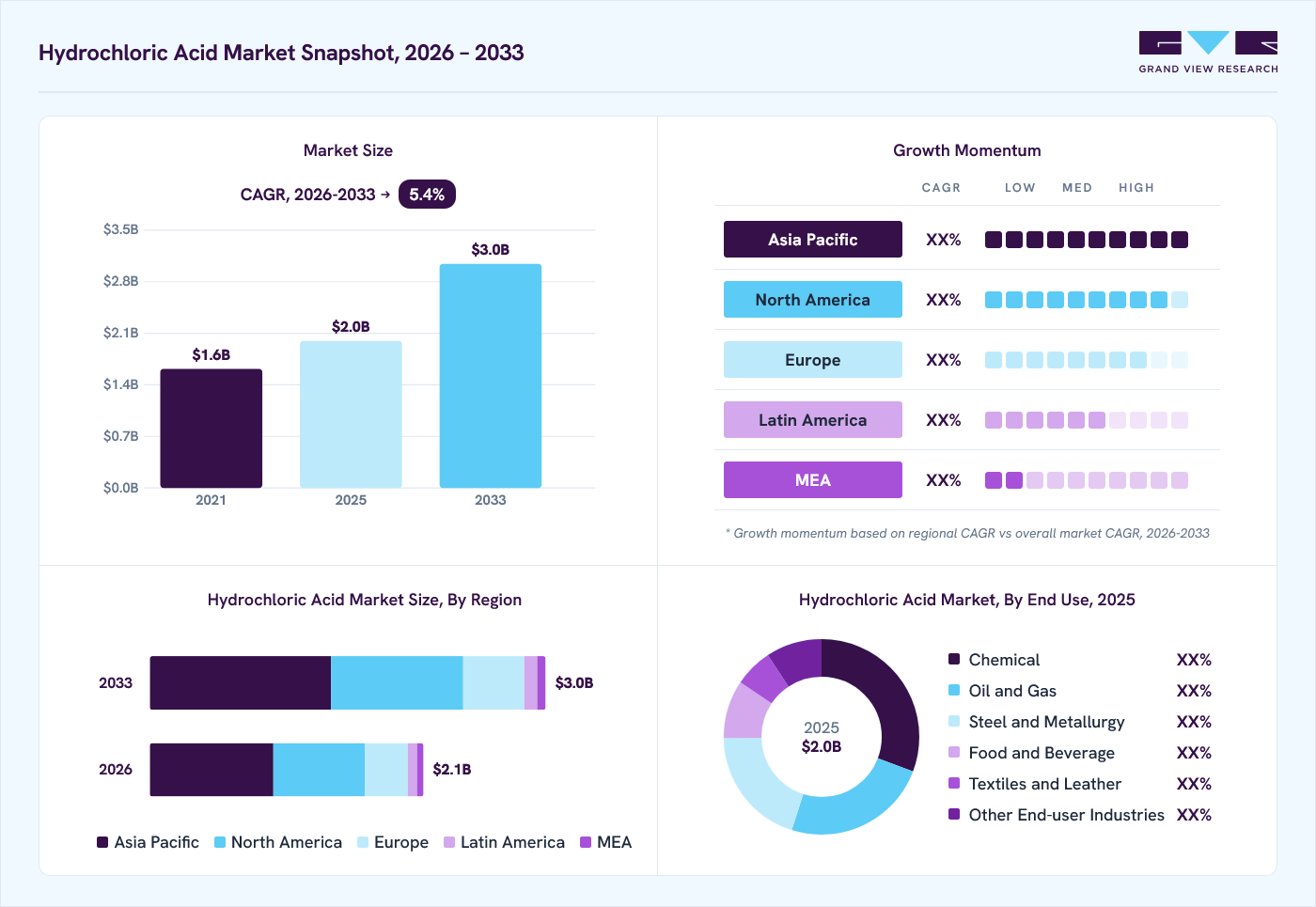
The global hydrochloric acid market size was valued at USD 2.0 billion in 2025 and is projected to grow from USD 2.1 billion in 2026 to USD 3.0 billion in 2033, at a CAGR of 5.4% from 2026 to 2033. Asia Pacific dominated the market, accounting for a revenue share of 45.1% in 2025. The global market growth is supported by the increasing consumption of hydrochloric acid in industrial and chemical processing applications, particularly for metal pickling and surface treatment, pH control, ore processing, chlor-alkali production, water treatment, and the manufacture of chemicals such as chlorides, vinyl chloride, and calcium chloride across steel, chemicals, mining, water treatment, and other industrial sectors.
 Source: Grand View Research, IR Documents, Primary Interviews, Paid DatabasesTo learn more about this report,
 Download Free Sample Report
Key Market Trends & Insights
- By grade: Industrial segment held the largest revenue share of 46.7% in 2025.
- By end use: Food and beverage segment is expected to grow at the fastest CAGR of 5.9% from 2026 to 2033.
Regional Highlights
- Largest regional market: Asia Pacific (45.1%, revenue share, 2025)
- By country: China held the largest revenue share in 2025
Market Size & Forecast
- Market size in 2025: USD 2.0 Billion
- Estimated market size in 2026: USD 2.1 Billion
- Projected market size by 2033: USD 3.0 Billion
- CAGR (2026-2033): 5.4%
Three ways to get this report
Buy it, customize it, or ask a question.Ask an Analyst
Analyst response in 1 business day
- AccessReport author, directly
- Reply timeWithin 1 working day
- No sales callDirect answer only
- FormatEmail reply
- CostFree, no cost
Get the Full Report
What the study covers
- FormatsPDF · Excel · Dashboard
- Timeline2026–2033 annual, 2025 base
- Coverage20+ countries, 5 regions
- Companies10+ key players profiled
Customize the Report
20% free customization
- IncludeCountries, segments, points
- TailorTo your product definition
- ExtendDeeper competitor detail
- OrA fully bespoke study
- Turnaround5–10 working days
Growth is supported by the increasing consumption of hydrochloric acid across steel pickling, chemical manufacturing, water treatment, mining, oil and gas, and other industrial applications. Hydrochloric acid is widely used for removing scale and oxides from steel surfaces, adjusting pH, regenerating ion-exchange resins, processing ores, and producing chlorides and other chemical intermediates.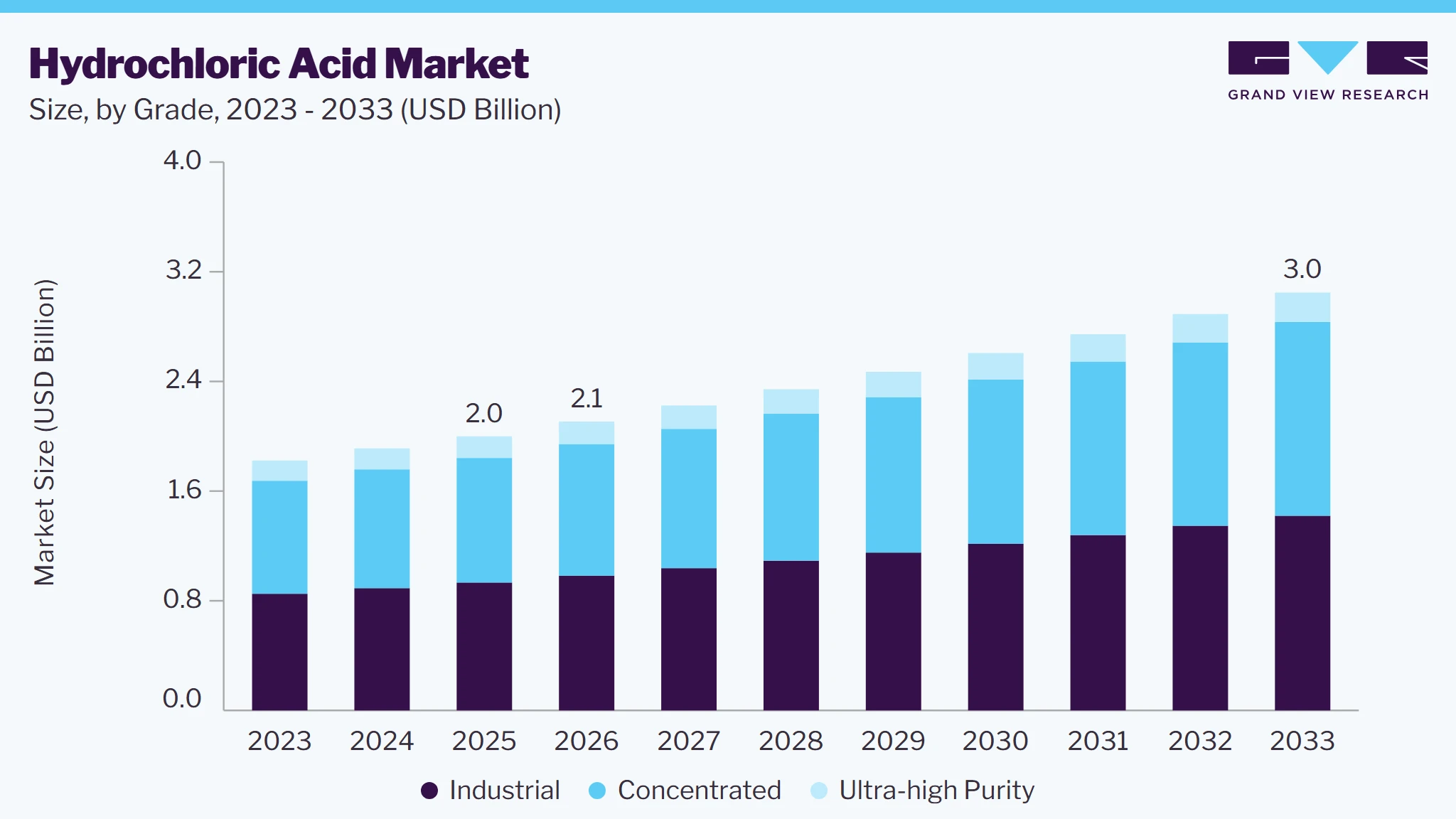 To learn more about this report, Download Free Sample Report
Market Dynamics
The hydrochloric acid market is supported by its widespread use as a process chemical across steel pickling, chemical manufacturing, oil and gas, water treatment, mining, food processing, and other industrial applications. Hydrochloric acid is used to remove oxides and scale from steel surfaces, regulate pH, produce inorganic and organic chlorides, regenerate ion-exchange resins, and process mineral ores. Demand is also influenced by industrial production levels, infrastructure development, chemical manufacturing capacity, and the expansion of water and wastewater treatment activities.
Growing steel production and the continued use of hydrochloric acid for surface treatment are key drivers of the hydrochloric acid market. HCl is widely used in steel pickling to remove rust, scale, and other surface impurities before downstream processes such as galvanizing, coating, and fabrication. The increasing need for treated steel products in construction, automotive, machinery, energy infrastructure, and other manufacturing industries supports the consumption of hydrochloric acid in metal-processing operations.
The adoption of hydrochloric acid-based pickling processes is also supported by the need for effective surface cleaning and preparation before subsequent coating or forming operations. Expansion of steel-processing capacity, particularly in regions with growing manufacturing activity, therefore contributes to demand for industrial-grade hydrochloric acid.
The highly corrosive nature of hydrochloric acid poses challenges for storage, transportation, handling, and workplace safety. Producers and industrial users require corrosion-resistant equipment, specialized storage systems, adequate ventilation, and safety measures to minimize exposure risks and prevent equipment damage. These requirements can increase operating and infrastructure costs, particularly for smaller industrial users.
Stringent environmental, occupational health, transportation, and chemical-handling requirements can further raise compliance costs. In addition, hydrochloric acid must generally be transported over relatively short distances or through specialized logistics systems because of its hazardous and corrosive characteristics, which can limit economical distribution across distant markets.
Increasing investment in municipal and industrial water treatment infrastructure presents an opportunity for hydrochloric acid manufacturers. Hydrochloric acid is used for pH adjustment, neutralization, regeneration of ion-exchange resins, and treatment processes involving alkaline water streams. Growing industrial activity is increasing the need for wastewater treatment in sectors such as chemicals, metals, food processing, power generation, and manufacturing.
The expansion of water reuse, industrial wastewater management, and treatment infrastructure in developing markets can further increase demand for hydrochloric acid. Manufacturers with reliable supply networks and consistent industrial-grade quality can benefit from rising consumption across decentralized and large-scale water treatment facilities.
Market Concentration & Characteristics
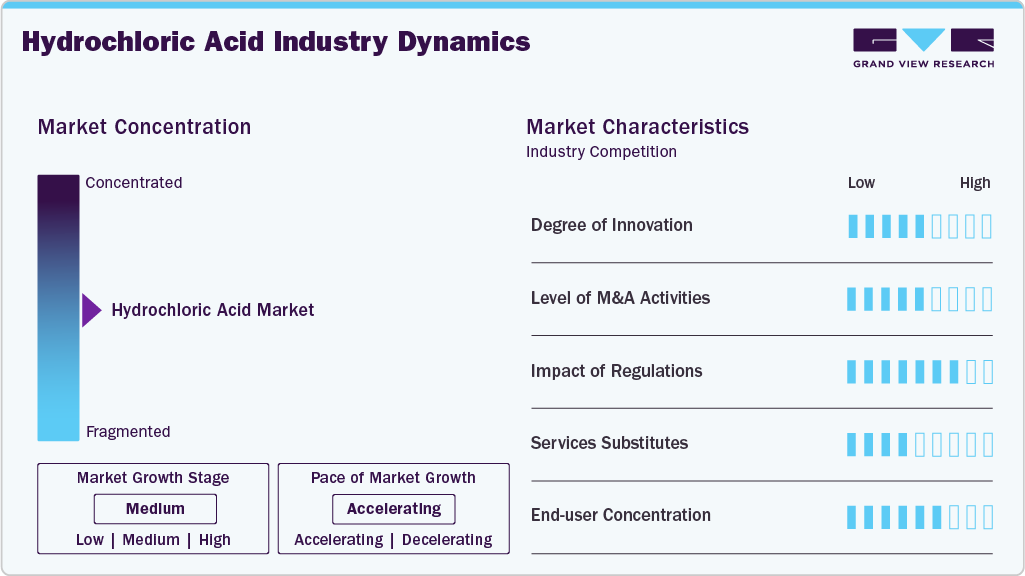
The hydrochloric acid market includes large chlor-alkali producers, integrated chemical manufacturers, regional producers, and specialized industrial chemical suppliers. Competitive positioning is influenced by product concentration and quality, production capacity, feedstock availability, plant location, logistics efficiency, supply reliability, and pricing. Because hydrochloric acid is frequently consumed close to the point of production, geographic proximity to major industrial customers is an important competitive factor. Market participants focus on expanding production capacity, improving chlor-alkali integration, optimizing transportation and storage infrastructure, and securing long-term supply relationships with industrial users. Demand conditions in steel processing, chemical manufacturing, water treatment, mining, and other end-use industries influence regional consumption, while transportation constraints and the corrosive nature of HCl contribute to the importance of localized supply networks.
 To learn more about this report, Download Free Sample Report
Leading hydrochloric acid producers are strengthening their market positions through production capacity expansions, chlor-alkali integration, supply agreements, distribution network development, and investments in production and storage infrastructure. Companies are also focusing on improving manufacturing efficiency, securing reliable chlorine and hydrogen feedstock, optimizing transportation, and maintaining consistent product quality for applications such as steel pickling, chemical manufacturing, water treatment, mining, and oil and gas processing.
Analyst Perspective
The hydrochloric acid market is supported by its extensive use as a process chemical across steel pickling, chemical manufacturing, water treatment, mining, and other industrial applications. Demand is closely linked to steel production and metal surface treatment, where hydrochloric acid is used to remove scale and oxides before downstream processing. Growing chemical manufacturing capacity, expansion of industrial and municipal water treatment, and increasing mineral processing activity are creating additional consumption opportunities. At the same time, the corrosive and hazardous nature of hydrochloric acid places greater emphasis on safe handling, specialized storage, transportation infrastructure, and reliable regional supply networks. These factors are shaping competition and influencing investment decisions across the hydrochloric acid value chain.
Grade Insights
The industrial segment dominated the hydrochloric acid market, accounting for 46.7% of total revenue in 2025, driven by its extensive use in steel pickling, metal surface treatment, chemical processing, mining, water treatment, and other industrial operations. Its broad applicability across manufacturing and process industries supports consistent demand for industrial-grade hydrochloric acid.
The concentrated segment is expected to grow at the fastest CAGR of 5.7% during the forecast period. The growth of the segment is supported by demand from chemical manufacturing, metal processing, mining, and other applications where higher acid concentration is required for efficient processing, reaction control, and material treatment.
End Use Insights
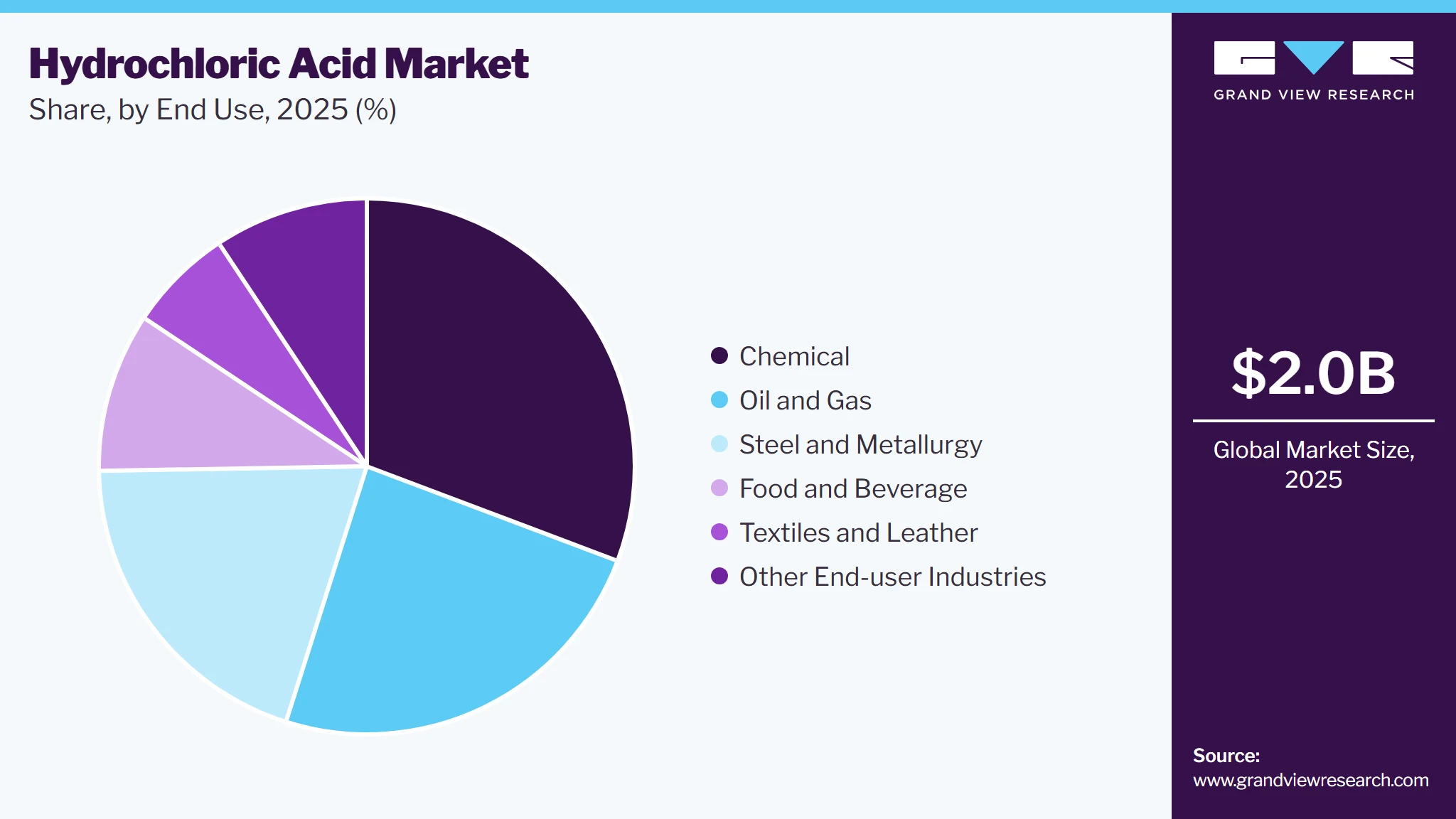
The chemical segment dominated the hydrochloric acid industry, accounting for 30.7% of total revenue in 2025, supported using hydrochloric acid in the production of chlorides and other chemical intermediates, pH adjustment, chemical synthesis, and process operations. Expansion of chemical manufacturing capacity and increasing industrial chemical consumption are supporting demand from this end-use segment.
 To learn more about this report, Download Free Sample Report
The food and beverage segment is expected to grow at the fastest CAGR of 5.9% during the forecast period.Hydrochloric acid is used in selected food-processing applications, including pH adjustment, ingredient processing, and gelatin production, while rising processed-food production and demand for standardized processing operations are supporting segment growth.
Regional Insights
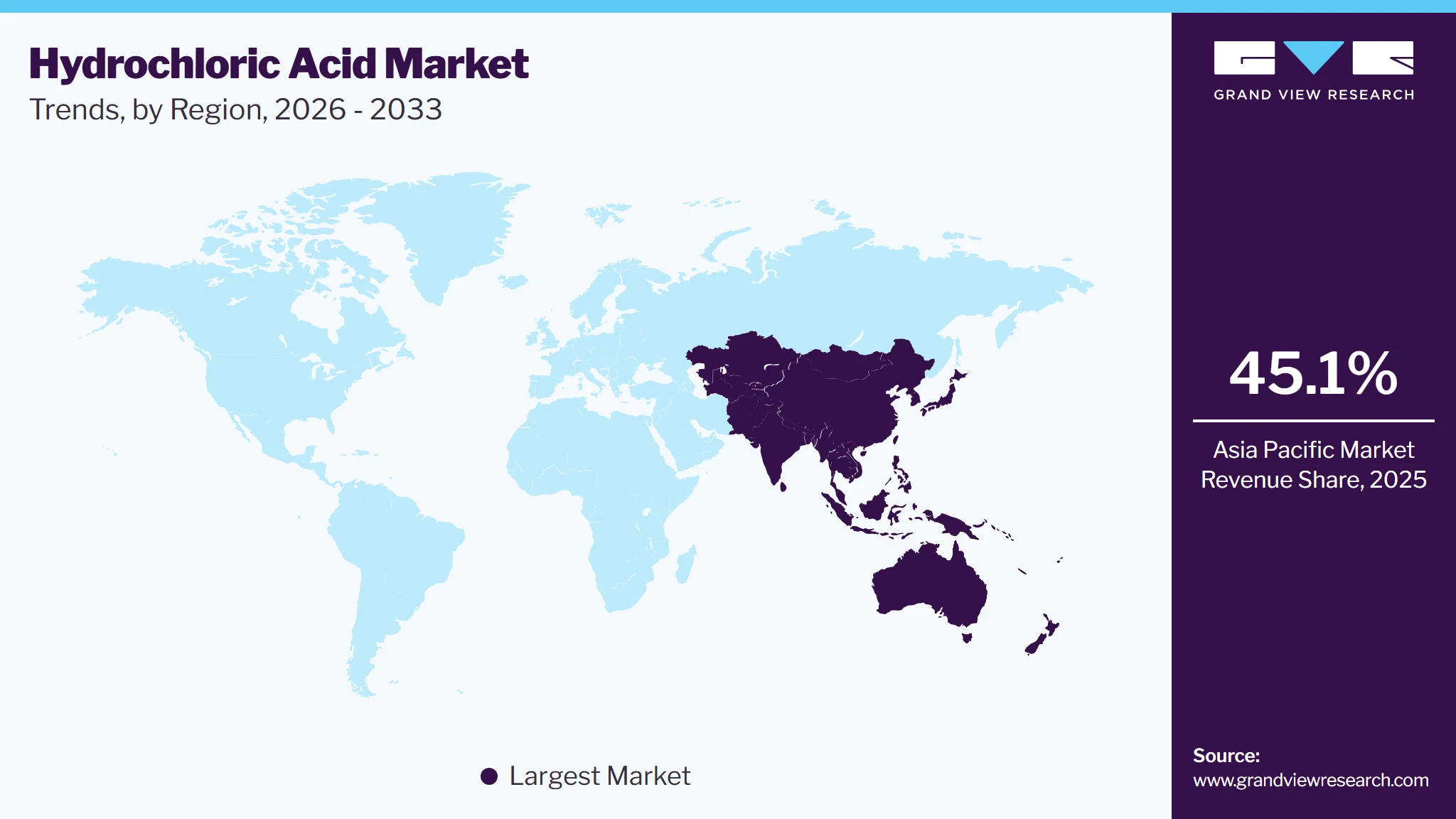
Asia Pacific dominated the hydrochloric acid market with a 45.1% revenue share in 2025, supported by large-scale chemical manufacturing, steel production, metal processing, mining, and water treatment activities across the region. China, India, Japan, and South Korea have established chemical and manufacturing bases that support substantial consumption of hydrochloric acid, while continued industrial capacity expansion and infrastructure development are sustaining demand across major end-use industries.
 To learn more about this report, Download Free Sample Report
China Hydrochloric Acid Market Trends
The China hydrochloric acid market is significant in Asia Pacific, with its growth driven by its extensive chemical manufacturing, steel processing, mining, and industrial production base. Hydrochloric acid is widely consumed in steel pickling, chemical synthesis, chlorides production, and water treatment, while the country's integrated chlor-alkali industry provides an important source of supply. Continued investment in industrial production and chemical processing capacity is supporting regional consumption.
North America Hydrochloric Acid Market Trends
The North America hydrochloric acid industry is driven by demand from chemical manufacturing, oil and gas, steel processing, water treatment, and mining applications. The region benefits from established chlor-alkali production capacity and extensive industrial infrastructure, while hydrochloric acid consumption is influenced by activity in energy production, metal processing, and chemical manufacturing. Demand for acidizing and well-treatment applications in the oil and gas industry also contributes to regional consumption.
The U.S. is a major hydrochloric acid industry in North America, with demand supported by chemical manufacturing, oil and gas well stimulation, steel pickling, water treatment, and industrial processing. The country's developed chlor-alkali production base provides domestic hydrochloric acid supply, while shale oil and gas activity creates demand for HCl in well completion and stimulation operations. Industrial water treatment and metal-processing activities provide additional consumption opportunities.
Europe Hydrochloric Acid Market Trends
The Europe hydrochloric acid industry is supported by chemical processing, steel production, water treatment, pharmaceuticals, food processing, and other industrial applications. Demand is influenced by the region's established chemical and manufacturing industries, while environmental regulations and efforts to improve resource efficiency are encouraging producers and users to optimize chemical consumption and handling practices. Industrial activity in Germany, France, Italy, the UK, and other manufacturing economies remains important to regional demand.
Latin America Hydrochloric Acid Market Trends
Latin America's hydrochloric acid industry is driven by mining, chemical manufacturing, steel processing, oil and gas, and water treatment activities. Brazil and Mexico are important consumption centers due to their established industrial and resource-processing sectors. Expansion of mining operations, mineral processing, industrial infrastructure, and water treatment capacity is creating additional demand for hydrochloric acid across the region.
Middle East & Africa Hydrochloric Acid Market Trends
The Middle East & Africa hydrochloric acid industry is primarily supported by oil and gas, chemical manufacturing, water treatment, and metal-processing activities. Hydrochloric acid is used extensively in oil and gas well stimulation and acidizing operations, making regional demand closely linked to upstream activity. Investments in petrochemical and industrial capacity, alongside growing water treatment requirements in water-stressed economies, are creating additional applications for hydrochloric acid.
Key Hydrochloric Acid Company Insights
Companies operating in the hydrochloric acid market are strengthening their competitive positions through production capacity expansion, chlor-alkali integration, supply network development, strategic partnerships, and investments in manufacturing and storage infrastructure. Leading producers are focusing on improving production efficiency, securing reliable chlorine feedstock, maintaining consistent hydrochloric acid quality, and optimizing transportation and handling systems. Companies are also strengthening their presence across steel pickling, chemical manufacturing, water treatment, mining, oil and gas, and other industrial applications, with regional production capacity and proximity to major industrial consumers remaining important factors in market competition.
-
BASF SE is a major chemical manufacturer with hydrochloric acid production and supply capabilities serving industrial applications. The company uses its integrated chemical manufacturing network to supply hydrochloric acid for applications including chemical processing, metal treatment, water treatment, and pH adjustment. BASF’s broad industrial portfolio, established production infrastructure, and focus on reliable chemical supply enable it to serve customers across diverse process industries and strengthen its position in the hydrochloric acid market.
-
Coogee is an Australian chemical manufacturer and supplier with hydrochloric acid among its industrial chemical offerings. The company produces and supplies hydrochloric acid for applications across mining, mineral processing, water treatment, chemical manufacturing, and other industrial operations. Its regional manufacturing capabilities, chemical supply infrastructure, and proximity to major mining and industrial customers support a reliable hydrochloric acid supply across Australia and strengthen its presence in the regional industrial chemicals market.
Key Hydrochloric Acid Companies
The following key companies have been profiled for this study of the hydrochloric acid market.
-
BASF SE
-
Coogee
-
Covestro AG
-
Prayon
-
Merck KGaA
-
Olin Corporation
-
Detrex Corporation
-
Ercros S.A.
-
Westlake Corporation
-
AGC Inc.
Company Categorization
Operating Strategies
Competitive Edge
Weaknesses
Mature Players BASF SE; Olin Corporation; Westlake Corporation; Ercros S.A.; AGC Inc.
- Expand hydrochloric acid production and strengthen integration with chlor-alkali and other chemical manufacturing operations.
- Optimize production processes, energy consumption, and plant utilization to improve manufacturing efficiency.
- Strengthen regional supply networks and storage infrastructure to ensure reliable delivery to industrial customers.
- Develop and supply different HCl concentrations and quality grades for chemical processing, metal treatment, water treatment, mining, and other applications.
- Strengthen long-term relationships with industrial customers and distributors across major consuming regions.
- Large-scale chemical manufacturing infrastructure and established production capabilities.
- Strong integration with chlorine, caustic soda, and other chemical production streams.
- Established customer relationships across chemicals, steel, mining, water treatment, and other industrial sectors.
- Broad geographic presence and developed distribution and logistics networks.
- Strong financial, technical, and operational resources to support capacity optimization and infrastructure investment.
- HCl's corrosive and hazardous characteristics increase storage, transportation, and handling requirements.
- Exposure to energy, chlorine, feedstock, logistics, and industrial production cost fluctuations.
- Large production networks can create higher fixed operating and maintenance costs.
- Regional demand fluctuations can affect plant utilization and supply-demand balance.
- Environmental, safety, and chemical-handling regulations can increase compliance and infrastructure costs.
Emerging Players: Coogee; Covestro AG; Detrex Corporation; Merck KGaA
- Expand regional hydrochloric acid production and supply capabilities to serve mining, chemical processing, water treatment, and other industrial customers.
- Improve regional distribution and logistics networks to reduce transportation costs and strengthen supply reliability.
- Utilize integrated or by-product HCl streams to improve resource utilization and manufacturing economics.
- Develop higher-purity or application-specific hydrochloric acid grades for specialized industrial and laboratory requirements.
- Greater flexibility in serving regional customers and adapting supply arrangements.
- Strong positioning in specific industrial applications or geographic markets.
- Access to integrated chemical production streams can provide cost and supply advantages.
- Specialized high-purity products can create differentiation beyond commodity-grade HCl.
- Smaller geographic footprint than the largest global chemical producers.
- Greater dependence on specific production sites, industrial sectors, or regional markets.
- Limited scale may restrict their ability to compete on large-volume commodity contracts.
- Exposure to transportation and hazardous-material handling costs.
- Specialized or laboratory-grade products may address narrower customer segments than bulk industrial HCl.
Recent Developments
-
In June 2025, Halo Industry SpA, associated with Caffaro Industrie, commissioned a new hydrochloric acid production plant in Torviscosa, Italy, with an annual capacity of 26,000 tons. The company invested EUR 5 million in the project, including upgrades to cooling, osmosis, treatment systems, process equipment, finished-product storage tanks, and the loading bay. The plant uses hydrogen and chlorine generated internally through Halo Industry's electrolysis cells, enabling greater utilization of internally produced raw materials and improving the efficiency of the integrated industrial cycle.
Hydrochloric Acid Market Report Scope
Report Attribute
Details
Market size in 2025
USD 2.0 billion
Estimated market size in 2026
USD 2.1 billion
Projected market size by 2033
USD 3.0 billion
Growth rate
CAGR of 5.4% from 2026 to 2033
Base year for estimation
2025
Historical data
2021 - 2024
Forecast period
2026 - 2033
Quantitative units
Volume in kilotons, revenue in USD million/billion, and CAGR from 2026 to 2033
Report coverage
Revenue forecast, volume forecast, company ranking, competitive landscape, growth factors, and trends
Segments covered
Grade, end use, region
Regional scope
North America; Europe; Asia Pacific; Latin America; Middle East & Africa
Country scope
U.S.; Canada; Mexico; Germany; UK; France; Italy; Spain; China; India; Japan; South Korea; Brazil; Argentina; Saudi Arabia; South Africa
Key companies profiled
BASF SE; Coogee; Covestro AG; Prayon; Merck KGaA; Olin Corporation; Detrex Corporation; Ercros S.A.; Westlake Corporation; AGC Inc.
Customization scope
Free report customization (equivalent up to 8 analysts’ working days) with purchase. Addition or alteration to country, regional & segment scope.
Pricing and purchase options
Avail customized purchase options to meet your exact research needs. Explore purchase options
Global Hydrochloric Acid Market Report Segmentation
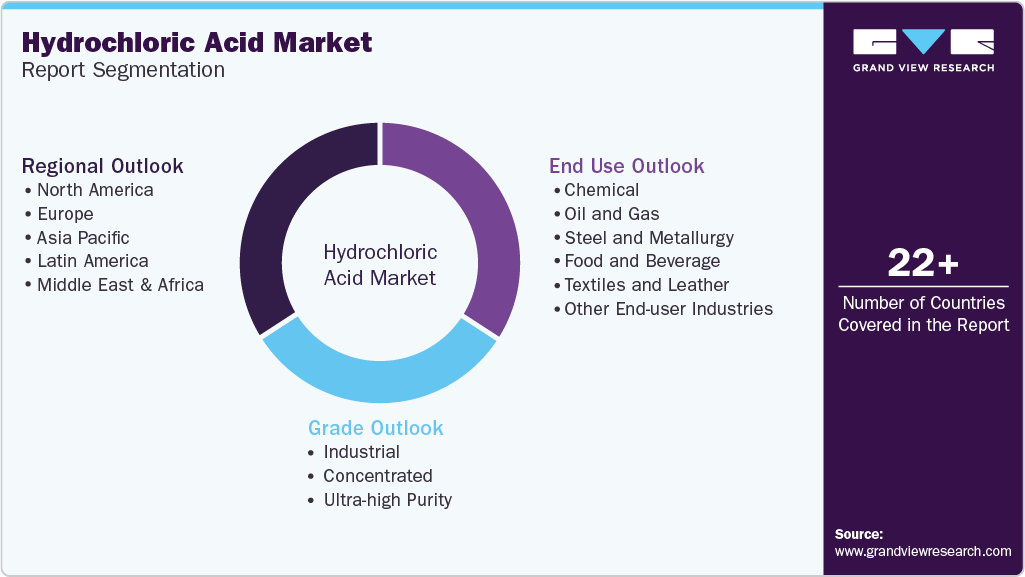
This report forecasts volume & revenue growth at the global, regional & country levels and provides an analysis of the latest industry trends in each of the sub-segments from 2021 to 2033. For this study, Grand View Research has segmented the global hydrochloric acid market report based on grade, end use, and region:
 To learn more about this report, Download Free Sample Report
-
Grade Outlook (Volume, Kilotons; Revenue, USD Million/Billion, 2021 - 2033)
-
Industrial
-
Concentrated
-
Ultra-high Purity
-
-
End Use Outlook (Volume, Kilotons; Revenue, USD Million/Billion, 2021 - 2033)
-
Chemical
-
Oil and Gas
-
Steel and Metallurgy
-
Food and Beverage
-
Textiles and Leather
-
Other End-user Industries
-
-
Regional Outlook (Volume, Kilotons; Revenue, USD Million/Billion, 2021 - 2033)
-
North America
-
U.S.
-
Canada
-
Mexico
-
-
Europe
-
Germany
-
UK
-
France
-
Italy
-
Spain
-
-
Asia Pacific
-
China
-
India
-
Japan
-
South Korea
-
-
Latin America
-
Brazil
-
Argentina
-
-
Middle East & Africa
-
Saudi Arabia
-
South Africa
-
-
Research Methodology
The hydrochloric acid market figures in this report are based on a proven research process that combines executive interviews with secondary research from proprietary databases, company filings, and recognized regulatory and institutional sources. Market size is built through value-chain sizing—reconciling supply-side and demand-side estimates—and triangulated with bottom-up and top-down approaches. Every estimate passes multiple levels of expert validation before publication, with each hydrochloric acid segment quantified using the revenue-capture definitions in the table below.
Segment Definition
Segment - Grade
Revenue capture definition
Industrial
Sales are generated from industrial-grade hydrochloric acid used in high-volume applications such as steel pickling, metal surface treatment, chemical manufacturing, mining, water treatment, and pH adjustment. Revenue is captured from bulk hydrochloric acid supplied to industrial users based on required concentration, purity, and process specifications.
Concentrated
Market revenues arise from higher-concentration hydrochloric acid supplied for applications requiring greater acid strength and process efficiency. It is used in chemical synthesis, metal treatment, mineral processing, industrial cleaning, and other processes where controlled acid concentration is required.
Ultra-high Purity
Revenue is generated from high-purity hydrochloric acid manufactured to stringent impurity specifications for specialized applications, including pharmaceutical processing, semiconductor and electronics manufacturing, laboratory applications, and high-purity chemical synthesis. Revenue capture reflects sales of HCl meeting controlled purity and trace-metal requirements.
Segment - End Use
Revenue capture definition
Chemical
Sales are generated from hydrochloric acid consumed in chemical manufacturing and processing, including the production of chlorides and other chemical intermediates, pH adjustment, neutralization, and chemical synthesis. Revenue includes bulk HCl supplied to chemical manufacturers for process and feedstock applications.
Oil and Gas
Revenue is captured from hydrochloric acid used in oil and gas well stimulation, acidizing, well completion, and related production operations. HCl is injected into formations to dissolve carbonate minerals and improve the flow of hydrocarbons toward the wellbore.
Steel and Metallurgy
Market revenues arise from hydrochloric acid used for steel pickling and metal surface treatment. HCl removes rust, scale, and oxide layers from steel surfaces before downstream processes such as galvanizing, coating, rolling, and fabrication.
Food and Beverage
Sales are generated from food-grade hydrochloric acid used in selected food-processing and ingredient-manufacturing applications, including pH adjustment, hydrolysis, processing of certain ingredients, and gelatin production. Revenue capture is limited to HCl meeting applicable food-processing quality and safety requirements.
Textiles and Leather
Revenue is derived from hydrochloric acid used in selected textile and leather processing operations, including pH adjustment, neutralization, cleaning, and treatment processes. Consumption depends on the specific processing chemistry and material-treatment requirements of textile and leather manufacturers.
Other End-user Industries
Market revenues are generated from hydrochloric acid consumed across mining, water and wastewater treatment, pharmaceuticals, power generation, pulp and paper, and other industrial applications. These uses include ore processing, ion-exchange resin regeneration, pH control, chemical cleaning, and process-water treatment.
Estimation Model
Layer No.
Layer Name
Key Question
Description
01
Raw Material & Gradeion Layer
What forms is the supply base?
Examine the production of hydrochloric acid from chlorine and hydrogen, including integrated chlor-alkali production, direct synthesis, and recovery of HCl generated as a by-product of chemical processes. The assessment covers chlorine and hydrogen availability, reaction and synthesis systems, absorption, purification, concentration, storage, production capacity, plant utilization, quality control, and transportation infrastructure. It also evaluates production efficiency, energy requirements, integrated manufacturing models, and technologies influencing HCl quality, availability, cost, and supply reliability.
02
Form Adoption Layer
Where is hydrochloric acid utilized?
Evaluate the adoption of hydrochloric acid across different concentrations and purity levels, including industrial-grade, concentrated, and ultra-high-purity HCl. The analysis examines its use in steel pickling, chemical manufacturing, oil and gas well stimulation, water treatment, mining, food processing, pharmaceuticals, and other industrial applications. Adoption is influenced by required acid concentration, purity specifications, process requirements, handling conditions, and the availability of suitable storage and transportation systems.
03
Consumption Intensity Layer
How much hydrochloric acid is consumed?
Assess hydrochloric acid consumption based on production activity and application-specific requirements across steel, chemicals, oil and gas, water treatment, mining, food processing, and other end-use industries. The analysis considers steel production and pickling volumes, chemical manufacturing capacity, oil and gas well stimulation activity, mineral-processing output, water-treatment requirements, application-specific acid consumption, and industrial production intensity to estimate hydrochloric acid demand across major markets.
04
Revenue Layer
How is market revenue generated?
Market revenue is generated through the production and sale of hydrochloric acid across industrial and specialized grades for applications including chemical manufacturing, steel pickling, oil and gas, water treatment, mining, food processing, pharmaceuticals, and other industrial uses. Revenue growth is influenced by chemical production, steel processing activity, oil and gas well stimulation, mining output, water treatment investment, regional production capacity, HCl concentration and purity requirements, and the costs of chlorine, energy, storage, and transportation.
Delivered Customizations
This report has been delivered with the following In-depth customizations:
Client Request
Customization Delivered
Value Adds
Cross-segmentation
The assessment provides detailed cross-segmentation of the hydrochloric acid market across grade, concentration/purity, application, and end-use industry. The analysis evaluates demand across industrial, concentrated, and ultra-high-purity hydrochloric acid, with end-use assessment covering chemical manufacturing, steel and metallurgy, oil and gas, food and beverage, water treatment, mining, and other industrial applications.
Enables identification of high-growth opportunities across specific grade-application-end-use combinations. Supports product development, production planning, capacity expansion, distribution strategies, and market-entry decisions by identifying applications with specific concentration and purity requirements, increasing consumption intensity, and expanding industrial activity.
Opportunity Assessment
Detailed evaluation of growth opportunities arising from chemical manufacturing expansion, steel pickling, oil and gas well stimulation, water and wastewater treatment, mining and mineral processing, and specialized high-purity applications. The assessment covers developments in integrated chlor-alkali production, HCl recovery, production efficiency, high-purity hydrochloric acid, storage infrastructure, and regional supply-chain optimization.
Enables identification of attractive investment opportunities across the hydrochloric acid value chain. Supports decisions related to production capacity expansion, integrated manufacturing, technology adoption, regional market entry, storage infrastructure, and distribution partnerships by highlighting high-potential end-use industries and regions with increasing HCl consumption.
Competitive Benchmarking
Comparative assessment of leading hydrochloric acid manufacturers based on production capacity, grade, and concentration portfolio, manufacturing integration, geographic presence, plant locations, production technologies, supply reliability, storage and logistics infrastructure, customer base, strategic partnerships, and application coverage. The benchmarking evaluates production efficiency, quality consistency, integrated chlorine supply, regional distribution capabilities, and the ability to serve bulk industrial and specialized high-purity requirements.
Supports benchmarking against key competitors while identifying opportunities to strengthen production efficiency, supply reliability, geographic coverage, product differentiation, and manufacturing integration. The analysis assists strategic decisions concerning capacity expansion, technology investment, plant location, logistics optimization, partnerships, and long-term positioning in the hydrochloric acid market.
Frequently Asked Questions About This Report
The hydrochloric acid market size was valued at USD 2.0 billion in 2025 and is estimated to reach USD 2.1 million in 2026.
The hydrochloric acid market is expected to grow at a compound annual growth rate of 5.4% from 2026 to 2033 to reach USD 3.0 million by 2033.
By grade, industrial dominated the market with a 46.7% revenue share in 2025 supported by extensive use in steel pickling, chemical processing, mining, water treatment, and metal surface treatment.
Asia Pacific dominated the global hydrochloric acid market, accounting for 45.1% of revenue in 2025 supported by large-scale chemical manufacturing, steel production, metal processing, mining, and water treatment activities. Expansion of manufacturing and industrial infrastructure in China, India, Japan, South Korea, and other Asian economies is supporting regional demand.
The hydrochloric acid market is driven by rising demand for steel pickling and metal treatment, expansion of chemical manufacturing, increasing use in oil and gas well stimulation, growing water and wastewater treatment requirements, and expanding mining and mineral-processing activities. Industrial infrastructure development and increasing chemical-processing capacity are also supporting hydrochloric acid consumption.
Key players in the hydrochloric acid include BASF SE, Coogee, Covestro AG, Prayon, Merck KGaA, Olin Corporation, Detrex Corporation, Ercros S.A., Westlake Corporation, AGC Inc. Competition is influenced by production capacity, chlor-alkali integration, product concentration and purity, regional supply networks, logistics capabilities, and proximity to major industrial customers.
The concentrated segment is expected to register the fastest growth, expanding at a CAGR of 5.7% during the forecast period. Growth is supported by increasing demand for higher-strength hydrochloric acid in chemical processing, metal treatment, mineral processing, and other applications requiring controlled acid concentration.
The chemical segment dominated the hydrochloric acid market, capturing 30.7% of revenue in 2025 driven by hydrochloric acid consumption in chemical synthesis, chloride production, pH adjustment, neutralization, and other chemical-processing operations. Expansion of chemical manufacturing capacity is supporting continued demand.
The food & beverages is expected to grow fastest at a CAGR of 7.2% during the forecast period. Growth is supported by increasing use of food-grade hydrochloric acid in selected processing applications, including pH adjustment, ingredient processing, hydrolysis, and gelatin production, alongside expansion of processed-food manufacturing.
About the Author(s)
Water & Sludge Treatment Research Team
Bulk Chemicals · Water & Sludge TreatmentThis report was authored by the water & sludge treatment research team at Grand View Research - comprising two research analysts, one senior research analyst, and one industry expert - with specialized expertise in the water & sludge treatment segment of the bulk chemicals industry. All findings are based on proprietary bulk chemicals databases, executive interviews, and regulatory analysis, subject to internal peer review prior to publication.
Last Updated:
Speak to Analyst

Customize this report to your needs - add regions, segments, or data points, with 20% free customization.
Or view our licence options:


ISO 9001:2015 & 27001:2022 Certified
We are GDPR and CCPA compliant! Your transaction & personal information is safe and secure. For more details, please read our privacy policy.


