
- Home
- »
- Automotive & Transportation
- »
-
Hyper Car Market Size, Share & Growth Report, 2026-2033GVR Report cover

Hyper Car Market (2026 - 2033)
Size, Share & Trends Analysis Report By Engine Type (Internal Combustion Engine, Hybrid Engine, Electric Engine), By Body Type (Coupe, Convertible, Roadster, Sedan), By Power Output, By Price Range, By Region, And Segment Forecasts
Market Size, 2025
$20.1BMarket Estimate, 2026
$21.5BMarket Forecast, 2033
$36.7BCAGR, 2026–2033
7.9%Hyper Car Market Summary
The global hyper car market size was valued at USD 20.1 billion in 2025 and is projected to grow from USD 21.5 billion in 2026 to reach USD 36.7 billion by 2033, at a CAGR of 7.9% from 2026 to 2033. Europe dominated the market, accounting for the largest revenue share of 35.1% in 2025. The increasing adoption of advanced powertrain and vehicle technologies is driving the growth of the market.
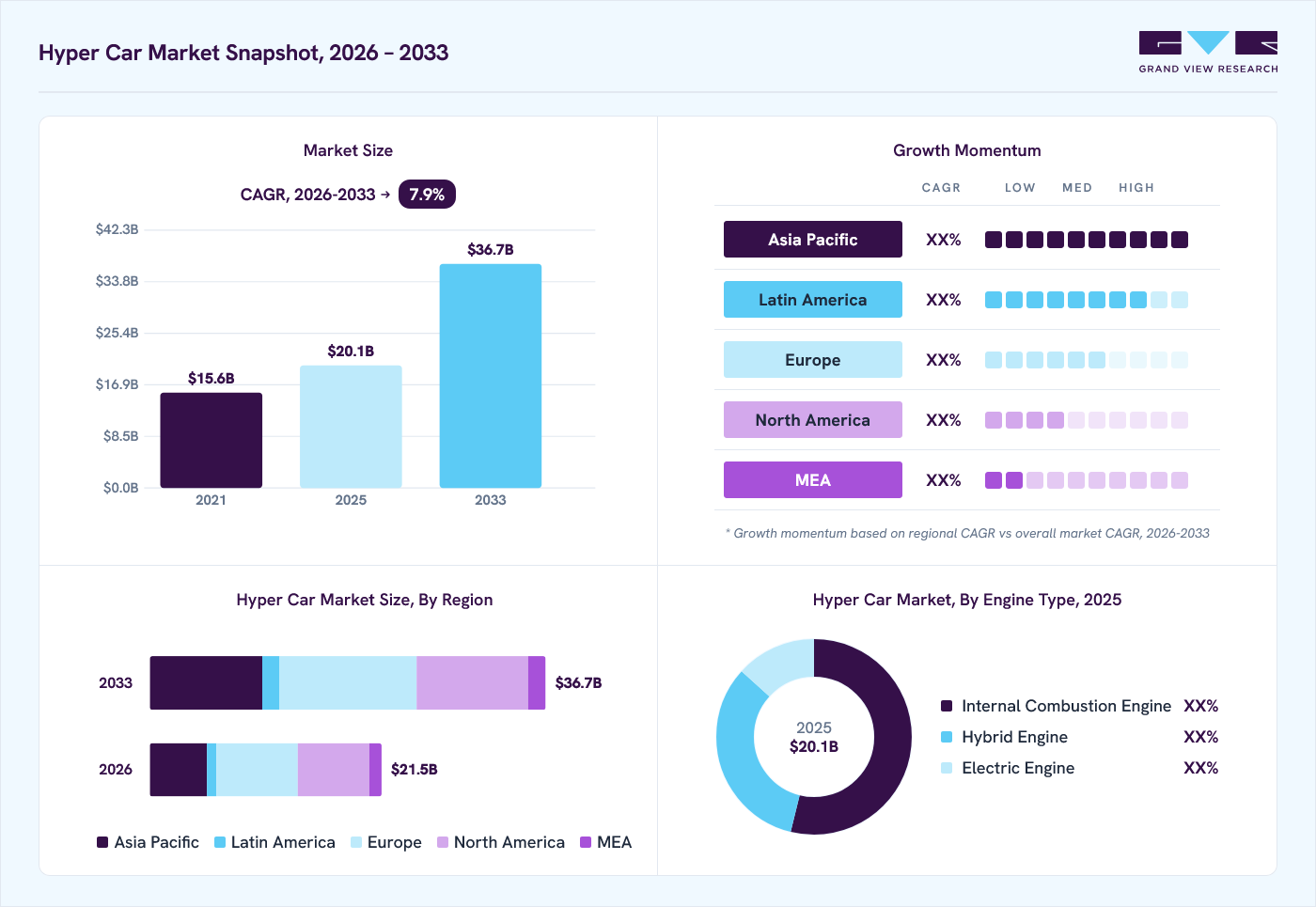 Source: Grand View Research, IR Documents, Primary Interviews, Paid DatabasesTo learn more about this report,
 Download Free Sample Report
Key Market Trends & Insights
- By engine type: The internal combustion engine segment led the market and accounted for 53.8% of the global revenue in 2025.
- By body type: The coupe segment led the market and accounted for 67.9% of the global revenue in 2025.
- By power output: The 1001-1200 HP segment accounted for the largest share of global revenue in 2025.
- By price ranges: The $1 million - $3 million segment accounted for the largest market revenue share in 2025.
Regional Highlights
- Largest regional market: Europe (35.1% revenue share, 2025)
- Fastest-growing regional market: Asia Pacific (highest CAGR, 2026-2033)
- By country: Germany held the largest market share in 2025.
Market Size & Forecast
- Market size in 2025: USD 20.1 Billion
- Estimated market size in 2026: USD 21.5 Billion
- Projected market size by 2033: USD 36.7 Billion
- CAGR (2026-2033): 7.9%
Prism AI by Grand View Research Free to tryAsk a question about the hyper car marketTry asking✓Every figure cited from GVR research Prefer the report? Download free sample →
Increasing consumer demand for high-performance vehicles is driving interest in hypercars with exceptional speed, acceleration, and driving capabilities. Growing demand for exclusive and technologically advanced vehicles is encouraging manufacturers to develop models with higher performance and distinctive design features. Automakers are responding by integrating lightweight materials, advanced powertrain systems, aerodynamic technologies, and sophisticated vehicle control systems into hypercars. The increasing adoption of these high-performance technologies and premium vehicle models is expanding consumer interest and supporting the growth of the hypercar market.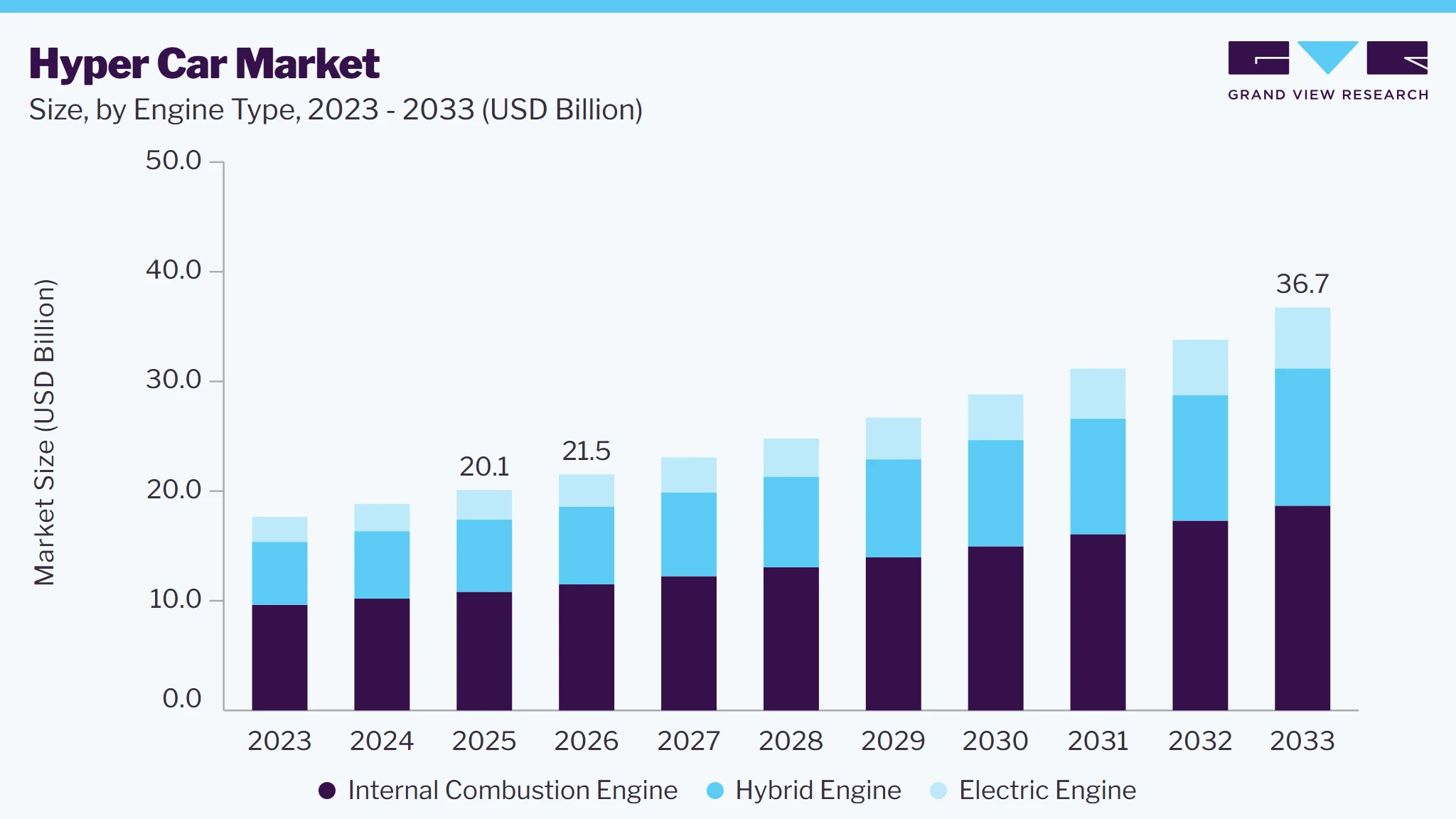 To learn more about this report, Download Free Sample Report
Hypercars are incorporating advanced technologies to improve overall performance. Manufacturers are optimizing aerodynamics to reduce drag and increase downforce, which improves high-speed stability and handling. Furthermore, lightweight materials such as carbon fiber and titanium are being used to reduce vehicle weight while maintaining strength and durability. These developments are supported by powerful internal combustion engines and advanced electric motors that deliver higher power and improved performance. Along with these performance technologies, manufacturers are integrating smart features such as collision avoidance and cruise control to improve vehicle control and driving safety.
Hypercar manufacturers are increasingly adopting standardized technical requirements to ensure consistent performance and development. These regulations require rear wheel-drive and hybrid powertrains while giving manufacturers flexibility in prototype development and chassis selection. This flexibility allows brands to maintain distinctive vehicle designs while meeting common technical specifications. At the same time, standardized requirements control development costs and provide greater stability for manufacturers. These developments are expected to encourage wider manufacturer participation and support the continued development of the hypercar market.
High maintenance costs are restraining the growth of the hypercar market. These vehicles require specialized servicing, while high-performance components increase maintenance expenses. In addition, premium tires, brakes, batteries, insurance, and storage further raise ownership costs. These higher expenses may limit customer demand and restrict broader market adoption.
Market Dynamics
The hyper car market is being shaped by increasing demand for extreme performance, advanced vehicle engineering, lightweight materials, and highly exclusive automotive products. Manufacturers are increasingly integrating electrification, hybrid powertrains, advanced aerodynamics, carbon-fiber structures, active chassis systems, and sophisticated vehicle software to improve acceleration, handling, efficiency, and driving experience. Meanwhile, limited production volumes, high customization, and strong brand positioning continue to define the market, while technological innovation and growing interest in high-performance electrified vehicles are creating new avenues for market expansion.
The increasing adoption of advanced powertrain and vehicle technologies is driving the growth of the hyper car market. Hyper cars require extremely high power-to-weight ratios, rapid acceleration, improved thermal management, and precise power delivery, which has encouraged manufacturers to adopt hybrid systems, high-performance electric motors, advanced battery technologies, lightweight materials, and sophisticated electronic control systems. Improvements in powertrain efficiency and vehicle dynamics are enabling manufacturers to achieve higher performance while addressing the increasing importance of emissions reduction and energy efficiency.
Hyper car manufacturers are responding by combining high-output engines with electric propulsion, advanced energy-management systems, active aerodynamics, and lightweight vehicle architectures. These technologies enable higher power output, faster acceleration, improved traction, and greater driving stability while supporting increasingly stringent environmental requirements. The integration of advanced technologies also increases the technological value and differentiation of hyper cars, encouraging premium pricing, new product development, and continued investment in high-performance vehicle platforms.
The extremely high purchase and ownership costs of hyper cars remain a significant restraint on market expansion. These vehicles require expensive materials, specialized engineering, low-volume manufacturing processes, advanced powertrains, sophisticated electronics, and extensive testing, resulting in substantially higher prices than conventional performance vehicles. In addition to the initial purchase price, maintenance, specialized servicing, insurance, replacement components, and storage requirements further increase the total cost of ownership.
This cost structure primarily limits the addressable customer base to high-net-worth consumers and collectors, thereby restricting unit sales despite strong demand for exclusivity and performance. The restraint is particularly relevant in price-sensitive markets and regions where import duties, taxes, registration costs, and infrastructure constraints further increase ownership costs. Consequently, manufacturers generally maintain limited production volumes, which supports exclusivity and margins but constrains the potential for mass-market expansion.
The transition toward electrification creates a significant opportunity for the hyper car market. Electric motors can provide immediate torque, rapid power delivery, advanced traction control, and flexible packaging. At the same time, hybrid systems can combine high-performance internal combustion engines with electric propulsion to improve acceleration and overall vehicle performance. Advances in battery energy density, power electronics, thermal management, and regenerative braking are enabling manufacturers to develop electrified hyper cars without relying solely on conventional engine configurations.
The opportunity is particularly strong in the high-performance hybrid and electric segments, where technological differentiation can justify premium pricing and attract technology-focused buyers. Electrification also allows manufacturers to develop new vehicle architectures, sophisticated torque-vectoring systems, and software-controlled performance functions. Hyper car manufacturers with strong engineering capabilities, access to advanced powertrain technologies, and established luxury positioning are best positioned to capture this opportunity through limited-edition electrified models and technologically differentiated vehicles.
Market Concentration & Characteristics
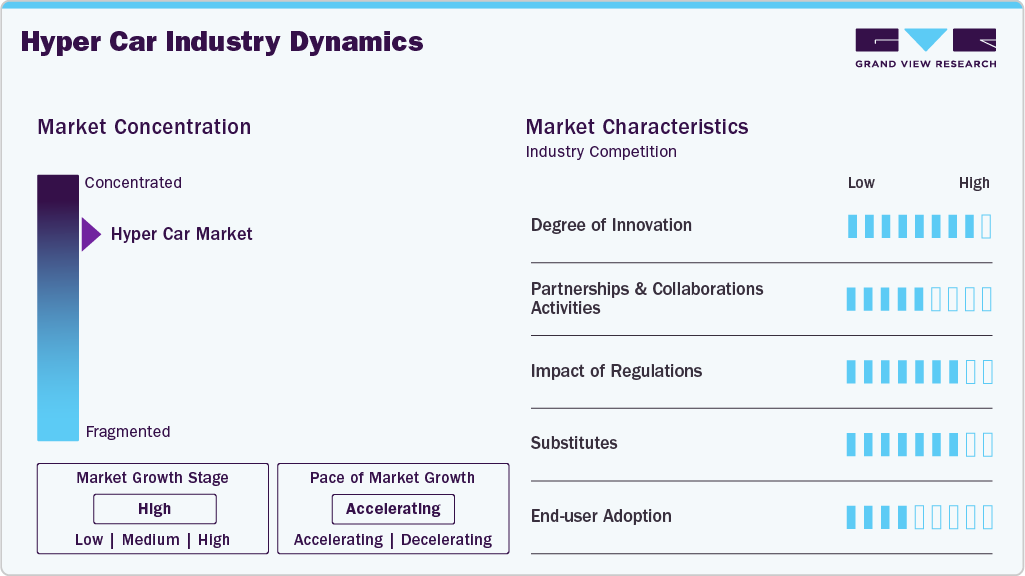
The hypercar market is highly consolidated, as a relatively small number of established luxury and performance vehicle manufacturers account for a substantial portion of the market. The high level of consolidation is supported by significant entry barriers, including very high development and production costs, limited production capacity, strong brand reputation, established customer relationships, and the need for specialized manufacturing capabilities. The market is also characterized by a high degree of innovation, as leading manufacturers continuously introduce new models, improve vehicle performance, and incorporate advanced features to differentiate their offerings. Partnerships and collaborations are present at a medium level, particularly for developing vehicles, sourcing specialized components, and accessing new technologies. Regulations have a moderate-to-high impact, as manufacturers must comply with vehicle safety, emissions, and environmental requirements, which can influence product development and production decisions.
 To learn more about this report, Download Free Sample Report
The market is also experiencing an exponential growth stage with an accelerating pace of growth, supported by rising interest in high-performance, luxury, and exclusive vehicles. End-user adoption remains relatively limited compared with conventional passenger vehicles due to extremely high prices and restricted production volumes, thereby making hyper cars accessible mainly to a small group of high-income customers and collectors. At the same time, the availability of substitutes is relatively high as premium sports cars, supercars, luxury performance vehicles, and high-end electric vehicles can satisfy some of the same customer preferences at lower prices. However, the strong focus on exclusivity, brand prestige, limited-edition models, personalization, and exceptional performance helps established manufacturers maintain their market position. Overall, the combination of high concentration, strong innovation, accelerating growth, limited customer base, and significant entry barriers makes the hyper car market distinct from the broader automotive market.
Analyst Perspective
The hyper car market is set for growth, driven by demand for top performance, exclusivity, advanced engineering, and unique vehicles. Hybrid, electric powertrains, lightweight materials, active aerodynamics, and software controls are transforming product development and performance. Investment is focused on electrification, next-gen batteries, lightweight designs, and vehicle dynamics. Manufacturers use limited-edition models, customization, and technology to boost margins and exclusivity. The industry shifts toward innovation, electrification, personalization, and controlled production.
Engine Type Insights
The internal combustion engine type segment held the largest share of 53.8% in 2025. The internal combustion engine segment is witnessing growth due to its ability to deliver high power output and strong performance. Manufacturers are introducing advanced V8 and V12 engines with outputs exceeding 1,000 PS. These developments enable hypercars to achieve rapid acceleration and high top speeds while retaining the characteristics of combustion-engine powertrains. The continued development of high-performance internal combustion engines is supporting segment growth.
The electric engine type segment is projected to grow at the fastest CAGR over the forecast period. The increasing demand for high-performance electric vehicles is supporting the growth of the electric engine segment. Electric motors provide instant torque, high power output, and rapid acceleration, making them suitable for high-performance hypercars. This performance is encouraging manufacturers to integrate advanced battery and electric propulsion technologies into new models. The growing adoption of these technologies is increasing the use of electric engines in the hypercar market.
Body Type Insights
The coupe segment accounted for 67.9% of the largest share of global revenue in 2025, driven by its fixed-roof design and high-performance characteristics. The fixed roof supports improved aerodynamics, structural rigidity, stability, and weight distribution. These features enable manufacturers to optimize vehicles for high-speed performance and handling. The continued use of coupe designs across high-performance hypercar models is supporting the dominance of this segment.
The roadster body type segment is projected to grow at the fastest CAGR over the forecast period, driven by increasing demand for lightweight and performance-oriented vehicles. Manufacturers are developing roadsters with advanced lightweight materials and aerodynamic designs to enhance driving dynamics. These technologies improve acceleration, handling, and high-speed stability while maintaining an open-air driving experience. The growing availability of high-performance roadster models is supporting the growth of this segment.
Power Output Insights
The 1001-1200 HP segment accounted for the largest share of global revenue in 2025. The segment is gaining opportunities from rising demand for high-performance hypercars. Advanced powertrains are enabling higher power output and improved performance. Lightweight materials optimize the power-to-weight ratio, while advanced aerodynamics improve stability and handling. These advancements are supporting the growth of hypercars in the 1,001-1,200 HP range.
The above 1200 hp segment is expected to grow at a significant CAGR over the forecast period. Manufacturers are advancing high-power powertrains to achieve higher performance levels in hypercars. These systems can deliver power outputs above 1,200 HP while supporting rapid acceleration and high-speed driving. Advanced electric motors, hybrid systems, and high-performance combustion engines are contributing to higher power capabilities. Improvements in battery systems, cooling, and power management are further supporting high-output performance. These developments are expanding the availability of hypercars in the above-1,200 HP segment.
Price Range Insights
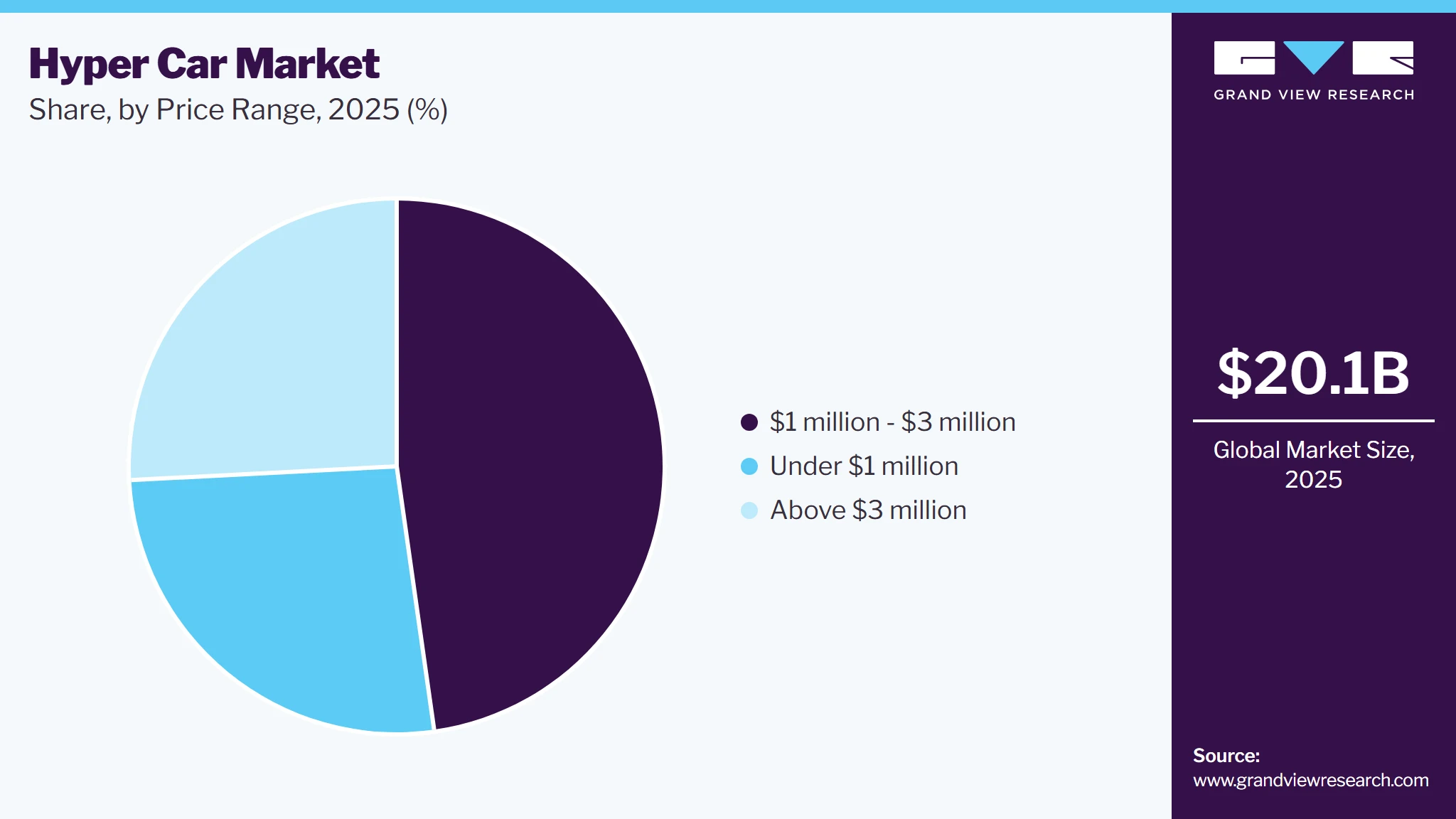
The $1 million-$3 million segment accounted for the largest share of market revenue in 2025, driven by demand from customers seeking a combination of extreme performance and exclusivity. These buyers typically value limited-production models, advanced engineering, premium materials, and distinctive vehicle designs. Manufacturers are developing high-performance hypercars with advanced powertrains and aerodynamic technologies to meet these expectations. The increasing preference for highly exclusive and technologically advanced vehicles is supporting growth in this segment.
 To learn more about this report, Download Free Sample Report
The above $3 million segment is projected to grow at the fastest CAGR from 2026 to 2033, owing to customers seeking the highest levels of performance, exclusivity, and customization. These buyers typically value ultra-limited production models, advanced engineering, premium materials, and bespoke vehicle specifications. Manufacturers are developing hypercars with cutting-edge powertrains, lightweight construction, and advanced aerodynamic technologies to meet these expectations. The increasing preference for ultra-exclusive and highly customized vehicles is supporting growth in this segment.
Regional Insights
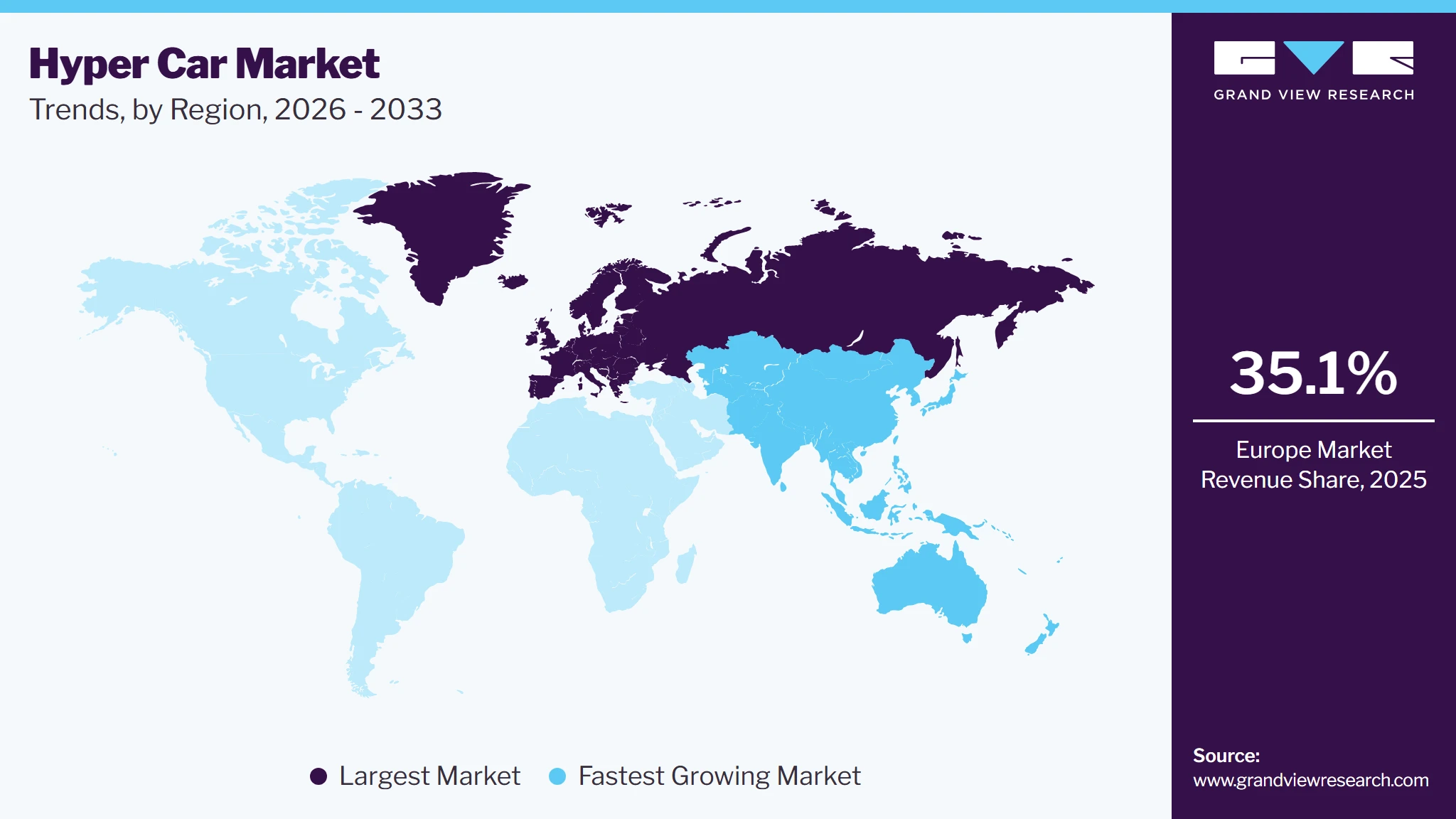
The hyper car market in Europe led the global market and accounted for 35.1% of the global revenue in 2025. Stringent regulations are encouraging manufacturers to reduce vehicle emissions and improve powertrain efficiency. This is increasing the use of hybrid and electric technologies in high-performance vehicles. The shift toward cleaner powertrains is supporting the development of electrified hypercars.
 To learn more about this report, Download Free Sample Report
UK Hyper Car Market Trends
The UK hyper car market is supported by customer interest in highly exclusive vehicles offering advanced performance and distinctive designs. Demand for limited-production models is encouraging greater use of premium materials and advanced powertrain technologies. This preference is supporting growth in higher-priced hypercars.
The hyper car market in Germany held a substantial share in the European market. The country is experiencing continued development of advanced vehicle technologies focused on high power output, lightweight construction, and improved aerodynamics. These technologies enable manufacturers to enhance acceleration, handling, and high-speed performance. This focus is supporting demand for premium and high-power hypercars.
Asia Pacific Hyper Car Market Trends
The hyper car market in APAC is projected to grow at the fastest CAGR over the forecast period. Increasing investment in electric mobility technologies across Asia Pacific is supporting the development of high-performance electric and hybrid vehicles. Improvements in battery technology and electric propulsion are enabling higher power output and rapid acceleration. This trend is creating opportunities for electric and hybrid hypercars.
Hyper car market in China held a dominant share in the Asia Pacific market. The expansion of electric vehicle ecosystem is supporting the development of high-performance electric powertrains. Advances in batteries, electric motors, and power electronics are enabling manufacturers to achieve higher power and acceleration. These developments are creating opportunities for electric hypercars and high-power-output models.
Japan hyper car market is expected to grow at a significant CAGR over the forecast period. Japan is witnessing continued development of hybrid technologies that combine combustion engines with electric propulsion. These systems improve power delivery and vehicle efficiency while maintaining high-performance characteristics. This technology development is supporting opportunities for hybrid hypercars in the country.
North America Hyper Car Market Trends
Hyper car market in North America held a significant share of the market in 2025. Demand for high-performance vehicles with greater power output and advanced driving capabilities is increasing across North America. Buyers are showing interest in vehicles that combine extreme acceleration, advanced aerodynamics, and premium design. This demand is supporting growth in higher power-output and premium-priced hyper cars.
The hyper car market in U.S. is held the largest market share. The U.S. market is witnessing increasing adoption of hybrid and electric powertrain technologies in high-performance vehicles. Improvements in battery systems, electric motors, and power management are enabling higher performance while improving vehicle efficiency. This shift is creating opportunities for hybrid and electric hypercars.
Key Hyper Car Company Insights
Key players operating in the hyper car market include BUGATTI Automobiles S.A.S., FERRARI N.V., McLaren, Automobili Lamborghini S.p.A., Koenigsegg Automotive AB, Pagani S.P.A., Aston Martin, Bugatti Rimac d.o.o., Mercedes-AMG GmbH. and SSC North America, LLC. Key players in the hyper car market are expanding their hypercar portfolios with advanced powertrains, lightweight materials, aerodynamic designs, and high-performance technologies while strengthening their focus on exclusive and limited-production models. Manufacturers are focusing on improving vehicle performance, enhancing driving dynamics, integrating hybrid and electric technologies, and supporting growing customer demand for high-performance vehicles.
-
BUGATTI Automobiles S.A.S. is a French luxury automotive manufacturer specializing in the development and production of highly exclusive hyper sports cars. The company’s vehicles combine high performance, luxury, advanced engineering, distinctive design, and craftsmanship. It emphasizes handcrafted production, material quality, engineering precision, and technological innovation in its vehicle development.
-
FERRARI N.V. is an Italian luxury automotive company specializing in the design, engineering, production, and sale of high-performance luxury sports cars. The company also includes racing, lifestyle products, collectibles, and experiences. It emphasizes exclusivity, technological innovation, sporting performance, Italian design, and craftsmanship across its products and brand activities. The company develops vehicles using technologies derived from its racing activities and maintains a portfolio of internal-combustion, hybrid, and electric models.
Key Hyper Car Companies
The following key companies have been profiled for this study on the hyper car market.
-
BUGATTI Automobiles S.A.S.
-
FERRARI N.V.
-
McLaren
-
Automobili Lamborghini S.p.A.
-
Koenigsegg Automotive AB
-
Pagani S.P.A.
-
Aston Martin
-
Bugatti Rimac d.o.o.
-
Mercedes-AMG GmbH.
-
SSC North America, LLC
Company Categorization
Operating Strategies
Competitive Edge
Weaknesses
Mature Players: BUGATTI Automobiles S.A.S., FERRARI N.V., Automobili Lamborghini S.p.A., McLaren
- Mature players in the hyper car market are focus on established luxury positioning, limited-production performance vehicles, continuous product development, advanced powertrain technologies, premium customization, and strong global brand distribution.
- Mature players gain a competitive advantage through strong brand recognition, extensive engineering expertise, established customer bases, premium pricing power, and broader high-performance vehicle portfolios support competitive positioning.
- These companies often face challenges related to high vehicle prices restrict the addressable customer base, while low production volumes create dependence on affluent buyers and limit overall unit-volume expansion.
Emerging Players: Koenigsegg Automotive AB, Pagani S.P.A., SSC North America, LLC
- Emerging players in the hyper car market are focusing on emphasize ultra-low-volume production, highly specialized engineering, bespoke vehicle development, extreme performance, and differentiated vehicle architectures to target niche high-net-worth customer segments.
- Emerging players gain market traction through exceptional performance differentiation, exclusivity, lightweight engineering, customization, and strong appeal among collectors provide significant positioning within the ultra-premium hyper car niche.
- Emerging players face limitations due to limited production capacity, smaller operational scale, narrow customer bases, and high development costs can constrain revenue expansion and reduce the ability to compete on production scale.
Recent Developments
-
In May 2026, McLaren unveiled the MCL-HY Hypercar for its planned 2027 FIA World Endurance Championship entry, alongside the track-only MCL-HY GTR. The MCL-HY combines a twin-turbo V6 engine with a hybrid system, producing up to 697 bhp. The GTR uses a 2.9-liter twin-turbo V6 without hybrid assistance and produces 720 bhp, highlighting the development of high-performance track-focused hypercars.
-
In February 2025, Aston Martin launched the Valkyrie hypercar for the 2025 Le Mans 24 Hours and FIA World Endurance Championship. The vehicle features a 6.5-liter V12 engine without hybrid assistance and is expected to compete with two cars in the hypercar class. The program also extends to the IMSA sports car racing series in the U.S., strengthening the brand’s presence in high-performance endurance racing.
Hyper Car Market Report Scope
Report Attribute
Details
Market size in 2025
USD 20.1 billion
Estimated market size in 2026
USD 21.5 billion
Projected market size by 2033
USD 36.7 billion
Growth rate
CAGR of 7.9% from 2026 to 2033
Base year for estimation
2025
Historical data
2021 - 2024
Forecast period
2026 - 2033
Quantitative units
Revenue in USD billion and CAGR from 2026 to 2033
Report coverage
Revenue forecast, company ranking, competitive landscape, growth factors, and trends
Segments covered
Engine type, body type, power output, price range, and region
Regional scope
North America; Europe; Asia Pacific; Latin America; MEA
Country scope
U.S.; Canada; Mexico; Germany; UK; France; China; Japan; India; South Korea; Australia; Brazil; KSA; UAE; South Africa
Key companies profiled
BUGATTI Automobiles S.A.S.; FERRARI N.V.; McLaren; Automobili Lamborghini S.p.A.; Koenigsegg Automotive AB; Pagani S.P.A.; Aston Martin; Bugatti Rimac d.o.o.; Mercedes-AMG GmbH.; SSC North America, LLC
Customization scope
Free report customization (equivalent up to 8 analysts working days) with purchase. Addition or alteration to country, regional & segment scope.
Pricing and purchase options
Avail customized purchase options to meet your exact research needs. Explore purchase options
Global Hyper Car Market Report Segmentation
The report forecasts revenue growth at global, regional, and country levels and provides an analysis of the latest industry trends in each of the sub-segments from 2021 to 2033. For this study, Grand View Research has segmented the hyper car market based on engine type, body type, power output, price range, and region.
-
Engine Type Outlook (Revenue, USD Billion, 2021 - 2033)
-
Internal Combustion Engine
-
Hybrid Engine
-
Electric Engine
-
-
Body Type Outlook (Revenue, USD Billion, 2021 - 2033)
-
Coupe
-
Convertible
-
Roadster
-
Sedan
-
-
Power Output Outlook (Revenue, USD Billion, 2021 - 2033)
-
Up to 800 HP
-
801-1000 HP
-
1001-1200 HP
-
Above 1200 HP
-
-
Price Range Outlook (Revenue, USD Billion, 2021 - 2033)
-
Under $1 million
-
$1 million - $3 million
-
Above $3 million
-
-
Regional Outlook (Revenue, USD Billion, 2021 - 2033)
-
North America
-
U.S.
-
Canada
-
Mexico
-
-
Europe
-
Germany
-
UK
-
France
-
-
Asia Pacific
-
China
-
India
-
Japan
-
South Korea
-
Australia
-
-
Latin America
-
Brazil
-
-
Middle East & Africa (MEA)
-
UAE
-
Kingdom of Saudi Arabia (KSA)
-
South Africa
-
-
Research Methodology
The hyper car market figures in this report are based on a proven research process that combines executive interviews with secondary research from proprietary databases, company filings, and recognized regulatory and institutional sources. Market size is built through value-chain sizing-reconciling supply-side and demand-side estimates-and triangulated with bottom-up and top-down approaches. Every estimate passes multiple levels of expert validation before publication, with eachhyper car segment quantified using the revenue-capture definitions in the table below.
Segment Definition
Engine Type
Revenue capture definition
Internal Combustion Engine
The segment revenue is generated from hyper cars powered primarily by high-performance gasoline or other internal combustion powertrains, including revenue from complete vehicles equipped with high-output engines, associated performance powertrain systems, and factory-installed engine configurations.
Hybrid Engine
The segment revenue is generated from hyper cars combining an internal combustion engine with one or more electric motors, including revenue from complete hybrid vehicles, integrated electric propulsion systems, hybrid battery systems, and factory-installed energy-management and powertrain technologies.
Electric Engine
The segment revenue is generated from fully electric hyper cars powered exclusively by electric motors and battery systems, including revenue from complete battery-electric vehicles, electric propulsion systems, high-performance battery packs, power electronics, and integrated electric drive technologies.
Body Type
Revenue capture definition
Coupe
The segment revenue is generated from two-door hyper cars featuring a fixed roof, including revenue from complete coupe vehicles, performance-oriented body structures, and factory-installed body and interior configurations.
Convertible
The segment revenue is generated from hyper cars featuring an openable or retractable roof system, including revenue from complete convertible vehicles and factory-integrated retractable roof, body, and performance systems.
Roadster
The segment revenue is generated from open-top, performance-oriented hyper cars generally designed with two seats, including revenue from complete roadster vehicles and integrated lightweight body, roof, and performance configurations.
Sedan
The segment revenue is generated from four-door hyper-performance vehicles, including revenue from complete high-performance sedan vehicles and factory-installed performance, body, interior, and powertrain configurations.
Power Output
Revenue capture definition
Up to 800 HP
The segment revenue is generated from hyper cars with a rated maximum power output of up to 800 horsepower, including complete vehicles and factory-installed powertrain configurations within this output range.
801-1000 HP
The segment revenue is generated from hyper cars with a rated maximum power output ranging from 801-1,000 horsepower, including complete vehicles and associated high-performance powertrain configurations.
1001-1200 HP
The segment revenue is generated from hyper cars with a rated maximum power output ranging from 1,001 to 1,200 horsepower, including complete vehicles and factory-installed high-output powertrain systems within this range.
Above 1200 HP
The segment revenue is generated from hyper cars producing more than 1,200 horsepower, including complete ultra-high-performance vehicles and their factory-integrated high-output propulsion systems.
Price Range
Revenue capture definition
Under $1 million
The segment revenue is generated from hyper cars sold at an estimated transaction price below $1 million, including revenue from complete vehicle sales and factory-installed performance and customization configurations.
$1 million - $3 million
The segment revenue is generated from hyper cars sold at prices ranging from $1 million to $3 million, including revenue from complete vehicles, premium specifications, factory options, and customization packages incorporated into the vehicle transaction.
Above $3 million
The segment revenue is generated from hyper cars sold at prices exceeding $3 million, including revenue from ultra-exclusive vehicles, limited-production models, bespoke configurations, advanced performance systems, and high-value factory customization.
Estimation Model
Layer Name
Key Question
Description
Industry & Vehicle Universe Assessment
What constitutes the Hyper Car Market?
The estimation begins by defining the hyper car universe based on performance characteristics, power output, vehicle positioning, production exclusivity, and premium pricing. The assessment distinguishes hyper cars from conventional sports cars and other high-performance vehicles. Vehicle launches, production programs, and manufacturer portfolios are evaluated to establish the addressable market universe.
Volume & Production Assessment
How many hyper cars are produced and sold?
This layer estimates annual hyper car production and sales volumes across engine type, body type, power output, and price categories. Limited-production programs, model availability, production allocations, and regional sales patterns are considered. Production constraints and manufacturer-specific delivery volumes are used to refine the estimated vehicle volume.
Revenue & ASP Assessment
What revenue is generated by hyper car sales?
The model applies estimated average selling prices to vehicle volumes across relevant market segments. Differences in pricing caused by power output, propulsion technology, body configuration, limited production, and customization are incorporated into the assessment. Factory options and premium configurations are considered where they form part of the captured vehicle revenue.
Market Validation & Forecasting
How will the market develop during the forecast period?
The final layer validates estimated revenue against manufacturer strategies, vehicle launches, technology investments, production expansion, and demand conditions. Forecast assumptions incorporate electrification, hybridization, technological advancements, regulatory developments, and changes in high-net-worth consumer preferences. Scenario-based assessments are used to determine the future direction of the Hyper Car Market.
Delivered Customization
We have successfully delivered the following deep-dive customizations
Client Request
Customization Delivered
Value Adds
Regional Hyper Car Market Opportunity Assessment
Country/region-wise market sizing and forecasts
Analysis of demand, adoption trends, and regulatory landscape
Identification of high-growth regions and investment hotspots
Identified region-specific growth opportunities
Supported expansion and go-to-market strategy
Enabled informed regional investment decisions
Cross-Segmentation Analysis for the Hyper Car Market
Criss-cross market analysis by engine type, body type, power output, price range
Demand and adoption assessment across key segments
Segment attractiveness and growth potential benchmarking
Identified high-potential market segments
Supported targeted engine type positioning and marketing strategy
Improved customer and segment prioritization
Competitive Benchmarking and Strategic Positioning in the Hyper Car Market
Benchmarking of key competitors across engine types, pricing, partnerships, and innovation
Comparative assessment of market share, capabilities, and strategies
Analysis of competitive strengths, gaps, and differentiation areas
Identified competitive white spaces and growth gaps
Supported strategic positioning and differentiation
Enabled data-driven competitive strategy development
Frequently Asked Questions About This Report
The global hyper car market size was estimated at USD 20.1 billion in 2025 and is expected to reach USD 21.5 billion in 2026.
The global hyper car market is expected to grow at a CAGR of 7.9% from 2026 to 2033, reaching USD 36.7 billion by 2033.
Internal combustion engine type segment accounted for 53.8% of the largest share of global revenue in 2025. The internal combustion engine segment is witnessing growth due to its ability to deliver high power output and strong performance
The Europe hyper car market led the global market and accounted for 35.1% of the global revenue in 2025. Stringent regulations are encouraging manufacturers to reduce vehicle emissions and improve powertrain efficiency
The increasing adoption of advanced powertrain and vehicle technologies is driving the growth of the hyper car market
Some key players operating in the hyper car market include BUGATTI Automobiles S.A.S., FERRARI N.V., McLaren, Automobili Lamborghini S.p.A., Koenigsegg Automotive AB, Pagani S.P.A., Aston Martin, Bugatti Rimac d.o.o., Mercedes-AMG GmbH., and SSC North America, LLC
Coupe segment led the market and accounted for 67.9% of the global revenue in 2025, while roadster body type segment is projected to grow at the fastest CAGR over the forecast period
1001-1200 HP segment accounted for the largest share of global revenue in 2025, while above 1200 hp segment is expected to grow at a significant CAGR over the forecast period
$1 million - $3 million segment accounted for the largest market revenue share in 2025, while above $3 million segment is projected to grow at the fastest CAGR over the forecast period
About the Author(s)
Automotive & Transportation Research Team
Technology · Automotive & TransportationThis report was authored by the automotive & transportation research team at Grand View Research - comprising two research analysts, one senior research analyst, and one industry expert - with specialized expertise in the automotive & transportation segment of the technology industry. All findings are based on proprietary technology databases, executive interviews, and regulatory analysis, subject to internal peer review prior to publication.
Last Updated:
Speak to Analyst

Customize this report to your needs - add regions, segments, or data points, with 20% free customization.
Or view our licence options:


ISO 9001:2015 & 27001:2022 Certified
We are GDPR and CCPA compliant! Your transaction & personal information is safe and secure. For more details, please read our privacy policy.


