
- Home
- »
- Next Generation Technologies
- »
-
In-flight internet Market Size And Share Report, 2025-2033GVR Report cover

In-flight Internet Market (2025 - 2033)
Size, Share & Trends Analysis Report By Service, By Connectivity Speed, By Technology (Air to Ground, Satellite-based, Hybrid), By End Use (Commercial Aircraft, Business Jets, Military Aircraft), By Region, And Segment Forecasts
Market Size, 2024
$1.8BMarket Estimate, 2026
$2.0BMarket Forecast, 2033
$3.0BCAGR, 2025–2033
5.9%In-flight Internet Market Summary
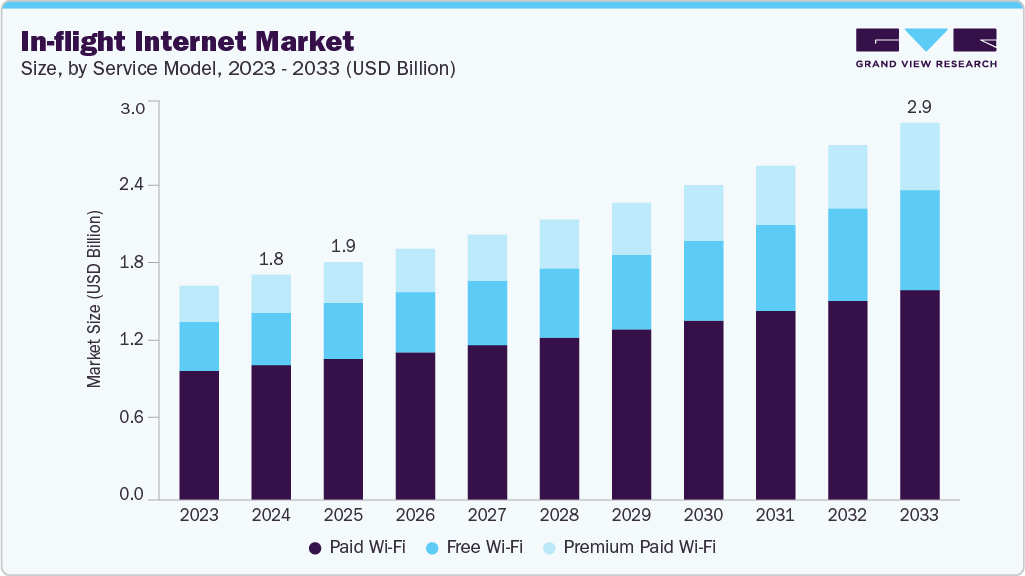
The global in-flight internet market size was valued at USD 1.8 billion in 2024 and is projected to grow from USD 2.0 billion in 2026 to USD 3.0 billion by 2033, at a CAGR of 5.9% from 2025 to 2033. North America dominated the market, accounting for a revenue share of 33.0% in 2024. The market growth is primarily driven by rising passenger demand for high-speed connectivity, increasing adoption of satellite-based systems, growing airline investments in digital services, and the shift toward freemium and hybrid service models.
 Source: Grand View Research, IR Documents, Primary Interviews, Paid DatabasesTo learn more about this report,
 Download Free Sample Report
 Key Market Trends & Insights
- The in-flight internet industry in the U.S. led North America and held the largest revenue share in 2024.
- By service model, the paid Wi-Fi segment led the market, holding the largest revenue share of over 59.0% in 2024.
- By connectivity speed, the standard segment led the market with the leading revenue share of over 48.0% in 2024.
- By end use, the military aircraft segment is expected to grow at the fastest CAGR of over 6.0% from 2025 to 2033.
Market Size & Forecast
- 2024 Market Size: USD 1.8 Billion
- 2033 Projected Market Size: USD 3.0 Billion
- CAGR (2025-2033): 5.9%
- Asia Pacific: Fastest growing market
GVR research-powered AIAsk Prism AI about the in-flight internet marketGet cited answers from GVR research on market growth, segments, regulations and forecasts.Start with✓ Source-linked answers ✓ Market-specific context ✓ Traceable figuresExplore Prism AI ↗
The growing demand for seamless digital experiences during air travel is significantly shaping connectivity investments across fleets. Airlines are responding to increased passenger expectations by offering fast, reliable onboard internet as a standard service rather than a premium feature. This shift is especially evident on long-haul and international routes where customer satisfaction and brand loyalty are influenced by connectivity quality. The in-flight internet industry’s growth is driven by a customer-centric approach that emphasizes real-time engagement and uninterrupted browsing.The rapid evolution of satellite technology, including high-throughput satellites (HTS) and low-earth orbit constellations, is transforming onboard connectivity capabilities. These advancements enable higher bandwidth, lower latency, and more consistent coverage for airborne networks. Airlines are increasingly adopting Ka-band and hybrid satellite solutions to meet rising performance demands. As a result, the in-flight internet industry is experiencing accelerated innovation and infrastructure upgrades.
 To learn more about this report, Download Free Sample Report
 Airlines are investing in digital ecosystems that integrate in-flight connectivity with aircraft operations, crew communication, and maintenance diagnostics. Real-time data transmission from connected aircraft improves turnaround time, safety, and cost efficiency. Crew can access up-to-date information mid-flight to better serve passengers. This operational integration is positioning the industry as a backbone of airline digital transformation.
The rising demand from corporate and private aviation clients for uninterrupted connectivity is boosting investments in high-speed internet for business jets. Executives expect to work in the air as seamlessly as they do on the ground, necessitating secure and reliable broadband. Providers are customizing premium connectivity solutions tailored for smaller cabins and long-range business flights. The in-flight internet industry is capitalizing on this trend by expanding high-value service offerings in the business aviation segment.
Service Model Insights
The paid Wi-Fi segment dominated the in-flight internet market with a share of over 59.0% in 2024, driven by airlines’ strategic focus on monetizing in-flight connectivity through tiered service offerings and premium access plans. As passenger expectations for in-flight digital experiences continue to rise, many carriers are leveraging paid Wi-Fi to enhance ancillary revenue streams. The growth of long-haul and international air travel has further propelled demand for reliable, uninterrupted internet access, reinforcing the relevance of paid models. Additionally, advancements in satellite technology and bandwidth efficiency have enabled airlines to deliver improved performance at a justifiable cost, supporting sustained adoption of paid connectivity solutions.
The free Wi-Fi segment is expected to register a significant CAGR of over 7.0% from 2025 to 2033, primarily driven by growing passenger demand for value-added services and enhanced customer experience. Airlines are increasingly offering complimentary connectivity as a competitive differentiator, particularly on long-haul and premium routes. The rise of ad-supported and sponsored models is enabling carriers to offset costs while expanding access. Moreover, advancements in high-throughput satellites and low-latency networks are enhancing the technical and economic feasibility for airlines to expand free Wi-Fi services across a larger number of aircraft.
Connectivity Speed Insights
The standard segment dominated the in-flight internet industry in 2024, owing to its widespread deployment across short- and medium-haul flights and its cost effectiveness for airlines balancing performance with operational expenses. It continues to serve as the baseline offering for many carriers seeking to provide basic internet access for browsing and messaging without incurring the higher costs associated with high-speed connectivity. The segment’s continued relevance is reinforced by existing legacy infrastructure and moderate passenger usage trends on regional routes. However, its growth trajectory is increasingly constrained by rising demand for high-speed, streaming-capable connectivity solutions.
The high-speed segment is expected to grow at the fastest CAGR in the coming years, fueled by increasing passenger demand for seamless streaming, real-time communication, and remote work capabilities during flights. Airlines are investing heavily in next-generation satellite technologies such as Ka-band and low-earth orbit constellations to deliver enhanced bandwidth and low-latency connectivity. This trend is particularly prominent on long haul and international routes, where high-speed internet has become a key differentiator in customer experience. Moreover, business travelers and premium class passengers are driving adoption, prompting carriers to upgrade onboard systems to meet rising expectations.
Technology Insights
The satellite-based segment dominated the market in 2024, owing to its ability to provide consistent, high-speed connectivity across long haul and transoceanic routes where air-to-ground networks are ineffective. Airlines are increasingly partnering with satellite service providers to ensure global coverage and enhance the quality of in-flight internet services. The growing deployment of high-throughput satellites (HTS) and low earth orbit constellations is further driving the performance and reliability of satellite-based systems. This trend is supported by rising passenger expectations for uninterrupted connectivity, prompting carriers to invest in scalable and future-ready satellite infrastructure.
The hybrid segment is expected to grow at the fastest CAGR in the coming years, driven by the need for flexible and cost-efficient connectivity solutions that combine the strengths of both air-to-ground and satellite technologies. Airlines are increasingly adopting hybrid systems to ensure seamless internet access across diverse flight routes, including regional and international operations. This approach enables carriers to optimize bandwidth usage, reduce latency, and maintain service continuity in varying geographical conditions. The advancement of network-switching technologies and intelligent connectivity management is further driving the adoption of hybrid connectivity solutions across modern aircraft operations.
End Use Insights
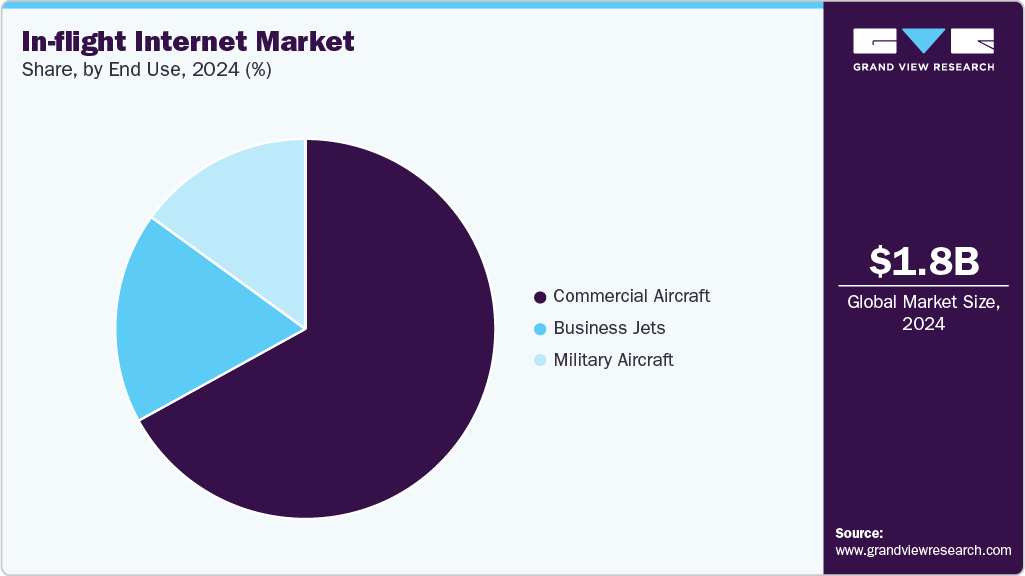
The commercial aircraft segment dominated the in-flight internet industry in 2024, the increasing demand for in-flight connectivity being fueled by rising passenger expectations for uninterrupted digital experiences during travel. Airlines are actively integrating advanced internet solutions to enhance customer satisfaction and differentiate their services in a competitive landscape. The surge in long haul and international flights, coupled with a growing reliance on personal and work-related online activities, has further amplified the need for reliable onboard connectivity. Additionally, fleet modernization programs and regulatory support for in-flight communications are accelerating the adoption of high-speed internet solutions across commercial aviation.
 To learn more about this report, Download Free Sample Report
 The military aircraft segment is expected to grow at the fastest CAGR in the coming years, owing to increasing defense modernization programs and the rising need for secure, real-time communication capabilities during missions. Governments are investing in advanced satellite-based connectivity solutions to support command, control, and surveillance operations across various platforms. The adoption of in-flight internet in military aviation is also driven by the integration of network-centric warfare systems and unmanned aerial vehicles (UAVs). Furthermore, rising geopolitical tensions and the increasing need for interoperability among allied forces are accelerating the deployment of robust and resilient connectivity infrastructure across military aviation assets.
Regional Insights
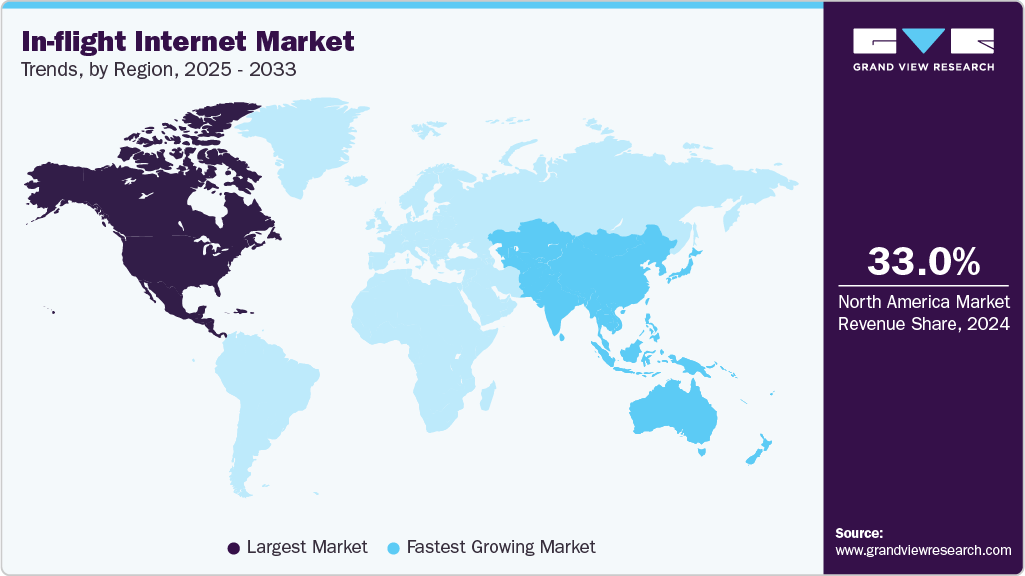
The North America in-flight internet market is dominated with a share of over 33.0% in 2024, the rapid adoption of next-gen satellite constellations and early commercial partnerships with providers like Starlink and OneWeb. Airlines are leveraging connectivity as part of loyalty and frequent flyer programs to enhance long-term customer engagement. Additionally, regulatory support and favorable spectrum policies are facilitating innovation and accelerating deployment timelines across the U.S. and Canadian airspace.
 To learn more about this report, Download Free Sample Report
 U.S. In-flight Internet Market Trends
The U.S. in-flight internet industry dominated the market with a share of over 72.0% in 2024, owing to the widespread availability of advanced satellite and air-to-ground infrastructure across domestic and international routes. Major U.S. carriers have prioritized onboard connectivity as a key differentiator, integrating it into loyalty programs and premium service tiers. Furthermore, strategic collaborations with leading technology providers, coupled with favorable FAA regulations, have expedited the deployment of high-speed in-flight internet across both legacy carriers and low-cost airline operations.
Europe In-flight Internet Market Trends
The Europe in-flight internet industry is expected to grow at a CAGR of over 4.0% from 2025 to 2033, driven by increased collaboration between airlines and telecom providers to implement scalable, pan-European in-flight broadband infrastructure. Low-cost carriers in the region are beginning to shift from limited offerings to ad-supported free internet to stay competitive. Moreover, the European Commission's Digital Sky initiative is supporting airspace modernization, which includes connected aircraft as a strategic component.
The Germany in-flight internet market is expected to grow at a significant rate in the coming years, fueled by airlines’ strategic investments in satcom upgrades to support expanding high-speed connectivity on both short-haul and intercontinental flights. German carriers are increasingly integrating in-flight Wi-Fi with loyalty programs and value-added digital services such as real-time entertainment and travel apps to deepen passenger engagement.
The in-flight internet market in the UK is expected to grow at a significant rate in the coming years, supported by airlines’ increasing focus on premium passenger experience and digital innovation. UK carriers are partnering with both global and regional satcom providers to deploy multi-band connectivity solutions tailored for short- and long-haul operations. Moreover, the integration of in-flight connectivity with real-time passenger services such as live journey updates, on-board retail, and personalized content will further drive market expansion.
Asia Pacific In-flight Internet Market Trends
The Asia Pacific in-flight internet industry is expected to grow at the fastest CAGR of over 8.0% from 2025 to 2033. The rising middle-class population and rapid expansion of regional carriers are fueling demand for onboard connectivity across emerging aviation hubs. Airlines are investing in multilingual content delivery and region-specific apps, driving passenger engagement beyond basic connectivity. Moreover, government-backed infrastructure programs in countries like India and China are encouraging local satellite deployment to improve cost-efficiency and coverage.
The China in-flight internet market is rapidly expanding, strengthened by strong domestic satellite infrastructure investments and aggressive rollout of Ka-band and HTS networks. Major Chinese carriers are incorporating localized content platforms and mobile integration features, such as in-flight e-commerce, regional streaming services, and travel apps, to enhance passenger engagement. Furthermore, government support for the “Digital Silk Road” and aviation modernization plans is driving innovation and accelerating the adoption of high-speed onboard connectivity across both domestic and international routes.
The in-flight internet market in Japan is experiencing strong momentum as airlines increasingly deploy next-generation in-flight connectivity systems such as Ka-band and hybrid architectures to accommodate rising demand for seamless streaming and business-class productivity. Airlines are also localizing digital services by integrating Japanese-language entertainment platforms, live news feeds, and travel tools to better cater to domestic travelers and inbound tourists. Supported by government initiatives to enhance aviation infrastructure and digital tourism, the market is poised for accelerated growth across both short-haul regional flights and long haul international routes.
Key In-flight Internet Company Insights
Some of the key players operating in the market include Panasonic Avionics and Thales Group.
-
Panasonic Avionics is a prominent player in in-flight entertainment and connectivity (IFEC), serving over 300 airlines worldwide. The company specializes in providing satellite-based broadband internet solutions and integrated content delivery platforms. Its strength lies in deep airline partnerships and a strong Ka-band satellite network that supports real-time streaming and global coverage. Panasonic continues to innovate through data analytics, passenger personalization, and seamless digital ecosystem integration.
-
Thales Group operates as an aerospace and defense technology company that also offers advanced in-flight connectivity and entertainment systems. The company specializes in full-stack IFEC solutions combining hardware, software, and satellite services. With a focus on enhancing passenger experience, Thales Group integrates real-time services, media content, and secure broadband through its FlytLIVE platform. Its strategic satellite partnerships and focus on digital aviation services make it a dominant player in global markets.
SmartSky Networks and Astronics are some of the emerging participants in the in-flight internet market.
-
SmartSky Networks is an emerging U.S.-based player focusing on high-speed air-to-ground (ATG) connectivity. The company specializes in low-latency, real-time data solutions optimized for domestic flights, particularly in the business aviation segment. Its innovative beamforming and network-switching technology differentiate it from traditional ATG providers. SmartSky is gaining attention for its performance in connected aircraft applications such as cockpit data sharing, VoIP, and in-flight streaming.
-
Astronics is known for providing cabin electronics and connectivity-enabling hardware to support in-flight internet systems. The company specializes in antennas, aircraft network servers, power systems, and other critical components used in IFEC deployments. While not a direct internet service provider, Astronics plays a vital supporting role in enabling seamless internet experiences on board. Its growing collaborations with IFEC integrators and OEMs are making it increasingly relevant in the evolving connectivity ecosystem.
Key In-flight Internet Companies:
The following are the leading companies in the in-flight internet market. These companies collectively hold the largest market share and dictate industry trends.
- Anuvu
- Astronics
- Cobham
- Collins Aerospace
- Gogo Business Aviation
- Iridium
- Panasonic Avionics
- SmartSky Networks
- Thales Group
- ViaSat
Recent Developments
-
In April 2025, Viasat introduced Amara, its next-generation in-flight connectivity solution designed to deliver scalable, high-capacity performance with seamless integration across multiple satellite networks and orbits. The solution supports future compatibility with the upcoming Viasat Aera electronically steered antenna, enabling dual-beam connectivity via GEO, HEO, and LEO satellites while leveraging existing onboard infrastructure. Amara also incorporates advanced digital services and ad-supported platforms, empowering airlines to enhance passenger experience, drive brand differentiation, and generate new ancillary revenue streams.
-
In February 2025, Aeromexico announced its collaboration with Viasat to retrofit its fleet of 17 Boeing 787 Dreamliners with next-generation Ka-band in-flight connectivity solutions. The upgrade will enable high-speed internet access for streaming, messaging, and browsing, supported by Viasat’s ad-funded platform to enhance passenger engagement. This strategic initiative reinforces Aeromexico’s commitment to elevating customer experience on long haul international routes while strengthening its long-term partnership with Viasat.
-
In January 2025, Air India rolled out complimentary in-flight Wi-Fi services on its domestic routes, becoming the first Indian airline to offer such a feature. The service is available on select Airbus A350, Boeing 787-9, and A321neo aircraft, allowing passengers to browse the internet, use social media, and stream content above 10,000 feet. This initiative reflects Air India’s commitment to enhancing passenger experience and aligning with global in-flight connectivity standards.
In-flight Internet Market Report Scope
Report Attribute
Details
Market size in 2024
USD 1.8 billion
Estimated Market size in 2026
USD 2.0 billion
Projected Market size by 2033
USD 3.0 billion
Growth rate
CAGR of 5.9% from 2025 to 2033
Base year of estimation
2024
Actual data
2021 - 2023
Forecast period
2025 - 2033
Quantitative units
Revenue in USD million/billion and CAGR from 2025 to 2030
Report coverage
Revenue forecast, company ranking, competitive landscape, growth factors, and trends
Segments covered
Service model, connectivity speed, technology, end use, region
Regional scope
North America; Europe; Asia Pacific; Latin America; Middle East & Africa
Country scope
U.S.; Canada; Mexico; Germany; UK; France; China; Japan; India; South Korea; Australia; Brazil; UAE; Saudi Arabia; South Africa
Key companies profiled
Anuvu; Astronics; Cobham; Collins Aerospace; Gogo Business Aviation; Iridium; Panasonic Avionics; SmartSky Networks; Thales Group; ViaSat
Customization scope
Free report customization (equivalent up to 8 analysts working days) with purchase. Addition or alteration to country, regional & segment scope.
Global In-flight Internet Market Report Segmentation
This report forecasts revenue growth at the global, regional, and country levels and provides an analysis of the latest industry trends in each of the sub-segments from 2021 to 2033. For this study, Grand View Research has segmented the global in-flight internet market report based on service model, connectivity speed, technology, end use, and region:
-
Service Model Outlook (Revenue, USD Million, 2021 - 2033)
-
Free Wi-Fi
-
Paid Wi-Fi
-
Premium Paid Wi-Fi
-
-
Connectivity Speed Outlook (Revenue, USD Million, 2021 - 2033)
-
High speed
-
Standard
-
Low bandwidth
-
-
Technology Outlook (Revenue, USD Million, 2021 - 2033)
-
Air to Ground
-
Satellite-based
-
Ka-band
-
Ku-band
-
L-band
-
Others
-
-
Hybrid
-
-
End Use Outlook (Revenue, USD Million, 2021 - 2033)
-
Commercial Aircraft
-
Business Jets
-
Military Aircraft
-
-
Regional Outlook (Revenue, USD Million, 2021 - 2033)
-
North America
-
U.S.
-
Canada
-
Mexico
-
-
Europe
-
Germany
-
UK
-
France
-
-
Asia Pacific
-
China
-
Japan
-
India
-
South Korea
-
Australia
-
-
Latin America
-
Brazil
-
-
Middle East and Africa (MEA)
-
UAE
-
Saudi Arabia
-
South Africa
-
-
Frequently Asked Questions About This Report
North America dominated the in-flight internet market with a share of 33.0% in 2024, owing to the high penetration of air travel, strong presence of major airlines, rapid adoption of advanced connectivity solutions, and significant investments in satellite and ground-based technologies to enhance passenger experience.
Some key players operating in the in-flight internet market include Anuvu, Astronics, Cobham, Collins Aerospace, Gogo Business Aviation, Iridium, Panasonic Avionics, SmartSky Networks, Thales Group, and ViaSat.
Key factors that are driving the market growth include rising passenger demand for seamless connectivity, increasing airline investments in satellite-based broadband solutions, and the growing adoption of BYOD (Bring Your Own Device) services during flights.
The global in-flight internet market size was valued at USD 1.8 billion in 2024 and is expected to reach USD 2.0 billion in 2026.
The global in-flight internet market is expected to grow at a compound annual growth rate of 5.9% from 2025 to 2033 to reach USD 3.0 billion by 2033.
About the Author(s)
Next Generation Technologies Research Team
Technology · Next Generation TechnologiesThis report was authored by the next generation technologies research team at Grand View Research - comprising two research analysts, one senior research analyst, and one industry expert - with specialized expertise in the next generation technologies segment of the technology industry. All findings are based on proprietary technology databases, executive interviews, and regulatory analysis, subject to internal peer review prior to publication.
Last Updated:
Speak to Analyst

Customize this report to your needs - add regions, segments, or data points, with 20% free customization.
Or view our licence options:


ISO 9001:2015 & 27001:2022 Certified
We are GDPR and CCPA compliant! Your transaction & personal information is safe and secure. For more details, please read our privacy policy.


