
- Home
- »
- Advanced Interior Materials
- »
-
In-Situ Recovery Mining Market Size & Share Report, 2033GVR Report cover

In-Situ Recovery Mining Market (2026 - 2033)
Size, Share & Trends Analysis Report By Material Recovery (Uranium, Copper, Lithium, Nickel), By Region (North America, Europe, Asia Pacific, Latin America, MEA), And Segment Forecasts
Market Size, 2025
$17.2BMarket Estimate, 2026
$18.7BMarket Forecast, 2033
$35.8BCAGR, 2026–2033
9.7%In-Situ Recovery Mining Market Summary
The global In-Situ recovery mining market size was valued at USD 17.2 billion in 2025 and is projected to grow from USD 18.7 billion in 2026 to USD 35.8 billion by 2033, at a CAGR of 9.7% from 2026 to 2033. The market in Asia Pacific dominated with a revenue share of 51.7% in 2025. The in-situ recovery mining industry is expanding due to the growing demand for uranium in nuclear power generation.
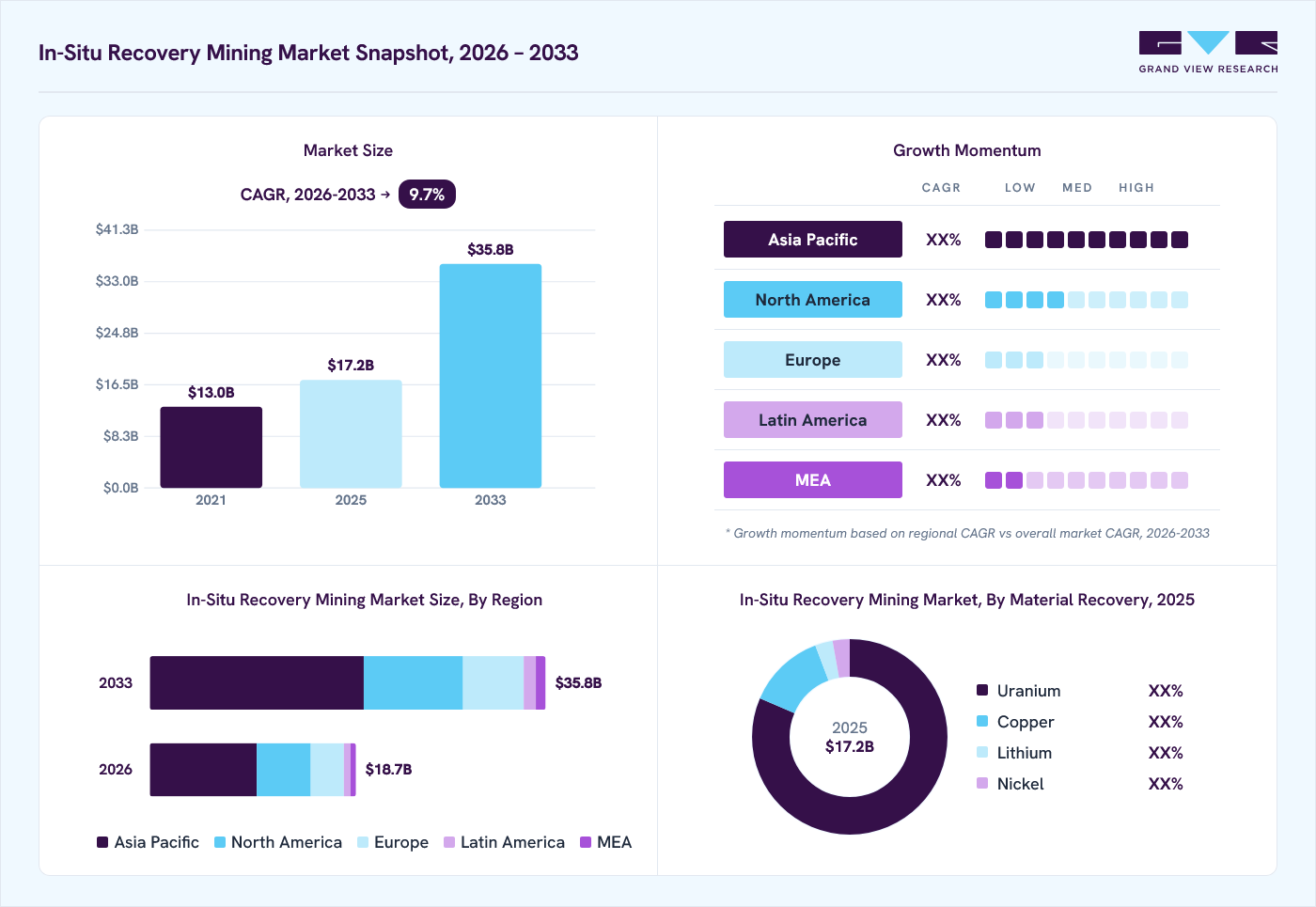 Source: Grand View Research, IR Documents, Primary Interviews, Paid DatabasesTo learn more about this report,
 Download Free Sample Report
Key Market Trends & Insights
- By material recovery: Uranium segment held the largest market share of 81.4% in 2025.
- The nickel segment is anticipated to register at the fastest CAGR over the forecast period.
Regional Highlights
- Largest regional market: Asia Pacific (51.7% revenue share, 2025)
- By country: Kazakhstan held the largest market share in 2025.
Market Size & Forecast
- Market size in 2025: USD 17.2 Billion
- Estimated market size in 2026: USD 18.7 Billion
- Projected market size by 2033: USD 35.8 Billion
- CAGR (2026-2033): 9.7%
Prism AI by Grand View Research Free to tryAsk a question about the In-Situ recovery mining marketTry asking✓Every figure cited from GVR research Prefer the report? Download free sample →Many countries are investing in nuclear energy as a reliable and cleaner source of electricity to reduce carbon emissions. This shift in energy policy has increased the requirement for uranium, which directly supports the adoption of in-situ recovery (ISR) techniques. These methods allow for efficient uranium extraction without the extensive environmental impact associated with traditional mining.
Cost efficiency is another major factor driving market growth. ISR mining requires significantly lower capital investment compared to open-pit or underground methods. Operating expenses remain relatively low since ISR mining eliminates the need for large-scale excavation and ore transportation. This cost advantage makes ISR an attractive option for new and existing players in the mining sector, particularly when dealing with low-grade deposits that would otherwise be uneconomical.
 To learn more about this report, Download Free Sample Report
Environmental benefits play a crucial role in the rising popularity of ISR mining. The process causes minimal surface disruption, reduces waste generation, and prevents the formation of large tailings or open pits. These environmental advantages make ISR projects more acceptable to local communities and regulatory authorities. Governments are also more likely to approve ISR operations due to their smaller ecological footprint and lower reclamation costs after mine closure.
Technological advancements are further supporting the growth of the in-situ recovery mining industry. Innovations in well design, solution chemistry, and monitoring systems have improved recovery rates and reduced contamination risks. Advanced data analytics and remote sensing technologies help operators control the leaching process more precisely, ensuring maximum yield while maintaining groundwater safety. Continuous research and development make ISR safer, more efficient, and economically viable across various mineral types.
Geopolitical and supply security factors are also contributing to the expansion of ISR mining. Countries seek to strengthen their domestic mineral supply chains to reduce import dependence, especially for strategic minerals like uranium and copper. In-situ recovery offers a faster and more flexible production route, enabling quicker responses to market fluctuations and policy changes. This strategic advantage and growing investment interest are expected to sustain the market’s upward trajectory in the coming years.
Market Dynamics
The in-situ recovery (ISR) mining market is gaining momentum as mining companies increasingly adopt extraction methods that offer lower capital investment, reduced environmental footprint, and faster project development compared to conventional mining. ISR technology enables the economic recovery of minerals from suitable ore bodies without large-scale excavation, making it an attractive solution for deposits located in environmentally sensitive regions or where traditional mining is technically challenging. Continuous advancements in hydrogeological modeling, wellfield design, process monitoring, and recovery technologies are improving extraction efficiency and expanding the range of minerals that can be recovered using ISR methods.
The rising focus on reducing mining costs while improving environmental performance is a major factor driving the in-situ recovery mining market. Compared to conventional open-pit and underground mining, ISR requires significantly lower upfront capital expenditure, minimal overburden removal, reduced infrastructure development, and fewer surface processing facilities. These advantages enable mining companies to economically develop lower-grade or deeper mineral deposits that may not be commercially viable through traditional mining methods.
In addition, stricter environmental regulations and growing pressure to reduce the ecological impact of mining operations are accelerating the adoption of ISR technologies worldwide. The process generates substantially less waste rock and tailings, reduces land disturbance, lowers greenhouse gas emissions associated with excavation and material transport, and simplifies mine site rehabilitation after production. As governments and mining operators prioritize sustainable resource development and responsible mining practices, investments in ISR projects are expected to increase across uranium and emerging critical mineral sectors, supporting long-term market growth.
The applicability of in-situ recovery mining is restricted to specific geological and hydrogeological conditions where mineral deposits possess adequate permeability, favorable ore mineralogy, and confined groundwater systems. Many mineral deposits do not meet these technical requirements, limiting the widespread deployment of ISR technology. In addition, obtaining environmental permits often involves extensive groundwater studies, long approval timelines, and continuous monitoring obligations, increasing project complexity and development costs.
The increasing global focus on securing domestic supplies of critical minerals presents substantial opportunities for the in-situ recovery mining market. Ongoing research into ISR techniques for lithium, rare earth elements, copper, and nickel is expanding the commercial potential of the technology beyond its traditional uranium applications. Advances in selective lixiviants, digital reservoir modeling, automation, and real-time monitoring systems are expected to improve recovery efficiency, reduce environmental risks, and enable economically viable extraction from previously inaccessible mineral deposits.
Analyst Perspective
The in-situ recovery (ISR) mining market is expected to maintain steady growth, supported by increasing investment in uranium and critical mineral development. The industry's shift toward cost-efficient and environmentally responsible extraction methods is accelerating the adoption of ISR technologies. Advancements in wellfield management and recovery processes are improving project economics and operational performance. Continued exploration of ISR-suitable deposits and supportive government policies are expected to strengthen the market's long-term growth outlook.
Material Recovery Insights
The uranium segment led the market, accounting for the largest revenue share of 81.4% in 2025, driven by its critical role in nuclear power generation and the continued demand for uranium-based fuel. Growing investments in nuclear energy capacity, reactor life extensions, and the development of new nuclear power projects are supporting uranium consumption. Rising focus on low-carbon electricity generation and energy security is further contributing to demand for uranium and strengthening the segment’s position in the market.
The nickel segment is anticipated to register at the fastest CAGR over the forecast period. The nickel segment is witnessing strong growth driven by rising demand from the electric vehicle and battery manufacturing industries. Nickel is a crucial component in lithium-ion batteries, and the shift toward clean energy and sustainable mobility has significantly increased its consumption. Expanding infrastructure for renewable power generation and storage systems is also adding momentum to nickel demand.
Regional Insights
The in-situ recovery mining market in North America is growing rapidly, due to rising demand for uranium, copper, and other critical minerals needed for the clean energy transition and industrial use. The U.S. and Canada are leading in adopting in-situ recovery technologies, aiming to reduce environmental impacts associated with conventional mining. Favorable geological formations in regions such as Wyoming and Texas support efficient in-situ leaching. At the same time, ongoing research in solution chemistry and ore-body mapping improves metal recovery efficiency and site safety.
U.S. In-Situ Recovery Mining Market Trends
The in-situ recovery mining market in the U.S. is experiencing steady growth supported by the rising need for domestically sourced minerals essential for energy security and industrial production. The technique is gaining importance in uranium and copper extraction, particularly in states such as Wyoming, Texas, and Nebraska, where favorable geology and established regulatory structures exist. Its appeal lies in minimal surface disruption and a lower carbon footprint than conventional mining, aligning well with national sustainability goals and environmental standards.
 To learn more about this report, Download Free Sample Report
Asia Pacific In-Situ Recovery Mining Market Trends
Asia Pacific dominated the in-situ recovery mining market with the largest revenue share of 51.7% in 2025, as demand for critical minerals and low-carbon production methods rises. Advances in hydrogeological modeling, leaching chemistries, and monitoring technologies have improved recovery rates and reduced surface disturbance, making the technique attractive for deposits that are otherwise uneconomic to mine. Growing interest from uranium and investors, paired with government support for domestic supply chains of battery and nuclear materials, encourages regional pilot projects and feasibility studies.
The in-situ recovery mining market in Kazakhstan held the largest share in the Asia Pacific region in 2025. Kazakhstan’s in-situ recovery (ISR) mining market is primarily supported by the country’s large uranium resources and extensive use of ISR for uranium extraction. The method enables selective recovery of uranium from suitable deposits with comparatively lower surface disturbance and reduced conventional mining requirements. Continued uranium production, resource development, and investments in mining efficiency and technology are expected to sustain demand for ISR-related equipment, services, and processing capabilities in Kazakhstan.
Europe In-Situ Recovery Mining Market Trends
The in-situ recovery mining market in Europe is gradually emerging as countries explore sustainable ways to extract strategic minerals needed for renewable energy technologies and electric vehicles. Nations such as Finland, Germany, and the Czech Republic are conducting feasibility studies to evaluate the potential of in-situ leaching for uranium, lithium, and rare earth elements. The method’s ability to minimize land disturbance and reduce waste generation aligns well with the European Union’s environmental and circular economy goals, creating a favorable policy environment for pilot projects.
Middle East & Africa In-Situ Recovery Mining Market Trends
The in-situ recovery mining market in the Middle East & Africa is gaining attention as countries look to diversify their mining portfolios and adopt more sustainable extraction practices. The technique offers a viable solution for mineral recovery in regions with sensitive ecosystems or limited water availability, as it reduces land disturbance and overall environmental impact. Nations such as Saudi Arabia, Namibia, and South Africa are exploring their potential for uranium and copper extraction, supported by rising mineral exploration investments and government-backed green mining technologies initiatives.
Latin America In-Situ Recovery Mining Market Trends
The in-situ recovery mining market in Latin America is developing as several countries explore cleaner and more cost-efficient extraction techniques for metals such as copper, uranium, and lithium. The region’s rich mineral reserves, particularly in Chile, Argentina, and Brazil, provide strong potential for implementing in-situ recovery methods. Growing attention toward minimizing surface disruption and meeting stricter environmental standards pushes uranium to test this approach in existing and new deposits. Supportive government policies promoting sustainable mining practices further encourage regional pilot projects and research collaborations.
Key In-Situ Recovery Mining Company Insight
Some of the key players operating in the market include Cameco Corporation, Crow Butte Resources, and Nickel.
-
Cameco Corporation is one of the world’s largest publicly traded uranium producers, headquartered in Saskatoon, Canada. Established in 1988, it has grown into a key player in the global nuclear fuel industry, supplying uranium for power generation in multiple countries. Cameco’s operations span exploration, mining, and refining, strongly focusing on sustainability, safety, and environmental stewardship. Cameco primarily operates through its U.S.-based ISR uranium facilities. These operations involve extracting uranium from underground ore deposits by circulating a leaching solution, which dissolves the uranium for recovery at the surface.
-
Crow Butte Resources, a subsidiary of Cameco Corporation, focuses on ISR uranium mining in the United States, particularly in Nebraska. Established in 1993, Crow Butte has developed expertise in operating ISR facilities efficiently and responsibly. The company emphasizes environmental stewardship, community engagement, and adherence to federal and state regulations, positioning itself as a reliable uranium supplier. Crow Butte’s ISR operations involve injecting oxygenated and bicarbonate solutions into underground uranium-bearing formations to dissolve uranium, which is then pumped to the surface for processing. The process is carefully monitored to protect groundwater and surrounding ecosystems, with reclamation plans implemented post-extraction.
Key In-Situ Recovery Mining Companies
The following key companies have been profiled for this study on the in-situ recovery mining market.
-
Cameco Corporation
-
Crow Butte
-
Denison Mines Corp
-
Energy Fuels Inc
-
Heathgate Resources Pty Ltd
-
KATCO
-
Kazatomprom
-
Smith Ranch‑Highland
-
Uranium Energy Corp
-
Ur‑Energy Inc
Competitive Benchmarking
Category
Operating Strategies
Competitive Edge
Weakness
Established Players (e.g., Cameco Corporation, Kazatomprom, KATCO, Energy Fuels Inc., Heathgate Resources Pty Ltd., Uranium Energy Corp., Ur-Energy Inc.)
- Optimize wellfield expansion and recovery rates to maximize output from existing ISR assets.
- Invest in digital monitoring and hydrogeological modeling to improve operational efficiency and resource recovery.
- Advance brownfield expansion and resource conversion programs to extend mine life and production capacity.
- Extensive operational experience enables efficient execution of large-scale ISR mining projects.
- Established regulatory expertise supports timely project approvals and environmental compliance.
- Large resource portfolios provide long-term production visibility and supply reliability.
- Production remains dependent on favorable hydrogeological conditions and suitable ore permeability.
- Wellfield development requires continuous capital investment to sustain production levels.
- Revenue is highly influenced by fluctuations in uranium prices and nuclear fuel demand.
Emerging & Regional Players (e.g., Denison Mines Corp., Crow Butte, Smith Ranch-Highland)
- Accelerate feasibility studies and pilot-scale ISR programs to commercialize new deposits.
- Strengthen strategic partnerships to secure financing and technical expertise for project development.
- Focus on selective asset acquisitions to expand regional ISR resource portfolios.
- Agile organizational structures enable faster project evaluation and development decisions.
- Focused asset portfolios allow efficient allocation of capital toward high-potential deposits.
- Strong regional presence facilitates engagement with local stakeholders and regulatory authorities.
- Limited production scale reduces economies of scale compared with established competitors.
- Dependence on external financing can delay project advancement and expansion activities.
- Smaller operational portfolios increase exposure to individual project development risks.
Recent Development
-
In October 2025, the U.S. Department of Energy’s Office of Fossil Energy launched a USD 95 million “Mine of the Future” initiative to propel sustainable mining innovation through ISR technology. ISR, also known as solution mining, extracts valuable minerals directly from underground deposits by injecting lixiviant solutions and recovering them through a network of wells, eliminating the need for excavation. This approach significantly reduces surface disturbance, water consumption, and greenhouse gas emissions, requiring less than 10% of the land used in traditional mining and recycling over 95% of process water.
In-Situ Recovery Mining Market Report Scope
Report Attribute
Details
Market definition
Market size represents the total value of indium refined or produced at the refinery level.
Market size in 2025
USD 17.2 billion
Estimated market size in 2026
USD 18.7 billion
Projected market size by 2033
USD 35.8 billion
Growth rate
CAGR of 9.7% from 2026 to 2033
Base year for estimation
2025
Historical data
2021 - 2024
Forecast period
2026 - 2033
Quantitative units
Revenue in USD million and CAGR from 2026 to 2033
Report coverage
Revenue forecast, company ranking, competitive landscape, growth factors, and trends
Segments covered
Material recovery, region
Regional scope
North America; Europe; Asia Pacific; Latin America
Country scope
U.S.; Canada; Mexico; Germany; UK; France; China; India; Japan; Brazil
Key companies profiled
Cameco Corporation; Crow Butte; Denison Mines Corp.; Energy Fuels Inc.; Heathgate Resources Pty Ltd.; KATCO; Kazatomprom; Smith Ranch-Highland; Uranium Energy Corp.; Ur-Energy Inc.
Customization scope
Free report customization (equivalent up to 8 analysts' working days) with purchase-addition or alteration to country, regional & segment scope.
Pricing and purchase options
Avail customized purchase options to meet your exact research needs. Explore purchase options
Global In-Situ Recovery Mining Market Report Segmentation
This report forecasts revenue and volume growth at global, regional, and country levels and provides an analysis of the latest industry trends in each of the sub-segments from 2021 to 2033. For this study, Grand View Research has segmented the global in-situ recovery mining market report based on mineral and region.
 To learn more about this report, Download Free Sample Report
-
Material Recovery Outlook (Volume, Tons; Revenue, USD Million, 2021 - 2033)
-
Uranium
-
Copper
-
Lithium
-
Nickel
-
-
Regional Outlook (Volume, Tons; Revenue, USD Million, 2021 - 2033)
-
North America
-
U.S.
-
Canada
-
Mexico
-
-
Europe
-
Germany
-
UK
-
France
-
-
Asia Pacific
-
China
-
India
-
Japan
-
-
Latin America
-
Brazil
-
-
Middle East & Africa
-
Research Methodology
The In-Situ recovery mining Market figures in this report are based on a proven research process that combines executive interviews with secondary research from proprietary databases, company filings, and recognized regulatory and institutional sources. Market size is built through value-chain sizing - reconciling supply-side and demand-side estimates - and triangulated with bottom-up and top-down approaches. Every estimate passes multiple levels of expert validation before publication, with each In-Situ Recovery Mining Market segment quantified using the revenue-capture definitions in the table below.
Segment Definition
Material Recovery
Revenue Capture Definition
Uranium
This segment includes uranium recovered through in-situ recovery (ISR) mining for use as nuclear fuel in commercial nuclear power plants and research reactors. Revenue is generated from the sale of uranium concentrate (U₃O₈/yellowcake) supplied to nuclear fuel conversion and enrichment facilities.
Copper
This segment comprises copper recovered through in-situ recovery mining and processed into cathodes or other refined copper products for use in electrical wiring, power transmission, construction, electronics, transportation, and industrial equipment. Revenue is generated from the sale of ISR-produced copper to downstream manufacturers and metal processors.
Lithium
This segment includes lithium recovered through in-situ recovery technologies, primarily from suitable brine or sedimentary deposits, to produce lithium chemicals used in rechargeable batteries, energy storage systems, ceramics, glass, and specialty chemicals. Revenue is generated from the sale of lithium compounds supplied to battery manufacturers and chemical producers.
Nickel
This segment covers nickel recovered through in-situ recovery mining for use in stainless steel production, electric vehicle batteries, aerospace alloys, and specialty industrial applications. Revenue is generated from the sale of nickel products supplied to battery material producers, stainless steel manufacturers, and alloy producers.
Estimation Model
Layer Name
Key Question
Description
ISR Project Development Layer
Where is future market potential concentrated?
This layer evaluates the global pipeline of in-situ recovery mining projects, covering exploration-stage, feasibility-stage, construction-stage, and operating assets. It identifies regions with favorable geological conditions, investment activity, licensing progress, and upcoming project developments that are expected to contribute to future market growth.
Operational Mining Layer
Which operations contribute to the current market?
This layer examines commercially operating ISR mines and production facilities by mineral and geography. It assesses the operating footprint of major mining companies, production capabilities, wellfield development, mine expansions, and operational performance that collectively support current market revenues.
Technology Adoption Layer
What factors improve commercial viability?
This layer analyzes the deployment of advanced ISR technologies and operational practices that enhance recovery efficiency, reduce operating costs, and improve environmental performance. It includes innovations in wellfield engineering, leaching processes, groundwater management, automation, digital monitoring, and process optimization that support wider adoption of ISR mining.
Revenue Layer
How is market value calculated?
This layer estimates the market in value terms by assessing revenue generated from commercial ISR mining activities. Market value is determined by the scale of active operations, commissioning of new projects, mineral price movements, production performance, investment in capacity expansion, and the overall commercial adoption of ISR mining across different mineral categories.
Delivered Customizations
This report has been delivered with the following In-depth customizations
Client Request
Customization Delivered
Value Adds
ISR Project Pipeline & Capacity Analysis
Comprehensive assessment of operational, under-development, and planned ISR mining projects by mineral and region, including production capacity, project status, mine life, and expansion plans.
Supported investment prioritization, capacity planning, and identification of future production opportunities.
Mine Life & Reserve Analysis
Evaluation of reserves, resources, mine life, production outlook, and reserve replacement across major ISR operations.
Assisted long-term production forecasting and asset valuation.
Wellfield & Recovery Technology Assessment
Analysis of ISR wellfield design, lixiviant systems, recovery methods, groundwater management practices, and process innovations across key projects.
Supported technology benchmarking and operational efficiency improvements.
Frequently Asked Questions About This Report
The key factor driving the growth of the global in-situ recovery mining market is the increasing demand for cost-effective and environmentally sustainable extraction methods that minimize surface disturbance and water consumption compared to conventional mining techniques.
The global in-situ recovery mining market size was valued at USD 17.2 billion in 2025 and is estimated at USD 18.7 billion for 2026.
The global in-situ recovery mining market is expected to grow at a CAGR of 9.7% from 2026 to 2033, reaching USD 35.8 billion by 2033.
Asia Pacific dominated the in-situ recovery mining market with the largest revenue share of 51.7% in 2025.
The in-situ recovery mining market in Kazakhstan held the largest share in the Asia Pacific region in 2025.
North America is anticipated to register the second fastest CAGR of 9.2% over the forecast period.
The Nickel segment is expected to grow at the fastest CAGR over the forecast period.
Based on minerals, the Uranium segment led the market with the largest revenue share of 81.4% in 2025.
The key players operating in the in-situ recovery mining market are Cameco Corporation, Crow Butte, Denison Mines Corp., Energy Fuels Inc., Heathgate Resources Pty Ltd., KATCO, Kazatomprom, Smith Ranch-Highland, Uranium Energy Corp., Ur-Energy Inc., among others.
About the Author(s)
Advanced Interior Materials Research Team
Advanced Materials · Advanced Interior MaterialsThis report was authored by the advanced interior materials research team at Grand View Research - comprising two research analysts, one senior research analyst, and one industry expert - with specialized expertise in the advanced interior materials segment of the advanced materials industry. All findings are based on proprietary advanced materials databases, executive interviews, and regulatory analysis, subject to internal peer review prior to publication.
Last Updated:
Speak to Analyst

Customize this report to your needs - add regions, segments, or data points, with 20% free customization.
Or view our licence options:


ISO 9001:2015 & 27001:2022 Certified
We are GDPR and CCPA compliant! Your transaction & personal information is safe and secure. For more details, please read our privacy policy.


