
- Home
- »
- Advanced Interior Materials
- »
-
Industrial Aerators Market Size & Share Report, 2026-2033GVR Report cover

Industrial Aerators Market (2026 - 2033)
Size, Share & Trends Analysis Report By Product (Diffused Aerators, Surface Aerators), By Installation (New Installation, Replacement), By End-use (Food & Beverage, Pharmaceuticals & Biotechnology), By Region, And Segment Forecasts
Market Size, 2025
$1,436.1MMarket Estimate, 2026
$1,483.6MMarket Forecast, 2033
$2,031.2MCAGR, 2026–2033
4.6%Industrial Aerators Market Summary
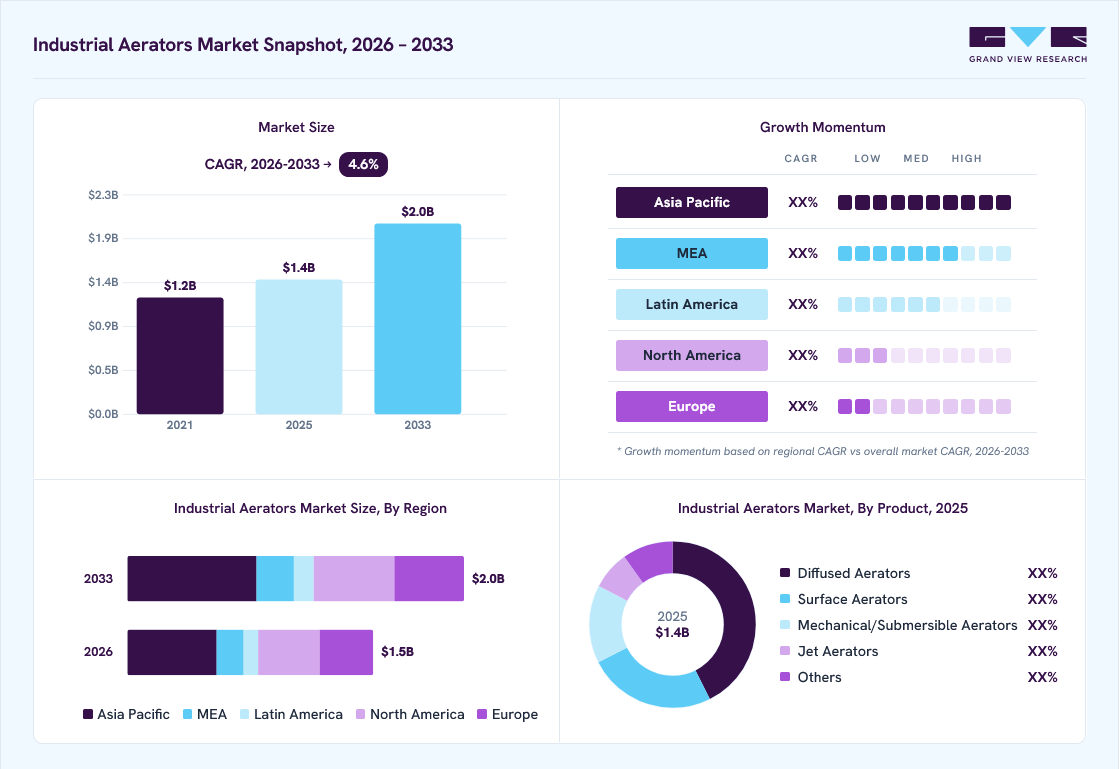
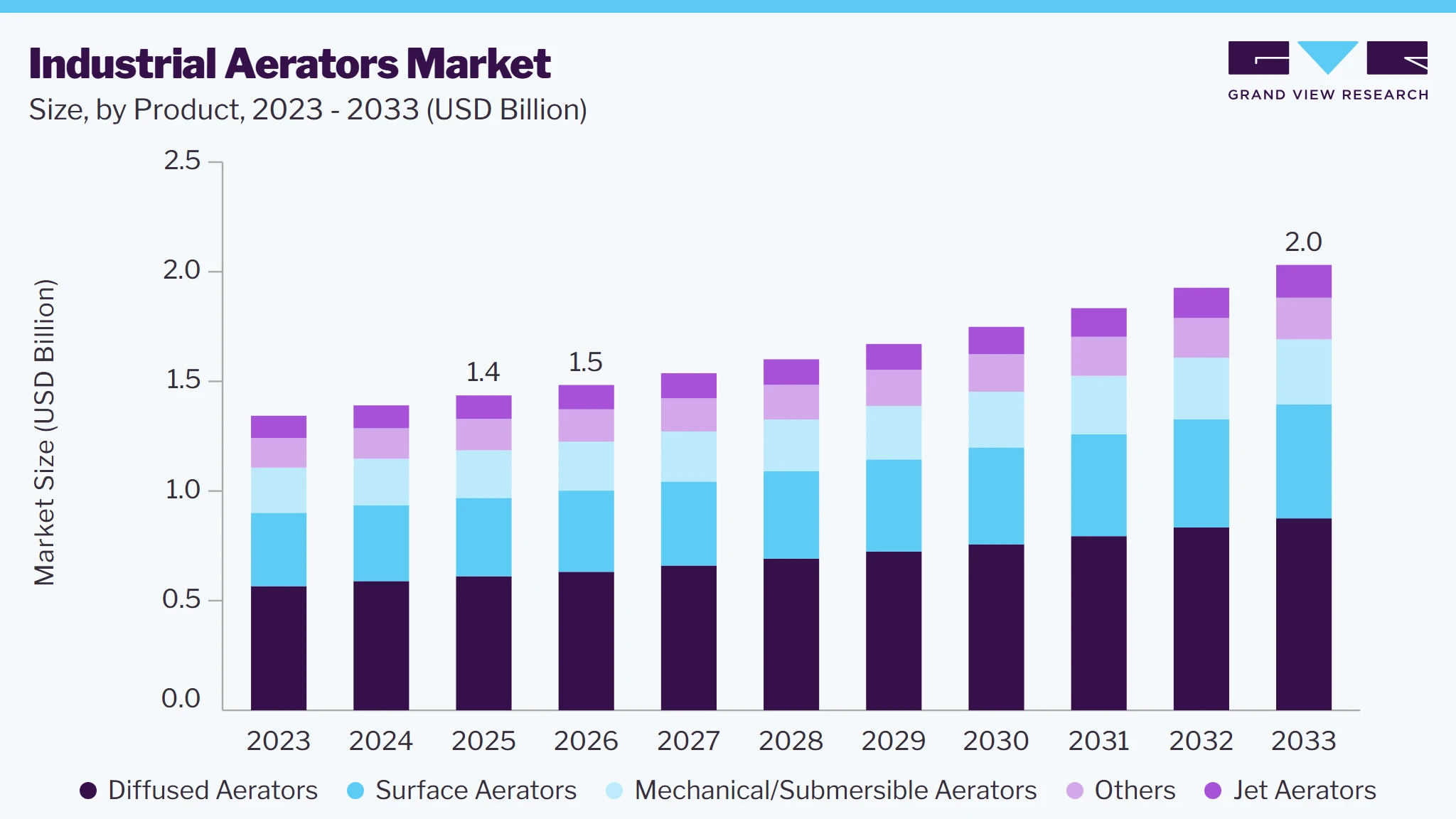
The global industrial aerators market size was valued at USD 1,436.1 million in 2025 and is projected to grow from USD 1,483.6 million in 2026 to USD 2,031.2 million by 2033, at a CAGR of 4.6% from 2026 to 2033. Asia Pacific dominated the market, accounting for the revenue share of 36.1% in 2025. The rising industrial wastewater treatment requirements are driving demand for industrial aerators as manufacturing activity expands across food & beverage, chemicals, pharmaceuticals, pulp & paper, textiles, and other water-intensive industries.
 Source: Grand View Research, IR Documents, Primary Interviews, Paid DatabasesTo learn more about this report,
 Download Free Sample Report
 Key Market Trends & Insights
- Based on product: Diffused aerators segment led the market with the largest revenue share of 42.6% in 2025.
- Based on installation: New installation segment led the market with the largest revenue share of 64.1% in 2025.
- Based on end use: Food & beverage segment led the market with the revenue share of 20.1% in 2025.
Regional Highlights
- Largest regional market: Asia Pacific (36.1% revenue share, 2025)
- By Country: China held the largest market share in 2025
Market Size & Forecast
- Market Size in 2025: USD 1,436.1 Million
- Estimated market size in 2026: USD 1,483.6 Million
- Projected Market Size by 2033: USD 2,031.2 Million
- CAGR (2026-2033): 4.6%
Three ways to get this report
Buy it, customize it, or ask a question.Ask an Analyst
A direct answer, usually in 1 working day
- AccessReport author, directly
- Reply timeWithin 1 working day
- No sales callDirect answer only
- FormatEmail reply
- CostFree, no cost
Get the Full Report
What the study covers
- FormatsPDF · Excel · Dashboard
- Timeline2026–2033 annual, 2025 base
- Coverage20+ countries, 5 regions
- Companies10+ key players profiled
Customize the Report
20% free customization
- IncludeCountries, segments, points
- TailorTo your product definition
- ExtendDeeper competitor detail
- OrA fully bespoke study
- Turnaround5–10 working days
Increasing wastewater volumes and the need to meet stringent effluent discharge standards are encouraging industrial facilities to invest in new treatment plants and upgrade existing systems. Aeration is a critical stage in biological wastewater treatment because it supplies the oxygen required for microbial degradation of organic pollutants, supporting effective BOD and COD removal and overall effluent quality.
 To learn more about this report, Download Free Sample Report
 Growing emphasis on energy efficiency and treatment performance is further supporting the adoption of advanced aeration technologies. Aeration can represent a substantial share of wastewater-treatment energy consumption, prompting industries to replace inefficient equipment with fine-bubble diffusers, high-efficiency mechanical aerators, variable-speed systems, and automated dissolved-oxygen controls. These technologies enable the oxygen supply to be better matched to actual treatment demand, helping to reduce electricity consumption and operating costs while maintaining treatment performance.
Market Dynamics
The industrial aerators market is driven by rising industrial wastewater generation, increasingly stringent effluent discharge requirements, expansion and modernization of wastewater treatment infrastructure, and a growing emphasis on energy-efficient treatment processes. Demand is also supported by the replacement of aging aeration equipment and the adoption of advanced systems that provide improved oxygen-transfer efficiency and process control. At the same time, high energy consumption, capital requirements, maintenance needs, and technical challenges associated with retrofitting existing treatment facilities can limit adoption. The growing focus on water reuse, digital monitoring, and energy optimization is creating additional opportunities for advanced aeration technologies.
Increasing industrial production across water-intensive sectors is generating larger and more complex wastewater streams, increasing the need for effective biological treatment systems. Aeration is a critical component of aerobic treatment because microorganisms require dissolved oxygen to break down organic pollutants and support nutrient removal. As industrial facilities expand their treatment capacity and seek to meet tighter effluent-quality requirements, demand for reliable aeration equipment is increasing. This trend is particularly relevant for industries such as food and beverage, chemicals, pharmaceuticals, pulp and paper, and textiles, where wastewater treatment is an integral part of production operations.
Stricter environmental requirements are also encouraging industries to upgrade existing wastewater-treatment systems and invest in more effective aeration solutions. In addition to achieving compliance, industrial operators are increasingly focused on reducing treatment operating costs, making oxygen-transfer efficiency an important criterion for equipment selection. Since aeration accounts for a major portion of wastewater treatment energy consumption, facilities have a strong incentive to adopt equipment and control systems that provide the required oxygen supply without excessive aeration. This combination of regulatory compliance, treatment performance, and operating-cost reduction supports sustained demand for industrial aerators.
High energy consumption and associated lifecycle costs remain a major restraint for the industrial aerators market. Aeration systems operate continuously in many treatment applications and can represent a substantial share of total wastewater-treatment energy use, particularly in biological treatment processes. Older or poorly optimized systems may supply more oxygen than required, resulting in unnecessary electricity consumption and higher operating costs. In addition, aeration equipment requires periodic maintenance because components can experience fouling, corrosion, wear, and performance degradation. These factors can discourage smaller industrial facilities or cost-sensitive operators from undertaking major aeration-system upgrades.
The increasing adoption of energy-efficient and digitally controlled aeration systems presents a significant opportunity for market participants. Fine-bubble diffusers, high-efficiency equipment, variable-speed operation, dissolved-oxygen sensors, and automated control systems can optimize oxygen delivery according to real-time treatment requirements. Advanced control strategies can reduce excess aeration while maintaining required treatment performance, improving the economic attractiveness of system upgrades. Opportunities are particularly strong in existing industrial treatment plants where operators can achieve energy savings through replacement, retrofit, and modernization of conventional aeration equipment.
Market Concentration & Characteristics
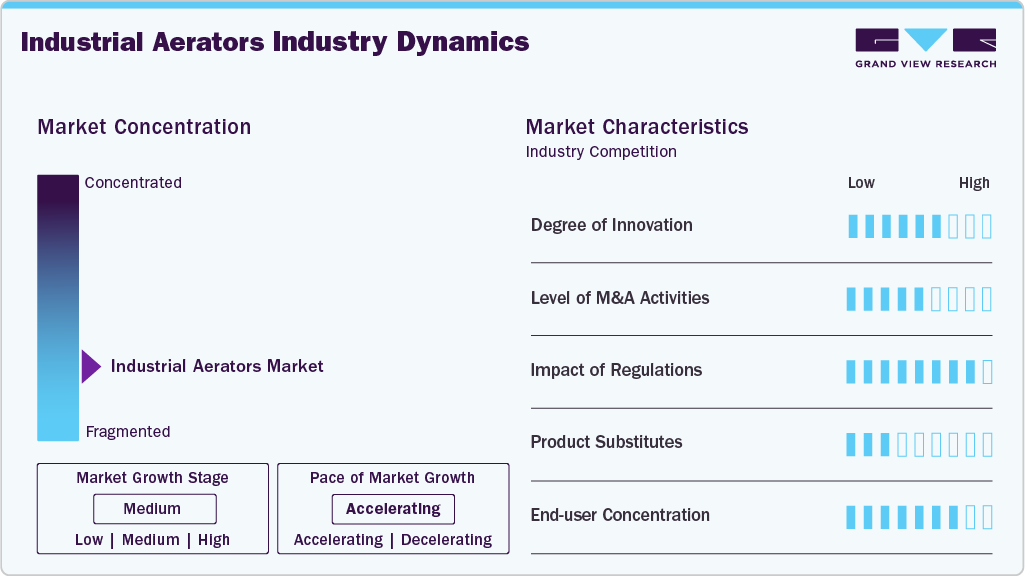
The industrial aerators market is fragmented, with a large number of global, regional, and specialized manufacturers competing across different aeration technologies and industrial applications. No single participant holds a dominant market share, while the presence of numerous suppliers across product categories creates intense competition. Market participants primarily compete based on oxygen-transfer efficiency, energy consumption, equipment reliability, customization, product lifecycle, and after-sales service. Fragmentation is further supported by varying wastewater-treatment requirements across industries and regions, which creates opportunities for specialized manufacturers to serve specific applications and customer needs.
The industrial aerators industry demonstrates a moderate-to-high degree of innovation, with technological development focused primarily on improving oxygen-transfer efficiency, reducing energy consumption, and enhancing process control. Innovation is increasingly centered on fine-bubble diffusion, high-efficiency blowers and motors, variable-speed operation, and automated dissolved-oxygen monitoring and control. These developments allow aeration systems to adjust oxygen supply according to changing wastewater loads while maintaining treatment performance.
 To learn more about this report, Download Free Sample Report
 Regulation has a high impact on the market because industrial facilities must comply with increasingly stringent wastewater discharge requirements. Standards governing organic pollutants, nutrients, and overall effluent quality encourage industries to install, upgrade, and optimize biological wastewater-treatment systems, thereby supporting demand for aeration equipment. Regulatory requirements also indirectly promote energy-efficient aeration technologies because treatment facilities need to achieve the required effluent quality while controlling operating costs.
The industry has a moderate level of end-user concentration, as demand is distributed across several wastewater-intensive industries rather than being dependent on a single sector. Food & beverage, chemical and petrochemical, pulp & paper, pharmaceutical, oil & gas, power generation, and textile industries have distinct wastewater characteristics and oxygen requirements, resulting in diverse aeration applications. However, larger industrial facilities with high wastewater volumes can account for substantial equipment demand because their treatment systems require higher-capacity and continuously operating aeration equipment.
Analyst Perspective
The industrial aerators market is expected to maintain steady growth as industries increasingly prioritize wastewater treatment, regulatory compliance, water reuse, and energy efficiency. Demand is likely to remain strongest in water-intensive industries such as food processing, chemicals, pharmaceuticals, pulp and paper, and oil & gas, while replacement and retrofit projects are expected to become increasingly important as the installed equipment base ages. From a technology perspective, the market is shifting toward higher-efficiency aeration, improved oxygen-transfer performance, and automated process control, creating opportunities for manufacturers offering solutions that reduce energy consumption and operating costs. Regionally, Asia Pacific offers the strongest growth potential, while mature markets in North America and Europe are likely to provide stable demand through modernization and equipment replacement.
Product Insights
The diffused aerators segment dominated the industrial aerators market in 2025, owing to their high oxygen-transfer efficiency and suitability for biological wastewater treatment. These systems introduce air through submerged diffusers, creating bubbles that increase the gas-liquid contact area and enable effective oxygen transfer throughout the treatment basin. Fine-pore diffused systems are particularly attractive for industrial facilities seeking to improve aeration efficiency and manage energy consumption, making them suitable across a broad range of wastewater-treatment applications.
The surface aerators segment is projected to be the fastest-growing product segment at a CAGR of 5.0% over the forecast period, driven by the ability to provide both oxygenation and mixing with comparatively straightforward installation and operation. These aerators are particularly suitable for industrial facilities where robust mixing, ease of maintenance, and flexibility in basin configuration are important considerations. Surface aeration can also offer an attractive solution for upgrading or replacing equipment in existing treatment facilities where installing extensive submerged diffuser networks or associated air infrastructure may be less practical.
Installation Insights
The new installation segment dominated the industry in 2025, fueled by the development of new industrial wastewater-treatment facilities and the expansion of existing production capacities. Increasing industrial activity across water-intensive sectors is creating additional wastewater treatment requirements, while stricter discharge standards are encouraging companies to incorporate efficient aeration systems into newly constructed treatment facilities. New installations also provide opportunities to deploy modern aeration technologies, automated controls, and energy-efficient equipment from the design stage, supporting their continued dominance.
The replacement segment is projected to grow at a CAGR of 4.4% over the forecast period, supported by the aging installed base of wastewater-treatment equipment and the need to improve reliability, treatment performance, and energy efficiency. Industrial facilities are increasingly replacing older aerators and associated equipment with higher-efficiency systems to reduce operating costs and maintain consistent oxygen transfer. Retrofit and replacement projects also provide an attractive pathway for upgrading existing plants without constructing entirely new treatment facilities, further supporting segment growth.
End Use Insights
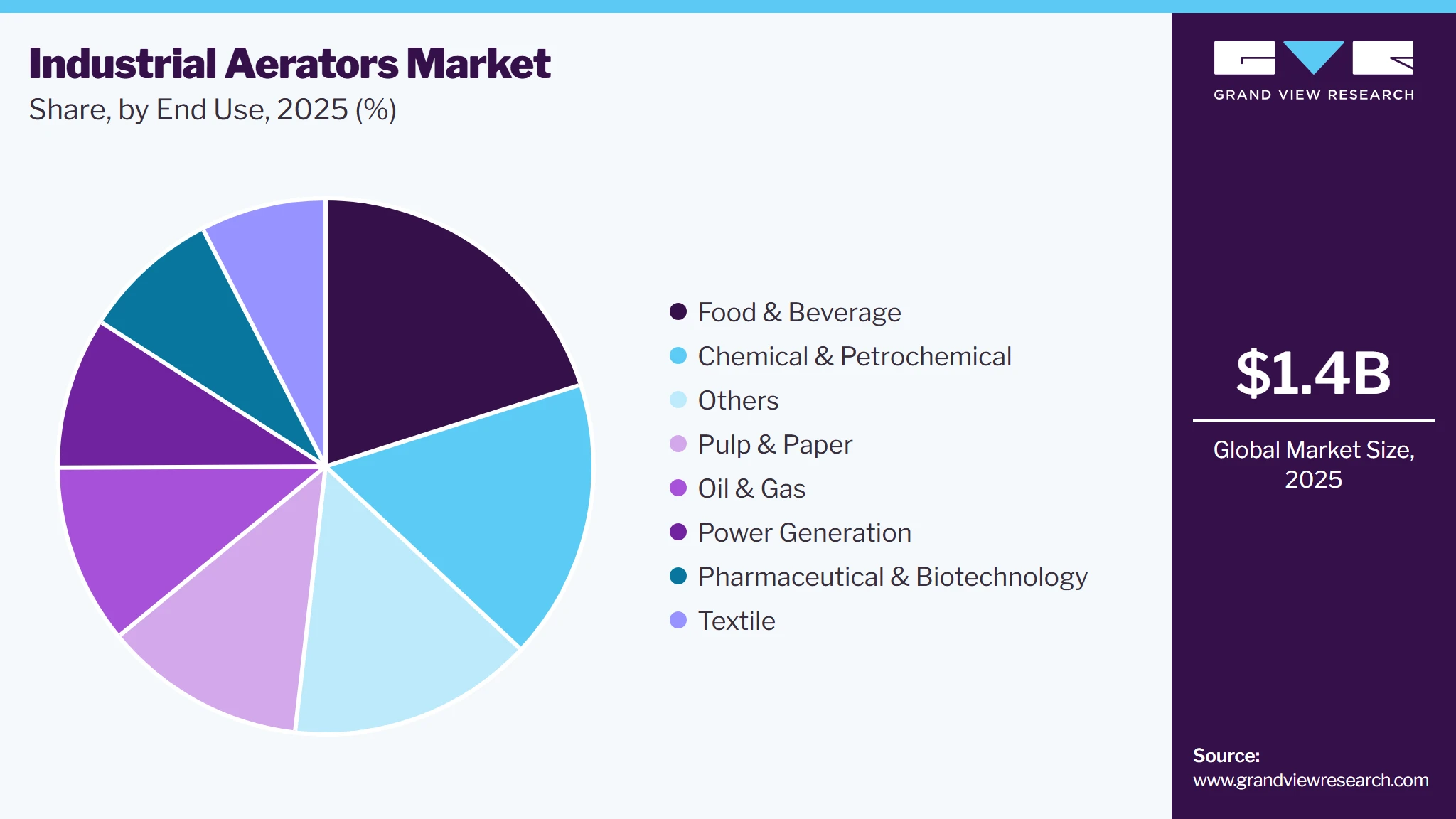
The food & beverage segment emerged as the largest end-use segment in 2025, driven by the high volume and organic load of wastewater generated by food-processing, dairy, beverage, meat, and other food-production facilities. These operations discharge wastewater containing substantial concentrations of biodegradable organic matter, fats, oils, proteins, and carbohydrates, necessitating biological wastewater treatment and a continuous oxygen supply. The need to maintain effluent quality, comply with discharge requirements, and handle wastewater generated from frequent cleaning and processing activities supports sustained demand for aeration equipment in this segment.
 To learn more about this report, Download Free Sample Report
 The pharmaceuticals & biotechnology segment is projected to be the fastest-growing segment at CAGR of 6.0%, driven by increasing pharmaceutical production and the complex nature of wastewater generated during drug and active pharmaceutical ingredient manufacturing. Pharmaceutical effluents can contain high organic loads, active compounds, chemicals, and nutrients, requiring carefully designed biological treatment processes. Aerobic treatment systems, including activated sludge and membrane-aerated processes, are increasingly relevant for reducing COD, BOD, and nitrogen while supporting stringent effluent-quality requirements. Growing investment in advanced treatment, water reuse, and energy-efficient wastewater management is expected to further accelerate demand for industrial aerators in pharmaceutical facilities.
Regional Insights
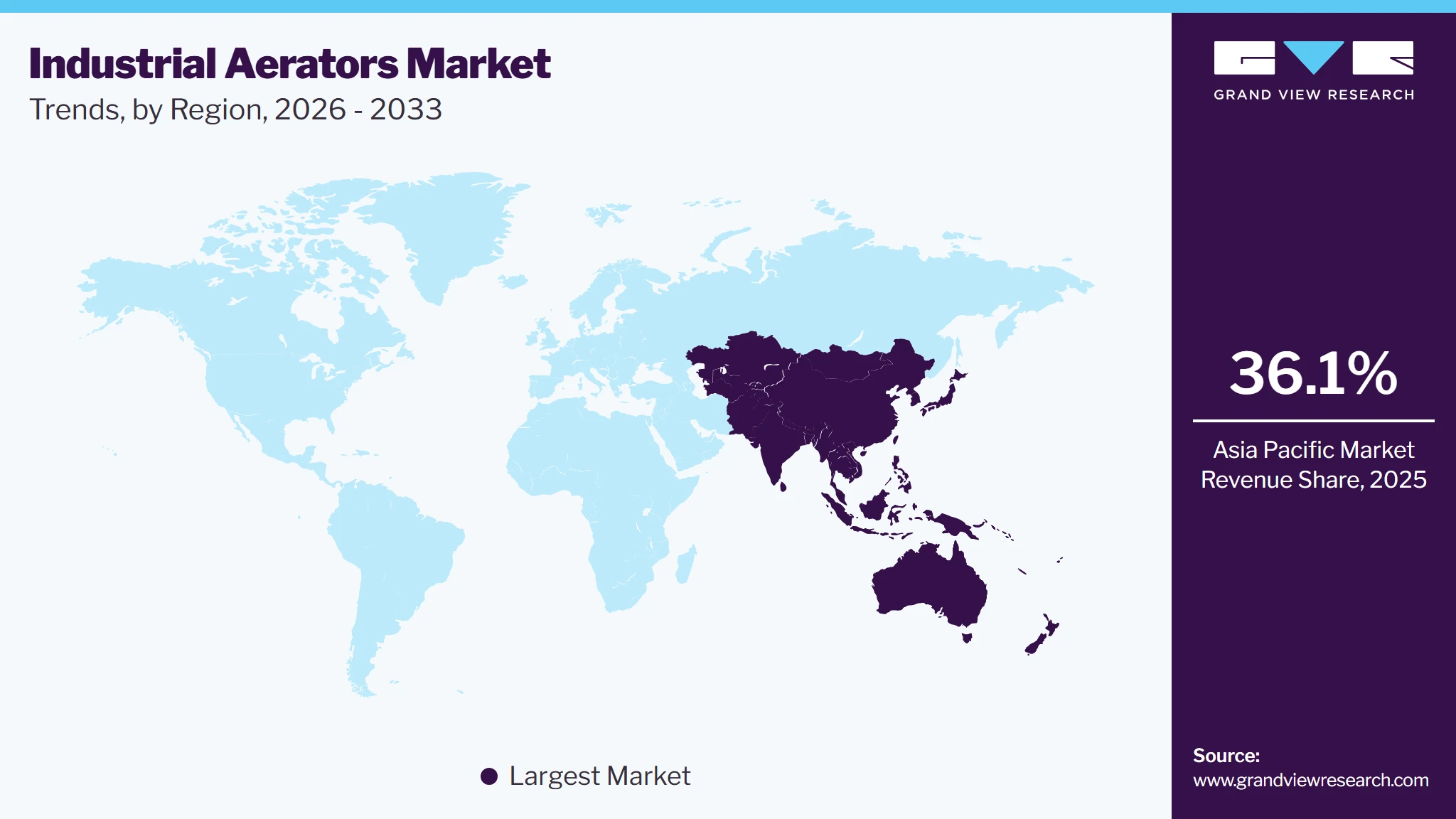
The industrial aerators market in the Asia Pacific dominated the global industry in 2025 with 36.1% share, and it is also projected to be the fastest-growing region over the forecast period, supported by rapid industrialization, expanding manufacturing capacity, and increasing wastewater-treatment requirements across major economies. China and India are key contributors, with strong activity in food processing, chemicals, pharmaceuticals, textiles, pulp and paper, and other water-intensive industries. Growing investments in industrial water reuse, wastewater recycling, and treatment infrastructure are further strengthening demand for aeration equipment, while tighter environmental controls are encouraging industries to modernize treatment systems.
 To learn more about this report, Download Free Sample Report
 China Industrial Aerators Market Trends
The China industrial aerators market led the Asia Pacific region, supported by its extensive manufacturing base, large industrial wastewater-treatment requirements, and continued emphasis on environmental protection and water efficiency. The country’s strong presence across chemicals, food processing, textiles, pulp and paper, pharmaceuticals, and other water-intensive industries creates a broad application base for aeration equipment. Increasing modernization of wastewater-treatment facilities, greater adoption of water recycling and reuse, and tighter control of industrial pollutant discharges are encouraging industries to improve treatment performance and upgrade aeration systems.
The industrial aerators market in India is expected to be driven by industrial expansion, increasing wastewater-treatment requirements, and government efforts to strengthen pollution-control infrastructure. Recent government data indicate that India generated approximately 61,754 MLD of sewage, while installed sewage-treatment capacity stood at 22,963 MLD, highlighting the substantial treatment-infrastructure gap. In addition, 25 sewage-treatment plants with a combined capacity of 530 MLD were commissioned during 2025 under Namami Gange, taking total treatment capacity created under the program to 3,977 MLD by December 2025. The government also identified that existing common effluent treatment plant capacity remains below the requirements of expanding industrial clusters, supporting further investment in industrial wastewater-treatment equipment, including aeration systems.
North America Industrial Aerators Market Trends
The industrial aerators market in North America is expected to grow steadily, supported by a mature wastewater-treatment infrastructure and a substantial installed base that requires replacement and modernization. Industrial operators are increasingly investing in efficient aeration technologies to improve treatment performance and reduce operating costs, while regulatory compliance provides a consistent demand base. The region's established engineering and service ecosystem also supports adoption of advanced monitoring, automation, and energy-optimization solutions.
The industrial aerators market in the U.S. held the largest share in North America, supported by its extensive industrial base and ongoing investment in wastewater-treatment and water-reuse infrastructure. Government data show that the food manufacturing sector represented 39% of reported water releases under the Toxics Release Inventory in 2023, reflecting the significant wastewater-management requirements associated with industrial processing. In addition, the U.S. government allocated USD 6.2 billion for water infrastructure in FY2025 under the Bipartisan Infrastructure Law, contributing to continued upgrades in wastewater-treatment facilities. The launch of Water Reuse Action Plan 2.0 in 2026 is further encouraging industrial water recycling and reuse across manufacturing, food and beverage, energy, and other sectors, creating opportunities for modern and energy-efficient aeration equipment.
Europe Industrial Aerators Market Trends
The industrial aerators market in Europe is projected to register consistent growth, primarily driven by stringent environmental requirements, sustainability targets, and the modernization of aging wastewater-treatment infrastructure. Industrial facilities are placing greater emphasis on reducing energy consumption and improving resource efficiency, creating demand for higher-performance aeration systems. Regulatory developments related to nutrient removal, wastewater quality, and energy efficiency are expected to encourage continued upgrades across existing treatment facilities.
The Germany industrial aerators market dominated European region, supported by its strong manufacturing base, established wastewater-treatment infrastructure, and emphasis on environmental protection and resource efficiency. The country has a mature water and wastewater technology ecosystem, while industries such as chemicals, food processing, pharmaceuticals, pulp and paper, and manufacturing generate sustained demand for advanced treatment solutions. Ongoing modernization of treatment facilities and the adoption of energy-efficient technologies are further supporting demand for industrial aeration equipment.
The industrial aerators market in Italy is expected to witness notable growth, driven by increasing investment in wastewater treatment, industrial water management, and water reuse. The country's manufacturing, food and beverage, chemical, and pharmaceutical industries provide a broad application base for aeration systems. Growing water-stress concerns and the need to improve wastewater recovery and reuse are encouraging industrial facilities to upgrade treatment processes, creating opportunities for both new aeration installations and replacement of aging equipment.
Middle East & Africa Industrial Aerators Market Trends
The industrial aerators market in the Middle East & Africa is expected to grow steadily, with water scarcity and increasing industrialization emerging as important demand catalysts. Investments in water reuse, industrial wastewater treatment, and resource-efficient water management are encouraging the adoption of advanced treatment equipment, particularly in water-intensive industrial clusters. In the Middle East, large-scale infrastructure and industrial development projects provide opportunities for aeration systems, while Africa offers longer-term potential as mining, manufacturing, and urban infrastructure expand.
The Saudi Arabia industrial aerators market is supported by rapid industrial development, water scarcity, and increasing emphasis on wastewater treatment and reuse. Expansion of industrial activities, particularly across oil & gas, petrochemicals, manufacturing, and industrial cities, is creating greater demand for effective wastewater-management systems. The government is also prioritizing treated wastewater reuse and water-sector localization under Vision 2030, while recent initiatives focus on expanding the use of reclaimed water within industrial zones. These developments are encouraging investments in modern treatment infrastructure and creating opportunities for efficient aeration technologies across new and existing industrial facilities.
Latin America Industrial Aerators Market Trends
The industrial aerators market in Latin America is expected to experience gradual growth, supported by expanding industrial activity and increasing investment in wastewater-treatment infrastructure. Demand is particularly linked to industries such as food processing, mining, pulp and paper, and chemicals, where wastewater management is becoming increasingly important. Improvements in sanitation infrastructure and growing attention to environmental compliance are creating additional opportunities, although project financing and uneven infrastructure development can influence the pace of adoption.
The Brazil industrial aerators market has gained ground from its diversified industrial base and increasing focus on water-resource management and wastewater treatment. Industrial activity is concentrated in major economic regions where water demand is particularly significant, creating a broad application base across food processing, pulp and paper, chemicals, petrochemicals, and other water-intensive industries. According to Brazil’s National Water and Basic Sanitation Agency (ANA), industry accounted for 9.9% of Brazil’s consumptive water withdrawals in 2024, with estimated withdrawals of 207.3 m³/s. The agency also projects continued growth in industrial water use through 2040, while recent regulatory initiatives around treated-effluent reuse are encouraging more efficient industrial water management. These developments are expected to support investments in wastewater-treatment systems and associated aeration equipment.
Key Industrial Aerators Company Insights
Some of the key players operating in the market include Xylem, Sulzer Ltd, and PentairAES.
-
Xylem Inc. is a global water technology company focused on addressing water and wastewater challenges through advanced equipment, technologies, and integrated solutions. The company provides products and services covering water transport, treatment, testing, monitoring, and resource management for municipal, industrial, commercial, and residential applications. Its portfolio includes pumping, mixing, aeration, wastewater treatment, filtration, analytical instrumentation, and digital water-management solutions. Xylem serves customers across multiple industries and geographies, with a strong focus on improving water efficiency, reducing energy consumption, enhancing treatment performance, and supporting sustainable water management.
-
Sulzer Ltd. is a global engineering company headquartered in Winterthur, Switzerland, specializing in critical applications for essential industries and infrastructure. The company provides integrated solutions that support energy efficiency, pollution reduction, resource management, and process optimization across industries worldwide. Sulzer operates through a global network of 160 manufacturing facilities and service centers, offering engineered products, technologies, and services designed to improve the performance, reliability, and sustainability of industrial processes. Its capabilities are relevant to the industrial aerators market through its wastewater treatment, pumping, mixing, and fluid-processing solutions.
Key Industrial Aerators Companies
The following key companies have been profiled for this study on the industrial aerators market.
-
Xylem
-
Sulzer Ltd
-
PentairAES
-
Aqua-Aerobic Systems, Inc.
-
Environmental Dynamics International
-
TSURUMI MANUFACTURING CO., LTD.
-
Newterra
-
ITT Flow Technologies
-
Ovivo Water Inc.
-
THE EIMCO-K.C.P. LIMITED
-
SFA Group
-
SSI Aeration, Inc.
-
WesTech Engineering, LLC.
-
Napier-Reid Ltd.
-
Aerzener Maschinenfabrik GmbH
Competitive Benchmarking
Category
Operating Strategies
Competitive Edge
Weakness
Established Players (e.g., Xylem; Sulzer Ltd; PentairAES; Aqua-Aerobic Systems, Inc.; Environmental Dynamics International; TSURUMI MANUFACTURING CO., LTD.; ITT Flow Technologies; Ovivo Water Inc.; SFA Group)
- Focus on broadening aeration portfolios across diffused, surface, submersible, and other technologies to address diverse industrial wastewater applications.
- Invest in energy-efficient equipment, smart monitoring, automation, and process optimization to improve treatment performance and reduce operating costs.
- Strengthen global distribution, engineering, installation, and aftermarket service capabilities to support large industrial projects.
- Strong brand recognition and established installed bases across wastewater-treatment facilities.
- Broad technological capabilities allow them to provide integrated aeration and wastewater-treatment solutions rather than standalone equipment.
- Greater financial and technical resources support R&D, customization, geographic expansion, and long-term customer support.
- Larger organizational structures can result in higher operating and project costs compared with smaller specialized suppliers.
- Broad product portfolios may reduce flexibility in highly customized or niche applications.
- Dependence on complex industrial projects and integration requirements can lengthen sales and implementation cycles.
Emerging & Regional Players (e.g., Newterra; THE EIMCO-K.C.P. LIMITED; SSI Aeration, Inc.; WesTech Engineering, LLC.; Napier-Reid Ltd.; Aerzener Maschinenfabrik GmbH)
- Concentrate on specialized aeration technologies and customized solutions for specific industrial wastewater applications.
- Target replacement, retrofit, and smaller-scale projects where flexibility and application-specific engineering are important.
- Build regional partnerships and localized service networks to expand customer reach while maintaining competitive pricing.
- Greater flexibility to customize equipment according to wastewater characteristics, basin configuration, and customer requirements.
- Faster decision-making and localized technical support can provide an advantage in regional and retrofit projects.
- Ability to focus on specific aeration technologies or niche applications allows differentiation from larger diversified suppliers.
- Smaller geographic footprint and limited installed bases can restrict access to large multinational industrial projects.
- Lower financial resources may constrain R&D investment and the development of advanced digital and energy-optimization solutions.
- Limited aftermarket networks and brand recognition can make it more difficult to compete for large, long-term contracts.
Recent Developments
-
In March 2026, ITT Inc. completed the acquisition of SPX FLOW, expanding its portfolio of engineered fluid-handling and process technologies. The transaction strengthened ITT’s capabilities in areas such as mixing, flow management, separation, and thermal processing across several industrial sectors. With SPX FLOW’s global operations and customer base added to its platform, ITT further enhanced its position in industrial process solutions, including applications relevant to wastewater and aeration systems.
-
In February 2024, Newterra acquired the aeration and mixing portfolio of Aeromix Systems, a Fluence Corporation division specializing in organic wastewater treatment. The acquisition added established aeration and mixing technologies to Newterra’s portfolio, including multiple aerator product lines. It also strengthened Newterra’s capabilities in serving both industrial and municipal wastewater treatment customers.
Industrial Aerators Market Report Scope
Report Attribute
Details
Market size in 2025
USD 1,436.1 million
Estimated market size in 2026
USD 1,483.6 million
Projected market size by 2033
USD 2,031.2 million
Growth rate
CAGR of 4.6% from 2026 to 2033
Historical data
2021 - 2025
Forecast period
2026 - 2033
Quantitative units
Revenue in USD Million and CAGR from 2026 to 2033
Report coverage
Revenue forecast, company ranking, competitive landscape, growth factors, and trends
Segments covered
Product, installation type, end use, region
Regional scope
North America; Europe; Asia Pacific; Latin America; Middle East & Africa
Country scope
U.S.; Canada; Mexico; UK; Germany; France; Spain; Italy; China; Japan; India; Indonesia; Thailand; Brazil; Argentina; Saudi Arabia; UAE; South Africa
Key companies profiled
Xylem; Sulzer Ltd; PentairAES; Aqua-Aerobic Systems, Inc.; Environmental Dynamics International; TSURUMI MANUFACTURING CO., LTD.; Newterra; ITT Flow Technologies; Ovivo Water Inc.; THE EIMCO-K.C.P. LIMITED; SFA Group; SSI Aeration, Inc.; WesTech Engineering, LLC.; Napier-Reid Ltd.; Aerzener Maschinenfabrik GmbH
Customization scope
Free report customization (equivalent up to 8 analysts working days) with purchase. Addition or alteration to country, regional & segment scope.
Pricing and purchase options
Avail customized purchase options to meet your exact research needs. Explore purchase options
Global Industrial Aerators Market Report Segmentation
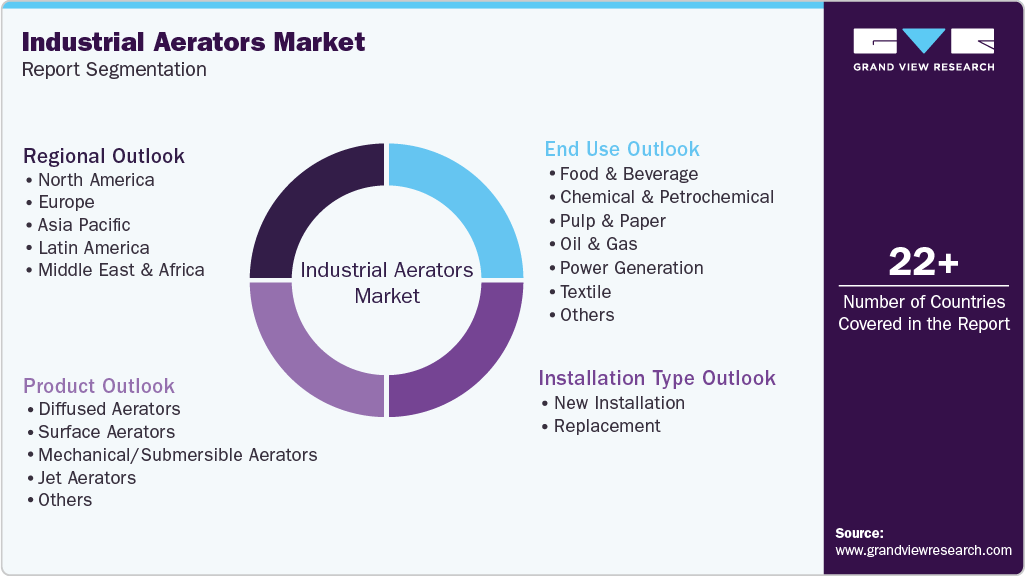
This report forecasts revenue growth at global, regional, and country levels and provides an analysis of the latest industry trends in each of the sub-segments from 2021 to 2033. For this study, Grand View Research has segmented the global industrial aerators market report based on product, installation type, end use, and region.
 To learn more about this report, Download Free Sample Report
 -
Product Outlook (Revenue, USD Million, 2021 - 2033)
-
Diffused Aerators
-
Surface Aerators
-
Mechanical/Submersible Aerators
-
Jet Aerators
-
Others
-
-
Installation Type Outlook (Revenue, USD Million, 2021 - 2033)
-
New Installation
-
Replacement
-
-
End Use Outlook (Revenue, USD Million, 2021 - 2033)
-
Food & Beverage
-
Chemical & Petrochemical
-
Pulp & Paper
-
Oil & Gas
-
Power Generation
-
Pharmaceutical & Biotechnology
-
Textile
-
Others
-
-
Regional Outlook (Revenue, USD Million, 2021 - 2033)
-
North America
-
U.S.
-
Canada
-
Mexico
-
-
Europe
-
Germany
-
France
-
Italy
-
Spain
-
UK
-
-
Asia Pacific
-
China
-
India
-
Japan
-
Thailand
-
Indonesia
-
- Latin America
-
Brazil
-
Argentina
-
Middle East & Africa
-
Saudi Arabia
-
UAE
-
South Africa
-
-
Research Methodology
The industrial aerators marketfigures in this report are based on a proven research process that combines executive interviews with secondary research from proprietary databases, company filings, and recognized regulatory and institutional sources. Market size is built through value-chain sizing-reconciling supply-side and demand-side estimates-and triangulated with bottom-up and top-down approaches. Every estimate passes multiple levels of expert validation before publication, with eachindustrial aerators segment quantified using the revenue-capture definitions in the table below.
Segment Definition
Product
Revenue Capture Definition
Diffused Aerators
Revenue generated from the sale of aeration systems that introduce compressed air into wastewater through submerged fine- or coarse-bubble diffusers, including diffuser assemblies and associated aeration equipment used to support oxygen transfer and biological treatment.
Surface Aerators
Revenue generated from the sale of mechanically operated aeration equipment that agitates wastewater at the surface to facilitate oxygen transfer and mixing, including fixed and floating surface aerator configurations.
Mechanical/Submersible Aerators
Revenue generated from the sale of mechanically driven aeration units installed below or near the wastewater surface to provide oxygen transfer and mixing, including submersible aerators and related mechanical assemblies.
Jet Aerators
Revenue generated from the sale of aeration systems that use high-velocity liquid or air-liquid jets to generate turbulence, improve oxygen transfer, and promote circulation within wastewater-treatment basins.
Others
Revenue generated from the sale of industrial aeration equipment based on technologies or configurations that do not fall under diffused, surface, mechanical/submersible, or jet aerators.
Installation Type
Revenue Capture Definition
New Installation
Revenue generated from the sale of aeration equipment installed in newly constructed wastewater-treatment facilities, new treatment units, greenfield industrial plants, or projects involving expansion of existing treatment capacity.
Replacement
Revenue generated from the sale of replacement aeration equipment used to substitute worn, outdated, damaged, or inefficient units in existing wastewater-treatment facilities, including equipment purchased as part of plant modernization or performance upgrades.
End Use
Revenue Capture Definition
Food & Beverage
Revenue generated from the sale of industrial aeration equipment used in wastewater treatment systems at food and beverage processing facilities to support biological treatment and management of organically loaded effluents.
Chemical & Petrochemical
Revenue generated from the sale of aeration equipment deployed in wastewater-treatment facilities serving chemical and petrochemical operations, where treatment systems handle complex and variable industrial effluents.
Pulp & Paper
Revenue generated from the sale of aeration equipment used to treat wastewater generated during pulp, paper, and related manufacturing processes, supporting biological treatment and pollutant removal.
Oil & Gas
Revenue generated from the sale of aeration equipment used in wastewater-treatment applications across oil and gas production, processing, refining, and associated industrial facilities.
Power Generation
Revenue generated from the sale of aeration equipment used in wastewater-treatment systems at power generation facilities, including applications associated with process and plant wastewater.
Pharmaceutical & Biotechnology
Revenue generated from the sale of aeration equipment used for treating wastewater from pharmaceutical and biotechnology manufacturing processes, where biological treatment is applied to complex and high-strength effluents.
Textile
Revenue generated from the sale of aeration equipment used in wastewater-treatment facilities serving textile manufacturing and processing operations, supporting the treatment of organically and chemically loaded wastewater.
Others
Revenue generated from the sale of industrial aeration equipment used across other end-use industries, including applications that are not separately classified within the major industry segments.
Estimation Model
Layer Name
Key Question
Description
Industrial Facility Universe
How many industrial facilities generate wastewater requiring aeration?
Estimate the universe of relevant industrial facilities across food & beverage, chemical & petrochemical, pulp & paper, oil & gas, power generation, pharmaceutical & biotechnology, textile, and other industries.
Aeration System Addressable Base
How many facilities require industrial aeration systems?
Identify the share of relevant facilities equipped with or requiring aeration systems for industrial wastewater treatment, including new treatment capacity and existing systems requiring replacement.
Aeration Equipment Demand
What is the annual requirement for aeration equipment?
Estimate demand based on new wastewater-treatment projects, treatment-plant expansions, replacement of aging equipment, technology upgrades, and the aeration requirements of different industrial applications.
Market Revenue
What is the annual revenue generated from aerator sales?
Revenue generated from the sale of industrial aerators across diffused, surface, mechanical/submersible, jet, and other aeration technologies, covering new installations and replacement demand.
Customization Table
Client Request
Customization Delivered
Value Adds
Regional Segmentation
Delivered detailed regional and country-level analysis covering North America, Europe, Asia Pacific, Latin America, and Middle East & Africa, with key country insights for the U.S., Germany, Italy, China, India, Brazil, and Saudi Arabia.
Enables identification of high-value markets, country-level growth opportunities, industrial wastewater-treatment demand patterns, and regional investment priorities.
Competitive Benchmarking
Delivered a structured competitive assessment covering major market participants, their product capabilities, operating strategies, competitive positioning, strengths, weaknesses, and recent strategic developments such as acquisitions and regional expansion.
Helps to evaluate competitive intensity, technology positioning, differentiation strategies, and potential areas for market entry or expansion.
Opportunity Assessment
Delivered opportunity analysis across product type, installation, end-use industry, and geography, supported by market drivers, restraints, industry characteristics, and emerging technology trends such as energy-efficient and digitally controlled aeration systems.
Supports identification of attractive growth pockets, priority customer segments, replacement and retrofit opportunities, and technology areas with stronger future demand potential.
Frequently Asked Questions About This Report
Asia Pacific held the largest regional share, accounting for 36.1% of the global industrial aerators market in 2025, supported by rapid industrialization, expanding manufacturing activity, increasing wastewater-treatment requirements, and investments in water-management infrastructure.
China held the largest country-level market share in 2025, supported by its extensive industrial base, large wastewater-treatment requirements, and continued investments in industrial water management and environmental infrastructure.
The diffused aerators segment dominated the market, accounting for the largest revenue share of 42.6% in 2025, supported by their effective oxygen-transfer performance and broad application in biological wastewater-treatment processes.
The new installation segment led the market with a revenue share of 64.1% in 2025, driven by the development of new industrial wastewater-treatment facilities, expansion of production capacity, and investment in modern treatment infrastructure.
The global industrial aerators market size was estimated at USD 1,436.1 million in 2025 and is expected to be USD 1,483.6 million in 2026.
The global industrial aerators market, in terms of revenue, is expected to grow at a compound annual growth rate of 4.6% from 2026 to 2033 to reach USD 2,031.2 million by 2033.
The food processing segment accounted for the largest revenue share of 20.1% in 2025, primarily due to the high volume of organically loaded wastewater generated during food and beverage processing and the resulting need for biological wastewater treatment.
Some of the key players operating in the global industrial aerators market include Xylem; Sulzer Ltd; PentairAES; Aqua-Aerobic Systems, Inc.; Environmental Dynamics International; TSURUMI MANUFACTURING CO., LTD.; Newterra; ITT Flow Technologies; Ovivo Water Inc.; THE EIMCO-K.C.P. LIMITED; SFA Group; SSI Aeration, Inc.; WesTech Engineering, LLC.; Napier-Reid Ltd.; Aerzener Maschinenfabrik GmbH
The global industrial aerators market is primarily driven by rising industrial wastewater generation, stricter wastewater discharge regulations, increasing investment in treatment infrastructure, growing adoption of water reuse, and the need to improve energy efficiency in wastewater-treatment operations.
About the Author(s)
Advanced Interior Materials Research Team
Advanced Materials · Advanced Interior MaterialsThis report was authored by the advanced interior materials research team at Grand View Research - comprising two research analysts, one senior research analyst, and one industry expert - with specialized expertise in the advanced interior materials segment of the advanced materials industry. All findings are based on proprietary advanced materials databases, executive interviews, and regulatory analysis, subject to internal peer review prior to publication.
Last Updated:
Speak to Analyst

Customize this report to your needs - add regions, segments, or data points, with 20% free customization.
Or view our licence options:


ISO 9001:2015 & 27001:2022 Certified
We are GDPR and CCPA compliant! Your transaction & personal information is safe and secure. For more details, please read our privacy policy.


