
- Home
- »
- Petrochemicals
- »
-
Industrial Lubricants Market Size & Share Report, 2026-2033GVR Report cover

Industrial Lubricants Market (2026 - 2033)
Size, Share & Trends Analysis Report Product (Process Oils, General Industrial Oils), By Application (Mining, Power Generation) By Region (North America, Europe, Asia Pacific, Middle East & Africa, Latin America), And Segment Forecasts
Market Size, 2025
$58.1BMarket Estimate, 2026
$60.0BMarket Forecast, 2033
$73.0BCAGR, 2026–2033
2.8%Industrial Lubricants Market Summary
The global industrial lubricants market size was valued at USD 58.1 billion in 2025 and is projected to grow from USD 60.0 billion in 2026 to USD 73.0 billion by 2033, at a CAGR of 2.8% from 2026 to 2033. Asia Pacific held the largest revenue share of 34.1% of the global market in 2025. The market is primarily driven by sustained industrialization across mining, power generation, steel & metals, and chemical manufacturing, coupled with rising demand for equipment reliability, higher uptime, and extended maintenance intervals.
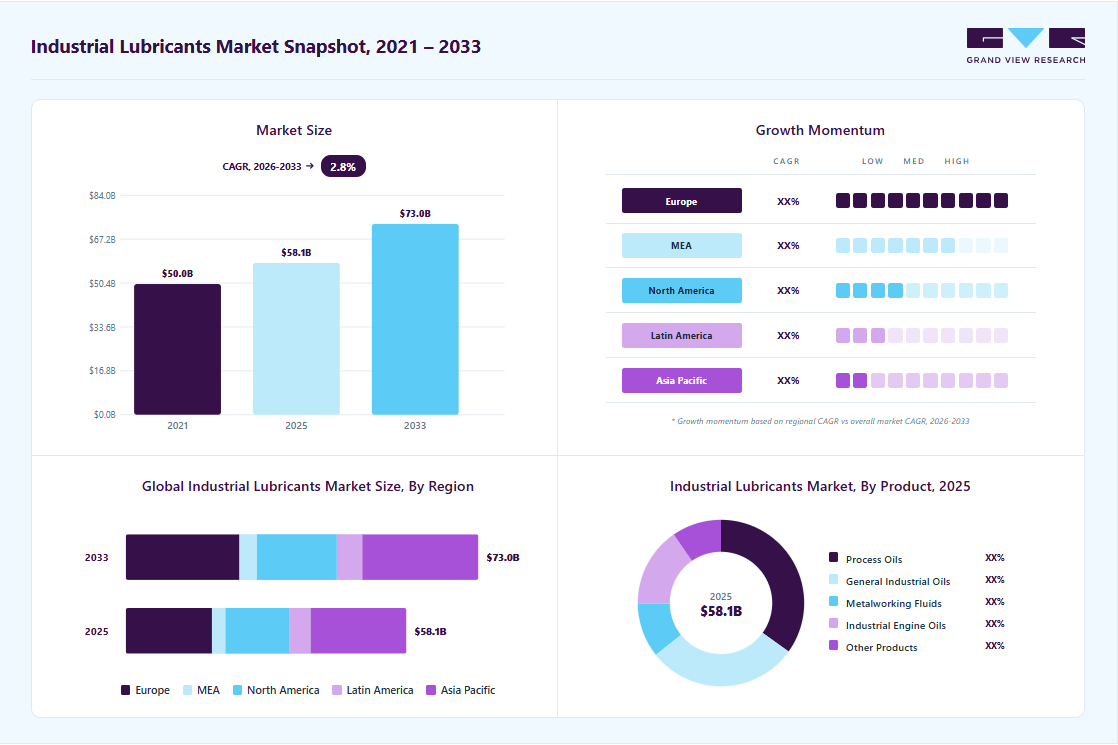 Source: Grand View Research, IR Documents, Primary Interviews, Paid DatabasesTo learn more about this report,
 Download Free Sample Report
 Key Market Trends & Insights
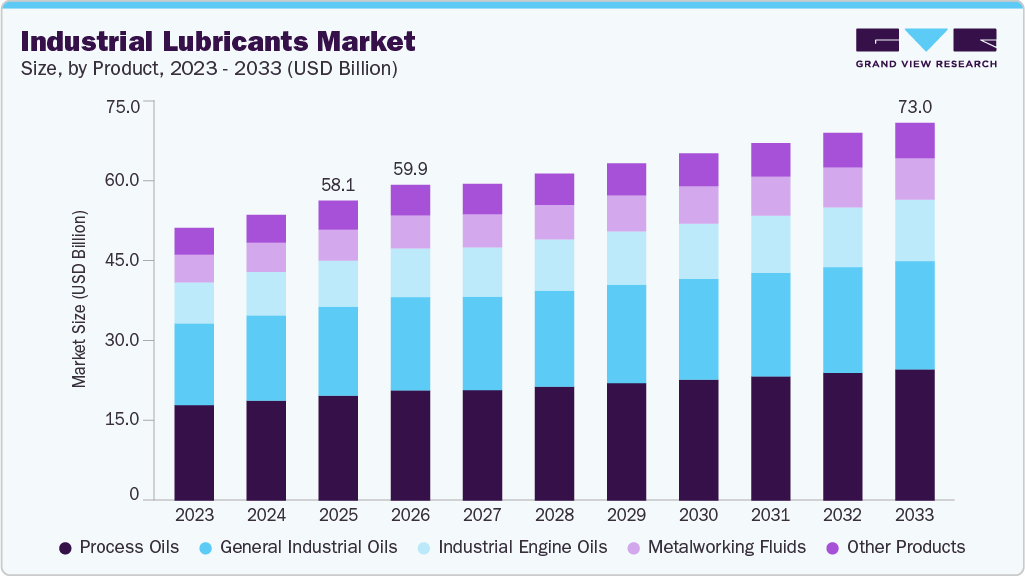
- By product: Process oils held the largest market share of 34.9% in 2025.
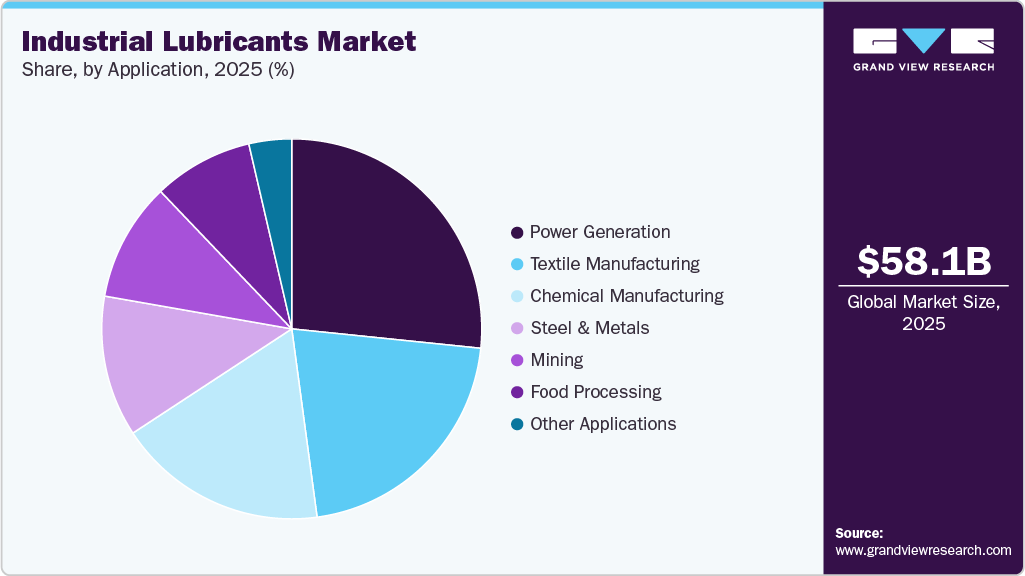
- By application: Power generation held the largest market share of 26.6% in 2025.
- By product: Metalworking fluids segment is expected to grow at the fastest CAGR of 3.7%.
Regional Highlights
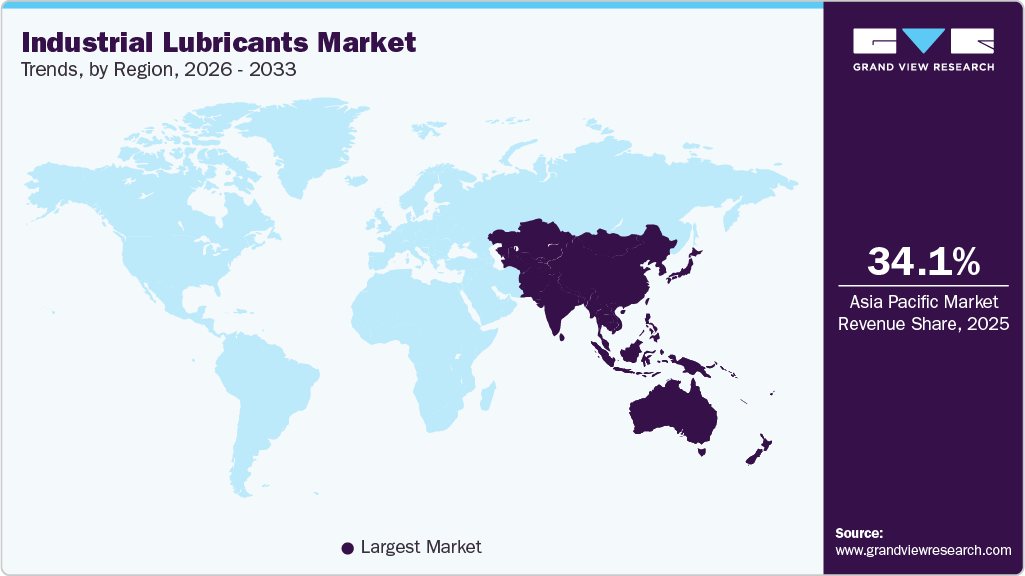
- Largest regional market: Asia Pacific (34.1% market share, 2025)
- By Country: China held the largest market share in 2025.
Market Size & Forecast
- Market size in 2025: USD 58.1 Billion
- Estimated market size in 2026: USD 60.0 Billion
- Projected market size by 2033: USD 73.0 Billion
- CAGR (2026–2033): 2.8%
Three ways to get this report
Buy it, customize it, or ask a question.Ask an Analyst
Analyst response in 1 business day
- AccessReport author, directly
- Reply timeWithin 1 working day
- No sales callDirect answer only
- FormatEmail reply
- CostFree, no cost
Get the Full Report
What the study covers
- FormatsPDF · Excel · Dashboard
- Timeline2026–2033 annual, 2025 base
- Coverage20+ countries, 5 regions
- Companies10+ key players profiled
Customize the Report
20% free customization
- IncludeCountries, segments, points
- TailorTo your product definition
- ExtendDeeper competitor detail
- OrA fully bespoke study
- Turnaround5–10 working days
Increasing adoption of advanced machinery and automated production lines has accelerated the need for high-performance lubricants that can operate under extreme pressure, temperature, and load conditions. The OEM recommendations, growing focus on asset lifecycle optimization, and expanding industrial output in emerging economies continue to underpin consistent lubricant consumption across end-use industries.
Significant opportunities are emerging from the growing adoption of synthetic, bio-based, and environmentally acceptable lubricants, driven by sustainability mandates and corporate ESG commitments. Rising demand for food-grade lubricants in food processing and specialty lubricants in chemicals, mining, and metalworking presents strong value-added growth avenues. Moreover, the integration of digital monitoring, predictive maintenance, and lubrication-as-a-service models is enabling suppliers to move beyond product sales toward solution-oriented offerings, strengthening customer retention and long-term revenue streams.
 To learn more about this report, Download Free Sample Report
 The market faces challenges stemming from volatility in base oil and additive prices, which directly impacts production costs and margin stability for lubricant manufacturers. Increasing regulatory scrutiny related to environmental toxicity, disposal norms, and workplace safety has heightened compliance costs and limited the use of certain conventional formulations. Furthermore, improvements in equipment efficiency and the shift toward longer oil drain intervals are gradually reducing the intensity of lubricant consumption, creating volume pressure, particularly in mature industrial markets.
Market Dynamics
Rapid industrialization across emerging economies continues to be a major driver for the industrial lubricants market. Expanding manufacturing sectors such as automotive, metal fabrication, cement, chemicals, food processing, and mining are increasing the demand for industrial machinery and equipment, thereby driving lubricant consumption. Industrial lubricants play a critical role in reducing friction, minimizing wear and tear, improving machine efficiency, and extending equipment lifespan, making them essential for large-scale industrial operations.
Additionally, rising investments in infrastructure development, industrial automation, and smart manufacturing technologies are further supporting market growth. As industries increasingly focus on operational efficiency and minimizing downtime, demand for high-performance lubricants with enhanced thermal stability, oxidation resistance, and longer service intervals continues to increase. This trend is particularly strong in developing regions where industrial production capacities are expanding rapidly.
Fluctuations in crude oil and base oil prices remain one of the key challenges affecting the industrial lubricants market. Since conventional lubricants are largely derived from petroleum-based feedstocks, changes in crude oil prices directly impact manufacturing costs and product pricing. Sudden increases in raw material prices can reduce profit margins for lubricant manufacturers and create pricing instability across the supply chain.
Moreover, unpredictable raw material pricing makes long-term procurement planning difficult for both manufacturers and industrial end users. In highly price-sensitive industries, rising lubricant costs may encourage customers to reduce lubricant replacement frequency or shift toward lower-cost alternatives, which can impact overall market demand. These pricing fluctuations also increase pressure on manufacturers to optimize production efficiency and diversify raw material sourcing strategies.
Market Concentration & Characteristics
The global industrial lubricants market is moderately consolidated, with competition dominated by large integrated oil & gas companies and established specialty lubricant manufacturers. Players such as Exxon Mobil, Shell, TotalEnergies, Chevron, Valvoline, and Castrol leverage global production capabilities, broad product portfolios, and strong distribution networks, while specialty players, including FUCHS, Lubrizol, Quaker Chemical, and Klüber Lubrication, differentiate through application-specific formulations, OEM approvals, and technical expertise across high-performance industrial segments.
 To learn more about this report, Download Free Sample Report
 Competitive differentiation is increasingly driven by innovation, sustainability, and service-led offerings rather than price alone. Market participants are investing in synthetic and bio-based lubricants, digital lubrication management solutions, and long-term customer partnerships to enhance equipment efficiency and reduce total cost of ownership. Strategic expansions, acquisitions, and collaborations in high-growth industrial regions further intensify competition, favoring suppliers with strong R&D capabilities and solution-oriented business models.
Product Insights
The process oils segment dominated the global industrial lubricants market, accounting for the largest revenue share of 34.9% in 2025. This dominance is primarily attributed to their extensive use as processing aids and performance enhancers across the rubber, polymer, chemical, and textile manufacturing industries. High consumption volumes, continuous usage cycles, and strong linkage with large-scale industrial output significantly support revenue generation from this segment. In addition, growing demand from tire manufacturing, elastomers, and plastics processing, coupled with the availability of both naphthenic and paraffinic grades, has reinforced the widespread adoption of process oils across emerging and developed industrial economies.
General industrial oils and metalworking fluids represent the next major contributors, driven by their critical role in hydraulic systems, gearboxes, compressors, and metal cutting, forming, and cooling operations across steel & metals, automotive, and heavy machinery manufacturing. Industrial engine oils continue to witness steady demand from stationary engines, generators, and mining equipment, particularly in power generation and resource extraction applications. Meanwhile, other products, including greases, specialty lubricants, and environmentally acceptable formulations, are gaining traction due to increasing focus on equipment protection, regulatory compliance, and sustainability, collectively enhancing the market’s shift toward higher-value and performance-driven lubricant solutions.
Application Insights
The power generation segment dominated the global industrial lubricants market, accounting for the largest revenue share of 26.6% in 2025. This dominance was driven by the extensive use of lubricants in turbines, generators, transformers, compressors, and auxiliary equipment across thermal, hydro, nuclear, and renewable power plants. Continuous, high-load operations and the critical need for reliability, thermal stability, and extended drain intervals have led to strong demand for high-performance industrial oils, including turbine, hydraulic, and gear oils. In addition, ongoing investments in grid expansion, power capacity additions, and the refurbishment of aging infrastructure, particularly in emerging economies, have further reinforced lubricant consumption in this segment.
 To learn more about this report, Download Free Sample Report
 Mining and steel & metals remain key application areas due to harsh operating conditions that require heavy-duty lubricants capable of withstanding extreme pressure, dust, and temperature variations. Food processing is witnessing increasing adoption of food-grade and specialty lubricants to comply with stringent safety and hygiene regulations, while chemical manufacturing demands lubricants with high chemical resistance and thermal stability. Textile manufacturing continues to generate steady demand for spindle and knitting oils, whereas other applications, including cement, pulp & paper, construction, and marine industries, collectively contribute to stable market growth by supporting diverse, equipment-intensive industrial operations.
Regional Insights
Asia Pacific led the global industrial lubricants market in 2025, accounting for 34.1% of total revenue, driven by rapid industrialization, expanding manufacturing capacity, and strong growth in mining, power generation, and steel & metals across China, India, and Southeast Asia. High-volume consumption of process oils, general industrial oils, and metalworking fluids, supported by cost-competitive production and rising infrastructure investments, continues to position the region as the primary demand hub for industrial lubricants.
 To learn more about this report, Download Free Sample Report
 China Industrial Lubricants Market Trends
China dominated the Asia Pacific market with a 44.1% share in 2025, underpinned by its large-scale chemical manufacturing, steel production, power generation, and heavy industrial base. Sustained investments in industrial automation, renewable and thermal power capacity, and domestic manufacturing expansion have driven consistent lubricant demand, particularly for process oils and metalworking fluids. Additionally, the presence of extensive local production facilities and growing adoption of higher-performance lubricants support long-term market stability.
Europe Industrial Lubricants Market Trends
Europe accounted for 30.7% of the global industrial lubricants market in 2025, supported by a strong focus on high-value manufacturing, energy efficiency, and sustainability-driven lubricant adoption. The region exhibits higher penetration of synthetic, specialty, and environmentally acceptable lubricants, particularly across power generation, chemicals, and food processing industries. Stringent regulatory frameworks and advanced OEM standards further reinforce demand for premium and application-specific lubricant formulations.
The Germany industrial lubricants market remains a key contributor to the European industrial lubricants market, driven by its leadership in automotive manufacturing, machinery, chemicals, and industrial engineering. High demand for precision lubrication, metalworking fluids, and specialty oils, combined with strong emphasis on equipment reliability and process optimization, supports steady lubricant consumption. The country’s advanced industrial infrastructure and strong OEM ecosystem continue to favor premium and high-performance lubricant solutions.
North America Industrial Lubricants Market Trends
North America held a 22.9% share of the global market in 2025, characterized by mature industrial operations and strong adoption of synthetic and performance-enhancing lubricants. Demand is primarily driven by power generation, mining, chemicals, and food processing, with end users increasingly prioritizing extended drain intervals, predictive maintenance, and total cost of ownership reduction. The region’s focus on operational efficiency and regulatory compliance supports steady replacement and upgrade-driven demand.
The U.S. industrial lubricants market dominated the North American market with a 66.9% share in 2025, supported by its large installed base of power generation assets, advanced manufacturing facilities, and diversified industrial end-use sectors. Strong demand for industrial engine oils, turbine oils, and metalworking fluids, coupled with early adoption of digital lubrication management and service-based models, continues to strengthen the country’s position as a high-value industrial lubricants market.
Middle East & Africa Industrial Lubricants Market Trends
The Middle East & Africa market is driven by demand from power generation, mining, cement, and heavy industrial operations, particularly in GCC countries and South Africa. High operating temperatures and harsh environmental conditions create sustained demand for high-performance and heavy-duty lubricants. Ongoing investments in energy infrastructure, industrial diversification initiatives, and resource extraction projects continue to support moderate but stable market growth across the region.
Latin America Industrial Lubricants Market Trends
Latin America represents a developing yet opportunity-rich industrial lubricants market, driven by mining, metals, power generation, and food processing industries across countries such as Brazil, Mexico, and Chile. Market growth is supported by infrastructure development, rising industrial output, and gradual modernization of equipment, although demand remains relatively price sensitive. Increasing investments in mining and energy projects are expected to drive steady lubricant consumption over the forecast period.
Key Industrial Lubricants Company Insights
Key players, such as Exxon Mobil Corporation, FUCHS , Lubrizol, Shell Global , TotalEnergies , and Klüber Lubrication are dominating the market.
Exxon Mobil Corporation
-
Exxon Mobil Corporation is a leading global player in the industrial lubricants market, leveraging its integrated upstream-to-downstream operations, strong base oil production capabilities, and well-established Mobil industrial lubricants portfolio. The company offers a comprehensive range of high-performance industrial oils, greases, and specialty lubricants serving power generation, mining, chemicals, steel & metals, and manufacturing applications. ExxonMobil’s competitive strength lies in its advanced R&D capabilities, strong OEM approvals, and focus on synthetic and premium lubricant formulations that enhance equipment reliability, extend drain intervals, and reduce total cost of ownership, positioning the company as a preferred supplier for large-scale and mission-critical industrial operations worldwide.
Key Industrial Lubricants Companies:
The following are the leading companies in the industrial lubricants market. These companies collectively hold the largest market share and dictate industry trends.
- Exxon Mobil Corporation
- FUCHS
- Lubrizol
- Shell Global
- TotalEnergies
- Klüber Lubrication
- Valvoline Global Operations
- Chevron Corporation
- Quaker Chemical Corporation
- Castrol Limited
Competitive Benchmarking
Operating Strategies
Competitive Edge
Weaknesses
Mature player: ExxonMobil Corporation; Shell plc.; Total Energies; Chevron Corp.; Fuchs; Castrol Limited
- Emerging players are expanding their product portfolios to cater to a wide range of applications in the various industries. They are introducing new lubricant solutions that address specific requirements, such as bio-base. By offering a comprehensive range of products, these players aim to capture a larger market share and cater to diverse customer needs.
- To stay ahead of the competition, mature players are continuously investing in research & development to innovate new adhesive products and expand their portfolios. This is expected to involve the development of adhesives with improved bonding strength, durability, and eco-friendly properties. By offering a diverse range of high-quality products, companies can cater to different customer needs and enhance their market presence.
- Dependency on existing customers: Mature players may have a significant portion of their revenue coming from a few key customers or industries. This dependency can make them vulnerable to changes in customer preferences, industry downturns, or the loss of major contracts.
Emerging Players: Valvoline; Kluber Lubricants; Quaker Chemical Corporation; Lubrizol
- Emerging players can focus on optimizing their operational processes and cost structures to improve efficiency and competitiveness. This can involve streamlining production processes, adopting lean manufacturing principles, and exploring cost-saving measures without compromising product quality
- Agility and Flexibility: Emerging players have the advantage of being more agile and flexible compared to larger, established companies. They can respond quickly to market changes, adapt their strategies, and seize new opportunities. This agility allows them to stay ahead of the competition and cater to evolving customers' demands effectively.
- Emerging players may face challenges such as limited recognition, scalability issues, and intense competition from established companies.
- Regulatory and compliance challenges: Compliance with regulatory requirements and obtaining necessary certifications can be complex and time-consuming for emerging players.
Recent Developments
-
In April 2025, FUCHS' acquisition of IRMCO, a U.S.-based manufacturer of metal-forming lubricants, strengthens its position in the industrial lubricants market by expanding its product portfolio and global reach. The deal enhances FUCHS’ capabilities in providing sustainable and high-performance lubrication solutions for demanding manufacturing processes such as metal forming, assembly, and finishing. This strategic move supports the company’s growth in the industrial segment and aligns with rising demand for process-optimized and environmentally friendly lubricants.
-
In May 2024, ExxonMobil’s acquisition of Pioneer Natural Resources significantly enhances its Permian Basin footprint, doubling production capacity and securing long-term feedstock for petroleum-based products, including industrial lubricants. This strengthens ExxonMobil’s position in the lubricants market by improving supply chain integration, cost efficiency, and base oil availability. The deal also supports sustainability goals, with net-zero targets and advanced emission reduction technologies, aligning with rising demand for environmentally responsible lubricants.
Industrial Lubricants Market Report Scope
Report Attribute
Details
Market size value in 2025
USD 58.1 billion
Estimated Market size in 2026
USD 60.0 bllion
Projected Market size by 2033
USD 73.0 billion
Growth rate
CAGR of 2.8% from 2026 to 2033
Base year for estimation
2025
Historical data
2018 - 2025
Forecast period
2026 - 2033
Quantitative units
Revenue in USD million/billion, Volume in Kilotons, and CAGR from 2025 to 2033
Report coverage
Revenue forecast, company ranking, competitive landscape, growth factors, and trends
Segments covered
Product, application, region
Regional scope
North America; Europe; Asia Pacific; Middle East & Africa; Latin America
Country scope
U.S.; Canada; Mexico; Germany; UK; France; Russia; Spain; China; India; Indonesia; South Korea; Brazil; Argentina; South Africa; Saudi Arabia
Key companies profiled
Exxon Mobil Corporation; FUCHS; Lubrizol; Shell Global; TotalEnergies; Klüber Lubrication; Valvoline Global Operations; Chevron Corporation; Quaker Chemical Corporation; Castrol Limited
Customization scope
Free report customization (equivalent up to 8 analysts’ working days) with purchase. Addition or alteration to country, regional & segment scope.
Pricing and purchase options
Avail customized purchase options to meet your exact research needs. Explore purchase options
Global Industrial Lubricants Market Report Segmentation
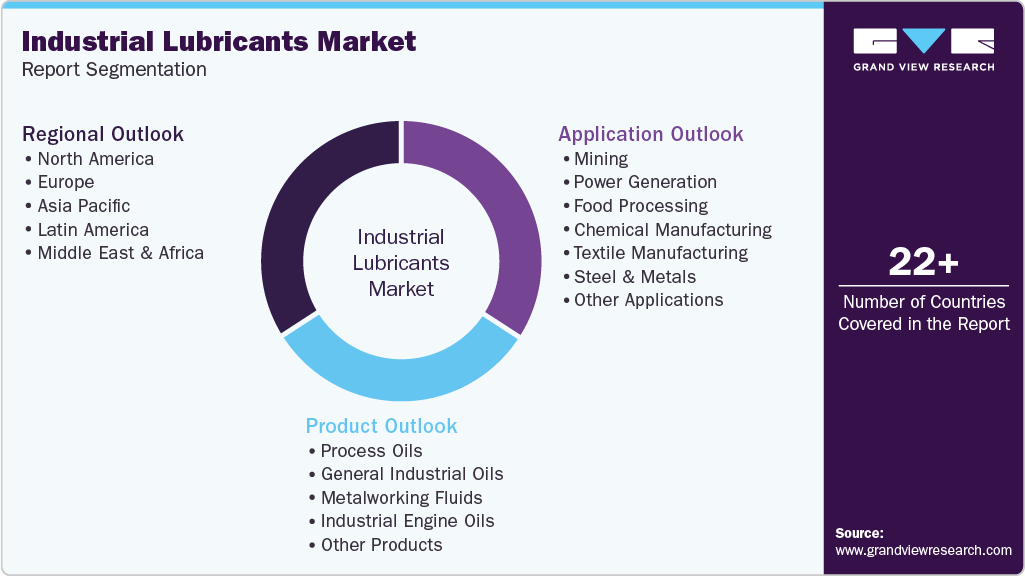
This report forecasts revenue growth at global, regional, and country levels and provides an analysis of the latest industry trends in each of the sub-segments from 2018 to 2033. For this study, Grand View Research has segmented the global industrial lubricants market report based on product, application, and region.
 To learn more about this report, Download Free Sample Report
 -
Product Outlook (Volume, Kilotons; Revenue, USD Million; 2018 - 2033)
-
Process Oils
-
General Industrial Oils
-
Metalworking Fluids
-
Industrial Engine Oils
-
Other Products
-
-
Application Outlook (Volume, Kilotons; Revenue, USD Million; 2018 - 2033)
-
Mining
-
Power Generation
-
Food Processing
-
Chemical Manufacturing
-
Textile Manufacturing
-
Steel & Metals
-
Other Applications
-
-
Regional Outlook (Volume, Kilotons; Revenue, USD Million; 2018 - 2033)
-
North America
-
U.S.
-
Canada
-
Mexico
-
-
Europe
-
Germany
-
UK
-
France
-
Russia
-
Spain
-
-
Asia Pacific
-
China
-
India
-
Indonesia
-
-
Middle East & Africa
-
Saudi Arabia
-
South Africa
-
-
Latin America
-
Brazil
-
Argentina
-
-
Delivered Customizations
This report has been delivered with the following In-depth customizations
Client Request
Customization Delivered
Value Adds
Regional Segmentation
Assessment of global and regional industrial lubricants trade dynamics, including import-export analysis, base oil supply trends, refinery integration, regional manufacturing capacities, raw material dependency, and demand outlook across key industrial sectors such as manufacturing, mining, construction, marine, and power generation. The analysis also covers country-level positioning, regulatory landscape, and supply-demand balance across major lubricant-consuming regions.
Help identify supply chain dependencies, regional sourcing opportunities, and market concentration risks. Support strategic procurement, manufacturing localization, capacity expansion, and regional market entry decisions through improved visibility into trade flows, raw material availability, and industrial demand trends
Cross-Segmentation
Detailed segmentation of the industrial lubricants market by product type, base oil type, application, end-use industry, and region to identify high-growth demand pockets and emerging opportunity areas. Analysis includes penetration trends for synthetic and bio-based lubricants, demand outlook across industrial machinery applications, and growth attractiveness by industry vertical and geography.
Enable prioritization of the most attractive application segments and regional markets. Identify high-growth industries and whitespace opportunities to support product portfolio optimization, expansion planning, customer targeting, and long-term growth strategy development
Competitive benchmarking
Comparative assessment of key industrial lubricant manufacturers based on product portfolio, manufacturing footprint, refinery/base oil integration, distribution network, sustainability initiatives, synthetic lubricant capabilities, application specialization, strategic developments, and regional presence. The analysis also evaluates competitive positioning across conventional, synthetic, specialty, and bio-based lubricant segments.
Support benchmarking against leading market participants and identify competitive gaps across technology, sustainability, distribution reach, and product differentiation. Enable informed decision-making related to strategic partnerships, product innovation, expansion opportunities, and competitive positioning in high-growth industrial lubricant segments
Frequently Asked Questions About This Report
Asia Pacific dominated with 34.1% market share in 2025.
Power generation dominated with 26.6% share in 2025.
Some of the key players operating in the industrial lubricants market include Exxon Mobil Corporation, FUCHS, Lubrizol, Shell Global, TotalEnergies, Klüber Lubrication, Valvoline Global Operations, Chevron Corporation, Quaker Chemical Corporation, and Castrol Limited
The industrial lubricants market is driven by expanding industrial activity across mining, power generation, steel & metals, and chemical manufacturing, alongside rising emphasis on equipment reliability, uptime, and lifecycle cost optimization. Increasing adoption of high-performance machinery and OEM-recommended lubrication practices further supports steady demand for advanced industrial lubricant solutions.
The global industrial lubricants market size was estimated at USD 58.1 billion in 2025 and is expected to reach USD USD 60.0 bllion in 2026.
The global industrial lubricants market is expected to grow at a compound annual growth rate of 2.8% from 2026 to 2033 to reach USD 73.0 billion by 2033.
The process oils segment dominated the market with a 34.9% revenue share in 2025 due to its high volume, continuous consumption across rubber, polymer, chemical, and textile manufacturing industries. Strong linkage with large-scale industrial output and widespread use as processing aids and performance enhancers significantly supported sustained revenue generation from this segment.
About the Author(s)
Petrochemicals Research Team
Bulk Chemicals · PetrochemicalsThis report was authored by the petrochemicals research team at Grand View Research - comprising two research analysts, one senior research analyst, and one industry expert - with specialized expertise in the petrochemicals segment of the bulk chemicals industry. All findings are based on proprietary bulk chemicals databases, executive interviews, and regulatory analysis, subject to internal peer review prior to publication.
Last Updated:
Speak to Analyst

Customize this report to your needs - add regions, segments, or data points, with 20% free customization.
Or view our licence options:


ISO 9001:2015 & 27001:2022 Certified
We are GDPR and CCPA compliant! Your transaction & personal information is safe and secure. For more details, please read our privacy policy.


