
- Home
- »
- Advanced Interior Materials
- »
-
Industrial Machinery Market Size & Share Report, 2026-2033GVR Report cover

Industrial Machinery Market (2026 - 2033)
Size, Share & Trends Analysis Report By Automation (Manual, Semi-Automatic, Fully Automatic), By Distribution Channel (Direct Sales, Indirect Sales), By Application, By Region, And Segment Forecasts
Market Size, 2025
$717.5BMarket Estimate, 2026
$766.6BMarket Forecast, 2033
$1,243.9BCAGR, 2026–2033
7.2%Industrial Machinery Market Summary
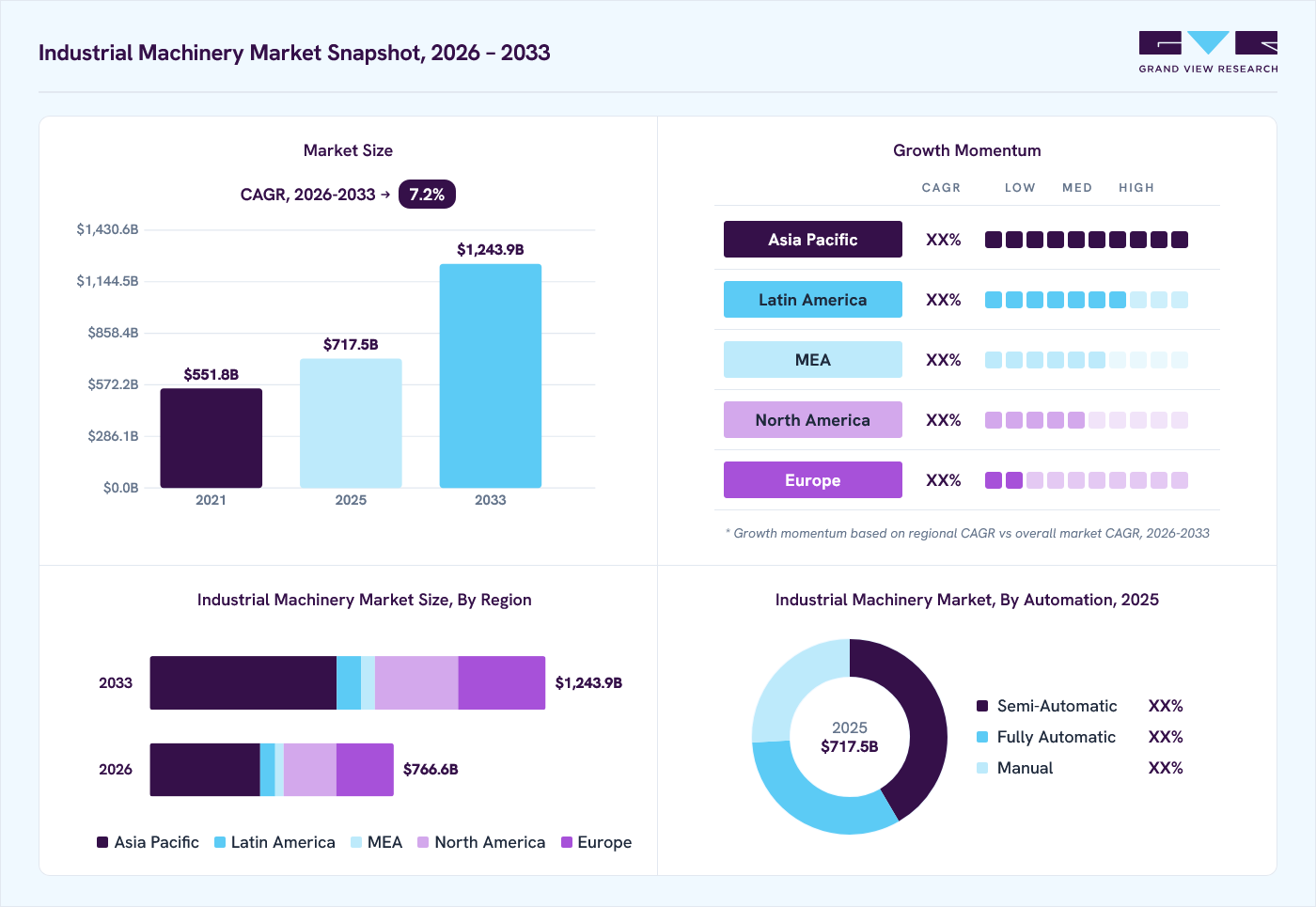
The global industrial machinery market size was valued at USD 717.5 billion in 2025 and is projected to grow from USD 766.6 billion in 2026 to USD 1,243.9 billion by 2033, at a CAGR of 7.2% from 2026 to 2033. Asia Pacific dominated the global market, accounting for the largest revenue share of 45.0% in 2025. The market is driven by sustained investments in manufacturing facilities, industrial infrastructure, construction, energy, mining, and process industries, which are increasing demand for high-performance production and material-handling equipment.
 Source: Grand View Research, IR Documents, Primary Interviews, Paid DatabasesTo learn more about this report,
 Download Free Sample Report
Key Market Trends & Insights
- By automation: The semi-automatic machinery segment led the market with the largest revenue share of 41.6% in 2025.
- By distribution channel: The direct sales segment held the largest revenue share of 58.6% in 2025.
- By application: The metalworking & general manufacturing segment dominated the market with the largest revenue share of 21.7% in 2025.
Regional Highlights
- Largest regional market: Asia Pacific (45.0% revenue share, 2025)
- Fastest-growing regional market: Asia Pacific (highest CAGR, 2026-2033)
- By country: The China dominated the Asia Pacific with the largest revenue share in 2025
Market Size & Forecast
- Market Size in 2025: USD 717.5 Billion
- Estimated Market Size in 2026: USD 766.6 Billion
- Projected Market Size by 2033: USD 1,243.9 Billion
- CAGR (2026-2033): 7.2%
Three ways to get this report
Buy it, customize it, or ask a question.Ask an Analyst
Analyst response in 1 business day
- AccessReport author, directly
- Reply timeWithin 1 working day
- No sales callDirect answer only
- FormatEmail reply
- CostFree, no cost
Get the Full Report
What the study covers
- FormatsPDF · Excel · Dashboard
- Timeline2026–2033 annual, 2025 base
- Coverage20+ countries, 5 regions
- Companies10+ key players profiled
Customize the Report
20% free customization
- IncludeCountries, segments, points
- TailorTo your product definition
- ExtendDeeper competitor detail
- OrA fully bespoke study
- Turnaround5–10 working days
The growing adoption of automation, robotics, computer-controlled systems, and digitally connected machinery is enabling manufacturers to improve productivity, precision, throughput, and operational flexibility while reducing manual intervention.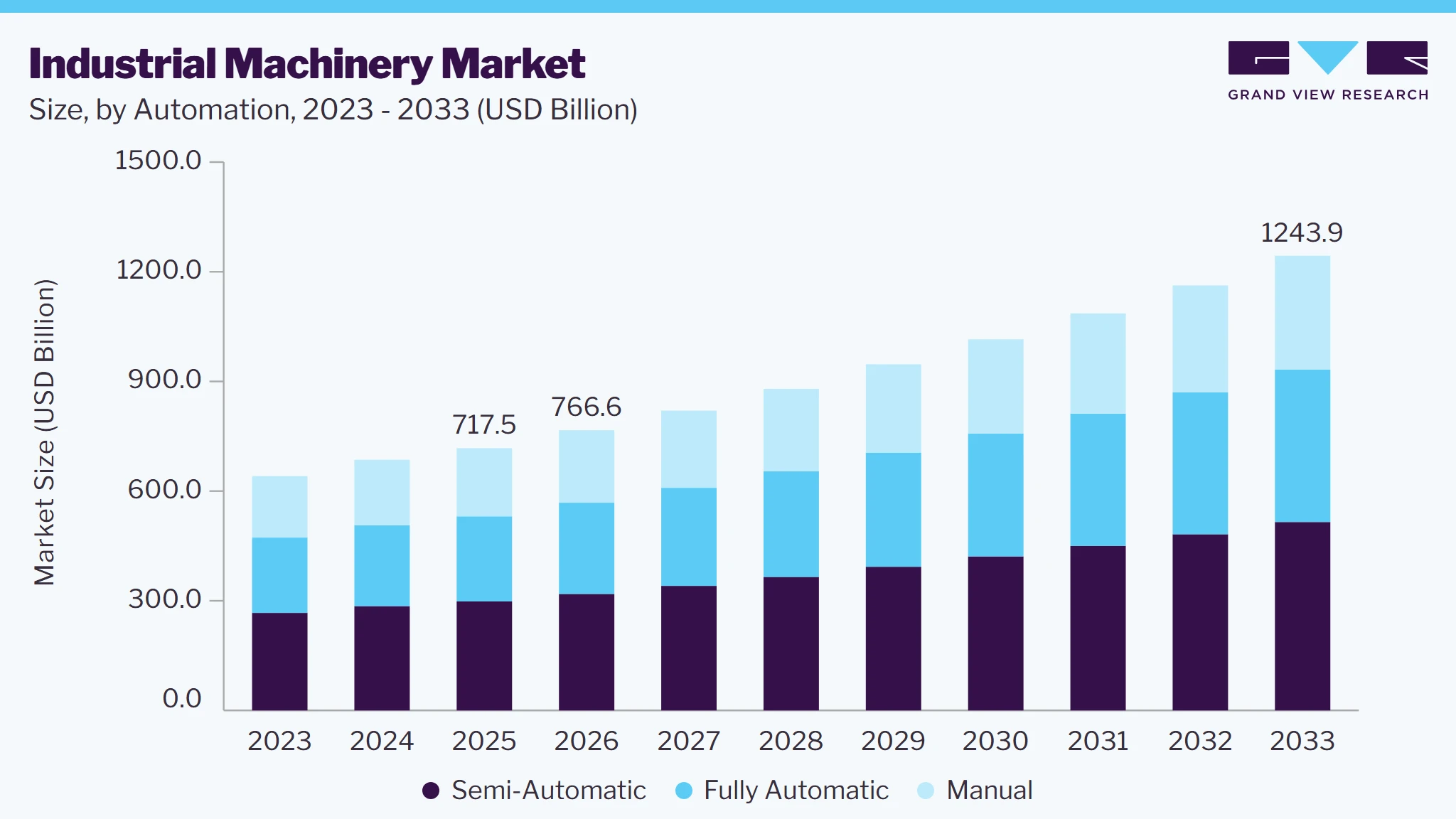 To learn more about this report, Download Free Sample Report
In addition, the increasing focus on energy efficiency, application lifecycle optimization, predictive maintenance, and resource utilization is encouraging industries to upgrade aging machinery and adopt technologically advanced equipment. The expansion of manufacturing capacity in emerging economies, infrastructure development programs, and investments in supply chain localization are further driving demand for industrial machinery.
Market Dynamics
The global industrial machinery industry is driven by rising capital investment in production equipment, factory automation, and the modernization of industrial assets across manufacturing sectors. Demand is increasingly shaped by the need for high-performance machinery that enhances productivity, improves precision, reduces downtime, and supports scalable production. The integration of automated systems, energy-efficient components, and digitally enabled machinery is transforming traditional equipment into connected and intelligent production assets.
Growth in manufacturing capacity across automotive, food and beverage, chemicals, metals, electronics, and heavy industries is a key driver for industrial machinery demand. New production facilities and the expansion of existing plants are increasing the procurement of advanced machinery, including CNC systems, processing equipment, material handling systems, and automated production lines. In addition, the replacement of outdated mechanical systems with modern, high-efficiency machinery is accelerating across established industrial bases, as manufacturers seek improved output quality, higher throughput, and reduced operational inefficiencies.
Industrial machinery requires significant capital investment and often involves customized engineering, installation, system integration, and commissioning within existing production environments. The complexity of machinery setup, along with the need for skilled technical expertise and infrastructure compatibility, increases total ownership costs and implementation timelines. These challenges can limit adoption among small and medium-sized manufacturers, particularly in cost-sensitive markets where access to financing and technical support is constrained.
The shift toward smart manufacturing is creating strong opportunities for advanced industrial machinery equipped with automation, IoT-enabled monitoring, predictive maintenance capabilities, and digital control systems. Demand is also rising for energy-efficient machinery, including high-efficiency motors, optimized drive systems, and low-consumption production equipment, as manufacturers focus on reducing operating costs and improving sustainability performance. The integration of machinery with industrial software platforms and flexible production architectures is further enabling manufacturers to adopt scalable, data-driven, and highly efficient production systems.
Market Concentration & Characteristics
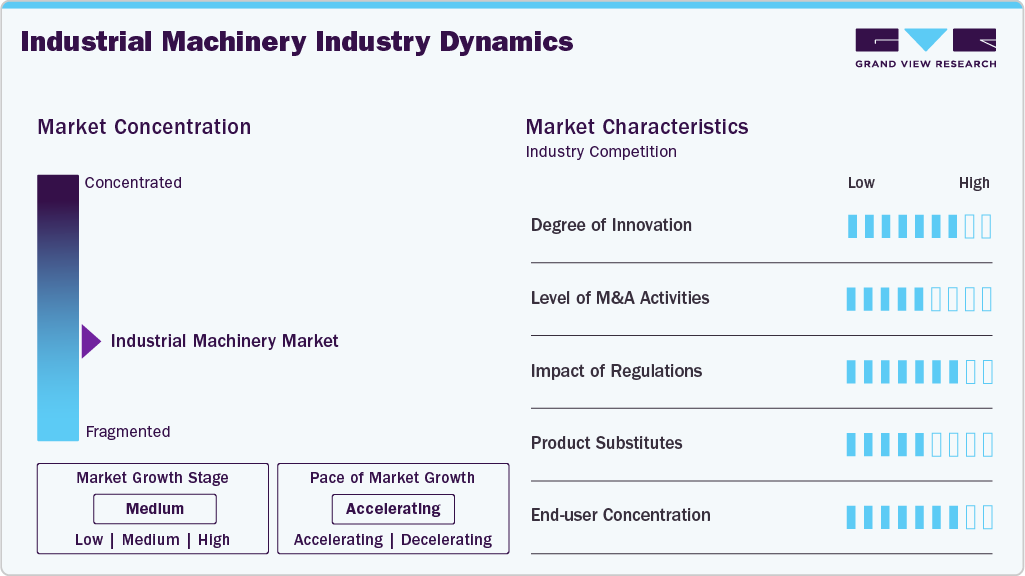
The industrial machinery industry is fragmented, with established multinational machinery manufacturers operating alongside specialized application producers and regional suppliers. Competition varies considerably across machinery categories, as product complexity, customization requirements, production scale, and end-use automations influence supplier positioning. Established manufacturers generally compete through broad product portfolios, engineering expertise, global distribution and service networks, while specialized and regional players focus on automation-specific applications, customization, and cost competitiveness.
 To learn more about this report, Download Free Sample Report
Product differentiation is increasingly influenced by automation, precision, energy efficiency, and digital capabilities. Machinery manufacturers are integrating advanced controls, sensors, connectivity, predictive maintenance, and data-monitoring functions to improve application productivity, reliability, and operational efficiency. The adoption of smart manufacturing technologies is also encouraging suppliers to offer connected, flexible machinery that integrates with broader production systems, making technological capabilities and system compatibility important competitive factors.
The market has a significant aftermarket and lifecycle-service component, including application maintenance, spare parts, upgrades, retrofits, installation, and technical support. Long machinery lifecycles and the need for specialized technical expertise strengthen customer relationships and create recurring service opportunities for manufacturers. Competition is therefore extending beyond initial application sales toward integrated machinery solutions, digital services, and lifecycle support, with manufacturers increasingly seeking to differentiate through application performance, service responsiveness, and technology-enabled offerings.
Analyst Perspective
The industrial machinery market is expected to grow steadily, driven by rising investments in manufacturing capacity, factory modernization, automation, and production efficiency. The adoption of Industry 4.0 technologies, including IoT, robotics, and predictive maintenance, is encouraging manufacturers to upgrade to advanced and energy-efficient machinery. Asia Pacific remains a key demand center due to its expanding manufacturing base, while North America and Europe are supported by replacement demand and investments in advanced manufacturing.
Automation Insights
The semi-automatic machinery segment led the market with the largest revenue share of 41.6% in 2025, reflecting its broad adoption across manufacturing environments that require a balance among operator involvement, production flexibility, and automation efficiency. These systems are particularly relevant for manufacturers transitioning from manual processes toward automated production while managing capital investment and operational requirements. Their adaptability across different production scales and processes supports continued demand within the industrial machinery industry.
The fully automatic machinery segment is projected to grow at the fastest CAGR during the forecast period, driven by manufacturers’ focus on improving production throughput, reducing manual intervention, and achieving consistent operational performance. Increasing integration of automated controls, sensors, robotics, and digitally connected systems is encouraging the adoption of fully automated equipment across industrial production lines. The shift toward smart manufacturing and greater process standardization is further strengthening demand for fully automatic machinery.
Distribution Channel Insights
The direct sales segment led the market with the largest revenue share of 58.6% in 2025, reflecting the importance of direct engagement between industrial machinery manufacturers and end users for equipment selection, customization, installation, and technical support. Direct sales are particularly relevant for complex machinery requiring application-specific configurations and after-sales service, enabling manufacturers to maintain closer customer relationships throughout the equipment lifecycle.
The indirect sales segment is projected to grow at the fastest CAGR of 7.6% during the forecast period, supported by the broader reach of distributors, dealers, and specialized machinery resellers. Indirect channels enable manufacturers to access diverse customer segments and geographic markets while providing localized sales, service, and distribution capabilities. Their expanding role is expected to strengthen market access for industrial machinery suppliers, particularly across fragmented and emerging industrial markets.
Application Insights
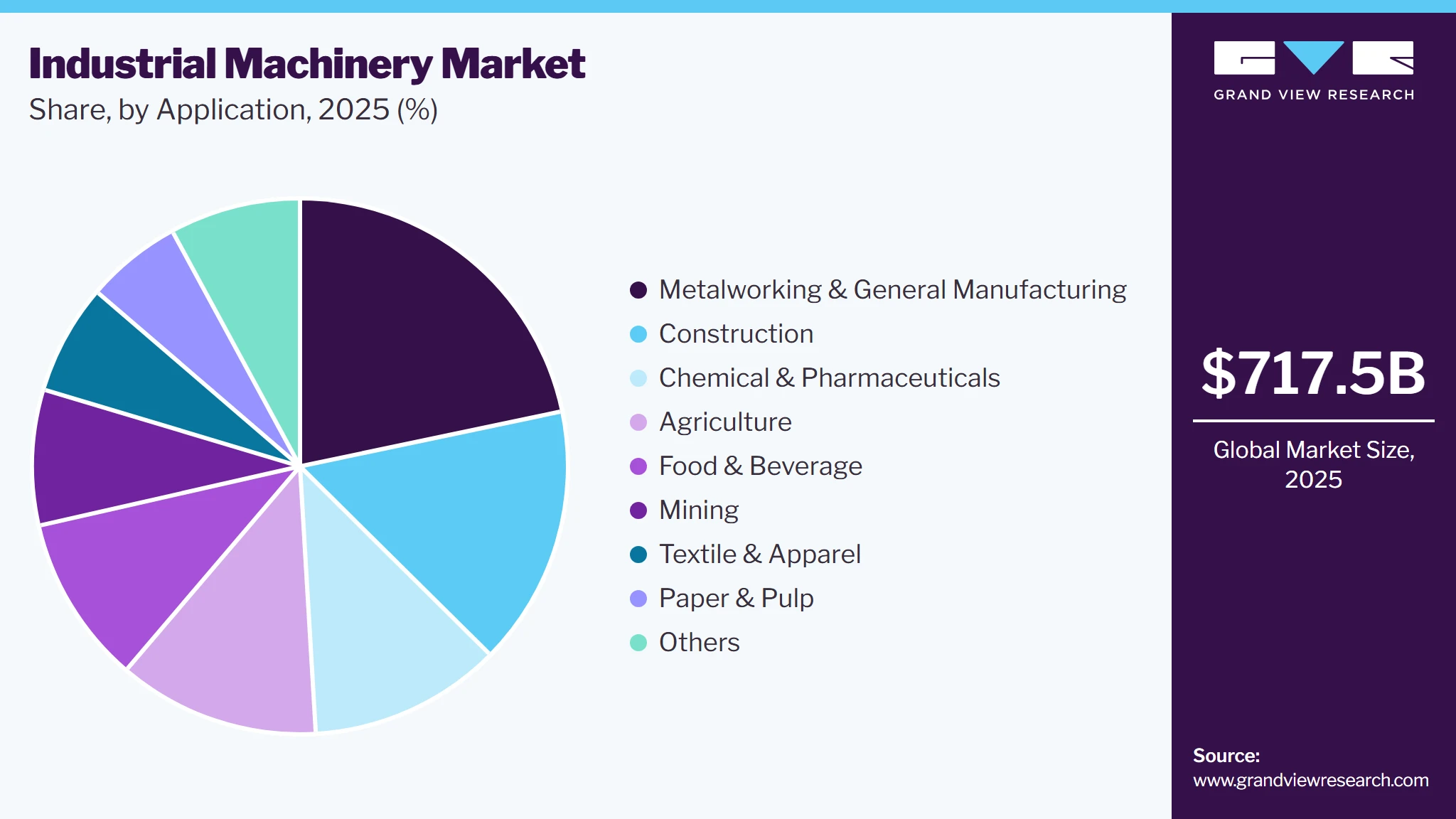
The metalworking & general manufacturing segment led the market with the largest revenue share of 21.7% in 2025, reflecting the broad deployment of industrial machinery across metal processing, fabrication, machining, and general manufacturing operations. Demand from these applications is closely linked to production capacity expansion, equipment replacement, and the need for improved productivity, precision, and operational efficiency across manufacturing facilities.
 To learn more about this report, Download Free Sample Report
The chemical & pharmaceuticals segment is projected to grow at the fastest CAGR during the forecast period, driven by increasing demand for specialized machinery that supports process efficiency, production consistency, safety, and stringent manufacturing requirements. The adoption of advanced processing, material-handling, and automated equipment across chemical and pharmaceutical facilities is driving demand for machinery as manufacturers modernize production infrastructure and improve operational performance.
Regional Insights
The industrial machinery market in North America is supported by a well-established manufacturing base, high levels of industrial automation penetration, and the continuous modernization of production facilities. Demand is driven by automotive, aerospace, chemicals, food and beverage, electronics, and general manufacturing industries, where manufacturers are increasingly investing in advanced machinery to enhance productivity, precision, and operational efficiency. The growing adoption of automated production systems connected to machinery and energy-efficient applications is further supporting replacement and upgrade cycles across the region.
U.S. Industrial Machinery Market Trends
The industrial machinery market in the U.S. accounted for a significant share in North America in 2025. Demand is driven by strong investments in factory modernization, smart manufacturing facilities, and the replacement of aging industrial applications across key end-use industries. The increasing deployment of robotics, precision machinery, and digitally integrated production systems is driving productivity improvements and operational optimization across manufacturing facilities.
The Canada industrial machinery market is expected to witness steady growth during the forecast period, supported by investments in manufacturing modernization, resource processing industries, food production, and industrial infrastructure development. Rising adoption of automated and energy-efficient machinery is driving application upgrades, while demand for specialized and replacement machinery continues to support market expansion.
Asia Pacific Industrial Machinery Market Trends
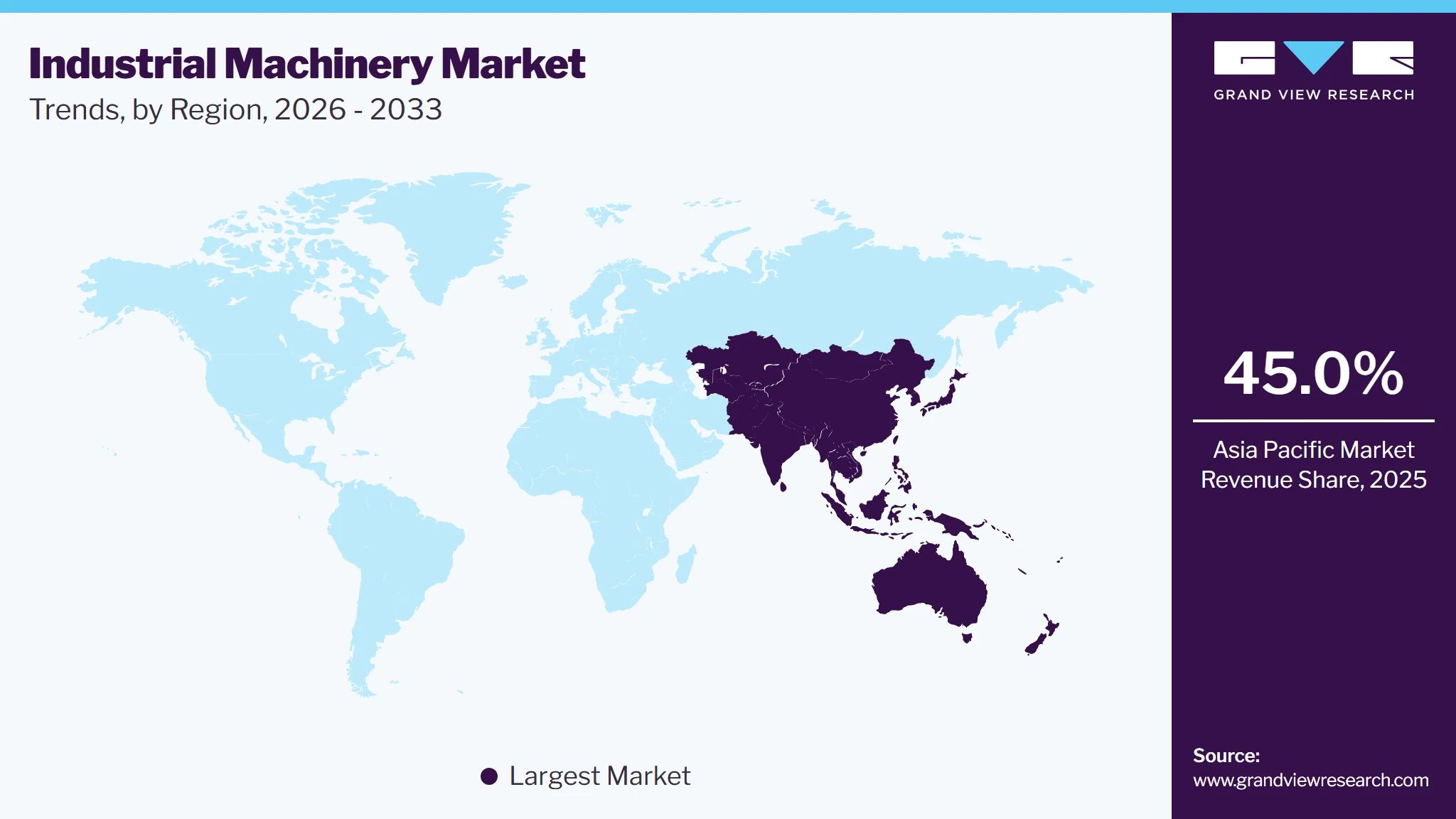
Asia Pacific dominated the global industrial machinery market with the largest revenue share of 45.0% in 2025, and is anticipated to grow at the fastest CAGR during the forecast period, supported by large-scale manufacturing activity, rapid industrialization, capacity expansion, and increasing adoption of automation. Demand spans automotive, electronics, metals, chemicals, pharmaceuticals, food processing, and general manufacturing industries, where manufacturers are investing heavily in production equipment to expand output and improve efficiency. Ongoing development of new manufacturing facilities and modernization of existing plants are driving strong demand for machinery across the region.
 To learn more about this report, Download Free Sample Report
The industrial machinery market in China accounted for the largest market revenue share in the Asia Pacific in 2025. Growth is supported by its extensive manufacturing base, large-scale industrial capacity, and continued investment in advanced and automated production systems. Strong demand across automotive, electronics, metals, chemicals, and general manufacturing industries is driving machinery procurement and replacement cycles.
The India industrial machinery market is expected to grow at a significant CAGR during the forecast period, driven by rapid industrial expansion, manufacturing infrastructure development, and increasing adoption of automation. Rising investment in the automotive, electronics, food processing, pharmaceuticals, and general manufacturing sectors is accelerating demand for modern, energy-efficient, and high-performance industrial machinery.
Europe Industrial Machinery Market Trends
The industrial machinery market in Europe continues to grow strongly, supported by its advanced manufacturing ecosystem, engineering expertise, and ongoing industrial modernization initiatives. Demand is driven by the adoption of automation, energy-efficient production systems, precision engineering machinery, and digital manufacturing technologies across the automotive, chemicals, metals, food processing, and machinery manufacturing industries. The replacement of aging equipment and the shift toward smart, efficient production systems are key growth drivers.
The Germany industrial machinery market accounted for a substantial share in Europe in 2025, supported by its strong industrial base and globally recognized machinery manufacturing sector. Demand is driven by automation, production line upgrades, precision engineering applications, and the replacement of legacy machinery across automotive, industrial manufacturing, chemicals, and process industries. Continuous investment in advanced manufacturing technologies is further strengthening machinery adoption.
The industrial machinery market in France is expected to grow at a significant CAGR during the forecast period, supported by investments in industrial modernization across automotive, aerospace, food processing, and general manufacturing sectors. Increasing focus on production efficiency, automation, and energy optimization is driving the replacement of conventional machinery with advanced, digitally enabled systems.
Middle East & Africa Industrial Machinery Market Trends
The industrial machinery market in the Middle East & Africa is supported by industrial diversification efforts, manufacturing expansion, mining activities, food processing, and infrastructure development projects. Gulf countries are actively expanding non-oil industrial sectors, while several African economies are strengthening manufacturing and resource-processing capabilities. Demand for modern, efficient, and automated machinery is increasing as industries focus on capacity expansion and operational efficiency.
The Saudi Arabia industrial machinery market is anticipated to grow at a significant CAGR during the forecast period, driven by strong investments in industrial diversification, manufacturing development, mining, food processing, and infrastructure projects. Expansion of non-oil industrial activities is driving demand for production, processing, and material-handling machinery, while modernization initiatives are accelerating the adoption of advanced industrial applications.
Latin America Industrial Machinery Market Trends
The industrial machinery market in Latin America is supported by manufacturing expansion, food processing growth, mining activities, automotive production, and industrial infrastructure development. Demand is increasingly driven by application replacement, production modernization, and efficiency improvement initiatives across industrial facilities. The adoption of automated, energy-efficient machinery is gradually increasing as industries modernize their operations.
The Brazil industrial machinery market accounted for a significant share in Latin America in 2025. Growth is supported by its diversified industrial base, including food processing, automotive, mining, chemicals, and general manufacturing sectors. Ongoing modernization of production facilities and the replacement of aging machinery are key drivers of demand for applications.
Key Industrial Machinery Company Insights
Some of the key players operating in the market include Caterpillar Inc. and Komatsu Ltd., among others.
-
Caterpillar Inc. is a U.S.-based manufacturer with a broad portfolio of construction, mining, energy, and industrial applications. Its offerings include earthmoving machinery, mining equipment, engines, power systems, and related technologies serving customers across infrastructure, resource, and industrial automation. The company combines application sales with digital solutions, financing, parts, maintenance, and dealer-supported services, enabling it to address machinery requirements across the application lifecycle. Its extensive product range and global distribution network strengthen its position in capital-intensive machinery markets.
-
Komatsu Ltd. is a Japan-based manufacturer of construction, mining, forestry, and industrial machinery, with operations spanning application manufacturing, technology solutions, and lifecycle support. Its portfolio includes excavators, wheel loaders, bulldozers, dump trucks, mining equipment, and other specialized machinery. The company is strengthening its application offerings through automation, smart construction technologies, autonomous systems, and digital fleet-management solutions. Its global production and distribution footprint, combined with parts and service capabilities, supports customers seeking higher application utilization, productivity, safety, and operating efficiency.
Key Industrial Machinery Companies
The following key companies have been profiled for this study on the global industrial machinery market:
-
Caterpillar Inc.
-
Komatsu Ltd.
-
Deere & Company
-
XCMG Machinery
-
Liebherr Group
-
SANY Heavy Industry Co., Ltd.
-
Hitachi Construction Machinery Co., Ltd.
-
Volvo Construction Application
-
JCB Ltd.
-
Sandvik AB
-
Epiroc AB
-
Terex Corporation
-
CNH Industrial N.V.
-
Kubota Corporation
-
Zoomlion Heavy Industry Science & Technology Co., Ltd.
Competitive Benchmarking
Category
Operating Strategies
Competitive Edge
Weakness
Established Players (e.g., Caterpillar Inc.; Komatsu Ltd.; Deere & Company; CNH Industrial N.V.; Volvo Construction Application; Liebherr Group; Hitachi Construction Machinery Co., Ltd.)
- Expand diversified machinery portfolios across construction, mining, agriculture, manufacturing, and material handling automations.
- Invest in automation, electrification, digital technologies, global distribution, and aftermarket service networks.
- Broad product portfolios and strong engineering capabilities.
- Established global distribution, brand recognition, and lifecycle service infrastructure.
- High R&D and manufacturing costs.
- Complex product development and dependence on capital-intensive industrial investment cycles.
Emerging & Regional Players (e.g., JCB Ltd.; Sandvik AB; Epiroc AB; Terex Corporation; SANY Heavy Industry Co., Ltd.; XCMG Construction Machinery Co., Ltd.; Zoomlion Heavy Industry Science & Technology Co., Ltd.; Kubota Corporation)
- Focus on specialized machinery, automation-specific applications, and cost-competitive product offerings.
- Expand regional presence through localized manufacturing, strategic partnerships, and customized solutions.
- Greater flexibility in addressing automation-specific requirements.
- Competitive pricing, faster customization, and strong regional market knowledge.
- Comparatively narrower product portfolios and global service networks.
- Lower scale in R&D, distribution, and aftermarket coverage compared with established multinational manufacturers.
Recent Developments
-
In April 2026, Komatsu Germany Mining Division announced the global launch of the PC9000-12 hydraulic mining excavator, underscoring ongoing advancements in large-scale mining automation and equipment within the industrial machinery market. Developed for surface mining applications, the excavator features high bucket capacity, extended reach, and increased digging force to enhance loading productivity and lower operating costs per ton. The PC9000-12 is offered in front shovel and backhoe configurations, with both diesel and electric drive options. The front shovel version supports bucket capacities of up to 46 m³, while the backhoe configuration accommodates buckets of up to 49 m³, enabling efficient loading of Komatsu's ultra-large mining trucks.
-
In April 2026, Caterpillar acquired Monarch Tractor, a California-based developer of electric and autonomous agricultural tractors, strengthening its capabilities in autonomous application, electrification, and software-defined vehicle technologies. The acquisition gives Caterpillar access to Monarch’s software platform, perception technology, and electrification systems, which can be applied across tractors, agricultural implements, utility vehicles, and construction equipment.
Industrial Machinery Market Report Scope
Report Attribute
Details
Market size in 2025
USD 717.5 billion
Estimated market size in 2026
USD 766.6 billion
Projected market size by 2033
USD 1,243.9 billion
Growth rate
CAGR of 7.2% from 2026 to 2033
Base year for estimation
2025
Historical data
2021 - 2024
Forecast period
2026 - 2033
Quantitative units
Revenue in USD million/billion, and CAGR from 2026 to 2033
Report coverage
Revenue forecast, company market position analysis, competitive landscape, growth factors, and trends
Segments covered
Automation, distribution channel, application, region
Regional scope
North America; Europe; Asia Pacific; Latin America; Middle East & Africa
Country scope
U.S.; Canada; Mexico; Germany; UK; Italy; Spain; France; China; Japan; India; Australia; South Korea; Brazil; Argentina; Saudi Arabia; UAE; South Africa
Key companies profiled
Caterpillar Inc.; Komatsu Ltd.; Deere & Company; XCMG Machinery; Liebherr Group; SANY Heavy Industry Co., Ltd.; Hitachi Construction Machinery Co., Ltd.; Volvo Construction Application; JCB Ltd.; Sandvik AB; Epiroc AB; Terex Corporation; CNH Industrial N.V.; Kubota Corporation; Zoomlion Heavy Industry Science & Technology Co., Ltd.
Customization scope
Free report customization (equivalent up to 8 analysts working days) with purchase. Addition or alteration to country, regional & segment scope.
Pricing and purchase options
Avail customized purchase options to meet your exact research needs. Explore purchase options
Global Industrial Machinery Market Report Segmentation
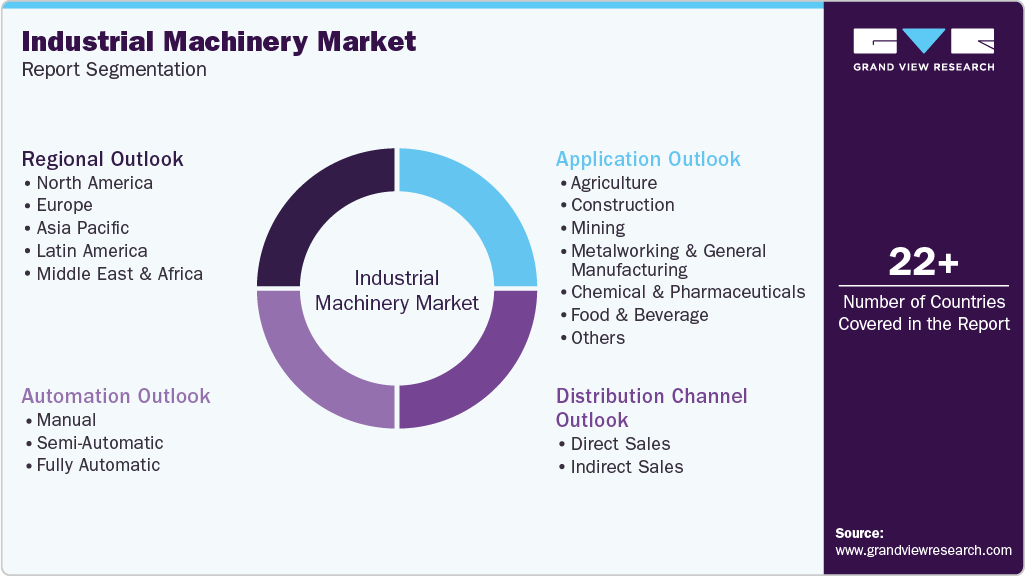
This report forecasts revenue growth at global, regional & country levels and provides an analysis on the industry trends in each of the sub-segments from 2021 to 2033. For this study, Grand View Research has segmented the global industrial machinery market report based on the automation, distribution channel, application, and region:
 To learn more about this report, Download Free Sample Report
-
Automation Outlook (Revenue, USD Billion, 2021 - 2033)
-
Manual
-
Semi-Automatic
-
Fully Automatic
-
-
Distribution Channel Outlook (Revenue, USD Billion, 2021 - 2033)
-
Direct Sales
-
Indirect Sales
-
-
Application Outlook (Revenue, USD Billion, 2021 - 2033)
-
Agriculture
-
Construction
-
Mining
-
Metalworking & General Manufacturing
-
Chemical & Pharmaceuticals
-
Food & Beverage
-
Textile & Apparel
-
Paper & Pulp
-
Others
-
-
Regional Outlook (Revenue, USD Billion, 2021 - 2033)
-
North America
-
U.S.
-
Canada
-
Mexico
-
-
Europe
-
Germany
-
France
-
UK
-
Spain
-
Italy
-
-
Asia Pacific
-
China
-
India
-
Japan
-
South Korea
-
Australia
-
-
Latin America
-
Brazil
-
Argentina
-
-
Middle East & Africa
-
Saudi Arabia
-
UAE
-
South Africa
-
-
Research Methodology
The industrial machinery marketfigures in this report are based on a proven research process that combines executive interviews with secondary research from proprietary databases, company filings, and recognized regulatory and institutional sources. Market size is built through value-chain sizing-reconciling supply-side and demand-side estimates-and triangulated with bottom-up and top-down approaches. Every estimate passes multiple levels of expert validation before publication, with eachindustrial machinery segment quantified using the revenue-capture definitions in the table below.
Segment Definition
Segment - Automation
Revenue Capture Definition
Manual
Revenue generated from the sale of manual industrial machinery that requires substantial operator involvement for machine operation, adjustment, monitoring, loading, and material handling.
Semi-Automatic
Revenue is generated from the sale of semi-automatic industrial machinery that combines automated functions with manual operator intervention during production processes.
Fully Automatic
Revenue generated from the sale of fully automatic industrial machinery capable of performing production operations with minimal operator intervention through automated controls, monitoring, and material handling.
Segment - Distribution Channel
Revenue Capture Definition
Direct Sales
Revenue generated from direct sales of industrial machinery made by manufacturers or their authorized sales organizations directly to industrial end users.
Indirect Sales
Revenue generated from indirect sales of industrial machinery through distributors, dealers, agents, system integrators, resellers, or other intermediaries.
Segment - Application
Revenue Capture Definition
Agriculture
Revenue generated from the sale of industrial machinery for agriculture automations, including applications used in agricultural production, processing, storage, irrigation, and post-harvest operations.
Construction
Revenue generated from the sale of industrial machinery for construction applications, including equipment used for excavation, infrastructure development, material handling, road construction, and concrete processing.
Mining
Revenue generated from the sale of industrial machinery for mining applications, including equipment used for mineral extraction, drilling, crushing, screening, hauling, and mineral processing.
Metalworking & General Manufacturing
Revenue generated from the sale of industrial machinery for metalworking and general manufacturing automations, including applications used for machining, fabrication, forming, cutting, welding, assembly, and material handling.
Chemical & Pharmaceuticals
Revenue generated from the sale of industrial machinery for chemical and pharmaceutical automations, including applications used for processing, mixing, conveying, filling, packaging, and material handling.
Food & Beverage
Revenue generated from the sale of industrial machinery for food and beverage applications, including equipment used for processing, preparation, filling, packaging, and production.
Textile & Apparel
Revenue generated from the sale of industrial machinery for textile and apparel automations, including applications used for spinning, weaving, knitting, dyeing, finishing, cutting, sewing, and garment production.
Paper & Pulp
Revenue generated from the sale of industrial machinery for paper and pulp automations, including applications used for pulp production, paper manufacturing, converting, coating, drying, finishing, and material handling.
Others
Revenue generated from the sale of industrial machinery for other automations, including electronics, plastics, rubber, utilities, printing, logistics, and specialized manufacturing activities.
Estimation Model
Layer Name
Key Question
Description
Industrial Machinery Demand Layer
Where is industrial machinery required?
Assess industrial production, manufacturing output, capacity utilization, plant expansions, infrastructure development, and application replacement requirements across manufacturing and industrial sectors. Machinery demand is evaluated across automotive, food & beverage, chemicals, pharmaceuticals, electronics, metals, plastics, packaging, mining, construction, and other machinery-intensive industries.
Industrial Investment & Capacity Layer
Where is demand for new machinery being created?
Evaluate capital investments in new manufacturing facilities, production-line expansions, plant modernization, automation projects, capacity additions, and replacement of aging machinery. Greenfield and brownfield investments are analyzed to quantify incremental application requirements across industries and regions.
Machinery Adoption Layer
Which machinery is being deployed?
Determine machinery adoption by application type, automation level, capacity, technology, and end-use industry. Adoption is assessed based on production requirements, application utilization, automation intensity, precision requirements, energy efficiency, labor availability, digitalization, and Industry 4.0 integration.
Revenue Generation Layer
How is machinery revenue captured?
Estimate annual revenue from the sale of new industrial machinery by machinery type, automation level, distribution channel, end-use industry, and region. Revenue is derived from OEM and manufacturer sales to industrial users, distributors, dealers, and system integrators.
Customization Table
Client Request
Customization Delivered
Value Adds
Competitive Benchmarking
A competitive benchmarking analysis was conducted by evaluating established industrial machinery manufacturers based on product portfolio breadth, machinery categories, application capacity, automation capabilities, energy efficiency, digital technologies, production capabilities, geographic presence, distribution networks, aftermarket support, and strategic developments.
The benchmarking provided insights into product differentiation, technological capabilities, manufacturing strengths, service coverage, and competitive positioning, enabling stakeholders to compare supplier capabilities and develop informed sourcing, partnership, and market strategies.
Regional Segmentation
A comprehensive regional assessment was conducted by analyzing demand for industrial machinery across manufacturing investment, industrial production, infrastructure development, machinery replacement, plant modernization, and automation activities. The analysis evaluated machinery demand across major industrial economies and end-use sectors.
The regional assessment enabled stakeholders to identify attractive markets, evaluate regional demand patterns, prioritize expansion opportunities, and align market strategies with evolving industrial machinery investment requirements.
Opportunity Assessment
A detailed opportunity assessment was conducted by evaluating demand generated by factory expansion, application replacement, industrial automation, smart manufacturing, energy-efficient machinery, production-line modernization, and infrastructure investment. The assessment also considered opportunities arising from the replacement of legacy equipment and the adoption of advanced machinery technologies.
The assessment enabled stakeholders to identify revenue opportunities, prioritize technology and capacity investments, support product portfolio development, and align expansion strategies with changing industrial machinery requirements.
Frequently Asked Questions About This Report
The global industrial machinery market size was valued at USD 717.5 billion in 2025 and is projected to reach USD 766.6 billion in 2026.
The global industrial machinery market is projected to grow at a CAGR of 7.2% from 2026 to 2033, reaching USD 1,243.9 billion by 2033.
Asia Pacific dominated the global industrial machinery market with the largest revenue share of 45.0% in 2025.
The fully automatic segment is projected to grow at a CAGR of 7.6% from 2026 to 2033, supported by increasing adoption of automated production systems and demand for higher manufacturing productivity.
The direct sales segment dominated the industrial machinery market in 2025, accounting for a revenue share of 58.6%.
The chemical & pharmaceuticals segment is projected to grow at the fastest CAGR of 8.7% from 2026 to 2033, supported by investments in production capacity, process automation, and specialized manufacturing equipment.
Key factors include industrial automation, manufacturing capacity expansion, modernization of production facilities, demand for energy-efficient machinery, and increasing investments across chemical, pharmaceutical, automotive, construction, agriculture, and manufacturing industries.
Which application segment held the largest revenue share in the industrial machinery market in 2025?Metalworking & general manufacturing held the largest revenue share of 21.7% in 2025, supported by broad demand for industrial machinery across fabrication, machining, and manufacturing operations.
Key players include Caterpillar Inc.; Komatsu Ltd.; Deere & Company; XCMG Machinery; Liebherr Group; SANY Heavy Industry Co., Ltd.; Hitachi Construction Machinery Co., Ltd.; Volvo Construction Equipment; JCB Ltd.; Sandvik AB; Epiroc AB; Terex Corporation; CNH Industrial N.V.; Kubota Corporation; and Zoomlion Heavy Industry Science & Technology Co., Ltd.
About the Author(s)
Advanced Interior Materials Research Team
Advanced Materials · Advanced Interior MaterialsThis report was authored by the advanced interior materials research team at Grand View Research - comprising two research analysts, one senior research analyst, and one industry expert - with specialized expertise in the advanced interior materials segment of the advanced materials industry. All findings are based on proprietary advanced materials databases, executive interviews, and regulatory analysis, subject to internal peer review prior to publication.
Last Updated:
Speak to Analyst

Customize this report to your needs - add regions, segments, or data points, with 20% free customization.
Or view our licence options:


ISO 9001:2015 & 27001:2022 Certified
We are GDPR and CCPA compliant! Your transaction & personal information is safe and secure. For more details, please read our privacy policy.


