
- Home
- »
- Advanced Interior Materials
- »
-
Industrial Valves Market Size & Share Report, 2026-2033GVR Report cover
![Industrial Valves Market (2026 - 2033)Report]()
Industrial Valves Market (2026 - 2033)
Size, Share & Trends Analysis Report By Product (Ball Valve, Butterfly Valve, Gate Valve, Plug Valve, Safety Valve, Globe Valve), By Application (Automotive, Oil & Gas, Chemical, Energy & Power, Pulp & Paper), By Region, And Segment Forecasts
Market Size, 2025
$80.4BMarket Estimate, 2026
$83.1BMarket Forecast, 2033
$126.4BCAGR, 2026–2033
6.2%Industrial Valves Market Summary
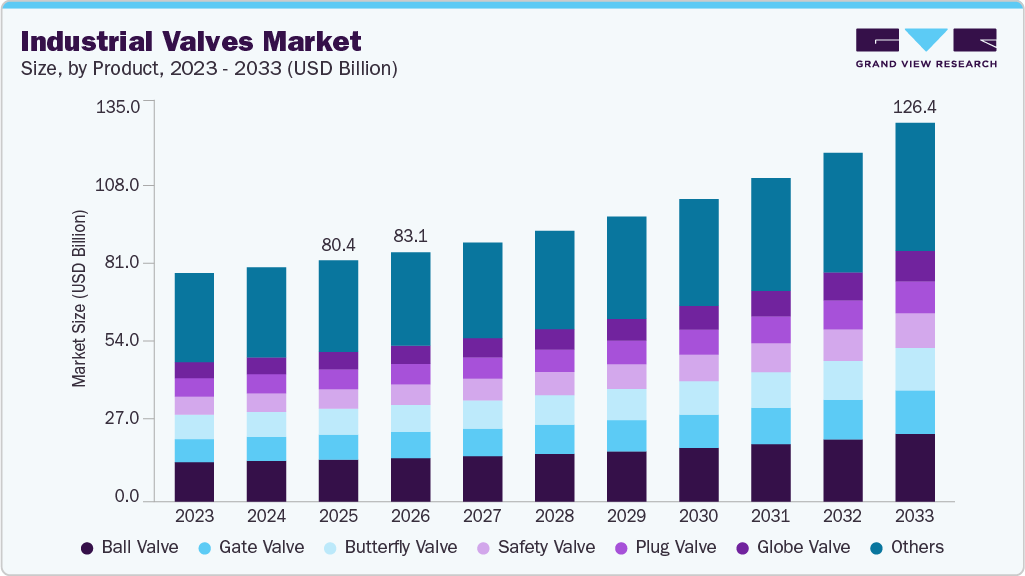
The global industrial valves market size was valued at USD 80.4 billion in 2025 and is projected to grow from USD 83.1 billion in 2026 to USD 126.4 billion by 2033, at a CAGR of 6.2% from 2026 to 2033. The market in Asia Pacific dominated with a revenue share of 36.3% in 2025. Rapid expansion of oil & gas, power generation, water & wastewater treatment, and chemical processing industries is increasing the demand for reliable flow control systems, driving the adoption of industrial valves.

Key Market Trends & Insights
- By product: The others segment dominated the industry in 2025, accounting for 37.9% of the total revenue.
- By application: The automotive segment dominated the industry in 2025, accounting for 18.8% revenue share.
Regional Highlights
- Largest regional market: Asia Pacific (36.3% revenue share, 2025)
- The industrial valves industry in the China held the largest revenue share in 2025.
Market Size & Forecast
- Market size in 2025: USD 80.4 Billion
- Estimated market size in 2026: USD 83.1 Billion
- Projected market size by 2033: USD 126.4 Billion
- CAGR (2026-2033): 6.2%
Additionally, growing investments in industrial infrastructure, energy projects, and automation across emerging economies are further accelerating the need for advanced and durable industrial valve solutions.The expansion of global process industries is a major factor accelerating demand for industrial valves across multiple applications. Sectors such as oil & gas, chemicals, power generation, water treatment, and manufacturing rely heavily on reliable flow-control systems to maintain operational safety and efficiency. As large-scale industrial facilities expand and modernize, there is a growing need for advanced solutions such as industrial spray valves and industrial thermostatic control valves that help regulate fluid pressure, temperature, and distribution with high precision. Increasing investment in industrial automation and plant efficiency is further encouraging the integration of intelligent valve systems that support improved operational performance and reduced downtime.
The growth of energy infrastructure and upstream oil & gas activities is also boosting the market growth. Exploration, production, refining, and pipeline transportation require extensive valve networks to control high-pressure fluids and hazardous materials. Industrial valves used in oil and gas operations must meet stringent safety and durability standards, which is increasing the adoption of high-performance valves and actuators capable of operating in extreme environments. Additionally, the transition toward cleaner fuels, LNG infrastructure expansion, and new petrochemical projects worldwide are stimulating demand for specialized valves such as industrial vacuum valves and automated valve systems that ensure safe fluid handling in complex processing environments.
The rapid adoption of industrial automation and smart manufacturing is also reshaping the role of valves in modern facilities. Industrial valve actuators are increasingly integrated with digital monitoring systems, sensors, and control platforms to enable remote operation, predictive maintenance, and real-time performance monitoring. These advancements are transforming conventional mechanical valves into intelligent flow-control components that improve process efficiency and reduce operational risks. As industries pursue higher productivity and reduced labor dependency, the deployment of automated industrial valves and actuators across manufacturing plants, energy facilities, and processing industries continues to rise.

Furthermore, stringent safety regulations and the need for efficient fluid management are encouraging industries to upgrade their valve infrastructure. Governments and regulatory bodies across regions are implementing strict standards related to leak prevention, pressure control, and environmental protection in industrial operations. This is driving the adoption of technologically advanced valve systems that offer higher reliability, corrosion resistance, and precise control over fluid flow. Applications such as industrial spray systems, vacuum processing environments, and temperature-controlled operations increasingly depend on specialized valves, further supporting the demand for industrial valves and actuators across diverse industrial sectors.
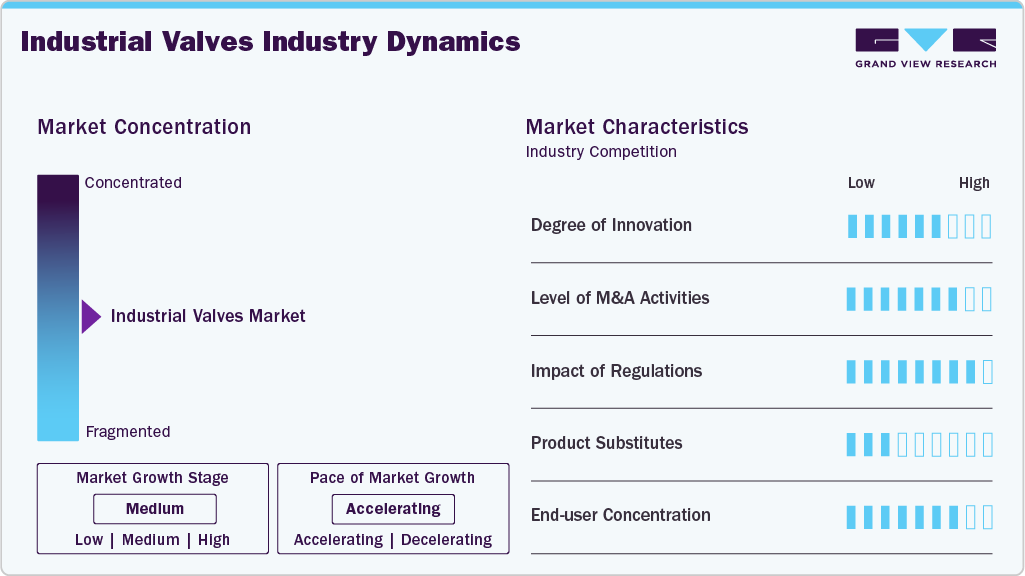
Market Concentration & Characteristics
The industry exhibits high dependence on capital-intensive end-use sectors, particularly oil & gas, power generation, chemicals, and water infrastructure. Demand for industrial valves is closely linked to investments in industrial plants, energy infrastructure, pipelines, refineries, and manufacturing facilities. As a result, market growth often follows industrial expansion cycles, large-scale infrastructure projects, and energy sector developments. Industrial valves used in oil and gas operations, for example, must withstand extreme pressures and corrosive environments, requiring advanced materials and specialized engineering capabilities.
Another defining characteristic is the strong integration with industrial automation and control systems. Modern industrial operations increasingly rely on automated flow control, which has led to the widespread use of valve actuators and smart valve technologies. Industrial valves and actuators are often integrated with digital monitoring systems, sensors, and centralized control platforms to enable remote operation, predictive maintenance, and process optimization. This shift toward smart and automated valve solutions is transforming traditional mechanical components into intelligent process-control equipment.
Product Insights
Ball valves represent one of the most widely used product segments within the industrial valves industry due to their reliable shut-off capability, durability, and ease of operation. These valves use a rotating spherical disc (ball) to control the flow of liquids or gases, allowing quick quarter-turn operation for efficient flow regulation. Ball valves are extensively utilized across industries such as oil & gas, chemicals, water & wastewater treatment, power generation, and manufacturing because they provide tight sealing, low pressure drop, and high resistance to corrosion and high-pressure environments.
The others segment dominated the industry in 2025, accounting for 37.9% of the total revenue. This segment includes a variety of specialized valves, such as diaphragm valves, pinch valves, needle valves, pressure relief valves, and vacuum valves, that are designed for specific industrial applications requiring precise fluid control and safety management. The strong share of this segment is driven by the growing demand for customized valve solutions across industries such as chemicals, pharmaceuticals, water & wastewater treatment, food processing, and energy.
Application Insights
The automotive segment dominated the industry in 2025, accounting for 18.8% revenue share, primarily due to the extensive use of valves in automotive manufacturing processes and vehicle component systems. Industrial valves play a critical role in regulating fluids and gases in applications such as paint systems, cooling systems, fuel handling, compressed air systems, and hydraulic operations across automotive production facilities. The expansion of global automotive manufacturing, particularly in emerging economies, has increased the demand for efficient fluid control systems to maintain operational efficiency and process safety.
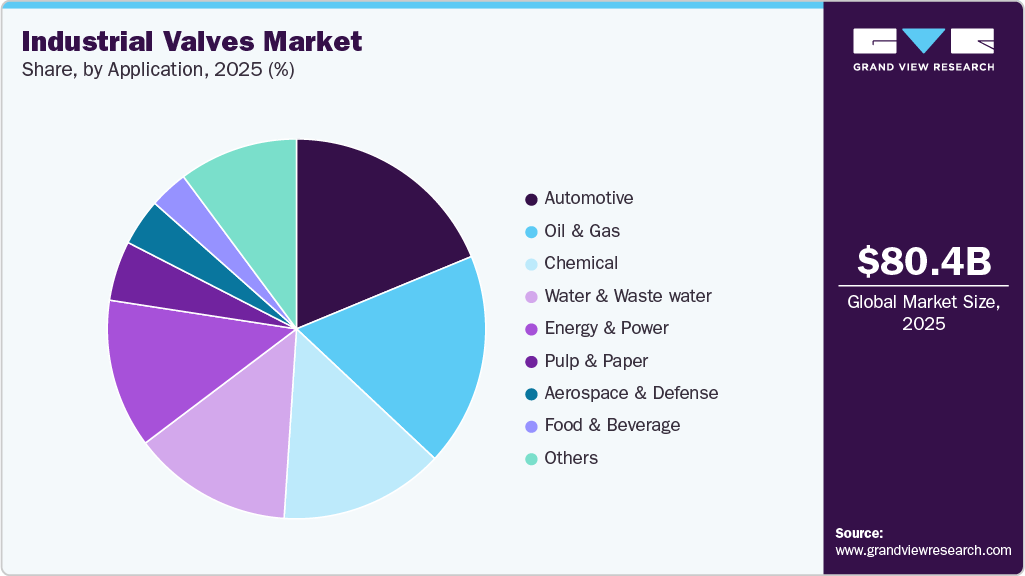
The oil & gas segment represented a significant share of the industry in 2025 due to the critical role valves play in exploration, production, refining, and pipeline transportation operations. Industrial valves are widely used to control the flow of crude oil, natural gas, steam, and other process fluids under high-pressure and high-temperature conditions, ensuring safe and efficient operations across upstream, midstream, and downstream activities. The expansion of global energy infrastructure, including new pipelines, LNG facilities, and petrochemical plants, has increased the demand for high-performance valves capable of handling corrosive and hazardous environments.
Regional Insights
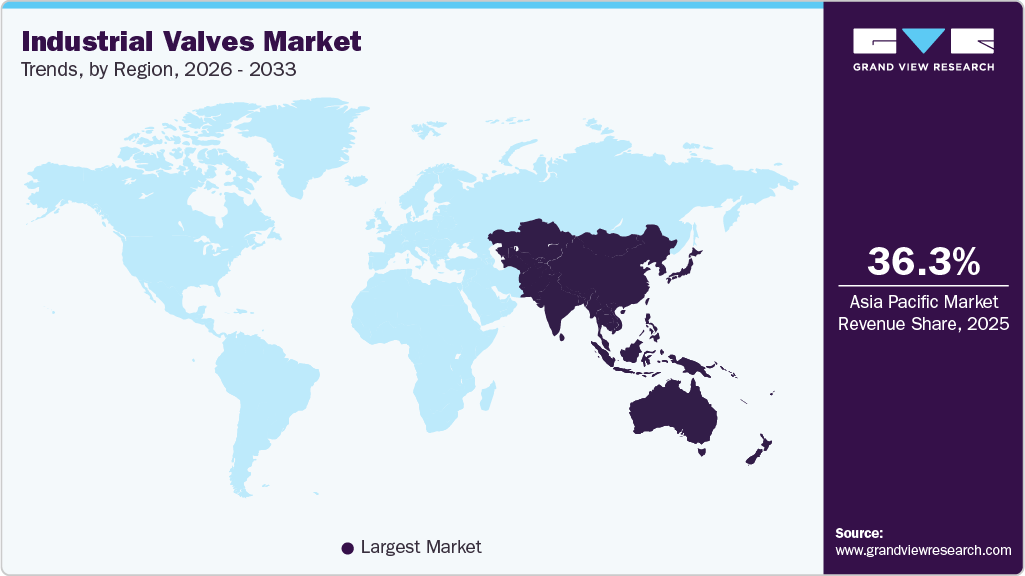
Asia Pacific was the largest market for industrial valves in 2025, with a revenue share of 36.3%. Asia Pacific industrial valves industry represented a leading regional segment due to rapid industrialization, expanding energy infrastructure, and strong manufacturing growth across major economies such as China, India, Japan, and South Korea. The region has witnessed significant investments in sectors including oil & gas, power generation, chemicals, water & wastewater treatment, and automotive manufacturing, all of which require advanced flow-control systems. Large-scale infrastructure development, refinery expansions, and increasing pipeline projects have further strengthened demand for industrial valves in the region. Additionally, the strong presence of domestic valve manufacturers, along with the rising adoption of automation and smart industrial equipment in manufacturing facilities, continues to support the growth of the industrial valves industry across the Asia Pacific.
India Industrial Valves Market Trends
Theindustrial valves industry in India represents a rapidly growing country segment within the industrial valves industry, driven by expanding industrial infrastructure, increasing energy demand, and strong growth in manufacturing activities. The country is witnessing significant investments in sectors such as oil & gas, power generation, chemicals, water & wastewater treatment, and automotive manufacturing, all of which require reliable flow-control systems. Government initiatives such as Make in India and large-scale infrastructure development projects are encouraging domestic manufacturing and industrial capacity expansion, which in turn increases the demand for industrial valves across processing plants and utility networks. Additionally, the development of new refineries, pipeline networks, and city gas distribution projects led by companies such as Oil and Natural Gas Corporation and Indian Oil Corporation continues to strengthen the adoption of advanced valve and actuator systems in the country’s industrial operations.
North America Industrial Valves Market Trends
The industrial valves industry in North America is supported by strong industrial infrastructure and demand from sectors such as oil & gas, power generation, chemicals, and water treatment. Countries including the U.S., Canada, and Mexico contribute significantly due to expanding energy production, refinery operations, and pipeline networks. In addition, ongoing investments in shale gas development, industrial modernization, and infrastructure upgrades across the region continue to drive the adoption of advanced industrial valves and automated valve systems.
Europe Industrial Valves Market Trends
The industrial valves industry in Europe is driven by advanced manufacturing, strong chemical and energy sectors, and strict industrial safety standards. Major economies such as Germany, the UK, France, and Italy contribute substantially due to their well-established industrial base and ongoing investments in energy infrastructure, water treatment, and process industries. Additionally, the region’s strong focus on industrial automation, sustainability, and modernization of aging infrastructure continues to support demand for advanced industrial valves and automated flow-control systems.
Key Industrial Valves Company Insights
The competitive environment of the industrial valves industry is characterized by the presence of several global manufacturers along with numerous regional and specialized producers, resulting in a moderately fragmented landscape. Key players focus on developing advanced valve and actuator systems, expanding automation capabilities, and strengthening aftermarket services to enhance their competitive position. At the same time, regional manufacturers compete by offering cost-effective products and customized solutions for local industries, particularly in emerging markets. Strategic initiatives such as mergers and acquisitions, partnerships, and product innovation remain key approaches used by companies to expand their geographic presence and strengthen their portfolios in specialized valve applications.
Key Industrial Valves Companies:
The following key companies have been profiled for this study on the industrial valves market.
- Emerson
- Velan
- AVK Water
- BEL Valves
- Cameron Schlumberger
- Flowserve
- KLINGER
- GG Valves Private Limited
- LESER
- Crane Fluid Systems
- Flomatic Valves
- Parker Hannifin Corp
Recent Developments
-
On 2nd March 2026, Parker Hannifin Corp launched the PE06 Proportional Pressure Reducing Valve, to enable brake-by-wire hydraulic systems in off-highway vehicles, showcased at CONEXPO-CON/AGG 2026. This compact valve features a proportional piston with hydraulic feedback for precise pressure control up to 170 bar, high flow (30 l/min), low leakage (<25cc at 200 bar), and low hysteresis, supporting single/dual-circuit designs with proven components from Parker's D1FB series for cost efficiency and reliability.
-
In September 2025, Flomatic Valves launched its new AIS/BABA-compliant 12” Model 92 Swing Check Valve in September 2025 for municipal and industrial water systems. This ductile iron valve, meeting ANSI/AWWA C508 standards, prevents water hammer with lever/spring, lever/weight, or lever/weight/air cushion options, plus corrosion-resistant epoxy coating and field-replaceable parts, all made in the U.S.
Industrial Valves Market Report Scope
Report Attribute
Details
Market size in 2025
USD 80.4 billion
Estimated market size in 2026
USD 83.1 billion
Projected market size by 2033
USD 126.4 billion
Growth rate
CAGR of 6.2% from 2026 to 2033
Base year for estimation
2025
Historical data
2021 - 2024
Forecast period
2026 - 2033
Quantitative units
Revenue in USD million/billion and CAGR from 2026 to 2033
Report coverage
Revenue forecast, company ranking, competitive landscape, growth factors, and trends
Segments covered
Product, application, region
Regional scope
North America; Europe; Asia Pacific; Latin America; Middle East & Africa
Country scope
U.S.; Canada; Mexico; Germany; UK; France; China; India; Japan; South Korea; Australia; Brazil; South Africa; Saudi Arabia; UAE
Key companies profiled
Emerson Electric Co.; Velan Inc.; AVK Holding A/S; BEL Valves; Cameron; Flowserve Corporation; Klinger Group; GG Valves Private Limited; LESER GmbH & Co. KG; Crane Fluid Systems; Flomatic Valves; Parker Hannifin Corporation
Customization scope
Free report customization (equivalent up to 8 analysts’ working days) with purchase. Addition or alteration to country, regional, and segment scope.
Pricing and purchase options
Avail customized purchase options to meet your exact research needs. Explore purchase options
Global Industrial Valves Market Report Segmentation
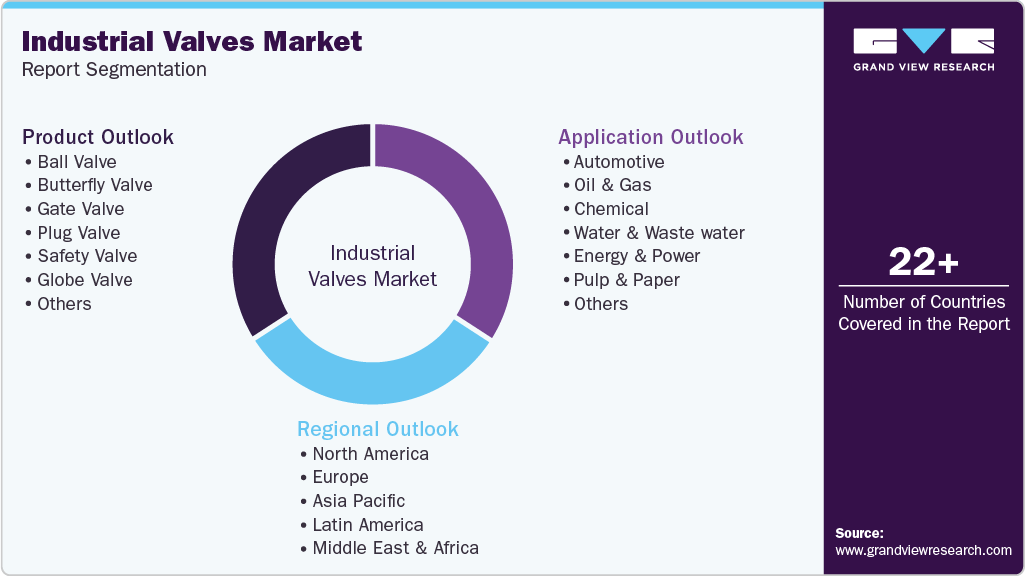
This report forecasts revenue growth at the global, regional, and country levels and provides an analysis of the latest industry trends in each of the sub-segments from 2021 to 2033. For this study, Grand View Research has segmented the global industrial valves market report on the basis of product, application, and region:
-
Product Outlook (Revenue, USD Million, 2021 - 2033)
-
Ball Valve
-
Butterfly Valve
-
Gate Valve
-
Plug Valve
-
Safety Valve
-
Globe Valve
-
Others
-
-
Application Outlook (Revenue, USD Million, 2021 - 2033)
-
Automotive
-
Oil & Gas
-
Chemical
-
Water & Waste water
-
Energy & Power
-
Pulp & Paper
-
Aerospace and Defense
-
Food & Beverage
-
Others
-
-
Regional Outlook (Revenue, USD Million, 2021 - 2033)
-
North America
-
U.S.
-
Canada
-
Mexico
-
-
Europe
-
Germany
-
UK
-
France
-
-
Asia Pacific
-
China
-
India
-
Japan
-
South Korea
-
Australia
-
-
Latin America
-
Brazil
-
-
Middle East & Africa
-
Saudi Arabia
-
UAE
-
South Africa
-
-
Frequently Asked Questions About This Report
The global industrial valves market is expected to grow at a compound annual growth rate of 6.2% from 2026 to 2033 to reach USD 126.4 billion by 2033.
The Asia Pacific dominated the market with a share of 36.3% in 2025.
Some key players operating in the industrial valves market include Flowserve Corporation; KITZ Corporation; Curtiss-Wright Corporation; Emerson Electric Co.; KSB SE & Co. KGaA; and Pentair plc amongst others.
Key factors that are driving the market growth include stringent government regulations, technological advancements propelling the use of smart valves and actuators, and increasing demand in the industrial sector.
The global industrial valves market size was estimated at USD 80.4 billion in 2025 and is expected to reach USD 83.1 billion in 2026.
The others segment led with a revenue share 37.9% in 2025.
Automotive segment held the largest revenue share 18.8% in 2025.
About the Author(s)
Advanced Interior Materials Research Team
Advanced Materials · Advanced Interior MaterialsThis report was authored by the advanced interior materials research team at Grand View Research - comprising two research analysts, one senior research analyst, and one industry expert - with specialized expertise in the advanced interior materials segment of the advanced materials industry. All findings are based on proprietary advanced materials databases, executive interviews, and regulatory analysis, subject to internal peer review prior to publication.
Last Updated:
Speak to Analyst


Customize this report to your needs — add regions, segments, or data points, with 20% free customization.
Or view our licence options:


ISO 9001:2015 & 27001:2022 Certified
We are GDPR and CCPA compliant! Your transaction & personal information is safe and secure. For more details, please read our privacy policy.


