
- Home
- »
- Network Security
- »
-
Intellectual Property Management Software Market Report, 2033GVR Report cover

Intellectual Property Management Software Market (2026 - 2033)
Size, Share & Trends Analysis Report By Component (Service, Software), By Deployment (On-Premise), By Application (Patent Management, Trade Management), By End-use, By Region, And Segment Forecasts
Market Size, 2025
$12.5BMarket Estimate, 2026
$13.7BMarket Forecast, 2033
$33.3BCAGR, 2026–2033
13.6%Intellectual Property Management Software Market Summary
The global intellectual property management software market size was valued at USD 12.5 billion in 2025 and is projected to grow from USD 13.7 billion in 2026 to USD 33.3 billion in 2033, at a CAGR of 13.6% from 2026 to 2033. North America dominated the market, accounting for a revenue share of 37.0% in 2025. North America's strong innovation ecosystem, led by the United States, drives significant patent, trademark, and copyright filing activity across technology, healthcare, biotechnology, and semiconductor industries. As intellectual property portfolios expand, organizations increasingly adopt IP management software to automate filings, monitor deadlines, ensure compliance, and efficiently manage valuable intellectual assets.
 Source: Grand View Research, IR Documents, Primary Interviews, Paid DatabasesTo learn more about this report,
 Download Free Sample Report
 Key Market Trends & Insights
- By component: Software segment dominated the market, with a revenue share of 59.4% in 2025
- By deployment: Cloud segment held the largest market share of 59.0% in 2025
- By application: Licensing segment held the largest revenue share of 55.1% in 2025
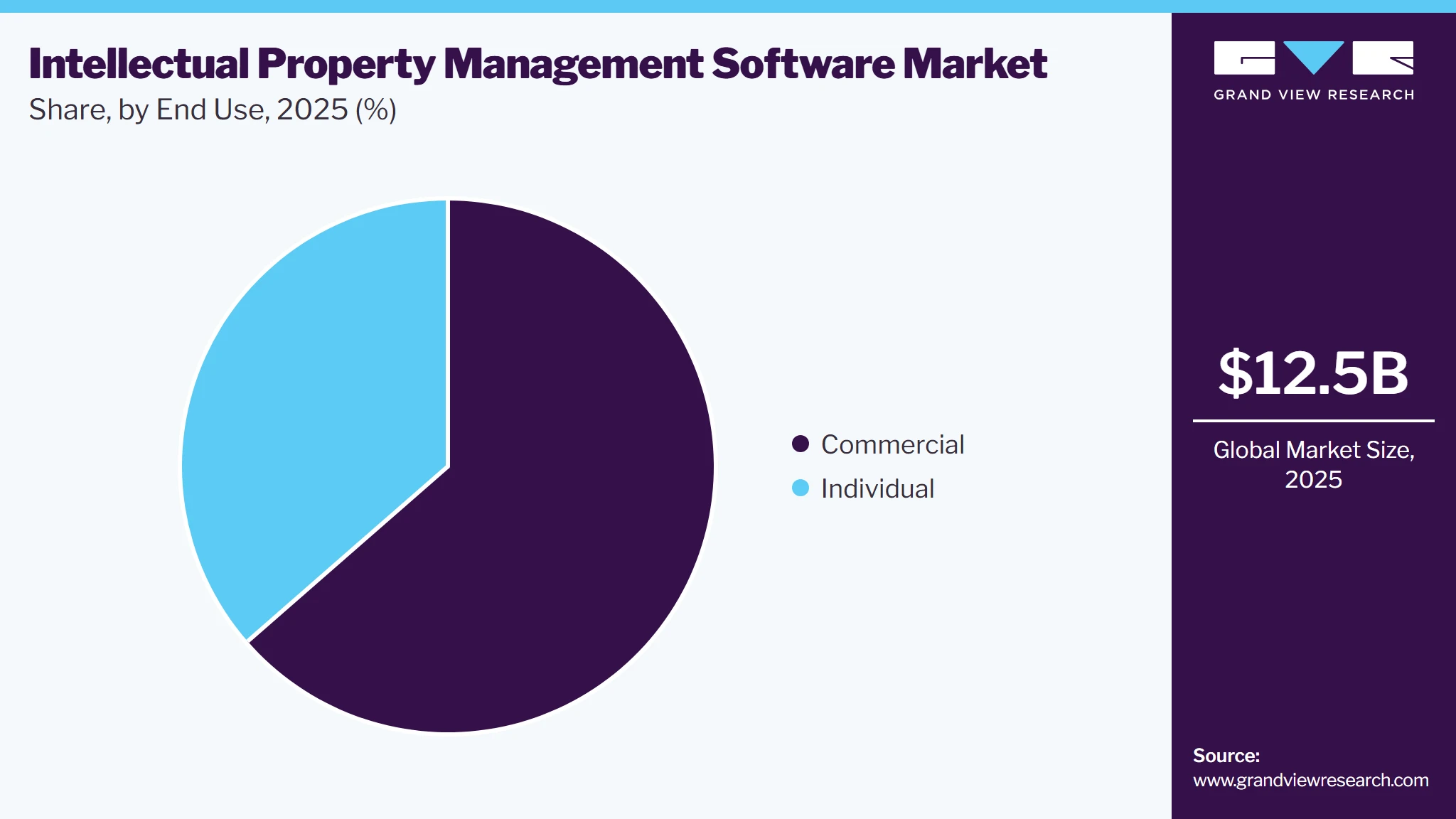
- By end use: Commercial segment held the largest revenue share in 2025
Regional Highlights
- Largest regional market: North America (37.0% revenue share, 2025)
- Fastest-growing regional market: Asia Pacific (highest CAGR, 2026–2033)
- By country: The U.S. held the largest market share in 2025.
Market Size & Forecast
- Market size in 2025: USD 12.5 Billion
- Estimated market size in 2026: USD 13.7 Billion
- Projected market size by 2033: USD 33.3 Billion
- CAGR (2026–2033): 13.6%
Three ways to get this report
Buy it, customize it, or ask a question.Ask an Analyst
Analyst response in 1 business day
- AccessReport author, directly
- Reply timeWithin 1 working day
- No sales callDirect answer only
- FormatEmail reply
- CostFree, no cost
Get the Full Report
What the study covers
- FormatsPDF · Excel · Dashboard
- Timeline2026–2033 annual, 2025 base
- Coverage20+ countries, 5 regions
- Companies10+ key players profiled
Customize the Report
20% free customization
- IncludeCountries, segments, points
- TailorTo your product definition
- ExtendDeeper competitor detail
- OrA fully bespoke study
- Turnaround5–10 working days
Furthermore, the increasing demand for a well-documented and secure system to manage intellectual properties within an organization is also expected to contribute to market growth. Intellectual property is a lawful approach to protecting inventions and ideas by offering the owners exclusive rights and enabling them to reap commercial benefits from their work. To learn more about this report, Download Free Sample Report
 Moreover, the increasing global emphasis on innovation and business expansion into new markets drives demand for advanced IP management solutions. As organizations seek to safeguard their innovations while adhering to various legal frameworks, sophisticated software that provides features such as predictive analytics and automated document management becomes increasingly essential. Furthermore, integrating artificial intelligence and machine learning technologies into these software solutions enhances their capabilities, making them more appealing to enterprises focused on optimizing their IP portfolios.
In addition to technological advancements, the growing awareness of intellectual property rights among businesses and individuals is likely to contribute to market expansion. As more companies recognize the value of their intellectual assets, there is a heightened demand for comprehensive management solutions that facilitate effective tracking and enforcement of IP rights. These factors position the intellectual property management software industry for sustained growth in the coming years.
Market Dynamics
Intellectual Property (IP) Management Software is witnessing increasing demand as organizations seek to efficiently manage patents, trademarks, copyrights, trade secrets, licensing agreements, and innovation portfolios through centralized digital platforms. These solutions enable enterprises, law firms, research institutions, and government organizations to automate IP lifecycle management, streamline filing and renewal processes, improve compliance, reduce administrative burdens, and strengthen intellectual asset protection. The growing volume of global patent and trademark filings, coupled with rising innovation activities across technology, pharmaceuticals, biotechnology, manufacturing, and semiconductor industries, is significantly accelerating software adoption worldwide. Furthermore, the increasing emphasis on digital transformation within legal and corporate functions is driving demand for cloud-based and AI-enabled IP management platforms equipped with advanced analytics, automated patent searches, infringement monitoring, workflow automation, and portfolio optimization capabilities. Growing cross-border intellectual property protection requirements, expanding research and development investments, and the rising importance of intellectual assets as strategic business resources are further supporting market growth. Additionally, increasing adoption among startups and small and medium-sized enterprises (SMEs), coupled with the need for efficient IP commercialization, licensing management, and regulatory compliance, is expected to drive the continued expansion of the intellectual property management software market.
The growing volume of patent, trademark, and copyright filings is a major driver of the intellectual property management software market, as organizations increasingly require centralized platforms to manage expanding intellectual property portfolios. Rapid innovation across technology, pharmaceuticals, biotechnology, manufacturing, and semiconductor industries is generating a significant number of intellectual assets that must be tracked, protected, and commercialized. IP management software helps automate filing processes, renewal tracking, compliance management, and portfolio administration, reducing operational complexity and legal risks. As businesses place greater strategic importance on protecting innovation and maintaining competitive advantage, demand for advanced IP management solutions continues to accelerate globally.
High implementation costs and integration complexity remain significant restraints for the intellectual property management software market. Enterprise-grade IP management platforms often require substantial investments in software licensing, customization, data migration, employee training, and ongoing maintenance. Organizations with large and complex intellectual property portfolios may face challenges integrating new solutions with existing legal, enterprise resource planning (ERP), document management, and compliance systems. Additionally, concerns regarding data security, regulatory requirements, and the migration of sensitive intellectual property records can slow adoption. These factors are particularly challenging for small and medium-sized enterprises (SMEs) with limited budgets and technical resources.
The increasing adoption of artificial intelligence and cloud-based technologies presents a significant opportunity for the intellectual property management software market. Modern IP management solutions are incorporating AI-driven capabilities such as patent landscape analysis, prior-art searches, infringement detection, portfolio valuation, and innovation trend forecasting. These advanced features enable organizations to make more informed strategic decisions while improving operational efficiency. Furthermore, cloud-based deployment models provide scalability, remote accessibility, lower infrastructure costs, and seamless collaboration across global teams. As enterprises, law firms, and research institutions accelerate digital transformation initiatives and seek data-driven approaches to intellectual property management, demand for intelligent and cloud-enabled IP platforms is expected to grow substantially.
Analyst Perspective
The intellectual property management software market is being reshaped by accelerating digital transformation, rising innovation, expanding R&D investments, and growing AI adoption across legal and corporate functions. Enterprises, IP law firms, universities, and government bodies are investing in platforms to streamline patent, trademark, copyright, and licensing workflows while ensuring compliance and maximizing asset value. With global IP portfolios expanding, organizations increasingly need cloud-based solutions that improve efficiency, collaboration, and visibility. Competitive advantage will belong to vendors offering AI-powered analytics, automated workflows, predictive portfolio intelligence, advanced security, and seamless integration with enterprise systems. As IP becomes a strategic business asset, scalable and data-driven platforms will deliver long-term value. Additionally, emphasis on IP commercialization, cross-border portfolio management, cybersecurity, and AI-enabled decision support will further drive sustained growth and innovation in this market.
Component Insights
Based on component, the software segment led the market with the largest revenue share of 59.4% in 2025 and is expected to grow at the significant CAGR over the forecast period. The segment growth can be attributed to the increasing adoption of intellectual property management software in various industries, such as BFSI, IT and telecom, technology, automotive, healthcare, and jewelry. These sectors widely use the software to apply for and keep track of their intellectual property rights. This can be attributed to the increasing reliance on software solutions for managing complex IP portfolios efficiently. Businesses are adopting these tools to streamline their processes, enhance compliance, and reduce the risk of IP infringement. As organizations continue to recognize the importance of protecting their intellectual assets, the demand for robust software solutions is expected to maintain its upward trajectory.
The service segment is projected to grow at the fastest CAGR during the forecast period. IP services play a vital role in the deployment process of intellectual property management software. Vendors offering this software also provide services such as software upgrades, maintenance, and fixing bugs and errors in the software. They also provide training & consultation services to assist end-users in operating the software with ease. The growth is driven by the rising need for specialized services that accompany software solutions, such as consulting, training, and support. As companies navigate the complexities of intellectual property management, they are increasingly seeking expert guidance and tailored services to optimize their IP strategies. The combination of software and services is essential for businesses looking to maximize their investment in the intellectual property management software industry.
Deployment Insights
Based on deployment, the cloud segment led the market with the largest revenue share of 59.0% in 2025. The segment growth can be attributed to the increasing adoption of cloud deployment services owing to factors such as on-demand availability of solutions and services and no setup cost. Furthermore, cloud services allow individuals and organizations to track applications conveniently by allowing them to carry out their tasks as per their convenience compared to on-premise, thus propelling the segment growth.
The on-premise segment is expected to grow at a significant CAGR over the forecast period, driven by organizations prioritizing data control and security. Many businesses prefer on-premise solutions, allowing for greater customization and compliance with internal policies. This deployment model is particularly appealing to industries with stringent regulatory requirements, where maintaining data within an organization’s infrastructure is crucial. As awareness of data privacy issues increases, the demand for on-premise intellectual property management software is anticipated to rise. This software is installed and operated from an organization’s internal infrastructure. Furthermore, individuals who file a patent can use the software on their PC to track and manage their applications. The on-premise deployment allows internal teams to fix bugs and detect errors in the systems.
Application Insights
Based on application, the licensing segment led the market with the largest revenue share of 55.1% in 2025. due to the increasing complexity of licensing agreements and the need for effective management solutions. As businesses seek to monetize their intellectual property assets, they often engage in licensing arrangements that require meticulous tracking and compliance management. Licensing software enables organizations to streamline these processes, ensuring that all terms are adhered to while maximizing revenue opportunities. This trend is further supported by the globalization of markets, where companies leverage licensing to expand their reach and enter new territories efficiently.
The patent management segment is expected to grow at the fastest CAGR over the forecast period,driven by a surge in patent applications worldwide. As innovation accelerates across various industries, organizations are filing more patents to protect their inventions and maintain competitive advantages. According to the World Intellectual Property Organization (WIPO), in 2023, 3.55 million patent applications were filed globally, reflecting a 2.7% rise compared to the previous year. Patent management software provides essential tools for tracking applications, managing deadlines, and ensuring compliance with legal requirements, which are crucial as the number of patents continues to rise. This growth reflects a broader recognition of the importance of intellectual property in fostering innovation and driving economic growth, making it a key focus area within the intellectual property management software industry.
End-use Insights
Based on end use, the commercial segment led the market with the largest revenue share of 63.6% in 2025, reflecting its critical role in various industries, including technology, pharmaceuticals, and automotive. Companies in these sectors increasingly recognize the value of their intellectual assets and invest in software solutions to manage them effectively. The commercial segment benefits from robust investments in Research and Development (R&D), leading to more patents and trademarks requiring diligent management. As businesses strive for innovation and market differentiation, the demand for comprehensive IP management solutions remains strong.
 To learn more about this report, Download Free Sample Report
 The individual segment is expected to grow at the fastest CAGR over the forecast period as more inventors and entrepreneurs seek accessible tools for managing their IP rights. This growth is fueled by an increasing awareness of IP rights among individuals who recognize the need to protect their innovations. Intellectual property management software designed for individual streamlines processes such as patent filing and application tracking, facilitating easier navigation through the complexities of IP management. As educational initiatives around intellectual property continue to expand, more individuals are likely to engage with these tools, driving further growth in this intellectual property management software industry segment.
Regional Insights
North America dominated the intellectual property management software market with the largest revenue share of 37.0% in 2025. The North American intellectual property management software market is experiencing significant growth, driven by a combination of factors that enhance its competitive landscape. Businesses and individuals are highly aware of intellectual property rights, creating an environment that encourages the adoption of IP management solutions in this region. In addition, numerous established companies, such as Anaqua, Clarivate, and Questel, contribute to the market's robustness by offering innovative software solutions tailored to various industries.
 To learn more about this report, Download Free Sample Report
 U.S. Intellectual Property Management Software Market Trends
The intellectual property management software market in the U.S. held the largest share in the North America region in 2025. The U.S. intellectual property management software market is thriving. The demand for intellectual property management software is increasing significantly due to the country's position in driving innovation. The United States Patent and Trademark Office (USPTO) has reported a steady increase in patent filings, reflecting the ongoing technological advancements across sectors such as biotechnology, pharmaceuticals, and information technology. According to USPTO, approximately 457,500 serialized patent applications were filed in fiscal year 2022, reflecting a 1.6% increase from the previous fiscal year, 2021. This surge in patent activity necessitates sophisticated management tools to track applications, ensure compliance, and protect intellectual property rights effectively.
Asia Pacific Intellectual Property Management Software Market Trends
Asia Pacific intellectual property management software market dominated the global market with a revenue share of 33.4% in 2024. reflecting its critical role in the growth of IP management solutions. This dominance is driven by rapid technological advancements and an increasing volume of patent filings across various industries. Countries such as China, India and Japan are heavily investing in research and development, leading to a surge in innovations that require effective management of intellectual property rights. The growing awareness of the importance of IP protection among businesses and supportive government policies promoting innovation further fuels the demand for specialized software solutions.
China intellectual property management software market dominated the regional market in 2024. China’s rapid economic growth and its position as a global leader in technology and manufacturing have resulted in a significant increase in patent applications. Major companies such as Huawei and Alibaba are actively filing patents to protect their innovations, driving the demand for robust IP management solutions. Furthermore, the Chinese government has implemented various initiatives to enhance IP protection and encourage innovation, including streamlined patent application processes and increasing enforcement against infringement.
Latin America Intellectual Property Management Software Market Trends
Latin America intellectual property management software market is expected to grow at the fastest CAGR from 2025 to 2033. driven by a growing recognition of the importance of intellectual property rights among businesses and individuals in the region. As economies in Latin America continue to develop, there is an increasing emphasis on innovation and protecting intellectual assets. This shift is prompting companies to adopt advanced software solutions that facilitate the management of patents, trademarks, and copyrights.
Brazil intellectual property management software market dominated the regional market in 2024, reflecting the country's significant investments in technology and innovation. Brazil has seen a surge in patent filings driven by its vibrant technology and manufacturing sectors. Companies increasingly recognize the need for robust IP management solutions to navigate complex legal frameworks and effectively protect their innovations. Furthermore, Brazil's commitment to improving its IP laws and enforcement mechanisms has created a more favorable environment for businesses to invest in intellectual property management software.
Key Intellectual Property Management Software Company Insights
The intellectual property management software market includes several companies offering diverse IP asset management solutions. Questel provides a comprehensive suite of tools for patent lifecycle management, while Anaqua Inc. focuses on integrating IP management with innovation strategies. Thales emphasizes security in its IP management solutions, catering to industries with stringent data protection needs. Clarivate offers analytics-driven tools that help organizations gain insights into their IP portfolios, enabling informed decision-making. Together, these companies play a vital role in shaping the market landscape.
-
PatSnap is a provider of innovation intelligence and R&D analytics that helps organizations navigate the complexities of intellectual property management. The company offers a comprehensive platform that aggregates and analyzes data from patents, scientific literature, and market reports, enabling clients to make informed decisions about their innovation strategies.
-
Anaqua Inc. specializes in integrated solutions for managing intellectual property and innovation. Its platform combines various aspects of IP management, including patent prosecution, trademark management, and licensing, allowing organizations to effectively align their intellectual assets with business objectives.
Key Intellectual Property Management Software Companies
The following key companies have been profiled for this study on the intellectual property management software market.
-
Anaqua Inc.
-
Questel
-
Thales
-
Clarivate
-
Innovation Asset Group Inc.
-
Dennemeyer & Associates S.A.
-
LexisNexis
-
PatSeer Technologies Pvt. Ltd
-
Patsnap
-
Cardinal Intellectual Property, Inc.
Competitive Benchmarking
Operating Strategies
Competitive Edge
Weaknesses
Established Players (Anaqua, Clarivate, Questel, Dennemeyer, CPA Global, PatSnap)
- Established players focus on delivering comprehensive end-to-end intellectual property management platforms covering patent, trademark, copyright, docketing, licensing, and portfolio management. Their strategies emphasize AI-powered patent analytics, cloud-based deployments, workflow automation, global IP database integration, regulatory compliance, and long-term enterprise contracts with multinational corporations, law firms, universities, and research organizations.
- Established players benefit from strong brand recognition, extensive global customer bases, mature software ecosystems, and comprehensive product portfolios. Their advanced AI capabilities, large proprietary IP databases, regulatory expertise, multilingual support, and ability to manage complex multinational IP portfolios provide significant competitive advantages. Their established customer relationships and recurring subscription revenue further strengthen their market position.
- These companies face high R&D and product maintenance costs to continuously enhance AI capabilities, cybersecurity, and regulatory compliance. Integration with legacy enterprise systems can be complex, while premium pricing may limit adoption among SMEs. Additionally, lengthy enterprise sales cycles and increasing competition from cloud-native software vendors can affect growth and pricing flexibility.
Emerging Players (Alt Legal, AppColl, IPzen, MaxVal, IPfolio)
- Emerging players focus on cloud-native, SaaS-based IP management solutions that offer intuitive interfaces, rapid implementation, and affordable subscription models. Their strategies emphasize automation of patent and trademark docketing, AI-assisted searches, collaboration tools, API integrations, and scalable solutions for startups, SMEs, and boutique law firms. Many also differentiate themselves through customer-centric product development and flexible deployment options.
- Emerging players offer faster innovation cycles, competitive pricing, simplified implementation, and greater product flexibility. Their cloud-first architectures, user-friendly platforms, and AI-enabled automation allow customers to reduce administrative workloads while improving efficiency. Their ability to quickly incorporate customer feedback enables them to compete effectively in niche and underserved market segments.
- Limited brand recognition, smaller customer bases, and lower financial resources can restrict expansion into large enterprise accounts. They often lack extensive global support networks, broad regulatory coverage, and comprehensive product ecosystems offered by established vendors. Dependence on venture funding and intense competition from larger software providers may also challenge long-term scalability and international market expansion.
Recent Development
-
In September 2024, Questel announced a strategic partnership with the SaaS platform Patently. This partnership integrates Questel's meticulously curated Standard Essential Patent (SEP) data into Patently's database. This collaboration aims to enhance the delivery of high-quality patent information and services to a broader audience of IP professionals.
-
In June 2024, Clarivate launched the IP Collaboration Hub at the Clarivate Ignite conference. This new solution integrates with Clarivate's IP Management Systems (IPMS) to create a centralized platform for collaboration with local agents globally. The IP Collaboration Hub streamlines the prosecution process and IP filing by providing a portal for users to exchange information, thereby reducing reliance on email and minimizing associated risks.
-
In December 2022, Questel acquired Equinox, an Intellectual Property Management System(IPMS) provider. This acquisition added a dedicated solution for law firm clients in Questel’s portfolio, strengthening its well-established IPMS business.
-
In March 2022, Questel acquired Markify, one of the leading trademark-watching and search service providers. This acquisition gave Questel access to one of the largest trademark databases of Markify, enabling Questel to offer global end-to-end Intellectual Property services.
Intellectual Property Management Software Market Report Scope
Report Attribute
Details
Market size in 2025
USD 12.5 billion
Estimated market size in 2026
USD 13.7 billion
Projected market size by 2033
USD 33.3 billion
Growth rate
CAGR of 13.6% from 2026 to 2033
Base year for estimation
2025
Historical data
2021 - 2024
Forecast period
2026 - 2033
Quantitative units
Revenue in USD billion and CAGR from 2026 to 2033
Report coverage
Revenue forecast, company ranking, competitive landscape, growth factors, and trends
Segments covered
Component; deployment; application; end use
Regional scope
North America; Europe; Asia Pacific; Latin America; MEA
Country scope
U.S.; Canada; Mexico; Germany; UK; France; China; Japan; India; South Korea; Australia; Brazil; Saudi Arabia; South Africa; UAE
Key companies profiled
Anaqua Inc.; Cardinal Intellectual Property, Inc; Clarivate; Dennemeyer & Associates S.A.; Innovation Asset Group Inc.; LexisNexis; PatSeer Technologies Pvt. Ltd; Patsnap; Questel; Thales
Customization scope
Free report customization (equivalent up to 8 analysts' working days) with purchase. Addition or alteration to country, regional & segment scope.
Pricing and purchase options
Avail customized purchase options to meet your exact research needs. Explore purchase options
Global Intellectual Property Management Software Market Report Segmentation
This report forecasts revenue growth at global, regional, and country levels and provides an analysis of the latest industry trends in each of the sub-segments from 2021 to 2033. For this study, Grand View Research has segmented the global intellectual property management software market report based on component, deployment, application, end-use, and region.
-
Component Outlook (Revenue, USD Million, 2021 - 2033)
-
Service
-
Software
-
-
Deployment Outlook (Revenue, USD Million, 2021 - 2033)
-
On-Premise
-
Cloud
-
-
Application Outlook (Revenue, USD Million, 2021 - 2033)
-
Patent Management
-
Trade Management
-
Licensing
-
Buses and Coaches
-
-
End-use Outlook (Revenue, USD Million, 2021 - 2033)
-
Individual
-
Commercial
-
BFSI
-
IT & Telecom
-
Automotive
-
Technology
-
Others
-
-
-
Regional Outlook (Revenue, USD Million, 2021 - 2033)
-
North America
-
U.S.
-
Canada
-
Mexico
-
-
Europe
-
Germany
-
UK
-
France
-
-
Asia Pacific
-
China
-
Japan
-
India
-
Australia
-
South Korea
-
-
Latin America
-
Brazil
-
-
Middle East and Africa (MEA)
-
UAE
-
Saudi Arabia
-
South Africa
-
-
Research Methodology
The intellectual property management software market figures in this report are based on a proven research process that combines executive interviews with secondary research from proprietary databases, company filings, and recognized regulatory and institutional sources. Market size is built through value-chain sizing-reconciling supply-side and demand-side estimates-and triangulated with bottom-up and top-down approaches. Every estimate passes multiple levels of expert validation before publication, with each intellectual property management software segment quantified using the revenue-capture definitions in the table below.
Segment Definition
Segment – Component
Revenue capture definition
Service
Services include consulting, implementation, customization, integration, training, technical support, maintenance, and managed services associated with intellectual property management software. These services help organizations deploy, optimize, and effectively manage IP management platforms while ensuring compliance and operational efficiency.
Software
Software refers to dedicated platforms and applications used to manage, track, protect, analyze, and commercialize intellectual property assets such as patents, trademarks, copyrights, trade secrets, and licensing agreements. These solutions typically offer workflow automation, portfolio management, compliance tracking, analytics, and reporting capabilities.
Segment – Deployment
Revenue capture definition
On-Premise
On-premise deployment refers to intellectual property management software installed and operated on an organization's internal servers and IT infrastructure. This deployment model provides greater control over data security, customization, and system management, making it suitable for organizations with strict compliance and confidentiality requirements.
Cloud
Cloud deployment refers to software hosted on remote servers and accessed through the internet on a subscription or Software-as-a-Service (SaaS) basis. Cloud-based solutions offer scalability, lower upfront costs, remote accessibility, automatic updates, and easier collaboration across multiple locations.
Segment – Application
Revenue capture definition
Patent Management
Patent management involves the administration and tracking of patent-related activities, including invention disclosures, patent filings, prosecution processes, renewals, portfolio analysis, prior-art searches, and patent lifecycle management. These solutions help organizations protect and maximize the value of patented innovations.
Trade Management
Trade management primarily refers to trademark management within the intellectual property ecosystem. It includes trademark registration, renewal tracking, brand protection, infringement monitoring, portfolio administration, and compliance management. These solutions help organizations safeguard brand identity and intellectual property rights across multiple jurisdictions.
Licensing
Licensing solutions facilitate the management of intellectual property licensing agreements, royalty tracking, contract administration, revenue management, compliance monitoring, and commercialization activities. They help organizations monetize intellectual assets while ensuring adherence to contractual obligations.
Segment – End Use
Revenue capture definition
Individual
The individual segment includes independent inventors, entrepreneurs, researchers, creators, and small intellectual property owners who use IP management software to manage patents, trademarks, copyrights, and licensing activities. These users typically require cost-effective and user-friendly solutions to protect and manage their intellectual assets.
Commercial
The commercial segment includes enterprises, corporations, law firms, research institutions, universities, government agencies, and other organizations that manage extensive intellectual property portfolios. These users leverage advanced IP management platforms to streamline operations, improve compliance, enhance portfolio visibility, and support intellectual property commercialization strategies.
Estimation Model
Layer Name
Key Question
Description
Intellectual Property Addressable Layer
Who can benefit from Intellectual Property Management Software?
Identify organizations that create, manage, or commercialize intellectual property, including large enterprises, SMEs, IP law firms, technology companies, pharmaceutical and biotechnology firms, manufacturing companies, universities, research institutions, government agencies, and individual inventors to define the total addressable market for IP management software.
Innovation & IP Generation Layer
Where is demand for Intellectual Property Management Software generated?
Evaluate regional innovation ecosystems by analyzing patent, trademark, and copyright filing volumes, R&D expenditure, startup activity, industry innovation intensity, technology commercialization, and regulatory IP frameworks to determine the operationally reachable market for software adoption.
Software Adoption & Digital Transformation Layer
Who actively adopts Intellectual Property Management Software?
Analyze enterprise digital transformation initiatives, legal operations modernization, cloud adoption, AI-enabled IP analytics deployment, portfolio expansion, compliance requirements, and intellectual asset management strategies across industries to identify active software buyers and adoption potential.
Monetization Layer
How is revenue generated?
Assess revenue potential by analyzing software licensing and subscription (SaaS) fees, implementation and integration services, consulting, training, maintenance and technical support, AI-powered analytics modules, portfolio management solutions, licensing management tools, and premium compliance and reporting capabilities to estimate overall market revenue.
Delivered Customizations
This report has been delivered with the following In-depth customizations
Client Request
Customization Delivered
Value Adds
Intellectual Property Lifecycle & Portfolio Management Assessment
Assessed demand for patent, trademark, copyright, trade secret, and licensing management solutions, including AI-powered patent analytics, docketing automation, portfolio optimization, infringement monitoring, compliance management, and cloud-based IP lifecycle platforms, along with technology adoption trends and implementation challenges.
Supports product development and investment strategies by identifying high-growth application areas, evaluating technology maturity, assessing competitive differentiation, and uncovering opportunities in next-generation AI-enabled IP management solutions.
Regional Innovation Ecosystem & IP Software Demand Forecast
Evaluated regional patent, trademark, and copyright filing trends, R&D investments, startup ecosystem growth, innovation intensity, technology commercialization activities, legal technology adoption, and procurement patterns across major innovation hubs globally.
Provides actionable insights into regional demand hotspots, innovation-driven investment priorities, competitive landscapes, software adoption trends, and future growth opportunities across rapidly expanding intellectual property management markets.
Digital Legal Transformation & AI-Driven IP Management Analysis
Analyzed enterprise legal digitalization initiatives, cloud migration, AI-assisted patent searches, workflow automation, predictive portfolio analytics, regulatory compliance requirements, and integration with enterprise legal, ERP, and document management systems across North America, Europe, Asia Pacific, and emerging markets.
Enables stakeholders to identify emerging opportunities in AI-powered legal technology, evaluate cloud adoption readiness, optimize digital transformation strategies, and capitalize on increasing investments in intelligent IP management platforms.
Frequently Asked Questions About This Report
The global intellectual property management software market size was estimated at USD 12.5 billion in 2025 and is expected to reach USD 13.7 billion in 2026.
The global intellectual property management software market is expected to grow at a compound annual growth rate of 13.6% from 2026 to 2033 to reach USD 33.3 billion by 2033.
Asia Pacific is the fastest-growing region over the forecast period.
The software segment led with a 59.4% revenue share in 2025, while service segment is the fastest-growing segment.
The cloud segment led with a 59.0% revenue share in 2025, and is the fastest-growing segment.
Some key players operating in the intellectual property management software market include Anaqua Inc., Questel, Thales, Clarivate, Innovation Asset Group Inc., Dennemeyer & Associates S.A., LexisNexis, PatSeer Technologies Pvt. Ltd, Patsnap, and Cardinal Intellectual Property, Inc.
Key factors that are driving the intellectual property management software market growth include increasing awareness and application of Intellectual Property (IP) rights among individual and commercial end users.
North America dominated with 37.0% revenue share in 2025.
The licensing segment held the largest share (over 55.1%) in 2025, while patent management is the fastest-growing segment.
About the Author(s)
Network Security Research Team
Technology · Network SecurityThis report was authored by the network security research team at Grand View Research - comprising two research analysts, one senior research analyst, and one industry expert - with specialized expertise in the network security segment of the technology industry. All findings are based on proprietary technology databases, executive interviews, and regulatory analysis, subject to internal peer review prior to publication.
Last Updated:
Speak to Analyst

Customize this report to your needs - add regions, segments, or data points, with 20% free customization.
Or view our licence options:


ISO 9001:2015 & 27001:2022 Certified
We are GDPR and CCPA compliant! Your transaction & personal information is safe and secure. For more details, please read our privacy policy.


