
- Home
- »
- IT Services & Applications
- »
-
Inventory Management Software Market Size Report, 2026-2033GVR Report cover

Inventory Management Software Market (2026 - 2033)
Size, Share, & Trends Analysis Report By Component (Software, Services), By Application, By Deployment (On-Premises, Cloud), By Enterprise Size, By End Use, By Region, And Segment Forecasts
Market Size, 2025
$3.7BMarket Estimate, 2026
$3.9BMarket Forecast, 2033
$7.1BCAGR, 2026–2033
8.9%Inventory Management Software Market Summary
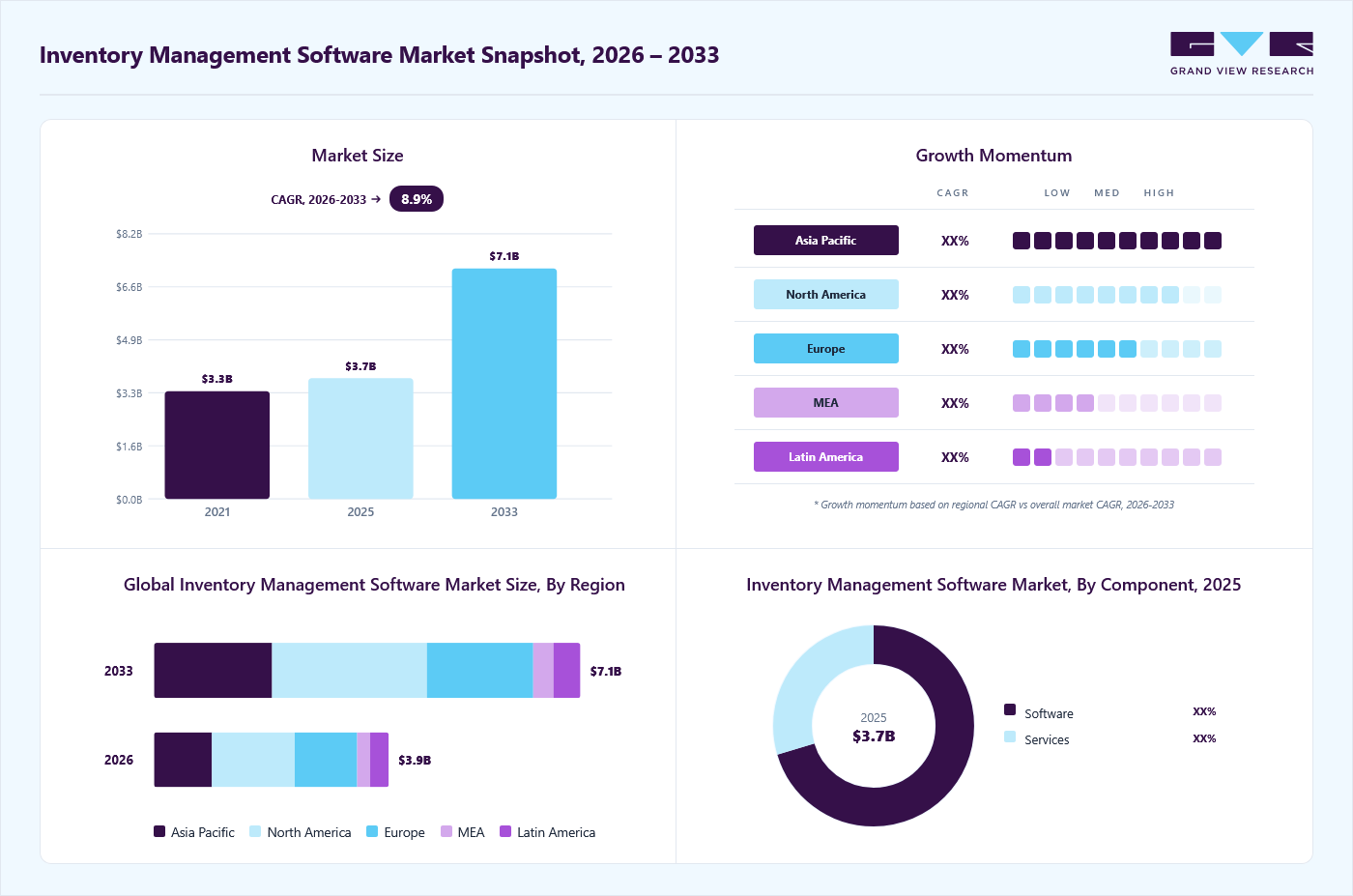
The global inventory management software market size was valued at USD 3.7 billion in 2025 and is projected to grow from USD 3.9 billion in 2026 to USD 7.1 billion by 2033, at a CAGR of 8.9% from 2026 to 2033 driven by the rise in drop shipping and third-party logistics (3PL), which is driving the growth of the market. The market in North America dominated with a revenue share of 35.1% in 2025. E-commerce businesses require advanced applications to manage large, diverse inventories, ensure timely fulfillment, and maintain optimal stock levels to meet fluctuating customer demands.
 Source: Grand View Research, IR Documents, Primary Interviews, Paid DatabasesTo learn more about this report,
 Download Free Sample Report
 Key Market Trends & Insights
- By component: Software segment held the largest market share of 70.3% in 2025.
- By type: Order management segment held the largest market share in 2025.
- By deployment: Cloud segment held the largest market share in 2025.
- By enterprise size: Large enterprise segment held the largest market share in 2025.
Regional Highlights
- Largest regional market: North America (35.1% revenue share, 2025)
- Fastest-growing regional market: Asia Pacific (highest CAGR, 2026-2033)
- By country: U.S. held the largest market share in 2025
Market Size & Forecast
- Market size in 2025: USD 3.7 Billion
- Estimated market size in 2026: USD 3.9 Billion
- Projected market size by 2033: USD 7.1 Billion
- CAGR (2026-2033): 8.9%
Three ways to get this report
Buy it, customize it, or ask a question.Ask an Analyst
Analyst response in 1 business day
- AccessReport author, directly
- Reply timeWithin 1 working day
- No sales callDirect answer only
- FormatEmail reply
- CostFree, no cost
Get the Full Report
What the study covers
- FormatsPDF · Excel · Dashboard
- Timeline2026–2033 annual, 2025 base
- Coverage20+ countries, 5 regions
- Companies10+ key players profiled
Customize the Report
20% free customization
- IncludeCountries, segments, points
- TailorTo your product definition
- ExtendDeeper competitor detail
- OrA fully bespoke study
- Turnaround5–10 working days
This drives demand for sophisticated inventory management systems that offer features such as automated reordering, demand forecasting, and integration with various sales channels. Consequently, as e-commerce continues to grow, so does the need for robust inventory management software, fueling market growth. According to the Indian Brand Equity Foundation (IBEF), India's e-commerce platforms achieved a significant milestone, hitting a GMV of USD 60 billion in fiscal year 2023, marking a 22% increase from the previous year. Similarly, the rising internet penetration is expected to boost the adoption of inventory management software for streamlining various e-commerce tasks such as order management, inventory control, etc.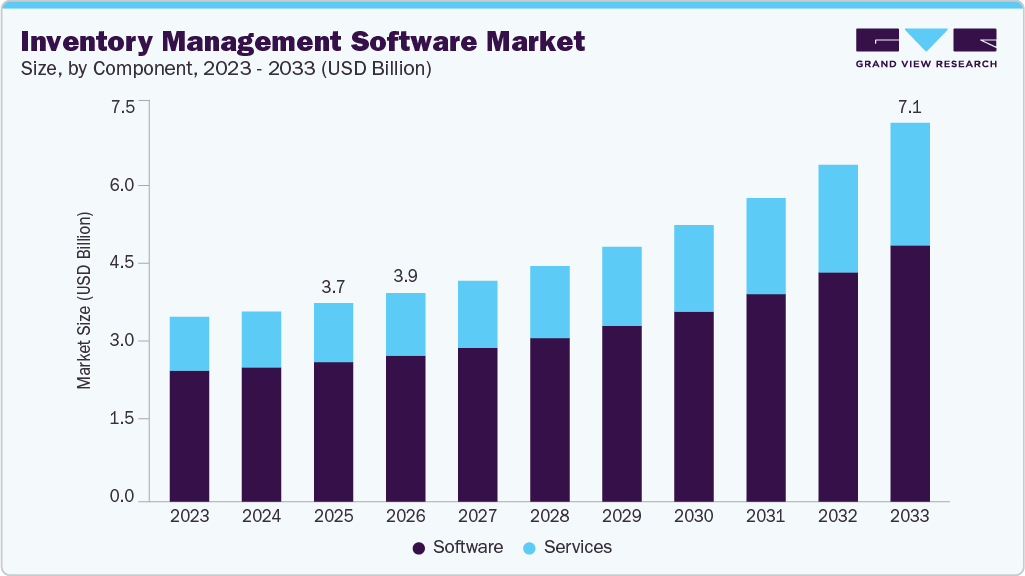 To learn more about this report, Download Free Sample Report
 Inventory management software plays a critical role in helping businesses efficiently track and control stock levels, orders, sales, and deliveries, making it a key component of the inventory management software industry. The software automates essential processes such as reordering, stock monitoring, and demand forecasting, ensuring optimal inventory levels while minimizing the risks of overstocking or stockouts. By providing real-time data and actionable insights, it enhances decision-making and operational efficiency across organizations. In addition, seamless integration with enterprise systems such as ERP and sales platforms helps streamline workflows and improve accuracy. These capabilities contribute to reduced operational costs, improved customer satisfaction, and better resource allocation, positioning inventory management solutions as a vital tool across the inventory management software industry, particularly in sectors such as retail, manufacturing, and healthcare.
The demand within the inventory management software industry is expected to grow significantly due to evolving supply chain models and increasing consumer demand, especially in transport & logistics, e-commerce, and retail sectors. Businesses are increasingly focusing on streamlining inventory processes and reducing operational costs, which is a key factor driving adoption in the inventory management software industry. The rising need to optimize supply chains, enhance visibility, and improve customer experience has further accelerated the uptake of these solutions. As companies expand their operations and manage more complex distribution networks, inventory management software continues to play a central role in enabling efficiency and scalability.
The increasing adoption of mobile and handheld technologies for inventory control is another major factor contributing to the growth of the inventory management software industry. Employees in warehouses, retail stores, and fulfillment centers are increasingly using smartphones, tablets, and barcode scanners to perform real-time inventory tasks, supported by mobile-enabled software solutions. This enables on-the-go stock updates, faster audits, and improved accuracy, enhancing overall productivity. Furthermore, the rise of subscription-based business models and recurring delivery services is driving the need for advanced inventory systems that can accurately forecast demand and automate replenishment cycles. Alongside this, the expansion of global and cross-border commerce has increased the complexity of inventory operations, prompting businesses to adopt solutions that support multi-location tracking, multi-currency transactions, and integration with third-party logistics providers. As a result, the inventory management software industry is witnessing strong growth, driven by the need for greater agility, efficiency, and centralized control over increasingly complex inventory ecosystems.
Component Insights
The software segment dominated the market, accounting for a 70.3% revenue share in 2025. The increasing digitization and automation of warehouse operations have propelled the demand for software-driven inventory solutions. Modern warehouses are becoming more complex and high-volume, requiring real-time coordination between inventory movement, labor management, and order fulfillment. Inventory management software is essential for automating warehouse processes like picking, packing, cycle counting, and slotting. It eliminates the need for manual data entry and enables seamless barcode and RFID scanning, which improves speed and reduces errors. Many software solutions now also offer 3D visualization of warehouse layouts, heatmaps for high-frequency zones, and labor optimization modules, allowing managers to make data-driven decisions that improve throughput and reduce operational costs. As warehouse automation becomes more prevalent through robotics and IoT-enabled systems, integrating these technologies with inventory software ensures cohesive and intelligent workflows.
The services segment is projected to be the fastest-growing segment from 2026 to 2033. Increasing demand for automation in order processing is driving the adoption of order management solutions. The global expansion of supply chains and the rise in cross-border trade have added layers of complexity to inventory management, further fueling the need for expert services. Multinational corporations must manage inventory across diverse geographical locations, each with its own regulations, tax structures, languages, and logistical challenges. Deploying inventory software in such scenarios demands careful localization, multi-currency and multi-language capabilities, and integration with region-specific carriers or suppliers. This level of customization and compliance cannot be handled through out-of-the-box solutions and requires specialized services. Service providers bridge this gap by offering localization support, compliance configuration, and tailored system architecture for international operations.
Application Insights
The order management segment dominated the market in 2025. The exponential rise of e-commerce and omnichannel retailing necessitates sophisticated order management systems to handle complex fulfillment processes, real-time inventory visibility, and seamless customer experiences. Technological advancements, such as AI and machine learning, enhance predictive analytics for demand forecasting and personalized customer service. Moreover, the integration of order management with existing ERP and CRM systems streamlines operations, reducing errors and improving efficiency. The increasing focus on supply chain optimization and the need for businesses to adapt to rapidly changing market dynamics further fuel demand for advanced order management applications.
The inventory control & tracking segment is projected to grow at a significant CAGR over the forecast period. Real-time data visibility is crucial for businesses to manage inventory levels efficiently. By having up-to-the-minute information on stock levels, companies can accurately forecast demand, replenish inventory promptly, and minimize stockouts. This helps in meeting customer demands promptly, enhancing customer satisfaction, and optimizing operational efficiency. Overall, real-time data empowers businesses to make proactive decisions and maintain a competitive edge in dynamic market environments. Regulatory requirements for accurate inventory reporting and data security also propel the demand for sophisticated tracking systems. Moreover, the push for supply chain optimization and cost reduction further fuels the adoption of advanced inventory control applications.
Deployment Insights
The cloud segment dominated the market in 2025 in terms of revenue share. The segment growth is attributed to cloud applications offering scalability, allowing businesses to expand or reduce their inventory management capabilities as needed easily. This flexibility is particularly attractive to small and medium-sized enterprises (SMEs) looking to avoid large upfront investments in hardware and software infrastructure. Moreover, cloud-based systems provide accessibility from anywhere with an internet connection, enabling real-time inventory tracking and management on mobile devices, which is essential in today's fast-paced business environment.
The on-premises segment is expected to grow significantly over the forecast period. End use industries with stringent data security requirements, such as those in finance and healthcare sectors, prefer on-premise applications due to perceived greater control over data access and security protocols. Organizations prefer on-premise applications for their ability to customize and integrate deeply with existing IT infrastructure, providing a seamless operational fit. Despite the growing popularity of cloud-based applications, the on-premise segment continues to thrive due to these factors, catering specifically to enterprises prioritizing data control, compliance, and integration capabilities.
Enterprise Size Insights
The large enterprise segment dominated the market in 2025. Large enterprises drive significant growth in the market due to their complex operational needs and substantial inventory volumes. These enterprises typically require sophisticated applications that can handle extensive product lines, multiple warehouses, and global supply chains. Large enterprises prioritize efficiency gains and cost reductions, and the demand for comprehensive, customizable inventory management applications continues to grow, fostering innovation and competition within the market.
The small & medium enterprises segment is projected to be the fastest-growing segment from 2026 to 2033. Increasing the affordability and accessibility of cloud-based applications enables SMEs to adopt sophisticated inventory management systems without significant upfront investment. The scalability offered by these applications allows SMEs to expand their capabilities as they grow. Furthermore, the rise of e-commerce and the need for efficient stock control and order fulfillment drive SMEs to implement robust inventory management tools.
End Use Insights
The manufacturing segment dominated the market with a revenue share in 2025. The increasing complexity of supply chains and the need for real-time tracking and optimization of inventory levels are paramount. Advanced inventory management software helps manufacturers reduce waste, lower costs, and improve production efficiency by providing precise demand forecasting and automated reordering. The integration of technologies such as IoT and AI enhances visibility and predictive maintenance, ensuring smoother operations.
 To learn more about this report, Download Free Sample Report
 The e-commerce segment is projected to be the fastest-growing segment from 2026 to 2033. The integration of 3D printing (additive manufacturing) technologies with cloud platforms is driving market growth. Inventory management software provides the computational power and storage capacity needed for complex design files, real-time rendering, and remote access to 3D printing resources. This enables manufacturers to collaborate on design, streamline prototyping, and distribute manufacturing capabilities globally, enhancing efficiency and innovation.
Regional Insights
North America Inventory Management Software Market Trends
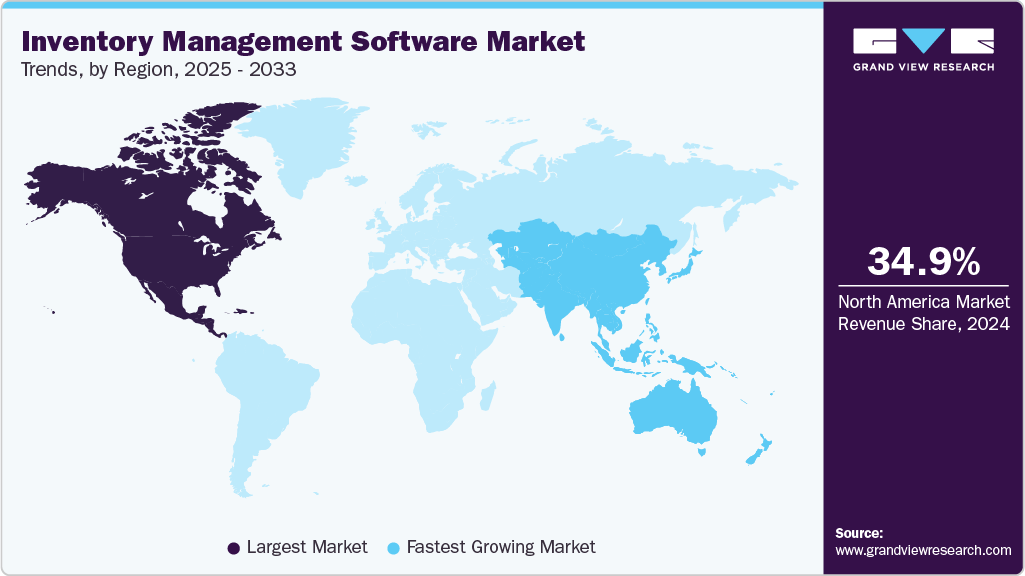
North America inventory management software industry emerged as the largest regional market globally, capturing a substantial market share of 35.1% in 2025. The presence of major industry players and continuous investments in R&D contribute to market expansion. The robust e-commerce sector demands sophisticated inventory applications to handle complex logistics and supply chain needs. Furthermore, regulatory requirements such as SOX and HIPAA ensure compliance and drive businesses to adopt advanced inventory management systems. The strong economic environment and the trend towards digital transformation across various industries also fuel growth in this region.
 To learn more about this report, Download Free Sample Report
 U.S. Inventory Management Software Market Trends
The inventory management software industry in the U.S. is expected to grow significantly from 2026 to 2033. This exponential growth of e-commerce requires sophisticated inventory management to handle vast and diverse inventories, real-time tracking, and fulfillment demands, driving demand for advanced software applications. According to the U.S. Department of Commerce, U.S. retail e-commerce sales for the 1st quarter of FY24 were USD 289.2 billion, an increase of 2.1 % from the 4th quarter of 2023. This steady rise in e-commerce sales highlights the increasing transaction volumes and order complexity that businesses must manage efficiently. As a result, organizations are accelerating the adoption of advanced inventory management software to ensure real-time visibility, optimize stock levels, and enhance fulfillment accuracy.
Asia Pacific Inventory Management Software Market Trends
The Asia Pacific inventory management software industry is expected to be the fastest-growing segment, with a CAGR of 10.7% over the forecast period. The rapid industrialization and urbanization in the Asia Pacific region are driving substantial demand for efficient inventory management applications across diverse sectors such as manufacturing, retail, and logistics. As countries in the region undergo rapid economic development and urban expansion, there is an increasing need for businesses to manage their supply chains more effectively. Industrial growth is leading to larger-scale production and distribution networks, necessitating sophisticated inventory management software (IMS) to handle complex inventory tracking, stock optimization, and order fulfillment processes.
China inventory management software industry held a significant share in 2025, driven by major players such as Alibaba and JD.com, which have significantly increased the need for advanced inventory management applications. These e-commerce giants handle vast and complex inventories, with billions of products that need to be tracked, stocked, and delivered efficiently. The sheer volume and variety of products, coupled with high customer expectations for fast delivery and accuracy, necessitate sophisticated inventory management systems.
The inventory management software industry in Japan is expanding rapidly. Japan's strong technological infrastructure and high adoption of advanced technologies such as AI, IoT, and automation are key drivers for the growth of sophisticated inventory management applications. The country is known for its technological innovation and robust IT infrastructure, which facilitates the integration of cutting-edge technologies into business operations.
India inventory management software industry held a significant share in 2025. The expansion of the organized retail sector in India, driven by rising consumer demand and increasing disposable incomes, necessitates efficient inventory management systems. As retail businesses scale up and diversify their product offerings, maintaining optimal stock levels becomes critical to prevent stockouts and overstocking, which can lead to significant financial losses. Efficient inventory management software enables retailers to track stock in real-time, forecast demand accurately, and streamline supply chain operations.
Europe Inventory Management Software Market Trends
The inventory management software industry in Europe is anticipated to register considerable growth from 2026 to 2033. Small and medium-sized enterprises (SMEs) in Europe are increasingly investing in digital transformation to enhance their competitiveness and agility in a rapidly evolving market. This transformation involves adopting advanced technologies, such as inventory management software, streamlining operations, reducing costs, and improving efficiency. By implementing inventory management applications, SMEs can automate and optimize stock control, ensuring they maintain the right inventory levels, minimize waste, and respond swiftly to market demands.
The inventory management software industry in the UK is expected to grow rapidly in the coming years. Digital transformation across industries is a key driver for the adoption of sophisticated inventory management systems as businesses seek to leverage application to enhance efficiency and competitiveness. This push for digitalization involves integrating advanced technologies such as AI, machine learning, and IoT into business processes to streamline operations, reduce costs, and improve decision-making.
Germany inventory management software industryheld a significant market share in 2025. Germany's robust industrial base, encompassing manufacturing, automotive, and engineering sectors, underscores the critical need for efficient inventory management applications. Germany's industrial strength necessitates sophisticated inventory management applications to optimize supply chains, improve operational efficiency, and maintain competitiveness in global markets.
Key Inventory Management Software Company Insights
Some of the key companies operating in the market, include Acumatica, Inc., Archon Systems, DataLogic, Fishbowl, Epicor Software Corporation, IBM Corporation, Intuit, Inc., among others.
-
In April 2025, Orders in Seconds, Inc. (OIS) partnered with Fishbowl Inventory to deliver a seamless integration that enhances order management and warehouse operations. This collaboration combines OIS's advanced automated order management system with Fishbowl Inventory's warehouse management solutions, enabling businesses to improve efficiency, accuracy, and customer satisfaction. Both platforms also integrate smoothly with Intuit QuickBooks, offering wholesale distributors and CPG brands a centralized solution for managing sales, inventory, and finances.
-
In April 2025, Manhattan Associates partnered with Natura, a cosmetics and personal care company, to implement both Manhattan Active Warehouse Management and Manhattan Active Transportation Management. This collaboration aims to unify Natura’s supply chain operations and enhance operational efficiency. With a single, swift implementation, Natura can streamline its planning, execution, and real-time visibility across all supply chain processes. The Manhattan Active platform seamlessly integrates warehousing and transportation activities, optimizing storage, picking, shipping, and routing decisions using live data.
-
In May 2024, Epicor Software Corporation acquired Smart Software. This acquisition strengthens Epicor’s ability to enhance its ERP offerings with advanced AI applications across business operations in the make, move, and sell industries. These capabilities improve forecast accuracy, enable swift identification and resolution of inventory imbalances, predict future operational performance, and track actual results.
Key Inventory Management Software Companies:
The following key companies have been profiled for this study on the inventory management software market.
- Acumatica, Inc.
- Archon Systems
- DataLogic
- Fishbowl
- Epicor Software Corporation
- IBM Corporation
- Intuit, Inc.
- Lightspeed Commerce Inc.
- Manhattan Associates
- Microsoft Corporation
- NCR Voyix Corporation
- Oracle Corporation
- Revel Systems
- SAP SE
- Zoho Corporation Pvt. Ltd.
Inventory Management Software Market Report Scope
Report Attribute
Details
Market size in 2025
USD 3.7 billion
Estimated Market size in 2026
USD 3.9 billion
Projected Market size by 2033
USD 7.1 billion
Growth rate
CAGR of 8.9% from 2026 to 2033
Actual data
2021 - 2025
Forecast period
2026 - 2033
Quantitative units
Revenue in USD billion and CAGR from 2026 to 2033
Report coverage
Revenue forecast, company share, competitive landscape, growth factors, and trends
Segments covered
Component, application, deployment, enterprise size, end use, region
Regional scope
North America; Europe; Asia Pacific; Latin America; MEA
Country scope
U.S.; Canada; Mexico; UK; Germany; France; China; India; Japan; Australia; South Korea; Brazil; UAE; Saudi Arabia; South Africa
Key companies profiled
Acumatica, Inc.; Archon Systems; DataLogic; Fishbowl; Epicor Software Corporation; IBM Corporation; Intuit, Inc.; Lightspeed Commerce Inc.; Manhattan Associates; Microsoft Corporation; NCR Voyix Corporation; Oracle Corporation; Revel Systems; SAP SE; Zoho Corporation Pvt. Ltd.
Customization scope
Free report customization (equivalent to 8 analysts working days) with purchase. Addition or alteration to country, regional & segment scope.
Pricing and purchase options
Avail customized purchase options to meet your exact research needs. Explore purchase options
Global Inventory Management Software Market Report Segmentation
This report forecasts revenue growth at global, regional, and country levels and provides an analysis of the latest industry trends in each of the sub-segments from 2021 to 2033. For this study, Grand View Research has segmented the global inventory management software market report based on component, application, deployment, enterprise size, end use, and region.
-
Component Outlook (Revenue, USD Billion, 2021 - 2033)
-
Software
-
Services
-
Professional Services
-
Managed Services
-
-
-
Application Outlook (Revenue, USD Billion, 2021 - 2033)
-
Inventory Control & Tracking
-
Order Management
-
Scanning and Barcoding
-
Asset Management
-
Others
-
-
Deployment Outlook (Revenue, USD Billion, 2021 - 2033)
-
On-Premises
-
Cloud
-
-
Enterprise Size Outlook (Revenue, USD Billion, 2021 - 2033)
-
Small & Medium Enterprises
-
Large Enterprise
-
-
End Use Outlook (Revenue, USD Billion, 2021 - 2033)
-
Retail
-
E-Commerce
-
Manufacturing
-
Healthcare
-
Logistics and Transportation
-
Others
-
-
Regional Outlook (Revenue, USD Billion, 2021 - 2033)
-
North America
-
U.S.
-
Canada
-
Mexico
-
-
Europe
-
Germany
-
UK
-
France
-
-
Asia Pacific
-
China
-
India
-
Japan
-
South Korea
-
Australia
-
-
Latin America
-
Brazil
-
-
Middle East & Africa
-
UAE
-
Saudi Arabia
-
South Africa
-
-
Frequently Asked Questions About This Report
The inventory management software market is experiencing robust growth, driven by the need for businesses to optimize supply chains, reduce costs, and enhance operational efficiency. Rapid expansion across the e-commerce industry and rising supply chain disruptions will propel market growth.
Asia Pacific is the fastest-growing region over the forecast period.
The software segment led with a 70.3% revenue share in 2025.
The order management segment held the largest revenue share in 2025.
The cloud segment held the largest revenue share in 2025.
Large enterprise segment held the largest share in 2025.
The global inventory management software market size was valued at USD 3.7 billion in 2025 and is estimated at USD 3.9 billion for 2026.
The global inventory management software market is expected to grow at a CAGR of 8.9% from 2026 to 2033, reaching USD 7.1 billion by 2033.
North America dominated the inventory management software market with a market share of 35.1% in 2025. The presence of major industry players and continuous investments in R&D contribute to market expansion.
The key players operating in inventory management software market include Acumatica, Inc.; Archon Systems; DataLogic; Fishbowl; Epicor Software Corporation ; IBM Corporation; Intuit, Inc.; Lightspeed Commerce Inc. ; Manhattan Associates; Microsoft Corporation; NCR Voyix Corporation; Oracle Corporation; Revel Systems; SAP SE; Zoho Corporation Pvt. Ltd.
About the Author(s)
IT Services & Applications Research Team
Technology · IT Services & ApplicationsThis report was authored by the it services & applications research team at Grand View Research - comprising two research analysts, one senior research analyst, and one industry expert - with specialized expertise in the it services & applications segment of the technology industry. All findings are based on proprietary technology databases, executive interviews, and regulatory analysis, subject to internal peer review prior to publication.
Last Updated:
Speak to Analyst

Customize this report to your needs - add regions, segments, or data points, with 20% free customization.
Or view our licence options:


ISO 9001:2015 & 27001:2022 Certified
We are GDPR and CCPA compliant! Your transaction & personal information is safe and secure. For more details, please read our privacy policy.


