
- Home
- »
- Communication Services
- »
-
IP Multimedia Subsystem Market Size, Share Report, 2033GVR Report cover

IP Multimedia Subsystem Market (2026 - 2033)
Size, Share, & Trends Analysis Report By Component (Hardware, Software), By Deployment (Cloud, On-premise), By End Use (Telecommunications Operators), By Region, And Segment Forecasts
Market Size, 2025
$5.7BMarket Estimate, 2026
$6.4BMarket Forecast, 2033
$16.5BCAGR, 2026–2033
14.4%IP Multimedia Subsystem Market Summary
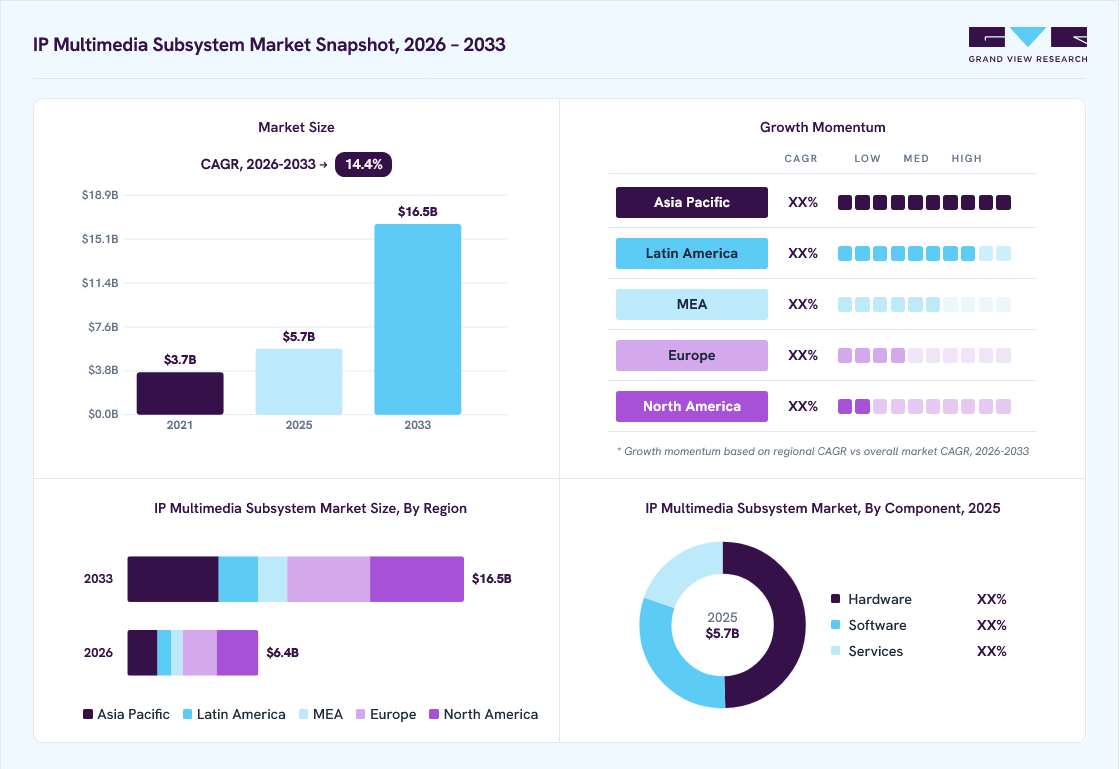
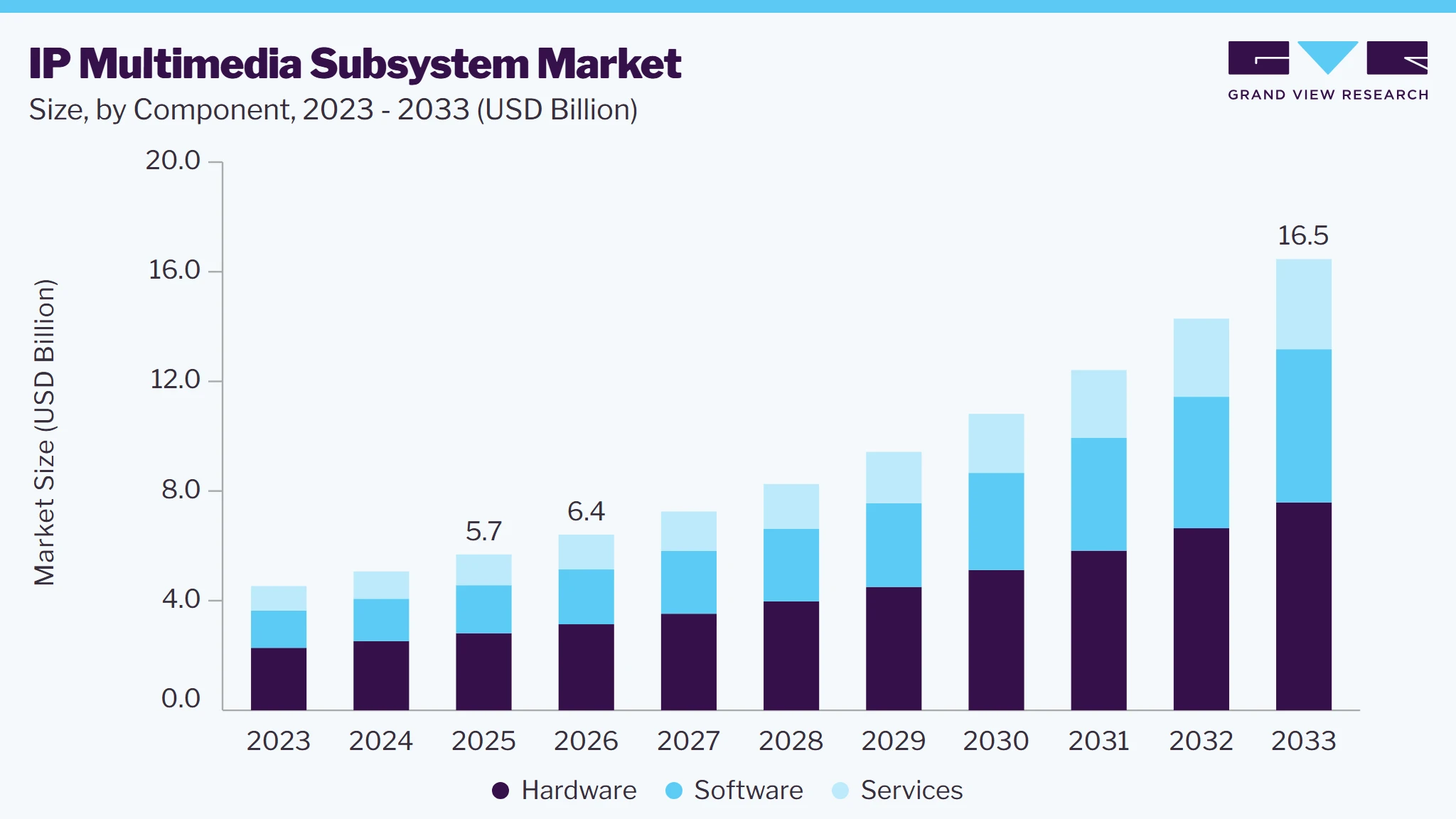
The global IP multimedia subsystem market size was valued at USD 5.7 billion in 2025 and is projected to grow from USD 6.4 billion in 2026 to USD 16.5 billion by 2033, at a CAGR of 14.4% from 2026 to 2033. North America dominated the market, accounting for the largest revenue share of 41.3% in 2025. Increasing deployment of IP-based communication services is driving market growth.
 Source: Grand View Research, IR Documents, Primary Interviews, Paid DatabasesTo learn more about this report,
 Download Free Sample Report
 Key Market Trends & Insights
- By component: Hardware segment dominated the market, with a revenue share of 47.8% in 2025
- By deployment: Cloud segment dominated the market, with a revenue share of 57.1% in 2025
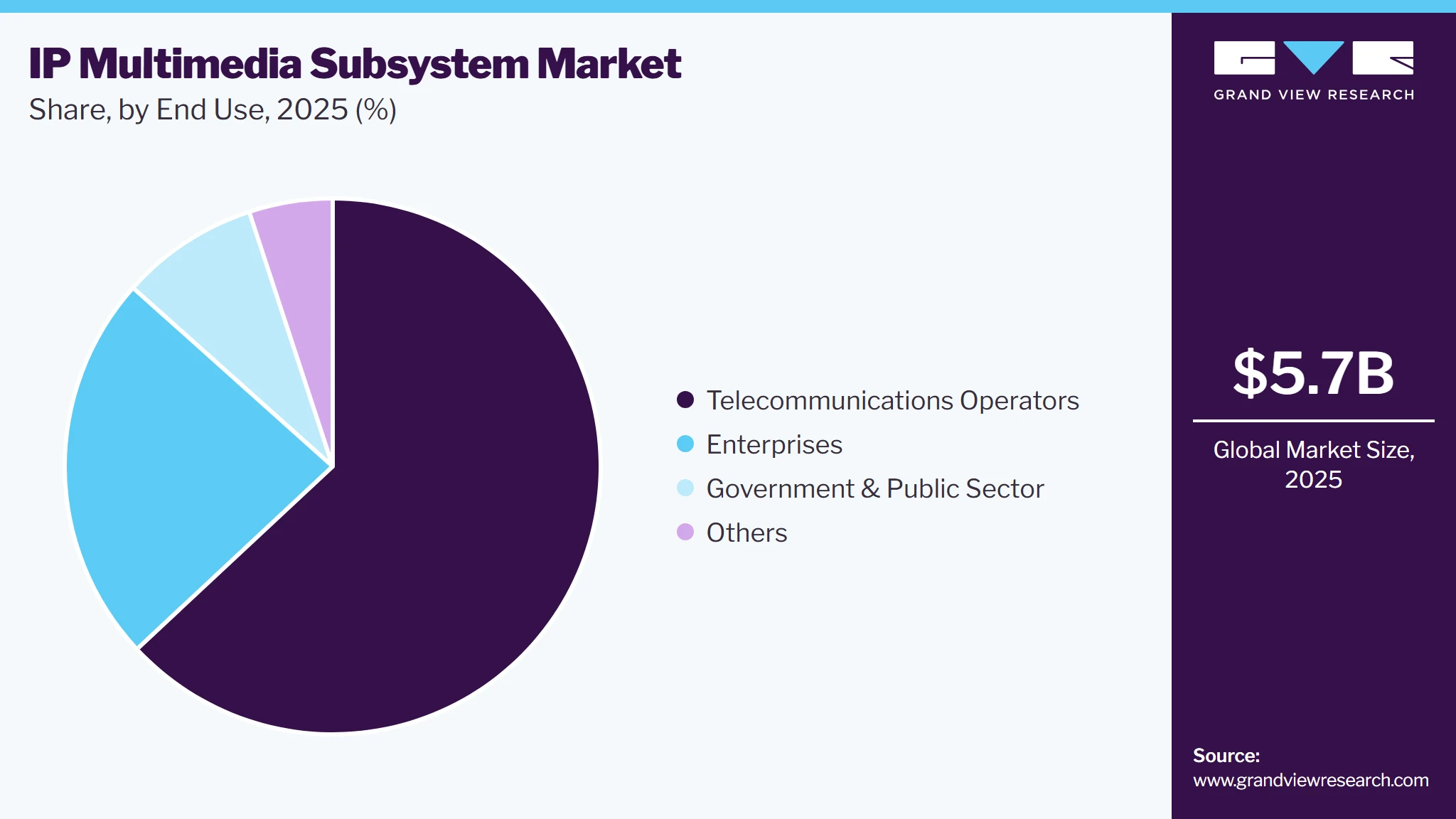
- By end use: Telecommunications operators segment held the largest revenue share in 2025
Regional Highlights
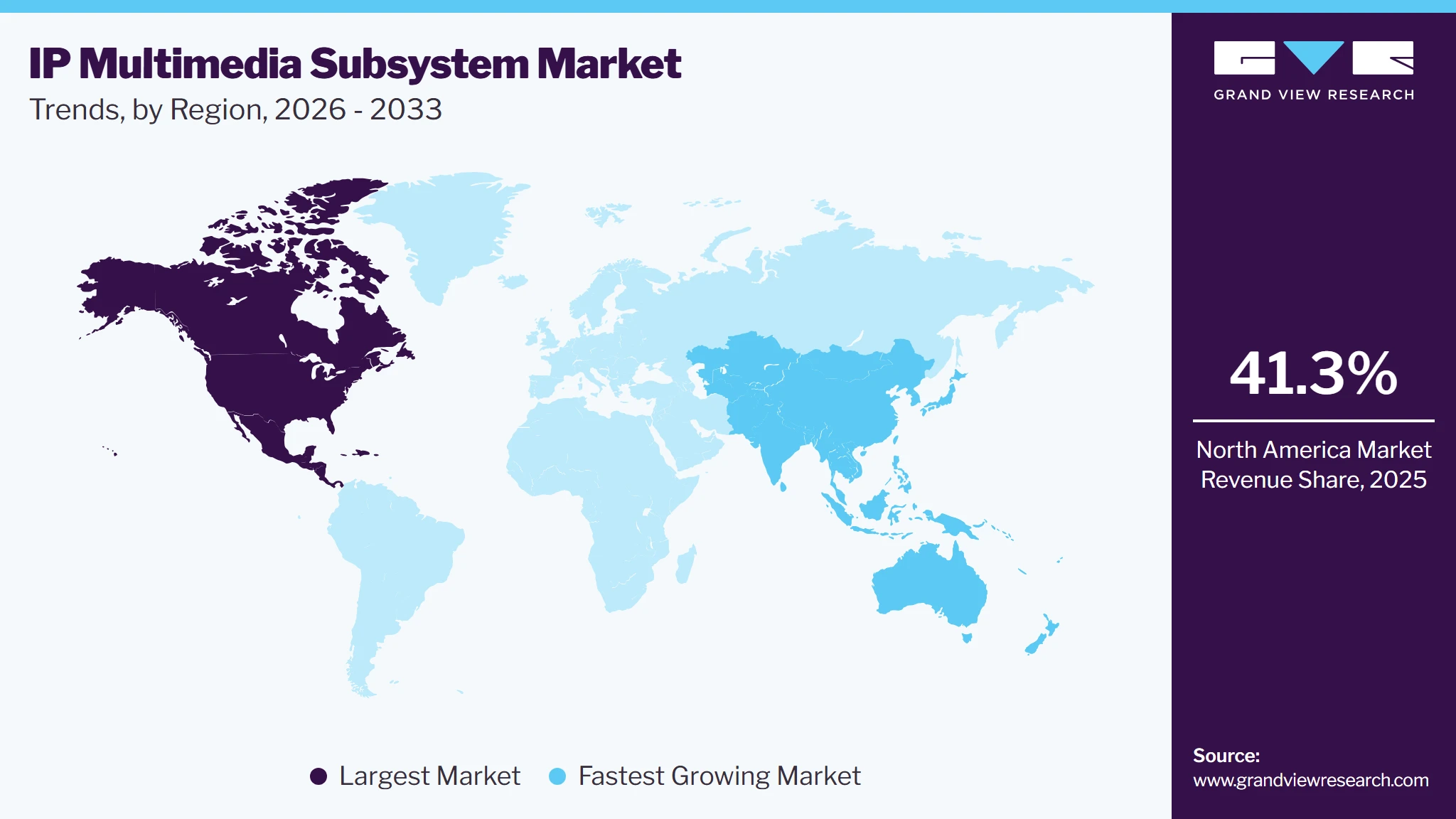
- Largest regional market: North America (41.3% revenue share, 2025)
- Fastest-growing regional market: Asia Pacific (highest CAGR, 2026-2033)
- By country: The U.S. held the largest market share in 2025.
Market Size & Forecast
- Market size in 2025: USD 5.7 Billion
- Estimated market size in 2026: USD 6.4 Billion
- Projected market size by 2033: USD 16.5 Billion
- CAGR (2026-2033): 14.4%
Three ways to get this report
Buy it, customize it, or ask a question.Ask an Analyst
A direct answer, usually in 1 working day
- AccessReport author, directly
- Reply timeWithin 1 working day
- No sales callDirect answer only
- FormatEmail reply
- CostFree, no cost
Get the Full Report
What the study covers
- FormatsPDF · Excel · Dashboard
- Timeline2026–2033 annual, 2025 base
- Coverage20+ countries, 5 regions
- Companies10+ key players profiled
Customize the Report
20% free customization
- IncludeCountries, segments, points
- TailorTo your product definition
- ExtendDeeper competitor detail
- OrA fully bespoke study
- Turnaround5–10 working days
The expansion of fixed-mobile convergence is driving market growth as operators combine mobile, broadband, and fixed communication services within unified service environments. Households and businesses increasingly use multiple communication connections from the same telecommunications provider. IMS can coordinate voice and multimedia services across fixed broadband and mobile access networks through common service-control mechanisms. This allows operators to manage communication identities and service profiles across different connectivity environments. Increasing convergence between fixed and mobile networks contributes to market growth. Multi-access service strategies are propelling market growth.
 To learn more about this report, Download Free Sample Report
 The rollout of fiber-to-the-home and fiber-to-the-business networks is driving growth in the market for IMS-based fixed communication services. Fiber networks provide the high-capacity IP infrastructure required to support multiple communication services over a single access connection. Operators can combine broadband, voice, video, and other IP services through coordinated service architectures. IMS can manage fixed voice and multimedia sessions while remaining connected with subscribers and policy systems. Expansion of fiber-based access infrastructure contributes to market growth. Increasing availability of high-speed fixed connectivity is propelling market growth.
The growing adoption of eSIM technology is driving market growth by transforming mobile subscriber provisioning and service management. eSIM allows subscriber credentials to be provisioned digitally without requiring a conventional physical SIM card. As users manage multiple profiles and switch between mobile service configurations, operators require flexible identity and service-management architectures. IMS can operate alongside these subscriber-management environments to deliver IP-based voice and multimedia services. The transition toward digitally managed subscriber identities contributes to market growth. Increasing use of programmable connectivity is propelling market growth.
The expansion of multi-device communication is driving market growth as subscribers increasingly use smartphones, tablets, computers, smartwatches, and connected vehicles for communication. Users expect communication identities and services to remain coordinated across multiple devices. IMS provides mechanisms for registering devices, managing sessions, and associating communication services with subscriber profiles. Operators can use these capabilities to coordinate voice and multimedia services across different endpoints. Increasing device diversification contributes to market growth. Growth in connected personal and enterprise devices is propelling market growth.
Market Dynamics
The IP multimedia subsystem market is expanding as telecommunications operators transition from circuit-switched voice infrastructure toward IP-based networks capable of delivering voice, messaging, video, and other multimedia services over packet-based connectivity. IMS provides a standardized service-control architecture that enables technologies such as voice over LTE, voice over Wi-Fi, rich communication services, and IP-based messaging to operate across mobile and fixed networks. The continued deployment of 4G LTE and 5G networks is increasing the need for IMS platforms capable of managing high-quality voice services alongside data-centric connectivity. Telecom operators are also using IMS to simplify network architectures, enable service convergence, improve spectrum utilization, and maintain voice continuity as legacy 2G and 3G networks are progressively retired.
The growing requirement for highly reliable communication infrastructure across national telecommunications networks is driving market growth in the IP multimedia subsystem market. Carrier-grade platforms are designed to maintain communication services under demanding traffic conditions while providing controlled availability, redundancy, and service continuity. IMS provides a structured architecture for managing subscriber registration, session control, authentication, routing, and multimedia services within operator networks. Telecommunications providers can use these capabilities to coordinate large-scale voice and multimedia traffic through standardized IP-based infrastructure. The transition toward more resilient communication architectures contribute to market growth. Increasing emphasis on carrier-grade network performance is propelling market growth.
High initial expenditure for IMS deployment can restrain market growth, particularly for telecommunications operators managing large legacy networks. An IMS implementation can involve core software, application servers, subscriber databases, signaling functions, policy systems, charging interfaces, orchestration platforms, and associated network infrastructure. Operators may need to procure and integrate several components before the communication environment becomes fully operational. Capital allocation can therefore become difficult when IMS modernization competes with investments in radio networks, fiber infrastructure, cloud platforms, and cybersecurity. The scale of initial investment contributes to slower deployment decisions. Extended capital-planning cycles can restrain market growth.
The development of AI-enabled network operations is creating new opportunities for IMS platforms through intelligent monitoring and automated service management. AI models can process large volumes of signaling, session, subscriber, and performance information generated across IMS environments. These capabilities can help network teams identify abnormal communication patterns, recognize recurring service issues, and prioritize operational events. AI-based systems can also correlate information from multiple network functions rather than requiring engineers to examine individual systems separately. Integration of intelligent operational capabilities contributes to market growth. The combination of IMS with AI-driven network management is propelling market growth.
Market Concentration & Characteristics
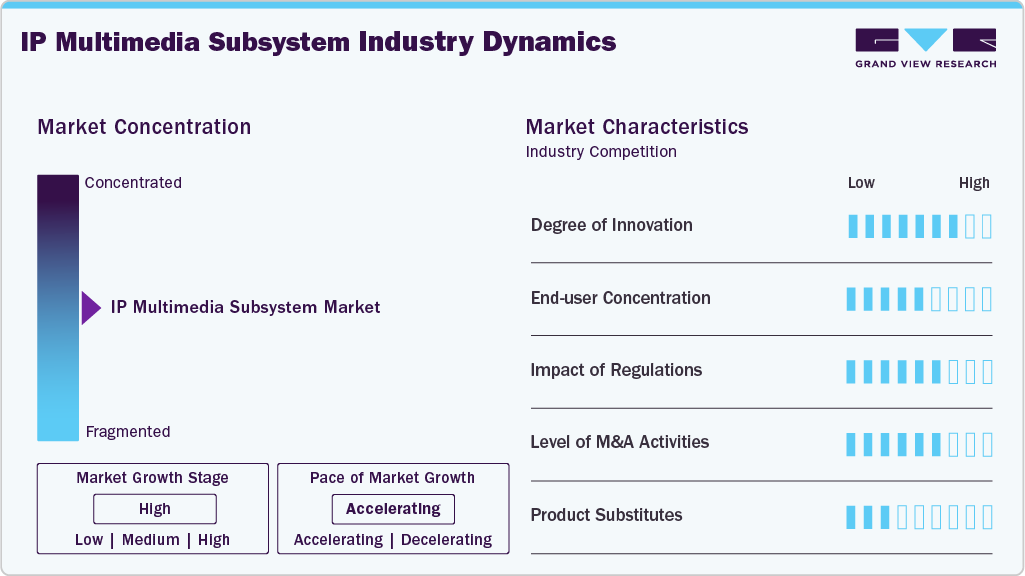
The IP multimedia subsystem market is moderately concentrated and strongly infrastructure-oriented, as deployments are closely tied to telecom operators, network equipment providers, and specialized communications software vendors with established capabilities in carrier-grade signaling, session control, policy management, and interoperability. Entry barriers are relatively high due to the need to comply with standards, integrate with mobile core and access networks, conduct extensive interoperability testing, and meet carrier-level reliability requirements. IMS is standardized across multiple 3GPP specifications and is designed to provide IP-based multimedia services across telecom access environments, making standards compatibility and seamless network integration important competitive factors.
 To learn more about this report, Download Free Sample Report
 The market has a network-modernization-driven demand structure rather than a standalone software adoption model. Telecommunications operators deploy IMS to manage services such as IP-based voice, messaging, multimedia communication, and service continuity across evolving mobile networks, with the technology continuing to be developed for newer network generations. The transition toward 5G and the evolution of multimedia telephony are therefore influencing IMS deployment decisions, particularly where operators need continuity between existing LTE services and newer 5G-based communication architectures.
Analyst Perspective
The IMS market is moving beyond its traditional role as a voice-enabling layer toward becoming a programmable service-control foundation for converged communications across mobile, fixed, enterprise, and private network environments. Competitive differentiation is increasingly centered on cloud-native architecture, interoperability, automation, compatibility with network slicing, service orchestration, and the ability to integrate IMS with 5G core networks and next-generation communication applications. As operators migrate toward software-defined network environments, IMS vendors are increasingly evaluated on their ability to reduce infrastructure complexity while maintaining carrier-grade reliability, service continuity, and efficient lifecycle management. The expansion of VoLTE, VoWiFi, RCS, private 5G, and enterprise communications is broadening the role of IMS from conventional mobile voice toward a wider portfolio of IP-based communication services.
Component Insights
The hardware segment accounted for the largest market share, at 47.8%, in the IP multimedia subsystem market in 2025. The increasing deployment of dedicated telecom computing infrastructure is driving market growth in the hardware segment of the IP multimedia subsystem market. IMS hardware can include high-performance servers, network appliances, signaling equipment, storage systems, and specialized processing infrastructure required to operate communication functions. Telecom operators continue to require reliable physical infrastructure for workloads that involve subscriber registration, session management, signaling, authentication, and multimedia services. Hardware remains relevant even as IMS functions increasingly move toward virtualized and cloud-based environments, particularly within hybrid architectures. Continued investment in carrier-grade computing infrastructure contributes to market growth. Modernization of telecom hardware platforms is propelling market growth.
The software segment is anticipated to grow at the fastest CAGR during the forecast period. Increasing adoption of network function virtualization is expanding the role of software within IMS architectures and enabling communication functions to operate independently of dedicated hardware appliances. The growing use of programmable network infrastructure is enabling operators to configure, scale, and modify IMS functions more efficiently across different network environments. Rising demand for automated service provisioning is driving the adoption of software platforms that coordinate subscriber management, session control, policy functions, and application services. Increasing integration between IMS and orchestration platforms is also enabling telecommunications providers to automate network lifecycle activities and reduce manual configuration requirements.
Deployment Insights
The cloud segment dominated the IP multimedia subsystem market with a revenue share of 57.1% in 2025. Increasing migration to cloud-native telecommunications infrastructure is prompting operators to deploy IMS functions in virtualized and distributed cloud environments. The growing availability of telecom-focused cloud platforms is enabling communication providers to allocate computing resources dynamically according to traffic and service requirements. The rising use of containerized network functions is enabling IMS workloads to be deployed and managed in more flexible software environments. Increasing demand for rapid service introduction is encouraging operators to use cloud infrastructure for faster provisioning and modification of communication functions. The growing emphasis on infrastructure automation is further enabling cloud-based IMS environments to integrate with orchestration, monitoring, and lifecycle management platforms.
The hybrid segment is expected to register the fastest CAGR from 2026 to 2033. The growing need to combine legacy telecom infrastructure with newer cloud-based network functions is driving market growth in the Hybrid segment of the IP Multimedia Subsystem Market. Telecommunications operators often cannot move every IMS component to a new architecture simultaneously, particularly when existing voice and multimedia services remain operational. Hybrid deployment allows selected IMS functions to remain within the established network infrastructure while newer components operate in private or public cloud environments or in virtualized environments. This model provides operators with a gradual architectural transition without requiring an immediate replacement of the complete IMS environment. The ability to coordinate different infrastructure models contributes to market growth. Increasingly flexible telecom architecture strategies are propelling market growth.
End Use Insights
The telecommunications operators segment accounted for the largest market share, at 62.3%, in the IP multimedia subsystem market in 2025. Increasing requirements for fixed-mobile convergence are expanding IMS deployment among telecommunications operators seeking to integrate voice and multimedia services across different access networks. Growing convergence between mobile, broadband, Wi-Fi, and fixed communication services is increasing the need for common service-control architectures. Rising demand for seamless communication across multiple access technologies is encouraging operators to centralize session management and service delivery through IMS environments. Increasing subscriber expectations for consistent voice and multimedia experiences are also encouraging operators to improve interoperability between communication platforms. Growing diversification of communication access methods is further increasing the importance of standardized service-control infrastructure.
 To learn more about this report, Download Free Sample Report
 The enterprises segment is anticipated to register the fastest CAGR during the forecast period. Increasing adoption of unified communications platforms is expanding the relevance of IMS technologies across enterprises managing voice, messaging, video, conferencing, and collaboration services. The growing use of mobile workforces is increasing the need for communication platforms that can coordinate services across office, remote, and mobile environments. The growing integration of enterprise communication with customer service and collaboration applications is encouraging organizations to deploy more sophisticated IP-based communication architectures. Increasing requirements for centralized communication management are also encouraging enterprises to consolidate fragmented voice and multimedia systems.
Regional Insights
North America dominated the IP multimedia subsystem industry, accounting for 41.3% of revenue in 2025. Increasing investment in network automation across North America is prompting telecommunications providers to modernize IMS environments with automated provisioning and service management capabilities. Growing adoption of artificial intelligence and analytics within network operations is increasing the need for IMS platforms capable of generating and processing detailed service and signaling information. Rising requirements for automated fault detection are encouraging operators to integrate IMS with advanced network monitoring and orchestration systems. The increasing focus on reducing manual network management activities is also accelerating the modernization of service control infrastructure.
 To learn more about this report, Download Free Sample Report
 U.S. IP Multimedia Subsystem Market Trends
The U.S. IP multimedia subsystem market is projected to grow significantly during the forecast period. Increasing enterprise adoption of cloud communications in the U.S. is expanding the need for advanced IP-based service-control architectures. Growing use of hosted voice, collaboration, video conferencing, and unified communications is increasing traffic across integrated communication environments. Rising demand for seamless communication between mobile and enterprise applications is encouraging greater coordination between telecom and enterprise communication platforms. Increasing migration from traditional business telephony toward software-based communication is also changing requirements for network service management. Growing integration of communications with enterprise cloud applications is expanding the role of IMS technologies in supporting interconnected communication services.
Asia Pacific IP Multimedia Subsystem Market Trends
The IP multimedia subsystem market in Asia Pacific is expected to grow at the fastest CAGR from 2026 to 2033. Increasing mobile application usage across the Asia Pacific is generating larger volumes of voice, video, messaging, and multimedia communication traffic that require sophisticated service-control infrastructure. Growing smartphone penetration is expanding the number of users accessing IP-based communication services through mobile networks. Rising consumption of multimedia communication is increasing session-management and signalling requirements for telecommunications operators. Increasing digital lifestyles across major Asian economies are also expanding the number of communication services integrated into mobile platforms.
The IP multimedia subsystem industry in China is projected to grow significantly during the forecast period. The increasing integration of 5G with industrial automation in China is driving demand for advanced communication service architectures in factories, logistics centers, ports, and industrial campuses. The growing deployment of connected industrial equipment is increasing the number of communication endpoints managed through private and public networks. Rising use of high-speed wireless infrastructure is encouraging enterprises to integrate voice and multimedia services into industrial connectivity environments. Increasing investment in digital manufacturing is also expanding the requirements for scalable communication platforms. Growing convergence between industrial networks and advanced mobile technologies is broadening IMS application opportunities.
The IP multimedia subsystem industry in India is projected to grow significantly during the forecast period. The increasing expansion of digital commerce in India is increasing the volume of mobile interactions between consumers, businesses, delivery networks, and service providers. Growing smartphone-based commerce is increasing dependence on mobile voice, messaging, and multimedia communication services. Rising digital transactions are increasing the need for reliable communication infrastructure across rapidly growing online service ecosystems. The increasing integration of communication services with customer engagement platforms is encouraging enterprises and operators to enhance IP-based service capabilities. Growing participation in digital commerce is increasing the overall complexity of mobile communication environments.
Europe IP Multimedia Subsystem Market Trends
The IP multimedia subsystem industry in Europe is anticipated to grow steadily from 2026 to 2033. Increasing emphasis on energy-efficient telecommunications infrastructure across Europe is encouraging operators to modernize IMS platforms and optimize network resource utilization. Growing pressure to reduce power consumption within telecommunications facilities is increasing interest in virtualized infrastructure that can consolidate workloads more efficiently. Rising energy-management requirements are encouraging operators to replace inefficient legacy systems with software-based network functions. The increasing use of workload optimization technologies is enabling IMS resources to be dynamically allocated in response to traffic conditions. Growing attention toward sustainable network operations is also influencing infrastructure modernization strategies among European telecommunications providers. Rising focus on energy-efficient network architecture is contributing to the market growth.
The IP multimedia subsystem industry in the UK is expected to grow significantly during the forecast period. Increasing migration to all-IP fixed networks in the UK is prompting operators to strengthen their IMS infrastructure for voice and multimedia services. The growing retirement of traditional telephony infrastructure is increasing requirements for IP-based service-control platforms. The rising transition toward packet-based fixed communication is encouraging operators to integrate voice services more closely with broadband infrastructure. Increasing convergence between broadband and voice services is also increasing the importance of common service-management architectures. The growing modernization of fixed telecommunications infrastructure is creating additional requirements for IMS software and network functions. Rising migration toward all-IP fixed communication is driving adoption.
The IP multimedia subsystem industry in Germany is expected to grow significantly during the forecast period. Increasing industrial automation across Germany is expanding requirements for a sophisticated communication infrastructure capable of coordinating connected machines, workers, facilities, and enterprise systems. The growing deployment of connected manufacturing environments is increasing the number of communication endpoints operating within industrial networks. Rising requirements for real-time coordination are encouraging manufacturers to integrate voice and multimedia communication with advanced industrial connectivity platforms. Increasing use of private networks within manufacturing facilities is also expanding the relevance of flexible communication architectures. Growing industrial digitalization is creating additional opportunities for IMS functions within enterprise and private network environments. Rising industrial automation is driving market growth.
Key IP Multimedia Subsystem Company Insights
Some prominent players in the IP multimedia subsystem market include Cisco Systems, Inc. and Nokia, among others.
-
Cisco Systems, Inc. is a global networking and technology company providing networking, communications, security, collaboration, and software solutions for enterprises, telecommunications operators, governments, and service providers. Its portfolio includes routing and switching platforms, wireless technologies, network security, collaboration solutions, data center infrastructure, and service-provider networking technologies. Cisco’s telecommunications infrastructure capabilities are relevant to the IP Multimedia Subsystem market through the networking, IP infrastructure, policy, mobility, and service-enablement technologies required to deliver IP-based voice and multimedia services.
-
Nokia is a global telecommunications technology company providing mobile and fixed network infrastructure, network management, cloud networking, optical networking, and communications technologies to telecommunications operators and enterprises. The company has a substantial portfolio focused on 4G, 5G, IP networking, network automation, and core network technologies. Nokia’s telecommunications portfolio directly intersects with the IP Multimedia Subsystem market through its mobile core and IMS technologies, which operators use to provide IP-based voice and multimedia communication services.
Key IP Multimedia Subsystem Companies
The following key companies have been profiled for this study on the IP multimedia subsystem market.
-
Alianza, LLC
-
Cisco Systems, Inc.
-
Connet, Inc.
-
EVISTEL
-
F5, Inc.
-
GL Communications Inc
-
Interop Technologies
-
IPLOOK
-
Mavenir
-
Motorola Solutions, Inc.
-
Nokia
-
Quobis
-
Ribbon Communications Operating Company, Inc
-
Telefonaktiebolaget LM Ericsson
-
XIUS
Competitive Benchmarking
Operating Strategies
Competitive Edge
Weakness
Mature Players: Ericsson; Nokia; Cisco; Oracle; Huawei
- Established providers focus on deploying IMS architectures that integrate voice, video, messaging, VoLTE, VoNR, and fixed-mobile convergence within carrier networks.
- Their strategies increasingly emphasize cloud-native IMS, network function virtualization, automation, and compatibility with 5G standalone deployments.
- Extensive carrier relationships and experience with large-scale telecom core networks provide strong integration capabilities across legacy and next-generation infrastructure.
- Mature IMS portfolios also enable operators to manage subscriber services, policy control, session management, and interworking through established platforms.
- Large IMS environments can entail complex migration processes as operators transition from legacy networks to fully cloud-native architectures.
- High integration requirements and long deployment cycles may also make customization more difficult for operators seeking lightweight or specialized solutions.
Emerging Players: Mavenir; Metaswitch; Ribbon Communications; Casa Systems; Affirmed Networks
- Emerging providers focus on virtualized, cloud-native IMS architectures designed for more flexible deployment across public, private, and operator clouds.
- Their offerings often target specific requirements such as VoLTE/VoNR enablement, open network architectures, communications APIs, and simplified modernization of telecom cores.
- Greater emphasis on software-defined architectures allows these companies to address operators seeking modular IMS components rather than highly integrated proprietary stacks.
- Their focus on automation, containerization, and open interfaces can also facilitate faster deployment across distributed 5G environments.
- A smaller scale can limit access to the extensive global carrier support infrastructure available to major telecom vendors.
- Adoption may also depend on interoperability testing, operator confidence, and the ability to maintain solutions across increasingly complex multi-vendor 5G core environments.
Recent Developments
-
In 2026, IPLOOK expanded its IMS platform with the launch of IMS R2.1.2, adding application-server functions for missed-call notification, color ringback tone, and voicemail services. The release extends the company's IMS offering beyond basic core voice capabilities and adds subscriber-facing value-added services that can be integrated into operator IMS environments. The additional application servers enable service providers to deploy supplementary voice services within the same IMS architecture, rather than relying on separate legacy platforms.
-
In March 2025, Alianza acquired Metaswitch from Microsoft, combining Alianza's cloud communications platform with Metaswitch's communications technology. The transaction expanded Alianza's portfolio for communications service providers and strengthened its capabilities around cloud-native communications infrastructure and network modernization. The transaction allows Alianza to combine its cloud communications capabilities with Metaswitch's technology and customer relationships, enhancing its ability to support service-provider migration from legacy network infrastructure to cloud-based communications architectures. This development can enhance competition in the IMS market by adding cloud-native communications capabilities to Alianza's portfolio.
IP Multimedia Subsystem Market Report Scope
Report Attribute
Details
Market size in 2025
USD 5.7 billion
Estimated market size in 2026
USD 6.4 billion
Projected market size by 2033
USD 16.5 billion
Growth rate
CAGR of 14.4% from 2026 to 2033
Actual data
2021 - 2025
Forecast period
2026 - 2033
Quantitative units
Revenue in USD billion and CAGR from 2026 to 2033
Report coverage
Revenue forecast, company share, competitive landscape, growth factors, and trends
Segments covered
Component, deployment, end use, region
Regional scope
North America; Europe; Asia Pacific; Latin America; MEA
Country scope
U.S.; Canada; Mexico; UK; Germany; France; China; India; Japan; Australia; South Korea; Brazil; UAE; Saudi Arabia; South Africa
Key companies profiled
Alianza, LLC; Cisco Systems, Inc.; Connet, Inc.; EVISTEL, F5, Inc.; GL Communications Inc; Interop Technologies; IPLOOK; Mavenir; Motorola Solutions, Inc.; Nokia; Quobis; Ribbon Communications Operating Company, Inc; Telefonaktiebolaget LM Ericsson; XIUS
Customization scope
Free report customization (equivalent to 8 analysts working days) with purchase. Addition or alteration to country, regional & segment scope.
Pricing and purchase options
Avail customized purchase options to meet your exact research needs. Explore purchase options
Global IP Multimedia Subsystem Market Report Segmentation
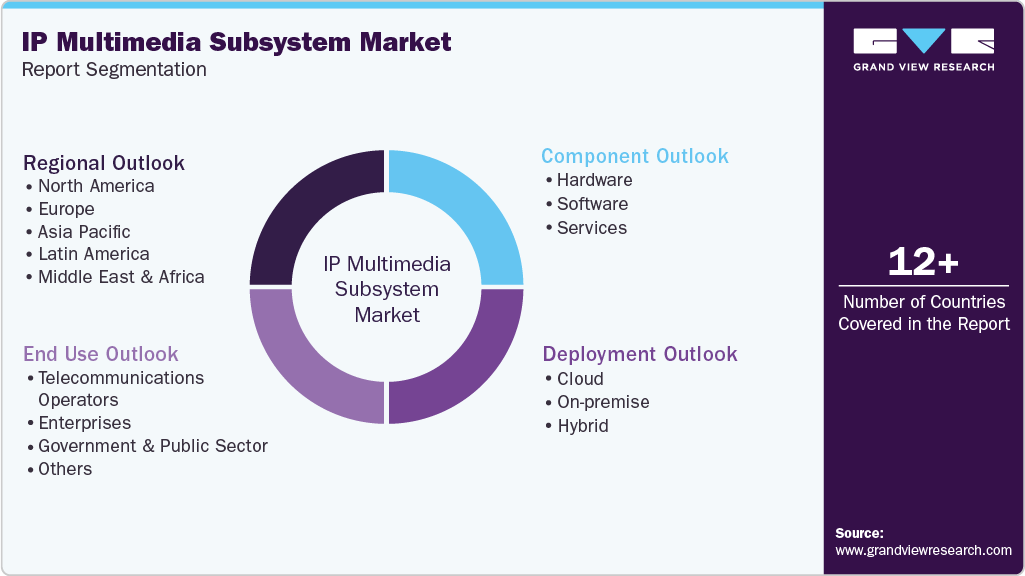
This report forecasts revenue growth at global, regional, and country levels and provides an analysis of the latest industry trends in each of the sub-segments from 2021 to 2033. For this study, Grand View Research has segmented the IP multimedia subsystem market report based on component, deployment, end use, and region:
 To learn more about this report, Download Free Sample Report
 -
Component Outlook (Revenue, USD Billion, 2021 - 2033)
-
Hardware
-
Voice over LTE
-
Voice over Wi-Fi
-
Rich Communication Services
-
Video Calling
-
Multimedia Messaging
-
Others
-
-
Software
-
Services
-
-
Deployment Outlook (Revenue, USD Billion, 2021 - 2033)
-
Cloud
-
On-premise
-
Hybrid
-
-
End Use Outlook (Revenue, USD Billion, 2021 - 2033)
-
Telecommunications Operators
-
Enterprises
-
Government & Public Sector
-
Others
-
-
Regional Outlook (Revenue, USD Billion, 2021 - 2033)
-
North America
-
U.S.
-
Canada
-
Mexico
-
-
Europe
-
Germany
-
UK
-
France
-
-
Asia Pacific
-
China
-
India
-
Japan
-
South Korea
-
Australia
-
-
Latin America
-
Brazil
-
-
Middle East & Africa
-
UAE
-
Saudi Arabia
-
South Africa
-
-
Research Methodology
The IP multimedia subsystem market figures in this report are based on a proven research process that combines executive interviews with secondary research from proprietary databases, company filings, and recognized regulatory and institutional sources. Market size is built through value-chain sizing - reconciling supply-side and demand-side estimates - and triangulated with bottom-up and top-down approaches. Every estimate passes multiple levels of expert validation before publication, with each IP multimedia subsystem segment quantified using the revenue-capture definitions in the table below.
Segment Definition
Component
Revenue capture definition
Hardware
Revenue is captured through IMS infrastructure equipment such as servers, media gateways, session border controllers, signaling components, and related networking hardware deployed by telecom operators and large communication environments. Commercial value is influenced by network scale, capacity requirements, equipment upgrades, and replacement of legacy voice infrastructure.
Software
The software segment derives value from IMS core platforms, application servers, policy and charging functions, subscriber management, signaling software, and service-enablement platforms. Monetization can follow perpetual licensing, subscription, usage-based models, or bundled software agreements, with demand linked to the expansion of IP-based communication services.
Services
Market value is captured through implementation, integration, consulting, network migration, maintenance, managed services, testing, and technical support associated with IMS deployments. Spending tends to increase where operators require interoperability with existing networks, customized service integration, or ongoing optimization of their communications infrastructure.
Deployment
Revenue capture definition
Cloud
Cloud deployment captures revenue through hosted IMS platforms, virtualized network functions, cloud infrastructure consumption, and managed communication services. Its economics are tied to flexible capacity, faster service rollout, reduced dependence on dedicated infrastructure, and the adoption of network function virtualization and cloud-native telecommunications architectures.
On-Premise
Investment in on-premises IMS is concentrated in dedicated infrastructure installed and operated within an operator’s or organization’s own facilities. Revenue comes from infrastructure procurement, software licensing, installation, upgrades, and long-term maintenance, where organizations prioritize direct control over network resources, security, customization, and integration with existing telecommunications systems.
Hybrid
Hybrid deployments generate value by combining operator-controlled IMS infrastructure with cloud-based resources or external network services. This model allocates spending across integration, orchestration, infrastructure, software, and managed services, while allowing organizations to retain selected workloads locally and shift other functions to scalable cloud environments.
End Use
Revenue capture definition
Telecommunications Operators
Telecommunications operators account for substantial IMS-related expenditure through the deployment of IP-based voice and multimedia communication capabilities across mobile and fixed networks. Revenue is linked to subscriber scale, VoLTE and VoWiFi rollout, legacy network migration, RCS deployment, service differentiation, and modernization of core network architecture.
Enterprises
Enterprises capture IMS-related value through unified communications, enterprise voice, messaging, video, collaboration, and connectivity services integrated with corporate communication systems. Spending is influenced by requirements for centralized communication management, mobility, interoperability, and integration between business applications and IP communication platforms.
Government & Public Sector
Public-sector demand generates revenue through secure IP communication infrastructure, institutional voice services, messaging, multimedia communication, and modernization of government communication networks. Procurement is typically associated with large-scale deployments, interoperability requirements, security controls, continuity requirements, and long-term infrastructure contracts.
Others
The remaining segment encompasses organizations such as educational institutions, healthcare providers, transportation operators, utilities, and specialized communication service providers. Revenue is derived from IMS-enabled voice, messaging, conferencing, and multimedia communication, where organizations require dependable IP-based connectivity without having to operate a large telecommunications network themselves.
Estimation Model
Layer No.
Layer
Question
Analysis
01
Network Convergence Layer
How is IMS embedded into modern telecom networks?
IMS provides a common IP-based architecture for delivering voice, messaging, video, and other multimedia services across mobile and fixed networks. Its role expands as operators migrate legacy circuit-switched services toward VoLTE, VoWiFi, and 5G-based communication.
02
Service Enablement Layer
Which communication services depend on IMS capabilities?
VoLTE, VoWiFi, Rich Communication Services, video calling, and multimedia messaging rely on IMS functions for session control, authentication, routing, and service management. This makes IMS increasingly relevant to operators seeking to deliver multiple communication services through a unified architecture.
03
Subscriber & Session Management Layer
How does IMS manage communication sessions?
IMS coordinates subscriber registration, identity management, call/session setup, policy enforcement, quality-of-service control, and interworking between different networks. These capabilities allow operators to maintain consistent service behavior across smartphones, fixed connections, Wi-Fi networks, and 5G environments.
04
Telecom Infrastructure Value Layer
How is commercial value generated across the IMS ecosystem?
Market value extends across IMS core platforms, application servers, policy and charging systems, signaling components, integration, managed services, and network modernization projects. Recurring software, cloud-native deployments, maintenance, and service-management contracts add to the revenue potential beyond initial inf
Delivered Customizations
This report has been delivered with the following In-depth customizations
Client Request
Customization Delivered
Value Adds
5G and IMS-based voice service evolution
Analysis of IMS deployment for VoNR, VoLTE expansion, and seamless voice continuity across 4G/5G networks.
Identifies operator migration priorities and opportunities linked to next-generation voice services.
Converged communication across mobile, fixed, and enterprise networks
Assessment of IMS integration with fixed-mobile convergence, unified communications, and enterprise communication platforms.
Helps identify revenue opportunities from integrated communication services and enterprise connectivity.
IMS monetization through communication and service orchestration
Evaluation of IMS-enabled service creation, real-time charging, multimedia services, and network API integration.
Highlights opportunities for operators to move beyond connectivity toward programmable communication services.
Frequently Asked Questions About This Report
The global IP multimedia subsystem market size was estimated at USD 5.7 billion in 2025 and is expected to reach USD 6.4 billion in 2026.
The global IP multimedia subsystem market is expected to grow at a compound annual growth rate of 14.4% from 2026 to 2033 to reach USD 16.5 billion by 2033.
Key factors include the IP multimedia subsystem, the expansion of fixed-mobile convergence and the rollout of fiber-to-the-home and fiber-to-the-business networks.
Asia Pacific is the fastest-growing region over the forecast period.
The hardware segment led with an 47.8% revenue share in 2025 and it is the fastest-growing segment.
The cloud segment led with an 57.1% revenue share in 2025, while hybrid is the fastest-growing segment.
Telecommunications operators segment held the largest revenue share in 2025
Key players operating in the IP multimedia subsystem market include Alianza, LLC, Cisco Systems, Inc., Connet, Inc., EVISTEL, F5, Inc., GL Communications Inc, Interop Technologies, IPLOOK, Mavenir, Motorola Solutions, Inc., Nokia, Quobis, Ribbon Communications Operating Company, Inc, Telefonaktiebolaget LM Ericsson, XIUS.
North America dominated the market with 41.3% revenue share in 2025.
About the Author(s)
Communication Services Research Team
Technology · Communication ServicesThis report was authored by the communication services research team at Grand View Research - comprising two research analysts, one senior research analyst, and one industry expert - with specialized expertise in the communication services segment of the technology industry. All findings are based on proprietary technology databases, executive interviews, and regulatory analysis, subject to internal peer review prior to publication.
Last Updated:
Speak to Analyst

Customize this report to your needs - add regions, segments, or data points, with 20% free customization.
Or view our licence options:


ISO 9001:2015 & 27001:2022 Certified
We are GDPR and CCPA compliant! Your transaction & personal information is safe and secure. For more details, please read our privacy policy.


