
- Home
- »
- Advanced Interior Materials
- »
-
Jewellery Machine Market Size, Share Report, 2026-2033GVR Report cover
![Jewellery Machine Market (2026 - 2033)Report]()
Jewellery Machine Market (2026 - 2033)
Size, Share & Trends Analysis Report By Product (Cutting Machines, Engraving Machines), By End Use (Jewellery Manufacturers, Artisans & Small Workshops), By Mode of Operation (Manual, Fully Automatic), By Region, And Segment Forecasts
Market Size, 2025
$4.2BMarket Estimate, 2026
$4.4BMarket Forecast, 2033
$6.0BCAGR, 2026–2033
4.6%Jewellery Machine Market Summary
The global jewellery machine market size was valued at USD 4.2 billion in 2025 and is projected to grow from USD 4.4 billion in 2026 to USD 6.0 billion by 2033, at a CAGR of 4.6% from 2026 to 2033. The market in Asia Pacific dominated with a revenue share of 40.7% in 2025. The jewellery machine industry is driven by rising demand for precision, consistency, and faster production in jewellery manufacturing.

Key Market Trends & Insights
- By product: Casting & foundry machines segment is expected to grow at a considerable CAGR of 5.1% from 2026 to 2033 in terms of revenue.
- By end use: Artisans & small workshops segment is expected to grow at a considerable CAGR of 5.1% from 2026 to 2033 in terms of revenue.
- By mode of operation: Fully automatic segment is expected to grow at a considerable CAGR of 5.0% from 2026 to 2033 in terms of revenue.
Regional Highlights
- Largest regional market: Asia Pacific (40.7% revenue share, 2025)
- By country: The China held the largest market share in 2025.
Market Size & Forecast
- Market size in 2025: USD 4.2 Billion
- Estimated market size in 2026: USD 4.4 Billion
- Projected market size by 2033: USD 6.0 Billion
- CAGR (2026-2033): 4.6%
Growing consumer preference for intricate designs and customized pieces is pushing manufacturers to adopt advanced cutting, engraving, and faceting machines. Automation also helps reduce material wastage, which is critical when working with high-value metals and gemstones.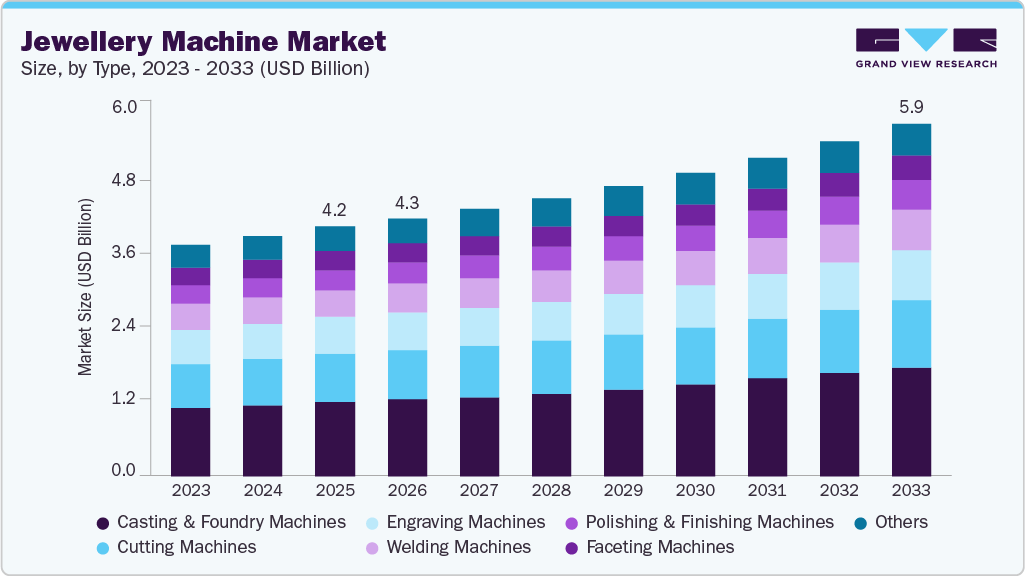
Another key driver is the rapid modernization of jewellery workshops, especially in emerging markets. Artisans and small workshops are gradually shifting from manual tools to semi-automatic and fully automatic machines to improve productivity and meet large orders. Expanding organized retail jewellery chains are also investing in modern equipment to maintain uniform design standards. In addition, supportive government initiatives for manufacturing and skill development are strengthening market growth.
Market Concentration & Characteristics
The jewellery machine industry shows a moderately fragmented industry structure, with a mix of global technology providers and a large number of regional and local manufacturers. No single company dominates the market, as demand varies widely based on jewellery type, scale of operation, and level of automation. Established players compete through advanced features and automation, while smaller firms focus on cost-effective and customized machines.
The market shows a steady level of innovation focused on precision, automation, and ease of use. Manufacturers are integrating digital controls, CAD/CAM compatibility, and laser-based technologies to support complex jewellery designs. Energy efficiency and reduced material loss are also key innovation areas. Product upgrades are largely incremental, driven by practical workshop needs rather than disruptive changes.
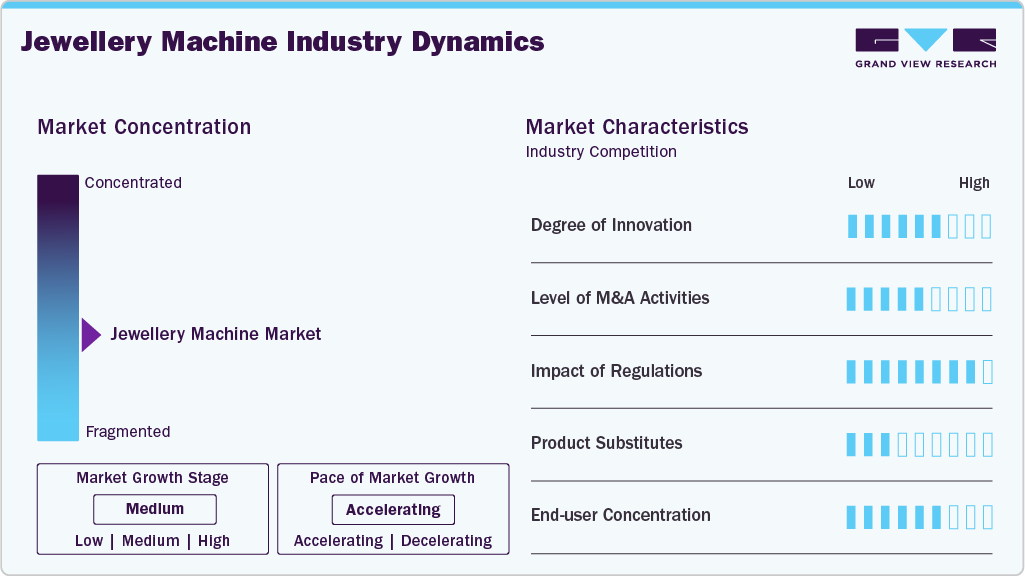
Regulations mainly influence the market through safety, environmental, and manufacturing standards. Compliance with workplace safety norms and emission controls is shaping the design of casting, welding, and finishing machines. Environmental rules related to waste handling and energy use are encouraging cleaner and more efficient equipment. While regulations raise compliance costs, they also promote technology upgrades and quality benchmarks.
End user concentration in the market is relatively low, with demand spread across manufacturers, artisans, and retail workshops. Large jewellery manufacturers account for higher-value purchases, especially fully automatic systems. However, small workshops and independent artisans form a broad customer base for manual and semi-automatic machines. This diverse end-user mix reduces dependency on any single customer group.
Drivers, Opportunities & Restraints
The jewellery machine industry is driven by growing demand for precision-made and customized jewellery across global markets. Rising labor costs and skill shortages are encouraging manufacturers to adopt automated and semi-automatic machines. Increasing production volumes from organized jewellery brands are further boosting demand for advanced equipment.
Strong growth opportunities are emerging from the modernization of small workshops and artisan clusters in developing regions. Affordable, compact, and user-friendly machines are opening new adoption avenues among first-time buyers. The rise of personalized and lightweight jewellery is also creating demand for advanced engraving and faceting solutions. Technological integration with digital design tools offers further scope for value-added machine offerings.
High initial investment costs remain a key restraint, particularly for small-scale jewellers and independent artisans. Limited access to skilled operators for advanced machines can slow adoption in certain regions. Maintenance costs and dependence on imported components also impact total ownership costs. In addition, fluctuating prices of precious metals can delay capital expenditure decisions by jewellery manufacturers.
Product Insights
Casting & foundry machines dominated the market and accounted for 29.8% share in 2025, due to their critical role in mass production and design replication. These machines enable consistent quality, complex shapes, and efficient use of precious metals. Growing demand for lightweight and intricately designed jewellery is increasing reliance on advanced casting technologies. Their ability to support high-volume output makes them essential for large jewellery manufacturers.
Welding Machines segment is expected to grow at a significant CAGR of 5.0% from 2026 to 2033 in terms of revenue. Welding machines are witnessing significant growth as jewellery designs become more delicate and material efficient. Laser and micro-welding solutions allow precise joining with minimal heat impact, reducing damage to gemstones and fine components. Rising repair, resizing, and customization activities are also boosting demand. Adoption is further supported by the shift toward modern workshop setups requiring flexible and accurate joining technologies.
End Use Insights
Jewellery manufacturers dominated the market in 2025 and accounted for 61.8% share, as they require advanced machines to support large-scale, standardized production. Their focus on automation helps ensure design consistency, faster turnaround times, and lower per-unit costs. High production volumes also justify investment in fully automatic casting, cutting, and finishing equipment. This segment continues to drive steady demand for technologically advanced machinery.
Artisans & small workshops segment is expected to grow at a considerable CAGR of 5.1% from 2026 to 2033 in terms of revenue. Artisans and small workshops represent the fastest-growing end use due to rapid modernization and rising demand for customized jewellery. Many small players are adopting compact and semi-automatic machines to improve productivity without losing craftsmanship. Increased access to affordable equipment and financing options is supporting this shift. Growing consumer preference for handcrafted and personalized designs is further accelerating adoption in this segment.
Mode of Operation Insights
Fully automatic machines dominated the market and accounted for a 52.4% share in 2025, as manufacturers prioritize high productivity and consistent output. These systems minimize manual intervention, reduce human error, and support complex, repeatable designs. Large jewellery producers favor fully automatic solutions to meet bulk orders and maintain uniform quality standards. Their long-term cost efficiency makes them a preferred choice for organized players.
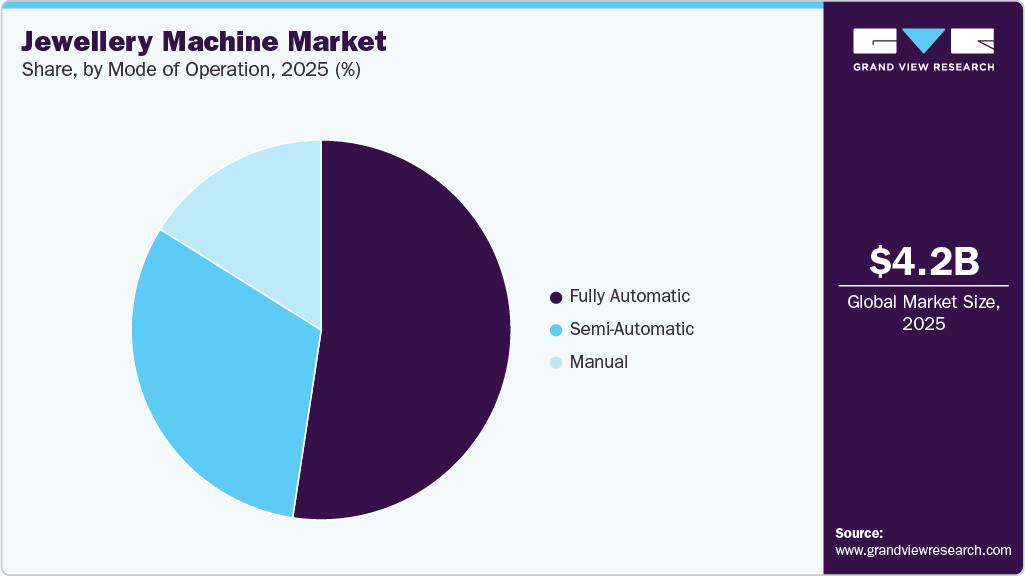
Semi-Automatic egment is expected to grow at a significant CAGR of 4.3% from 2026 to 2033 in terms of revenue. Semi-automatic machines are expected to grow significantly over the forecast period, due to their balance between affordability and performance. They allow artisans and mid-sized workshops to enhance efficiency while retaining design flexibility. Lower upfront costs and simpler operation make them suitable for gradual automation. This segment is expanding as small players transition from manual tools to mechanized processes.
Regional Insights
North America jewellery machine industry is growing steadily at a CAGR of 3.8% over the forecast period, driven by demand for high-precision and technologically advanced jewellery machines. Manufacturers in the region focus on automation to support customized and premium jewellery production. Rising use of laser welding and digital engraving technologies is boosting equipment upgrades. Strong presence of organized jewellery brands supports consistent market growth.
U.S. Jewellery Machine Market Trends
U.S. jewellery machine industry dominated the North American market due to its strong presence of organized jewellery manufacturers and technology-driven workshops. High demand for customized and premium jewellery is pushing adoption of advanced casting, engraving, and laser welding machines. Manufacturers focus on automation to improve precision and reduce production time. Continuous investment in digital and automated equipment supports market leadership.
The jewellery machine industry in Canada is growing steadily as jewellery producers modernize small and mid-sized workshops. Rising demand for personalized and designer jewellery is encouraging adoption of semi-automatic and compact machines. Improved access to advanced equipment and skilled labor is supporting market expansion. Growth in local jewellery retail and exports is further driving machine demand.
Europe Jewellery Machine Market Trends
Europe jewellery machine industry is witnessing growth due to its emphasis on design innovation and high-quality craftsmanship. Jewellery producers are investing in advanced casting, faceting, and finishing machines to maintain premium standards. Strict quality and safety regulations are encouraging equipment modernization. Demand is also supported by luxury jewellery exports.
Italy jewellery machine industry dominated the European market due to its long-standing leadership in jewellery design and manufacturing. The country hosts a strong base of high-end jewellery producers that demand advanced casting, engraving, and finishing machines. Emphasis on precision, aesthetics, and premium quality drives continuous equipment upgrades. Italy’s export-oriented jewellery industry further strengthens its dominant position.
The jewellery machine industry in Germany is growing steadily, supported by its expertise in industrial machinery and advanced manufacturing technologies. Jewellery producers in the country are increasingly adopting automated and laser-based machines for higher efficiency. Strong focus on engineering precision and process optimization supports demand growth. Rising investments in smart and energy-efficient equipment are also contributing to market expansion.
Asia Pacific Jewellery Machine Market Trends
Asia Pacific jewellery machine industry dominated the global market and accounted for 40.7% share, due to its strong jewellery manufacturing base and large artisan population. Countries like India and China benefit from abundant skilled labor and high domestic jewellery demand. Rapid adoption of semi-automatic and automatic machines is improving production efficiency. Cost-effective manufacturing and expanding exports further support regional leadership.
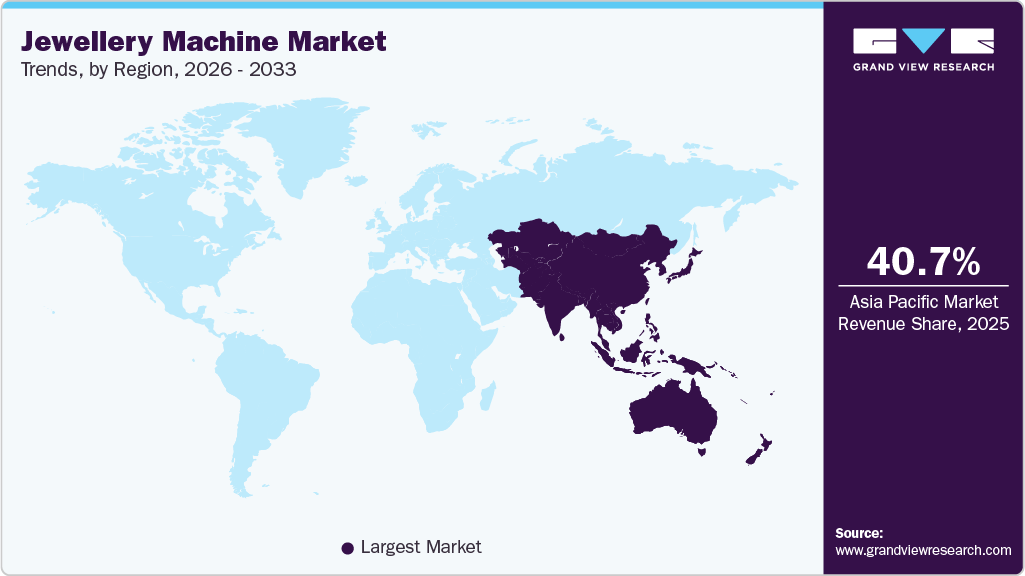
China jewellery machine industry dominated the Asia Pacific market due to its large-scale jewellery manufacturing ecosystem and strong export orientation. High production volumes drive demand for fully automatic casting, cutting, and polishing machines. Continuous investment in modern manufacturing infrastructure supports rapid technology adoption. Competitive production costs further strengthen China’s leading position.
The jewellery machine industry in India is growing rapidly, supported by its vast artisan base and expanding organized jewellery sector. Increasing shift from manual tools to semi-automatic and automatic machines is improving productivity and quality. Rising domestic jewellery consumption and export demand are accelerating equipment upgrades. Government initiatives promoting manufacturing and skill development also support market growth.
Middle East & Africa Jewellery Machine Market Trends
Middle East and Africa jewellery machine industry is experiencing gradual growth, supported by strong demand for gold and ornamental jewellery. The region is seeing increased investment in modern jewellery workshops and retail manufacturing units. Growing tourism and luxury jewellery demand are driving machine adoption. Imports of advanced equipment are helping to upgrade traditional production methods.
UAE jewellery machine industry is growing as a key market due to its role as a global trading and manufacturing hub for gold and diamond jewellery. Rising investments in modern jewellery workshops are driving demand for advanced casting and welding machines. Strong tourism and luxury retail demand are encouraging local production capabilities. Supportive trade policies and access to imported machinery further fuel market growth.
Latin America Jewellery Machine Market Trends
Latin America jewellery machine industry is growing as local jewellery production expands and small workshops modernize operations. Rising middle-class income is increasing demand for machine-made and customized jewellery. Adoption of semi-automatic machines is improving productivity among small manufacturers. Government support for local manufacturing also aiding market development.
The jewellery machine industry in Brazilis emerging as a growing market for jewellery machines, driven by expanding domestic jewellery production. Local manufacturers are increasingly adopting semi-automatic and automatic equipment to improve design consistency and output. Rising consumer demand for affordable and customized jewellery is encouraging workshop modernization. Improving access to modern machinery and skilled labor is further supporting market growth.
Key Jewellery Machine Company Insights
Some of the key players operating in the market include Gravotech; Epilog Laser, and Indutherm.
-
Gravotech plays a strong role in the jewellery machine industry through its precision engraving and marking solutions tailored for fine detailing. The company is widely adopted by professional jewellery manufacturers for consistent, repeatable engraving quality. Its machines are valued for compatibility with automated workflows and CAD/CAM-based design processes. Gravotech focuses on high-end applications where accuracy and surface finish are critical. This positions the company strongly in premium and export-oriented jewellery production.
-
Epilog Laser is a key player in laser-based engraving and cutting for customized and small-batch jewellery production. Its systems are commonly used by designers, workshops, and retail jewellers for rapid personalization. The company’s strength lies in ease of operation and high-precision laser output for intricate patterns. Epilog machines support short lead times, making them suitable for on-demand jewellery manufacturing. This has helped the company gain traction in customization-driven market segments.
Key Jewellery Machine Companies:
The following key companies have been profiled for this study on the jewellery machine market.
- Kalyan Engineering
- HK Malvi Industries
- Sahajanand Laser Technology Limited (SLTL)
- Doit Industries Limited
- Epilog Laser
- Elements Nxt & Co.
- Gravotech
- Indutherm
- Laser Star Technologies
- Orotig Spa
- Pepetools
- Rio Grande
- Schultheiss GmbH
- Superb Electromachinery Co.
- United Induction Heating Machine Limited
Recent Developments
-
In September 2025, Gravotech has introduced the TYPE EDIT / LASER TYPE V15 software to improve engraving and laser machining workflows. The update enhances design preview accuracy, helping users visualize tool paths before production. It also supports more efficient cutting and finishing operations for complex designs. These improvements help reduce errors, save material, and speed up jewellery manufacturing processes.
-
In April 2023, Epilog Laser has expanded its Fusion Maker Laser series with new models that boost power and workspace size. These additions improve cutting and engraving speed, letting users handle larger projects more efficiently. The upgrade also supports a wider range of materials and finer detail work for creative and production applications. This expansion strengthens Epilog’s appeal to designers, makers, and small manufacturers.
Jewellery Machine Market Report Scope
Report Attribute
Details
Market size in 2025
USD 4.2 billion
Estimated market size in 2026
USD 4.4 billion
Projected market size by 2033
USD 6.0 billion
Growth rate
CAGR of 4.6% from 2026 to 2033
Historical data
2021 - 2024
Forecast period
2026 - 2033
Quantitative units
Revenue in USD million and CAGR from 2026 to 2033
Report coverage
Revenue forecast, company ranking, competitive landscape, growth factors, and trends
Segments covered
Product, end use, mode of operation, region.
Regional scope
North America; Europe; Asia Pacific; Latin America; Middle East & Africa
Country scope
U.S.; Canada; Mexico; UK; Germany; France; Spain; Italy; China; Japan; India; Thailand; South Korea; Brazil; Argentina; Saudi Arabia; UAE; South Africa
Key companies profiled
Kalyan Engineering; HK Malvi Industries; Sahajanand Laser Technology Limited (SLTL); Doit Industries Limited; Epilog Laser; Elements Nxt & Co.; Gravotech; Indutherm; Laser Star Technologies; Orotig Spa; Pepetools; Rio Grande; Schultheiss GmbH; Superb Electromachinery Co.; United Induction Heating Machine Limited.
Customization scope
Free report customization (equivalent up to 8 analysts working days) with purchase. Addition or alteration to country, regional & segment scope.
Pricing and purchase options
Avail customized purchase options to meet your exact research needs. Explore purchase options
Global Jewellery Machine Market Report Segmentation
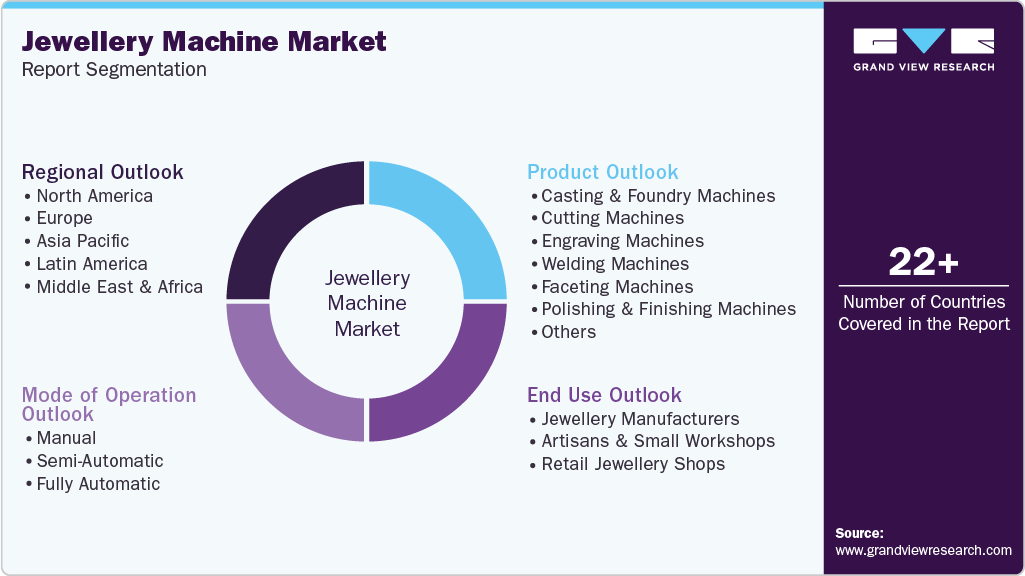
This report forecasts revenue growth at global, regional, and country levels and provides an analysis of the latest industry trends in each of the sub-segments from 2021 to 2033. For this study, Grand View Research has segmented the global jewellery machine market report based on product,end use, mode of operation, and region.
-
Product Outlook (Revenue, USD Million, 2021 - 2033)
-
Casting & Foundry Machines
-
Cutting Machines
-
Engraving Machines
-
Welding Machines
-
Faceting Machines
-
Polishing & Finishing Machines
-
Others
-
-
End Use Outlook (Revenue, USD Million, 2021 - 2033)
-
Jewellery Manufacturers
-
Artisans & Small Workshops
-
Retail Jewellery Shops
-
-
Mode of Operation Outlook (Revenue, USD Million, 2021 - 2033)
-
Manual
-
Semi-Automatic
-
Fully Automatic
-
-
Regional Outlook (Revenue, USD Million, 2021 - 2033)
-
North America
-
U.S.
-
Canada
-
Mexico
-
-
Europe
-
Germany
-
France
-
Italy
-
Spain
-
UK
-
-
Asia Pacific
-
China
-
India
-
Japan
-
South Korea
-
Thailand
-
-
Latin America
-
Brazil
-
Argentina
-
-
Middle East and Africa
-
Saudi Arabia
-
UAE
-
South Africa
-
-
Frequently Asked Questions About This Report
The casting & foundry segment led with a 29.8% revenue share in 2025.
Jewellery manufacturers held the largest revenue share 61.8% in 2025.
Fully automatic machines held the largest share (over 52.4%) in 2025.
Asia Pacific dominated the jewellery machine market and accounted for 40.7%.
Key players include Kalyan Engineering; HK Malvi Industries; Sahajanand Laser Technology Limited (SLTL); Doit Industries Limited; Epilog Laser; Elements Nxt & Co.; Gravotech; Indutherm; Laser Star Technologies; Orotig Spa; Pepetools; Rio Grande; Schultheiss GmbH; Superb Electromachinery Co.; United Induction Heating Machine Limited.
The global jewellery machine market is driven by rising demand for precision, consistency, and high-quality jewellery production. Increasing adoption of automation and laser-based technologies helps manufacturers reduce material loss and improve efficiency. Growing preference for customized and intricate jewellery designs is further accelerating investment in advanced machinery.
The global jewellery machine market is expected to grow at a CAGR of 4.6% from 2026 to 2033, reaching USD 6.0 billion.
The global jewellery machine market size was valued at USD 4.2 billion in 2025 and is estimated at USD 4.4 billion for 2026.
About the Author(s)
Advanced Interior Materials Research Team
Advanced Materials · Advanced Interior MaterialsThis report was authored by the advanced interior materials research team at Grand View Research - comprising two research analysts, one senior research analyst, and one industry expert - with specialized expertise in the advanced interior materials segment of the advanced materials industry. All findings are based on proprietary advanced materials databases, executive interviews, and regulatory analysis, subject to internal peer review prior to publication.
Last Updated:
Speak to Analyst


Customize this report to your needs — add regions, segments, or data points, with 20% free customization.
Or view our licence options:


ISO 9001:2015 & 27001:2022 Certified
We are GDPR and CCPA compliant! Your transaction & personal information is safe and secure. For more details, please read our privacy policy.


