
- Home
- »
- Homecare & Decor
- »
-
Kitchen And Warewashing Chemicals Market Report, 2026-2033GVR Report cover

Kitchen And Warewashing Chemicals Market (2026 - 2033)
Size, Share & Trends Analysis Report By Product (Hand Dishwashing, Commercial Automatic Dishwashing), By End Use (Healthcare, Food Service), By Supply, By Type, By Enterprise Size, By Region (North America, Europe, Asia Pacific), And Segment Forecasts
Market Size, 2025
$16.7BMarket Estimate, 2026
$17.4BMarket Forecast, 2033
$24.2BCAGR, 2026–2033
4.8%Kitchen And Warewashing Chemicals Market Summary
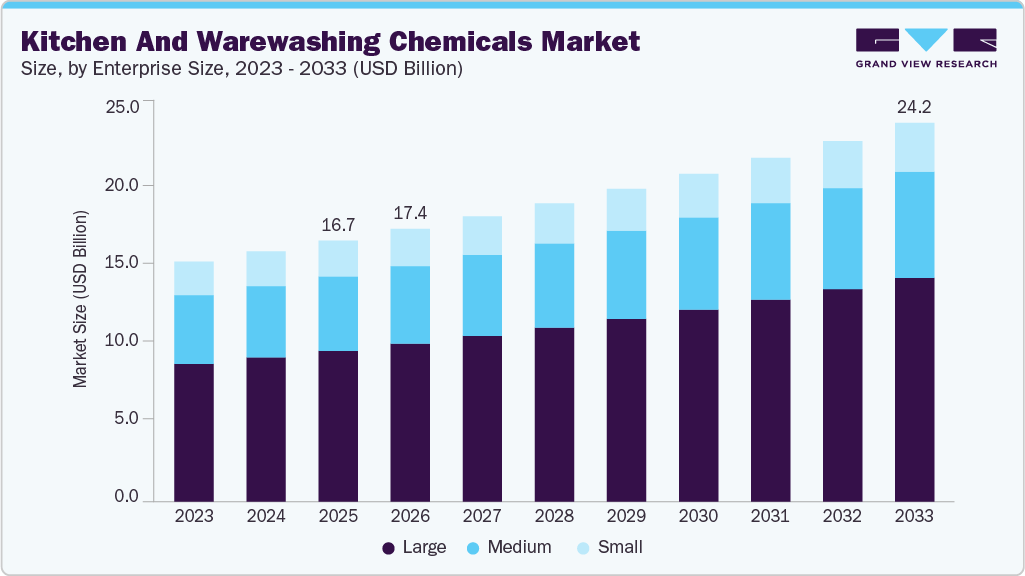
The global kitchen and warewashing chemicals market size was valued at USD 16.7 billion in 2025 and is projected to grow from USD 17.4 billion in 2026 to USD 24.2 billion by 2033, at a CAGR of 4.8% from 2026 to 2033. The market in North America dominated with a revenue share of 32.8% in 2025. The market is principally propelled by the rapid global expansion of commercial foodservice establishments, including quick-service restaurants, institutional catering, and cloud kitchens, which generate consistently high warewashing volumes requiring specialized chemical inputs.
Key Market Trends & Insights
- By supply: Contract segment held the largest market share of 58.2% in 2025.
- By type: Contract segment held the largest market share of 58.2% in 2025.
- By enterprise size: Large enterprise segment held the largest market share of 57.8% in 2025.
- By product: Commercial automatic dishwashing (c-ADW) segment held the largest market share of 42.8% in 2025.
- By end use: Food service segment held the largest market share of 13.8% in 2025.
Regional Highlights
- Largest regional market: North America (32.8% revenue share, 2025)
- By country: The U.S. held the largest market share in 2025
Market Size & Forecast
- Market size in 2025: USD 16.7 Billion
- Estimated market size in 2026: USD 17.4 Billion
- Projected market size by 2033: USD 24.2 Billion
- CAGR (2026-2033): 4.8%
Prism AI by Grand View Research Free to tryAsk a question about the kitchen and warewashing chemicals marketTry asking✓Every figure cited from GVR research Prefer the report? Download free sample →
Tightening food safety and sanitation regulations across major economies are further mandating the use of validated chemical programs for surface sanitization and dishwashing.At the same time, procurement preferences among hospitality and institutional buyers are shifting toward eco-certified, phosphate-free, and biodegradable formulations. The rise of delivery-only foodservice models has also created a structurally distinct demand source, as ghost kitchens operate continuously with elevated wash cycles per square foot, driving higher consumption of detergents, rinse aids, and sanitizers. For instance, in June 2025, Bengaluru-based Curefoods filed its Draft Red Herring Prospectus with SEBI to raise INR 800 crore through an IPO aimed at expanding cloud kitchen and retail operations, signaling accelerating infrastructure investments that are expected to amplify downstream chemical demand across Asian markets.Foodservice operators are also navigating an increasingly prescriptive regulatory environment governing the sanitization of food contact surfaces and dishware. According to the U.S. Food & Drug Administration, in October 2024, the FDA launched its Human Foods Program, consolidating the Center for Food Safety and Applied Nutrition, the Office of Food Policy and Response, and field operations into a single framework focused on microbiological food safety, chemical safety, and post-market assessment of food-contact substances. The restructuring is expected to strengthen enforcement consistency across commercial kitchens, compelling operators to adopt validated warewashing chemical programs.
 Source: Grand View Research, IR Documents, Primary Interviews, Paid DatabasesTo learn more about this report,
 Download Free Sample Report
Institutional procurement teams, particularly across hospitality chains and contract catering providers, are increasingly mandating compliance with sustainability certifications such as the EU Ecolabel and Cradle to Cradle standards. This has accelerated demand for reformulated warewashing chemistries that replace phosphates, chlorine-based actives, and quaternary ammonium compounds with plant-derived surfactants and enzymatic actives. For instance, in 2024, Diversey, a Solenis company, launched two new mechanical warewashing products under the SURE brand that meet stringent EU Ecolabel requirements.
In addition, the transition toward reusable packaging and alternatives to single-use plastics has further created a specialized niche within warewashing chemicals. For instance, in 2024, Diversey introduced the Suma PolyWash L56R and Suma PolyDry A9 system, specifically designed for reusable plastic ware, coinciding with implementation targets under the EU Single-Use Plastics Directive (2019/904), which established a 75% recyclability target for plastic cups and food containers by 2024, increasing to 90% by 2027.
The growing emphasis on hygiene, sanitation compliance, and operational efficiency across commercial kitchens, hospitality establishments, healthcare facilities, and institutional foodservice operations is significantly driving demand within the warewashing chemicals market. Increasing awareness regarding food safety standards and the prevention of cross-contamination has accelerated the adoption of advanced cleaning and sanitization solutions, particularly in automated dishwashing and kitchen maintenance applications. As a result, the warewashing chemicals market continues to witness strong momentum as foodservice operators increasingly invest in high-performance and sustainable cleaning products. In parallel, the broader industrial cleaning chemicals market is also benefiting from rising industrial hygiene requirements and stricter regulatory frameworks across end use industries.
The expansion of quick-service restaurants, cloud kitchens, catering services, and institutional dining facilities is further contributing to the growth of the industrial and institutional cleaning chemicals market. Commercial operators are increasingly prioritizing concentrated, low-foaming, and environmentally sustainable formulations that improve cleaning efficiency while reducing water and energy consumption. This shift is creating substantial opportunities for manufacturers operating in the Industrial Cleaning Chemicals Market to develop innovative warewashing and kitchen cleaning solutions aligned with evolving customer and regulatory expectations. In addition, the integration of automated dispensing systems and smart warewashing technologies is enhancing chemical utilization efficiency across the warewashing chemicals market.
Another major factor supporting the growth of the industrial and institutional cleaning chemicals market is the increasing preference for worker-safe and eco-friendly cleaning formulations. Manufacturers are actively introducing phosphate-free, biodegradable, aluminum-safe, and caustic-free products to address growing sustainability concerns while ensuring high cleaning performance. The industrial cleaning chemicals market is also witnessing increased investments in research and development aimed at improving product efficacy, reducing environmental impact, and supporting regulatory compliance across commercial and institutional environments. Consequently, the warewashing chemicals market is expected to maintain steady long-term growth, supported by evolving hygiene standards, expanding foodservice infrastructure, and continuous product innovation within the industrial and institutional cleaning chemicals market.
Company Market Share Insights
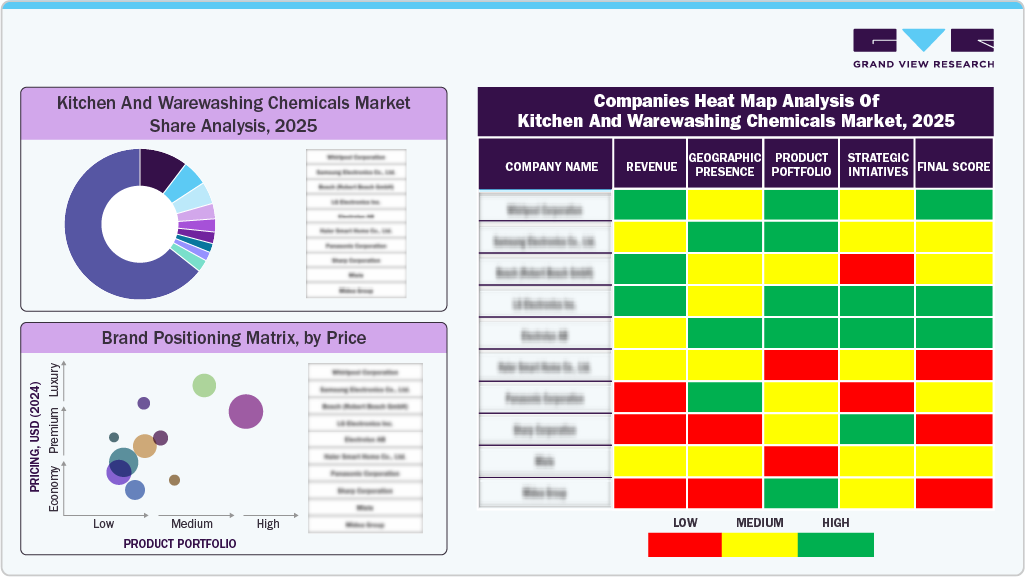
The global market for kitchen and warewashing chemicals is highly competitive, driven by continuous product innovation and rising demand for high-performance cleaning, sanitization, and warewashing solutions across commercial foodservice environments. Major companies such as Ecolab Inc., Solenis Group, Procter & Gamble, 3M Company, and Reckitt Benckiser Group plc compete through frequent launches of advanced detergents, rinse aids, food wash solutions, and machine warewashing formulations designed to improve cleaning efficiency, reduce water and energy consumption, and support automated cleaning systems. Competition is increasingly centered on multifunctional and sustainable formulations that combine superior soil removal, antimicrobial performance, and compatibility with reusable food-contact materials, alongside low-toxicity, biodegradable, phosphate-free, and green-certified chemistries. Rising regulatory scrutiny and growing hygiene requirements across hospitality, healthcare, institutional catering, and quick-service restaurant sectors are further accelerating the adoption of safer, compliant, and environmentally sustainable warewashing chemical solutions.
 To learn more about this report, Download Free Sample Report
Product Insights
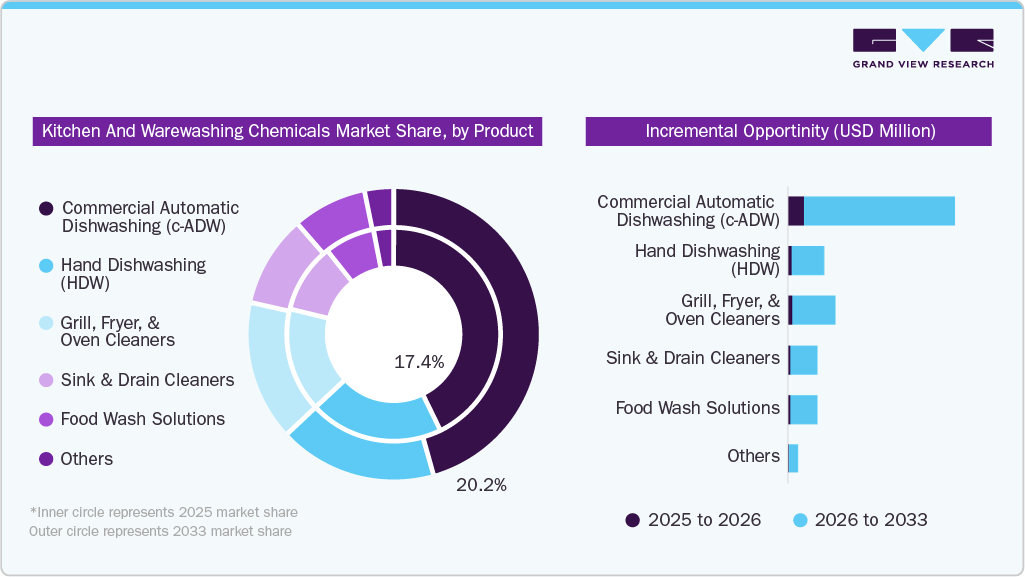
Commercial automatic dishwashing (c-ADWs) accounted for the largest market share of 42.8% in 2025. The growth of the commercial automatic dishwashing (c-ADWs) segment is being driven by the rising installation of conveyor and flight-type dishwashing systems in high-volume foodservice facilities, which require low-foam, fast-rinsing, and machine-compatible chemical formulations. Increasing adoption of reusable plastic ware under sustainability mandates is also accelerating demand for specialized detergents capable of removing grease and protein residues without damaging surfaces. In addition, the shift toward energy-efficient low-temperature wash cycles is boosting demand for enzyme-based detergents and rinse aids that maintain cleaning performance while reducing utility consumption and machine downtime.
 To learn more about this report, Download Free Sample Report
The demand for food wash solutions is anticipated to grow at a CAGR of 5.8% from 2026 to 2033, driven by stricter regulations governing microbial contamination and pesticide residue removal across fresh produce, meat, and seafood processing operations. Rising adoption of minimally processed and ready-to-eat foods is increasing the need for specialized antimicrobial wash chemistries that extend shelf life without affecting product quality. In addition, expanding exports of fresh foods are compelling processors to implement validated food-contact sanitation programs that comply with international safety standards, thereby accelerating demand for chlorine-free, peracetic acid-based, and bio-based food wash solutions.
End Use Insights
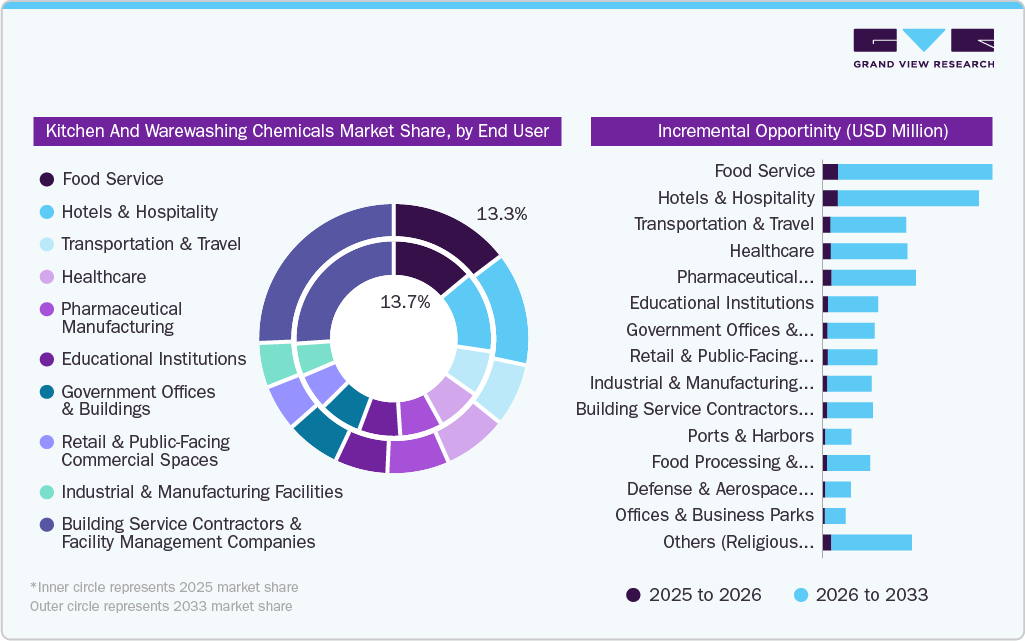
Kitchen and warewashing chemicals in food service accounted for 13.8% of the market in 2025, driven by the increasing deployment of high-capacity conveyor and rack-type warewashing systems across quick-service restaurant chains and centralized cloud kitchens, which require machine-specific detergents and rinse aids for continuous operations. Rising use of reusable cups, trays, and plastic food containers under sustainability initiatives is also increasing demand for specialized cleaning chemistries capable of removing grease, starch, and protein residues without surface degradation. In addition, the expansion of multi-brand delivery kitchens operating with extended service hours is significantly increasing daily wash cycles and chemical consumption per facility.
 To learn more about this report, Download Free Sample Report
Kitchen and warewashing chemicals in hotels & hospitality is expected to grow at a CAGR of 5.2% from 2026 to 2033. Consumers are increasingly preferring premium hospitality experiences, buffet dining, and reusable foodservice ware, driving higher warewashing volumes across hotels, resorts, and large convention properties. This is accelerating the deployment of automated flight-type and tunnel dishwashing systems that require machine-specific detergents, rinse aids, and descaling chemicals for continuous operations. In addition, the expansion of multi-outlet hotel kitchens, banquet facilities, and luxury catering services is significantly increasing demand for high-performance warewashing and sanitization chemistries within the hospitality sector.
Enterprise Size Insights
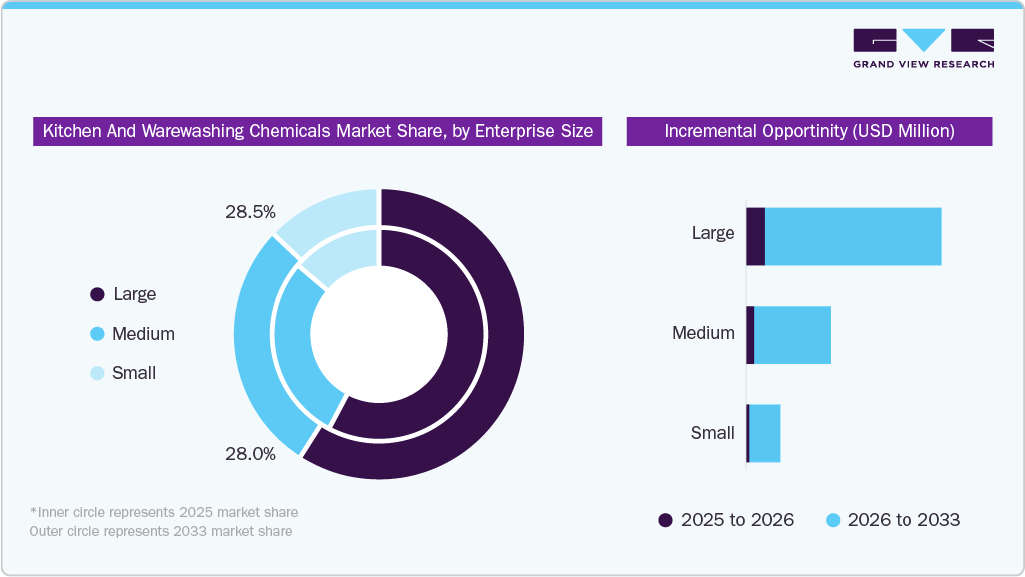
The large enterprise size segment accounted for 57.8% share in 2025. Large enterprises are increasingly driving demand in the market through the expansion of multi-location hotel chains, quick-service restaurant networks, and institutional catering facilities that require standardized warewashing performance across sites. These operators are rapidly deploying centralized chemical dispensing systems, automated conveyor warewashing equipment, and digital monitoring platforms to optimize chemical usage and maintain audit-ready hygiene compliance. In addition, high-volume kitchen operations within large enterprises are accelerating the adoption of concentrated, machine-specific, and sustainability-certified formulations that reduce water consumption, labor intervention, and operational downtime across large-scale foodservice environments.
 To learn more about this report, Download Free Sample Report
The medium enterprise size segment is expected to grow at a CAGR of 4.6% from 2026 to 2033. Consumers are increasingly operating medium-sized restaurant chains, regional hotel groups, and multi-unit catering businesses that are transitioning from manual cleaning processes to semi-automated and automated warewashing systems to manage growing service volumes. This is increasing demand for mid-volume chemical dispensing solutions, concentrated detergents, and machine-compatible rinse aids that improve cost efficiency without requiring large-scale infrastructure investments. In addition, medium enterprises are increasingly adopting standardized hygiene programs across multiple outlets to maintain brand consistency and comply with food safety inspections, thereby driving higher consumption of specialized warewashing chemicals.
Supply Insights
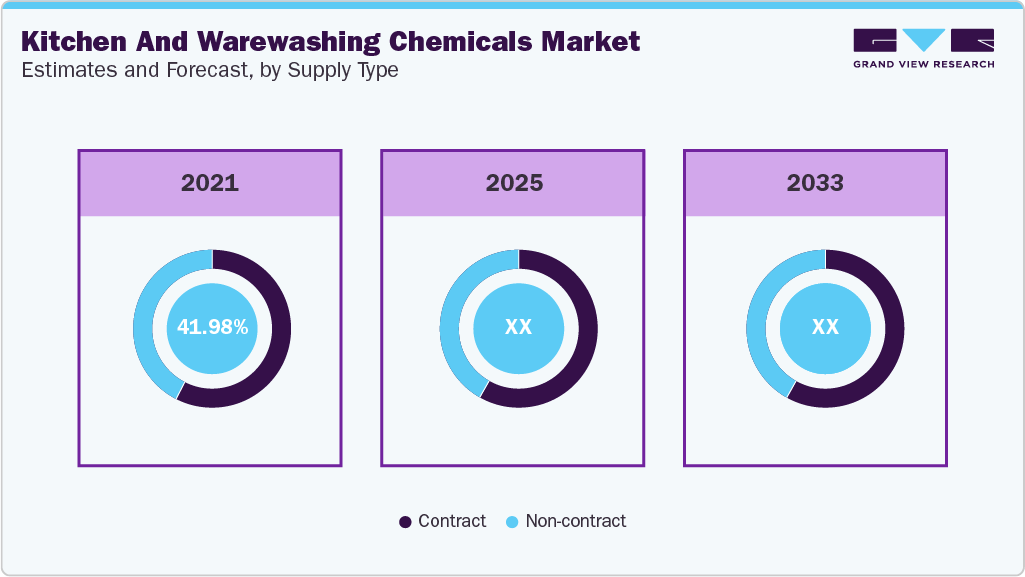
Contract-based kitchen and warewashing chemicals accounted for 58.2% of the market in 2025, driven by the increasing preference for integrated chemical management programs that combine automated dispensing systems, equipment servicing, compliance monitoring, and scheduled chemical replenishment under long-term agreements. Large foodservice operators and hospitality chains are increasingly adopting centralized procurement contracts to standardize warewashing performance, reduce chemical overuse, and improve cost predictability across multiple facilities. In addition, rising adoption of data-enabled dosing systems and performance-based chemical supply models is accelerating demand for bundled contract solutions that ensure operational consistency, hygiene compliance, and lower water and energy consumption.
 To learn more about this report, Download Free Sample Report
Non-contract-based kitchen and warewashing chemicals are expected to grow at a CAGR of 4.7% from 2026 to 2033, driven by the rising number of independent restaurants, small cloud kitchens, cafés, and regional foodservice operators that prefer flexible purchasing models without long-term commitments. Increasing availability of ready-to-use detergents and rinse aids through wholesale distributors and e-commerce channels is further supporting spot-based procurement and rapid product switching based on price and performance. In addition, frequent demand fluctuations in small-scale foodservice operations are encouraging operators to purchase warewashing chemicals on an as-needed basis rather than through fixed-volume contractual agreements.
Type Insights
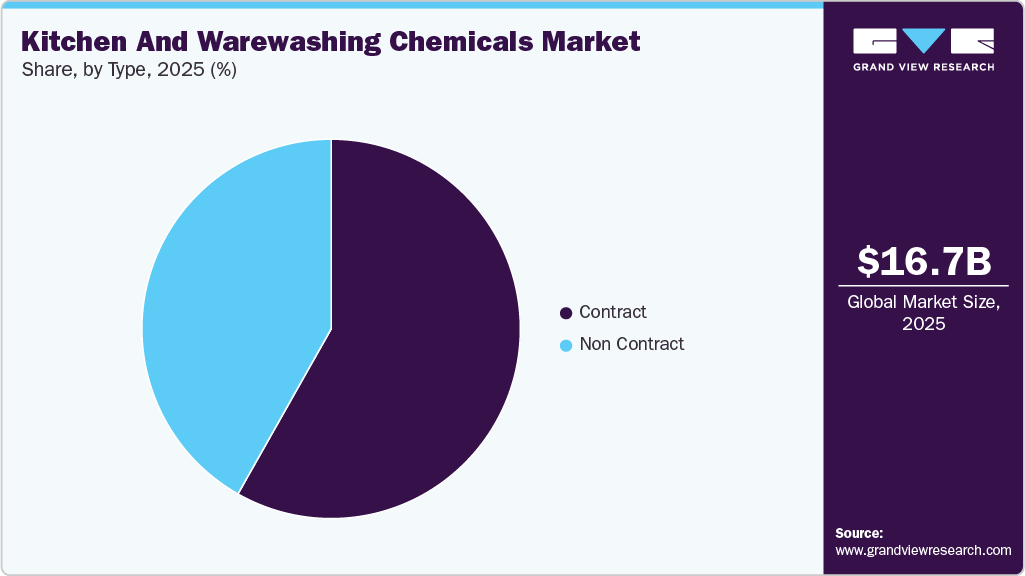
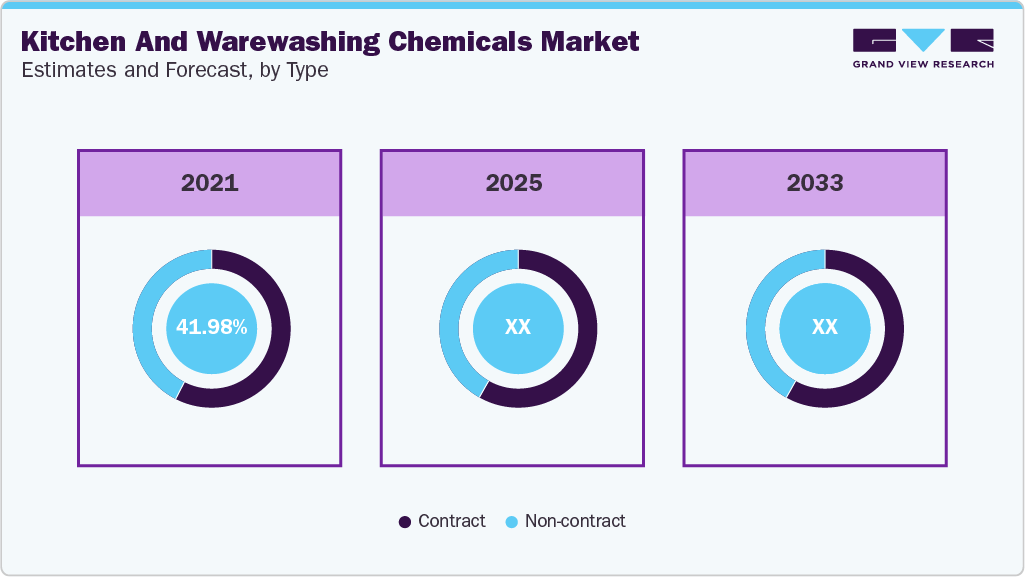
Contract-based kitchen and warewashing chemicals accounted for 58.2% of the market in 2025, driven by the increasing adoption of bundled supply agreements that combine chemical provisioning with dispensing equipment installation, preventive servicing, staff training, and hygiene compliance monitoring. Large hospitality chains, institutional kitchens, and quick-service restaurant operators are increasingly preferring performance-based contracts that optimize chemical dosing, reduce machine downtime, and ensure standardized sanitization outcomes across multiple locations. In addition, the integration of digital monitoring systems and Hygiene-as-a-Service (HaaS) models is accelerating demand for long-term contracts that provide real-time operational tracking, audit support, and consumption-based chemical management solutions.
 To learn more about this report, Download Free Sample Report
 To learn more about this report, Download Free Sample Report
Non-contract-based kitchen and warewashing chemicals are expected to grow at a CAGR of 4.7% from 2026 to 2033. Consumers are increasingly favoring non-contract-based procurement models to gain greater control over chemical selection, dosing preferences, and purchasing frequency across foodservice operations. This is driving higher adoption of ready-to-use and concentrated warewashing formulations that can be purchased independently without equipment leasing or service commitments. In addition, the growing availability of private-label and regionally manufactured kitchen hygiene chemicals is enabling operators to source lower-cost alternatives and rapidly adjust procurement strategies based on occupancy rates, menu changes, and wash-volume requirements.
Regional Insights
North America Kitchen And Warewashing Chemicals Market Trends
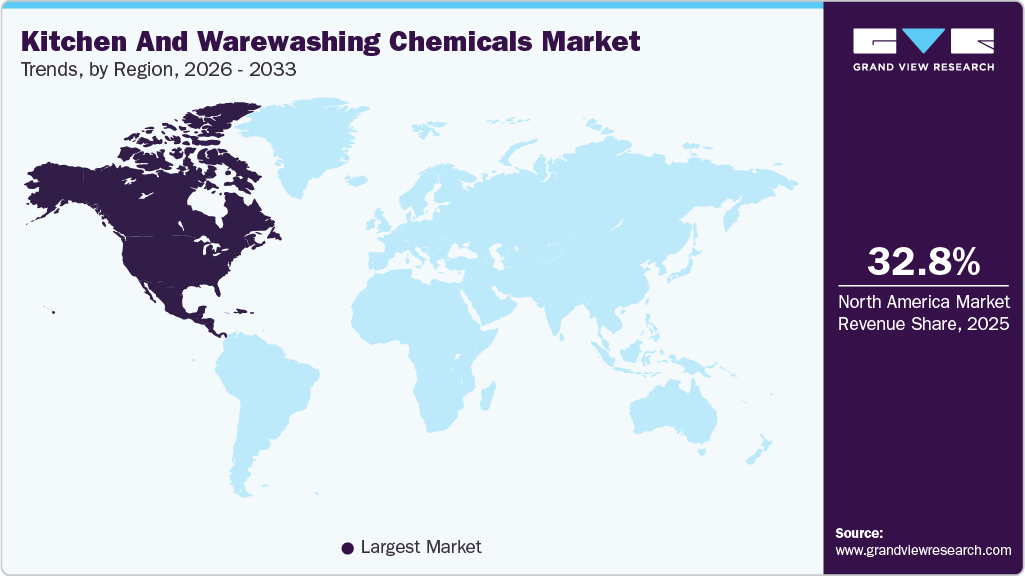
The kitchen and warewashing chemicals industry in North America accounted for the largest share of 32.8% in 2025. The market is driven by highly standardized commercial foodservice operations across the U.S. and Canada, where large-scale adoption of automated conveyor and flight-type dishwashing systems in quick-service restaurant chains and institutional cafeterias significantly elevates chemical consumption intensity. Strict enforcement of EPA-compliant surfactant formulations and OSHA-mandated workplace chemical handling protocols is accelerating demand for low-toxicity, high-efficiency warewashing chemistries. The presence of centralized procurement structures in major hospitality groups further strengthens volume-based chemical deployment across multi-site operations. In addition, widespread integration of IoT-enabled dosing systems in commercial kitchens is increasing precision chemical usage, particularly in high-throughput environments such as stadium catering and corporate dining facilities.
 To learn more about this report, Download Free Sample Report
U.S. Kitchen And Warewashing Chemicals Market Trends
The kitchen and warewashing chemicals industry in the U.S. is expected to grow at a CAGR of 5.1% from 2026 to 2033, supported by the extensive penetration of national QSR chains and institutional foodservice contractors operating under stringent FDA Food Code compliance requirements, particularly regarding sanitization of food-contact surfaces. The consolidation of food safety oversight under the FDA Human Foods Program is further reinforcing standardized warewashing chemical adoption across states. Large-scale adoption of reusable service ware in stadiums and airline catering hubs is increasing demand for enzyme-based detergents capable of low-temperature cleaning efficiency. In addition, the rapid expansion of cloud kitchen clusters in metropolitan hubs such as New York, Chicago, and Los Angeles is intensifying wash-cycle density per facility, driving higher consumption of concentrated detergents and automated dispensing system-compatible chemical formulations.
The kitchen and warewashing chemicals industry in Canada is expected to grow at a CAGR of 3.8% from 2026 to 2033, supported by strict provincial-level food safety frameworks, which mandate validated sanitization protocols across commercial kitchens and institutional catering facilities. High penetration of centralized hospital catering systems and university foodservice networks is increasing reliance on standardized warewashing chemical programs to ensure compliance and consistency. In addition, sustainability mandates in provinces such as British Columbia are accelerating the adoption of phosphate-free and biodegradable formulations in public-sector foodservice procurement.
Europe Kitchen And Warewashing Chemicals Market Trends
The kitchen and warewashing chemicals industry in Europe accounted for the revenue share of 25.5% fo the global market in 2025. The European market is driven by stringent regulatory harmonization under the European Food Safety Authority (EFSA) and REACH chemical compliance framework, which is reshaping formulation standards for warewashing chemicals across commercial kitchens. Mandatory adoption of eco-certified cleaning agents under EU Ecolabel guidelines is accelerating the substitution of conventional surfactants with biodegradable and low-impact alternatives. The region’s dense concentration of institutional catering facilities, particularly in Germany and Italy, is increasing demand for precision-dosed automated warewashing systems.
The kitchen and warewashing chemicals industry in France is expected to grow at a CAGR of 3.9% from 2026 to 2033. The market is influenced by strict food hygiene enforcement under the Direction Générale de l’Alimentation (DGAL), which mandates validated chemical sanitation protocols in hospitality and institutional kitchens. France’s strong hospitality sector, particularly in Paris, is driving high utilization of premium hotel warewashing systems with integrated chemical dosing technologies. In addition, national sustainability policies promoting the reduction of hazardous chemical discharge in commercial cleaning applications are accelerating demand for eco-labeled, phosphate-free formulations.
The kitchen and warewashing chemicals industry in the UK isexpected to grow at a CAGR of 4.1% from 2026 to 2033, supported by the enforcement of Food Standards Agency (FSA) hygiene regulations, which require strict validation of cleaning and sanitization processes in commercial kitchens. The UK’s rapidly expanding contract catering sector, particularly in healthcare and education institutions, is increasing demand for standardized warewashing chemical programs with centralized procurement models. In addition, the proliferation of cloud kitchens across London and Manchester is driving higher wash-cycle intensity in compact urban foodservice environments. Sustainability mandates under the UK Plastics Pact are also accelerating the adoption of biodegradable and low-residue detergents, particularly in hospitality chains seeking compliance with environmental reporting frameworks and corporate ESG commitments.
Asia Pacific Kitchen And Warewashing Chemicals Market Trends
The kitchen and warewashing chemicals industry in the Asia Pacific accounted for a revenue share of 24.5% of the global market in 2025. The market is driven by the rapid expansion of organized foodservice infrastructure, particularly in India, China, Japan, and Southeast Asia, where urbanization and the growth of delivery-led foodservice models are significantly increasing warewashing intensity per outlet. The region’s accelerating adoption of automated kitchen systems in commercial hospitality is boosting demand for concentrated detergents and enzyme-based formulations suited for high-frequency cleaning cycles. Government-led food safety modernization initiatives, such as China’s Food Safety Law enforcement upgrades and India’s FSSAI compliance tightening, are reinforcing structured chemical sanitation practices.
The kitchen and warewashing chemicals industry in China isexpected to grow at a CAGR of 5.5% from 2026 to 2033. The market is supported by strict enforcement of the Food Safety Law, which mandates standardized sanitation protocols across commercial kitchens and institutional catering facilities. Rapid expansion of centralized food preparation hubs for delivery platforms such as Meituan and Ele.me is significantly increasing demand for high-throughput warewashing systems and industrial-grade detergents. In addition, large-scale modernization of hospitality infrastructure in Tier 1 and Tier 2 cities is accelerating the adoption of automated dishwashing technologies.
The kitchen and warewashing chemicals industry in India is expected to grow at a CAGR of 5.8% from 2026 to 2033, supported by tightening enforcement of FSSAI hygiene and sanitation regulations across organized foodservice establishments, particularly in urban hospitality clusters and institutional catering services. Rapid expansion of cloud kitchen networks in metropolitan cities such as Bengaluru, Mumbai, and Delhi is significantly increasing wash-cycle density and chemical consumption intensity. In addition, expansion of organized hospitality infrastructure driven by domestic tourism growth is further reinforcing demand for standardized warewashing chemical programs across hotels, banquet facilities, and quick-service restaurant chains.
Central & South America Kitchen And Warewashing Chemicals Market Trends
The kitchen and warewashing chemicals industry in Central & South America is expected to grow at a CAGR of 4.6% from 2026 to 2033. The market is driven by increasing formalization of foodservice operations in Brazil, Mexico, and Chile, where rising adoption of standardized hygiene protocols in hospitality chains and institutional catering facilities is expanding demand for warewashing chemicals. Regulatory tightening under ANVISA food safety guidelines in Brazil is accelerating the adoption of validated sanitization processes in commercial kitchens. In addition, the expansion of international hotel chains and quick-service restaurant franchises in major urban centers is increasing the utilization of automated dishwashing systems requiring consistent chemical dosing.
Middle East & Africa Kitchen And Warewashing Chemicals Market Trends
The kitchen and warewashing chemicals industry in the Middle East & Africa is expected to grow at a CAGR of 4.8% from 2026 to 2033, supported by the rapid expansion of luxury hospitality infrastructure in the Gulf Cooperation Council (GCC) countries, particularly in the UAE and Saudi Arabia, driven by tourism diversification initiatives such as Saudi Vision 2030. Large-scale deployment of centralized catering facilities for aviation, healthcare, and mega-events is increasing demand for high-capacity automated warewashing systems. In addition, strict hygiene compliance requirements in hospitality zones and international hotel chains are reinforcing the adoption of premium-grade chemical sanitization programs.
Key Kitchen And Warewashing Chemicals Companies:
The following key companies have been profiled for this study on the kitchen and warewashing chemicals market.
- Ecolab Inc.
- Solenis Group
- Procter & Gamble
- 3M Company
- Henkel AG & Co. KGaA
- The Clorox Company
- Reckitt Benckiser Group plc
- S.C. Johnson & Son, Inc.
- Zep Inc.
- Spartan Chemical Company, Inc.
- Betco Corporation
- Kao Corporation
Recent Developments
-
In October 2025, Diversey, a Solenis company and a leading provider of cleaning and hygiene solutions, introduced Suma D-GREAZEE D9.9, an advanced degreasing solution developed for commercial kitchen environments. The aluminum-safe and caustic-free formulation is designed to effectively remove grease buildup and carbonized residues from ovens, grills, and fryers while eliminating the requirement for specialized protective equipment during application.
-
In March 2025, Cascade, a Procter & Gamble brand, launched its new and improved Platinum Plus dishwasher detergent designed to address tougher modern cooking residues such as baked-on proteins, greasy meats, and starchy food soils. The upgraded formulation incorporates enhanced enzyme systems and stronger grease-fighting surfactants to deliver up to 100% food residue removal and improved spot-free dishwashing performance.
-
In January 2025, Henkel introduced its Smartwash technology at CES 2025, an AI-driven, cartridge-based detergent dosing system designed to optimize dishwasher performance through sensor-based chemical dispensing. The innovation integrates algorithmic wash-cycle optimization with connected appliance systems, enabling precise dosing based on soil load, fabric type, and cycle conditions.
-
In May 2024, Diversey, a Solenis company, launched its SURE machine warewashing solutions designed for professional kitchen and commercial dishwashing applications, offering high-performance cleaning of grease and dried-on food residues while ensuring spot-free rinsing performance. The product line is certified under EU Ecolabel and Cradle to Cradle Gold standards, reflecting its compliance with stringent sustainability and material health requirements for foodservice hygiene chemicals.
Kitchen And Warewashing Chemicals Market Report Scope
Report Attribute
Details
Market size in 2025
USD 16.7 billion
Estimated market size in 2026
USD 17.4 billion
Projected market size by 2033
USD 24.2 billion
Growth rate
CAGR of 4.8% from 2026 to 2033
Base year for estimation
2025
Historical data
2021 - 2024
Forecast period
2026 - 2033
Quantitative units
Revenue in USD million/billion and CAGR from 2026 to 2033
Report coverage
Revenue forecast, company ranking, competitive landscape, growth factors, and trends
Segments covered
Product, end use, supply, type, enterprise size, and region
Regional scope
North America; Europe; Asia Pacific; Central & South America; Middle East & Africa
Country scope
U.S.; Canada; UK; Germany; France; Italy; Spain; Poland; China; India; Japan; South Korea; Australia & New Zealand; Malaysia; Thailand; Vietnam; Brazil; Argentina; Mexico; South Africa; Saudi Arabia; and UAE
Key companies profiled
Ecolab Inc.; Solenis Group; Procter & Gamble; 3M Company; Henkel AG & Co. KGaA; The Clorox Company; Reckitt Benckiser Group plc; S.C. Johnson & Son, Inc.; Zep Inc.; Spartan Chemical Company, Inc.; Betco Corporation; Kao Corporation
Customization scope
Free report customization (equivalent up to 8 analysts working days) with purchase. Addition or alteration to country, regional & segment scope.
Pricing and purchase options
Avail customized purchase options to meet your exact research needs. Explore purchase options
Global Kitchen And Warewashing Chemicals Market Report Segmentation
This report forecasts revenue growth at global, regional & country levels and provides an analysis on the latest trends and opportunities in each of the sub-segment from 2021 to 2033. For this study, Grand View Research has segmented the kitchen and warewashing chemicals market report based on product, end use, supply, type, enterprise size, and region.
-
Product Outlook (Revenue, USD Million, 2021 - 2033)
-
Hand Dishwashing (HDW)
-
Commercial Automatic Dishwashing (c-ADW)
-
Sink & Drain Cleaners
-
Food Wash Solutions
-
Grill, Fryer, and Oven Cleaners
-
Others (Stainless Steel Cleaner, Bleach-based Cleaners, etc.)
-
-
End Use Outlook (Revenue, USD Million, 2021 - 2033)
-
Healthcare
-
Hospitals
-
Senior Living and Retirement Communities
-
Medical Centers (Life Science, Biotech, Research Centers)
-
Ambulatory Surgical Centers
-
Doctor's Offices and Clinics
-
Others (Small Rehab Centers, etc.)
-
-
Food Service
-
Restaurants & Beverage Outlets
-
Cafés, Bars, and Pubs
-
Catering Establishments
-
Informal and Mobile Food Service Establishments
-
-
Hotels & Hospitality
-
Hotels & Resorts
-
Non-Hotel & Alternative Hospitality Accommodation
-
Leisure and Entertainment Parks
-
Event Venues and Recreational Facilities
-
-
Industrial and Manufacturing Facilities
-
Food Processing and Beverage Facilities
-
Pharmaceutical Manufacturing
-
Defense & Aerospace Facilities
-
Building Service Contractors and Facility Management Companies
-
Retail & Public-Facing Commercial Spaces
-
Educational Institutions
-
Transportation and Travel
-
Airports
-
Railway Stations
-
Bus Terminals and Depots
-
Metro and Subway Systems
-
-
Ports and Harbors
-
Offices and Business Parks
-
Government Offices and Buildings
-
Others (Religious Institutions, etc.)
-
-
Supply Outlook (Revenue, USD Million, 2021 - 2033)
-
Contract
-
Service-Led Contract Holders
-
Building Service Contractors (BSCs)
-
Facilities Management (FM) Companies
-
-
End-user-led contract holders
-
Group Purchasing Organizations (GPOs)
-
-
Non-contract
-
-
Type Outlook (Revenue, USD Million, 2021 - 2033)
-
Contract
-
Product-Only Supply Contracts
-
Service Inclusive Contracts
-
Equipment Inclusive Supply Contracts
-
Training & Compliance Inclusive Contracts
-
Fully Integrated Hygiene-as-a-Service (HaaS)/Performance-Based
-
-
Non-contract
-
- Enterprise Size Outlook (Revenue, USD Million, 2021 - 2033)
-
Small
-
Medium
-
Large
-
-
Regional Outlook (Revenue, USD Million, 2021 - 2033)
-
North America
-
U.S.
-
Canada
-
-
Europe
-
UK
-
Germany
-
France
-
Italy
-
Spain
-
Poland
-
-
Asia Pacific
-
China
-
India
-
Japan
-
South Korea
-
Australia & New Zealand
-
Malaysia
-
Vietnam
-
Thailand
-
-
Central & South America
-
Brazil
-
Argentina
-
Mexico
-
-
Middle East & Africa
-
South Africa
-
Saudi Arabia
-
UAE
-
-
Frequently Asked Questions About This Report
Key players include Ecolab Inc.; Solenis Group; Procter & Gamble; 3M Company; Henkel AG & Co. KGaA; The Clorox Company; Reckitt Benckiser Group plc; S.C. Johnson & Son, Inc.; Zep Inc.; Spartan Chemical Company, Inc.; Betco Corporation; Kao Corporation.
Key factors driving market growth include rising foodservice and hospitality expansion, stringent hygiene and food safety regulations, increasing demand for automated dishwashing systems, and growing adoption of sustainable and concentrated cleaning formulations.
The commercial automatic dishwashing (c-ADW) segment led with a 42.8% revenue share in 2025.
North America dominated with a 32.8% revenue share in 2025.
Food service segment dominated the market and accounted for the largest revenue share of 13.8% in 2025.
The contract segment accounted for the largest revenue share of 58.2% in 2025.
Contract segment held the largest share (over 58.0%) in 2025.
The large enterprise segment led with a 57.8% revenue share in 2025.
The global kitchen and warewashing chemicals market size was valued at USD 16.7 billion in 2025 and is estimated at USD 17.4 billion for 2026.
The global kitchen and warewashing chemicals market is expected to grow at a CAGR of 4.8% from 2026 to 2033, reaching USD 24.2 billion by 2033.
About the Author(s)
Homecare & Decor Research Team
Consumer Goods · Homecare & DecorThis report was authored by the homecare & decor research team at Grand View Research - comprising two research analysts, one senior research analyst, and one industry expert - with specialized expertise in the homecare & decor segment of the consumer goods industry. All findings are based on proprietary consumer goods databases, executive interviews, and regulatory analysis, subject to internal peer review prior to publication.
Last Updated:
Speak to Analyst

Customize this report to your needs - add regions, segments, or data points, with 20% free customization.
Or view our licence options:


ISO 9001:2015 & 27001:2022 Certified
We are GDPR and CCPA compliant! Your transaction & personal information is safe and secure. For more details, please read our privacy policy.


