
- Home
- »
- Animal Health
- »
-
KSA Livestock Genetics Market Size Report, 2026-2033GVR Report cover
![KSA Livestock Genetics Market (2026 - 2033)Report]()
KSA Livestock Genetics Market (2026 - 2033)
Size, Share & Trends Analysis Report By Species (Ovine, Caprine, Bovine), By Genetic Material (Semen, Embryos, Live Breeding Animals) , By Technology, By End User, By Region, And Segment Forecasts
Market Size, 2025
$207.1MMarket Estimate, 2026
$223.0MMarket Forecast, 2033
$416.1MCAGR, 2026–2033
9.3%KSA Livestock Genetics Market Summary
The KSA livestock genetics market size was valued at USD 207.1 million in 2025 and is projected to grow from USD 223.0 million in 2026 to USD 416.1 million by 2033, at a CAGR of 9.3% from 2026 to 2033.The growth of the market is owed to Vision 2030 mandates boosting genetic investment, ADF capital funds asset modernization, MEWA registration formalizing livestock traceability data, government programs localizing genomic breeding capability, dairy consolidation concentrating on commercial breeding demand, public-private partnerships lowering capital barriers.
Key Market Trends & Insights
- By species: Bovine held the largest share of 54.3% in 2025.
- Based on genetic material: Semen segment held the highest market share of more than 73.8% in 2025.
- Based on technology: IVF technologies segment is expected to grow at the fastest rate of more than 11% over the forecast period.
- Based on end user: Dairy farms segment held the highest market share in 2025
Market Size & Forecast
- Market Size in 2025: USD 207.1 Million
- Estimated Market Size in 2026: USD 223.0 Million
- Projected Market Size by 2033 : USD 416.1 Million
- CAGR (2026-2033): 9.3%
The market is shaped by a convergence of state-directed food security policy and structural constraints tied to production system fragmentation. Vision 2030 mandates are boosting genetic investment by positioning domestic livestock improvement as a national priority, with capital funds from the Agricultural Development Fund supporting asset modernization across breeding centers and commercial farms. Mandatory MEWA registration is formalizing livestock traceability data, building the record-keeping foundation genetic programs require to scale beyond isolated pilots.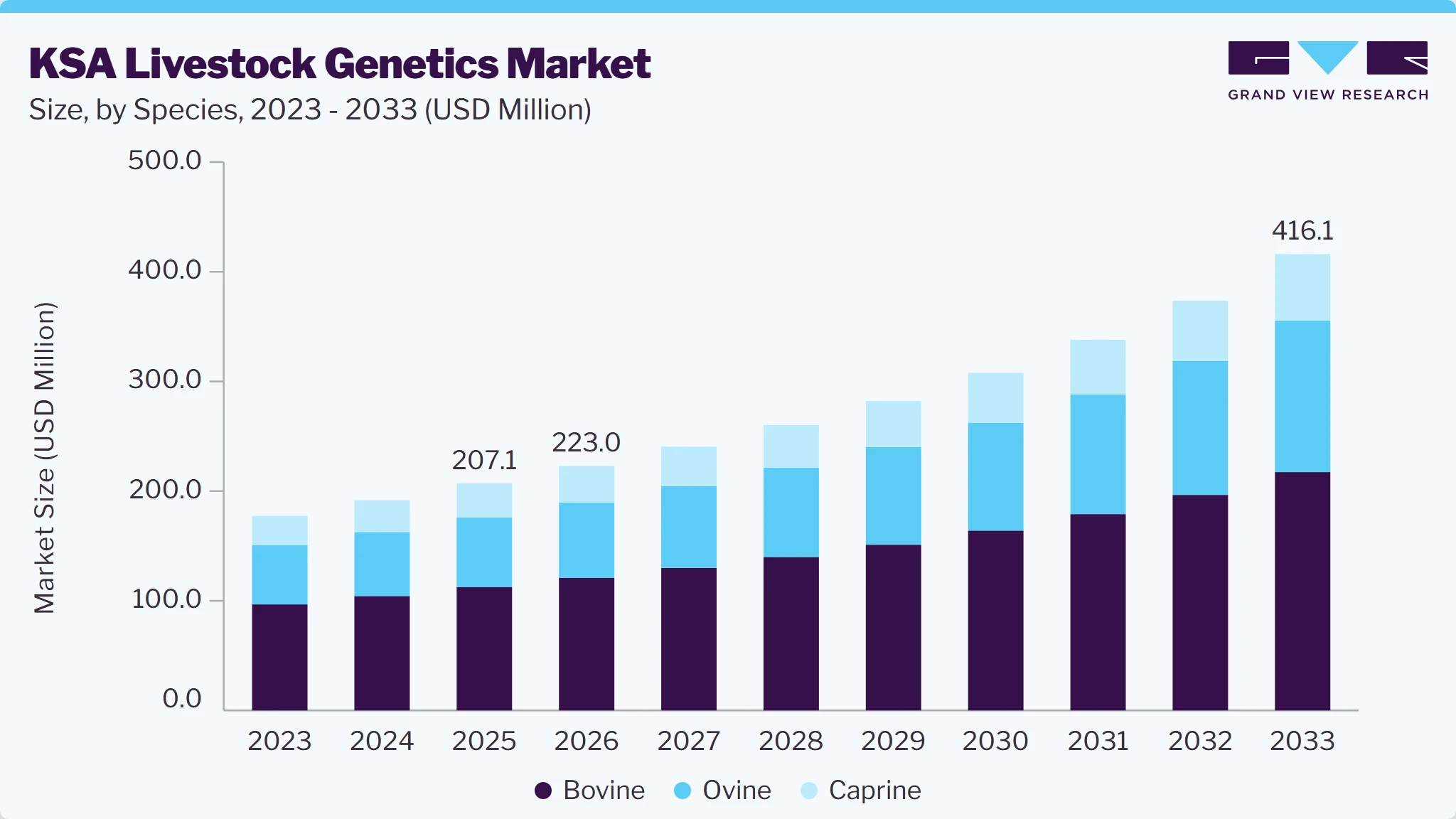
Government programs are localizing genomic breeding capability to reduce dependence on imported semen and embryos, while dairy consolidation is concentrating breeding demand among fewer, larger commercial operators, raising per-unit spending on genetics services. Public-private partnerships are lowering capital barriers for technology deployment at scale.
Growth is tempered by cold-chain deficiencies across nomadic and semi-nomadic herds, which restrict semen and embryo-based technologies to a limited share of the national flock. Anatomical complexity in small ruminants constrains embryo transfer and AI success rates, and consumer preference for traditional breeds moderates uptake in meat-focused segments, keeping adoption concentrated in organized cattle operations.
Market Dynamics
Saudi Vision 2030 is channeling substantial capital into livestock genetic improvement to strengthen domestic food security and reduce import dependence, supporting the long-term expansion of the animal genetics market. For instance, in 2026, multiple government, research, and industry collaborations expanded livestock productivity, breeding, and biotechnology initiatives under the Vision 2030 framework, broadening the institutional base for genetic investment beyond isolated projects. Earlier funding commitments established the scale of this push. Furthermore, in 2025, Saudi Arabia launched a five-year national genomic profiling program targeting dairy cattle productivity enhancement.
The Agricultural Development Fund committed close to USD 293 million (SAR 1.1 billion) to the Alraie (NADEC) breeding project, structured to expand domestic sheep genetics capacity, while NADEC separately launched a USD 533.0 million (SAR 2 billion) livestock project in Hail to strengthen local meat production and lower reliance on imports, aligned with Vision 2030 sustainability goals. Regulatory support has paralleled this capital flow. For instance, structured breeding programs advanced genetic improvement across small ruminant populations under 2024 MEWA and FAO initiatives, and local dairy production covered 109% of domestic demand that year, a gain tied to resource-efficient agriculture under Vision 2030.
Saudi Arabia's sheep and goat sectors remain heavily reliant on pastoral and nomadic production systems, a structural feature that constrains the operational reach of temperature-sensitive genetic technologies. According to the joint sector assessment by Saudi REEF, FAO, and MEWA, small ruminants are managed across dispersed grazing areas with limited infrastructure, fragmented breeding records, and inconsistent access to veterinary services. Moreover, sheep and goats account for close to 30 million head nationally, yet advanced reproductive technology adoption remains low relative to this population base, pointing to a wide gap between herd scale and genetic service penetration.
Furthermore, in 2025, multiple livestock disease surveillance studies highlighted persistent challenges in animal movement monitoring and service delivery across extensive production systems. In addition, these studies flagged the complications this creates for temperature-controlled distribution of reproductive materials, since semen and embryo viability depend on cold-chain continuity that dispersed grazing systems are not equipped to maintain. Consequently, small ruminant genetics adoption remains concentrated in organized, settled operations rather than the pastoral base that accounts for the majority of the national flock.
Cold-chain infrastructure gaps across nomadic and semi-nomadic production systems currently restrict advanced reproductive technology adoption to organized, settled operations, leaving close to 30 million head of sheep and goats largely outside the addressable base for semen and embryo-based genetics. This gap represents a distinct service opportunity rather than a fixed limitation. Mobile artificial insemination units, portable liquid nitrogen storage, and decentralized field technician networks could extend reproductive technology access into dispersed grazing areas without requiring fixed infrastructure investment at each location.
Given that structured breeding programs under MEWA and FAO initiatives are already advancing genetic improvement in small ruminant populations, a mobile service layer would align directly with existing government-backed frameworks. Providers entering with field-deployable cold-chain capability, rather than centralized breeding-center models alone, stand to access a substantially larger share of the national flock than current infrastructure permits, creating significant growth opportunities within the larger animal genetics market.
Ovine Import Dependency Analysis
Sudan and Somalia dominate Saudi Arabia's ovine import sourcing in 2024, together accounting for USD 981.0 Mn, close to 77% of total tracked import value, reflecting proximity along the Red Sea corridor and established low-cost supply relationships. Jordan and Djibouti hold secondary positions at USD 116.0 Mn and USD 82.0 Mn, sustaining regional sourcing diversity without challenging East African leadership. Romania's presence has weakened to USD 46.4 Mn, signaling contraction of the higher-cost European supply line.
Import Country
Ovine Import (USD Mn)
Sudan
716
Somalia
265
Jordan
116
Djibouti
82
Romania
46.4
Spain
3.36
Spain's ovine export footprint remains marginal at USD 3.36 Mn, confirming the country holds negligible competitiveness in bulk live sheep trade against regional low-cost suppliers. This sourcing concentration indicates Saudi Arabia's ovine import demand is anchored in cost and logistics proximity rather than genetic quality differentiation, a dynamic that favors capability-based entry over live animal trade for European players.
Market Concentration & Characteristics
The KSA livestock genetics market is at an early-to-mid growth stage, marked by rising institutional investment against a low existing base of advanced reproductive technology adoption, reflecting the evolving dynamics of the broader animal genetics market. Market expansion is being driven primarily by government-backed capital programs and regulatory formalization rather than organic commercial demand, positioning the sector as investment-led rather than demand-led at this stage. Structural gaps in traceability, breeding records, and cold-chain infrastructure remain widespread outside organized commercial operations.
Innovation activity is concentrated in institution-led genomic profiling programs and government-funded breeding projects rather than distributed across the private commercial base. The five-year national genomic profiling program targeting dairy cattle productivity, alongside ADF-backed breeding infrastructure projects, indicates innovation is currently top-down and policy-directed. Advanced reproductive technologies such as embryo transfer and IVF remain limited to elite breeding centers and nucleus herds, with artificial insemination the only technology to see broader penetration, primarily in organized dairy cattle operations concentrated in Riyadh.
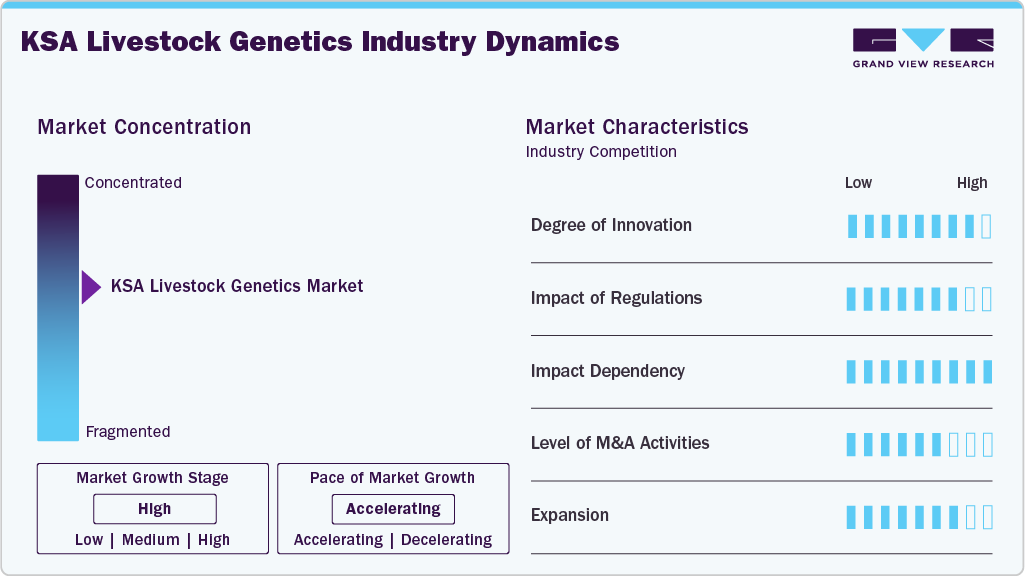
Regulatory formalization is actively reshaping the animal genetics market structure, led by mandatory MEWA digital registration requirements that are building the traceability infrastructure genetic improvement programs depend on. Structured breeding programs under MEWA and FAO initiatives are advancing genetic improvement in small ruminant populations, indicating regulation is functioning as a market-enabling mechanism rather than a compliance burden alone. Regulatory requirements around movement tracking, biosecurity, and health compliance are shaping which production systems, primarily organized and settled operations, can practically participate in advanced genetics adoption.
Import dependency is high and rising across all three species and imports are sustaining elevated levels throughout the period. Domestic export capacity remains marginal by comparison across sheep, goats, and cattle, producing a trade deficit that widened consistently. Sourcing has consolidated toward low-cost regional suppliers for small ruminants and South American producers for cattle, reflecting a market still structurally reliant on external live animal supply despite parallel domestic genetic capital investment.
Product and service expansion is centered on reproductive biotechnology, animal ID and traceability systems, and breeder training rather than live animal trade, given weak competitiveness in bulk live commodity exports. Regional expansion is uneven, with Riyadh established as the primary bovine genetics hub at close to 54.9% of national bovine cluster concentration, while the Northern Livestock Belt and Rest of Saudi Arabia represent the largest underserved small-ruminant opportunity, holding a combined share exceeding 50% of national sheep and goat clusters. This regional split points to a dual expansion path: premium bovine technology transfer in Riyadh against small-ruminant productivity and breeding-management services in peripheral regions.
The market is witnessing modest expansion across advanced reproductive services, genomic testing, pedigree verification, and specialized breeding programs. Furthermore, investments in equestrian clubs, breeding centers, veterinary reproductive facilities, and rider development academies are expanding the commercial adoption of equine genetics. Regional expansion is particularly evident in Abu Dhabi and Dubai, supported by growing investments in breeding infrastructure and organized equestrian activities.
Analyst Perspective
The competitive structure of KSA's livestock genetics market exhibits a classic incumbent-entrant dynamic within an import-dependent, capital-constrained buyer base. Established players currently dominate revenue due to their proven bovine genetic evaluation systems and strong distribution ties with commercial dairy operators. However, these incumbents face key vulnerabilities from general market price sensitivity and an overconcentration in cattle, even though small ruminants make up over 70% of the national herd. This gap allows emerging players to enter strategically by addressing specific technical constraints-such as pastoral cold-chain limits and small ruminant biology-rather than competing purely on scale. While incumbents rely on infrastructure lock-in and institutional relationships to defend their share, new entrants use a wedge strategy targeting underserved segments like small ruminants, genomic diagnostics, and research. As Saudi Arabia's genomic localization agenda matures, these emerging players aim to expand their share of wallet across the broader market. Ultimately, the central strategic battle hinges on whether emerging specialized players can scale their distribution before well-capitalized incumbents decide to expand their proven playbooks into the small ruminant segment.
Species Insights
Based on species, the bovine segment led the market with the largest revenue share of 54.3% in 2025, backed by concentrated commercial dairy operations centered in Riyadh, which accounts for close to 54.9% of the national bovine cluster. Consolidation within the dairy industry has channeled genetic investment toward organized cattle farms, where artificial insemination adoption is already established, and where returns on reproductive technology are more predictable given controlled housing and closed production systems. Institution-led genomic profiling programs targeting dairy cattle productivity have reinforced this concentration, positioning bovine as the segment best equipped to absorb capital-intensive genetic services. Structured herd management and closed-housing dominance across regions further support consistent AI and ET utilization in this segment.
On the other hand, the ovine segment is expected to grow at the fastest CAGR over the forecast period, supported by the scale of the underlying sheep population, which accounts for close to 73.8% of the national livestock herd. Government-backed breeding programs under MEWA and FAO initiatives are extending structured genetic improvement into small ruminant populations that have historically operated with limited reproductive technology penetration. As mandatory MEWA registration formalizes traceability data across pastoral and semi-nomadic flocks, a wider share of the ovine base becomes addressable for genetics services, converting an underserved population into an accelerating growth base relative to the already-consolidated bovine segment.
Genetic Material Insights
Based on genetic material, the semen segment led the market with the largest revenue share of 73.8% in 2025, reflecting its position as the lowest-cost, most logistically viable genetic material across production systems. Artificial insemination infrastructure, already the dominant reproductive technology at over 77.2% share, is built primarily around semen distribution, giving this segment the broadest addressable base across commercial dairy, breeding centers, and government livestock authorities. Its cost profile and compatibility with existing veterinary infrastructure allow semen-based breeding to scale across both organized and semi-organized farms without requiring the specialized cold-chain and technical capacity that embryo or oocyte-based methods demand.
On the other hand, the oocytes/genetic samples segment is expected to grow at the fastest CAGR over the forecast period, driven by expanding research and advanced reproduction applications tied to institutional and university-linked breeding programs. As genomic localization efforts intensify under Vision 2030-aligned initiatives, demand for genetic material supporting IVF, gene banking, and research-stage breeding trials is rising from a comparatively small base. This segment's growth is tied closely to the expansion of universities and research centers, which are themselves projected as the fastest-growing end-user category, positioning oocytes and genetic samples as the material layer underpinning advanced reproduction research infrastructure.
Technology Insights
Based on technology, the artificial insemination (AI) segment led the market with the largest revenue shar of over 77.2% in 2025, consistent with its status as the most cost-accessible and widely deployable reproductive technology across KSA's production systems. AI's compatibility with both commercial dairy operations and structured small-ruminant breeding programs allows broader geographic and species reach than embryo transfer or IVF, which require specialized laboratory and veterinary capacity concentrated in elite breeding centers. Mandatory MEWA registration and expanding veterinary service delivery have supported AI's continued scale advantage, as it remains the entry-level technology for farms transitioning from natural mating to structured genetic improvement.
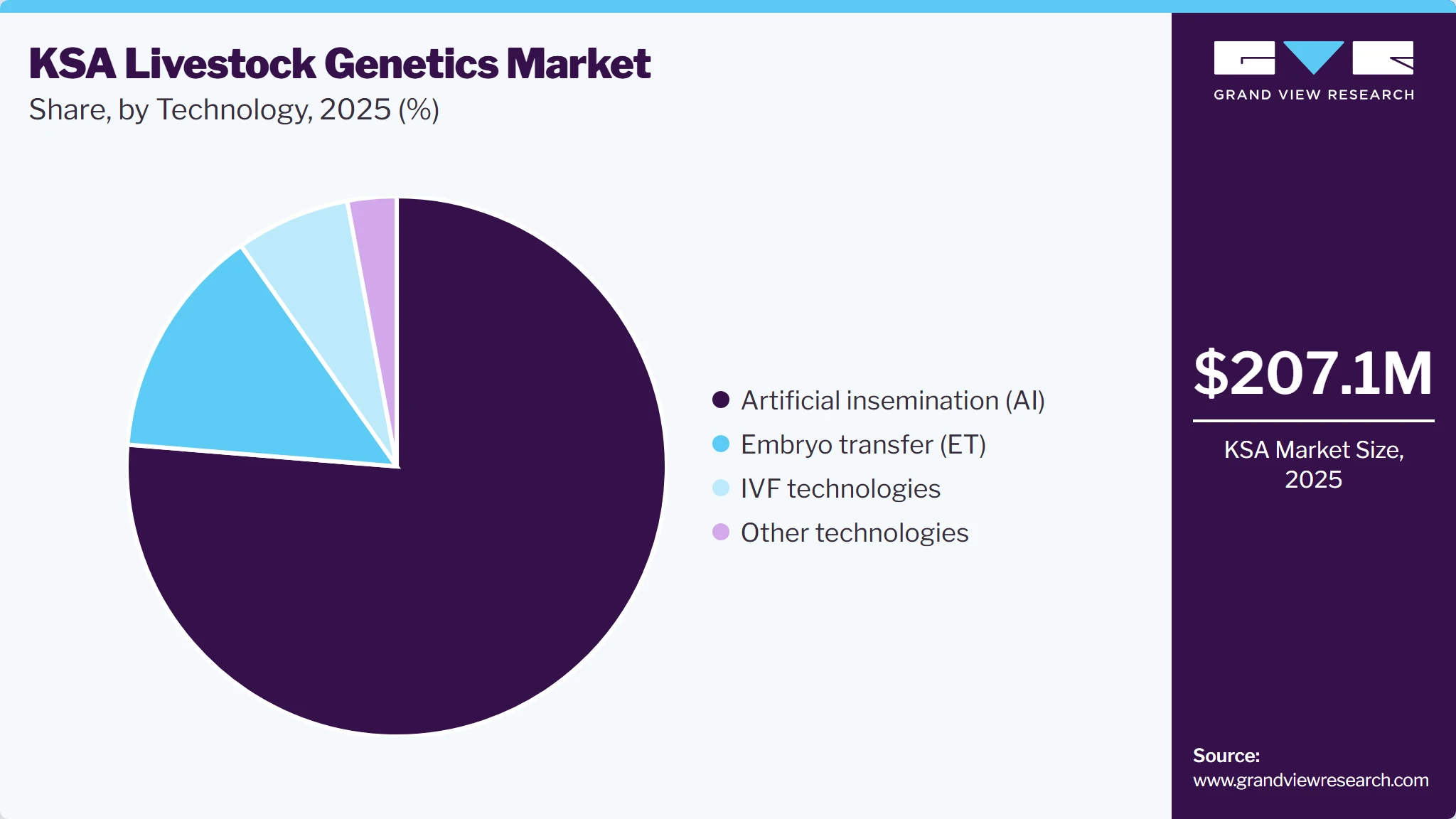
Whereas, the IVF technologies segment is expected to grow at the fastest CAGR over the forecast period. driven by rising demand for premium genetic gain among elite breeding centers, nucleus herds, and institutional buyers pursuing advanced reproduction goals. As genomic localization programs push domestic breeding capability beyond conventional AI, IVF adoption is expanding among government-supported genetic improvement initiatives and research-linked breeding operations that require lab-based fertilization and embryo culture capacity. This growth trajectory reflects a shift toward higher-value, technically intensive breeding methods among a narrower set of well-capitalized institutional buyers, even as the segment remains a smaller share of total technology revenue.
End User Insights
Based on end user, the dairy farms segment led the market with the largest revenue share of 41.5% in 2025. The segment is driven by hyper-consolidation within the dairy industry that has concentrated breeding demand among fewer, larger commercial operators. These operations sustain high-frequency demand for reproductive genetics tied to milk yield improvement, fertility management, and herd replacement, supported by established veterinary infrastructure and closed-housing systems that make AI and ET adoption more consistent than in pastoral small-ruminant systems. Dairy farms' concentration in Riyadh and other central commercial zones further reinforces their position as the primary revenue base for genetics providers.
On the other hand, the universities & research centers segment is expected to witness the fastest growth over the forecast period. The growth is supported by supported by expanding institutional capacity building under Vision 2030-aligned genomic localization initiatives. As government-directed R&D funding channels into breeding-program design and reproductive science, academic and research-linked buyers are scaling demand for advanced genetic material and IVF-related technologies faster than the broader commercial base. This trajectory positions research institutions as an increasingly active segment within the genetics value chain, aligned with structured breeding programs and genomic profiling initiatives already advancing under national food security mandates.
Regional Insights
Riyadh Livestock Genetics Market Trends
Riyadh accounted for the largest market share of 26.0% in 2025 due to the region's concentration of bovine production clusters, which stands at more than half of the national bovine cluster, alongside a diversified livestock base spanning ovine (20.5%) and caprine (14.3%) populations. The presence of government-led genomic-selection initiatives, national livestock-development programs, and veterinary biotechnology investments, including the world's first Veterinary Biotech Park launched by NLFDP in December 2025, has fortified Riyadh's role as the country's leading livestock breeding and genomics hub, supported by institutions such as MEWA, King Saud University, and FAO.
Eastern Province Livestock Genetics Market Trends
The Eastern Province market is expected to grow at the fastest growth rate over the forecast period. This can be attributed to large-scale livestock investments, including the Jubail Livestock Farm Complex, which surpassed 75% completion in April 2026, and the USD 2.3 billion livestock city announced in Hafar Al-Batin, both incorporating artificial insemination and breed-improvement infrastructure. The region's second-largest bovine cluster concentration (39.2%), paired with expanding industrial dairy operations along the Riyadh-Eastern corridor and government-backed investment opportunities in breeding and fattening, is driving accelerated reproductive-technology adoption.
Key KSA Livestock Genetics Company Insights
Companies operating in the KSA livestock genetics market are increasingly focusing on expanding artificial insemination infrastructure, semen cryopreservation, and embryo transfer capabilities to support the country's organized dairy and breeding ecosystem. Furthermore, market participants are strengthening collaborations with government-backed breeding programs, veterinary institutions, and commercial farm operators to facilitate the adoption of genomic selection and advanced reproductive technologies. Increasing investments in genetic material distribution, cold-chain logistics, and breeding-management systems are expected to improve herd productivity, genetic quality, and the localization of livestock genetics across KSA.
Key KSA Livestock Genetics Companies
-
Genus plc (ABS Global)
-
STgenetics
-
CRV Holding B.V.
-
URUS Group LP
-
Semex Alliance
-
Select Sires Inc.
-
VikingGenetics
-
IMV Technologies
-
Neogen Corporation
-
Zoetis
-
Hendrix Genetics
-
Cogent Breeding Ltd.
Competitive Benchmarking
Category
Operating Strategies
Competitive Edge
Weakness
Established Players (STgenetics; CRV Holding B.V.; URUS Group LP; Semex Alliance; Select Sires Inc.; Zoetis)
Established players focus on supplying bovine semen, sexed semen, genomic selection tools, and reproductive health diagnostics to organized dairy and breeding operations. Their strategies include expanding artificial insemination infrastructure, strengthening distributor and government partnerships across the Middle East, supporting breeding centers with sexed semen and genomic evaluation technologies, and integrating genomic testing platforms into herd management decisions.
Established players benefit from extensive global experience in bovine reproduction, validated genetic evaluation systems, comprehensive product portfolios spanning semen, diagnostics, and genomics, and established relationships with commercial dairy farms and government livestock authorities. Their scale and proven track record enable them to support large-volume breeding programs while meeting international genetic quality and traceability standards.
Established players may face challenges associated with premium product pricing, dependence on imported genetic material and cold-chain logistics, and longer commercialization timelines tied to import regulations. Furthermore, limited local manufacturing and distribution infrastructure and high cold-chain requirements for semen and genomic testing may increase operating costs within the KSA market.
Emerging Players (VikingGenetics; IMV Technologies; Neogen Corporation; Hendrix Genetics; Cogent Breeding Ltd.)
Emerging players focus on specialized reproductive technology equipment, genomic testing systems, multi-species genetics, and precision breeding solutions. Their strategies include expanding collaborations with breeding centers and research institutions, introducing genomic screening and DNA-based traceability services, supporting cryopreservation and semen-processing technology adoption, and developing niche solutions across multiple livestock species beyond bovine.
Emerging players benefit from technological specialization, focused product portfolios in reproductive equipment and genomic diagnostics, and the ability to adapt solutions across species, including small ruminants underserved by bovine-focused incumbents. Their expertise in cryopreservation systems, genomic testing, and multi-species genetics positions them to support KSA's institution-led genomic localization and small ruminant breeding initiatives.
Emerging players generally have smaller commercial footprints, limited distributor networks, and lower brand recognition compared to established bovine genetics leaders. Their dependence on strategic partnerships, narrower geographic presence, and comparatively limited access to large-scale commercial dairy programs may constrain market penetration, particularly against incumbents already embedded in Riyadh's consolidated dairy operations.
Recent Developments
-
In June 2026, FAO partnered with MEWA, King Saud University, NLFDP, and Saudi REEF to hold a national workshop in Riyadh on advancing small ruminant breeding systems. The event brought together technical experts to present genetic research findings, discuss genetic selection methodology, and promote artificial insemination and digital performance-tracking integration at farm level.
-
In May 2026, NADEC signed an agreement to acquire full ownership of Al-Ra'i National Livestock Company for SAR 23.7 million (approximately USD 6.3 million) from Saudi Enmaa Trading Company. The deal expands NADEC's sheep and goat breeding and meat production capacity, supporting Vision 2030 food security and import-reduction goals.
-
In January 2026, MEWA confirmed that the "Saudi GAP" quality label now covers 95% of the Kingdom's milk production, with raw milk output from specialized dairy cattle projects exceeding 2.7 billion liters in 2024, led by Riyadh (1.6 billion liters) and the Eastern Region (1.1 billion liters). The certification campaign forms part of MEWA's broader push to standardize Good Agricultural Practices across production, aligned with Vision 2030 food security and quality assurance goals.
KSA Livestock Genetics Market Report Scope
Report Attribute
Details
Market size value in 2025
USD 207.1 million
Market size value in 2026
USD 223.0 million
Revenue forecast in 2033
USD 416.1 million
Growth rate
CAGR of 9.3% from 2026 to 2033
Historical data
2021 - 2025
Forecast period
2026 - 2033
Quantitative units
Revenue in USD million and CAGR from 2026 to 2033
Report coverage
Revenue forecast, company ranking, competitive landscape, growth factors, and trends
Segments covered
Species, genetic material, technology, end user, and region
Regional scope
Riyadh; Qassim; Eastern Province; Western Region; Northen Livestock Belt; Rest of Saudi Arabia
Key companies profiled
STgenetics; CRV Holding B.V.; URUS Group LP; Semex Alliance; Select Sires Inc.; VikingGenetics; IMV Technologies; Neogen Corporation; Zoetis; Hendrix Genetics; Cogent Breeding Ltd.
Customization scope
Free report customization (equivalent up to 8 analysts' working days) with purchase. Addition or alteration to country, regional & segment scope.
Pricing and purchase options
Avail customized purchase options to meet your exact research needs. Explore purchase options
KSA Livestock Genetics Market Report Segmentation
This report forecasts revenue growth at a country level and provides an analysis of the latest industry trends in each of the sub-segments from 2021 to 2033. For this study, Grand View Research has segmented the global KSA livestock genetics market report based on species, genetic material, technology, end user, and region:
-
Species Outlook (Revenue, USD Million, 2021 - 2033)
-
Ovine
-
Dairy
-
Meat
-
-
Caprine
-
Dairy
-
Meat
-
-
Bovine
-
Dairy
-
Meat
-
-
-
Genetic Material Outlook (Revenue, USD Million, 2021 - 2033)
-
Semen
-
Embryos
-
Live Breeding Animals
-
Oocytes/Genetic Samples
-
-
Technology Outlook (Revenue, USD Million, 2021 - 2033)
-
Artificial insemination (AI)
-
Embryo transfer (ET)
-
IVF technologies
-
Others
-
-
End User Outlook (Revenue, USD Million, 2021 - 2033)
-
Commercial Livestock Farms
-
Dairy Farms
-
Breeding Centers
-
Government Livestock Authorities
-
Veterinary Institutions
-
Universities and Research Centers
-
-
Regional Outlook (Revenue, USD Million, 2021 - 2033)
-
Riyadh
-
Qassim
-
Eastern Province
-
Western Region
-
Northern Livestock Belt
-
Rest of Saudi Arabia
-
Research Methodology
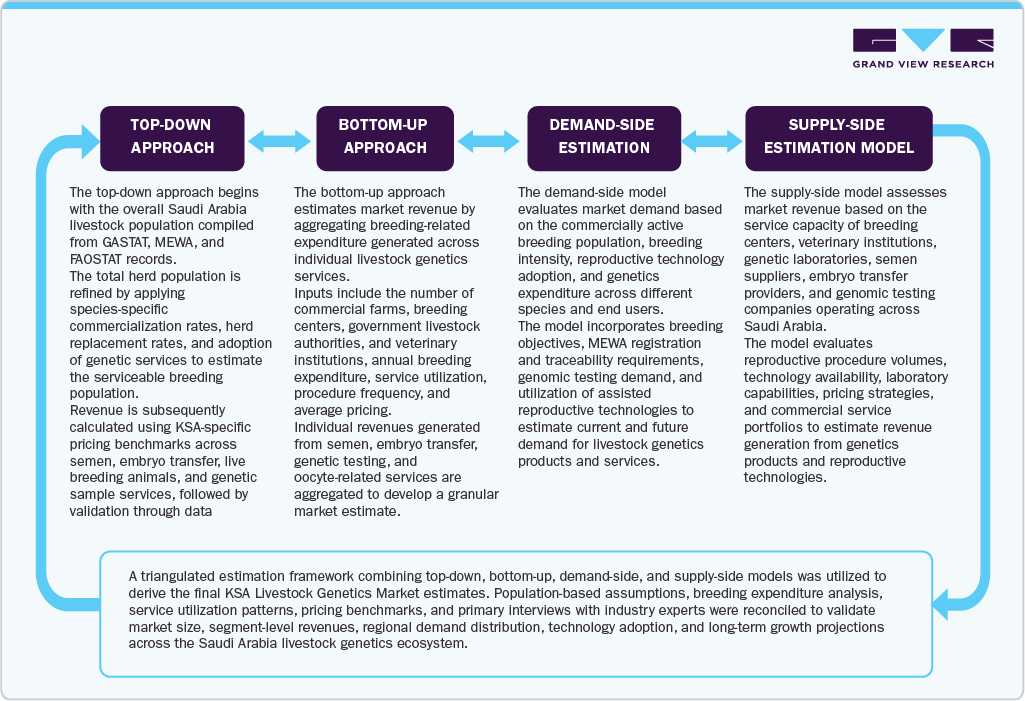
The U.S. healthcare IT software market figures in this report are based on a proven research process that combines executive interviews with secondary research from proprietary databases, company filings, and recognized regulatory and institutional sources. Market size is built through value-chain sizing-reconciling supply-side and demand-side estimates-and triangulated with bottom-up and top-down approaches. Every estimate passes multiple levels of expert validation before publication, with each U.S. healthcare IT software segment quantified using the revenue-capture definitions in the table below.
Segment Definition
Segment
Sub-Segment
Definition
Species - Ovine
Dairy
The segment captures revenue generated from sheep genetics products and services utilized for dairy-oriented ovine production. The segment includes semen, embryos, and reproductive technologies supporting milk yield improvement, fertility management, and breeding-stock replacement in sheep dairy operations.
Species - Ovine
Meat
The segment captures revenue generated from sheep genetics products and services utilized for meat-oriented ovine production. The segment includes genetic material, artificial insemination, and breeding technologies supporting growth rate, carcass quality, and reproductive efficiency in sheep meat operations.
Species - Caprine
Dairy
The segment captures revenue generated from goat genetics products and services utilized for dairy-oriented caprine production. The segment includes semen, embryos, and reproductive technologies supporting milk yield improvement and herd replacement in goat dairy operations.
Species - Caprine
Meat
The segment captures revenue generated from goat genetics products and services utilized for meat-oriented caprine production. The segment includes genetic material and breeding technologies supporting growth performance and reproductive efficiency in goat meat operations.
Species - Bovine
Dairy
The segment captures revenue generated from cattle genetics products and services utilized for dairy-oriented bovine production. The segment includes semen, embryos, genomic selection, and reproductive technologies supporting milk yield, fertility, and herd productivity in commercial dairy farms.
Species - Bovine
Meat
The segment captures revenue generated from cattle genetics products and services utilized for meat-oriented bovine production. The segment includes genetic material and breeding technologies supporting growth rate, carcass quality, and reproductive efficiency in beef cattle operations.
Genetic Material
Semen
The segment captures revenue generated from semen-based genetic material used across artificial insemination programs. The segment includes conventional and sexed semen products supporting breeding across bovine, ovine, and caprine production systems.
Genetic Material
Embryos
The segment captures revenue generated from embryo-based genetic material used in embryo transfer and IVF programs. The segment includes fresh and cryopreserved embryos supporting accelerated genetic improvement in commercial and elite breeding operations.
Genetic Material
Live Breeding Animals
The segment captures revenue generated from the trade and supply of live breeding animals, including imported and domestically bred stock, used to introduce or expand genetic capacity across commercial farms and breeding centers.
Genetic Material
Oocytes/Genetic Samples
The segment captures revenue generated from oocytes and genetic samples used in advanced reproduction and research applications. The segment includes material supporting IVF, gene banking, and institution-led genomic research programs.
Technology
Artificial Insemination (AI)
The segment captures revenue generated from artificial insemination technologies and services. The segment includes semen distribution infrastructure, insemination equipment, and technician services supporting broad-based genetic improvement across production systems.
Technology
Embryo Transfer (ET)
The segment captures revenue generated from embryo transfer technologies and services. The segment includes embryo collection, processing, and transfer procedures supporting accelerated genetic gain in elite and commercial breeding herds.
Technology
IVF Technologies
The segment captures revenue generated from in-vitro fertilization technologies and services. The segment includes oocyte collection, laboratory fertilization, and embryo culture supporting premium genetic improvement among institutional and elite breeding buyers.
Technology
Others
The segment captures revenue generated from supplementary reproductive technologies, including semen cryopreservation systems, genomic testing platforms, and pedigree verification services supporting broader breeding infrastructure.
End User
Commercial Livestock Farms
The segment captures revenue generated from genetics products and services utilized by commercial livestock farms across bovine, ovine, and caprine production, supporting herd productivity and reproductive efficiency.
End User
Dairy Farms
The segment captures revenue generated from genetics products and services utilized by dairy farms, supporting milk yield improvement, fertility management, and herd replacement across consolidated commercial dairy operations.
End User
Breeding Centers
The segment captures revenue generated from genetics products and services utilized by breeding centers, supporting genetic material production, embryo transfer, and elite breeding-stock development.
End User
Government Livestock Authorities
The segment captures revenue generated from genetics products and services procured by government livestock authorities, supporting national breeding programs, genomic profiling initiatives, and food security mandates.
End User
Veterinary Institutions
The segment captures revenue generated from genetics products and services utilized by veterinary institutions, supporting reproductive health services, diagnostics, and technical delivery of breeding technologies.
End User
Universities and Research Centers
The segment captures revenue generated from genetics products and services utilized by universities and research centers, supporting genomic research, breeding-program design, and advanced reproduction studies.
Estimation Model
Delivered Customizations
This report has been delivered with the following In-depth customizations
Client Request
Customization Delivered
Value Adds
Government Breeding Ecosystem & Procurement Opportunity Assessment
The study was customized to provide a detailed assessment of government-backed breeding programs, ADF-financed livestock projects, procurement patterns for genetic material, artificial insemination and embryo transfer adoption, and investment priorities across Riyadh, Eastern Province, and the Northern Livestock Belt. The analysis further evaluated purchasing behavior by species, production system, and reproductive technology utilization.
Enabled identification of high-value procurement opportunities tied to public-private breeding initiatives, prioritized engagement with government livestock authorities and commercial breeding centers, and supported the development of targeted commercial strategies for suppliers of genetic material and reproductive technologies.
Livestock Genetics Technology Adoption & Competitive Benchmarking
The report was expanded to benchmark the adoption of artificial insemination, embryo transfer, IVF, semen cryopreservation, genomic testing, and digital traceability systems across breeding centers, veterinary institutions, and commercial farms. The analysis compared technology penetration, service capabilities, and commercialization maturity across bovine, ovine, and caprine market participants.
Enabled technology providers to identify adoption gaps by species and region, benchmark competitive positioning against incumbent bovine-focused suppliers, prioritize commercialization opportunities in underserved small ruminant segments, and optimize product portfolios according to evolving MEWA regulatory requirements.
International Genetics Supply Chain & Import Dependency Analysis
The study was customized to include a comprehensive assessment of imported semen, embryos, and live breeding animals, covering supplier countries, logistics pathways, cold-chain infrastructure, regulatory requirements, and sourcing strategies. The analysis also evaluated opportunities for regional partnerships and localized genetic material production.
Supported supply chain optimization, supplier diversification, risk mitigation, and strategic sourcing decisions while identifying opportunities to strengthen domestic breeding capability and reduce dependence on Sudan, Somalia, and South American live animal imports.
Regional Breeding Cluster & Investment Opportunity Mapping
The report was customized to evaluate breeding infrastructure, reproductive service availability, dairy consolidation, and investment attractiveness across Riyadh, Eastern Province, Western Region, and the Northern Livestock Belt. The assessment included regional demand forecasting, stakeholder mapping, and infrastructure readiness analysis.
Enabled informed regional expansion planning, identified high-growth breeding clusters including the Jubail Livestock Farm Complex and Hafar Al-Batin livestock city, supported investment prioritization, and assisted organizations in selecting optimal locations for breeding centers, genomic laboratories, and reproductive service expansion.
Frequently Asked Questions About This Report
Eastern province is the fastest-growing region over the forecast period.
Based on species, the bovine segment led the market with the largest revenue share of 54.3% in 2025, while ovine segment is expected to grow at the fastest CAGR over the forecast period.
Based on technology, the artificial insemination (AI) segment led the market with the largest revenue shar of over 77.2% in 2025.
Based on genetic material, the semen segment led the market with the largest revenue share of 73.8% in 2025, the oocytes/genetic samples segment is expected to grow at the fastest CAGR over the forecast period.
By region, Riyadh accounted for the largest market share of 26.0% in 2025 due to the region's concentration of bovine production clusters, which stands at more than half of the national bovine cluster, alongside a diversified livestock base spanning ovine and caprine populations.
Key players include STgenetics, CRV Holding B.V., URUS Group LP, Semex Alliance, Select Sires Inc., VikingGenetics, IMV Technologies, Neogen Corporation, Zoetis, Hendrix Genetics, and Cogent Breeding Ltd.
Key factors include Vision 2030 mandates boosting genetic investment, ADF capital funds asset modernization, MEWA registration formalizing livestock traceability data, government programs localizing genomic breeding capability, dairy consolidation concentrating on commercial breeding demand, and public-private partnerships lowering capital barriers.
The KSA livestock genetics market is expected to grow at a CAGR of 9.3% from 2026 to 2033, reaching USD 416.1 million.
The KSA livestock genetics market size was valued at USD 207.1 million in 2025 and is estimated at USD 223.0 million for 2026.
About the Author(s)
Animal Health Research Team
Healthcare · Animal HealthThis report was authored by the animal health research team at Grand View Research - comprising two research analysts, one senior research analyst, and one industry expert - with specialized expertise in the animal health segment of the healthcare industry. All findings are based on proprietary healthcare databases, executive interviews, and regulatory analysis, subject to internal peer review prior to publication.
Last Updated:
Speak to Analyst


Customize this report to your needs — add regions, segments, or data points, with 20% free customization.
Or view our licence options:


ISO 9001:2015 & 27001:2022 Certified
We are GDPR and CCPA compliant! Your transaction & personal information is safe and secure. For more details, please read our privacy policy.


