KSA Precast Concrete Market Summary
The KSA precast concrete market size was estimated at USD 3.90 billion in 2025 and is projected to reach USD 7.23 billion by 2033, growing at a CAGR of 8.2% from 2026 to 2033. The demand for precast concrete in Saudi Arabia is increasing due to the country’s accelerated infrastructure and urban development agenda under Vision 2030.
Key Market Trends & Insights
- By product, the structural building components segment held the highest revenue market share of 39.0% in 2025.
- By product, the architectural building components segment is expected to grow at a significant CAGR of 8.3% over the forecast period.
- By end use, the infrastructure segment is expected to grow at the fastest CAGR of 8.7% over the forecast period.
Market Size & Forecast
- 2025 Market Size: USD 3.90 Billion
- 2033 Projected Market Size: USD 7.23 Billion
- CAGR (2026-2033): 8.2%
Large-scale housing programs, smart cities, transport corridors, and industrial zones are driving the adoption of prefabricated construction solutions.
Precast concrete offers faster construction timelines, which aligns well with Saudi Arabia’s push to meet tight project deadlines. The growing need for cost-efficient and durable construction materials in residential, commercial, and public infrastructure further supports demand. Labor shortages in on-site construction have also encouraged a shift toward factory-made precast elements.
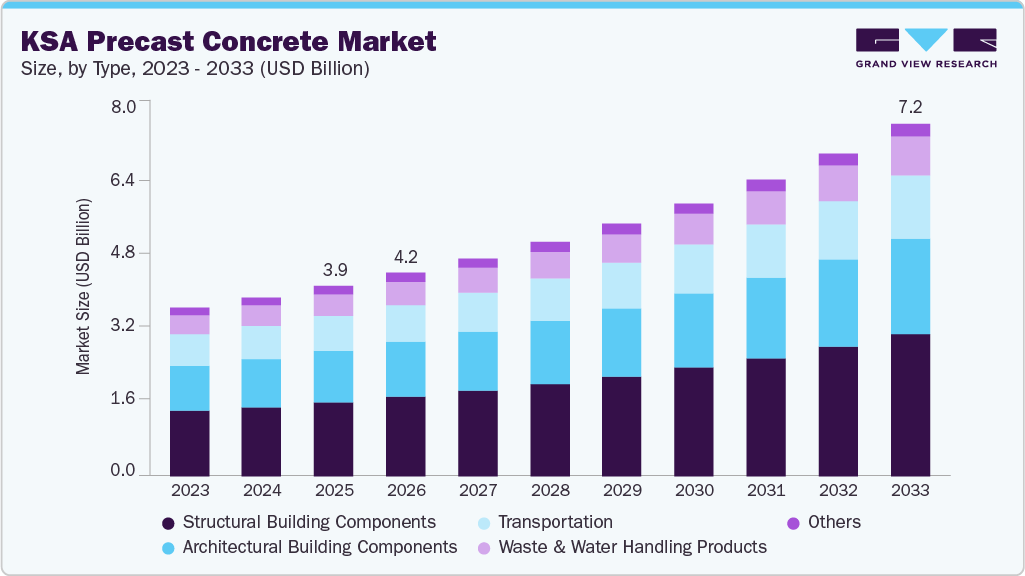
Key demand drivers include rapid urbanization, population growth, and increasing government spending on mega projects. Infrastructure projects such as NEOM, Qiddiya, Red Sea Project, and Diriyah Gate are major consumers of precast concrete components. The need for standardized quality and structural reliability is pushing contractors toward precast solutions. Reduced construction waste and better material utilization make precast concrete economically appealing. The growth of industrial and logistics facilities is also driving demand for precast structural systems. Improved project planning and BIM integration favor precast construction methods.
The Saudi government strongly supports precast concrete adoption through Vision 2030 infrastructure and housing initiatives. Programs such as Sakani and the National Transformation Program encourage modern construction technologies to accelerate housing delivery. Government-backed giga projects mandate high-quality, durable, and scalable construction methods, benefiting precast suppliers. Public-private partnerships (PPPs) are increasing investments in industrialized construction. Regulations promoting sustainability and efficient resource utilization indirectly favor precast concrete. Investments in transport, airports, metros, and ports further stimulate market demand.
Market Concentration & Characteristics
The KSA precast concrete market is moderately consolidated, with a mix of large domestic players and regional construction groups dominating high-value projects. Established manufacturers benefit from long-term relationships with government entities and major contractors. Large players operate integrated facilities supplying structural, architectural, and infrastructure precast components. Smaller regional players cater to localized residential and commercial demand. Entry barriers are relatively high due to capital-intensive manufacturing setups and certification requirements. Pricing power remains competitive due to multiple suppliers. Strategic partnerships and capacity expansions are common to secure mega-project contracts.
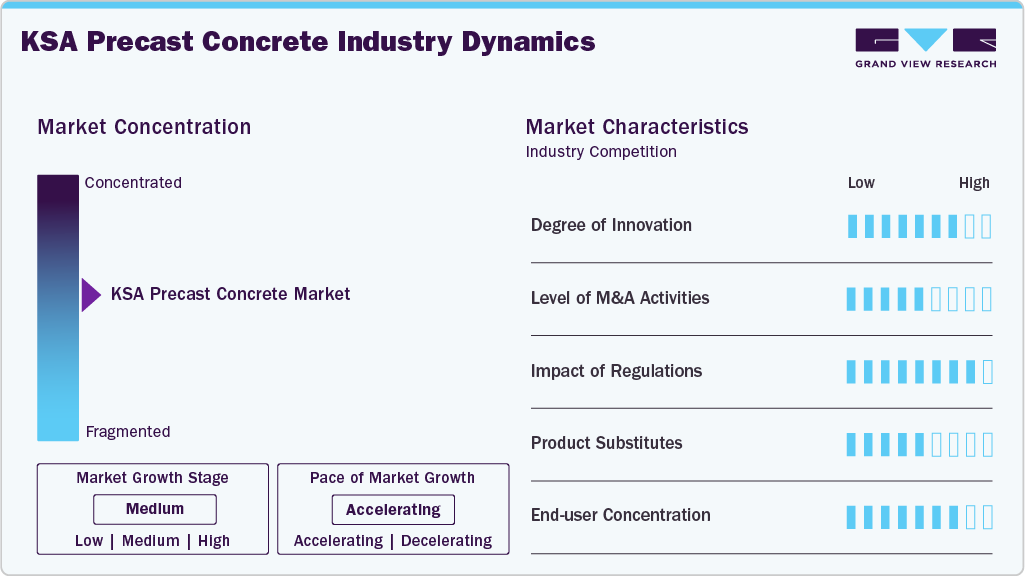
Cast-in-situ concrete remains the primary substitute, particularly for smaller or customized projects. Steel structures pose competition in industrial and warehouse construction due to faster erection times. However, precast concrete offers superior durability and lifecycle cost advantages compared to substitutes. Lightweight construction materials are gaining interest but lack the structural strength needed for large-scale projects. Traditional masonry is still used in low-rise residential buildings but is gradually losing share. Technological advancements are strengthening precast’s competitive position. Overall, the threat of substitutes is moderate.
Product Insights
The structural building components segment held the highest revenue market share of 39.0% in 2025, driven by extensive use in residential, industrial, and large-scale mixed-use developments. Structural elements such as beams, columns, slabs, walls, and load-bearing systems are widely adopted due to their strength, durability, and ability to accelerate construction timelines. Mega projects under Vision 2030 heavily rely on precast structural components to meet strict delivery schedules and quality standards. High-volume housing developments and industrial facilities further support demand for standardized structural precast solutions. The segment benefits from repeat orders, large contract sizes, and long-term infrastructure visibility.
The architectural building components segment is expected to grow at a significant CAGR of 8.3% over the forecast period, supported by rising demand for aesthetic, customized, and high-quality building façades. Precast architectural elements such as façades, cladding panels, decorative columns, and exterior wall systems are increasingly used in commercial, hospitality, and high-end residential projects. Mega tourism and entertainment developments are emphasizing design flexibility and premium finishes, favoring architectural precast solutions. Advancements in mold technology and surface treatments are enabling complex designs and textures. Developers are also adopting architectural precast to reduce on-site finishing time and ensure consistency.
End Use Insights
The infrastructure segment held the highest revenue market share of 40.5% in 2025, due to sustained government investment in transport and public infrastructure projects. Precast components are extensively used in bridges, tunnels, metro systems, culverts, drainage systems, and utility structures. Large-scale road and rail developments prioritize precast solutions for faster installation and minimal disruption. Government-backed infrastructure programs under Vision 2030 provide long-term project pipelines, ensuring steady demand. High durability and low maintenance requirements further strengthen precast adoption in infrastructure applications.
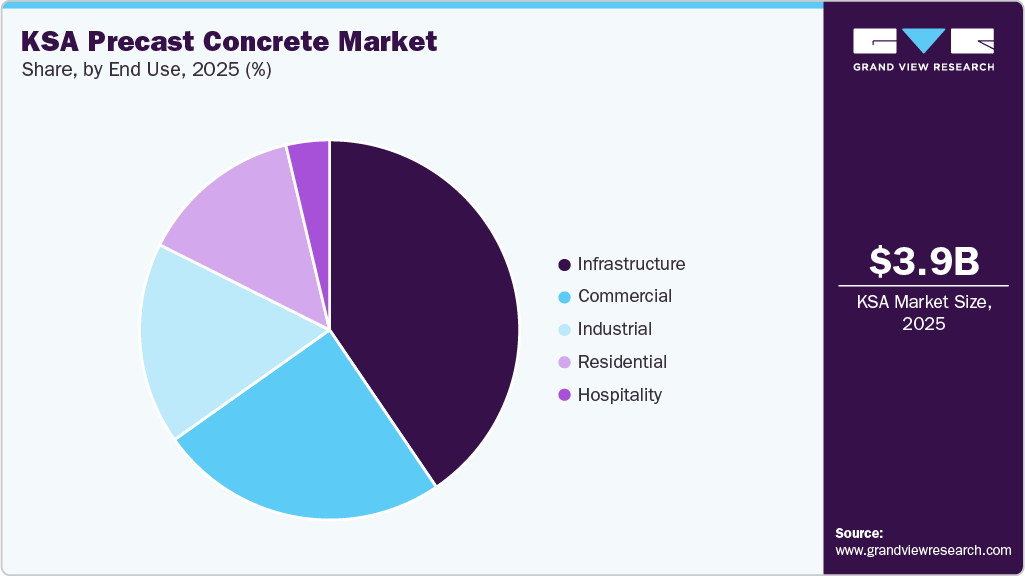
The commercial segment is expected to grow at a significant CAGR of 8.3% over the forecast period, driven by rapid development of offices, retail centers, hotels, and mixed-use complexes across major Saudi cities. Precast concrete is increasingly preferred in commercial construction due to faster project completion and cost efficiency. Growth in tourism, entertainment, and business districts is fueling demand for modern commercial spaces. Developers are also adopting precast systems to achieve consistent quality and scalability across large projects. Architectural flexibility and sustainability advantages further support adoption. These factors are expected to accelerate growth in the commercial segment over the forecast period.
Key KSA Precast Concrete Company Insights
Some of the key players operating in the market include AL-AYUNI Company, and Al Muthanna Precast
-
AL-AYUNI Company is a diversified Saudi construction and industrial group known for delivering large-scale infrastructure, civil, and building works. The company operates across road construction, concrete solutions, industrial services, and project development. Its offerings typically include precast components, ready-mix concrete, infrastructure materials, and EPC support services.
-
Al Muthanna Precast specializes in manufacturing high-quality precast concrete elements tailored for residential, commercial, and infrastructure applications. The company provides engineered solutions such as wall panels, hollow-core slabs, boundary walls, and structural precast components. With modern production facilities, it focuses on accuracy, durability, and rapid installation.
Bina Precast and RDB-El Seif Co Ltd are some of the emerging market participants in the precast concrete market.
-
Bina Precast is a leading producer of precast concrete solutions serving residential, commercial, and public-sector projects across Saudi Arabia. Its product lineup includes wall panels, slabs, beams, boundary walls, storm-water systems, and precast architectural elements. The company emphasizes efficient manufacturing workflows and strict quality control.
-
RDB-El Seif is a collaborative venture delivering engineered precast and pre-stressed concrete solutions for major regional developments. The company manufactures structural components such as girders, beams, slabs, columns, and bridge units. It integrates international design expertise with local production capabilities to meet demanding engineering requirements.
Key KSA Precast Concrete Companies:
- AL-AYUNI Company
- Al Muthanna Precast
- Ranco & Zamil
- Al Babtain Group
- Ideal Precast Company
- PRAINSA Saudi Arabia
- Bina Precast
- RDB-El Seif Co Ltd
- Aamal Company Q.P.S.C.
- AIM Industries
Recent Developments
-
In January 2025, Aamal Company Q.P.S.C. announced the establishment of a new subsidiary in Saudi Arabia, further expanding its regional footprint and strengthening its Industrial Manufacturing portfolio. The entity is positioned to support construction and infrastructure development through an extensive scope of services.
-
In November 2025, Al Babtain Group inaugurated an AI-driven smart precast plant marking a significant technological advancement in its construction operations. The new facility reportedly reduces production time by 30% and enhances material efficiency by 20% across its projects.
KSA Precast Concrete Market Report Scope
|
Report Attribute
|
Details
|
|
Market size value in 2026
|
USD 4.17 billion
|
|
Revenue forecast in 2033
|
USD 7.23 billion
|
|
Growth rate
|
CAGR of 8.2% from 2026 to 2033
|
|
Base year for estimation
|
2025
|
|
Actual estimates/Historical data
|
2021 - 2023
|
|
Forecast period
|
2026 - 2033
|
|
Quantitative units
|
Revenue in USD million/billion and CAGR from 2023 to 2033
|
|
Report coverage
|
Revenue forecast, company ranking, competitive landscape, growth factors, and trends
|
|
Segments covered
|
Product and end use
|
|
Key companies profiled
|
AL-AYUNI Company; Al Muthanna Precast; Ranco & Zamil; Al Babtain Group; Ideal Precast Company; PRAINSA Saudi Arabia; Bina Precast; RDB-El Seif Co Ltd; Aamal Company Q.P.S.C.; AIM Industries
|
|
Customization scope
|
Free report customization (equivalent up to 8 analysts working days) with purchase. Addition or alteration to country, regional & segment scope.
|
|
Pricing and purchase options
|
Avail customized purchase options to meet your exact research needs. Explore purchase options
|
KSA Precast Concrete Market Report Segmentation
This report forecasts revenue growth at country levels and provides an analysis on the industry trends in each of the sub-segments from 2021 to 2033. For the purpose of this study, Grand View Research has segmented the KSA precast concrete market on the basis of product and end use:
-
Product Outlook (Revenue, USD Million, 2021 - 2033)
-
Structural Building Components
-
Architectural Building Components
-
Transportation
-
Waste & Water Handling Products
-
Others
-
End Use Outlook (Revenue, USD Million, 2021 - 2033)
-
Residential
-
Commercial
-
Hospitality
-
Infrastructure
-
Industrial
Frequently Asked Questions About This Report
b. The KSA precast concrete market size was estimated at USD 3.90 billion in 2025 and is expected to reach USD 4.17 billion in 2026.
b. The KSA precast concrete market is expected to grow at a compound annual growth rate of 8.2% from 2026 to 2033 to reach around USD 7.23 billion by 2033.
b. The structural building components segment held the highest revenue market share of 39.0% in 2025, driven by extensive use in residential, industrial, and large-scale mixed-use developments.
b. Some of the key players operating in the KSA precast concrete market include AL-AYUNI Company, Al Muthanna Precast, Ranco & Zamil, Al Babtain Group, Ideal Precast Company, PRAINSA Saudi Arabia, Bina Precast, RDB-El Seif Co Ltd, Aamal Company Q.P.S.C., and AIM Industries.
b. Large-scale Vision 2030 infrastructure and housing projects, rapid urbanization, and the need for faster, cost-efficient construction are the key factors driving the KSA precast concrete market.

 Download Sample Report
















