
- Home
- »
- Advanced Interior Materials
- »
-
Laminar Airflow Cabinet Market Size, Industry Report, 2033GVR Report cover
![Laminar Airflow Cabinet Market Size, Share & Trends Report]()
Laminar Airflow Cabinet Market (2025 - 2033) Size, Share & Trends Analysis Report By Size (2x2 Feet, 3x2 Feet), By Product (Vertical Laminar Flow Cabinet, Vertical Laminar Flow Cabinet), By Class (Class 1, Class 2), By End Use, By Region, And Segment Forecasts
- Report ID: GVR-4-68040-691-0
- Number of Report Pages: 100
- Format: PDF
- Historical Range: 2021 - 2023
- Forecast Period: 2025 - 2033
- Industry: Advanced Materials
- Report Summary
- Table of Contents
- Interactive Charts
- Methodology
- Download FREE Sample
-
 Download Sample Report
Laminar Airflow Cabinet Market Summary
The global laminar airflow cabinet market size was estimated at USD 205.9 million in 2024 and is projected to reach USD 295.1 million by 2033, growing at a CAGR of 4.1% from 2025 to 2033. The market growth is primarily driven by the rising demand for contamination-free work environments across the pharmaceutical, biotechnology, and healthcare sectors.
Key Market Trends & Insights
- North America dominated the laminar airflow cabinet market with the largest revenue share of 35.2% in 2024.
- The laminar airflow cabinet industry in the U.S. is expected to grow at a substantial CAGR of 3.5% from 2025 to 2033.
- By size, the 6x2 feet segment is expected to grow at a considerable CAGR of 5.1% from 2025 to 2033 in terms of revenue.
- By product, the vertical laminar flow cabinet segment is expected to grow at a considerable CAGR of 4.3% from 2025 to 2033 in terms of revenue.
- By end use, the semiconductor & electronics segment is expected to grow at a considerable CAGR of 4.7% from 2025 to 2033 in terms of revenue.
Market Size & Forecast
- 2024 Market Size: USD 205.9 Million
- 2033 Projected Market Size: USD 295.1 Million
- CAGR (2025-2033): 4.1%
- North America: Largest market in 2024
- Asia Pacific: Fastest growing region
Regulatory requirements for sterile conditions in drug manufacturing and clinical laboratories are further boosting the adoption of advanced laminar flow systems to ensure safety and compliance.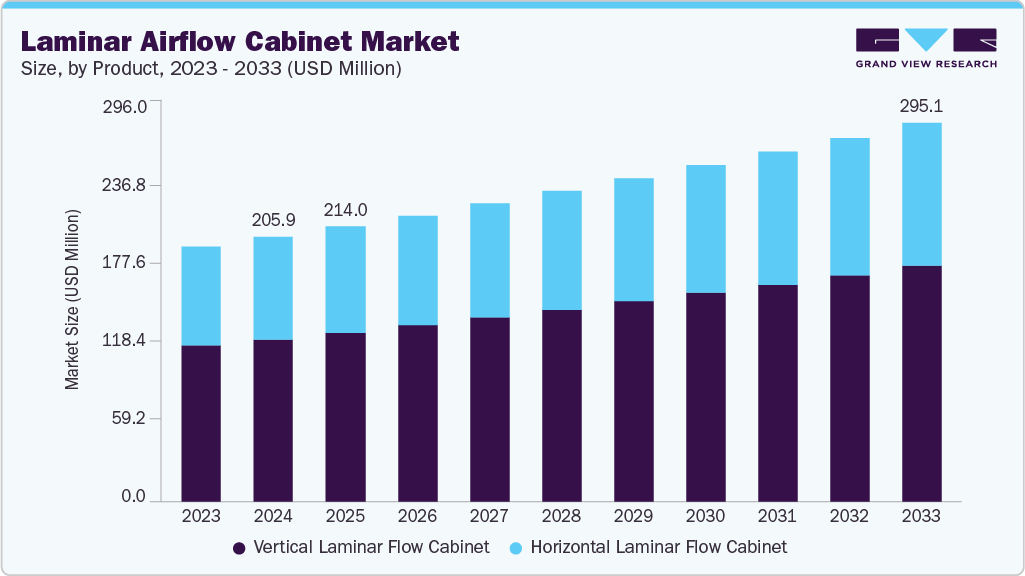
In addition, rapid growth in the semiconductor and electronics industries is fueling demand for cleanroom solutions, where laminar airflow cabinets play a crucial role in preventing particulate contamination. Technological advancements and the increasing adoption of automation in cleanroom operations are also contributing to the expansion of the laminar airflow cabinet industry.
Market Concentration & Characteristics
The global laminar airflow cabinet market is moderately concentrated, with a few major players holding a significant share due to their strong product portfolios and global distribution networks. These companies often invest in innovation and customization to meet industry-specific requirements. However, the presence of several regional and niche manufacturers adds a level of fragmentation to the market. This blend of dominance and competition creates a dynamic industry landscape.
The laminar airflow cabinet industry exhibits a moderate to high degree of innovation, driven by the need for enhanced airflow efficiency, user safety, and energy conservation. Manufacturers are integrating HEPA/ULPA filtration, digital controls, and IoT-based monitoring systems. Customization for industry-specific needs is also gaining traction. Innovation is crucial to stay competitive in regulated and precision-demanding environments.
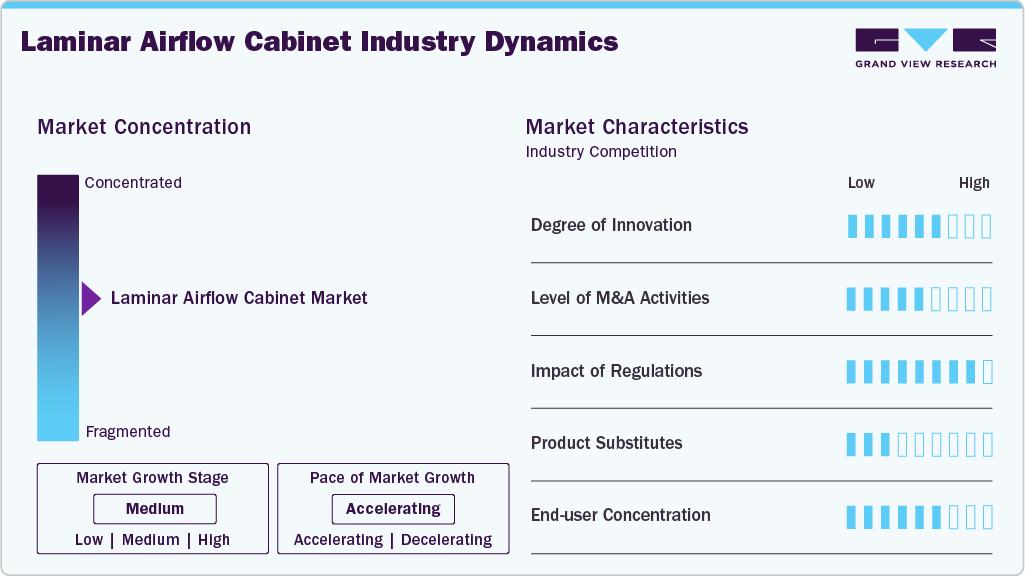
The market has witnessed a steady level of mergers and acquisitions as companies seek to expand their product lines, enter new geographic markets, and enhance technical capabilities. Larger players often acquire smaller firms with niche expertise or regional presence. These activities help streamline supply chains and consolidate market share. M&A is also a strategy to gain regulatory approvals and patents quickly.
Regulations significantly influence product design, manufacturing standards, and adoption rates in the market. Compliance with global standards such as ISO 14644, GMP, and NSF/ANSI drives demand for certified airflow cabinets. Stricter hygiene and safety protocols in healthcare, food, and pharma sectors further boost adoption. Regulatory changes often prompt upgrades and accelerate innovation cycles.
Drivers, Opportunities & Restraints
The growing demand for sterile and particle-free environments in the pharmaceutical, biotechnology, and healthcare sectors is a key driver for the market growth. Increased investments in cleanroom infrastructure and R&D labs further support market growth. The rise in hospital-acquired infection control practices also boosts adoption. Additionally, advancements in filtration and airflow technologies enhance product appeal.
Expanding applications in the semiconductor, food & beverage, and academic research sectors present significant growth opportunities. Emerging economies are witnessing increased investments in healthcare and manufacturing, fueling demand for laminar cabinets. Customizable and energy-efficient models are attracting new customers. Rising awareness of contamination control in non-traditional sectors also opens new markets.
High initial costs and maintenance requirements of laminar airflow cabinets can limit adoption, especially among small labs and facilities. Limited awareness and technical expertise in developing regions also pose challenges. Regulatory complexities across regions may delay product approvals. Additionally, the availability of alternative air purification systems may hinder market penetration.
Size Insights
The 4x2 feet laminar airflow cabinets dominate the laminar airflow cabinet market and accounted for a 30.3% share, due to their optimal size, making them suitable for a wide range of laboratory and cleanroom applications. They offer a balance between workspace and compactness, ideal for medium-sized operations. Their popularity is further driven by cost-effectiveness and ease of installation. These units are widely used in pharmaceutical, research, and clinical labs.
The 6x2 feet cabinets segment is expected to witness the fastest growth over the forecast period, as industries demand larger workspace without compromising on contamination control. These units are preferred in high-throughput environments such as large pharmaceutical facilities and semiconductor manufacturing. The growing need for scalable cleanroom setups is also fueling their adoption. Additionally, technological advancements have made larger units more energy-efficient and user-friendly.
Product Insights
Vertical laminar flow cabinets dominate the laminar airflow cabinet industry and accounted for a 61.5% share in 2024, due to their safer airflow design, which directs air downward and away from the operator. This configuration reduces the risk of contamination and is widely used in pharmaceutical, medical, and research settings. Their compact design and effective containment make them suitable for a variety of sterile applications. Increasing demand for user safety and regulatory compliance supports their widespread adoption.
The horizontal laminar flow cabinets segment is expected to witness significant growth, driven by their ability to provide direct airflow over the work surface, offering enhanced protection for sensitive materials. These are particularly favored in electronics and semiconductor industries where particulate control is crucial. Their ergonomic design also improves user comfort during prolonged operations. Rising demand for precision manufacturing is boosting their market growth.
Class Insights
The class 1 segment dominated the laminar airflow cabinet market and accounted for a share of 39.3% in 2024due to their simplicity, cost-effectiveness, and ability to provide basic personnel and environmental protection. These cabinets are widely used in applications where product protection is not required, such as non-hazardous sample handling and dust-free operations. Their low maintenance and energy-efficient design also support their widespread use. Industries like electronics, quality testing, and basic lab work continue to drive steady demand.
Class 2 cabinets are witnessing significant growth as they offer dual protection for both the user and the sample, making them suitable for biosafety and pharmaceutical environments. Increasing regulatory pressure for sterile handling in diagnostics, drug development, and healthcare settings is boosting adoption. These cabinets are ideal for microbiological work involving moderate-risk agents. Enhanced airflow systems and ergonomic features are further driving their popularity.
End Use Insights
The pharmaceutical facilities segment held a significant share of the laminar airflow cabinet industry and accounted for a share of 34.7% in 2024, owing to strict regulatory requirements for sterile and contamination-free environments during drug manufacturing and quality testing. Laminar airflow cabinets are essential for ensuring the clean handling of active ingredients and formulations. Their role in maintaining GMP compliance supports widespread adoption. Ongoing expansion of pharmaceutical production and R&D globally sustains this segment's dominance.
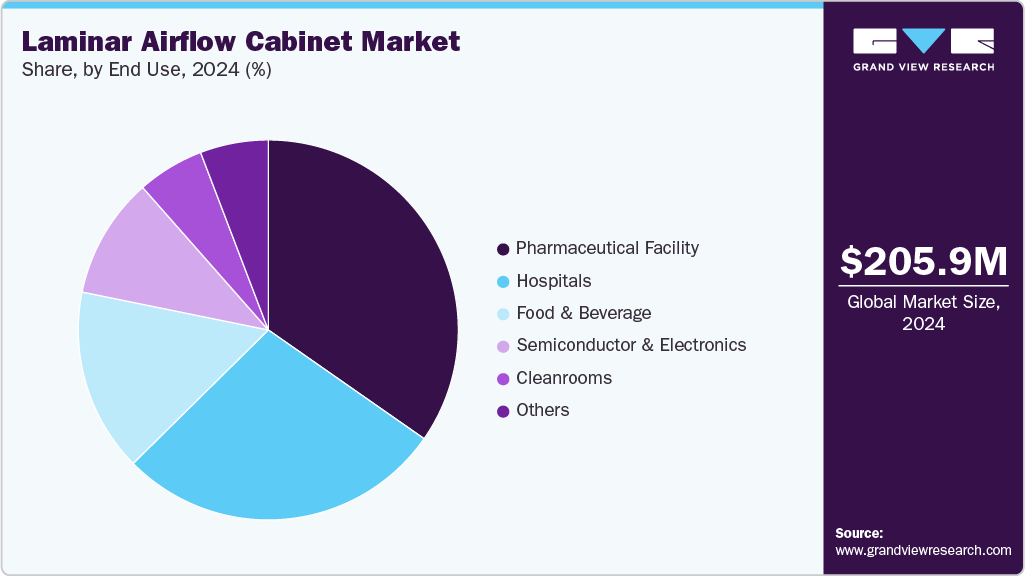
The semiconductor and electronics sector is the fastest-growing end use segment, driven by the need for ultra-clean environments during component assembly and testing. Even minute particulate contamination can affect product quality, making laminar cabinets critical for production lines. The rapid growth of advanced electronics, AI chips, and cleanroom facilities fuels demand. Increasing automation in precision manufacturing also contributes to market expansion.
Regional Insights
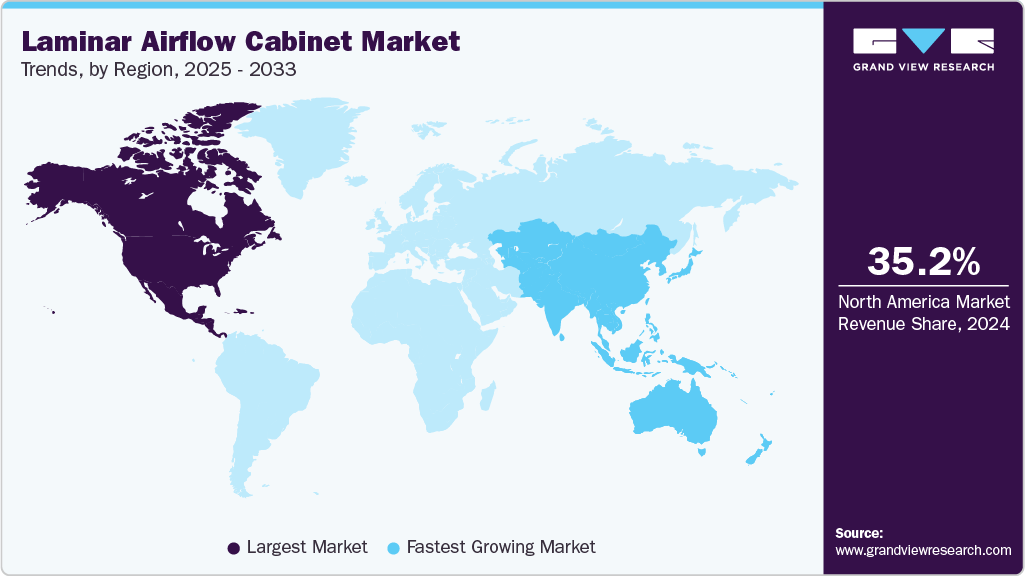
North America led the laminar airflow cabinet market with a share of 35.2% in 2024, driven by strong healthcare infrastructure and advanced pharmaceutical manufacturing. High regulatory standards and investments in R&D labs drive consistent demand. The presence of leading manufacturers and robust cleanroom technology adoption further supports growth. Additionally, increased awareness of contamination control in hospitals and labs fuels market expansion.
U.S. Laminar Airflow Cabinet Market Trends
The U.S. dominates the North American laminar airflow cabinet industry due to its advanced healthcare infrastructure and strong pharmaceutical and biotech industries. High regulatory standards and a focus on infection control drive widespread cabinet adoption in labs and hospitals. Major manufacturers and research institutions are based in the U.S., supporting steady product demand. Continuous investment in R&D and cleanroom technologies further strengthens its market leadership.
The Canada laminar airflow cabinet market is experiencing steady growth, supported by expanding healthcare and research facilities. Government initiatives to boost pharmaceutical production and life sciences research are contributing to increased demand. Rising awareness of contamination control and laboratory safety is also encouraging adoption. While smaller in scale compared to the U.S., Canada's market is gaining momentum through modernization efforts.
Europe Laminar Airflow Cabinet Market Trends
Europe maintains steady growth in the laminar airflow cabinet industry, driven by established biotechnology and food safety regulations. The region has a well-developed healthcare system and cleanroom infrastructure supporting sustained demand. Adoption is also supported by stringent EU standards for sterile manufacturing environments. However, the market is relatively mature, limiting rapid expansion.
The Germany laminar airflow cabinet market is a key contributor to the regional market, driven by its strong pharmaceutical, biotechnology, and healthcare sectors. The country’s emphasis on research and compliance with stringent EU regulations supports continuous demand. Expansion of cleanroom applications in manufacturing and diagnostics further fuels market growth. Investment in advanced laboratory infrastructure also contributes to its rising adoption.
The laminar airflow cabinet market in the UK is growing steadily due to increased focus on healthcare safety, pharmaceutical innovation, and biomedical research. Government funding for R&D and public health initiatives supports cabinet installations in labs and hospitals. The presence of academic research institutions and clinical trial centers adds to the demand. Post-pandemic investments in healthcare infrastructure continue to enhance growth prospects.
Asia Pacific Laminar Airflow Cabinet Market Trends
The Asia Pacific laminar airflow cabinet industry is expected to grow at the fastest CAGR of 4.8% over the forecast period, fueled by rapid industrialization and increasing investments in pharmaceutical and electronics manufacturing. Countries like China, India, and South Korea are expanding cleanroom facilities and healthcare infrastructure. Rising demand for sterile environments and supportive government initiatives are boosting adoption. Local manufacturing and cost-effective production also contribute to growth.
The China laminar airflow cabinet market is experiencing significant growth due to its expanding pharmaceutical, biotechnology, and semiconductor industries. Government support for healthcare modernization and cleanroom standardization is driving product adoption. Domestic manufacturers are also increasing production to meet rising local demand. The country's focus on high-tech manufacturing and biosafety strengthens its market position.
The laminar airflow cabinet in India is growing rapidly, fueled by the increased investment in pharmaceutical manufacturing, diagnostics, and healthcare infrastructure. Rising demand for contamination control in hospitals and research labs is boosting the adoption of laminar flow cabinets. Government initiatives like “Make in India” and regulatory reforms are supporting local production. Additionally, growth in clinical trials and biotechnology research further drives market expansion.
Middle East & Africa Laminar Airflow Cabinet Market Trends
The Middle East & Africa laminar airflow cabinet industry is gradually expanding its presence, supported by investments in healthcare and scientific research infrastructure. Demand is rising for sterile environments in diagnostic labs and pharmaceutical operations. Countries like the UAE and South Africa are leading regional adoption. However, limited local manufacturing and cost barriers pose challenges to faster growth.
The UAE laminar airflow cabinet market is witnessing steady growth, driven by rising investments in healthcare infrastructure and pharmaceutical production. Expansion of diagnostic labs and research centers is boosting demand for contamination control solutions. Supportive government policies and private sector involvement further enhance market prospects. The country’s growing role as a regional hub for medical and scientific services contributes to sustained adoption.
Latin America Laminar Airflow Cabinet Market Trends
The Latin America laminar airflow cabinet industry is experiencing moderate growth due to improving healthcare services and rising investments in research labs and pharmaceutical facilities. Brazil and Argentina are leading contributors in expanding cleanroom applications. Although adoption is slower compared to developed regions, awareness of contamination control is increasing. Economic development and healthcare modernization are expected to drive future growth.
The Brazil laminar airflow cabinet market is witnessing steady expansion, driven by increasing investments in pharmaceutical manufacturing and biotechnology research facilities. The rise of R&D labs and diagnostic centers is fueling demand for high-quality contamination control solutions. Government initiatives to enhance healthcare infrastructure also support market growth. Although still emerging in scale, growing awareness of laboratory safety and cleanroom standards is rapidly advancing adoption across industries.
Key Laminar Airflow Cabinet Company Insights
Some of the key players operating in the market include MRC Group, Brinda Pharma Technologies, and Bionics Scientific Technologies (P) Ltd.
-
MRC Group is a prominent manufacturer and supplier of scientific, laboratory, and analytical equipment, serving industries such as pharmaceuticals, biotechnology, food & beverage, chemical, and environmental testing. The company offers a wide range of products, including laminar airflow cabinets, incubators, centrifuges, and cleanroom solutions. MRC caters to both academic institutions and industrial research facilities with advanced, customizable instruments. It maintains a strong global presence through distribution partnerships and export operations. The company is known for delivering reliable solutions that meet strict international quality and safety standards.
-
Brinda Pharma Technologies specializes in designing and manufacturing cleanroom and laboratory equipment for the pharmaceutical, biotechnology, and healthcare industries. Its product range includes laminar airflow cabinets, pass boxes, cleanroom doors, biosafety cabinets, and modular cleanroom systems. The company also supports sectors like food processing, cosmetics, and electronics, where contamination control is critical. With a focus on turnkey cleanroom solutions, Brinda Pharma serves both domestic and international markets. Its engineering expertise and adherence to global regulatory standards have positioned it as a key player in contamination control infrastructure.
Key Laminar Airflow Cabinet Companies:
The following are the leading companies in the laminar airflow cabinet market. These companies collectively hold the largest market share and dictate industry trends.
- MRC Group
- Brinda Pharma Technologies
- Bionics Scientific Technologies (P) Ltd.
- Esco Micro Pte. Ltd.
- Labocon
- Roch Mechatronics Inc.
- Biobase Biodusty (Shandong), Co., Ltd.
- Thermo Fisher Scientific Inc.
- Lamsystems
- Airclean Systems
- Allentown Inc.
- Kimberly-Clark Corporation
- Labconco Corporation
- NuAire
Recent Developments
-
In October 2024, Esco Medical introduced the MIRI Laminar Flow Cabinet, designed for IVF labs with advanced airflow control and high-efficiency ULPA filtration. It features low noise, energy-saving operation, and ergonomic enhancements. The unit supports clean, vibration-free environments for delicate procedures. Its antimicrobial coating adds an extra layer of protection.
-
In October 2024, Germfree acquired Arcoplast to strengthen its cleanroom and containment facility offerings. This move enhances its ability to deliver turnkey solutions with advanced, seamless architectural finishes. The acquisition supports growth in biopharma, high-containment labs, and sterile manufacturing. It also broadens Germfree’s presence in modular and fixed cleanroom markets.
-
In March 2023, Kewaunee highlights new advancements in laminar flow hood technology, focusing on better airflow control, energy efficiency, and user-friendly features. These upgrades enhance safety and performance in labs. The improvements are especially valuable for pharmaceutical, biotech, and precision manufacturing environments.
Laminar Airflow Cabinet Market Report Scope
Report Attribute
Details
Market size value in 2025
USD 214.0 million
Revenue forecast in 2033
USD 295.1 million
Growth rate
CAGR of 4.1% from 2024 to 2033
Historical data
2021 - 2023
Forecast period
2025 - 2033
Quantitative units
Revenue in USD million and CAGR from 2025 to 2033
Report coverage
Revenue forecast, company ranking, competitive landscape, growth factors, and trends
Segments covered
Size, product, class, end use, region
Regional scope
North America; Europe; Asia Pacific; Latin America; Middle East & Africa
Country scope
U.S.; Canada; Mexico; Germany; France; Italy; Spain; UK; China; India; Japan; South Korea; Australia; Brazil; Argentina; Saudi Arabia; UAE; South Africa
Key companies profiled
MRC Group; Brinda Pharma Technologies; Bionics Scientific Technologies (P) Ltd.; Esco Micro Pte. Ltd.; Labocon; Roch Mechatronics Inc.; Biobase Biodusty(Shandong), Co., Ltd.; Thermo Fisher Scientific Inc.; Lamsystems; Airclean Systems; Allentown Inc.; Kimberly-Clark Corporation; Labconco Corporation; NuAire.
Customization scope
Free report customization (equivalent up to 8 analysts working days) with purchase. Addition or alteration to country, regional & segment scope.
Pricing and purchase options
Avail customized purchase options to meet your exact research needs. Explore purchase options
Global Laminar Airflow Cabinet Market Report Segmentation
This report forecasts revenue growth at the global, regional, and country levels and provides an analysis of the latest industry trends in each of the sub-segments from 2021 to 2033. For this study, Grand View Research has segmented the global laminar airflow cabinet market report based on size, product, class, end use, and region:
-
Size Outlook (Revenue, USD Million, 2021 - 2033)
-
2x2 Feet
-
3x2 Feet
-
4x2 Feet
-
6x2 Feet
-
8x2 Feet
-
-
Product Outlook (Revenue, USD Million, 2021 - 2033)
-
Vertical Laminar Flow Cabinet
-
Horizontal Laminar Flow Cabinet
-
-
Class Outlook (Revenue, USD Million, 2021 - 2033)
-
Class 1
-
Class 2
-
Class 3
-
-
End Use Outlook (Revenue, USD Million, 2021 - 2033)
-
Food & Beverage
-
Hospitals
-
Semiconductor & Electronics
-
Cleanrooms
-
Pharmaceutical Facility
-
Others
-
-
Regional Outlook (Revenue, USD Million, 2021 - 2033)
-
North America
-
U.S.
-
Canada
-
Mexico
-
-
Europe
-
Germany
-
France
-
Italy
-
Spain
-
UK
-
-
Asia Pacific
-
China
-
India
-
Japan
-
South Korea
-
Australia
-
-
Latin America
-
Brazil
-
Argentina
-
-
Middle East and Africa
-
Saudi Arabia
-
UAE
-
South Africa
-
-
Frequently Asked Questions About This Report
b. Some of the key players operating in the global laminar airflow cabinet market include MRC Group; Brinda Pharma Technologies; Bionics Scientific Technologies (P). Ltd.; Esco Micro Pte. Ltd.; Labocon; Roch Mechatronics Inc.; Biobase Biodusty(Shandong), Co., Ltd.; Thermo Fisher Scientific Inc.; Lamsystems; Airclean Systems; Allentown Inc.; Kimberly-Clark Corporation; Labconco Corporation; NuAire.
b. The global laminar airflow cabinet market is driven by rising demand for contamination control in pharmaceuticals, biotechnology, and research laboratories. Growth in cleanroom applications across electronics and healthcare sectors also fuels adoption. Additionally, advancements in cabinet technology and stricter regulatory standards support market expansion.
b. The global laminar airflow cabinet market size was estimated at USD 205.9 million in 2024 and is expected to be USD 214.0 million in 2025.
b. The global laminar airflow cabinet market, in terms of revenue, is expected to grow at a compound annual growth rate of 4.1% from 2025 to 2033 to reach USD 295.1 million by 2033.
b. Vertical laminar flow cabinets dominate the market and accounted for 61.5% share in 2024, due to their safer airflow design, which directs air downward and away from the operator. This configuration reduces the risk of contamination and is widely used in pharmaceutical, medical, and research settings.


Share this report with your colleague or friend.
Need a Tailored Report?
Customize this report to your needs — add regions, segments, or data points, with 20% free customization.


ISO 9001:2015 & 27001:2022 Certified
We are GDPR and CCPA compliant! Your transaction & personal information is safe and secure. For more details, please read our privacy policy.
Trusted market insights - try a free sample
See how our reports are structured and why industry leaders rely on Grand View Research. Get a free sample or ask us to tailor this report to your needs.













