
- Home
- »
- Organic Chemicals
- »
-
Lanolin Market Size, Share & Growth Report, 2026-2033GVR Report cover

Lanolin Market (2026 - 2033)
Size, Share & Trends Analysis Report By Product (Isopropyl Lanolate, Laneth, Lanogene, Lanosterols, Quaternium 33, PEG-75, Lanolin Fatty Acid), By Application (Personal Care & Cosmetics, Baby Care), By Region, And Segment Forecasts
Market Size, 2025
$312.1MMarket Estimate, 2026
$323.6MMarket Forecast, 2033
$436.0MCAGR, 2026–2033
4.4%Lanolin Market Summary
The global lanolin market size was valued at USD 312.1 million in 2025 and is projected to grow from USD 323.6 million in 2026 to USD 436.0 million by 2033, growing at a CAGR of 4.4% from 2026 to 2033. Asia Pacific dominated the market with the highest revenue share of 34.0% in 2025. The industry is driven by rising demand for natural and multifunctional ingredients in personal care, cosmetics, and pharmaceutical products.
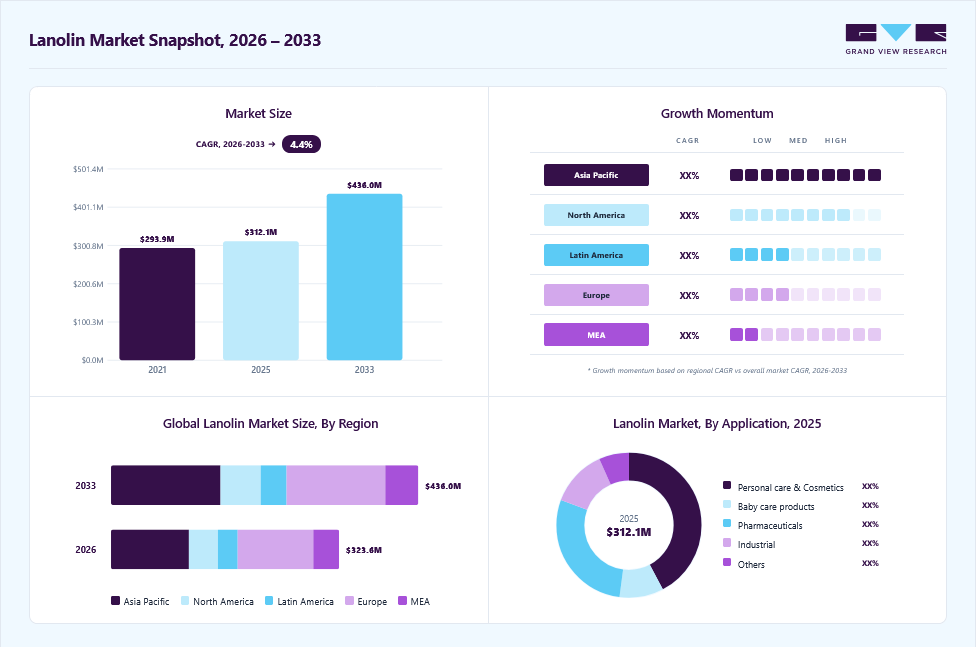 Source: Grand View Research, IR Documents, Primary Interviews, Paid DatabasesTo learn more about this report,
 Download Free Sample Report
 Key Market Trends & Insights
- By product: Lanolin fatty acid segment accounted for the highest market share, representing 18.7% of total revenue in 2025.
- By application: Personal care & cosmetics held a dominant position, contributing 42.2% of total revenue in 2025.
Regional Highlights
- Largest regional market: Asia Pacific (34.0% revenue share, 2025)
- By country: The China held the largest market share in 2025.
Market Size & Forecast
- Market size in 2025: USD 312.1 Million
- Estimated market size in 2026: USD 323.6 Million
- Projected market size by 2033: USD 436.0 Million
- CAGR (2026-2033): 4.4%
Three ways to get this report
Buy it, customize it, or ask a question.Ask an Analyst
Analyst response in 1 business day
- AccessReport author, directly
- Reply timeWithin 1 working day
- No sales callDirect answer only
- FormatEmail reply
- CostFree, no cost
Get the Full Report
What the study covers
- FormatsPDF · Excel · Dashboard
- Timeline2026–2033 annual, 2025 base
- Coverage20+ countries, 5 regions
- Companies10+ key players profiled
Customize the Report
20% free customization
- IncludeCountries, segments, points
- TailorTo your product definition
- ExtendDeeper competitor detail
- OrA fully bespoke study
- Turnaround5–10 working days
Increasing consumer preference for safe, skin-friendly, and bio-based formulations is encouraging manufacturers to incorporate lanolin as a natural moisturizer, emulsifier, and skin-conditioning agent. Growth in the skincare and baby care segments globally further supports the adoption of lanolin across multiple applications. A key driver for the industry is its expanding use in advanced dermatological and medical formulations. Lanolin’s biocompatibility, barrier-protecting properties, and ability to enhance the efficacy of topical drugs make it an essential ingredient for ointments, wound-healing creams, and medicated skincare products. Increasing healthcare awareness and rising prevalence of skin-related conditions are fueling demand in this segment. To learn more about this report, Download Free Sample Report
 The industry presents significant opportunities in emerging markets, where growing urbanization, rising disposable income, and increasing awareness of natural skincare are driving consumption. Companies can capitalize on the trend of sustainable and premium cosmetic products by offering high-purity lanolin and derivative-based formulations tailored for local consumer preferences, expanding their market reach and revenue potential.
Market Dynamics
The lanolin market is experiencing steady growth driven by increasing demand for natural, multifunctional ingredients across personal care, pharmaceutical, and specialty industrial applications. Derived from sheep wool wax, lanolin is valued for its superior emollient, moisturizing, and protective properties, making it a preferred ingredient in skincare creams, lip care products, ointments, and baby care formulations. Growing consumer preference for naturally sourced and sustainable ingredients has further strengthened the adoption of lanolin and its derivatives in premium cosmetic and personal care products. Market participants are increasingly focusing on product innovation, purification technologies, and the development of high-value lanolin derivatives to meet evolving regulatory and consumer requirements.
Lanolin and its derivatives are extensively utilized in skincare creams, lip balms, hair care products, and moisturizing formulations due to their excellent emollient, conditioning, and moisture-retention properties. As consumers increasingly seek products formulated with naturally derived and multifunctional ingredients, manufacturers are incorporating lanolin into a wide range of beauty and wellness offerings. The rising popularity of clean-label cosmetics and skin-nourishing formulations is further contributing to sustained demand across both developed and emerging markets.
Another significant growth driver is the expanding use of lanolin in pharmaceutical and healthcare applications. Lanolin serves as an effective base ingredient in topical ointments, wound care products, dermatological treatments, and therapeutic creams owing to its biocompatibility and skin-protective characteristics. Increasing healthcare expenditure, growing awareness of skin-related disorders, and rising demand for specialized treatment products are encouraging pharmaceutical companies to incorporate lanolin-based ingredients into their product portfolios. The trend toward advanced topical drug delivery systems is also supporting market expansion.
Variations in wool output caused by climatic conditions, livestock population fluctuations, and changes in agricultural practices can impact the availability and pricing of lanolin. The growing preference among certain consumer groups for vegan and plant-based alternatives may limit adoption in specific end-use segments. These factors can create supply chain uncertainties and intensify competitive pressure from alternative bio-based ingredients. Stringent quality standards and regulatory requirements for lanolin used in pharmaceutical and personal care applications can increase production and compliance costs for manufacturers. The need for advanced purification processes to remove impurities and ensure product safety adds to operational expenses.
As regulatory bodies and consumers place greater emphasis on environmentally responsible products, manufacturers are investing in traceable sourcing practices and advanced purification technologies to enhance product quality and sustainability credentials. This trend is creating opportunities for premium-grade lanolin products that align with the evolving requirements of cosmetic, pharmaceutical, and specialty chemical industries.
Emerging economies across Asia Pacific, Latin America, and the Middle East offer substantial growth potential due to rising disposable incomes, urbanization, and increasing expenditure on personal care and healthcare products. Expanding retail networks, growing awareness of skincare benefits, and the rapid development of local cosmetic manufacturing industries are generating new avenues for market participants. Companies that establish strong regional distribution channels and customized product offerings are well positioned to capitalize on these high-growth markets.
Market Concentration & Characteristics
The industry is moderately concentrated, with a few key players controlling a significant share of global production through strong refining expertise and well-established supply chains. Companies focus on producing high-purity lanolin, lanolin derivatives, and specialty products like lanolin fatty acids and cholesterin to gain a competitive advantage. Strategic partnerships with cosmetic, pharmaceutical, and personal care manufacturers, along with expansion into emerging markets, are common strategies shaping the competitive landscape.
 To learn more about this report, Download Free Sample Report
 In terms of characteristics, the industry is innovation-driven and quality-focused, requiring advanced refining, purification, and formulation capabilities. Entry barriers are moderate due to the need for technical expertise in lanolin processing, compliance with cosmetic and pharmaceutical standards, and sourcing of raw wool wax. The market also shows strong collaboration between lanolin producers, cosmetic brands, and pharmaceutical companies to develop high-value, application-specific products. Regional supply chains for raw wool and refined lanolin influence production costs, product availability, and pricing stability.
Analyst Perspective
The lanolin market is positioned for steady growth, supported by increasing demand for natural, multifunctional ingredients across personal care, pharmaceutical, and baby care applications. The market benefits from rising consumer preference for sustainable and bio-based products, particularly in premium skincare and therapeutic formulations. Innovation in high-purity lanolin derivatives and expanding applications in specialty chemicals are creating additional value-generation opportunities. While supply dependence on sheep wool production and the growing popularity of vegan alternatives present challenges, established manufacturers are mitigating risks through advanced purification technologies and sustainable sourcing initiatives. Overall, the market is expected to maintain a growth trajectory, driven by strong demand from cosmetics and healthcare sectors and increasing adoption in emerging economies.
Product Insights
Based on product, the lanolin fatty acid segment accounted for the highest market share, representing 18.7% of total revenue in 2025. This segment dominates because lanolin fatty acids are widely used in cosmetics, skincare, and pharmaceutical products as natural moisturizers and emulsifiers. They help keep skin soft, stabilize creams and lotions, and are preferred by manufacturers for their safety and effectiveness. Growing demand for natural and renewable ingredients in personal care products is also supporting the strong position of this segment.
The Cholesterin segment is the fastest-growing segment with a CAGR of 5.7% during the forecast period . This growth is driven by its use in premium skincare, hair care, and medical products, where it works as a natural skin conditioner and barrier-protecting ingredient. Cholesterin is gaining popularity because it is gentle, effective, and improves product quality. Improved refining methods that increase purity are also helping more companies include it in high-end formulations, boosting its demand.
Application Insights
By application, personal care & cosmetics held a dominant position, contributing 42.2% of total revenue in 2025, because lanolin is widely used in creams, lotions, lip balms, hair care, and baby care products as a natural moisturizer and skin-conditioning agent. Its ability to retain moisture, smooth skin, and enhance product stability makes it a preferred ingredient for cosmetic manufacturers. Rising consumer preference for natural and safe ingredients in personal care products further strengthens the dominance of this segment.
 To learn more about this report, Download Free Sample Report
 The pharmaceuticals segment is the fastest-growing segment with a CAGR of 4.7% during the forecast period. This growth is driven by the increasing use of lanolin in ointments, medicated creams, and wound-healing formulations for its skin-protective and emulsifying properties. Its high biocompatibility and ability to improve drug absorption in topical applications are encouraging pharmaceutical companies to adopt lanolin in new products, boosting demand in this segment.
Regional Insights
Asia Pacific dominated the lanolin market with the highest revenue share of 34.0% in 2025. The market growth is driven by expanding cosmetic manufacturing and rapid industrial growth in emerging economies. The region’s market is supported by increasing production of personal care ingredients, rising consumer preference for multifunctional natural emollients, and strong demand for lanolin-based moisturizing formulations across skincare and baby care segments.
 To learn more about this report, Download Free Sample Report
 China Lanolin Market Trends
China accounted for 34.5% of the Asia Pacific lanolin market in 2025, driven by its large-scale industrial production and export of cosmetic ingredients. A major trend is the country’s growing investment in advanced refining technologies to enhance lanolin purity and meet pharmaceutical-grade standards. This shift is supported by the rising number of domestic pharmaceutical and dermatology brands focusing on high-quality, safe, and traceable ingredient sourcing.
Europe Lanolin Market Trends
The lanolin market in Europe is driven by the region’s strong focus on sustainable and ethical ingredient sourcing across cosmetic and healthcare applications. The market benefits from well-established R&D capabilities and regulatory frameworks promoting traceability and eco-certifications for animal-derived ingredients, which enhance consumer confidence in lanolin-based formulations.
Germany leads the European lanolin market, supported by its strong presence in specialty chemical and dermatological product manufacturing. A key trend is the growing use of lanolin derivatives in pharmaceutical coatings and transdermal drug delivery systems, where their emulsifying properties improve drug absorption and stability. The demand from advanced medical and therapeutic product manufacturers continues to propel market growth in the country.
North America Lanolin Market Trends
The lanolin market in North America is experiencing stable growth driven by increasing consumer awareness regarding natural healing and recovery products. The market is supported by rising adoption of lanolin in wound-care dressings, post-surgical ointments, and protective creams designed for sensitive skin applications.
U.S. Lanolin Market Trends
In the U.S. lanolin market, a key trend is the integration of lanolin into high-performance industrial lubricants and rust-prevention formulations. Its biodegradability and superior protective properties against moisture and corrosion are gaining traction in the automotive and machinery maintenance sectors. This diversification beyond cosmetics is expanding lanolin’s commercial relevance across new industrial applications.
Latin America Lanolin Market Trends
The lanolin market in Latin America is expanding steadily, supported by the rise of domestic beauty brands and the growing popularity of natural and multifunctional ingredients. A significant trend is the increasing use of lanolin in veterinary and agricultural care formulations, particularly in livestock ointments and protective balms for animal skin health. This diversification beyond cosmetics is creating new growth opportunities for local producers and strengthening the region’s export potential.
Middle East & Africa Lanolin Market Trends
The lanolin market in the Middle East & Africa is experiencing gradual growth, driven by increasing consumer interest in high-performance skincare suited to arid climates. A key trend is the rising adoption of lanolin-enriched moisturizers and grooming products in Gulf countries, where its natural moisture retention capabilities are valued for addressing skin dryness. The growing influence of international cosmetic brands and the expanding distribution of premium personal care products further support market development in the region.
Key Lanolin Company Insights
Key players operating in the lanolin market are undertaking various initiatives to strengthen their presence and increase the reach of their products and services. Strategies such as expansion activities and partnerships are key in propelling the market growth.
-
NK CHEMICALS CHINA LTD is a subsidiary of NK Chemicals Pte Ltd, which is based in Singapore. The company was formed with the primary motive of manufacturing refined lanolin and its derivatives. It offers sterol, lubricants, grease products, and lanolin & its various derivatives. The company has been working independently since 2012 and partnered with Rowi Biotech to promote its lanolin products in China. It also acts as the sole agent of Rowi Biotech and NK Chemicals Pte Ltd in China.
-
The Lubrizol Corporation, a subsidiary of Berkshire Hathaway, operates its business through two major segments, namely Lubrizol Additives and Lubrizol Advanced Materials. It offers different types of lanolin and its derivatives for applications in the cosmetic, personal care, and other sectors. The company is active in over 100 countries and has 60 manufacturing sites, 40 labs/technical facilities, and 47 sales offices across the globe.
Key Lanolin Companies:
The following key companies have been profiled for this study on the lanolin market.
-
The Lubrizol Corporation
-
Imperial-Oel-Import Handelsgesellschaft mbH
-
Nippon Fine Chemical Co., Ltd
-
NK CHEMICALS CHINA LTD
-
Lanotec
-
Industria Quimica del Centro S.A. de C.V.
-
Rolex Lanolin Products Limited
-
Croda International Plc
-
Esperis S.p.A.
-
Sancai(lanolin) CO., LTD
Competitive Benchmarking
Category
Operating Strategies
Competitive Edge
Weakness
Established Players (Croda International Plc, The Lubrizol Corporation, Nippon Fine Chemical Co., Ltd., Rolex Lanolin Products Limited, Esperis S.p.A., Imperial-Oel-Import Handelsgesellschaft mbH)
- Focus on high-purity lanolin derivatives for premium personal care and pharmaceutical applications.
- Invest heavily in R&D to develop specialty ingredients with enhanced functionality and regulatory compliance.
- Maintain vertically integrated supply chains and long-term sourcing agreements for raw wool grease.
- Expand global presence through strategic partnerships, acquisitions, and diversified distribution networks.
- Strong brand recognition and established customer relationships across global markets.
- Extensive product portfolios covering multiple lanolin derivatives and end-use industries.
- Advanced purification technologies that ensure consistent product quality and regulatory compliance.
- Greater financial resources to support innovation, capacity expansion, and sustainability initiatives
- Higher operational and compliance costs associated with maintaining global manufacturing standards.
- Longer product development and commercialization timelines due to complex organizational structures.
- Greater exposure to fluctuations in raw material availability and sourcing costs.
- Limited flexibility in responding quickly to niche market opportunities compared to smaller competitors.
Emerging Players (NK CHEMICALS CHINA LTD, Sancai (Lanolin) CO., LTD, Lanotec, Industria Quimica del Centro S.A. de C.V.)
- Concentrate on regional markets and specialized lanolin product segments.
- Compete through cost-effective manufacturing and flexible production capabilities.
- Develop customized formulations tailored to specific customer requirements.
- Expand market presence through distributor partnerships and targeted export activities.
- Greater agility in responding to changing customer preferences and market trends.
- Lower operating costs enabling competitive pricing strategies.
- Ability to focus on niche applications and underserved regional markets.
- Faster decision-making processes and shorter product development cycles.
- Limited brand recognition and weaker penetration in international markets.
- Smaller R&D budgets restrict the development of advanced specialty products.
- Dependence on third-party suppliers and distributors for market access.
- Greater vulnerability to raw material price volatility and supply chain disruptions due to lower procurement scale.
Recent Developments
-
In August 2025, Lanolips launched Lanolips SPF 30 Sun Balm. It is untinted and is made using lanolin to keep lips hydrated and offers sun protection.
Lanolin Market Report Scope
Report Attribute
Details
Market size in 2025
USD 312.1 million
Estimated market size in 2026
USD 323.6 million
Projected market size by 2033
USD 436.0 million
Growth rate
CAGR of 4.4% from 2026 to 2033
Base year for estimation
2025
Historical data
2021 - 2024
Forecast period
2026 - 2033
Quantitative units
Revenue in USD million/million, Volume in Kilotons and CAGR from 2026 to 2033
Report coverage
Revenue forecast, company ranking, competitive landscape, growth factors, and trends
Segments covered
Product, Application, Region
Regional scope
North America; Europe; Asia Pacific; Latin America; MEA
Country scope
U.S.; Canada; Mexico; Germany; UK; France; Italy; China; Japan; India; South Korea; Brazil; Argentina; South Africa; Saudi Arabia; UAE
Key companies profiled
The Lubrizol Corporation; Imperial-Oel-Import Handelsgesellschaft mbH; Nippon Fine Chemical Co., Ltd; NK CHEMICALS CHINA LTD; Lanotec; Industria Quimica del Centro S.A. de C.V.; Rolex Lanolin Products Limited; Croda International Plc; Esperis S.p.A.; Sancai(lanolin) CO., LTD.
Customization scope
Free report customization (equivalent up to 8 analysts' working days) with purchase. Addition or alteration to country, regional & segment scope.
Pricing and purchase options
Avail customized purchase options to meet your exact research needs. Explore purchase options
Global Lanolin Market Report Segmentation
This report forecasts volume & revenue growth at global, regional, and country levels and provides an analysis of the latest industry trends in each of the sub-segments from 2021 to 2033. For this study, Grand View Research has segmented the global lanolin market report based on product, application, and region:
 To learn more about this report, Download Free Sample Report
 -
Product Outlook (Volume, Kilotons; Revenue, USD Million, 2021 - 2033)
-
Lanolin Alcohol
-
Liquid Absorption Base
-
Others
-
-
Cholesterin
-
Feed Grade
-
Cosmetic & Pharmaceutical Grade
-
-
Isopropyl Lanolate
-
Laneth
-
Lanogene
-
Lanosterols
-
Quaternium 33
-
PEG-75
-
Lanolin Fatty Acid
-
Others
-
-
Application Outlook (Volume, Kilotons; Revenue, USD Million, 2021 - 2033)
-
Personal care & Cosmetics
-
Baby care products
-
Pharmaceuticals
-
Industrial
-
Others
-
-
Regional Outlook (Volume, Kilotons; Revenue, USD Million, 2021 - 2033)
-
North America
-
U.S.
-
Canada
-
Mexico
-
-
Europe
-
Germany
-
UK
-
France
-
-
Asia Pacific
-
China
-
Japan
-
India
-
-
Latin America
-
Brazil
-
Argentina
-
-
Middle East & Africa
-
Saudi Arabia
-
South Africa
-
-
Research Methodology
The lanolin market figures in this report are based on a proven research process that combines executive interviews with secondary research from proprietary databases, company filings, and recognized regulatory and institutional sources. Market size is built through value-chain sizing - reconciling supply-side and demand-side estimates - and triangulated with bottom-up and top-down approaches. Every estimate passes multiple levels of expert validation before publication, with each lanolin segment quantified using the revenue-capture definitions in the table below.
Segment Definition
Segment - Product
Revenue capture definition
Lanolin Alcohol
Revenue is generated through the production and sale of lanolin alcohol used as an emulsifier, emollient, and stabilizing agent in personal care, cosmetic, and pharmaceutical formulations. Demand is driven by its superior moisturizing properties and compatibility with premium skincare products.
Cholesterin
Revenue is derived from the sale of isopropyl lanolate utilized in skincare, sun care, and cosmetic formulations as a lightweight emollient. Its ability to improve product spreadability and provide a non-greasy skin feel drives adoption among personal care manufacturers.
Isopropyl Lanolate
Revenue is generated through the incorporation of laneth derivatives into creams, lotions, and cleansing products as emulsifying and surfactant agents. Increasing demand for multifunctional cosmetic ingredients contributes to market expansion.
Laneth
Revenue is generated through the incorporation of laneth derivatives into creams, lotions, and cleansing products as emulsifying and surfactant agents. Increasing demand for multifunctional cosmetic ingredients contributes to market expansion.
Lanogene
Revenue capture is supported by the use of lanogene in specialty cosmetic and personal care formulations requiring enhanced moisturization and skin protection properties. Demand is driven by premium skincare and dermatological applications.
Lanosterols
Revenue is generated from lanosterols used in advanced cosmetic, pharmaceutical, and specialty chemical formulations. Their role in skin-conditioning and anti-aging products supports revenue growth, particularly in high-value personal care applications.
Quaternium 33
Revenue is derived from the utilization of Quaternium 33 in hair care products, conditioners, and skin-conditioning formulations. Strong demand for premium hair treatment products and functional cosmetic ingredients supports segment development.
PEG-75
Revenue is generated through the sale of PEG-75 lanolin derivatives used as emulsifiers, solubilizers, and moisturizing agents in cosmetics, toiletries, and pharmaceutical preparations. Growth is supported by increasing demand for stable and high-performance formulations.
Lanolin Fatty Acid
Revenue is supported by the application of lanolin fatty acids in cosmetics, lubricants, coatings, and specialty chemical products. Rising interest in bio-based ingredients and sustainable chemical solutions contributes to segment expansion.
Other Products
Revenue capture is driven by a broad range of lanolin derivatives used across personal care, pharmaceutical, industrial, and specialty chemical applications. Product innovation and customized formulations support demand in niche end-use markets.
Segment - Application
Revenue capture definition
Personal care & Cosmetics
Revenue is generated using lanolin and its derivatives in skincare creams, lip care products, hair conditioners, moisturizers, and color cosmetics. Strong consumer demand for natural, moisturizing, and multifunctional ingredients drives growth within this segment.
Baby care products
Revenue is supported by the incorporation of lanolin into baby creams, diaper rash treatments, and skin protection products. Its gentle moisturizing properties and skin compatibility make it a preferred ingredient in infant care formulations.
Pharmaceuticals
Revenue is generated through the use of lanolin in topical ointments, wound care products, dermatological treatments, and therapeutic creams. Demand is supported by its emollient properties, biocompatibility, and effectiveness as a pharmaceutical base ingredient.
Industrial
Revenue is derived from industrial applications including lubricants, anti-corrosion coatings, leather treatment products, and specialty chemical formulations. Growing demand for bio-based and high-performance industrial ingredients supports market expansion.
Other Applications
Revenue capture is driven by the utilization of lanolin in niche applications such as animal care products, textile processing, metalworking fluids, and specialty formulations. Expanding research and development activities continue to create opportunities in emerging end-use sectors.
Estimation Model
Layer Name
Key Question
Description
Raw Material & Production Layer
What forms the supply base?
Identify the global production of lanolin derived from wool grease recovered during sheep wool processing and scouring operations. Evaluate the availability of key raw materials including raw wool, crude wool wax, and refining intermediates required for the manufacture of lanolin and its derivatives. Assess processing technologies, purification methods, production capacities, supply chain dynamics, and major manufacturing hubs that support the supply of lanolin for personal care, pharmaceutical, baby care, industrial, and specialty chemical applications.
Application Adoption Layer
Where is lanolin consumed?
Assess the allocation of lanolin across major end-use sectors including personal care & cosmetics, baby care products, pharmaceuticals, industrial applications, and other specialty uses. Demand patterns are influenced by consumer preference for natural ingredients, growth in skincare and beauty products, rising healthcare expenditure, increasing demand for dermatological formulations, and the expanding use of bio-based ingredients across industrial applications.
Consumption Intensity Layer
How much lanolin is utilized?
Analyze lanolin consumption volumes across end-use industries by evaluating formulation inclusion rates, product production volumes, and application-specific performance requirements. This includes moisturizers, lip care products, hair conditioners, baby creams, wound care products, topical ointments, industrial lubricants, leather treatment products, and specialty chemical formulations. The layer determines annual demand intensity across key applications, product categories, and regional markets.
Revenue Layer
How is market revenue generated?
Market revenue is generated through the production and sale of refined lanolin and lanolin derivatives such as lanolin alcohol, cholesterin, isopropyl lanolate, laneth, lanosterols, PEG-75 lanolin, lanolin fatty acids, and other specialty products. Revenue growth is influenced by product purity, functional performance, regulatory compliance, innovation in personal care and pharmaceutical formulations, premium product positioning, and increasing demand for natural and sustainable ingredients across global consumer and industrial markets.
Delivered Customizations
This report has been delivered with the following In-depth customizations
Client Request
Customization Delivered
Value Adds
Regional Segmentation
The study delivers detailed country-level analysis across major lanolin production and consumption markets including Australia, New Zealand, China, India, Japan, South Korea, the U.S., Germany, Brazil, and other key regions. The assessment covers wool production trends, lanolin refining capacities, trade dynamics, regulatory frameworks, raw material availability, and demand outlook across personal care & cosmetics, baby care products, pharmaceuticals, industrial applications, and specialty chemical sectors.
Enables stakeholders to identify high-growth regional markets, evaluate supply-demand dynamics, understand competitive intensity, assess raw material availability, and prioritize investments in countries experiencing rising demand for natural and bio-based ingredients across cosmetics, healthcare, and industrial applications.
Trade Assessment
The report delivers comprehensive historical trade analysis covering lanolin and lanolin derivative imports, exports, major producing and consuming countries, trade flows, supply chain networks, pricing trends, and evolving global market developments influencing product availability and competitiveness. The assessment further evaluates regional production concentration, wool grease sourcing patterns, and cross-border supply dependencies.
Provides valuable insights into sourcing strategies, export opportunities, procurement risks, and international trade patterns, enabling companies to optimize supply chains, strengthen market positioning, diversify sourcing networks, and mitigate disruptions associated with raw material availability and logistics challenges.
Opportunity Assessment
The study delivers detailed assessment of growth opportunities across personal care & cosmetics, baby care products, pharmaceuticals, industrial lubricants, specialty chemicals, and emerging applications for lanolin derivatives. The analysis further evaluates opportunities arising from increasing consumer preference for natural ingredients, growth in premium skincare products, rising healthcare expenditure, and expanding demand for sustainable bio-based materials in emerging economies.
Helps companies identify high-potential investment areas, assess long-term demand prospects, align product development and expansion strategies with evolving consumer and regulatory requirements, and capitalize on emerging opportunities across cosmetics, healthcare, industrial, and specialty ingredient markets.
Frequently Asked Questions About This Report
Some key players operating in the lanolin market include The Lubrizol Corporation, Imperial-Oel-Import Handelsgesellschaft mbH, Nippon Fine Chemical Co., Ltd, NK CHEMICALS CHINA LTD, Lanotec¸ Industria Quimica del Centro S.A. de C.V., Rolex Lanolin Products Limited, Croda International Plc, Esperis S.p.A., Sancai(lanolin) CO., LTD.
The lanolin market is driven by rising demand for natural and multifunctional ingredients in personal care, cosmetics, and pharmaceutical products. Increasing consumer preference for safe, skin-friendly, and bio-based formulations is encouraging manufacturers to incorporate lanolin as a natural moisturizer, emulsifier, and skin-conditioning agent.
Lanolin fatty acid segment accounted for the highest market share, representing 18.7% of total revenue in 2025.
Personal care & cosmetics held a dominant position, contributing 42.2% of total revenue in 2025.
Asia Pacific dominated the market with largest revenue share of 34.0% in 2025.
The global lanolin market size was valued at USD 312.1 million in 2025 and is estimated at USD 323.6 million for 2026.
The global lanolin market is expected to grow at a CAGR of 4.4% from 2025 to 2033, reaching USD 436.0 million by 2033.
About the Author(s)
Organic Chemicals Research Team
Bulk Chemicals · Organic ChemicalsThis report was authored by the organic chemicals research team at Grand View Research - comprising two research analysts, one senior research analyst, and one industry expert - with specialized expertise in the organic chemicals segment of the bulk chemicals industry. All findings are based on proprietary bulk chemicals databases, executive interviews, and regulatory analysis, subject to internal peer review prior to publication.
Last Updated:
Speak to Analyst

Customize this report to your needs - add regions, segments, or data points, with 20% free customization.
Or view our licence options:


ISO 9001:2015 & 27001:2022 Certified
We are GDPR and CCPA compliant! Your transaction & personal information is safe and secure. For more details, please read our privacy policy.


