
- Home
- »
- Healthcare IT
- »
-
Large Language Models In Healthcare Market Report, 2026-2033GVR Report cover

Large Language Models In Healthcare Market (2026 - 2033)
Size, Share & Trends Analysis Report By Component (Software & GPT Platform, Services), By Application (Clinical Documentation & Ambient AI), By Deployment Mode, By End-use, By Region, And Segment Forecasts
Market Size, 2025
$1.3BMarket Estimate, 2026
$1.8BMarket Forecast, 2033
$12.5BCAGR, 2026–2033
32.3%Large Language Models In Healthcare Market Summary
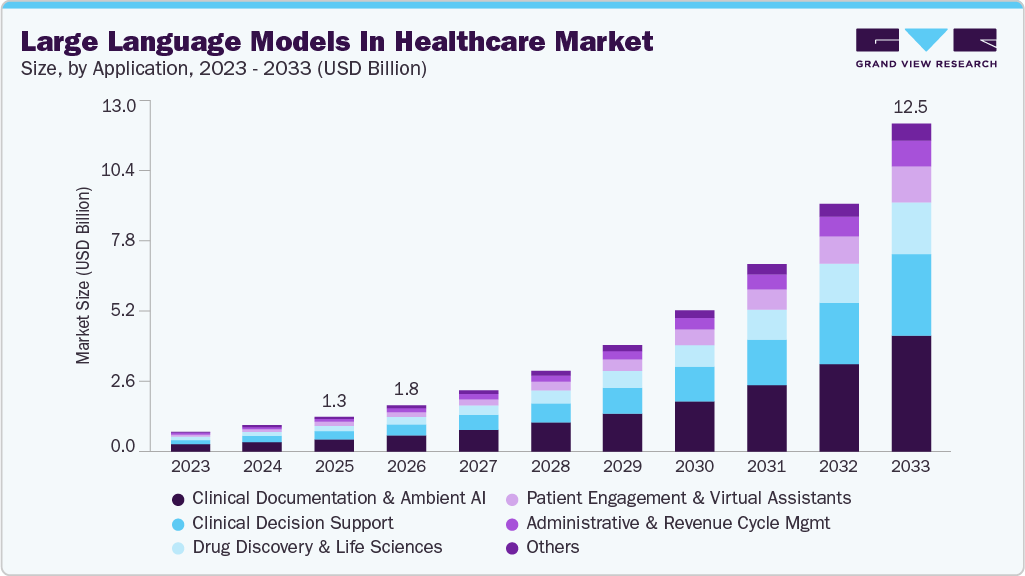
The global large language models in healthcare market size was estimated at USD 1.3 billion in 2025 and is projected to grow from USD 1.8 billion in 2026 to USD 12.5 billion in 2033, at a CAGR of 32.3% from 2026 to 2033. North America dominated the market with a revenue share of 55.9% in 2025. Rising volume of unstructured healthcare data, increasing adoption of AI in healthcare IT ecosystems, expansion of use cases in drug discovery and life sciences are factors driving the growth of the global large language models (LLM) in the healthcare market.
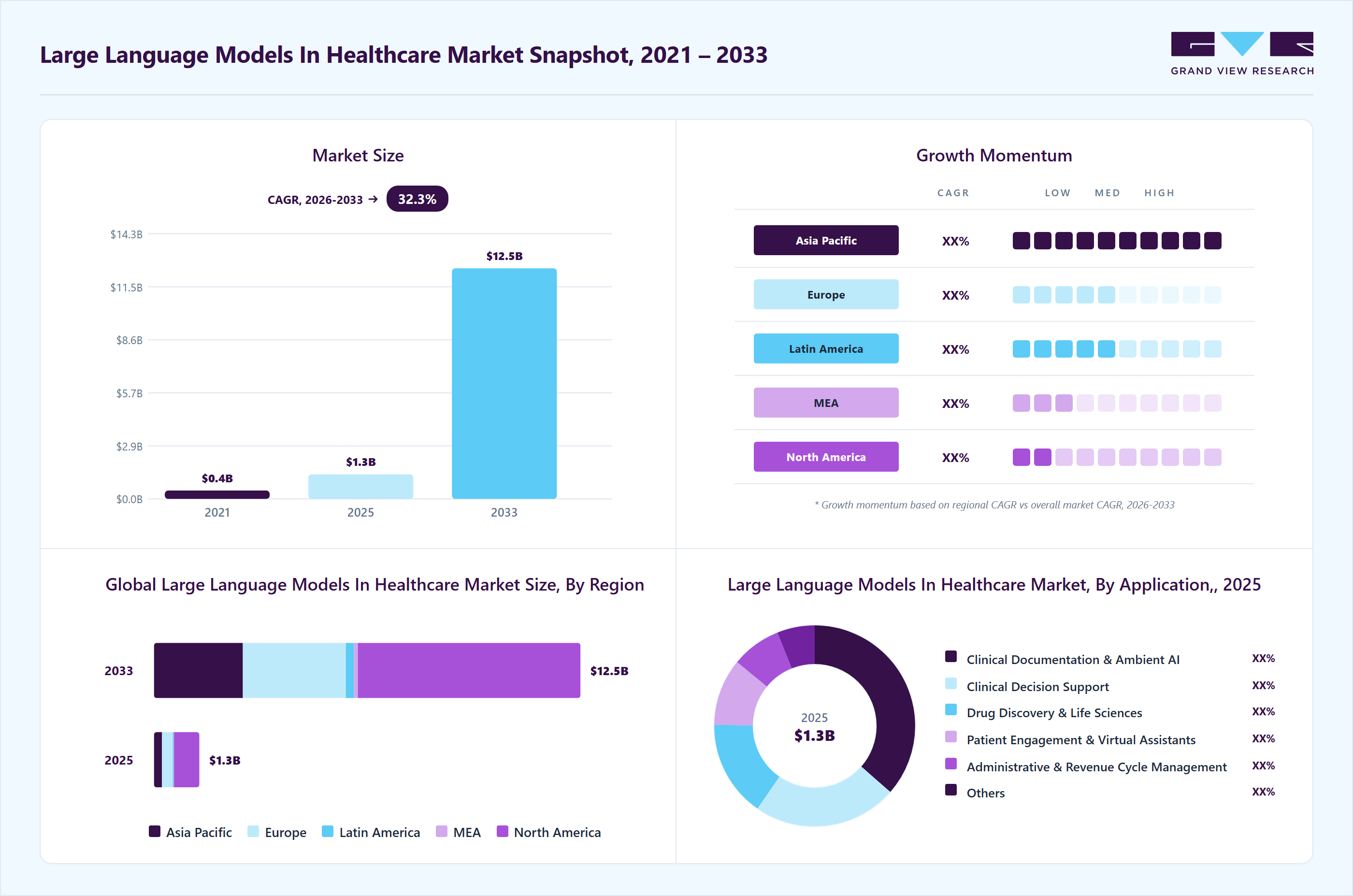 Source: Grand View Research, IR Documents, Primary Interviews, Paid DatabasesTo learn more about this report,
 Download Free Sample Report
 Key Market Trends & Insights
- By component: Software & GPT Platform segment held the largest revenue share of 66.6% in 2025.
- By application: Clinical documentation & ambient AI segment held the largest revenue share of 36.4% in 2025.
- By end use: Hospitals segment led the market with the largest revenue share of 45.6% in 2025.
- By deployment mode: The web/cloud-based segment accounted for the largest revenue share in 2025.
Regional Highlights
- Largest regional market: North America (55.9% market share, 2025)
- Fastest-growing Market: Asia Pacific (highest CAGR, 2026-2033)
- By Country: The U.S. held the largest market share in 2025.
Market Size & Forecast
- Market size in 2025: USD 1.3 Billion
- Market size in 2026: USD 1.8 Billion
- Projected market size by 2033: USD 12.5 Billion
- CAGR (2026–2033): 32.3%
Three ways to get this report
Buy it, customize it, or ask a question.Ask an Analyst
Analyst response in 1 business day
- AccessReport author, directly
- Reply timeWithin 1 working day
- No sales callDirect answer only
- FormatEmail reply
- CostFree, no cost
Get the Full Report
What the study covers
- FormatsPDF · Excel · Dashboard
- Timeline2026–2033 annual, 2025 base
- Coverage20+ countries, 5 regions
- Companies10+ key players profiled
Customize the Report
20% free customization
- IncludeCountries, segments, points
- TailorTo your product definition
- ExtendDeeper competitor detail
- OrA fully bespoke study
- Turnaround5–10 working days
 To learn more about this report, Download Free Sample Report
 The section below outlines the key factors driving the growth of large language models (LLM) in healthcare market, highlighting the Rising volume of unstructured healthcare data, increasing adoption of AI in healthcare IT ecosystems, and expansion of use cases in drug discovery and life sciences.
Rising Volume of Unstructured Healthcare Data
Healthcare systems generate vast amounts of unstructured data, including clinical notes, discharge summaries, radiology reports, and medical literature. A significant proportion of healthcare data remains text-heavy and underutilized due to limitations of traditional analytics tools. For instance, according to an article published by HealthTech in May 2023, around 80% of healthcare data is unstructured.
The large language models (LLM) address this gap by enabling advanced natural language understanding, extraction, and summarization of complex clinical information. This capability allows healthcare providers to gain actionable insights from electronic health records (EHRs), improving clinical decision-making and operational efficiency. Furthermore, the increasing digitization of healthcare systems and the widespread adoption of EHR platforms are amplifying data volumes, underscoring the need for scalable language-based AI solutions.
Increasing Adoption of AI in Healthcare IT Ecosystems
The broader adoption of artificial intelligence across healthcare IT infrastructure is creating a favorable environment for the deployment of LLMs. Healthcare organizations are investing in AI-enabled tools for diagnostics, workflow automation, and patient engagement, with LLMs emerging as a critical component of next-generation digital health platforms. Supportive regulatory developments around AI-based software as a medical device (SaMD), along with increased acceptance of AI-driven clinical tools, are further facilitating market growth. In addition, interoperability improvements and API-based integration models are enabling seamless incorporation of LLM capabilities into existing healthcare systems. For instance, in January 2026, Ensemble Health Partners partnered with Cohere to develop an RCM-native large language model tailored for healthcare. The model aims to automate administrative tasks such as coding and billing, improve accuracy, and enhance operational efficiency.
Expansion of Use Cases in Drug Discovery and Life Sciences
Pharmaceutical and biotechnology companies are increasingly leveraging LLMs for research and development activities, including literature review, hypothesis generation, clinical trial design, and patient recruitment. The ability of LLMs to process large volumes of biomedical literature and generate insights accelerates drug discovery timelines and reduces R&D costs. Growing investments in AI-driven drug discovery platforms and collaborations between technology providers and life sciences companies are further contributing to market expansion. For instance, in June 2024, Google introduced Tx-LLM, a large language model designed to accelerate drug discovery and therapeutic development. The model supports tasks such as target identification, clinical trial design, and scientific literature analysis. By leveraging advanced AI capabilities, Tx-LLM aims to improve research efficiency, enhance decision-making, and reduce timelines in pharmaceutical innovation. Moreover, this segment is expected to grow significantly as LLM capabilities evolve and become more specialized.
Market Concentration & Characteristics
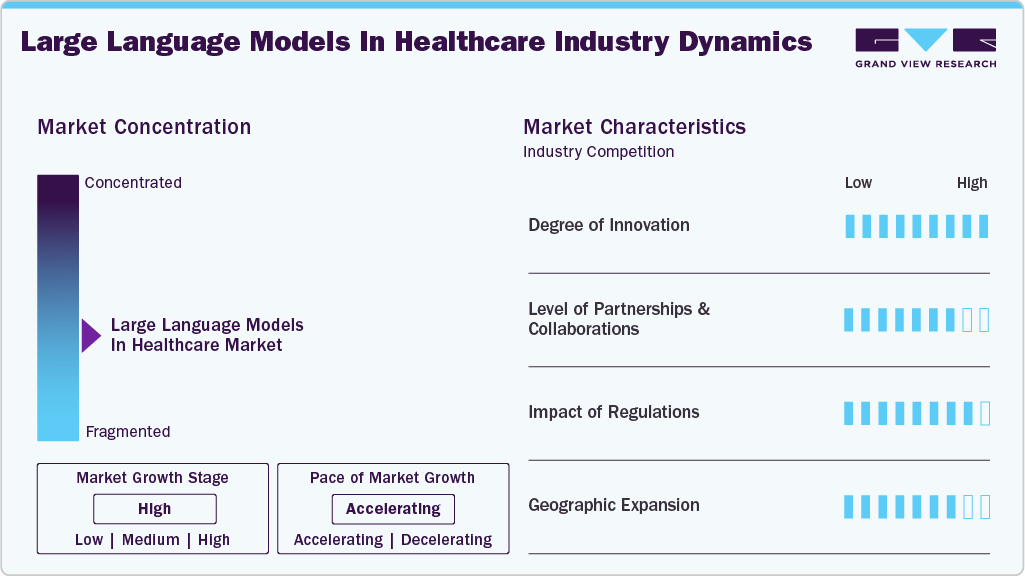
The chart below represents the relationship between industry concentration, industry characteristics, and industry participants. The market experiences a high degree of innovation, a significant level of partnership and collaboration activities, a high impact of regulations and geographic expansion of the industry.
The degree of innovation in the large language models (LLM) in healthcare industry is high. Technological advancements are driven by growing use of AI and other technologies in healthcare IT, drug discovery & research, patient care, disease diagnostics, etc. For instance, in January 2026, Insilico Medicine launched Science MMaI, a multimodal generative AI system integrating large language models with biological and chemical data. The platform supports drug discovery by enabling target identification, molecule generation, and scientific analysis.
 To learn more about this report, Download Free Sample Report
 Partnerships and collaborations enable companies to expand their geographic presence, strengthen financial capabilities, and enhance technologically. For instance, in March 2025, the American Cancer Society partnered with Layer Health to use large language models to accelerate cancer research. The collaboration focuses on extracting insights from clinical data, improving patient matching for studies, and streamlining research workflows, enabling faster evidence generation and advancing oncology research and care delivery.
"Abstracting high-quality, real-world data from medical records has been one of the most significant bottlenecks in cancer research. Traditional manual abstraction is slow, costly and highly variable, while past AI approaches struggled with scalability and accuracy. Our platform is designed to overcome these limitations by reasoning over entire patient histories and justifying every extraction with direct evidence from the record. By bringing this capability to ACS’ groundbreaking research, we’re not just improving efficiency; we’re enabling a new depth of discovery that simply wasn’t possible before."
- David Sontag, CEO Layer Health, told MobiHealthNews.
The U.S. FDA classifies AI-driven clinical decision tools as Software as a Medical Device (SaMD) and requires premarket submissions under the 510(k) or De Novo pathways. The EU AI Act categorizes healthcare LLMs as high-risk systems, mandating conformity assessments, transparency obligations, and human oversight. GDPR and HIPAA impose stringent data privacy constraints on training datasets and patient interactions.
Geographic expansion significantly drives large language models (LLM) in healthcare industry by increasing market penetration, enabling access to diverse data sources, and fostering regulatory compliance and standardization. For instance, in November 2025, epikdoc launched epikdoc Pro and Patient LLM to enhance AI-driven dental decision-making in India.
“Dentistry in India has long needed a bridge between patients, practitioners, and labs. With epikdoc Pro and Patient LLM, we are not just adding features, we are rebuilding the foundation of trust in oral healthcare. Finally, an AI built by dentists for dentists. By making it an active partner in preventive care, diagnosis, and patient understanding, we are enabling dentists to focus on care while empowering patients with clarity and confidence.”
- Dr. Sanjeet Shanker, Founder and CEO, epikdoc.
Component Insights
The software and GPT platforms segment dominated the market with the largest market share of 66.6% in 2025. The software and GPT platforms segment is the core of large language models in the healthcare market, encompassing foundational models, clinical NLP engines, and AI development platforms delivered via APIs and integrated solutions. These core GPT platforms enable healthcare organizations to process and interpret unstructured data such as clinical notes, radiology reports, and medical literature. Integration with electronic health records and interoperability frameworks is a key feature that enables seamless data exchange. Adoption of software platforms is driven by the need to automate documentation, enhance clinical decision support, and improve operational efficiency. For instance, in April 2026, Ubie launched Consult, a medically validated LLM for patient health consultations, enabling conversational symptom analysis, photo uploads, OTC medication checks, and personalized guidance.
Deployment Mode Insights
The web/cloud-based segment accounted for the largest revenue share in 2025, driven by scalability, flexibility, and rapid implementation. In addition, this segment is anticipated to grow at the fastest CAGR from 2026 to 2033. Cloud platforms enable real-time processing of large-scale clinical and administrative datasets without requiring extensive on-site infrastructure. These solutions are typically delivered via APIs and SaaS models, enabling healthcare organizations to integrate LLM capabilities into existing systems, such as EHRs and revenue cycle platforms. For instance, in August 2023, Cognizant expanded its generative AI partnership with Google Cloud to develop healthcare-specific large language model (LLM) solutions, leveraging Vertex AI and Gemini models. These target administrative workflows include appeals/grievances management, provider contracting, marketing operations, and member engagement.
"Together, Cognizant and Google Cloud are moving beyond highly publicized content generation applications of generative AI to build enterprise healthcare solutions that drive significant cost optimization, business efficiencies and better experience. We're excited to be working closely with Google Cloud to realize the potential this new technology offers and demonstrate its business value for healthcare clients."
- Ravi Kumar S, CEO of Cognizant
Application Insights
Based on application, the clinical documentation & ambient AI segment held the largest revenue share of 36.4% in 2025. LLMs convert clinician-patient conversations into structured clinical notes, discharge summaries, and coding outputs in near real time. Ambient AI systems operate passively during consultations, capturing context and generating accurate documentation without disrupting workflows. LLM-enabled documentation systems also support medical coding and billing, improving revenue cycle efficiency. Advances in speech recognition and context-aware language modeling are enhancing transcription accuracy and clinical relevance. Increasing deployment across outpatient and inpatient environments is supporting the sustained growth of this segment.
The clinical decision support segment is expected to grow at the fastest CAGR during the forecast period. LLMs analyze structured and unstructured patient data, including clinical notes, lab results, and medical history, to generate evidence-based insights. These systems assist clinicians by summarizing patient records, identifying potential diagnoses, and suggesting treatment pathways. Adoption is supported by increasing demand for data-driven care and the need to reduce variability in clinical decision-making.
End-use Insights
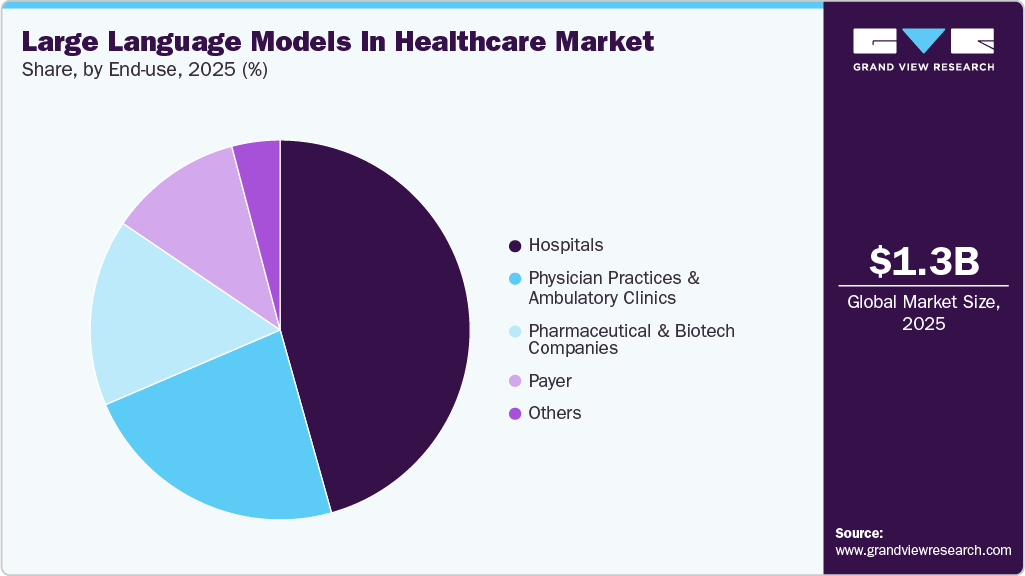
By end use, the hospitals segment registered the largest revenue share of 45.6% in 2025, driven by high patient volumes and complex clinical workflows. Hospitals generate extensive unstructured data across departments, creating a strong demand for LLM-enabled analytics and automation. Moreover, utilization is expanding across emergency care, inpatient units, and specialty departments to improve efficiency and care quality. LLMs reduce documentation burden through ambient AI and enhance coding accuracy for revenue cycle management. Hospitals also leverage these tools for patient communication, discharge planning, and clinical summarization.
 To learn more about this report, Download Free Sample Report
 The physician practices & ambulatory clinics segment is anticipated to grow at the fastest CAGR from 2026 to 2033, supported by increasing digitization of outpatient care. Adoption is driven by the need to improve efficiency, reduce administrative workload, and enhance patient interaction in time-constrained environments. LLMs support real-time transcription, clinical summarization, and automated coding, reducing manual effort and improving reimbursement accuracy. Practices are also deploying conversational AI tools for appointment management, patient queries, and care reminders, thereby contributing to market growth.
Regional Insights
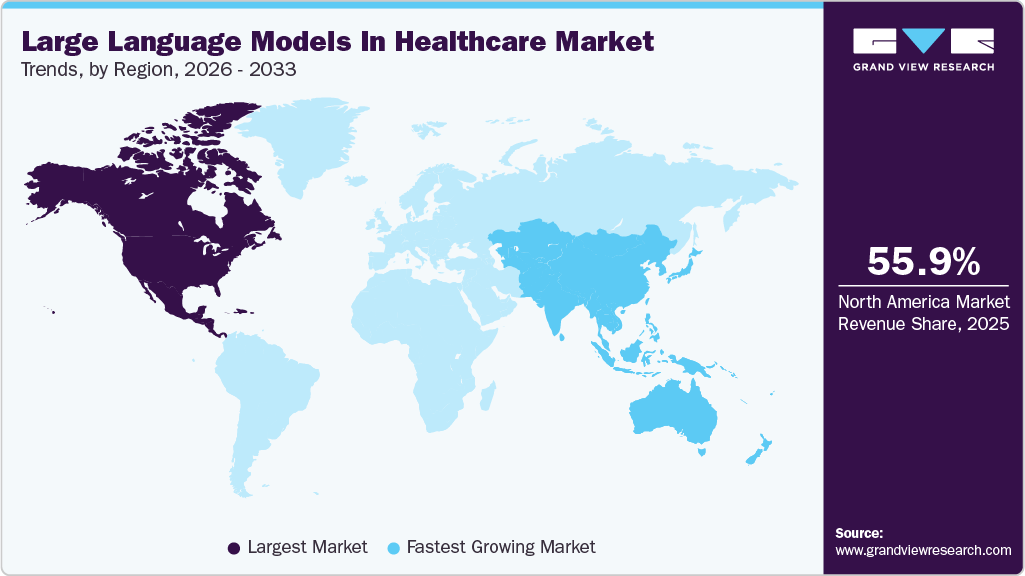
North America dominated the large language models in healthcare market with a revenue share of 55.9% in 2025. This growth is driven by advanced digital health infrastructure, high adoption of electronic health records (EHRs), and strong integration of AI into clinical and administrative workflows. The region benefits from a mature technology ecosystem and significant investments from the public and private sectors. Healthcare organizations are increasingly leveraging LLMs for clinical documentation, decision support, patient communication, and workflow automation. The presence of leading AI developers and healthcare institutions fosters rapid innovation, enabling widespread deployment of LLM-based solutions across care delivery settings.
 To learn more about this report, Download Free Sample Report
 U.S. Large Language Models In Healthcare Market Trends
The U.S. large language models (LLM) in healthcare market dominated the North America region in 2025. This growth is supported by widespread digitization of healthcare systems and strong adoption of advanced AI technologies. Integration of LLMs with EHR systems is improving workflow efficiency and reducing administrative burden. In addition, strong investment in digital health and AI innovation is accelerating the adoption of LLM-driven applications across hospitals, payers, and research organizations.
Europe Large Language Models In Healthcare Market Trends
The large language models (LLM) in healthcare market in Europe is steadily growing, supported by well-established public healthcare systems and increasing focus on digital transformation. Countries across the region are integrating LLMs into clinical workflows, medical documentation, and patient engagement platforms to enhance operational efficiency.
TheUK large language model (LLM) marketin healthcare is advancing as the country integrates AI technologies into its publicly funded healthcare system. Adoption is supported by national digital health initiatives, with healthcare providers increasingly utilizing LLMs for clinical documentation, patient triage, and administrative automation. Strong research capabilities and partnerships between healthcare institutions and technology providers are driving the development and adoption of LLM-based solutions. For example, UK-LLM is a large language model project developed by University College London, Bangor University, and NVIDIA to improve public service delivery in healthcare.
TheGermany large language models (LLMs) in healthcare marketis expanding as the country accelerates digitalization within its healthcare system and research ecosystem. LLMs are being increasingly adopted for clinical documentation, medical research, and healthcare data analysis. Strong emphasis on healthcare innovation and integration of AI into clinical and research workflows is supporting market growth.
Asia Pacific Large Language Models In Healthcare Market Trends
The Asia Pacific large language models (LLMs) in healthcare market is expected to grow at the fastest CAGR over the forecast period. The region is emerging as a key growth hub due to rapid digital transformation, expanding healthcare infrastructure, and increasing adoption of AI technologies. Rising demand for efficient healthcare delivery, combined with large patient populations and growing data availability, is driving the adoption of LLM-based solutions.
Moreover, governments and healthcare providers are focusing on leveraging AI to improve access, efficiency, and quality of care. For instance, in June 2025, Gleneagles Hospital Hong Kong partnered with HKUST spin-offs PanopticAI and SmartCare to deploy AI-powered clinical solutions at its new Gleneagles MediCentre day procedure center in Admiralty. SmartCare's multimodal LLM enables virtual consultations, patient triage, and pre-check-in, while PanopticAI provides camera-based vital signs monitoring.
TheChina large language models (LLMs) in healthcare marketis expected to grow significantly over the forecast period. The country is rapidly advancing in AI adoption within healthcare, supported by strong government initiatives and large-scale data availability. The focus on improving healthcare accessibility and efficiency is driving the deployment of LLM-based applications across hospitals and healthcare networks.
The Japan large language models (LLM) in healthcare marketis expanding steadily, supported by advanced healthcare infrastructure and a strong emphasis on digital transformation. The country is increasingly adopting LLMs to improve clinical documentation, streamline administrative workflows, and enhance patient engagement. For instance, in February 2026, Fujitsu announced the development of a healthcare-focused large language model designed to support clinical decision-making and medical research.
Latin America Large Language Models In Healthcare Market Trends
The large language models in healthcare market in Latin Americais expected to grow significantly over the forecast period. The region is increasingly adopting AI-driven solutions to address challenges related to healthcare access, efficiency, and resource constraints. Growing investments in digital health infrastructure and rising demand for cost-effective healthcare delivery are supporting the adoption of LLM-based applications.
Middle East and Africa Large Language Models In Healthcare Market Trends
Thelarge language models (LLMs) in healthcare market in MEAis expected to grow at a notable pace over the forecast period. The region is witnessing increasing adoption of AI technologies to enhance healthcare delivery and operational efficiency. LLMs are being implemented across applications such as clinical documentation, patient communication, and administrative automation. Government initiatives and investments in digital health infrastructure are supporting market growth, particularly in improving access to quality healthcare services.
Key Large Language Models In Healthcare Company Insights
Strategic initiatives, including partnerships, new launches, collaborations, & acquisitions, foster innovation and accelerate the development & deployment of LLM solutions in healthcare.
Key Large Language Models In Healthcare Companies:
The following key companies have been profiled for this study on the large language models (LLM) in healthcare market.
- MedGPT
- OpenAI
- Google DeepMind
- Microsoft
- Oracle
- Certilytics
- John Snow Labs
- Merative
- Anthropic
- Meta AI
- Hippocratic AI
- Ambience Healthcare
- Abridge AI, Inc.
- Tempus AI
- Aidoc
- Viz.ai
- Qure.ai
- PathAI
- Insilico Medicine
- Owkin
- BenevolentAI
Recent Developments
-
In March 2026, Certilytics Health Language Model (CertHLM) debuted as a healthcare-specific LLM providing real-time, expert-level decision support for clinical and financial intelligence. The agentic AI interface converts natural language queries into instant answers and reports, eliminating the need for manual dashboard navigation.
-
In November 2025, NVIDIA, Sheba Medical Center's ARC Innovation, and Mount Sinai's Icahn School of Medicine launched a three-year collaboration to decode 98% of the human genome, previously "junk DNA"-using LLMs.
-
In October 2025, John Snow Labs partnered with Lunar Analytics to deploy agentic AI solutions for pharmacy benefits, prior authorization, and workflow automation. The platform securely processes clinical and patient data on-premises, leveraging John Snow Labs' specialized medical LLMs and robust de-identification tools.
“This partnership combines proven medical LLMs, regulatory-grade de-identification, and secure environments so organizations can unlock opportunities along their value chain with strong governance from day one.”
-David Talby, CEO, John Snow Labs.
-
In September 2025, Rescripted launched Clara, the first large language model (LLM) built exclusively on science-backed women's health content. This free consumer-facing AI tool provides conversational answers on periods, menopause, postpartum health, and more, trained on Rescripted's medically reviewed editorial library and vetted partner content.
-
In May 2025, John Snow Labs acquired WiseCube, a leader in biomedical knowledge graphs and AI literature analysis, to improve the accuracy of healthcare AI.
-
In March 2025, John Snow Labs launched Medical LLM Reasoner, the first commercially available healthcare-specific reasoning LLM, at NVIDIA GTC 2025.
-
In May 2024, Rejoy Health launched "ChatGPT for Healthcare", a platform featuring specialized Large Language Models (LLMs) for healthcare AI agents.
Large Language Models In Healthcare Market Report Scope
Report Attribute
Details
Market size value in 2025
USD 1.3 billion
Estimated Market size in 2026
USD 1.8 billion
Projected Market size by 2033
USD 12.5 billion
Growth rate
CAGR of 32.3% from 2026 to 2033
Actual data
2021 - 2025
Forecast period
2026 - 2033
Quantitative units
Revenue in USD million/billion, and CAGR from 2026 to 2033
Report coverage
Revenue forecast, company ranking, competitive landscape, growth factors, and trends
Segments covered
Component, application, deployment mode, end-use, region
Regional scope
North America; Europe; Asia Pacific; Latin America; MEA
Country scope
U.S.; Canada; Mexico; UK; Germany; Spain; France; Italy; Denmark; Sweden; Norway; China; Japan; India; Australia; South Korea; Thailand; Brazil; Argentina; South Africa; Saudi Arabia; UAE; Kuwait
Key companies profiled
MedGPT; OpenAI; Google DeepMind; Microsoft; Oracle
Certilytics; John Snow Labs; Merative; Anthropic; Meta AI; Hippocratic AI; Ambience Healthcare; Abridge AI, Inc.; Tempus AI; Aidoc; Viz.ai; Qure.ai; PathAI; Insilico Medicine; Owkin; Benevolent AI
Customization scope
Free report customization (equivalent up to 8 analysts working days) with purchase. Addition or alteration to country, regional & segment scope.
Pricing and purchase options
Avail customized purchase options to meet your exact research needs. Explore purchase options
Global Large Language Models In Healthcare Market Report Segmentation
This report forecasts revenue growth and provides at global, regional, and country levels an analysis of the latest trends in each of the sub-segments from 2021 to 2033. For this report, Grand View Research has segmented the global large language models (LLM) in healthcare market report based on component, application, deployment mode, end-use, and region:
-
Component Outlook (Revenue, USD Million, 2021 - 2033)
-
Software and GPT Platform
-
Services
-
-
Application Outlook (Revenue, USD Million, 2021 - 2033)
-
Clinical Documentation & Ambient AI
-
Clinical Decision Support
-
Drug Discovery & Life Sciences
-
Patient Engagement & Virtual Assistants
-
Administrative & Revenue Cycle Mgmt
-
Others
-
-
Deployment Mode Outlook (Revenue, USD Million, 2021 - 2033)
-
Web & Cloud-based
-
On-premise
-
-
End-use Outlook (Revenue, USD Million, 2021 - 2033)
-
Hospitals
-
Physician Practices & Ambulatory Clinics
-
Pharmaceutical & Biotech Companies
-
Payer
-
Others
-
-
Regional Outlook (Revenue, USD Million, 2021 - 2033)
-
North America
-
U.S.
-
Canada
-
Mexico
-
-
Europe
-
UK
-
Germany
-
France
-
Italy
-
Spain
-
Denmark
-
Sweden
-
Norway
-
-
Asia Pacific
-
Japan
-
China
-
India
-
Australia
-
South Korea
-
Thailand
-
-
Latin America
-
Brazil
-
Argentina
-
-
Middle East & Africa
-
South Africa
-
Saudi Arabia
-
UAE
-
Kuwait
-
-
Frequently Asked Questions About This Report
The global large language models in healthcare market size was estimated at USD 1.3 billion in 2025 and is expected to reach USD 1.8 billion in 2026.
The global large language models in healthcare market is expected to grow at a compound annual growth rate of 32.3% from 2026 to 2033 to reach USD 12.5 billion by 2033.
The software & GPT platform segment held the largest market share of 66.6% in 2025.
Some key players operating in the largest large language models (LLM) in healthcare market include MedGPT; OpenAI; Google DeepMind; Microsoft; Oracle Certilytics; John Snow Labs; Merative; Anthropic; Meta AI; Hippocratic AI; Ambience Healthcare; Abridge AI, Inc.; Tempus AI; Aidoc; Viz.ai; Qure.ai; PathAI; Insilico Medicine; Owkin; Benevolent AI
Key factors that are driving the largest large language models (LLM) in healthcare market are rising volume of unstructured healthcare data, increasing adoption of AI in healthcare IT ecosystems, and expansion of use cases in drug discovery and life sciences.
The clinical documentation & ambient AI segment dominated with a 36.4% share in 2025, while clinical decision support segment is expected to grow at the fastest CAGR.
The hospitals segment held the largest revenue share of 45.6% in 2025, while physician practices & ambulatory clinics segment is anticipated to grow at the fastest CAGR.
North America dominated with a 55.9% revenue share in 2025, heavily propelled by infrastructure investments and the dominant market presence of the U.S.
About the Author(s)
Healthcare IT Research Team
Healthcare · Healthcare ITThis report was authored by the healthcare it research team at Grand View Research - comprising two research analysts, one senior research analyst, and one industry expert - with specialized expertise in the healthcare it segment of the healthcare industry. All findings are based on proprietary healthcare databases, executive interviews, and regulatory analysis, subject to internal peer review prior to publication.
Last Updated:
Speak to Analyst

Customize this report to your needs - add regions, segments, or data points, with 20% free customization.
Or view our licence options:


ISO 9001:2015 & 27001:2022 Certified
We are GDPR and CCPA compliant! Your transaction & personal information is safe and secure. For more details, please read our privacy policy.


