
- Home
- »
- Advanced Interior Materials
- »
-
Laser Welding Machine Market Size And Share Report, 2033GVR Report cover
![Laser Welding Machine Market Size, Share & Trends Report]()
Laser Welding Machine Market (2026 - 2033) Size, Share & Trends Analysis Report By Laser Type (Fiber Laser, Nd:YAG Laser, Diode Laser, CO2 Lasers), By Mode of Operation (Automatic, Semi-automatic, Manual), By End Use (Automotive, Medical, Electronics & Semiconductor), By Region, And Segment Forecasts
Market Size, 2025
$1.4BMarket Estimate, 2026
$1.5BMarket Forecast, 2033
$2.4BCAGR, 2026–2033
6.6%Laser Welding Machine Market Summary
The global laser welding machine market size was valued at USD 1.4 billion in 2025 and is projected to grow from USD 1.5 billion in 2026 to USD 2.4 billion by 2033, at a CAGR of 6.6% from 2026 to 2033. The market in Asia Pacific dominated with a revenue share of 37.0% in 2025. The increasing demand for high-precision and high-speed joining solutions across manufacturing industries primarily drives the growth.
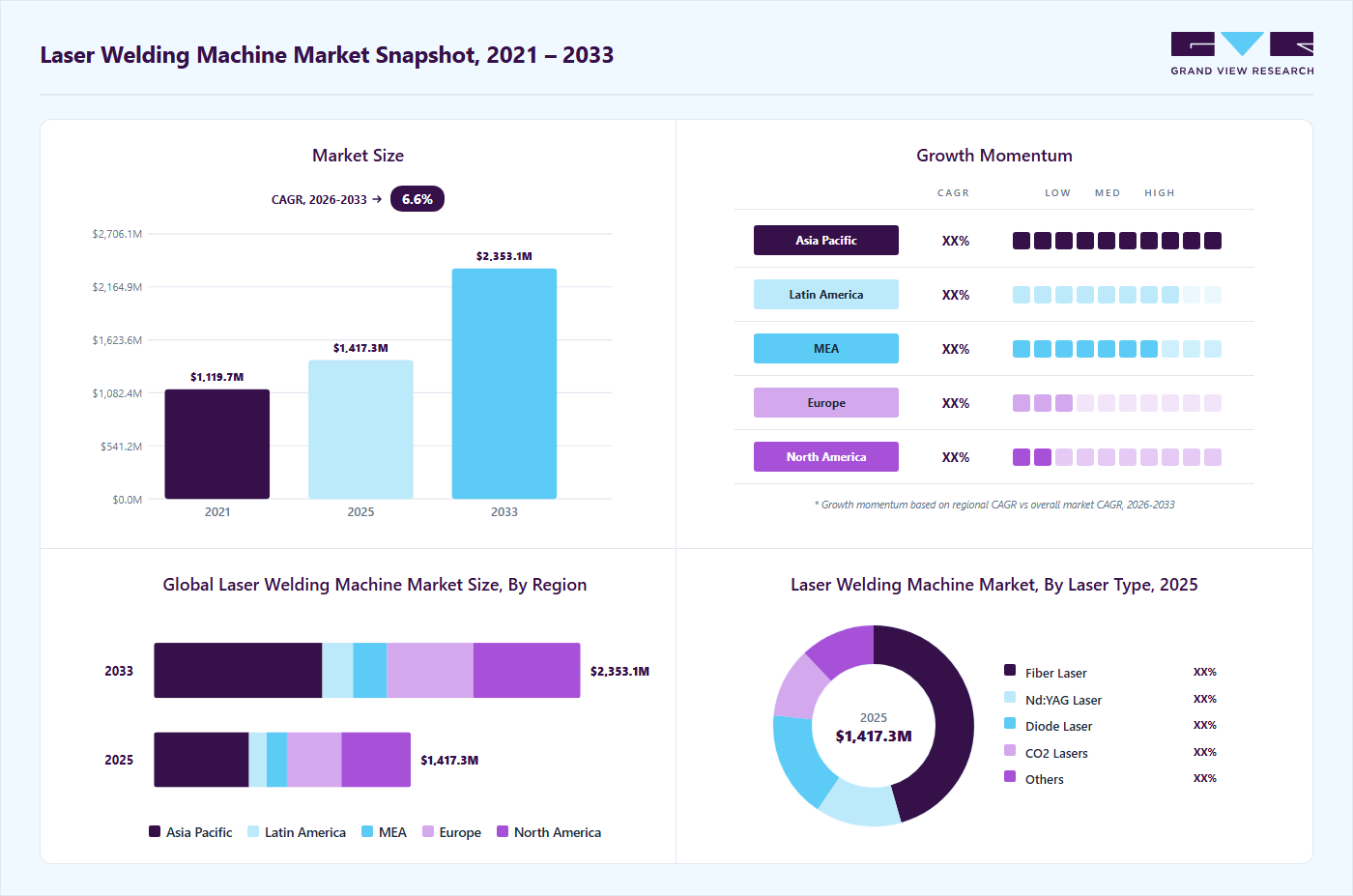
Key Market Trends & Insights
- By laser type: Fiber laser segment dominated the market, accounting for a revenue share of 45.5% in 2025.
- By mode of operation: Automatic segment accounted for 48.6% of the laser welding machine market share in 2025.
- By end-use: Automotive segment accounting for a revenue share of 35.9% in 2025.
Regional Highlights
- Largest regional market: Asia Pacific (37.0% revenue share, 2025)
- By country: The China held the largest market share in 2025.
Market Size & Forecast
- Market size in 2025: USD 1.4 Billion
- Estimated market size in 2026: USD 1.5 Billion
- Projected market size by 2033: USD 2.4 Billion
- CAGR (2026-2033): 6.6%
Three ways to get this report
Buy it, customize it, or ask a question.Get the Full Report
What the study covers
- FormatsPDF · Excel · Dashboard
- Timeline2026–2033 annual, 2025 base
- Coverage20+ countries, 5 regions
- Companies10+ key players profiled
Customize the Report
20% free customization
- IncludeCountries, segments, points
- TailorTo your product definition
- ExtendDeeper competitor detail
- OrA fully bespoke study
- Turnaround5–10 working days
Ask an Analyst
A direct answer, usually in 1 working day
- AccessReport author, directly
- Reply timeWithin 1 working day
- No sales callDirect answer only
- FormatEmail reply
- CostFree, no cost
Sectors such as automotive, aerospace, electronics, and medical devices are adopting laser welding due to its ability to deliver strong, clean, and consistent welds with minimal heat distortion. Technological advancements, such as fiber laser systems and improved beam control, are enhancing performance while lowering operating costs. Furthermore, stricter quality standards and the need for reliable welding in critical applications are pushing industries to adopt laser-based solutions, strengthening the long-term growth outlook for the laser welding machine industry.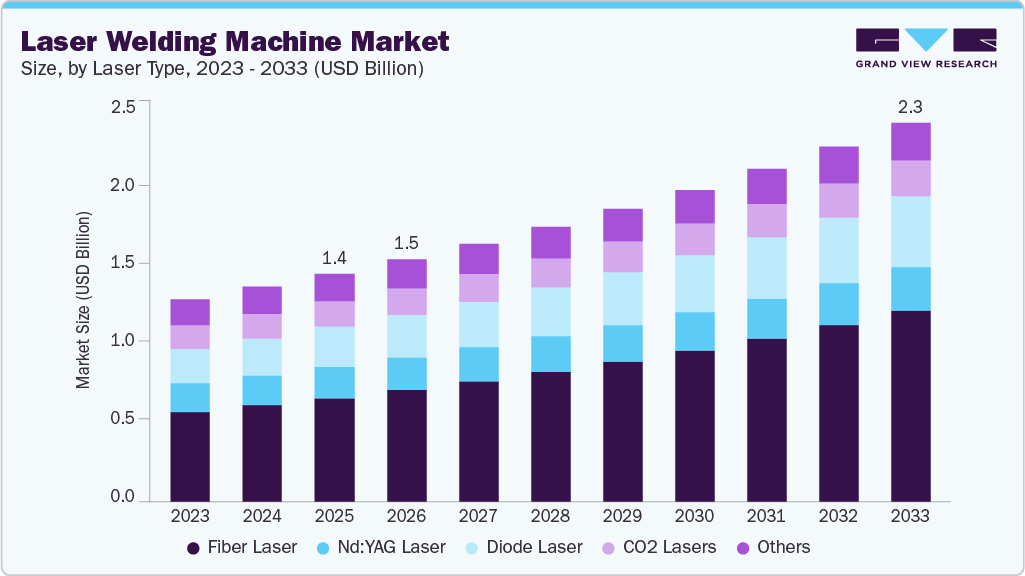
Market Dynamics
The growing demand for high-precision, high-speed, and automated joining technologies across industries such as automotive, electronics, aerospace, medical devices, and heavy engineering is a major factor driving the laser welding machine market. Laser welding machines are increasingly preferred over conventional welding technologies due to their ability to deliver precise, clean, and high-strength welds with minimal heat distortion and material wastage. These systems are widely used in applications requiring complex geometries, thin materials, micro-welding, and high-quality finishing, particularly in electric vehicle battery manufacturing, semiconductor production, and precision component fabrication.
In the automotive sector, rising production of electric vehicles (EVs) and battery systems is significantly accelerating demand for laser welding technologies used in battery cells, power electronics, and lightweight vehicle structures. Similarly, increasing miniaturization in electronics manufacturing and growing use of advanced materials in aerospace and medical applications are further supporting market growth.
Advanced laser welding systems require expensive components, including high-power laser sources, precision optics, robotic integration systems, cooling units, and advanced control software, resulting in substantial upfront equipment costs. Small and medium-sized manufacturers often face financial barriers in adopting laser welding technologies, particularly in price-sensitive industrial sectors. In addition, laser welding processes require skilled operators and precise parameter control to achieve consistent weld quality and avoid defects such as porosity, cracking, and thermal distortion. Material compatibility, joint preparation, beam alignment, and process calibration also require specialized technical expertise, increasing operational complexity and training requirements.
Laser Type Insights
The fiber laser segment dominated the market, accounting for a revenue share of 45.5% in 2025, driven by strong demand for high-speed, high-precision welding in automotive, electronics, and metal fabrication industries. Their superior beam quality, high energy efficiency, and low maintenance requirements make them well-suited for continuous industrial production. The increasing focus on lightweight materials, Electric Vehicle (EV) components, and automation further supports the adoption of fiber laser systems for consistent and repeatable welding performance.
The diode laser segment is expected to grow at a significant CAGR of 7.6% from 2026 to 2033 in terms of revenue. Diode laser welding machines are gaining traction due to their compact design, high electrical efficiency, and suitability for applications requiring controlled heat input. Demand is supported by their use in electronics, medical device manufacturing, and thin-material welding, where thermal distortion must be minimized. Growth opportunities are also emerging from cost-sensitive industrial users seeking reliable laser solutions with lower operational complexity.
Mode of Operation Insights
The automatic segment accounted for 48.6% of the laser welding machine market share in 2025, primarily driven by the rising adoption of Industry 4.0 manufacturing practices, which require high throughput and consistent weld quality, particularly in robotics- and automated production-line applications. Automotive and electronics manufacturers increasingly invest in fully automated laser systems to improve productivity, reduce labor dependency, and enhance process traceability. The need for scalable mass production, particularly in EV battery and component assembly, further accelerates demand.
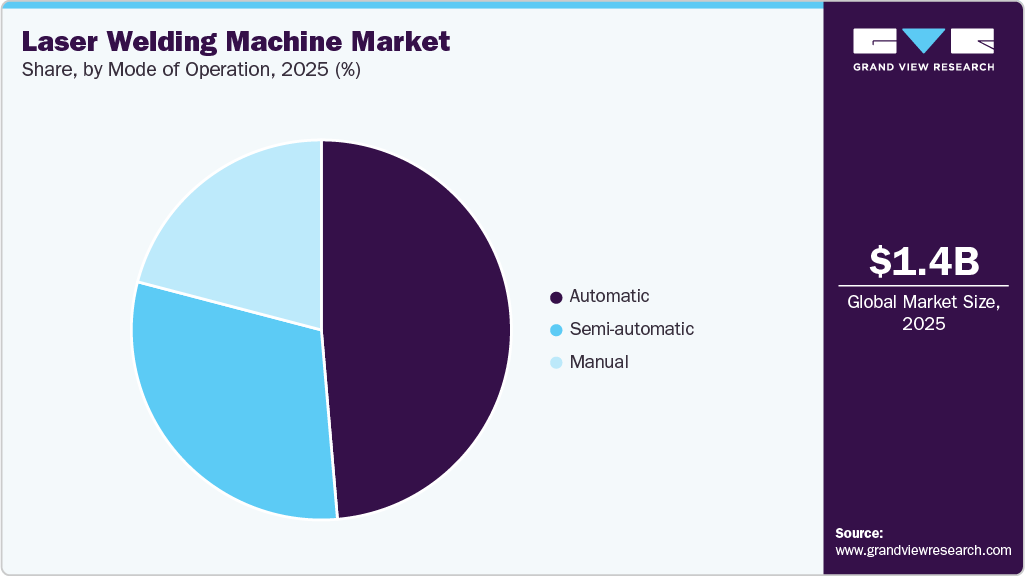
The growth of the semi-automatic segment is projected to expand at a CAGR of 5.4% from 2026 to 2033 in terms of revenue. The growth of the semi-automatic laser welding machines is expected to be driven by demand from mid-sized manufacturers seeking a balance between flexibility and productivity. These systems are widely adopted in job-shop environments and specialized fabrication settings where partial automation improves efficiency while retaining operator control. Growth is supported by lower capital investment compared to fully automatic systems and the need for adaptable welding solutions across diverse industrial applications.
End Use Insights
The automotive segment dominated the global laser welding machine industry, accounting for a revenue share of 35.9% in 2025, driven by the increasing shift toward lightweight vehicle structures, Electric Vehicles (EVs), and advanced safety requirements that demand strong and precise welds. Laser welding is widely used for body-in-white applications, battery pack assembly, and powertrain components due to its speed and suitability for automated production. Rising global vehicle electrification and higher manufacturing efficiency targets remain key growth drivers.
The electronics & semiconductor segment is expected to grow at a significant CAGR of 7.9% from 2026 to 2033 in terms of revenue. The growth of the electronics and semiconductor end-use segment is driven by the need for ultra-precise, low-heat welding in miniaturized components, sensors, and microelectronics assemblies. Laser welding enables clean, high-quality joints with minimal thermal damage, making it critical for advanced packaging and high-reliability semiconductor devices. The expansion of consumer electronics, 5G infrastructure, and semiconductor manufacturing capacity continues to strengthen demand.
Regional Insights
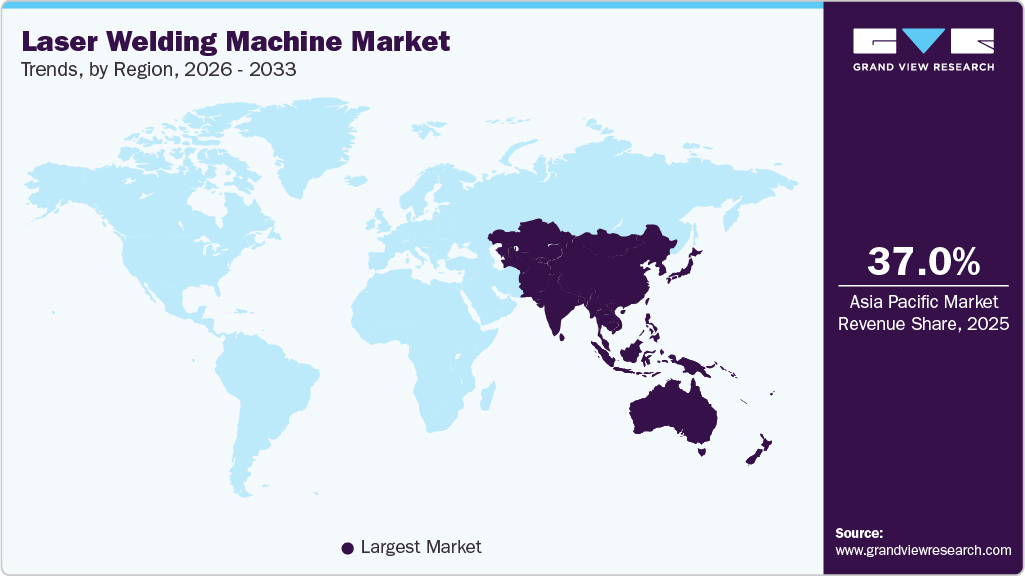
The Asia Pacific laser welding machine industry held the largest global revenue share of over 37.0% in 2025, driven by rapid industrialization, strong electronics and semiconductor manufacturing bases, and expanding automotive production in countries such as China, Japan, South Korea, and India. Rising investments in Electric Vehicle (EV) supply chains, large-scale manufacturing capacity additions, and increasing adoption of automation in factories continue to accelerate demand for advanced laser welding solutions.
China Laser Welding Machine Market Trends
The China laser welding machine market is a major industry in the region and worldwide, driven by its dominant position in electronics manufacturing, large-scale automotive production, and the rapidly expanding Electric Vehicle (EV) supply chain. Strong government support for advanced manufacturing, increased factory automation, and ongoing investments in high-tech industrial capacity are accelerating the adoption of high-speed, precision laser welding systems across multiple end-use sectors.
The laser welding machine market in India is poised for growth, driven by rising industrialization, expanding automotive manufacturing, and increasing investments in electronics assembly and semiconductor initiatives. Demand is further driven by government programs promoting domestic production and the modernization of industrial infrastructure. Adoption of laser welding is gaining momentum as manufacturers seek efficient, high-quality joining solutions for competitive production.
North America Laser Welding Machine Market Trends
The North America laser welding machine industry is expected to grow, driven by the high adoption of advanced manufacturing technologies across the automotive, aerospace, defense, and medical device industries. The region benefits from strong investments in automation, robotics integration, and high-value production requiring precision welding. Growth is further supported by the expansion of EV manufacturing and the need for efficient, high-quality joining processes in industrial modernization initiatives.
The U.S. market’s growth is driven by strong demand from the aerospace, defense, automotive, and medical device industries, which require advanced precision welding technologies. High adoption of automation, robotics-enabled manufacturing, and Industry 4.0 integration supports steady growth. The expansion of EV production and battery manufacturing capacity also significantly contributes to investments in laser welding systems.
Europe Laser Welding Machine Market Trends
The Europe laser welding machine industry is supported by a strong automotive and aerospace base, along with stringent quality and sustainability standards that encourage the adoption of energy-efficient laser welding systems. Demand is reinforced by the region’s leadership in Electric Vehicle (EV) production, lightweight material applications, and advanced industrial automation. Government-backed initiatives for smart manufacturing and emissions reduction also contribute to steady market expansion.
The Germany laser welding machine market is a key regional market, supported by its leadership in automotive engineering, industrial machinery, and high-value manufacturing. Demand is driven by the need for advanced welding solutions in Electric Vehicle (EV) platforms, lightweight material processing, and automated production lines. Strong emphasis on quality, efficiency, and technological innovation continues to position Germany as a major hub for laser welding adoption.
The laser welding machine market in France is experiencing steady growth, supported by its aerospace and defense industry base and demand from the automotive and advanced manufacturing sectors. Investments in industrial modernization, automation, and high-precision fabrication are driving the uptake of laser welding technologies. The push toward sustainable manufacturing and advanced mobility solutions further supports market development.
Latin America Laser Welding Machine Market Trends
The Latin America laser welding machine industry is experiencing gradual growth, driven by expanding industrial activity, increasing automotive assembly operations, and the modernization of manufacturing infrastructure. Adoption is supported by demand for improved production efficiency and higher-quality welding in the metal fabrication and transportation sectors. However, growth remains influenced by investment cycles and the pace of industrial automation across key economies.
The Brazil laser welding machine market is witnessing significant growth, driven by growth in automotive assembly, metal fabrication, and industrial equipment manufacturing. Demand for laser welding is increasing as manufacturers modernize production processes and seek higher efficiency and improved weld quality. Market expansion is gradual, influenced by economic conditions and the pace of industrial technology adoption.
Middle East & Africa Laser Welding Machine Market Trends
The Middle East and Africa laser welding machine industry is driven by growing infrastructure development, industrial diversification efforts, and rising investments in metal fabrication, oil and gas equipment manufacturing, and construction-related industries. Demand for laser welding is emerging as regional manufacturers seek higher precision and productivity. Market growth is still in its early stages, supported by the gradual adoption of advanced manufacturing technologies.
The Saudi Arabia laser welding machine market is an emerging industry, supported by industrial diversification initiatives under Vision 2030 and rising investments in manufacturing, infrastructure, and energy-related equipment production. Demand is developing in metal fabrication and industrial construction applications where precision welding can enhance productivity. Growth potential is linked to the continued expansion of advanced manufacturing capabilities in the region.
Key Laser Welding Machine Company Insights
Some of the key players operating in the market include TRUMPF and IPG Photonics Corporation.
-
TRUMPF is a prominent manufacturer of industrial laser technology and machine tools for manufacturing. It develops and produces a broad portfolio of laser welding systems, along with beam-delivery and automation solutions for cutting, marking, and surface processing across automotive, aerospace, electronics, and other industrial sectors. The company has over 70 subsidiaries and has a strong global network.
-
IPG Photonics Corporation is a U.S.-based company involved in fiber laser technology, founded in 1990. The company designs and manufactures a wide range of laser systems for welding, cutting, drilling, heating, drying, and cleaning applications. The company serves the electronics, automotive, aerospace, telecommunications, and medical industries, among others. The company has a strong presence in North America, Europe, and Asia Pacific.
Key Laser Welding Machine Companies:
The following key companies have been profiled for this study on the laser welding machine market.
- TRUMPF
- IPG Photonics Corporation.
- Coherent Corp
- AMADA WELD TECH
- PRIMA INDUSTRIE S.p.A.
- Han’s Laser Technology Group Co., Ltd
- Wuhan HGLaser Engineering Co., Ltd
- Baison Laser
- JI NAN SENFENG LASER TECHNOLOGY CO., LTD
- Alpha Laser US
- The Lincoln Electric Company
- Laser Star Technologies
- Penta Laser (Zhejiang) Co., Ltd
- Worldwel
- ShenZhen Herolaser Equipment Co., Ltd
Competitive Benchmarking
Operating Strategies
Competitive Edge
Weaknesses
Mature Players: TRUMPF; IPG Photonics Corporation; Coherent Corp; AMADA WELD TECH; PRIMA INDUSTRIE S.p.A.; Han’s Laser Technology Group Co., Ltd; The Lincoln Electric Company
- Strong investments in high-power fiber laser systems, automation integration, and smart welding technologies
- Expansion of robotic laser welding solutions for automotive, aerospace, electronics, and EV battery manufacturing applications
- Focus on Industry 4.0-enabled welding systems with AI-based monitoring and precision process control
- Strong global brand recognition and advanced laser processing expertise
- High welding precision, operational speed, and automation capabilities
- Established customer base across automotive, electronics, aerospace, and industrial manufacturing sectors
- Strong R&D capabilities in fiber lasers, beam control, and intelligent welding solutions
- High equipment and integration costs compared to conventional welding systems
- Dependence on industrial capital expenditure and manufacturing investment cycles
- Complex installation, calibration, and operator skill requirements
- Increasing competition from cost-competitive Asian laser equipment suppliers
Emerging Players: Wuhan HGLaser Engineering Co., Ltd; Baison Laser; JI NAN SENFENG LASER TECHNOLOGY CO., LTD; Alpha Laser U.S.; Laser Star Technologies
- Focus on cost-effective laser welding solutions and regional manufacturing market expansion
- Increasing emphasis on compact, automated, and customized laser welding systems
- Expansion into small and medium-sized industrial manufacturing applications
- Competitive pricing and flexibility in customized welding system configurations
- Strong responsiveness to localized industrial and fabrication requirements
- Growing adoption in metal fabrication, electronics, jewelry, and precision engineering applications
- Comparatively lower global market penetration and brand visibility
- Limited financial scale for large R&D and international expansion investments
- Lower technological diversification compared to multinational laser technology providers
Recent Developments
-
In September 2025, Han’s Laser introduced its next-generation handheld laser welding machine lineup called the Blue Crystal series, comprising models A55, A65, and A85. This series is engineered for improved stability, deep weld penetration, and reliable performance in challenging environments, including high temperatures, humidity, and dusty conditions. It features advanced thermal management, intelligent control systems, and ergonomic, lightweight designs that support consistent, high-quality welds across a range of materials and thicknesses. The offering also integrates a broader ecosystem of support, including training, process assistance, and accessories to enhance operational flexibility and efficiency in industrial welding applications.
-
In September 2025, Lincoln Electric launched the Flex Lase Handheld Laser Welding System, a 2 kW portable laser solution designed to bring high-precision, high-speed welding to the shop floor and fabrication environments. The system delivers welding travel speeds up to four times faster than traditional TIG (Tungsten Inert Gas) processes while maintaining consistent weld quality and reducing distortion across materials such as stainless steel, carbon steel, and aluminum. It supports both autogenous and wire-fed operations, including Lincoln’s HyperFill twin-wire technology, and aims to simplify operator onboarding with an intuitive interface that accelerates time-to-production.
Laser Welding Machine Market Report Scope
Report Attribute
Details
Market size in 2025
USD 1.4 billion
Estimated market size in 2026
USD 1.5 billion
Projected market size by 2033
USD 2.4 billion
Growth rate
CAGR of 6.6% from 2026 to 2033
Base year for estimation
2025
Historical data
2021 - 2024
Forecast period
2026 - 2033
Quantitative units
Revenue in USD million and CAGR from 2026 to 2033
Report coverage
Revenue forecast, company market position analysis, competitive landscape, growth factors, and trends
Segments covered
Laser type, mode of operation, end use, region
Regional scope
North America; Europe; Asia Pacific; Latin America; Middle East & Africa
Country Scope
U.S.; Canada; Mexico; UK; Germany; France; Italy; Spain; China; India; Japan; South Korea; Australia; Brazil;
Argentina; South Africa; Saudi Arabia; UAE
Key companies profiled
TRUMPF; IPG Photonics Corporation; Coherent Corp; AMADA WELD TECH; PRIMA INDUSTRIE S.p.A.; Han’s Laser Technology Group Co., Ltd; Wuhan HGLaser Engineering Co., Ltd; Baison Laser; JI NAN SENFENG LASER TECHNOLOGY CO., LTD; Alpha Laser US; The Lincoln Electric Company; Laser Star Technologies; Penta Laser (Zhejiang) Co., Ltd; Worldwel; ShenZhen Herolaser Equipment Co., Ltd
Customization scope
Free report customization (equivalent up to 8 analysts working days) with purchase. Addition or alteration to country, regional & segment scope.
Pricing and purchase options
Avail customized purchase options to meet your exact research needs. Explore purchase options
Global Laser Welding Machine Market Report Segmentation
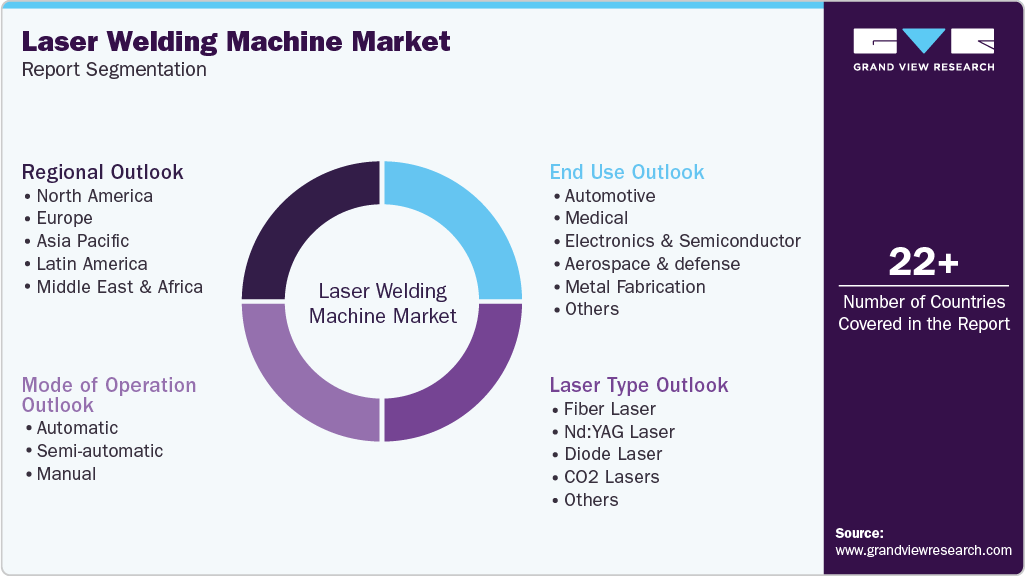
This report forecasts revenue growth at the global, regional & country levels and provides an analysis of the industry trends in each of the sub-segments from 2021 to 2033. For this study, Grand View Research has segmented the global laser welding machine market report based on laser type, mode of operation, end use, and region:
-
Laser Type Outlook (Revenue, USD Million, 2021 - 2033)
-
Fiber Laser
-
Nd:YAG Laser
-
Diode Laser
-
CO2 Lasers
-
Others
-
-
Mode of Operation Outlook (Revenue, USD Million, 2021 - 2033)
-
Automatic
-
Semi-automatic
-
Manual
-
-
End Use Outlook (Revenue, USD Million; 2021 - 2033)
-
Automotive
-
Medical
-
Electronics & Semiconductor
-
Aerospace & defense
-
Metal Fabrication
-
Others
-
-
Regional Outlook (Revenue, USD Million, 2021 - 2033)
-
North America
-
U.S.
-
Canada
-
Mexico
-
-
Europe
-
UK
-
Germany
-
France
-
Italy
-
Spain
-
-
Asia Pacific
-
China
-
India
-
Japan
-
South Korea
-
Australia
-
-
Latin America
-
Brazil
-
Argentina
-
-
Middle East & Africa
-
South Africa
-
Saudi Arabia
-
UAE
-
-
Delivered Customizations
This report has been delivered with the following In-depth customizations
Client Request
Customization Delivered
Value Adds
Regional Segmentation
Detailed market estimates and forecasts for the laser welding machine market across North America, Europe, Asia Pacific, Latin America, and Middle East & Africa. Country-level demand analysis covering automotive, aerospace, electronics, medical devices, battery manufacturing, and industrial fabrication sectors.
Identify high-growth regional markets and advanced manufacturing investment hotspots. Support regional expansion planning, distributor network optimization, and demand forecasting.
Market Share & Competitive Positioning
Comprehensive analysis of market share by leading laser welding machine manufacturers, including revenue share, technological leadership, regional dominance, automation capabilities, and competitive intensity within the Laser Welding Machine Market.
Enable evaluation of market concentration and competitive landscape. Support acquisition targeting, market entry planning, and strategic positioning.
Opportunity Assessment
Identification of emerging growth opportunities driven by electric vehicle production growth, battery manufacturing expansion, Industry 4.0 adoption, precision electronics manufacturing, and increasing use of lightweight materials in industrial applications.
Prioritize high-growth applications and investment opportunities. Support innovation roadmap development and long-term strategic planning.
Frequently Asked Questions About This Report
The global laser welding machine market size was estimated at USD 1.4 billion in 2025 and is expected to reach USD 1.5 billion in 2026.
The global laser welding machine market, in terms of revenue, is expected to grow at a compound annual growth rate of 6.6% from 2026 to 2033 to reach USD 2.4 billion by 2033.
Asia Pacific dominated with a 37.0% revenue share in 2025.
Some of the key players operating in the laser welding machine market TRUMPF, IPG Photonics Corporation, Coherent Corp, AMADA WELD TECH, PRIMA INDUSTRIE S.p.A., Han’s Laser Technology Group Co., Ltd, Wuhan HGLaser Engineering Co., Ltd, Baison Laser, JI NAN SENFENG LASER TECHNOLOGY CO., LTD, Alpha Laser US, The Lincoln Electric Company, Laser Star Technologies, Penta Laser (Zhejiang) Co., Ltd, Worldwel, and ShenZhen Herolaser Equipment Co.,Ltd.
Key factors include rising demand for high-precision joining in automotive, electronics, and aerospace industries, supported by Electric Vehicle (EV) growth, automation adoption, and the need for efficient, high-speed manufacturing processes.
The fiber laser segment led with a 45.5% revenue share in 2025, while diode laser is the growing significantly.
The automatic segment segment held the highest market share of 48.6% in 2025.
The automotive segment accounted for the largest share of 35.9% in 2025, while electronics & semiconductor is the growing significantly.
About the Author(s)
Advanced Interior Materials Research Team
Advanced Materials · Advanced Interior MaterialsThis report was authored by the advanced interior materials research team at Grand View Research - comprising two research analysts, one senior research analyst, and one industry expert - with specialized expertise in the advanced interior materials segment of the advanced materials industry. All findings are based on proprietary advanced materials databases, executive interviews, and regulatory analysis, subject to internal peer review prior to publication.
Last Updated:
Speak to Analyst


Customize this report to your needs - add regions, segments, or data points, with 20% free customization.
Or view our licence options:


ISO 9001:2015 & 27001:2022 Certified
We are GDPR and CCPA compliant! Your transaction & personal information is safe and secure. For more details, please read our privacy policy.


