
- Home
- »
- Advanced Interior Materials
- »
-
Lightweight Aggregate Concrete Market Size Report, 2033GVR Report cover

Lightweight Aggregate Concrete Market (2025 - 2033) Size, Share & Trends Analysis Report By End-use (Residential Construction, Commercial Construction), By Concrete Type, By Region, And Segment Forecasts
Market Size, 2024
$6.0BMarket Estimate, 2026
$6.4BMarket Forecast, 2033
$10.1BCAGR, 2025–2033
5.9%Lightweight Aggregate Concrete Market Summary
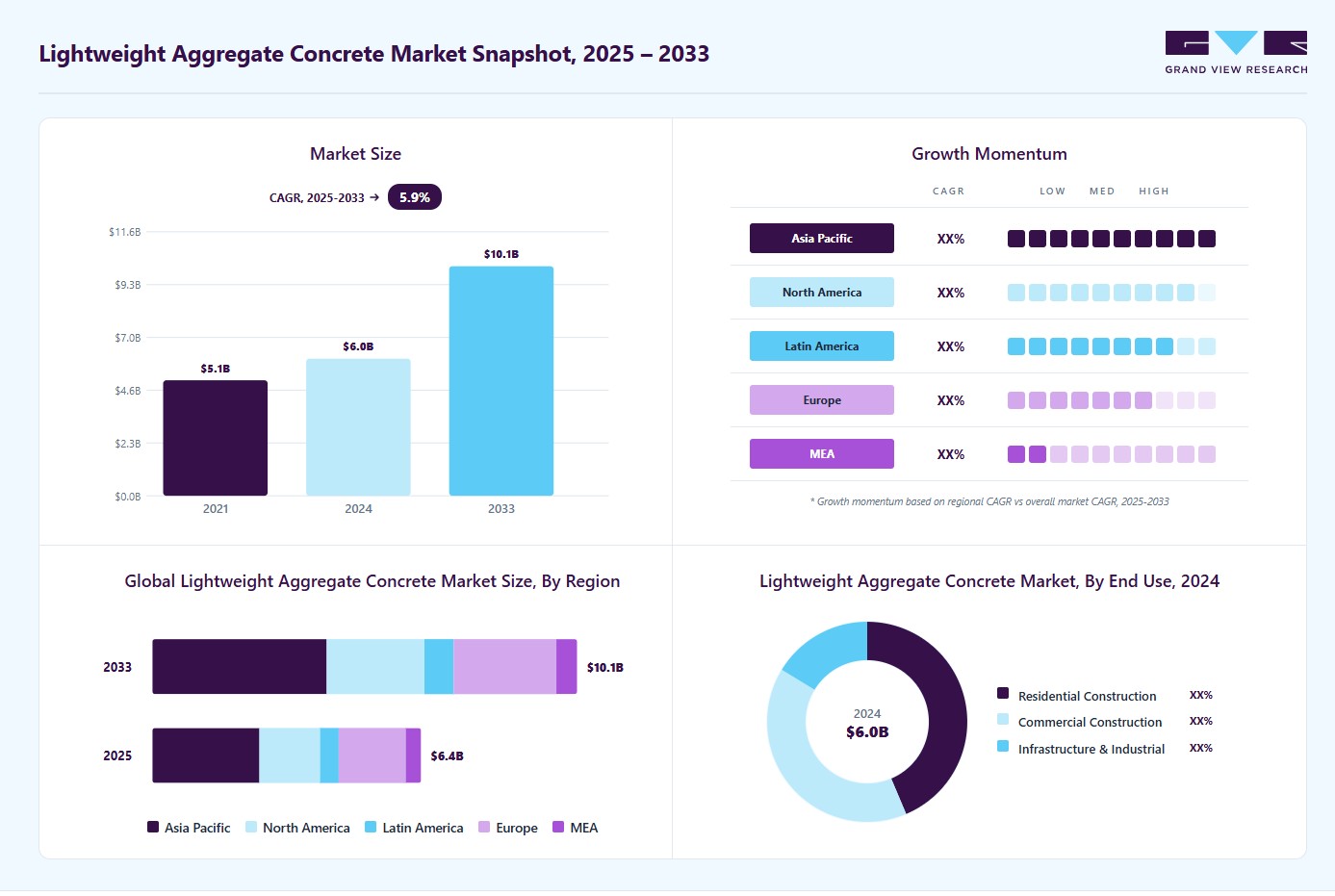
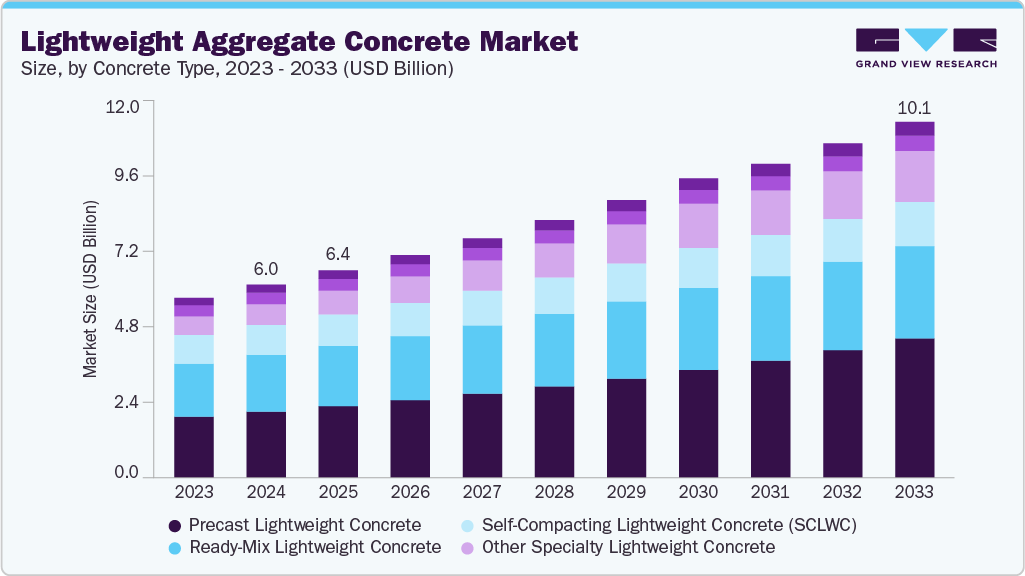
The global lightweight aggregate concrete market size was estimated at USD 6.02 billion in 2024 and is projected to reach USD 10.07 billion by 2033, growing at a CAGR of 5.9% from 2025 to 2033. This growth is driven by the rising demand for sustainable and energy-efficient construction materials.
 Source: Grand View Research, IR Documents, Primary Interviews, Paid DatabasesTo learn more about this report,
 Download Free Sample Report
 Key Market Trends & Insights
- The Asia Pacific lightweight aggregate concrete market held the highest revenue share of 39.59% in 2024.
- China's lightweight aggregate concrete market is expanding, driven by major infrastructure projects in transport, energy, and urban housing projects.
- By concrete type, the precast lightweight concrete segment dominated the lightweight aggregate concrete industry, with the largest revenue share of 38.7% in 2024.
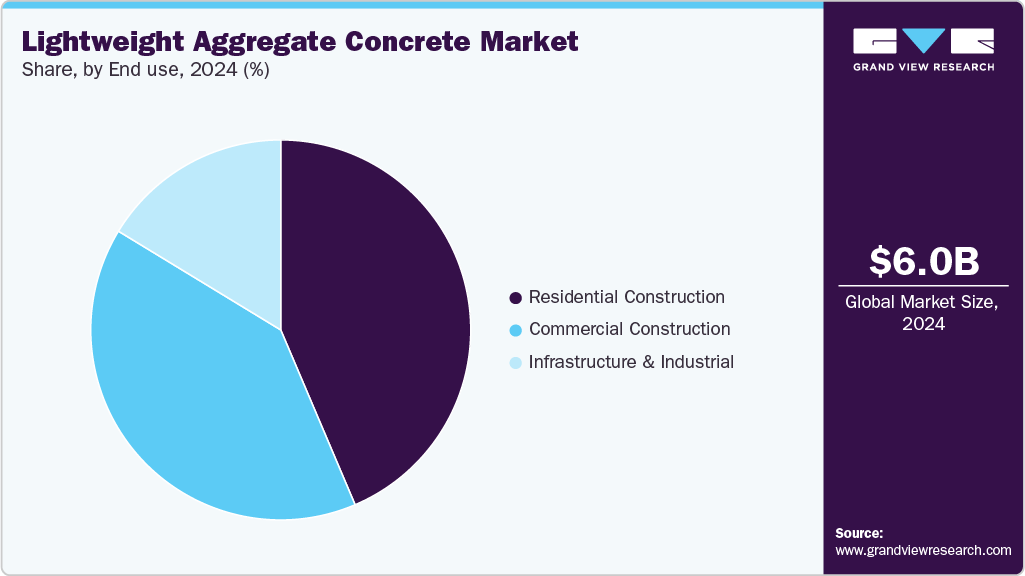
- By end use, the residential construction segment led the lightweight aggregate concrete market, with the largest revenue share of 43.6% in 2024.
Market Size & Forecast
- 2024 Market Size: USD 6.02 Billion
- 2033 Projected Market Size: USD 10.07 Billion
- CAGR (2025-2033): 5.9%
- Asia Pacific: Largest market in 2024
Three ways to get this report
Buy it, customize it, or ask a question.Ask an Analyst
Analyst response in 1 business day
- AccessReport author, directly
- Reply timeWithin 1 working day
- No sales callDirect answer only
- FormatEmail reply
- CostFree, no cost
Get the Full Report
What the study covers
- FormatsPDF · Excel · Dashboard
- Timeline2025–2033 annual, 2024 base
- Coverage20+ countries, 5 regions
- Companies10+ key players profiled
Customize the Report
20% free customization
- IncludeCountries, segments, points
- TailorTo your product definition
- ExtendDeeper competitor detail
- OrA fully bespoke study
- Turnaround5–10 working days
Lightweight Aggregate Concrete (LWAC) offers significant advantages such as reduced structural weight and enhanced thermal insulation, which are critical for achieving energy efficiency in buildings. These benefits align with increasing government regulations and incentives promoting green building practices across developed regions like North America and Europe. The incorporation of eco-friendly aggregates, including recycled and industrial waste materials, supports circular economy goals and enhances the environmental sustainability of construction projects, further fueling market expansion.Urbanization and infrastructure development in emerging economies play a critical role in boosting the demand for LWAC. Rapid growth in population and the consequent rise in residential, commercial, and infrastructural construction activities necessitate cost-effective, durable, and lightweight materials. LWAC’s ability to reduce dead load helps in constructing taller structures and long-span bridges with lower foundation requirements, which translates into cost savings and greater design flexibility. This is particularly beneficial in regions experiencing intensive urbanization and significant investments in infrastructure projects such as roads, railways, and smart city initiatives.
 To learn more about this report, Download Free Sample Report
 Technological advancements in manufacturing and mix design have enhanced the performance and commercial viability of LWAC. Innovations now allow the use of diverse lightweight aggregates, such as expanded clay, shale, volcanic tuff, and fly ash, which improve strength, durability, and fire resistance. These improvements make LWAC suitable for complex applications like precast concrete, offshore structures, and seismic-resistant construction. Additionally, the material’s lighter weight reduces transportation expenses and labor costs, increasing construction efficiency and accelerating project timelines, which are important economic drivers in modern construction.
Market Dynamics
The rising adoption of green building standards and modern infrastructure development is significantly driving the demand for lightweight aggregate concrete. The material’s reduced density helps decrease the overall dead load of structures, allowing builders to optimize the use of steel and foundation materials while improving structural efficiency. In addition, lightweight aggregate concrete offers enhanced thermal insulation and fire resistance properties, making it highly suitable for energy-efficient residential and commercial buildings. These advantages are encouraging architects and contractors to increasingly incorporate lightweight concrete solutions into sustainable construction projects.
Furthermore, growing investments in high-rise buildings, bridges, and prefabricated construction are accelerating market expansion. Lightweight aggregate concrete improves ease of transportation, handling, and installation, thereby reducing construction time and labor costs. Its ability to enhance seismic performance and reduce stress on supporting structures makes it particularly valuable in earthquake-prone and densely urbanized regions. The increasing popularity of modular construction and precast building components is also contributing to the rising adoption of lightweight aggregate concrete in global infrastructure projects.
The lightweight aggregate concrete market faces challenges due to the relatively higher cost of lightweight aggregates compared to conventional aggregates used in standard concrete. Manufacturing lightweight aggregates often involves energy-intensive processes such as kiln expansion or sintering, which increase production costs. In addition, the availability of suitable raw materials such as expanded clay, shale, pumice, and slate can vary significantly by region, creating supply chain and transportation challenges. These cost-related factors may limit adoption in price-sensitive construction projects, particularly in developing economies where conventional concrete remains more economically viable.
Market Concentration & Characteristics
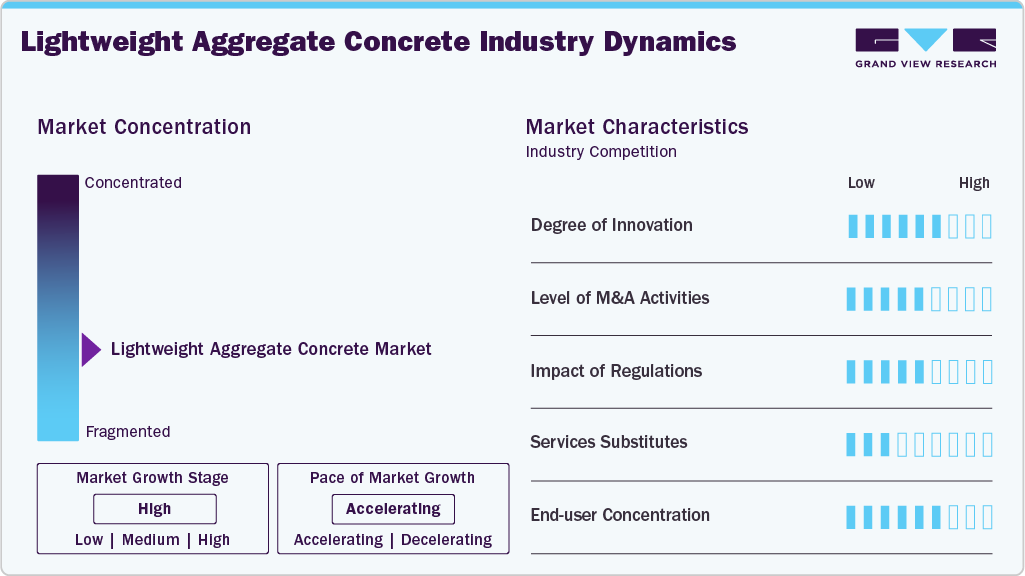
The lightweight aggregate concrete (LWAC) market exhibits a moderately concentrated competitive landscape, dominated by a mix of global cement and construction materials giants such as Holcim, Cemex, and HeidelbergCement. These key players command significant market share due to their extensive product portfolios, innovative lightweight aggregates, and established supply chains. Market concentration is further influenced by barriers such as the capital-intensive nature of production and the need for consistent raw material quality, which limit the entry of smaller producers. While the sector experiences ongoing mergers and acquisitions, these moves primarily serve to strengthen regional presence and technological capabilities rather than result in market monopolization. The competitive environment stimulates continuous innovation in aggregate processing and concrete formulation, enhancing product performance and sustainability.
 To learn more about this report, Download Free Sample Report
 Innovation within the lightweight aggregate concrete industry is centered on improving structural performance, sustainability, and adaptability to complex construction demands. Advances in mix design, including the development of hybrid and synthetic lightweight aggregates, enhance compressive strength, thermal insulation, and fire resistance, broadening application scopes. Regulatory frameworks globally encourage the use of recycled and industrial waste materials as aggregates, underlining environmental compliance as a vital market driver. This regulatory push also directs R&D towards sustainable production methods, mitigating the environmental footprint of concrete. Substitute materials, such as structural steel or normal-weight concrete with additives, pose a moderate threat. Still, LWAC’s unique balance of low weight and high strength sustains its distinct market position. End user concentration varies with commercial and infrastructure sectors being the most significant consumers due to their scale and demand for innovation, while residential adoption is growing steadily with green building trends.
End Use Insights
The residential construction segment led the LWAC market, with the largest revenue share of 43.6% in 2024, driven by increasing demand for sustainable, energy-efficient building materials that offer superior thermal insulation and structural weight reduction. Government incentives and green building regulations encourage the adoption of eco-friendly and lightweight materials. Rising urbanization and the consequent need for durable, cost-effective homes further fuel market growth. The lightweight nature of LWAC enables faster construction and easier handling.
 To learn more about this report, Download Free Sample Report
 The commercial construction segment is expected to grow at the fastest CAGR of 6.5% over the forecast period, driven by the need for materials that optimize load-bearing efficiency in high-rise and long-span structures. The segment benefits from infrastructure modernization in developed and emerging economies, requiring lightweight yet strong concrete. Adoption of prefab and modular construction methods increases demand, as LWAC facilitates faster construction and lower labor costs.
Concrete Type Insights
The precast lightweight concrete segment dominated the lightweight aggregate concrete industry, with the largest revenue share of 38.7% in 2024, driven by advancements in offsite construction technologies that prioritize speed and quality control. The segment gains from reduced site labor, faster assembly, and consistent material performance. LWAC's compatibility with prefabrication supports the efficient transport and installation of concrete components.
The self-compacting lightweight concrete (SCLWC) segment is expected to grow at a CAGR of 6.5% over the forecast period, driven by its capability to flow and compact under its own weight, reducing labor and equipment costs. It offers enhanced durability and high performance in complex structural forms, fitting modern architectural designs. The segment benefits from increasing demand for high-strength, lightweight concrete in both commercial and residential projects.
Regional Insights
The growth of the North America lightweight aggregate concrete market is driven by the rising emphasis on sustainable building practices and the increasing adoption of green certifications such as LEED and BREEAM across commercial and residential projects. Lightweight aggregate concrete is gaining traction for its thermal insulation, durability, and lower structural load, aligning with evolving construction codes. Government investments in infrastructure modernization, including bridges and highways, have further accelerated the uptake, especially in the U.S. and Canada. Moreover, the strong presence of advanced construction technologies and high disposable incomes contribute to demand for premium, eco-friendly concrete solutions. The push toward reducing carbon emissions from cement production is also encouraging manufacturers to adopt lightweight aggregates as substitutes for traditional materials.
U.S. Lightweight Aggregate Concrete Market Trends
The growth of the U.S. lightweight aggregate concrete industry stems from the combination of rapid urbanization, federal infrastructure investments, and growing demand for energy-efficient structures. Lightweight aggregate concrete offers reduced construction weight, which lowers overall costs in high-rise and large-scale construction projects, making it highly attractive to U.S. developers. The ongoing implementation of the Infrastructure Investment and Jobs Act has increased funding for bridges, airports, and roads, creating opportunities for its usage. Additionally, rising awareness among U.S. contractors about lifecycle benefits such as reduced maintenance costs and improved seismic resistance supports higher adoption rates. The shift toward sustainable building codes and renewable material utilization further boosts demand.
Asia Pacific Lightweight Aggregate Concrete Market Trends
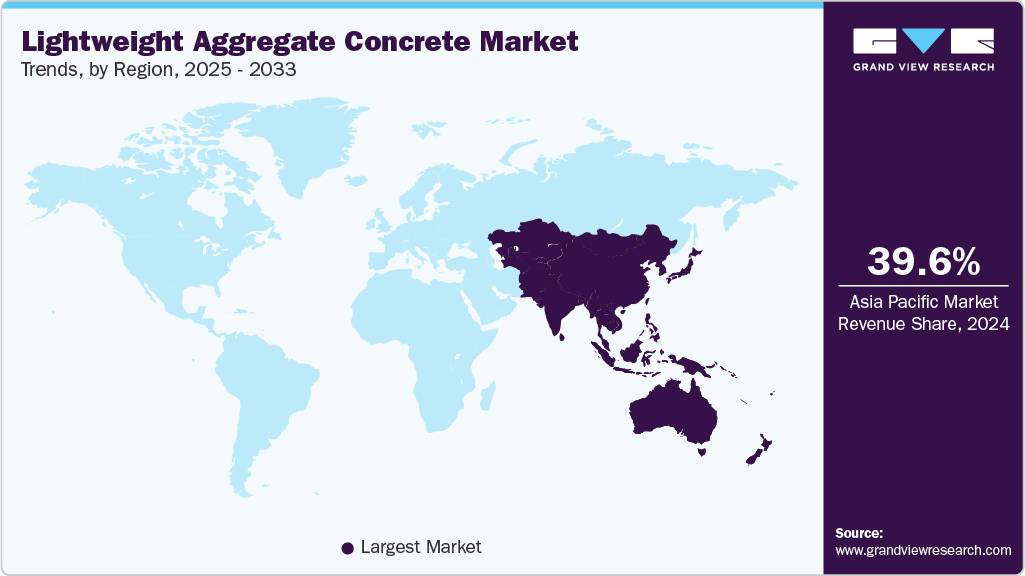
The Asia Pacific lightweight aggregate concrete market held the highest revenue share of 39.59% in 2024, driven by rapid population growth, urban expansion, and massive investments in housing and infrastructure, particularly in developing economies like India, China, and Southeast Asian nations. Lightweight aggregate concrete addresses the region’s need for cost-effective, durable, and energy-efficient materials in high-density urban settings. Rapid industrialization and government smart city programs have further propelled its demand in high-rise residential and commercial complexes. Moreover, the use of lightweight concrete in precast construction has been growing in the Asia Pacific, where speed and cost efficiency are critical. Increasing environmental awareness is also encouraging the adoption of lightweight aggregates as substitutes for natural sand and gravel.
 To learn more about this report, Download Free Sample Report
 The China lightweight aggregate concrete market is witnessing growth due to the country’s extensive infrastructure development agenda, including large-scale transport, energy, and urban housing projects. Lightweight aggregate concrete is being used to reduce structural load and improve energy efficiency in mega-projects such as bridges, tunnels, and skyscrapers. China’s government has also prioritized reducing emissions from cement production, making lightweight aggregate concrete an important part of its sustainability framework. The continued expansion of prefabricated construction techniques across provinces further enhances demand. The country’s growing urban population, coupled with stricter building energy codes, drives adoption across both public and private sectors.
Europe Lightweight Aggregate Concrete Market Trends
The Europe lightweight aggregate concrete industry is driven by stringent EU regulations on building energy efficiency and carbon reduction. Lightweight aggregate concrete supports sustainable construction goals by lowering overall material usage and offering better thermal properties, which align with green building standards. Countries across Europe are actively promoting circular economy practices, and the incorporation of recycled aggregates into lightweight concrete is gaining prominence. Demand is particularly high in residential retrofitting projects, where lightweight solutions reduce structural stress while meeting insulation requirements. With rising investments in modern infrastructure and public buildings, the material is finding a broader application base.
For the Germany lightweight aggregate concrete market, the driver is the country’s strong emphasis on energy-efficient construction and its leadership in sustainable building technologies. Lightweight aggregate concrete is increasingly utilized in residential housing, commercial complexes, and transportation projects due to its high load-bearing capacity and reduced carbon footprint. The German government’s initiatives for energy-positive buildings further encourage its adoption, especially in urban redevelopment. In addition, the expansion of precast concrete technologies has accelerated the use of lightweight aggregates in construction. Germany’s advanced manufacturing sector also facilitates innovation in lightweight aggregate formulations, driving competitive product offerings.
Latin America Lightweight Aggregate Concrete Market Trends
The Latin America lightweight aggregate concrete industry’s growth is driven by the growing need for affordable housing, infrastructure development, and resilience against seismic risks, especially in countries such as Brazil, Chile, and Mexico. Lightweight aggregate concrete provides advantages in earthquake-prone regions due to its structural flexibility and reduced weight, which improves building safety. Governments are increasingly investing in social housing programs, where cost-effective and sustainable materials are preferred. Additionally, Latin America is witnessing a rise in urbanization, requiring lightweight and faster construction solutions. Growing environmental concerns and an increasing shift toward sustainable construction also support the use of lightweight aggregates in concrete applications.
Middle East & Africa Lightweight Aggregate Concrete Market Trends
The Middle East & Africa lightweight aggregate concrete industry is witnessing growth due to the rapid urban expansion, mega-infrastructure projects, and the demand for climate-responsive building materials. Lightweight aggregate concrete provides superior thermal insulation, reducing cooling loads in the hot climate, which is particularly critical for GCC countries such as Saudi Arabia and the UAE. The material’s lower weight is also advantageous for large-scale developments like stadiums, airports, and high-rises being built under national diversification programs. In Africa, rising investments in affordable housing and infrastructure projects are boosting demand. Furthermore, government sustainability targets are encouraging the integration of lightweight aggregates derived from waste and natural resources.
Key Lightweight Aggregate Concrete Company Insights
Some of the key players operating in the market include Cemex S.A.B. de C.V. and BASF SE.
-
Cemex S.A.B. de C.V. is a global building materials company engaged in producing, distributing, and marketing cement, ready-mix concrete, aggregates, and related products. The company’s lightweight aggregate concrete solutions are designed to improve thermal insulation, structural efficiency, and sustainability in construction.
-
BASF SE operates through its construction chemicals division, offering advanced admixtures and sustainable concrete solutions. Its lightweight aggregate concrete products focus on reducing structural loads while enhancing durability, energy efficiency, and resilience across infrastructure and commercial projects.
Heidelberg Materials AG and Holcim Ltd are some of the emerging participants in the lightweight aggregate concrete market.
-
Heidelberg Materials AG is a leading supplier of aggregates, cement, and concrete. Its lightweight aggregate concrete products are designed for structural and non-structural applications, ensuring strength, reduced density, and improved fire resistance for modern infrastructure projects.
-
Holcim Ltd specializes in sustainable construction solutions, including cement, concrete, and aggregates. Its lightweight aggregate concrete portfolio emphasizes eco-friendly design, energy efficiency, and enhanced structural performance for both residential and industrial applications.
Key Lightweight Aggregate Concrete Companies:
The following are the leading companies in the lightweight aggregate concrete market. These companies collectively hold the largest market share and dictate industry trends.
- Cemex S.A.B. de C.V.
- BASF SE
- Heidelberg Materials AG
- Holcim Ltd
- CRH plc
- Lafarge S.A.
- Charah Solutions, Inc.
- Buzzi Unicem S.p.A.
- Lytag Ltd
Competitive Benchmarking
Operating Strategies
Competitive Edge
Weakness
Mature Players: Cemex S.A.B. de C.V.; BASF SE; Heidelberg Materials AG
- Focus on large-scale infrastructure and commercial construction projects
- Investment in sustainable and high-strength lightweight concrete solutions
- Strong global distribution network and production capacity
- Advanced construction material technologies
- Exposure to energy and raw material price fluctuations
Emerging Players: Buzzi Unicem S.p.A.; Lytag Ltd
- Focus on specialized lightweight aggregate solutions
- Emphasis on sustainable and energy-efficient concrete materials
- Flexibility in niche construction applications
- Higher operational and transportation costs
Recent Developments
-
In February 2023, Heidelberg Materials completed the purchase of The SEFA Group Inc., the US's largest fly ash recycler for concrete products. This acquisition enhances Heidelberg’s footprint in the Southeastern US cementitious market. It also supports the company’s objective to advance toward carbon neutrality.
Lightweight Aggregate Concrete Market Report Scope
Report Attribute
Details
Market size value in 2025
USD 6.37 billion
Revenue forecast in 2033
USD 10.07 billion
Growth rate
CAGR of 5.9% from 2025 to 2033
Base year for estimation
2024
Historical data
2021 - 2023
Forecast period
2025 - 2033
Quantitative units
Revenue in USD million and CAGR from 2025 to 2033
Report coverage
Revenue forecast, company ranking, competitive landscape, growth factors, and trends
Segments covered
End use, concrete type, region
Regional scope
North America; Europe; Asia Pacific; Central & South America; Middle East & Africa
Country scope
U.S.; Canada; Mexico; UK; Germany; France; Italy; Spain; China; India; Japan; South Korea
Key companies profiled
Cemex S.A.B. de C.V.; BASF SE; Heidelberg Materials AG; Holcim Ltd; CRH plc; Lafarge S.A.; Charah Solutions, Inc.; Buzzi Unicem S.p.A.; Lytag Ltd.
Customization scope
Free report customization (equivalent up to 8 analysts’ working days) with purchase. Addition or alteration to country, regional & segment scope.
Pricing and purchase options
Avail customized purchase options to meet your exact research needs. Explore purchase options
Global Lightweight Aggregate Concrete Market Report Segmentation
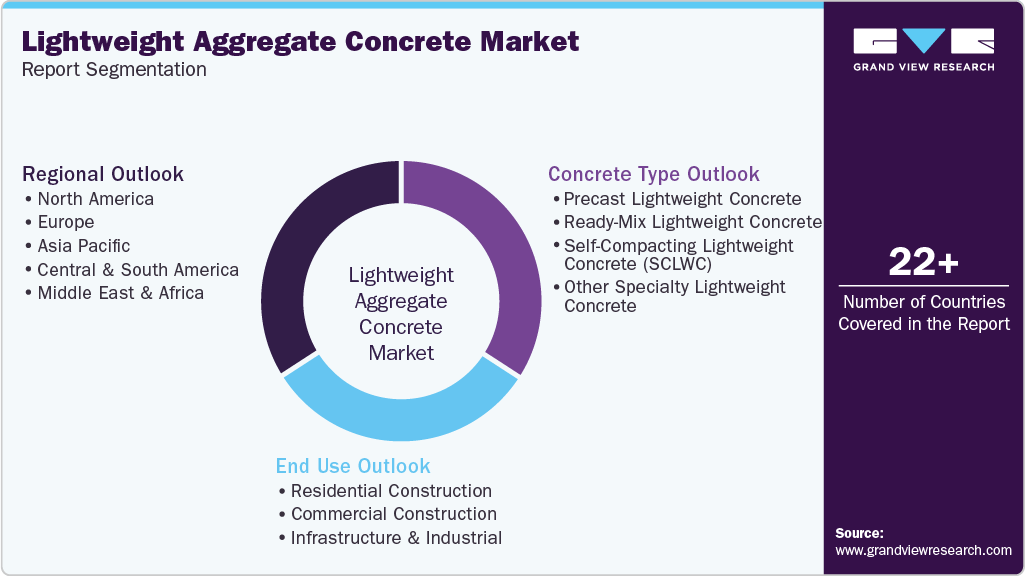
This report forecasts revenue growth at the global, regional, and country levels and provides an analysis of the latest industry trends in each of the sub-segments from 2021 to 2033. For this study, Grand View Research has segmented the global lightweight aggregate concrete market report based on end use, concrete type, and region:
 To learn more about this report, Download Free Sample Report
 -
End Use Outlook (Revenue, USD Million, 2021 - 2033)
-
Residential Construction
-
Commercial Construction
-
Infrastructure & Industrial
-
-
Concrete Type Outlook (Revenue, USD Million, 2021 - 2033)
-
Precast Lightweight Concrete
-
Ready-Mix Lightweight Concrete
-
Self-Compacting Lightweight Concrete (SCLWC)
-
Other Specialty Lightweight Concrete
-
-
Regional Outlook (Revenue, USD Million, 2021 - 2033)
-
North America
-
U.S.
-
Canada
-
Mexico
-
-
Europe
-
Germany
-
UK
-
France
-
Italy
-
Spain
-
-
Asia Pacific
-
China
-
Japan
-
India
-
South Korea
-
-
Central & South America
-
Middle East & Africa
-
Delivered Customizations
This report has been delivered with the following In-depth customizations
Client Request
Customization Delivered
Value Adds
Sustainability Analysis
Detailed assessment of sustainable construction trends, carbon emission reduction initiatives, recycled aggregate usage, and energy-efficient lightweight concrete technologies across residential, commercial, and infrastructure projects.
Helps understand environmental impact reduction strategies, green building compliance trends, and the adoption of sustainable lightweight concrete solutions.
Opportunity Assessment
Comprehensive evaluation of growth opportunities across high-rise buildings, bridges, precast construction, modular housing, and infrastructure modernization projects, including emerging lightweight aggregate technologies.
Supports identification of high-growth construction segments, infrastructure investment trends, and expansion opportunities across developed and emerging markets.
Competitive Assessment
In-depth analysis of key market participants based on product portfolio, production capacity, regional presence, pricing strategies, sustainability initiatives, and strategic partnerships.
Enables understanding of competitive positioning, market share dynamics, product differentiation strategies, and expansion initiatives among lightweight aggregate concrete manufacturers.
Frequently Asked Questions About This Report
The global lightweight aggregate concrete market size was estimated at USD 6.02 billion in 2024 and is expected to reach USD 6.37 billion in 2025.
The global lightweight aggregate concrete market is expected to grow at a compound annual growth rate of 5.9% from 2025 to 2033 to reach USD 10.07 billion by 2033.
The residential construction segment led the market and accounted for the largest revenue share of 43.6% in 2024, driven by increasing demand for sustainable, energy-efficient building materials that offer superior thermal insulation and structural weight reduction.
Some of the key players operating in the lightweight aggregate concrete market include Cemex S.A.B. de C.V., BASF SE, Heidelberg Materials AG, Holcim Ltd, CRH plc, Lafarge S.A., Charah Solutions, Inc., Buzzi Unicem S.p.A., and Lytag Ltd.
The key factors that are driving the lightweight aggregate concrete market include rising demand for sustainable, energy-efficient building materials, rapid urbanization, infrastructure development, and advances in aggregate production technologies.
About the Author(s)
Advanced Interior Materials Research Team
Advanced Materials · Advanced Interior MaterialsThis report was authored by the advanced interior materials research team at Grand View Research - comprising two research analysts, one senior research analyst, and one industry expert - with specialized expertise in the advanced interior materials segment of the advanced materials industry. All findings are based on proprietary advanced materials databases, executive interviews, and regulatory analysis, subject to internal peer review prior to publication.
Last Updated:
Speak to Analyst

Customize this report to your needs - add regions, segments, or data points, with 20% free customization.
Or view our licence options:


ISO 9001:2015 & 27001:2022 Certified
We are GDPR and CCPA compliant! Your transaction & personal information is safe and secure. For more details, please read our privacy policy.


