
- Home
- »
- Advanced Interior Materials
- »
-
Lithium Market Size, Share And Trends Report, 2026-2033GVR Report cover
![Lithium Market Size, Share & Trends Report]()
Lithium Market (2026 - 2033) Size, Share & Trends Analysis Report By Product (Carbonate, Hydroxide), By Application (Automotive, Consumer Electronics, Grid Storage, Glass & Ceramics), By Region, And Segment Forecasts
Market Size, 2025
$32.4BMarket Estimate, 2026
$37.5BMarket Forecast, 2033
$96.5BCAGR, 2026–2033
14.5%Lithium Market Summary
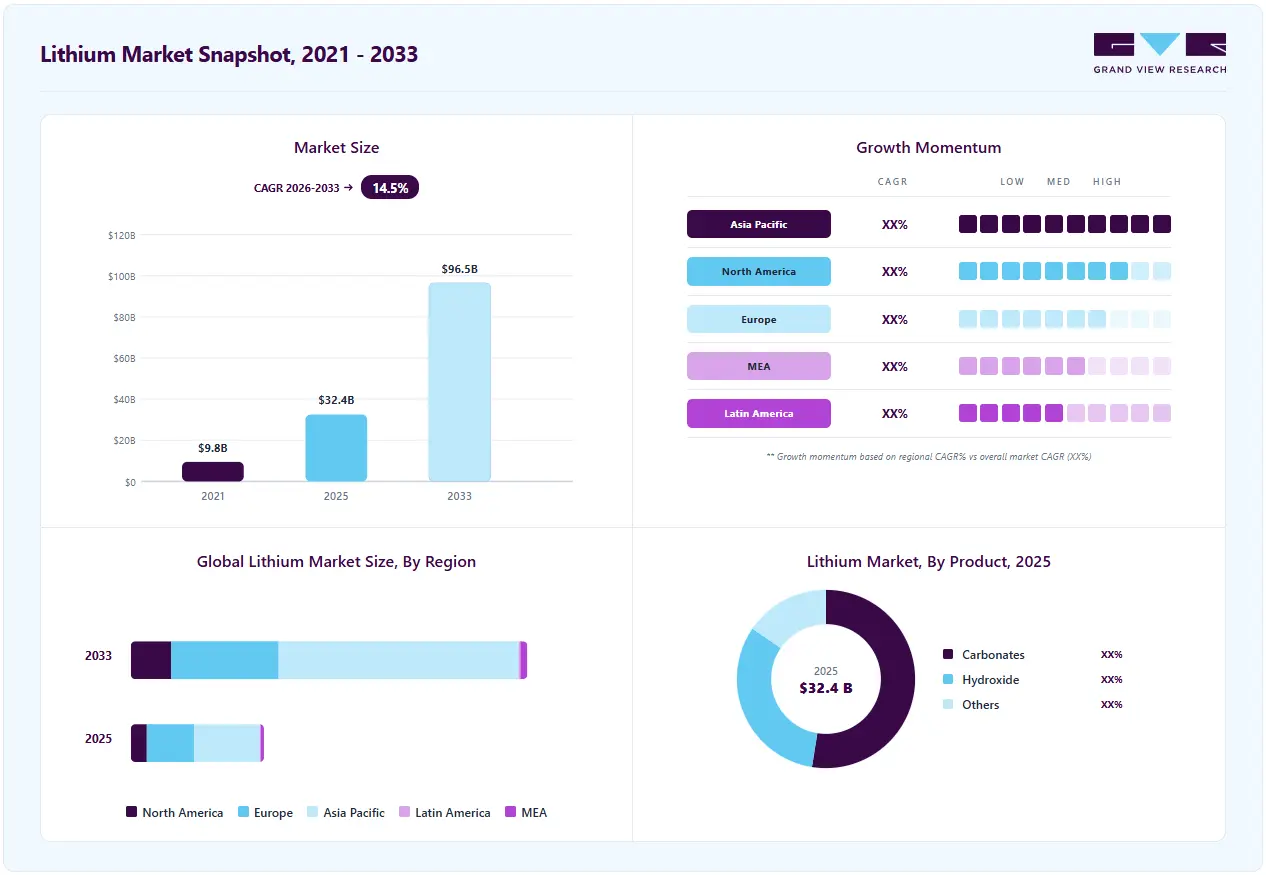
The global lithium market size was valued at USD 32.4 billion in 2025 and is projected to grow from USD 37.5 billion in 2026 to USD 96.5 billion by 2033, at a CAGR of 14.5% from 2026 to 2033. The Asia Pacific held the largest share of 49% of the global market in 2025. Vehicle electrification is projected to attract a significant volume of lithium-ion batteries, which is anticipated to drive market growth over the forecast period.
Key Market Trends & Insights
- By product: Carbonate led the global market and accounted for a share of 52% in 2025.
- By application: Automotive segment led the market and accounted for a share of 41% in 2025.
Regional Highlights
- Largest regional market: Asia Pacific (49% revenue share, 2025)
- By country: The China held the largest revenue share in 2025.
Market Size & Forecast
- Market size in 2025: USD 32.4 Billion
- Estimated market size in 2026: USD 37.5 Billion
- Projected market size by 2033: USD 96.5 Billion
- CAGR (2026-2033): 14.5%
The automotive application segment is expected to grow substantially, driven by stringent regulations imposed by government bodies on ICE automakers to reduce vehicle carbon dioxide emissions. This has shifted automakers' interest toward producing EVs, which is anticipated to benefit from the demand for lithium and related products.Government subsidies for EVs and investments in this space will likely be an additional booster to market growth. The U.S. holds significant importance in battery production after China, making it one of the key lithium-consuming countries in the world. As of 2024, the United States possesses substantial lithium resources, with estimates ranging from 14 million metric tons to 20-40 million tons, depending on new geological findings. Despite this, domestic lithium production remains limited. In 2024, the U.S. produced approximately 610 metric tons of lithium, accounting for about 0.3% of global production. This output is insufficient to meet the growing demand driven by the EV market.

The U.S. government is investing heavily in domestic lithium production. The U.S. Department of Energy (DOE) announced an investment of USD 25 million across 11 projects to advance materials, processes, machines, and equipment for domestic manufacturing of next-generation batteries. These projects will advance platform technologies upon which battery manufacturing capabilities can be built, enabling flexible, scalable, and highly controllable processes.
Recognizing the strategic importance of lithium, the U.S. Department of the Interior designated it as a critical mineral in 2018, a move that expedited the mine permitting process. This was highlighted by the approval of the Thacker Pass Lithium Mine by the Bureau of Land Management in January 2021. Operated by Lithium Nevada Corporation, this mine is poised to become the largest lithium supply source in the U.S., with projections indicating its capability to produce approximately 60 kilotons of battery-grade lithium carbonate annually by 2026.

The U.S. government is implementing measures to ensure a sufficient lithium supply to meet the increasing demand from various industries. In September 2023, an agreement worth USD 90 million was signed between Albemarle Corporation and the U.S. government to support domestic mining and production of lithium. The agreement's objective is to assist Albemarle in reopening its Kings Mountain, N.C., lithium mine, which is anticipated to commence operations between 2025 and 2030. Albemarle's Kings Mountain mine is expected to contribute to expanding domestic lithium production for the country's battery supply chain. Arkansas is sitting atop lithium reserves that could be vast enough to satisfy the entire world’s demand for EV batteries, according to the US Geological Survey (USGS).
Market Dynamics
The rapid growth of the global electric vehicle (EV) industry is significantly driving demand for lithium used in lithium-ion battery manufacturing. Lithium remains a critical battery material due to its high energy density and long operational life. According to industry estimates, global electric car sales surpassed 20 million units in 2025, representing nearly 18% y-o-y growth. The sales are supported by expanding charging infrastructure, government incentives, and rising investments in battery gigafactories across China, Europe, and North America. The increasing shift toward vehicle electrification and energy storage systems is expected to continue supporting long-term growth in the lithium market.
The global lithium market faces challenges related to limited supply availability and complex processing requirements for battery-grade lithium materials. Although demand for lithium is rapidly increasing due to electric vehicle and energy storage applications, lithium extraction and refining remain time-intensive and capital-intensive processes. Production from brine deposits can take several years, while hard-rock extraction involves high operational and environmental costs. In addition, lithium refining infrastructure remains concentrated in a few countries, creating supply chain and geopolitical risks. According to industry estimates, the global lithium market could face a supply deficit, exceeding 1 million tons by 2030 if production capacity expansion fails to keep pace with rising demand.
Product Insights
Carbonate segment held the revenue share of over 52.0% in 2025. Lithium Carbonate (Li2CO3) is the most stable inorganic compound used to form other compounds, such as LiOH and even pure metal. Carbonate products are also used in the treatment of bipolar disorder. This compound is also used in batteries and has several applications in the construction sector, including waterproofing slurries and adhesives. LiOH is a white hygroscopic crystalline material and an inorganic compound primarily used by battery manufacturers; it is commercially available as anhydrous and monohydrate.
It is used in transportation applications, such as manufacturing submarines and spacecraft. Rapid development in battery technologies propels demand for LiOH, thus driving market growth. Many automotive players are inclined to adopt LiOH for battery manufacturing, which is expected to benefit market growth positively.
For instance, in 2024, BMW strengthened its EV supply chain through strategic partnerships to secure lithium supplies. A notable development was BMW's agreement with Critical Metals Corp., which included a USD 15 million pre-payment for lithium hydroxide (LiOH) from the Wolfsberg Lithium Project in Austria. This arrangement underscores BMW's commitment to ensuring a stable supply of critical materials for EV production in Europe.
Application Insights
Automotive segment held the revenue share of over 41.0% in 2025. Automakers are accelerating the shift from internal combustion engines to battery-powered vehicles to meet fuel efficiency targets and reduce emissions. Lithium-ion batteries remain the preferred energy storage solution for electric cars due to their high energy density, longer driving range, and declining cost per kilowatt hour, directly translating into higher lithium demand from the automotive industry. In 2024, global electric vehicle sales reached record levels with about 17 million units sold, reflecting strong consumer and manufacturer adoption of electrified mobility. These sales accounted for more than 20 % of all new car sales worldwide, highlighting the automotive segment’s substantial contribution to lithium demand for battery production.

The consumer electronics application segment is anticipated to register the fastest revenue CAGR over the forecast period. The consumer electronics segment stands as the foundational pillar of the lithium-ion battery market, and its sustained growth is propelled by an ever-expanding and innovating array of portable devices. The primary driver remains the relentless consumer demand for greater mobility, connectivity, and functionality, which directly translates into a need for compact, high-energy-density power sources. Lithium-ion batteries, with their superior energy-to-weight ratio and rechargeability compared to older technologies, are uniquely positioned to meet this demand. From smartphones and laptops to tablets and wireless earbuds, the proliferation of these essential tools of modern life creates a vast, continuous replacement market.
Regional Insights
Asia Pacific Lithium Market Trends
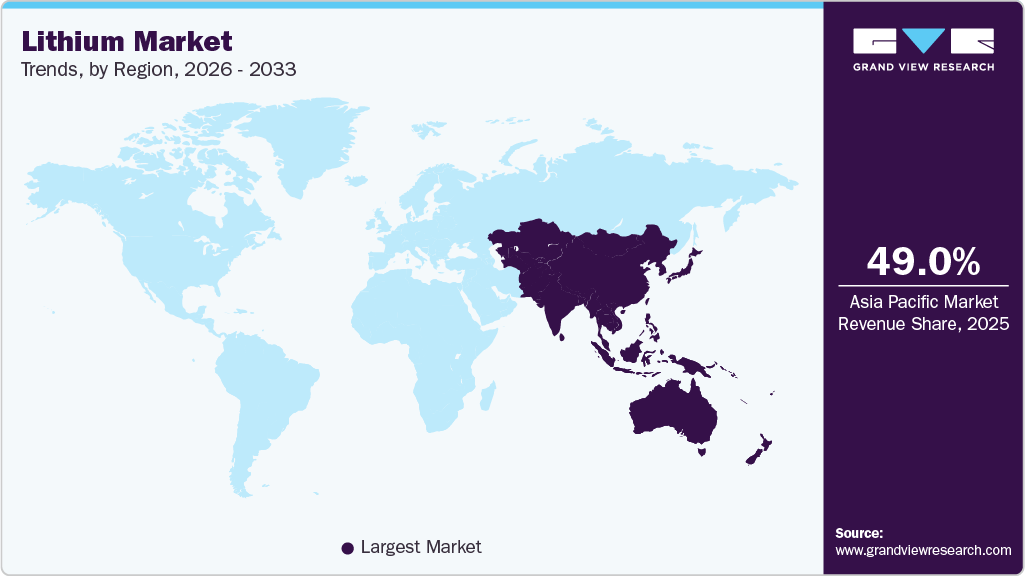
Asia Pacific held over 49% revenue share in 2025 of the global lithium market. The Asia Pacific market is primarily driven by its strategic dominance of the EV battery supply chain, which is underpinned by decisive government mandates. China, as the regional and global leader, has implemented aggressive New Energy Vehicle (NEV) sales targets and consumer subsidies, creating a massive and guaranteed domestic market. This policy-driven demand is serviced by an integrated manufacturing ecosystem, exemplified by battery behemoths like CATL and BYD, which have constructed sprawling gigafactories and secured long-term lithium supply from mines worldwide to ensure feedstock for millions of batteries annually.
North America Lithium Market Trends
The North American lithium market is undergoing a transformative acceleration, primarily driven by a powerful combination of federal policy and a strategic push for energy independence and supply chain security. The landmark U.S. Inflation Reduction Act (IRA) of 2022 serves as the central catalyst, creating direct financial incentives for both EV adoption and the establishment of a domestic battery supply chain.
The U.S. lithium market is booming, fueled by surging domestic EV sales. Driven by federal policies like the Inflation Reduction Act's consumer tax credits, EV adoption has accelerated rapidly, with sales exceeding 2 million units in 2024. This demand from top-selling models like the Ford F-150 Lightning and Tesla Model Y compels automakers and battery manufacturers to invest heavily in domestic gigafactories, creating a self-reinforcing cycle of production and supply chain expansion.
Europe Lithium Market Trends
The European lithium market is being rapidly reshaped by the continent's aggressive green industrial policy and a surge in localized electric vehicle production. The overarching driver is the European Union's Green Deal and its 2035 ban on the sale of new internal combustion engine vehicles, which has created a regulatory imperative for automakers to electrify.
Latin America Lithium Market Trends
The Latin American lithium market is defined by its vast resource wealth and a pivotal strategic shift, as producing nations move beyond their traditional role as mere exporters of raw brine to capture greater value domestically. The primary growth driver is soaring global demand, but it is now increasingly mediated by assertive national industrial policies aimed at developing local battery supply chains. This is most pronounced in the "Lithium Triangle" of Argentina, Bolivia, and Chile, where governments are implementing varied models, from Argentina's more open investment approach to Chile's state-led public-private partnerships and Bolivia's fully nationalized control, to mandate on-site lithium processing and foster downstream industries like battery component manufacturing.
Key Lithium Company Insights
Some of the key players operating in the market include Albemarle, Ganfeng Lithium Co., Ltd., and Mineral Resources.
-
Albemarle’s lithium segment is developing lithium-based materials for various industries. The segment manufactures lithium carbonate, hydroxide, chloride, value-added lithium specialties, and reagents, including butyllithium and lithium aluminum hydride. In addition, the segment offers technical services such as handling reactive lithium products and customer recycling services for lithium-containing by-products obtained from synthesis with organolithium products, lithium metal, and other reagents.
-
Ganfeng Lithium Co., Ltd. serves various industries, including electric vehicles, pharmaceuticals, chemicals, energy storage, and 3C (Computer, Communication, and Consumer Electronics) products. The company can extract lithium from ore, brine, and recycled materials, offering more than 40 lithium and other metal compounds.
Key Lithium Companies:
The following are the leading companies in the lithium market. These companies collectively hold the largest market share and dictate industry trends.
- Albemarle Corporation
- Sigma Lithium
- Ganfeng Lithium Group Co., Ltd
- Pilbara Minerals
- Lithium Americas Corp
- Tianqi Lithium Australia
- Mineral Resources
- Core Lithium
- Galaxy Resources Limited
- Lithium Corporation
Competitive Benchmarking
Operating Strategies
Competitive Edge
Weaknesses
Mature Players: Albemarle Corporation; Ganfeng Lithium Group Co., Ltd.; Pilbara Minerals; Mineral Resources; Tianqi Lithium Australia
- Secure long-term supply agreements with EV manufacturers and battery gigafactories while strengthening downstream battery material integration.
- Expand spodumene mining and lithium brine extraction capacities to meet rising EV battery demand.
- High production scalability and diversified lithium sourcing across hard-rock and brine assets.
- Strong financial capabilities supporting rapid capacity expansion and processing investments.
- Environmental concerns related to water-intensive brine extraction and mining activities.
- Exposure to lithium price fluctuations and oversupply-demand imbalance risks.
Emerging Players:
- Develop localized low-carbon lithium supply chains targeting European and North American battery manufacturers.
- Collaborate with clean energy and EV ecosystem players to commercialize sustainable lithium production technologies.
- Lower carbon footprint and reduced water usage compared to conventional lithium extraction methods.
- Increasing interest from automakers and ESG-focused investors in cleaner lithium supply sources.
- Technological and scalability risks associated with the commercialization of DLE and geothermal extraction methods.
- High capital requirements and dependence on regulatory approvals and strategic funding support.
Lithium Market Report Scope
Report Attribute
Details
Market size in 2025
USD 32.4 billion
Estimated Market size in 2026
USD 37.5 billion
Projected Market size by 2033
USD 96.5 billion
Growth rate
CAGR of 14.5% from 2026 to 2033
Base year for estimation
2025
Historical data
2021 - 2024
Forecast period
2026 - 2033
Quantitative Units
Revenue in USD million/billion, volume in kilotons, and CAGR from 2026 to 2033
Report coverage
Revenue and volume forecast, company ranking, competitive landscape, growth factors, and trends
Segments covered
Product, application, region
Regional scope
North America; Europe; Asia Pacific; Latin America; Middle East & Africa
Country scope
U.S.; Canada; Mexico; Germany; France; Italy; Spain; China; Japan; South Korea; India; Argentina; Brazil; UAE; Saudi Arabia
Key companies profiled
Albemarle Corporation; Sigma Lithium; Ganfeng Lithium Group Co., Ltd; Pilbara Minerals; Lithium Americas Corp; Tianqi Lithium Australia; Mineral Resources; Core Lithium; Galaxy Resources Limited; Lithium Corporation
Customization scope
Free report customization (equivalent to up to 8 analysts working days) with purchase. Addition or alteration to country, regional & segment scope.
Pricing and purchase options
Avail customized purchase options to meet your exact research needs. Explore purchase options
Global Lithium Market Report Segmentation
This report forecasts revenue and volume growth at global, regional, and country levels and provides an analysis of the latest industry trends in each of the sub-segments from 2018 to 2030. For the purpose of this study, Grand View Research has segmented the global lithium market report on the basis of product, application, and region.

-
Product Outlook (Volume, Kilotons; Revenue, USD Million; 2021 - 2033)
-
Carbonates
-
Hydroxide
-
Others
-
-
Application Outlook (Volume, Kilotons; Revenue, USD Million; 2021 - 2033)
-
Automotive
-
Consumer Electronics
-
Grid Storage
-
Glass & Ceramics
-
Other
-
-
Regional Outlook (Volume, Kilotons; Revenue, USD Million; 2021 - 2033)
-
North America
-
U.S.
-
Canada
-
Mexico
-
-
Europe
-
Germany
-
France
-
UK
-
Italy
-
Spain
-
-
Asia Pacific
-
China
-
India
-
Japan
-
South Korea
-
-
Latin America
-
Argentina
-
Brazil
-
-
Middle East & Africa
-
UAE
-
Saudi Arabia
-
-
Delivered Customizations
This report has been delivered with the following In-depth customizations
Client Request
Customization Delivered
Value Adds
Enhanced Lithium Manufacturing & Technology Assessment
Detailed coverage of lithium sources, mining methods, direct lithium extraction (DLE) technologies, lithium recycling processes, conversion analysis, and comparative assessment of conventional vs. DLE extraction methods. The customization also included technology advantages, limiting factors, case studies, price trend analysis, and demand-supply assessment.
Provided deeper technical understanding of evolving lithium extraction and processing technologies, enabling evaluation of production efficiency, sustainability trends, and future commercialization opportunities across the lithium value chain.
Lithium Foil Market Assessment
Comprehensive assessment of the global lithium foil market with detailed analysis by product purity and application segments, along with global and regional price trend analysis across Europe, the U.S., and India. The study also included manufacturing process evaluation, competitive landscape analysis, key manufacturer profiling, prospective consumer mapping, and strategic developments.
Enabled detailed understanding of lithium foil manufacturing technologies, regional pricing dynamics, end-use demand trends, competitive positioning, and emerging commercial opportunities across battery, electronics, and aerospace applications.
Lithium Supply Chain & Distribution Network Assessment
Assessment of the global lithium distribution ecosystem covering raw material flow, refining hubs, battery-grade lithium supply chains, distribution channels, and regional trade movement across Asia Pacific, Europe, and North America. The study also included analysis of logistics networks, downstream battery material supply, key distributors, and strategic partnerships between lithium producers, refiners, and battery manufacturers.
Gave understanding of lithium supply chain dependencies, regional distribution dynamics, and strategic sourcing opportunities across the evolving EV battery and energy storage ecosystem.
Frequently Asked Questions About This Report
Key players operating in the lithium market include Albemarle Corporation, Sigma Lithium, Ganfeng Lithium Group Co., Ltd, Pilbara Minerals, Lithium Americas Corp, Tianqi Lithium Australia, Mineral Resources, Core Lithium, Galaxy Resources Limited, Lithium Corporation.
The carbonate segment led with a 52.0% revenue share in 2025.
The automotive segment led with a 41.0% revenue share in 2025, while consumer electronics is the fastest-growing segment.
Key factors include escalating demand for lithium-ion batteries (LIBs) across various industries, increasing adoption of electric vehicles (EVs), advancements in consumer electronics, and the expansion of renewable energy storage solutions.
Asia Pacific dominated with a 49.0% revenue share in 2025.
The global lithium market size was valued at USD 32.4 billion in 2025 and is projected to reach USD 37.5 billion in 2026.
The global lithium market is expected to grow at a compound annual growth rate of 14.5% from 2026 to 2033 to reach USD 96.5 billion by 2033.
About the Author(s)
Advanced Interior Materials Research Team
Advanced Materials · Advanced Interior MaterialsThis report was authored by the advanced interior materials research team at Grand View Research - comprising two research analysts, one senior research analyst, and one industry expert - with specialized expertise in the advanced interior materials segment of the advanced materials industry. All findings are based on proprietary advanced materials databases, executive interviews, and regulatory analysis, subject to internal peer review prior to publication.
Last Updated:
Speak to Analyst


Customize this report to your needs — add regions, segments, or data points, with 20% free customization.
Or view our licence options:


ISO 9001:2015 & 27001:2022 Certified
We are GDPR and CCPA compliant! Your transaction & personal information is safe and secure. For more details, please read our privacy policy.


