
- Home
- »
- Advanced Interior Materials
- »
-
Lithium Iron Phosphate Powder Market Size Report, 2033GVR Report cover
![Lithium Iron Phosphate Powder Market Size, Share & Trends Report]()
Lithium Iron Phosphate Powder Market (2026 - 2033) Size, Share & Trends Analysis Report By End Use (Energy Storage Systems, Electric Vehicles, Electric Two/Three Wheelers), By Region, And Segment Forecasts
- Report ID: GVR-4-68040-861-3
- Number of Report Pages: 100
- Format: PDF
- Historical Range: 2021 – 2024
- Forecast Period: 2026 - 2033
- Industry: Advanced Materials
- Report Summary
- Table of Contents
- Segmentation
- Methodology
- Download FREE Sample
-
 Download Sample Report
Lithium Iron Phosphate Powder Market Summary
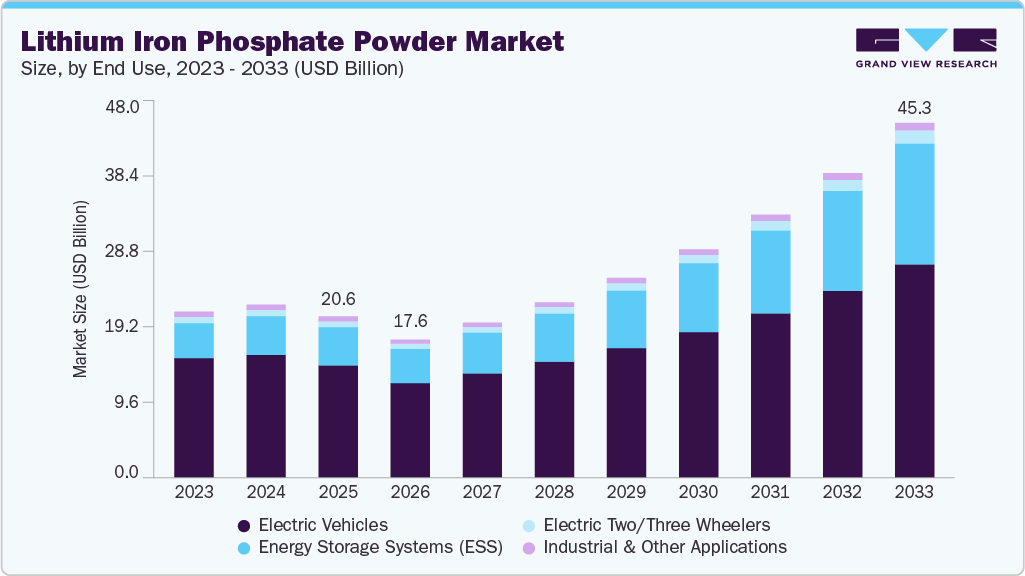
The global lithium iron phosphate powder market size was estimated at USD 20.57 billion in 2025 and is projected to reach USD 45.26 billion by 2033, at a CAGR of 14.4% from 2026 to 2033. The market is experiencing robust growth, primarily driven by the accelerating adoption of electric vehicles (EVs), large-scale energy storage systems (ESS), and increasing investments in renewable energy integration.
Key Market Trends & Insights
- Asia Pacific dominated the lithium iron phosphate powder market with the largest revenue share of 66.4% in 2025.
- China dominated the lithium iron phosphate powder market in the Asia Pacific.
- By end use, the electric vehicles segment held the largest revenue share of over 69.0% in 2025.
Market Size & Forecast
- 2025 Market Size: USD 20.57 Billion
- 2033 Projected Market Size: USD 45.26 Billion
- CAGR (2026-2033): 14.4%
- Asia Pacific: Largest market region in 2025
LFP chemistry is gaining preference over nickel-based cathodes due to its superior thermal stability, longer cycle life, enhanced safety profile, and cost competitiveness, particularly in mass-market EVs and stationary storage applications.The sustainability profile of lithium iron phosphate (LFP) powder is a major growth catalyst in the global battery materials ecosystem. Unlike nickel- and cobalt-based cathode chemistries, LFP eliminates reliance on critical and geopolitically sensitive metals such as cobalt, significantly reducing environmental and ethical sourcing concerns. The absence of cobalt and the lower reliance on nickel not only improve supply chain transparency but also reduce the carbon intensity of mining and refining activities. In addition, LFP batteries offer longer cycle life and superior thermal stability, extending product lifespan and reducing replacement frequency, thereby improving lifecycle sustainability metrics. With governments tightening ESG compliance requirements and OEMs targeting carbon neutrality goals, LFP chemistry is increasingly positioned as a lower-risk, environmentally aligned alternative within the broader lithium-ion battery landscape.
LFP powder is gaining strong traction due to its cost-efficiency, safety advantages, and suitability for high-volume applications. Major EV and battery manufacturers such as Tesla, Inc., and BYD Company Limited are expanding the deployment of LFP-based battery packs, particularly in standard-range passenger EVs and commercial fleet vehicles where affordability and durability outweigh ultra-high energy density requirements. Additionally, energy storage system (ESS) integrators prefer LFP chemistry for grid-scale and residential storage due to its low thermal runaway risk and strong cycling performance. As battery pack prices continue to decline and performance enhancements narrow the energy density gap, LFP powder is emerging as the preferred cathode material for cost-sensitive, safety-critical, and long-duration storage applications globally.
Drivers, Opportunities & Restraints
The lithium iron phosphate (LFP) powder market is being propelled by strong adoption in both electric vehicles (EVs) and energy storage systems (ESS), where cost and safety are critical decision factors. In 2025, LFP chemistry surpassed nickel-based alternatives to become the largest battery chemistry deployed in EVs, with global kWh deployment growing approximately 43% over the first eleven months of the year, driven by its lower cost and robust economics compared to nickel-based cathodes. This broad acceptance across passenger EVs and light-duty vehicles underscores LFP’s affordability, which is reshaping cathode demand and accelerating market uptake worldwide. Additionally, global lithium-ion battery deployment exceeded USD 150 billion in 2025 as battery prices fell and demand from EVs and ESS expanded, with LFP pack prices dropping over 15%, further stimulating demand for LFP materials.
The lithium iron phosphate powder industry is poised to benefit from expanding applications beyond traditional EV and stationary storage sectors, particularly through recycling, circular supply initiatives, and renewable integration. As demand for safe and sustainable battery systems grows, LFP battery recycling is emerging as a high-growth opportunity. A dedicated LFP battery recycling market is expected to expand rapidly, offering a pathway to recover valuable materials and reduce dependence on primary raw materials as battery volumes increase. Technological enhancements that boost cycle life and efficiency also create commercial openings in industrial and telecom backup systems, expanding potential end-use markets.
Despite strong growth fundamentals, the LFP powder market faces notable constraints stemming from inherent performance and supply chain dynamics. LFP chemistry’s lower energy density compared to nickel-cobalt-based alternatives limits its suitability for long-range or performance-intensive EVs, potentially restricting adoption in premium automotive segments. Geographic and production concentration, particularly China’s dominant share of LFP production and processing, introduces supply chain risk and geopolitical exposure for Western manufacturers seeking diversification. Commodity price volatility, especially for key precursors such as lithium carbonate, further complicates cost forecasting and investment planning for producers.
End Use Insights
The electric vehicle (EV) segment accounted for the largest revenue share of 69.0% in 2025, driven by widespread adoption across mass-market passenger cars, buses, and commercial fleets. Automakers are increasingly integrating LFP batteries into standard-range EV models to optimize cost structures and enhance safety performance. Companies such as Tesla, Inc. and BYD Company Limited have expanded the deployment of LFP-based battery packs in high-volume vehicle platforms, particularly in China, Europe, and North America. The chemistry’s longer cycle life, improved thermal stability, and reduced dependence on cobalt and nickel make it economically attractive for high-production EV programs, thereby sustaining its dominant revenue contribution in 2025.
The energy storage systems (ESS) segment is projected to register the fastest CAGR over the forecast period, driven by rapid integration of renewable energy, grid modernization initiatives, and growing investments in utility-scale storage infrastructure. LFP chemistry is particularly well-suited for stationary applications due to its high safety profile, stable long-duration cycling capability, and lower total cost of ownership compared to nickel-based alternatives. As countries expand solar and wind capacity and deploy battery storage to manage intermittency, demand for LFP powder in grid-scale, commercial, and residential ESS installations is expected to accelerate significantly.
Regional Insights
North America's Lithium Iron Phosphate Powder Market Trends
The North America lithium iron phosphate powder industry is expanding steadily, driven by accelerating EV adoption, federal clean energy incentives, and supply chain localization efforts. Policy frameworks such as the Inflation Reduction Act (IRA) are encouraging domestic production of battery materials and reducing dependence on Asian imports. Automakers and battery manufacturers are increasingly shifting toward LFP chemistry for cost-sensitive EV models and grid-scale storage applications. Strategic investments in battery gigafactories and cathode material plants are strengthening regional manufacturing capacity, positioning North America as a fast-emerging LFP production hub outside Asia.
U.S. Lithium Iron Phosphate Powder Market Trends
The U.S. represents the largest contributor within North America, supported by strong EV penetration, federal tax credits tied to local sourcing, and expanding utility-scale energy storage installations. Leading automakers such as Tesla Inc. are incorporating LFP batteries into standard models to optimize costs and qualify for domestic content incentives. Additionally, rapid growth in solar-plus-storage projects across states like California and Texas is driving LFP demand for stationary storage systems, reinforcing long-term market expansion.
Europe Lithium Iron Phosphate Powder Market Trends
The lithium iron phosphate powder industry in Europe is gaining traction amid aggressive decarbonization targets and expanding battery manufacturing under the European Green Deal. While historically focused on nickel-rich chemistries, European OEMs are increasingly evaluating LFP for entry-level EVs and commercial fleets to reduce battery costs and mitigate raw material supply risks. Investments in gigafactories across Germany, France, and Eastern Europe, along with rising grid storage deployments to stabilize power systems reliant on renewables, are gradually strengthening regional demand for LFP materials.
Asia Pacific Lithium Iron Phosphate Powder Market Trends
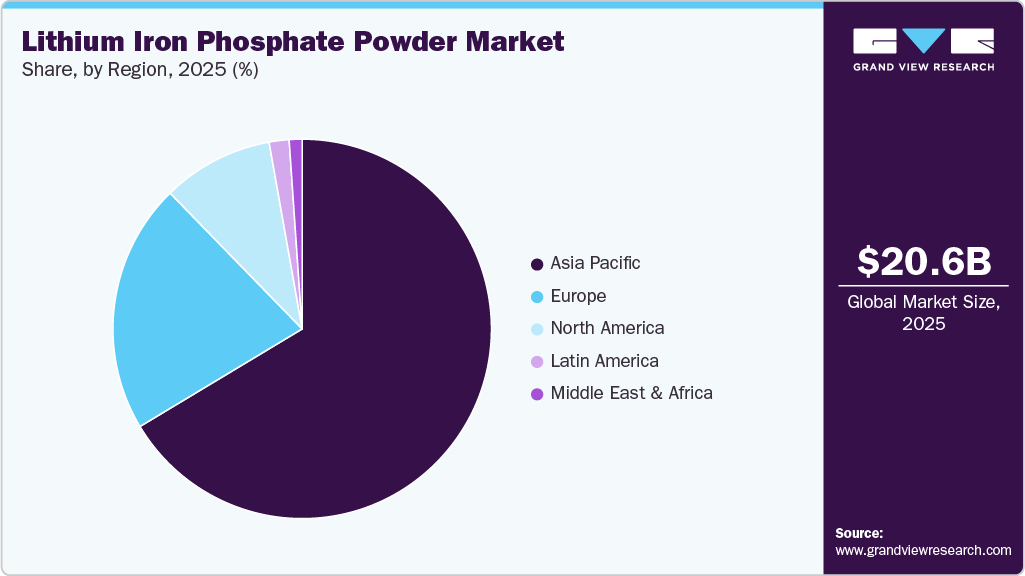
Asia Pacific dominated the market with the largest revenue share of 66.4% in 2025. Asia Pacific dominates the lithium iron phosphate powder industry in terms of production and consumption, led by China’s well-established battery supply chain ecosystem. Major manufacturers such as Contemporary Amperex Technology Co. Limited and BYD Company Limited continue to scale LFP battery output for both domestic and export markets. Strong EV penetration, extensive government support, and cost-competitive manufacturing capabilities position the region as the global center for LFP cathode production. Additionally, rapid integration of renewable energy across China, South Korea, and Southeast Asia further supports demand for stationary storage.
China is the largest country in the global LFP powder market, accounting for the majority of global production capacity. The country benefits from a well-established battery materials ecosystem, strong domestic EV demand, and large-scale manufacturing by leading battery producers such as CATL and BYD. Government incentives for new energy vehicles (NEVs), advancements in lithium iron phosphate chemistry, and aggressive capacity expansions have further reinforced China’s dominance. Its integrated supply chain from raw material processing to cathode production and battery assembly provides significant cost advantages, making it the central hub of the global LFP powder industry.
Latin America Lithium Iron Phosphate Powder Market Trends
Latin America is an emerging market for LFP powder, driven by growing renewable energy investments and the gradual adoption of EVs in countries such as Brazil, Chile, and Mexico. The region’s abundant lithium reserves enhance its strategic importance within the broader battery value chain, though local cathode production remains limited. The increasing deployment of solar and wind projects, coupled with the need for grid stabilization, is expected to drive incremental demand for LFP-based energy storage systems over the forecast period.
Middle East & Africa Lithium Iron Phosphate Powder Market Trends
The Middle East & Africa (MEA) region is witnessing gradual growth in LFP demand, supported by expanding solar energy projects and diversification efforts away from hydrocarbon-dependent economies. Countries such as the UAE and Saudi Arabia are investing in utility-scale renewable energy and battery storage installations to enhance grid reliability. While EV adoption remains at an early stage compared to other regions, the strong focus on large-scale energy storage and infrastructure modernization is anticipated to drive steady long-term demand for LFP powder in stationary applications.
Key Lithium Iron Phosphate Powder Company Insights
Some of the key players operating in the market include Contemporary Amperex Technology Co. Limited and BYD.
-
Contemporary Amperex Technology Co. Limited (CATL) is a China-based battery manufacturer founded in 2011 and headquartered in Ningde, Fujian. The company is the world’s largest producer of lithium-ion batteries and a leading supplier of lithium iron phosphate (LFP) cathode materials and LFP-based battery systems for electric vehicles and energy storage applications. Through continuous R&D investment and vertical integration across the battery value chain, CATL focuses on enhancing energy density, safety performance, and lifecycle efficiency. The company serves global automotive OEMs, utility-scale energy storage developers, and commercial fleet operators across Asia Pacific, Europe, and North America.
-
BYD Company Limited is a China-based electric vehicle and battery manufacturer founded in 1995 and headquartered in Shenzhen, Guangdong. The company is a leading producer of lithium iron phosphate (LFP) batteries, particularly recognized for its proprietary Blade Battery technology, which is designed to improve safety and structural efficiency. BYD maintains strong vertical integration, spanning battery materials, cell manufacturing, and EV production, enabling cost competitiveness and supply chain control. The company serves the passenger vehicle, electric bus, commercial vehicle, and stationary energy storage markets across China, Europe, Latin America, and other international regions.
-
Gotion High-Tech Co., Ltd. is a China-based battery technology company founded in 2006 and headquartered in Hefei, Anhui. The company specializes in lithium iron phosphate (LFP) batteries and cathode materials for electric mobility and energy storage systems. Gotion emphasizes technological advancement in high-cycle-life LFP chemistry, fast-charging capabilities, and localized manufacturing expansion in international markets. The company supplies battery solutions to automotive OEMs, grid-scale storage providers, and industrial customers across Asia, Europe, and North America.
Key Lithium Iron Phosphate Powder Companies:
The following key companies have been profiled for this study on the lithium iron phosphate powder market.
- BYD Company Limited
- Contemporary Amperex Technology Co. Limited
- EVE Energy Co., Ltd.
- Gotion High-Tech Co., Ltd.
- Hunan Yuneng New Energy Battery Material Co., Ltd.
- LG Energy Solution Ltd.
- L&F Co., Ltd.
- SVOLT Energy Technology Co., Ltd.
- Tianjin Lishen Battery Joint-Stock Co., Ltd.
- Wanrun New Energy Technology Co., Ltd.
Recent Developments
-
Contemporary Amperex Technology Co. Limited and Stellantis N.V. announced on 10 December 2024 a joint venture to invest approximately USD 4.8 billion to build a large-scale lithium iron phosphate (LFP) battery plant in Zaragoza, Spain, aimed at supporting local EV manufacturing and enhancing regional LFP supply for passenger vehicles by late 2026.
-
Gotion High-Tech Co., Ltd. announced on 22 May 2025 plans to begin construction of a gigafactory in Kenitra, Morocco, with a total investment of approximately USD 6.5 billion, including an initial USD 1.3 billion first phase to produce battery cells, cathodes, and anodes, marking one of Africa’s largest EV battery projects with production expected to start in 2026.
-
BYD Company Limited announced on 9 January 2026 the commissioning and expansion of new energy power battery production lines at its Shengzhou base with investments totaling roughly USD 1.5 billion, aimed at increasing Blade battery and energy storage battery capacity to meet growing global EV and ESS demand.
Lithium Iron Phosphate Powder Report Scope
Report Attribute
Details
Market size value in 2026
USD 17.60 billion
Revenue forecast in 2033
USD 45.26 billion
Growth rate
CAGR of 14.4% from 2026 to 2033
Base year for estimation
2025
Historical data
2021 - 2024
Forecast period
2026 - 2033
Quantitative Units
Revenue in USD million/billion, volume in kilotons, and CAGR from 2026 to 2033
Report coverage
Revenue and volume forecast, competitive landscape, growth factors, and trends
Segments covered
End use, region
Regional scope
North America; Europe; Asia Pacific; Latin America; Middle East & Africa
Country scope
U.S.; Canada; Mexico; Germany; UK; Italy; France; Spain; China; Japan; South Korea; India; Australia; Brazil; Argentina; Saudi Arabia; UAE; South Africa
Key companies profiled
BYD Company Limited; Contemporary Amperex Technology Co. Limited; EVE Energy Co., Ltd.; Gotion High-Tech Co., Ltd.; Hunan Yuneng New Energy Battery Material Co., Ltd.; LG Energy Solution, Ltd.; L&F Co., Ltd.; SVOLT Energy Technology Co., Ltd.; Tianjin Lishen Battery Joint-Stock Co., Ltd.; Wanrun New Energy Technology Co., Ltd.
Customization scope
Free report customization (equivalent up to 8 analysts working days) with purchase. Addition or alteration to country, regional & segment scope.
Pricing and purchase options
Avail customized purchase options to meet your exact research needs. Explore purchase options
Global Lithium Iron Phosphate Powder Market Report Segmentation
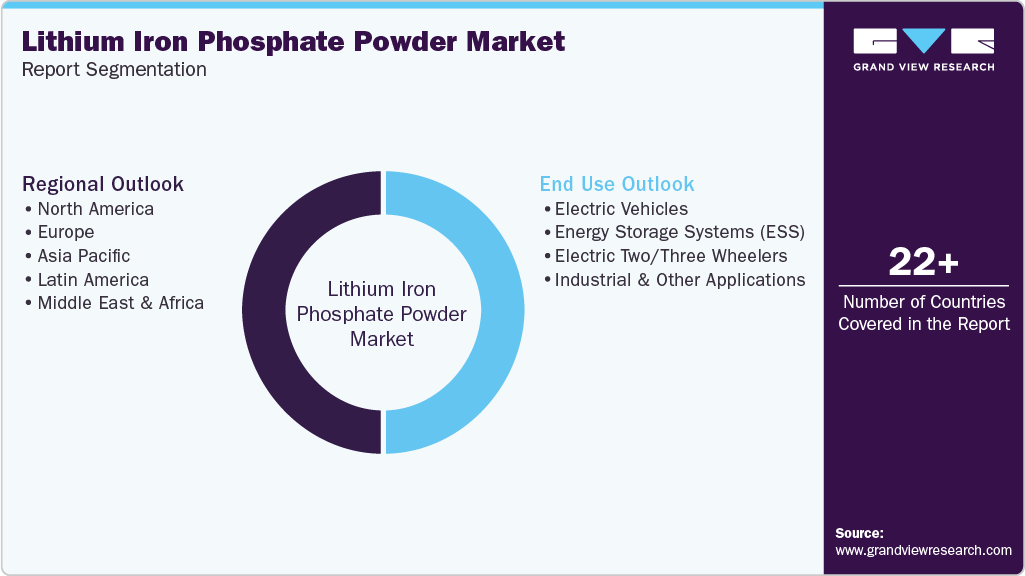
This report forecasts country revenue & volume growth and analyzes the latest trends in each sub-segment from 2021 to 2033. For this study, Grand View Research has segmented the lithium iron phosphate powder market report based on end use and region:
-
End Use Outlook (Volume, Kilotons; Revenue, USD Million, 2021 - 2033)
-
Electric Vehicles
-
Energy Storage Systems (ESS)
-
Electric Two/Three Wheelers
-
Industrial & Other Applications
-
-
Regional Outlook (Volume, Kilotons; Revenue, USD Million, 2021 - 2033)
-
North America
-
U.S.
-
Canada
-
Mexico
-
-
Europe
-
Germany
-
UK
-
Italy
-
France
-
Spain
-
-
Asia Pacific
-
China
-
Japan
-
South Korea
-
India
-
Australia
-
-
Latin America
-
Brazil
-
Argentina
-
-
Middle East & Africa
-
Saudi Arabia
-
UAE
-
South Africa
-
-
Frequently Asked Questions About This Report
b. By end use, the electric vehicles segment has the largest market share, accounting for over 69.0% in 2025, driven by large-scale adoption of cost-effective LFP batteries in mass-market passenger EVs, commercial fleets, and electric buses across China, North America, and Europe.
b. Some key players in the lithium iron phosphate powder market include BYD Company Limited; Contemporary Amperex Technology Co. Limited, EVE Energy Co., Ltd.; Gotion High-Tech Co., Ltd., Hunan Yuneng New Energy Battery Material Co., Ltd.; LG Energy Solution, Ltd.; L&F Co., Ltd.; SVOLT Energy Technology Co., Ltd.; Tianjin Lishen Battery Joint-Stock Co., Ltd.; Wanrun New Energy Technology Co., Ltd., and others.
b. The key driver of the lithium iron phosphate powder market is the rising demand for cost-efficient and thermally stable battery chemistries in electric vehicles and grid-scale energy storage systems. Increasing electrification, renewable energy integration, and OEM preference for cobalt-free cathode materials are significantly accelerating LFP adoption worldwide.
b. The global lithium iron phosphate powder market size was estimated at USD 20.57 billion in 2025 and is expected to reach USD 17.60 billion in 2026.
b. The global lithium iron phosphate powder market is expected to grow at a compound annual growth rate of 14.4% from 2026 to 2033 to reach USD 45.26 billion by 2033.


Share this report with your colleague or friend.
Need a Tailored Report?
Customize this report to your needs — add regions, segments, or data points, with 20% free customization.


ISO 9001:2015 & 27001:2022 Certified
We are GDPR and CCPA compliant! Your transaction & personal information is safe and secure. For more details, please read our privacy policy.
Trusted market insights - try a free sample
See how our reports are structured and why industry leaders rely on Grand View Research. Get a free sample or ask us to tailor this report to your needs.













