
- Home
- »
- Animal Health
- »
-
Livestock Genetics Market Size & Share Report, 2026-2033GVR Report cover

Livestock Genetics Market (2026 - 2033)
Size, Share & Trends Analysis Report By Species, By Genetic Material (Semen, Embryos, Live Breeding Animals), By Technology, By End-user, By Region, And Segment Forecasts
Market Size, 2025
$7.8BMarket Estimate, 2026
$8.4BMarket Forecast, 2033
$16.4BCAGR, 2026–2033
10.0%Livestock Genetics Market Summary
The global livestock genetics market size was valued at USD 7.8 billion in 2025 and is projected to grow from USD 8.4 billion in 2026 to USD 16.4 billion by 2033, at a CAGR of 10.0% from 2026 to 2033. North America dominated the market, accounting for the largest revenue share of 32.2% in 2025. The market is primarily driven by key factors such as investment in bovine breeding programs across commercial dairy and beef operations; sovereign food-security spending driving the build-out of Gulf livestock genetics infrastructure; adoption of embryo transfer (ET) and IVF among elite breeding programs; and government-funded national breeding improvement and food-security investment programs.
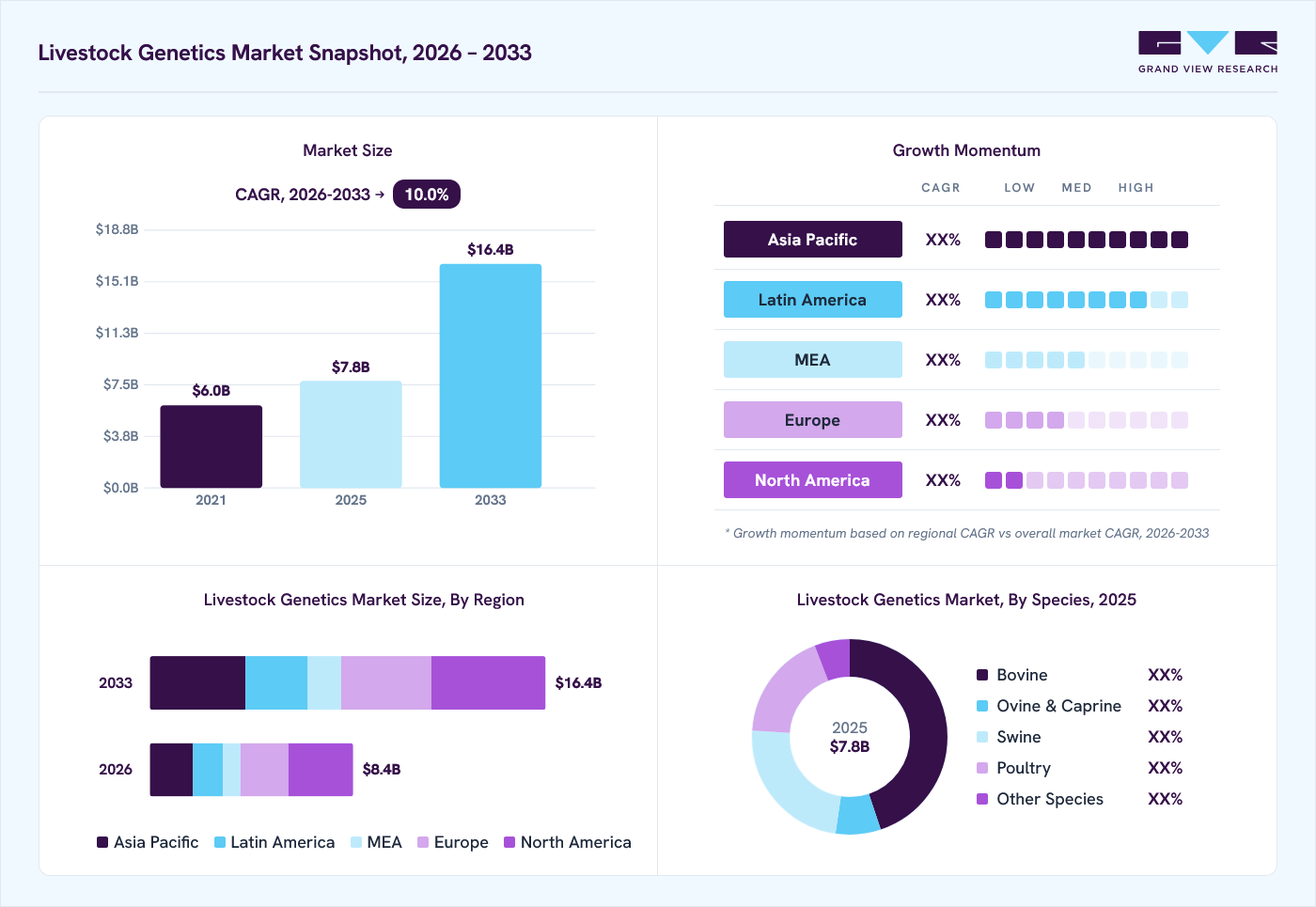 Source: Grand View Research, IR Documents, Primary Interviews, Paid DatabasesTo learn more about this report,
 Download Free Sample Report
Key Market Trends & Insights
- By species: Bovine segment led the market with the largest revenue share of 44.8% in 2025.
- By genetic material: Semen segment led the market with the largest revenue share of 56.0% in 2025.
- By technology: Artificial insemination segment dominated the market, accounting for over 57.8% in 2025.
- By end user: Commercial livestock farms segment accounted for the largest market share of 50.1% in 2025.
Regional Highlights
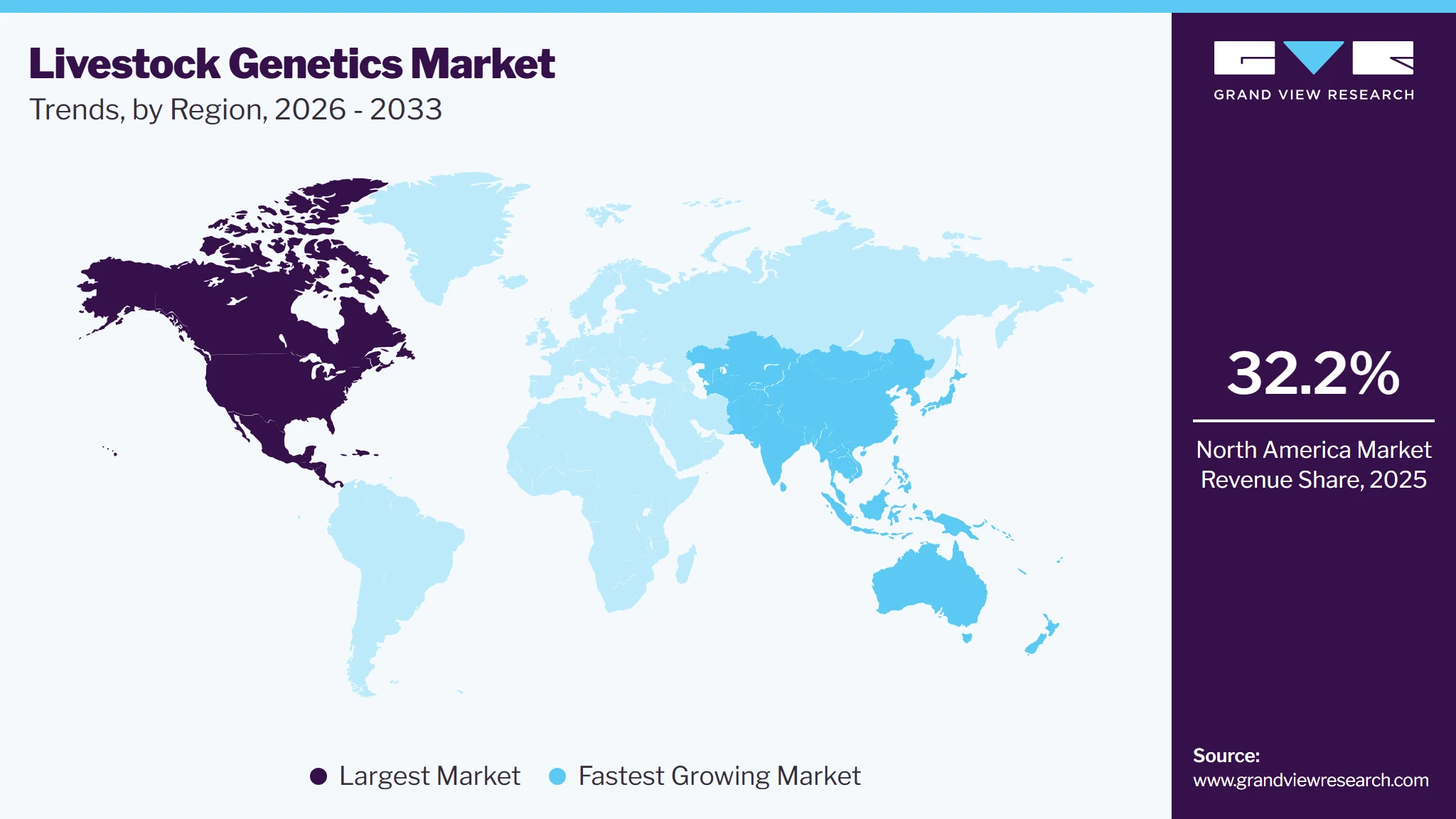
- Largest regional market: North America (32.2% revenue share, 2025)
- Fastest-growing regional market: Asia Pacific (highest CAGR, 2026-2033)
- By country: The U.S. held the largest market share in 2025
Market Size & Forecast
- Market size in 2025: USD 7.8 Billion
- Estimated market size in 2026: USD 8.4 Billion
- Projected market size by 2033: USD 16.4 Billion
- CAGR (2026-2033): 10.0%
Prism AI by Grand View Research Free to tryAsk a question about the livestock genetics marketTry asking✓Every figure cited from GVR research Prefer the report? Download free sample →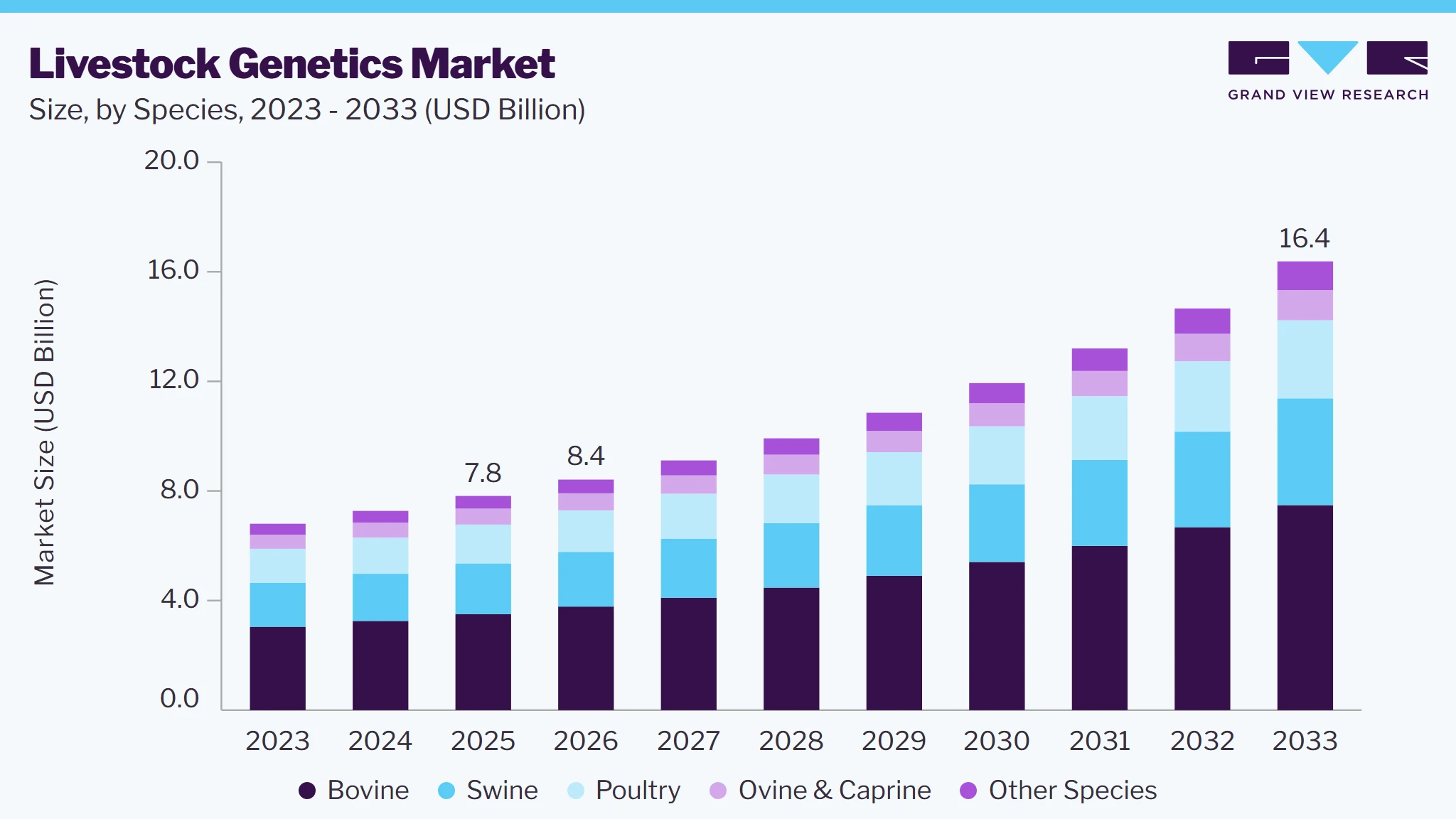 To learn more about this report, Download Free Sample Report
Market Dynamics
The global market is structurally split between mature, high-penetration regions and emerging markets still building foundational infrastructure, and this divide shapes where growth actually concentrates. North America and Europe anchor absolute market scale on the strength of deeply institutionalized breeding cooperatives, dense AI and ET networks, and decades of maturity in genetic evaluation systems, but this same infrastructure density caps their headroom for outsized expansion. Growth instead migrates toward Asia Pacific and MEA, where a combination of post-ASF rebuilding of swine genetics, sovereign food-security investment in the Gulf states, and accelerating institutional R&D activity in markets like India is compounding adoption from a comparatively underdeveloped base.
Bovine genetics remains the structural core of the market, given its dominant position across dairy and beef breeding programs globally, while embryo-based and IVF technologies represent the fastest-scaling technology tier as capital-rich operators upgrade beyond AI-only programs. Government authorities are emerging as an increasingly influential end-user category, propelled by national breeding-improvement mandates and food-security policy rather than purely commercial demand. This positions the market's next growth phase around technology depth in mature economies and infrastructure build-out in emerging ones, a bifurcation that will define competitive strategy for genetics providers through 2033.
One of the key drivers is the accelerating shift toward embryo transfer and IVF adoption among elite breeding programs, as capital-rich operators move beyond artificial insemination to capture the higher genetic gain these technologies enable. This transition is concentrated in markets with established cryopreservation and clinical infrastructure, positioning ET and IVF providers to command premium pricing over AI-only competitors even as their share of total genetic material volume remains smaller. For instance, in February 2026, Leads Genetics opened an integrated R&D center for indigenous cattle genetics in Bareilly, India, signaling institutional commitment to advanced reproductive technology beyond conventional breeding.
Furthermore, ICAR-IVRI's breakthrough in producing Sahiwal calves through advanced reproductive methods demonstrated how embryo-based techniques are extending elite genetics into indigenous breed conservation, a use case that broadens the addressable base for ET and IVF providers beyond commercial dairy and beef operators alone. This dual momentum, institutional infrastructure build-out paired with breed-conservation applications, structurally favors technology providers over conventional semen-only distributors as breeding programs mature.
Smallholder-dominated farming systems structurally constrain genetics providers because AI and ET adoption depend on clinical infrastructure, trained technicians, and cold-chain logistics that fragmented subsistence-oriented operations cannot economically support. This concentrates commercial genetics revenue among organized farms while leaving the majority of the global herd population outside the addressable market, a structural ceiling rather than a temporary gap. Regions such as ROAPAC, ROMEA, and India illustrate this pattern most clearly, where large livestock populations coexist with minimal breeding-organization infrastructure and low capacity for producer investment. Government extension programs partially offset this gap by driving AI adoption in the absence of private-sector density, but ET and IVF penetration remain structurally out of reach without capital-intensive clinical buildout. This positions government authorities and NGO-linked conservation initiatives, rather than commercial breeding centers, as the primary near-term channel for expanding access to genetics in these systems, and genetics providers entering these markets should expect a longer infrastructure-development runway before commercial-scale returns materialize.
Aquaculture and camelid genetics represent a structurally distinct growth pathway because both categories combine a small current commercial base with disproportionately high per-transaction value, a profile that rewards early entrants over incumbents optimized for high-volume bovine and swine genetics. Aquaculture genetics, spanning salmon and shrimp breeding programs, is scaling quickly in select Asia-Pacific markets as export-oriented aquaculture operations adopt genetic selection tools to improve yield and disease resistance.
Camelid genetics is a distinct value driver, commanding high per-transaction pricing in Gulf markets where camel genomics intersects with sovereign-backed biotech investment and cultural significance, beyond pure production economics. This positions niche-species genetics as a wedge opportunity for providers seeking to differentiate themselves from the crowded bovine and swine competitive set, particularly given that established genetics leaders have concentrated their infrastructure and distribution networks on mainstream livestock species, leaving camelid and aquaculture genetics comparatively underserved despite their growth trajectories.
Sovereign Germplasm Diplomacy as a Structural Market Differentiator
Context -
In August 2026, the National Advisory Board on Management of Genetic Resources (NABMGR), reconstituted under the Indian Council of Agricultural Research, called for stronger regional germplasm exchange agreements with Central and Southeast Asian countries. The proposal explicitly named livestock, including sheep, alongside crop genetics as strategic assets for building climate-resilient agricultural systems, and called for stronger use of existing memorandums of understanding to formalize this exchange.
Significance -
This development illustrates a structural USP of the livestock genetics industry that differentiates it from most other agri-input categories: genetic material carries strategic, cross-border value that governments actively coordinate to access, rather than treating it as a purely commercial input. Unlike feed or pharmaceuticals, livestock genetics function as a national resilience asset, positioning government authorities and research institutions, not just commercial buyers, as active participants shaping trade flows and market access.
Structural Implication -
This positions livestock genetics providers and breeding institutions operating in South and Southeast Asia to benefit from government-brokered access corridors that reduce the traditional barriers posed by import regulations and biosecurity friction associated with live-animal or genetic-material trade. Where conventional genetics trade depends on bilateral commercial agreements, regional germplasm frameworks create a policy-backed channel for exchange, reducing time-to-market for breeding programs seeking access to climate-adapted ovine and caprine genetic lines from neighboring markets.
Key Highlights -
Genetics as sovereign resilience infrastructure
Livestock genetic diversity is increasingly treated as a national asset requiring active government stewardship, not a passive commercial category.
Institutional demand as a growth channel distinct from commercial farms
Government advisory bodies and research bureaus are structurally motivated to expand access to genetics independent of near-term commercial returns.
Regional exchange frameworks as a market-access accelerant
MoU-backed germplasm corridors can circumvent the regulatory friction that typically constrains cross-border trade in genetic material, particularly relevant for ovine and caprine genetics, given India's explicit inclusion of sheep in this proposal.
Market Concentration & Characteristics
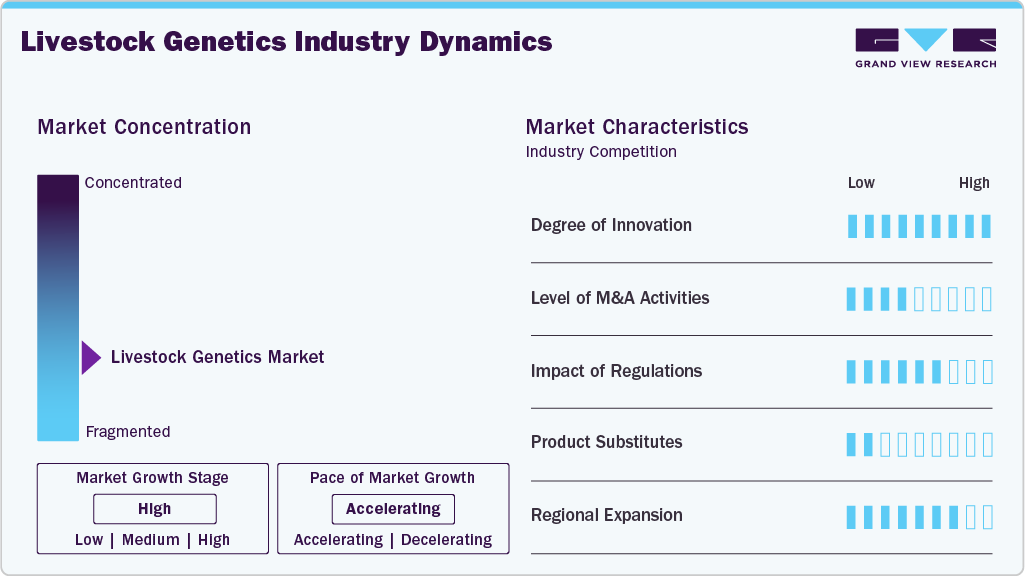
The global livestock genetics industry is moderately fragmented, with established multinational genetics leaders competing alongside regional breeding cooperatives and specialized technology providers across species-specific niches. Market participants are continuously investing in genomic selection, embryo transfer, and IVF capabilities, while pursuing capability-driven acquisitions and cross-border collaborations to strengthen breeding-technology portfolios. This innovation intensity, paired with expansion into underpenetrated Gulf and Asia Pacific markets, is broadening the industry's addressable base and reinforcing its long-term growth trajectory.
The market shows high innovation intensity, concentrated around genomic selection, IVF technologies, and sexed semen platforms. Elite breeding programs are pushing genetic gain beyond conventional AI, and R&D activity spans indigenous breed conservation to hornless-gene selection. This positions technology-forward providers to command premium pricing while conventional semen-only distributors face margin compression as genomic tools become table stakes for competitive breeding programs.
 To learn more about this report, Download Free Sample Report
Consolidation is moderate to high among established players seeking genomics and software capabilities rather than pure scale. Zoetis's acquisition of Neogen's animal genomics business and URUS Group's acquisition of AgriWebb both reflect a strategic shift toward precision genetics and farm data integration. This positions M&A as a capability-acquisition tool for incumbents rather than a market-share consolidation play among fragmented regional players.
Regulatory influence varies sharply by geography, shaping the trade in genetic material more than technology adoption itself. Import restrictions on live animals versus semen or embryos often determine which genetic material format dominates a given market, while government-funded breeding programs in APAC and MEA introduce policy-driven demand independent of commercial market forces. This creates an uneven competitive terrain where market access depends as much on regulatory navigation as on product quality.
Genetics products face limited direct substitution given their biological specificity, though substitution occurs at the technology tier rather than at the product category level. Operators can substitute AI for ET or IVF based on cost and access to infrastructure, and live breeding animals can substitute for semen or embryo imports where regulatory or logistical barriers exist. This positions technology-tier substitution, rather than product replacement, as the primary competitive dynamic that providers must navigate.
Expansion activity focuses on underpenetrated markets rather than mature ones, driven by government-backed food-security programs in the Gulf states and post-ASF genetics rebuilding across the Asia-Pacific. Established players are expanding their distribution networks and clinical infrastructure into these regions rather than deepening their penetration in already saturated North American and European markets. This positions emerging-market infrastructure investment as the primary driver of competitive positioning over the next decade.
Analyst Perspective
The central strategic question is whether future market growth will be driven by advanced technology in mature economies or infrastructure expansion in underpenetrated markets. Established players with strong AI networks and breeding-center infrastructure retain an advantage in North America and Europe. However, this advantage is narrowing in Asia Pacific and MEA, where government-backed food-security initiatives are accelerating market development. Sovereign germplasm strategies and public-sector investments are becoming increasingly important growth drivers. This shift creates opportunities for new entrants through government authorities and research institutions. These channels can help emerging providers overcome the distribution barriers of established commercial players. Incumbents face risks if they underestimate the impact of policy-driven demand on market expansion. India’s efforts to promote regional germplasm exchange highlight this changing landscape. Providers that prioritize institutional and government partnerships can capture emerging opportunities more effectively. Overall, policy-led investment is expected to reshape competitive dynamics and influence market leadership over the next decade.
Species Insights
The bovine segment accounted for the largest market share of 44.8% in 2025. The growth is driven by its central role in global dairy and beef breeding programs, where herd improvement objectives and deep AI and ET penetration drive sustained demand for genetics. Growth is driven by expanding adoption of genomic selection among commercial dairy and beef operators, rising cross-border embryo trade among elite herds, and continued investment in breeding-evaluation infrastructure across mature and consolidating markets alike, reinforcing bovines' position as the category's structural anchor.
The other species segment is anticipated to grow at the fastest CAGR over the forecast period. This segment, spanning aquaculture, camelids, and yak, is scaling fastest from a comparatively small base as niche genetic-improvement programs gain commercial traction. Growth is driven by expanding adoption of aquaculture genetics in export-oriented Asia Pacific operations targeting yield and disease resistance, alongside rising investment in camelid genetics in Gulf markets, where sovereign-backed biotech programs are extending genetic selection into previously underserved species.
Genetic Material Insights
Semen dominated the market in 2025 with a share of 56.0%. Segment growth is driven by rising adoption of sexed semen for herd-gender optimization, continued AI-network expansion into emerging commercial farming systems, and steady replacement-cycle demand from breeding centers that position semen as the highest-frequency, lowest-friction category of genetic material across both mature and developing markets.
The embryos segment is anticipated to grow at the second-fastest CAGR over the forecast period. Growth is driven by expanding elite dairy and beef embryo export activity in developed markets, rising institutional investment in ET-based breed conservation programs, and increasing adoption of embryo transfer within premium breeding operations seeking faster genetic improvement than AI alone can deliver.
End User Insights
The commercial livestock farms segment accounted for the largest market share of 50.1% in 2025. This position reflects large-scale industrialized dairy, beef, swine, and poultry operations that drive the overwhelming majority of global genetics volume, supported by consistent replacement-cycle purchasing and sustained investment in herd productivity and reproductive performance improvement across mature and consolidating commercial systems alike.
The academic & research institutions segment is the fastest-growing, with the highest CAGR over the forecast period. Growth is driven by rising institutional investment in genomic testing and breeding innovation, expanding university-led reproductive technology research programs, and growing collaboration between research institutions and commercial breeding organizations, which together are elevating this smaller-volume segment's growth trajectory above that of traditional commercial end-user channels.
Technology Insights
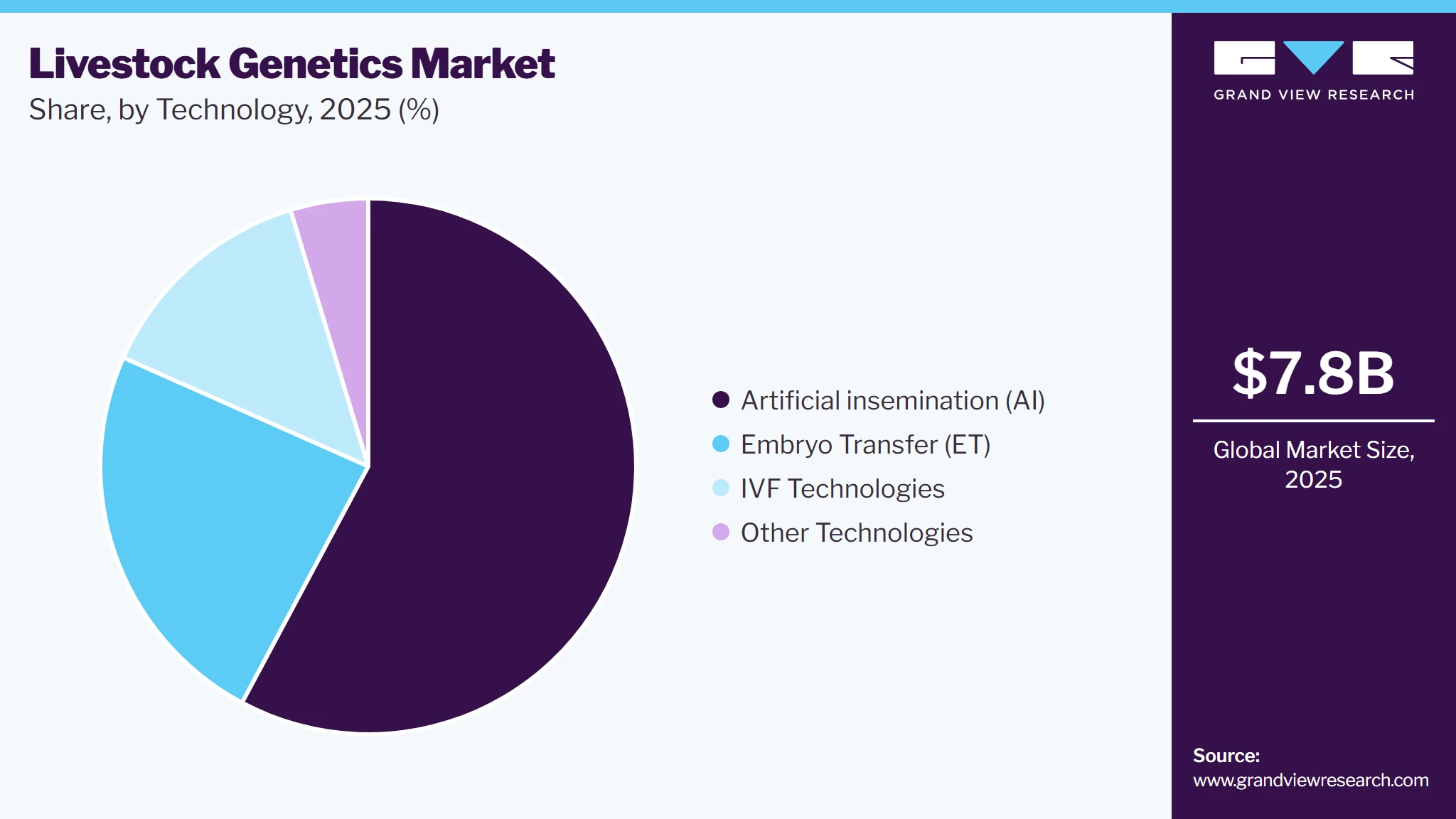
The artificial insemination segment dominated the market, accounting for over 57.8% in 2025. Segment growth is driven by continued AI-infrastructure expansion into smallholder and emerging commercial systems, government-extension program support in developing markets, and sustained replacement-cycle demand that keeps AI the highest-penetration, highest-frequency technology category even as premium alternatives gain share.
 To learn more about this report, Download Free Sample Report
The IVF technologies segment is expected to grow with the fastest CAGR over the forecast period. Growth is driven by expanding institutional R&D investment in IVF-based breeding programs, rising adoption among elite dairy and beef operators seeking maximum genetic gain per procedure, and growing integration of IVF with genomic selection tools that together are compressing the technology-adoption curve in leading markets.
Regional Insights
North America held the largest revenue share of 32.2% in 2025, driven by the widespread adoption of genomic selection technologies, advanced artificial insemination and embryo transfer programs, and the presence of well-established livestock breeding companies. The region has a large commercial cattle, swine, poultry, and dairy industry that continues to invest in genetic improvement to increase productivity, disease resistance, feed efficiency, and reproductive performance. Furthermore, strong investments in animal genomics research, digital breeding technologies, and precision livestock farming support the adoption of advanced livestock genetics solutions across the region.
 To learn more about this report, Download Free Sample Report
U.S. Livestock Genetics Market Trends
The livestock genetics market in the U.S. held the largest share in the North America region in 2025, driven by its large commercial cattle, swine, poultry, and dairy industries and the widespread adoption of genomic selection, artificial insemination, embryo transfer, and genomic breeding technologies. The country has well-established breeding organizations, livestock genetics companies, and research institutions that continuously develop high-performance genetic lines to improve productivity, feed efficiency, reproductive performance, and disease resistance. Increasing demand for premium-quality meat and dairy products has encouraged producers to adopt genetically superior breeding stock to improve herd performance and operational efficiency. Furthermore, advancements in genomic testing and data-driven breeding programs continue to support precision livestock management across commercial farms. For instance, in January 2025, the U.S. Department of Agriculture (USDA) reported that the national cattle inventory totaled 86.7 million head, indicating sustained demand for advanced livestock genetics technologies and breeding solutions across large-scale commercial livestock production systems.
Mexico livestock genetics marketis estimated to grow at the fastest CAGR during the forecast period, driven by increasing adoption of artificial insemination, embryo transfer, and genomic selection technologies to improve livestock productivity and reproductive efficiency. Rising demand for high-quality beef and dairy products is encouraging livestock producers to adopt genetically superior breeding stock to enhance production efficiency and herd performance. Furthermore, government initiatives supporting livestock modernization, animal breeding, and genetic resource conservation are contributing to the adoption of advanced breeding technologies nationwide. Mexico's large cattle population, expanding commercial dairy and beef industries, and increasing awareness of genetic improvement programs are expected to sustain demand for livestock genetics solutions. In addition, advancements in genomic testing and breeding technologies are enabling producers to improve disease resistance, feed efficiency, reproductive performance, and overall livestock productivity, supporting long-term market growth.
Europe Livestock Genetics Market Trends
The livestock genetics market in Europe is experiencing steady growth, driven by the increasing adoption of genomic selection, artificial insemination, embryo transfer, and other advanced breeding technologies across the livestock sector. The region has well-established cattle, swine, sheep, and poultry industries that continue to invest in genetic improvement to enhance productivity, reproductive performance, feed efficiency, and disease resistance. Furthermore, supportive government programs, strong animal breeding associations, and continuous research in animal genomics are accelerating the adoption of livestock genetics solutions. Increasing demand for high-quality meat and dairy products, coupled with sustainability objectives focused on improving production efficiency and reducing environmental impact, is expected to support market growth across Europe.
Germany livestock genetics market held the largest share in 2025, fueled by its advanced livestock breeding industry, strong dairy and swine production, and widespread adoption of genomic selection technologies. The country has established breeding organizations, research institutions, and artificial insemination programs that support continuous genetic improvement across commercial livestock operations. Furthermore, increasing investment in precision livestock farming and genomic evaluation is enabling producers to improve productivity, reproductive efficiency, feed conversion, and disease resistance. Germany's focus on sustainable livestock production and breeding efficiency continues to support the adoption of advanced livestock genetics technologies across the commercial agriculture sector.
The livestock genetics market in the UK is expected to grow significantly over the forecast period. The market is driven by increasing adoption of genomic breeding technologies, expanding livestock improvement programs, and growing investment in animal genomics research. The country's well-established cattle and sheep industries are increasingly utilizing genomic selection to improve productivity, fertility, disease resistance, and production efficiency. Furthermore, collaboration between research organizations, breeding companies, and livestock producers is accelerating the development and commercialization of advanced genetic solutions. Government initiatives supporting agricultural innovation and sustainable livestock production are expected to further encourage the adoption of livestock genetics technologies across commercial farming operations.
Asia Pacific Livestock Genetics Market Trends
The livestock genetics market in the Asia Pacific is expected to grow at the fastest CAGR over the forecast period, driven by the region’s large livestock population, increasing commercialization of animal farming, and rising adoption of advanced breeding technologies. Expanding dairy, poultry, and swine industries across China, India, and Southeast Asia are encouraging producers to adopt genomic selection, artificial insemination, and embryo transfer technologies to improve productivity and breeding efficiency. Furthermore, government programs supporting livestock improvement, food security, and sustainable animal production are contributing to the adoption of genetic solutions. Increasing adoption of genomic technologies by breeding companies and research institutions is expected to support market expansion across the region.
China livestock genetics market held the largest share in the Asia Pacific in 2025, driven by the country’s large-scale livestock production, increasing focus on breeding efficiency, and growing adoption of genomic technologies. The modernization of dairy, swine, and poultry farming is encouraging producers to use genetic evaluation and advanced breeding programs to improve production traits, reproductive performance, and disease resistance. Furthermore, government programs focused on improving livestock productivity and strengthening domestic breeding capabilities are supporting the adoption of advanced genetic solutions. China’s large commercial livestock sector and growing research activities in animal breeding research are expected to sustain demand for livestock genetics technologies.
The livestock genetics market in India is estimated to grow at the fastest rate over the forecast period, driven by increasing government focus on cattle improvement, rising adoption of artificial insemination programs, and growing awareness regarding genetically superior breeding stock. The expansion of dairy production and the need to improve milk yield, fertility, and animal productivity are encouraging farmers to adopt advanced breeding techniques. Furthermore, national programs focused on genetic improvement of indigenous cattle breeds and strengthening breeding infrastructure are supporting market growth. Increasing participation of private breeding companies and research organizations is expected to accelerate the adoption of livestock genetics solutions across the country.
Latin America Livestock Genetics Market Trends
The livestock genetics market in Latin America is expected to grow significantly during the forecast period, driven by the region’s strong cattle, poultry, and swine industries and increasing demand for productivity improvements in commercial livestock production. Countries such as Brazil, Argentina, and Mexico are adopting advanced breeding technologies to improve meat quality, reproductive efficiency, and herd performance. Furthermore, the expansion of export-oriented beef and dairy production is encouraging producers to invest in genetically superior livestock and genomic evaluation programs. Greater adoption of breeding technologies among commercial producers, supported by collaboration between breeding companies, farmers, and research institutions, is expected to support the adoption of livestock genetics technologies across the region.
Brazil livestock genetics market held the largest share in Latin America in 2025, driven by its extensive cattle population, strong beef export industry, and widespread adoption of genetic improvement programs. Brazilian producers are increasingly using artificial insemination, embryo transfer, and genomic selection technologies to improve cattle productivity, reproductive performance, and meat quality. Furthermore, the presence of leading livestock genetics companies and established breeding associations supports the development and commercialization of advanced genetic solutions. The country’s focus on improving livestock efficiency and maintaining competitiveness in global meat markets is expected to support continued demand for livestock genetics.
Middle East & Africa Livestock Genetics Market Trends
The livestock genetics market in MEA is witnessing steady growth, driven by a growing focus on improving livestock productivity, rising demand for animal protein, and the gradual adoption of advanced breeding technologies. The region’s livestock-dependent economies are investing in breeding programs to enhance animal performance, reproductive efficiency, and resilience under challenging climatic conditions. Furthermore, increasing collaboration with international breeding organizations and expanding access to artificial insemination and genetic evaluation services are supporting market development. Growing efforts to improve food security and strengthen domestic livestock production are expected to create opportunities for livestock genetics adoption across emerging markets.
South Africa livestock genetics market held the largest share in MEA in 2025, driven by its developed commercial livestock sector, established cattle breeding programs, and increasing adoption of genomic technologies. The country has a strong beef and dairy industry that uses artificial insemination, genetic evaluation, and selective breeding programs to improve herd performance and production efficiency. Furthermore, the presence of livestock breeding organizations and research institutions supports innovation in animal genetics. Increasing demand for high-quality livestock products and improved breeding outcomes is expected to sustain the adoption of advanced livestock genetics solutions in South Africa.
Key Livestock Genetics Company Insights
The global market is fairly competitive. Key companies deploy strategic initiatives, such as product development, launches, and sales & marketing strategies to increase product awareness and regional expansions and partnerships to strengthen their market share. Market players are also involved in conducting clinical testing of their products, patent applications, and increasing product penetration.
Key Livestock Genetics Companies
The following key companies have been profiled for this study on the livestock genetics market:
-
Genus plc
-
STgenetics
-
URUS Group LP
-
SEMEX
-
Select Sires Inc.
-
CRV
-
VikingGenetics
-
Hendrix Genetics BV
-
Topigs Norsvin
-
Aviagen Group
-
Cobb-Vantress, LLC
-
EW Group
-
MINITÜB GMBH
-
Neogen Corporation
-
Zoetis
Competitive Benchmarking
Operating Strategies
Competitive Edge
Weaknesses
Mature Players: Genuss plc; URUS Group LP; SEMEX; Zoetis; Hendrix Genetics BV; Aviagen Group; Cobb-Vantress, LLC
- Established players focus on expanding multi-species genetics portfolios through acquisitions, genomic selection investment, and integration of breeding technology with farm-data platforms. Companies increasingly pursue capability-driven M&A, such as genomics and precision-agriculture acquisitions, to extend product depth beyond conventional AI. Strategic partnerships with research institutions and biotechnology firms strengthen proprietary genetic-line development. These companies leverage extensive global distribution networks and breeding-center infrastructure to introduce new genetic lines and technologies across mature and emerging markets alike.
- Established companies benefit from strong brand recognition across dairy, beef, swine, and poultry genetics, extensive global distribution networks, deep breeding-center infrastructure, and substantial R&D and financial resources. Large installed bases of elite genetic lines and long-standing breeding-organization relationships enable these companies to introduce new genomic and reproductive technologies to an existing customer base. Their scale allows them to combine semen, embryo, and live-animal trade with genomic testing and precision-breeding software, supporting recurring revenue across the full genetics value chain.
- Established players may face higher operating and R&D costs, lengthy genetic-line development and regulatory approval processes, and greater organizational complexity across multi-species portfolios. Maintaining large breeding-center networks and cold-chain distribution infrastructure increases capital and operational requirements and integrating acquired genomics or software capabilities can strain organizational focus and slow time-to-market for new offerings.
Emerging Players: STgenetics; Select Sires Inc.; CRV; VikingGenetics; Topigs Norsvin; EW Group; MINITÜB GMBH; Neogen Corporation
- Specialized and technology-focused players concentrate on species-specific or technology-specific niches, such as sexed semen, genomic testing, or AI and ET equipment, rather than pursuing multi-species scale. These companies invest in focused R&D around specific breeding technologies and pursue partnerships with cooperatives, research institutions, and commercial breeding programs to expand technical reach without building extensive independent distribution infrastructure. Several pursue regional consolidation within core species categories, such as swine or poultry genetics, to deepen market concentration in defined geographies.
- Specialized players benefit from focused technical expertise, agile R&D structures, and the ability to advance niche breeding technologies such as sexed semen, cryopreservation systems, or genomic testing platforms faster than diversified competitors. Concentration on specific species or technology categories allows these companies to respond quickly to advances in genomics and reproductive science, while cooperative ownership structures in several cases (VikingGenetics, CRV) provide stable producer-aligned demand and lower customer-acquisition friction.
- Specialized players often face limited geographic reach, smaller commercial scale, and narrower species or technology coverage compared with established multi-species leaders. Expansion into new species categories or geographies typically requires partnership or licensing rather than independent infrastructure build-out, and reliance on a concentrated technology or species niche leaves these companies more exposed to shifts in adoption patterns within that specific category.
Recent Developments
-
In August 2026, Negros Occidental's provincial government distributed 1,546 heads of livestock and poultry to farmers, associations, and institutions under its Animal Genetic Improvement and Livelihood Program. The dispersal, sourced from provincial breeding facilities, included piglets, cattle, sheep, and poultry, as well as a separate cattle-fattening initiative aimed at generating income for 40 beneficiary organizations and individuals.
-
In May 2026, Northern Ireland's DAERA launched the next phase of its ~80 million USD (GBP 60 million) Bovine Genetics Project at Balmoral Show, introducing an online Livestock Genetics portal alongside a government-funded cattle genotyping scheme. Delivered in partnership with Sustainable Ruminant Genetics, the initiative gives herd owners earlier access to trait-level data (feed efficiency, health characteristics) to improve breeding decisions, with the genotyping rollout and farmer training beginning September 2026.
Livestock Genetics Market Report Scope
Report Attribute
Details
Market size in 2025
USD 7.8 billion
Estimated market size in 2026
USD 8.4 billion
Projected market size by 2033
USD 16.4 billion
Growth rate
CAGR of 10.0% from 2026 to 2033
Actual data
2021 - 2025
Forecast period
2026 - 2033
Quantitative units
Revenue in USD billion and CAGR from 2026 to 2033
Report coverage
Revenue forecast, company ranking, competitive landscape, growth factors, and trends
Segments covered
Species, genetic material, technology, end user, region
Regional scope
North America; Europe; Asia Pacific; Latin America; MEA
Country scope
U.S.; Canada; Mexico; UK; Germany; France; Italy; Spain; Denmark; Sweden; Norway; Japan; China; India; Thailand; South Korea; Australia; Brazil; Argentina; South Africa; UAE; Saudi Arabia; Kuwait; Qatar; Oman
Key companies profiled
Genus plc; STgenetics; URUS Group LP; SEMEX; Select Sires Inc.; CRV; VikingGenetics; Hendrix Genetics BV; Topigs Norsvin; Aviagen Group; Cobb-Vantress, LLC; EW Group; MINITÜB GMBH; Neogen Corporation; Zoetis
Customization scope
Free report customization (equivalent up to 8 analysts working days) with purchase. Addition or alteration to country, regional & segment scope.
Pricing and purchase options
Avail customized purchase options to meet your exact research needs. Explore purchase options
Global Livestock Genetics Market Report Segmentation
This report forecasts revenue growth at global, regional, and country levels and provides an analysis of the latest industry trends in each of the sub-segments from 2021 to 2033. For this study, Grand View Research has segmented the global livestock genetics market report based on species, genetic material, technology, end user, and region:
-
Species Outlook (Revenue, USD Billion, 2021 - 2033)
-
Bovine
-
Ovine & Caprine
-
Swine
-
Poultry
-
Other Species
-
-
Genetic Material Outlook (Revenue, USD Billion, 2021 - 2033)
-
Semen
-
Embryos
-
Live Breeding Animals
-
Oocytes/Genetic Samples
-
-
Technology Outlook (Revenue, USD Billion, 2021 - 2033)
-
Artificial insemination (AI)
-
Embryo Transfer (ET)
-
IVF Technologies
-
Other Technologies
-
-
End User Outlook (Revenue, USD Billion, 2021 - 2033)
-
Commercial Livestock Farms
-
Breeding Centers
-
Government Authorities
-
Academic & Research Institutions
-
-
Regional Outlook (Revenue, USD Billion, 2021 - 2033)
-
North America
-
U.S.
-
Canada
-
Mexico
-
-
Europe
-
UK
-
Germany
-
France
-
Italy
-
Spain
-
Denmark
-
Sweden
-
Norway
-
-
Asia Pacific
-
Japan
-
China
-
India
-
Australia
-
Thailand
-
South Korea
-
-
Latin America
-
Brazil
-
Argentina
-
-
Middle East & Africa
-
South Africa
-
UAE
-
Saudi Arabia
-
Kuwait
-
Qatar
-
Oman
-
-
Research Methodology
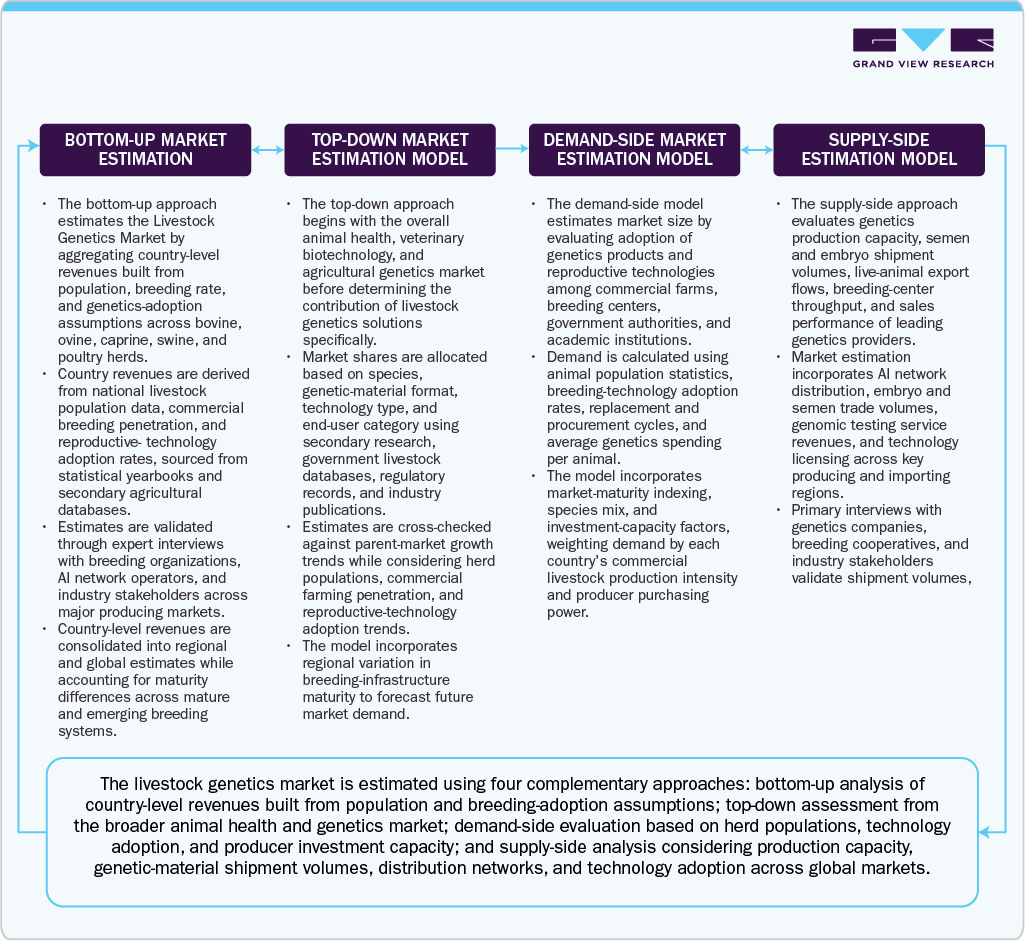
The livestock genetics market figures in this report are based on a proven research process that combines executive interviews with secondary research from proprietary databases, company filings, and recognized regulatory and institutional sources. Market size is built through value-chain sizing-reconciling supply-side and demand-side estimates-and triangulated with bottom-up and top-down approaches. Every estimate passes multiple levels of expert validation before publication, with each livestock genetics segment quantified using the revenue-capture definitions in the table below.
Segment Definition
Segment
Sub-segment
Definition
Livestock Genetics Market
The market captures revenue generated from the sale of livestock genetic materials, breeding technologies, and related reproductive services used by farms, breeding organizations, research institutions, and government bodies to improve animal productivity, fertility, disease resistance, and genetic performance.
Species Segment
Definition
Species
Bovine
The segment captures revenue generated from genetic materials, breeding technologies, and reproductive services used in cattle breeding programs for dairy and beef production based on herd improvement objectives, technology adoption, and breeding investments.
Species
Ovine & Caprine
The segment captures revenue generated from genetic materials, breeding technologies, and reproductive services used for sheep and goat breeding to improve meat, milk, fiber, and reproductive performance across commercial production systems.
Species
Porcine
The segment captures revenue generated from genetic materials, breeding technologies, and reproductive services used in commercial swine breeding programs to improve productivity, reproductive efficiency, feed conversion, and meat quality.
Species
Poultry
The segment captures revenue generated from genetic materials, breeding technologies, and reproductive services used in commercial poultry breeding for broiler, layer, and breeder stock improvement based on production efficiency and genetic advancement.
Species
Other Species
The segment captures revenue generated from genetic materials and breeding services used for camelids, aquaculture, and other minor livestock species where commercial genetic improvement programs are implemented.
Genetic Material Segment
Definition
Genetic Material
Semen
The segment captures revenue generated from the sale and use of livestock semen for artificial insemination and genetic improvement programs across commercial breeding operations and institutional users.
Genetic Material
Embryos
The segment captures revenue generated from livestock embryos supplied for embryo transfer, elite breeding programs, herd multiplication, and international germplasm exchange.
Genetic Material
Live Breeding Animals
The segment captures revenue generated from the sale of pedigree breeding males and females used for herd establishment, genetic improvement, and nucleus breeding programs.
Genetic Material
Oocytes / Genetic Samples
The segment captures revenue generated from oocytes and genetic samples supplied for IVF, genomic testing, research, gene banking, and advanced livestock breeding applications.
Technology Segment
Definition
Technology
Artificial Insemination (AI)
The segment captures revenue generated from artificial insemination technologies, products, and associated breeding solutions used for livestock genetic improvement. This includes AI-compatible genetic materials, insemination consumables, equipment, and related technical support supplied to commercial breeding programs.
Technology
Embryo Transfer (ET)
The segment captures revenue generated from embryo transfer technologies, products, and associated breeding solutions used for elite livestock breeding and herd multiplication. This includes embryo transfer media, transfer equipment, synchronization products, and related technical support.
Technology
IVF Technologies
The segment captures revenue generated from in vitro fertilization technologies, laboratory products, equipment, culture media, oocyte handling systems, and associated breeding solutions used for advanced livestock genetic improvement.
Technology
Other Technologies
The segment captures revenue generated from complementary livestock breeding technologies and associated products, including cryopreservation systems, estrus detection technologies, reproductive diagnostics, breeding management solutions, and related breeding support technologies.
End User Segment
Definition
End User
Commercial Livestock Farms
The segment captures revenue generated from livestock genetics products and breeding services purchased by commercial farms to improve herd productivity, reproductive performance, and production efficiency.
End User
Breeding Centers
The segment captures revenue generated from livestock genetics products and breeding technologies purchased by breeding centers, nucleus herds, and genetic multiplication facilities for elite breeding programs.
End User
Government Authorities
The segment captures revenue generated from livestock genetics products and breeding services procured by government agencies for national breeding programs, breed conservation, livestock development, and food security initiatives.
End User
Academic & Research Institutions
The segment captures revenue generated from livestock genetics products, biological materials, and breeding technologies purchased by universities, research institutes, and biotechnology organizations for research, education, and genetic innovation.
Estimation Model
 To learn more about this report, Download Free Sample Report
Delivered Customizations
This report has been delivered with the following In-depth customizations
Client Request
Customization Delivered
Value Adds
Market Intelligence & Stakeholder GTM Study: KSA Livestock (Bovine, Ovine, Caprine) Genetics
Detailed evaluation of Saudi commercial dairy and beef operators, government livestock authorities, breeding centers, and academic research institutions. Covers procurement behavior, technology adoption maturity, import dependency for semen and embryos, Vision 2030 food-security investment linkages, and unmet demand for elite bovine, ovine, and caprine genetics across organized and semi-commercial operations. Includes stakeholder prioritization scoring and a phased market-entry roadmap.
This supports market-entry sequencing, identifies priority stakeholder segments for early engagement, strengthens positioning against import-dependent competitors, and enables development of a phased go-to-market strategy aligned with government procurement cycles and Vision 2030 investment timing.
Regulatory & Trade-Flow Assessment: Livestock Genetics Import Corridors
In-depth assessment of import tariff structures, quarantine and biosecurity protocols, semen versus embryo versus live-animal import regulations, and veterinary certification requirements across key destination markets. Includes country-level regulatory scoring, comparative cost-to-market analysis by genetic-material format, and identification of regulatory bottlenecks affecting time-to-market for new entrants.
It helps organizations select the optimal genetic-material format for market entry, anticipate regulatory approval timelines, minimize compliance risk, and structure distribution partnerships that navigate import restrictions more efficiently than direct market entry alone.
Competitive Benchmarking: Global Genetics Providers in Emerging Gulf Markets
Delivered detailed competitive profiling of established and emerging genetics providers active or expanding into Gulf markets, covering species focus, genetic-material portfolio depth, technology capabilities (AI, ET, IVF, genomics), distribution partnerships, pricing positioning, and recent market-entry or acquisition activity. Includes SWOT analysis, operating-strategy benchmarking, and identification of white-space opportunities by species and technology tier.
This enables clients to identify competitive gaps in the Gulf genetics landscape, evaluate partnership or distributor opportunities, benchmark pricing and technology positioning against incumbents, and formulate differentiated market-entry strategies supported by region-specific competitive intelligence.
Frequently Asked Questions About This Report
The global livestock genetics market size was valued at USD 7.8 billion in 2025 and is estimated at USD 8.4 billion for 2026.
The global livestock genetics market is expected to grow at a CAGR of 10.0% from 2026 to 2033, reaching USD 16.4 billion in 2033
Key factors include bovine breeding program investment across commercial dairy and beef operations, sovereign food-security spending driving gulf livestock genetics infrastructure build-out, embryo transfer (ET) and IVF adoption among elite breeding programs, government-funded national breeding improvement and food-security investment programs.
North America dominated with a 32.2% revenue share in 2025.
Asia Pacific is the fastest-growing region over the forecast period.
The bovine segment accounted for the largest market share of 44.8% in 2025. The growth if driver by its central role in global dairy and beef breeding programs, where herd improvement objectives and deep AI and ET penetration drive sustained genetics demand.
The semen dominated the market in 2025 with a share of 56.0%, while the embryos segment is anticipated to grow at the second-fastest CAGR over the forecast period.
The artificial insemination (AI) segment dominated the market with share of over 57.8% in 2025, while the IVF technologies segment is expected to grow with highest CAGR over the forecast period.
Key players include Genus plc; STgenetics; URUS Group LP; SEMEX; Select Sires Inc.; CRV; VikingGenetics; Hendrix Genetics BV; Topigs Norsvin; Aviagen Group; Cobb-Vantress, LLC; EW Group; MINITÜB GMBH; Neogen Corporation; and Zoetis, among others
About the Author(s)
Animal Health Research Team
Healthcare · Animal HealthThis report was authored by the animal health research team at Grand View Research - comprising two research analysts, one senior research analyst, and one industry expert - with specialized expertise in the animal health segment of the healthcare industry. All findings are based on proprietary healthcare databases, executive interviews, and regulatory analysis, subject to internal peer review prior to publication.
Last Updated:
Speak to Analyst

Customize this report to your needs - add regions, segments, or data points, with 20% free customization.
Or view our licence options:


ISO 9001:2015 & 27001:2022 Certified
We are GDPR and CCPA compliant! Your transaction & personal information is safe and secure. For more details, please read our privacy policy.


