
- Home
- »
- Advanced Interior Materials
- »
-
LNG And Gas Processing Equipment Market Report, 2033GVR Report cover

LNG And Gas Processing Equipment Market (2026 - 2033)
Size, Share & Trends Analysis Report By Process Stage (Upstream Gas Processing, Midstream LNG Infrastructure), By Equipment (LNG Liquefaction Equipment, Gas Processing Equipment), By Region, And Segment Forecasts
Market Size, 2025
$50.7BMarket Estimate, 2026
$53.6BMarket Forecast, 2033
$80.6BCAGR, 2026–2033
6.0%LNG And Gas Processing Equipment Market Summary
The global LNG and gas processing equipment market size was valued at USD 50.7 billion in 2025 and is projected to grow from USD 53.6 billion in 2026 to USD 80.6 billion by 2033, at a CAGR of 6.0% from 2026 to 2033. Asia Pacific dominated the market, accounting for the revenue share of 33.0% in 2025. The global market is benefiting from rising investment in gas processing plants, liquefaction facilities, storage terminals, regasification infrastructure, and associated transportation networks.
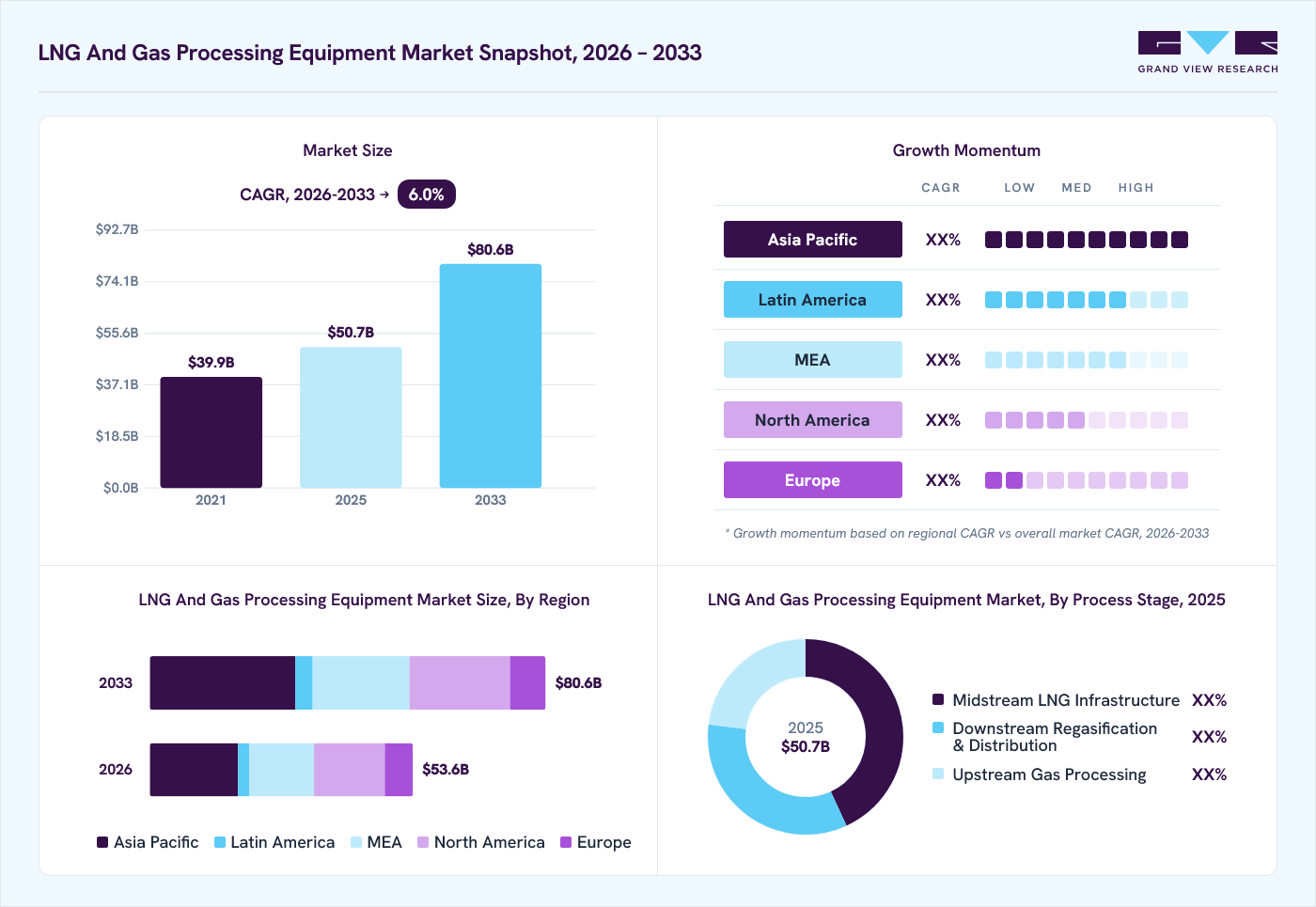 Source: Grand View Research, IR Documents, Primary Interviews, Paid DatabasesTo learn more about this report,
 Download Free Sample Report
 Key Market Trends & Insights
- By process stage: The midstream LNG Infrastructure segment dominated the market with the largest revenue share of 43.1% in 2025.
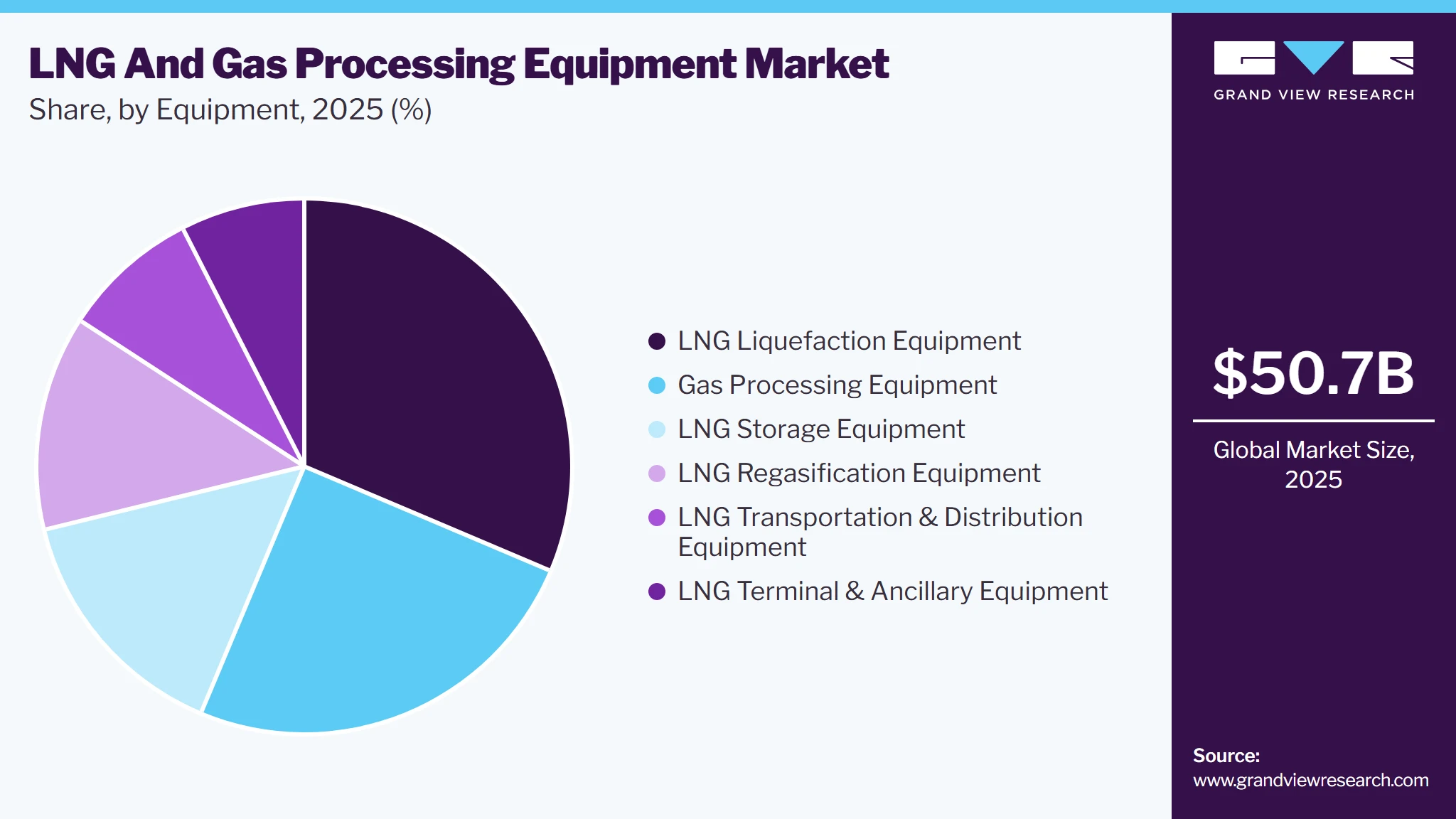
- By equipment: The LNG liquefaction equipment segment held the largest revenue share of 31.4% in 2025.
Regional Highlights
- Largest regional market: Asia Pacific (33.0% revenue share, 2025)
- By country: China held the largest market share in 2025.
Market Size & Forecast
- Market size in 2025: USD 50.7 Billion
- Estimated market size in 2026: USD 53.6 Billion
- Projected market size by 2033: USD 80.6 Billion
- CAGR (2026-2033): 6.0%
Three ways to get this report
Buy it, customize it, or ask a question.Ask an Analyst
Analyst response in 1 business day
- AccessReport author, directly
- Reply timeWithin 1 working day
- No sales callDirect answer only
- FormatEmail reply
- CostFree, no cost
Get the Full Report
What the study covers
- FormatsPDF · Excel · Dashboard
- Timeline2026–2033 annual, 2025 base
- Coverage20+ countries, 5 regions
- Companies10+ key players profiled
Customize the Report
20% free customization
- IncludeCountries, segments, points
- TailorTo your product definition
- ExtendDeeper competitor detail
- OrA fully bespoke study
- Turnaround5–10 working days
Growing LNG trade, expansion of export capacity, and development of new import terminals are increasing procurement of compressors, heat exchangers, cryogenic systems, pumps, vaporizers, storage tanks, and process control systems. Capacity additions in established producing regions and emerging gas markets are creating a broader project base for equipment manufacturers and technology suppliers.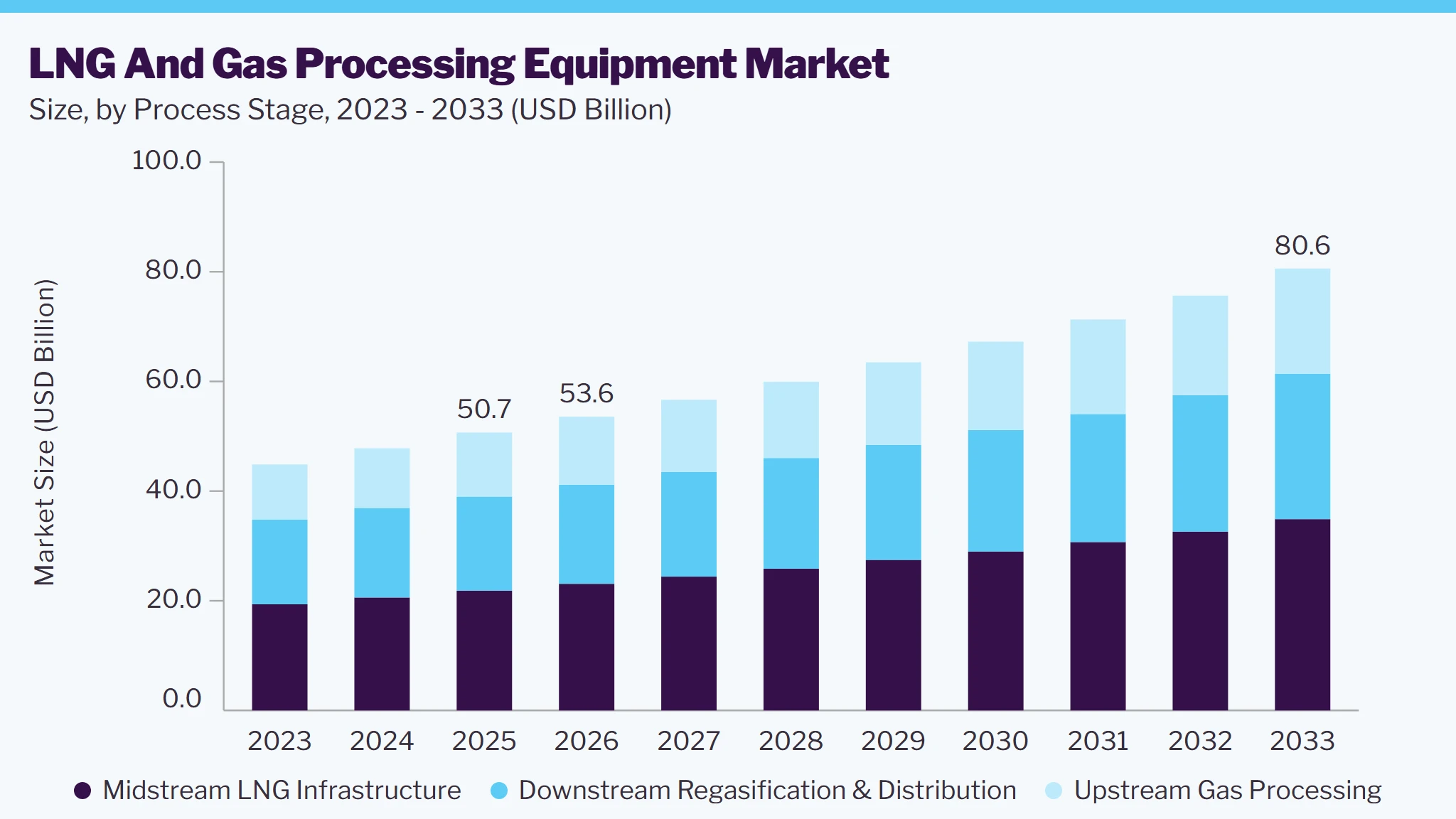 To learn more about this report, Download Free Sample Report
 Replacement of aging processing assets and upgrades to existing facilities are creating another source of equipment demand. Operators are investing in plant modernization, capacity debottlenecking, process upgrades, and equipment replacement to maintain operating reliability and accommodate changing feed-gas conditions. These projects generate demand for individual process units and auxiliary systems alongside large greenfield developments, providing a more diversified revenue base for suppliers.
Market Dynamics
The global LNG & gas processing equipment industry is characterized by sustained capital deployment across gas conditioning, liquefaction, cryogenic storage, regasification, and transmission infrastructure. The increasing complexity of gas value chains is elevating requirements for process-specific equipment capable of operating under high-pressure, low-temperature, and variable feed-gas conditions. Procurement is consequently shifting toward integrated equipment packages that incorporate advanced turbomachinery, cryogenic heat-transfer systems, process automation, instrumentation, and supervisory control architectures, particularly for large-scale greenfield and capacity-expansion projects.
Accelerating additions to LNG export capacity and gas processing infrastructure are generating substantial requirements for specialized process equipment. New liquefaction trains incorporate extensive equipment packages encompassing gas pretreatment, acid-gas removal, dehydration, compression, refrigeration, cryogenic heat exchange, and LNG handling, while upstream processing facilities require separation, purification, compression, and conditioning systems. Parallel investment in import terminals, regasification capacity, storage facilities, and transmission networks is broadening procurement requirements beyond production-side infrastructure.
The capital intensity of LNG and gas processing infrastructure represents a structural constraint on equipment adoption and project development. Expenditure encompasses process equipment, engineering and integration, specialized materials, installation, commissioning, control architecture, safety systems, and supporting infrastructure, resulting in substantial upfront investment. Equipment selection is further constrained by stringent performance specifications, pressure and temperature requirements, hazardous-area standards, certification obligations, and compatibility with existing plant configurations.
The modernization of operating gas processing and LNG facilities presents an expanding opportunity for equipment suppliers as operators seek to enhance throughput, replace aging assets, and extend plant operating lives. Brownfield programs can involve compressor replacement, heat exchanger upgrades, vapor system refurbishment, storage system improvements, and modernization of instrumentation and control infrastructure. The integration of digital condition monitoring, predictive maintenance, remote diagnostics, advanced process control, and asset-performance management further expands the scope for technology-led equipment replacement.
Market Concentration & Characteristics
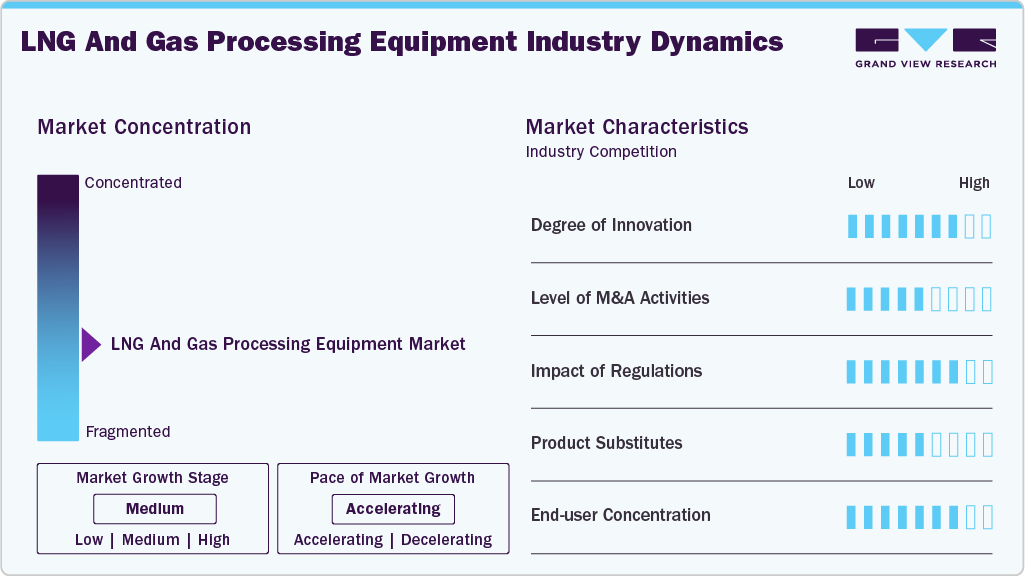
The global LNG and gas processing equipment industry exhibits a moderately concentrated competitive landscape, particularly within technically intensive equipment categories where established suppliers possess extensive engineering expertise, proprietary process technologies, manufacturing capabilities, and project references. Competition is distributed across multinational equipment manufacturers, process technology providers, and specialized engineering companies, with market positioning varying considerably by product class.
The industry is characterized by substantial technical complexity, stringent performance specifications, and project-specific equipment configurations. Procurement requirements are shaped by feed-gas composition, throughput, pressure and temperature conditions, process architecture, plant capacity, environmental requirements, and applicable technical standards. Large projects typically involve extended engineering, procurement, and commissioning cycles, with equipment suppliers required to coordinate closely with technology licensors, EPC contractors, and facility developers.
 To learn more about this report, Download Free Sample Report
 The competitive structure is further influenced by lifecycle service capabilities, installed-base presence, customization expertise, delivery reliability, and compliance with international safety and quality standards. Demand is generated through greenfield developments as well as capacity expansions, debottlenecking, equipment replacement, refurbishment, and plant modernization, creating differentiated revenue pools across the project lifecycle. Regional disparities in gas production, LNG export and import capacity, pipeline infrastructure, terminal development, and capital expenditure further shape supplier opportunities and contribute to distinct competitive dynamics across geographic markets.
Analyst Perspective
The global LNG and gas processing equipment market is closely tied to capital expenditure on gas processing, LNG liquefaction, storage, regasification, transportation, and terminal infrastructure. Equipment demand is driven by processing capacity additions, new LNG projects, brownfield expansions, replacement cycles, and plant modernization, with procurement values varying with throughput, process configuration, feed-gas characteristics, operating conditions, and equipment specifications. Large-scale liquefaction and gas processing projects generate substantial equipment requirements, while regasification, storage, transportation, and terminal investments broaden recurring procurement opportunities. Supplier competitiveness depends on engineering capabilities, equipment reliability, project execution, customization, process integration, and compliance with technical and safety standards.
Process Stage Insights
The midstream LNG Infrastructure segment dominated the market with the largest revenue share of 43.1% in 2025. Its leading position is attributable to the high equipment intensity of liquefaction plants, cryogenic storage facilities, transfer systems, export terminals, and associated handling infrastructure. Large-scale capital projects require coordinated procurement of compressors, heat exchangers, pumps, valves, storage systems, loading equipment, instrumentation, and control systems, resulting in a substantial revenue pool.
The upstream gas processing segment is projected to grow at the fastest CAGR during the forecast period. The increasing development of natural gas resources is creating a need for facilities capable of separating, conditioning, dehydrating, purifying, and compressing raw gas before it enters transmission or liquefaction infrastructure. Equipment demand is also being shaped by variations in feed-gas composition, processing capacity, pressure conditions, and contaminant levels, which require application-specific configurations.
Equipment Insights
The LNG liquefaction equipment segment led the market with the largest revenue share of 31.4% in 2025, reflecting the substantial equipment requirements associated with liquefaction facilities. The segment encompasses large-scale compressors, refrigeration systems, cryogenic heat exchangers, expanders, pumps, and related process machinery that form the principal equipment packages within liquefaction trains. The high capital intensity of these systems, coupled with continuing investment in new export capacity and additional liquefaction trains, reinforces the segment's leading revenue position.
 To learn more about this report, Download Free Sample Report
 The gas processing equipment segment is projected to grow at the fastest CAGR of 6.5% during the forecast period. Demand is being reinforced by expansion of gas treatment infrastructure and the increasing need to process feed streams with varying hydrocarbon compositions and contaminant profiles. Separators, dehydration units, acid-gas removal systems, filtration equipment, compressors, and purification systems constitute important procurement categories within this segment. New processing facilities, capacity expansions, plant upgrades, and replacement of aging process units are collectively broadening demand, particularly in regions where natural gas production and processing infrastructure are expanding.
Regional Insights
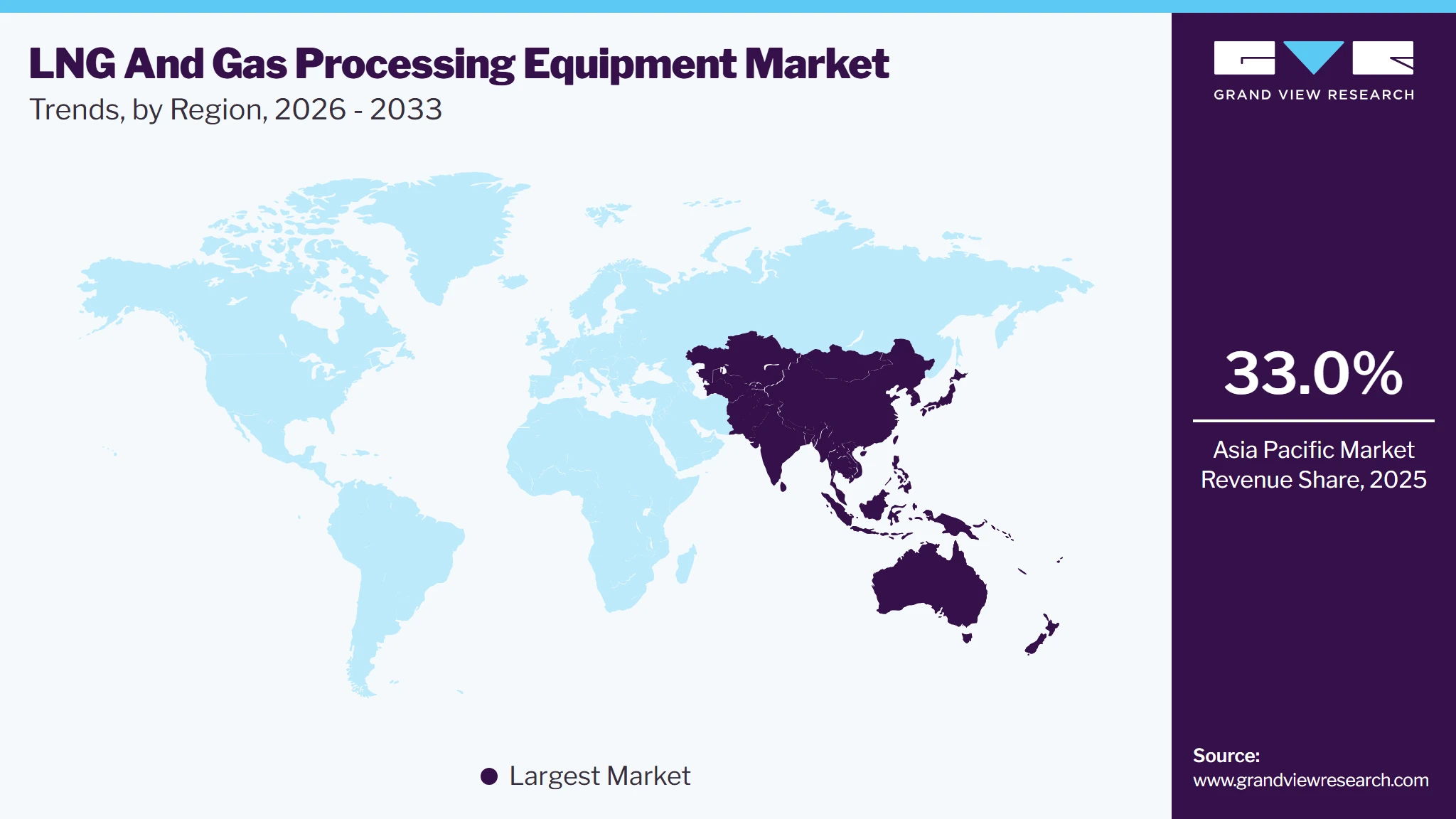
The Asia Pacific LNG and gas processing equipment market held the largest revenue share of 33.0% in 2025 and is projected to grow at the fastest CAGR during the forecast period, because of the contrast between rapidly expanding gas infrastructure and long-established LNG systems. Countries vary widely in domestic resource availability, import dependence, industrial gas consumption, and infrastructure maturity. Consequently, regional revenue is distributed across new processing and receiving capacity, network expansion, asset renewal, and modernization rather than being concentrated around a single investment pattern.
 To learn more about this report, Download Free Sample Report
 China LNG And Gas Processing Equipment Market Trends
The LNG and gas processing equipment market in China accounted for the largest revenue share in the Asia Pacific in 2025, as it represents a large installed base market where equipment expenditure is increasingly balanced between capacity development and modernization. Extensive gas-processing, transmission, storage, and LNG infrastructure creates a substantial replacement pool, while continued network development generates additional procurement. The scale of China's gas system also underscores the importance of process integration, automation, and equipment upgrades to improve the operating characteristics of existing facilities.
The India LNG and gas processing equipment market is characterized by a more expansion-oriented demand structure. The ongoing development of LNG receiving facilities, natural gas transmission networks, city gas systems, and industrial gas applications is expanding the country's infrastructure footprint. This creates equipment opportunities across imported LNG handling, gas processing, compression, metering, and distribution, while rising gas consumption and ongoing network expansion are creating additional requirements for processing and downstream infrastructure.
North America LNG And Gas Processing Equipment Market Trends
The LNG and gas processing equipment market in North America remains mature and capital-intensive, with procurement shaped by the coexistence of extensive upstream activity and a large installed infrastructure base. The market is not limited to new LNG capacity; spending also arises from plant debottlenecking, equipment replacement, capacity optimization, and modifications to operating facilities. The concentration of engineering, manufacturing, and project development capabilities within the region also supports sophisticated equipment packages for technically demanding gas projects.
The LNG and gas processing equipment market in the U.S. is experiencing steady growth due to rising natural gas production, expanding LNG export capacity, and increasing investments in gas processing and liquefaction infrastructure. The expansion of LNG export terminals along the Gulf Coast, particularly in Texas and Louisiana, is driving demand for compressors, heat exchangers, cryogenic equipment, gas treatment systems, and liquefaction technologies. Additionally, increasing demand for natural gas across power generation, industrial manufacturing, and international energy markets is encouraging investments in processing capacity, pipeline infrastructure, and facility modernization.
The Canada LNG and gas processing equipment market is project-led, centered on the movement of Western Canadian gas to domestic and export markets. The development of Pacific Coast LNG capacity is creating a new procurement cycle spanning upstream gas handling, long-distance transportation, and export facilities. Canada's geographic characteristics also increase the importance of equipment designed for remote operating environments and extended transmission routes, giving the market a distinct profile compared with the highly concentrated U.S. Gulf Coast project base.
The LNG and gas processing equipment market in Mexico is shaped by its position within the integrated North American gas system. Cross-border gas flows influence requirements for transmission, compression, metering, and associated gas-handling infrastructure, while domestic investment is directed toward improving the reach and reliability of the country's gas network. LNG-related projects provide an additional avenue for equipment suppliers, particularly where import, storage, or export infrastructure interfaces with existing pipeline systems.
Europe LNG And Gas Processing Equipment Market Trends
The LNG and gas processing equipment market in Europe is predominantly supply-diversification-oriented. Changes in the regional gas-supply mix have altered the role of LNG receiving facilities, storage assets, and transmission networks, creating procurement opportunities for both new installations and modifications to established infrastructure. The relatively mature condition of European gas assets also gives replacement, refurbishment, and control-system modernization a greater role in equipment expenditure than in emerging infrastructure markets.
The Germany LNG and gas processing equipment market has developed a strong equipment opportunity, driven by the rapid integration of LNG receiving infrastructure into one of Europe's largest gas transmission systems. Procurement is influenced by the need to connect coastal receiving capacity with inland demand centers and cross-border networks. This creates a market profile centered on network integration, pressure management, gas transfer, and infrastructure adaptation rather than LNG infrastructure in isolation.
The LNG and gas processing equipment market in France has a comparatively mature LNG ecosystem, giving lifecycle expenditure a greater influence on the equipment market. Established receiving facilities require periodic refurbishment, replacement of aging components, upgrades to handling systems, and modernization of instrumentation and controls. France's interconnected gas network also allows LNG infrastructure to serve a broader regional supply function, creating demand for equipment that helps maintain flexibility and reliability across existing assets.
Middle East & Africa LNG & Gas Processing Equipment Market Trends
The LNG and gas processing equipment market in the Middle East & Africa is predominantly resource-led, with equipment procurement closely tied to the conversion of substantial natural gas reserves into processed gas, LNG, and other commercially usable forms. Project expenditure is often concentrated in large-scale developments requiring extensive process integration and high-capacity systems. The region's established production base also creates a parallel market for expansion and modernization of operating facilities.
The Saudi Arabia LNG and gas processing equipment market is gas-processing-focused, with equipment demand driven primarily by the development and monetization of domestic gas resources. Expansion of processing capacity is increasing the requirement for systems that prepare raw gas for transmission and downstream consumption, while the broader development of the domestic gas network creates additional procurement opportunities. The country's growing industrial base further strengthens the need for dependable gas infrastructure beyond traditional upstream applications.
Latin America LNG And Gas Processing Equipment Market Trends
The LNG and gas processing equipment market in Latin America remains developing, with natural gas resource development and infrastructure availability varying considerably across countries. Equipment procurement is consequently influenced by the pace at which producing regions are connected to processing facilities, transmission networks, and domestic or international markets. Brazil represents the principal opportunity within the defined regional scope, with offshore gas development giving the market a technically distinct demand profile.
The Brazil LNG and gas processing equipment market is closely linked to the development of offshore gas resources, particularly production from deepwater fields where gas handling and treatment form an important part of the overall field-to-market chain. The technical and logistical demands of offshore production increase the need for specialized processing and gas-handling systems, while associated onshore facilities provide another layer of procurement. Expansion of domestic gas utilization and continued development of offshore resources should sustain equipment requirements across both new projects and supporting infrastructure.
Key LNG And Gas Processing Equipment Company Insights
Some of the key players operating in the market include Air Products and Chemicals, Inc., Linde plc, Baker Hughes Company, among others.
-
Linde plc is a global industrial gases and engineering company headquartered in Woking, United Kingdom. The company operates across industrial gases, engineering, and related process technologies, serving customers in energy, chemicals, manufacturing, healthcare, food and beverage, and other industrial sectors. Its engineering business develops and supplies process plants, equipment, and technologies for gas processing, separation, purification, and cryogenic applications.
-
Baker Hughes Company is an energy technology company headquartered in Houston, Texas, providing equipment, technologies, and services to the global energy industry. The company operates across oilfield services, gas technology, industrial energy technology, and related energy infrastructure applications, serving upstream, midstream, LNG, and downstream customers. Its portfolio includes turbomachinery, compressors, gas turbines, pumps, valves, flow-control systems, and other equipment used in energy-processing applications.
Key LNG And Gas Processing Equipment Companies:
The following key companies have been profiled for this study on the global LNG and gas processing equipment market:
-
Air Products and Chemicals, Inc.
-
Linde plc
-
Baker Hughes Company
-
Cryostar SAS
-
Honeywell International Inc.
-
Siemens Energy AG
-
Mitsubishi Heavy Industries, Ltd.
-
Technip Energies N.V.
-
Wärtsilä Corporation
-
IHI Corporation
-
Atlas Copco AB
-
MAN Energy Solutions SE
-
Air Liquide S.A.
-
Ebara Corporation
-
Nikkiso Co., Ltd.
Company Categorization
Category
Operating Strategies
Competitive Edge
Weakness
Established Players (e.g., Air Products and Chemicals, Inc.; Linde plc; Baker Hughes Company; Cryostar SAS; Honeywell International Inc.; Siemens Energy AG; Mitsubishi Heavy Industries, Ltd.; Technip Energies N.V.; Wärtsilä Corporation; IHI Corporation; MAN Energy Solutions SE; Air Liquide S.A.)
- Develop integrated LNG and gas-processing solutions covering liquefaction, gas treatment, compression, cryogenic processing, turbomachinery, automation, and plant systems.
- Strengthen project participation through proprietary technologies, engineering, equipment integration, commissioning, aftermarket services, and long-term customer relationships.
- Broad technology portfolios, established engineering and manufacturing capabilities, and extensive experience in large-scale LNG and gas projects.
- Global service networks and large installed bases provide access to major projects and recurring replacement, modernization, and expansion requirements.
- High capital requirements and lengthy project cycles can restrict flexibility in smaller projects.
- Complex organizational structures and stringent technical qualification requirements can increase project execution and procurement timelines.
Emerging & Regional Players (e.g., Atlas Copco AB; Ebara Corporation; Nikkiso Co., Ltd.
- Concentrate on specialized equipment such as compressors, pumps, cryogenic systems, and fluid-handling technologies for selected LNG and gas-processing applications.
- Expand through customized configurations, application engineering, regional distribution, partnerships, and localized technical support.
- Focused technical expertise and specialized product portfolios enable deeper capabilities within targeted equipment categories.
- Greater flexibility in application-specific configurations and regional customer engagement can strengthen competitiveness in niche procurement opportunities.
- Narrower product portfolios limit participation in integrated LNG and gas-processing projects requiring multiple equipment categories.
- More limited geographic coverage and turnkey engineering capabilities can constrain access to large-scale projects.
Recent Developments:
-
In July 2026, Baker Hughes obtained an order from Venture Global. The former plans to supply a liquefaction system to the latter for its CP2 LNG expansion project in Louisiana, U.S. Booked in 2026, the contract includes a comprehensive solution covering liquefaction blocks comprising liquefaction modules equipped with centrifugal compressors, cold boxes, air coolers, and control systems. This deal builds on a long-standing partnership, with Baker Hughes acting as a primary technology supplier across Venture Global's existing and planned capacity exceeding 100 million tonnes per annum
-
In September 2026, Technip Energies introduced SnapLNG 1.5 as a standardized modular configuration for LNG production, centered on a 1.5 MTPA liquefaction train. The offering integrates Technip Energies’ modular engineering and LNG project capabilities with Honeywell’s solutions for gas conditioning, liquefaction, and automation, while Siemens Energy contributes electrically driven compression and turbomachinery technology.
LNG And Gas Processing Equipment Market Report Scope
Report Attribute
Details
Market size in 2025
USD 50.7 billion
Estimated market size in 2026
USD 53.6 billion
Projected market size by 2033
USD 80.6 billion
Growth rate
CAGR of 6.0% from 2026 to 2033
Base year for estimation
2025
Historical data
2021 – 2024
Forecast period
2026 – 2033
Quantitative units
Revenue in USD billion and CAGR from 2026 to 2033
Report coverage
Revenue forecast, company ranking, competitive landscape, growth factors, and trends
Segments covered
Process stage, equipment, region.
Regional scope
North America; Europe; Asia Pacific; Latin America; Middle East & Africa
Country scope
U.S.; Canada; Mexico; UK; Germany; France; Italy; Spain; China; Japan; India; Australia; South Korea; Brazil; Argentina; UAE; Saudi Arabia; Nigeria; Qatar; Oman
Key companies profiled
Air Products and Chemicals, Inc.; Linde plc; Baker Hughes Company; Cryostar SAS; Honeywell International Inc.; Siemens Energy AG; Mitsubishi Heavy Industries, Ltd.; Technip Energies N.V.; Wartsila Corporation; IHI Corporation; Atlas Copco AB; MAN Energy Solutions SE; Air Liquide S.A.; Ebara Corporation; Nikkiso Co., Ltd.
Customization scope
Free report customization (equivalent up to 8 analysts working days) with purchase. Addition or alteration to country, regional & segment scope.
Pricing and purchase options
Avail customized purchase options to meet your exact research needs. Explore purchase options
Global LNG And Gas Processing Equipment Market Report Segmentation
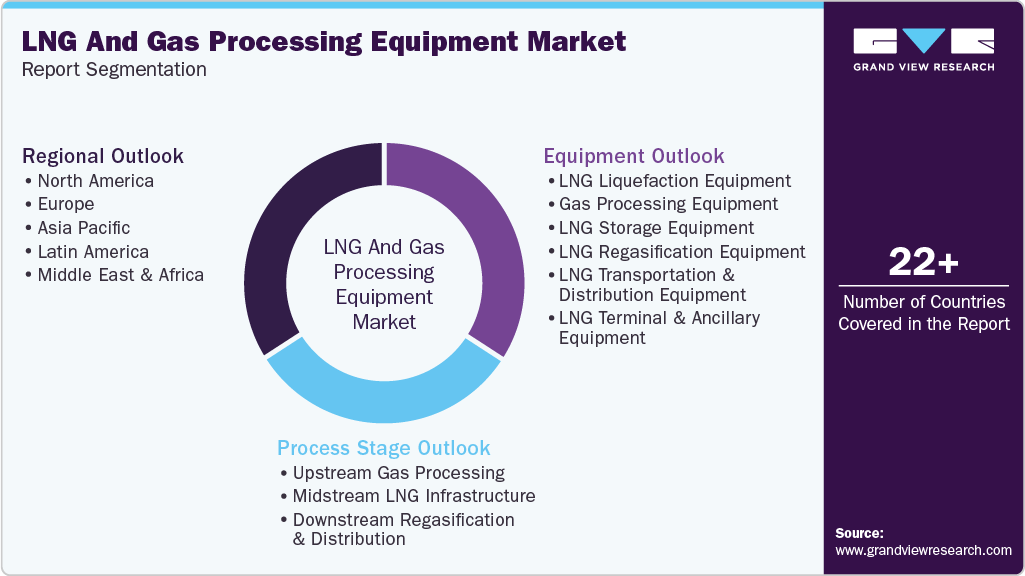
This report forecasts revenue growth at global, regional, and country levels and provides an analysis of the latest industry trends in each of the sub-segments from 2021 to 2033. For this study, Grand View Research has segmented the global LNG and gas processing equipment market report based on process stage, equipment, and region:
 To learn more about this report, Download Free Sample Report
 -
Process Stage Outlook (Revenue, USD Billion, 2021 - 2033)
-
Upstream Gas Processing
-
Midstream LNG Infrastructure
-
Downstream Regasification & Distribution
-
-
Equipment Outlook (Revenue, USD Billion, 2021 - 2033)
-
LNG Liquefaction Equipment
-
Gas Processing Equipment
-
LNG Storage Equipment
-
LNG Regasification Equipment
-
LNG Transportation & Distribution Equipment
-
LNG Terminal & Ancillary Equipment
-
-
Regional Outlook (Revenue, USD Billion, 2021 - 2033)
-
North America
-
U.S.
-
Canada
-
Mexico
-
-
Europe
-
Germany
-
Spain
-
France
-
Italy
-
UK
-
-
Asia Pacific
-
China
-
India
-
Japan
-
Australia
-
South Korea
-
-
Latin America
-
-
Brazil
-
Argentina
-
-
Middle East and Africa
-
Saudi Arabia
-
UAE
-
Nigeria
-
Qatar
-
Oman
-
-
Research Methodology
The LNG and gas processing equipment marketfigures in this report are based on a proven research process that combines executive interviews with secondary research from proprietary databases, company filings, and recognized regulatory and institutional sources. Market size is built through value-chain sizing—reconciling supply-side and demand-side estimates—and triangulated with bottom-up and top-down approaches. Every estimate passes multiple levels of expert validation before publication, with eachLNG and gas processing equipment segment quantified using the revenue-capture definitions in the table below.
Segment Definition
Segment - Process Stage
Revenue Capture Definition
Upstream Gas Processing
Revenue generated from the sale of Upstream Gas Processing equipment, comprising gas separation, dehydration, purification, compression, acid gas removal, and related processing systems.
Midstream LNG Infrastructure
Revenue generated from the sale of Midstream LNG Infrastructure equipment, covering liquefaction systems, cryogenic storage and transfer equipment, terminal handling systems, and associated infrastructure components.
Downstream Regasification & Distribution
Revenue generated from the sale of Downstream Regasification & Distribution equipment, including LNG vaporizers, pressure regulation systems, metering equipment, pumps, and gas distribution systems.
Segment–Equipment
Revenue Capture Definition
LNG Liquefaction Equipment
Revenue generated from the sale of LNG Liquefaction Equipment, including liquefaction trains, compressors, heat exchangers, refrigeration systems, expanders, and related process equipment.
Gas Processing Equipment
Revenue generated from the sale of Gas Processing Equipment, encompassing separators, dehydration units, gas treatment systems, compressors, filtration equipment, and other processing machinery.
LNG Storage Equipment
Revenue generated from the sale of LNG Storage Equipment, comprising cryogenic storage tanks, containment systems, insulation systems, pumps, valves, and associated storage components.
LNG Regasification Equipment
Revenue generated from the sale of LNG Regasification Equipment, covering vaporizers, heat-transfer systems, LNG pumps, pressure control units, and related regasification systems.
LNG Transportation & Distribution Equipment
Revenue generated from the sale of LNG Transportation & Distribution Equipment, including cryogenic transfer systems, loading and unloading equipment, pumps, valves, hoses, and associated handling systems.
LNG Terminal & Ancillary Equipment
Revenue generated from the sale of LNG Terminal & Ancillary Equipment, comprising loading arms, metering systems, boil-off gas equipment, control systems, safety systems, and other terminal-related equipment.
Estimation Model
Layer No.
Layer Name
Key Question
Description
01
LNG & Gas Processing Equipment Demand Layer
Where does demand for LNG & gas processing equipment originate?
Assess the requirement for LNG & gas processing equipment based on natural gas production, processing capacity, LNG liquefaction and regasification capacity, storage infrastructure, transmission networks, and terminal development. Evaluate infrastructure requirements and processing volumes to establish the addressable equipment demand across the LNG and gas value chain.
02
Infrastructure Development & Capital Investment Layer
Where is additional demand for equipment being created?
Examine new LNG facilities, gas processing plants, liquefaction trains, regasification terminals, storage facilities, and related infrastructure projects. Consider capacity additions, plant expansions, equipment replacement, modernization programs, and capital expenditure to identify new equipment procurement opportunities.
03
Process Stage & Equipment Adoption Layer
Which equipment categories are being adopted across the value chain?
Evaluate equipment requirements across upstream gas processing, midstream LNG infrastructure, and downstream regasification & distribution. Assess the adoption of liquefaction, gas processing, storage, regasification, transportation & distribution, and terminal & ancillary equipment according to facility configuration, processing capacity, project requirements, and technology selection.
04
Revenue Generation Layer
How much revenue is generated from equipment sales?
Calculate annual market revenue generated from the sale of LNG & gas processing equipment across defined process stages, equipment categories, and geographic markets. Account for new installations, capacity expansions, replacement demand, facility upgrades, and modernization projects, while considering variations in equipment specifications and project scale.
Customization Table
Client Request
Customization Delivered
Value Adds
Competitive Benchmarking
Compared leading manufacturers on product portfolio breadth, process technology capabilities, engineering expertise, project execution track record, manufacturing footprint, geographic coverage, customization capabilities, and technology development activity.
Establishes relative supplier positioning and competitive differentiation. The assessment highlights strengths in capabilities, portfolio gaps, technology-intensive areas, and potential avenues for strategic differentiation or expansion.
Regional Segmentation
Examined North America, Europe, Asia Pacific, Latin America, and the Middle East & Africa using indicators such as gas production, processing capacity, liquefaction and regasification capacity, import and export activity, terminal development, pipeline networks, project pipelines, and capital expenditure.
Identifies differences in investment intensity, infrastructure maturity, and procurement potential across countries. The findings support geographic prioritization, market-entry sequencing, resource deployment, and country-level opportunity screening.
Opportunity Assessment
Assessed commercial potential across upstream processing, midstream infrastructure, and downstream regasification & distribution, covering liquefaction, processing, storage, regasification, transportation & distribution, and terminal & ancillary categories. Greenfield projects, capacity additions, brownfield expansions, replacement cycles, refurbishment, and modernization activity were considered.
Differentiates near-term procurement opportunities from longer-cycle infrastructure prospects. The assessment helps prioritize revenue pools, identify replacement-led demand, evaluate emerging investment themes, and direct product, sales, and investment strategies toward higher-potential areas.
About the Author(s)
Advanced Interior Materials Research Team
Advanced Materials · Advanced Interior MaterialsThis report was authored by the advanced interior materials research team at Grand View Research - comprising two research analysts, one senior research analyst, and one industry expert - with specialized expertise in the advanced interior materials segment of the advanced materials industry. All findings are based on proprietary advanced materials databases, executive interviews, and regulatory analysis, subject to internal peer review prior to publication.
Last Updated:
Speak to Analyst

Customize this report to your needs - add regions, segments, or data points, with 20% free customization.
Or view our licence options:


ISO 9001:2015 & 27001:2022 Certified
We are GDPR and CCPA compliant! Your transaction & personal information is safe and secure. For more details, please read our privacy policy.


