
- Home
- »
- Plastics, Polymers & Resins
- »
-
Low-Carbon Footprint Packaging Market Report, 2026-2033GVR Report cover

Low-Carbon Footprint Packaging Market (2026 - 2033)
Size, Share & Trends Analysis Report By Material (Plastic, Paper & Paperboard, Glass, Metal, Molded Fiber), By Primary Approach, By Packaging Format, By End-use Industry, By Region, And Segment Forecasts
Market Size, 2025
$168.6BMarket Estimate, 2026
$181.9BMarket Forecast, 2033
$327.8BCAGR, 2026–2033
8.8%Low-Carbon Footprint Packaging Market Summary
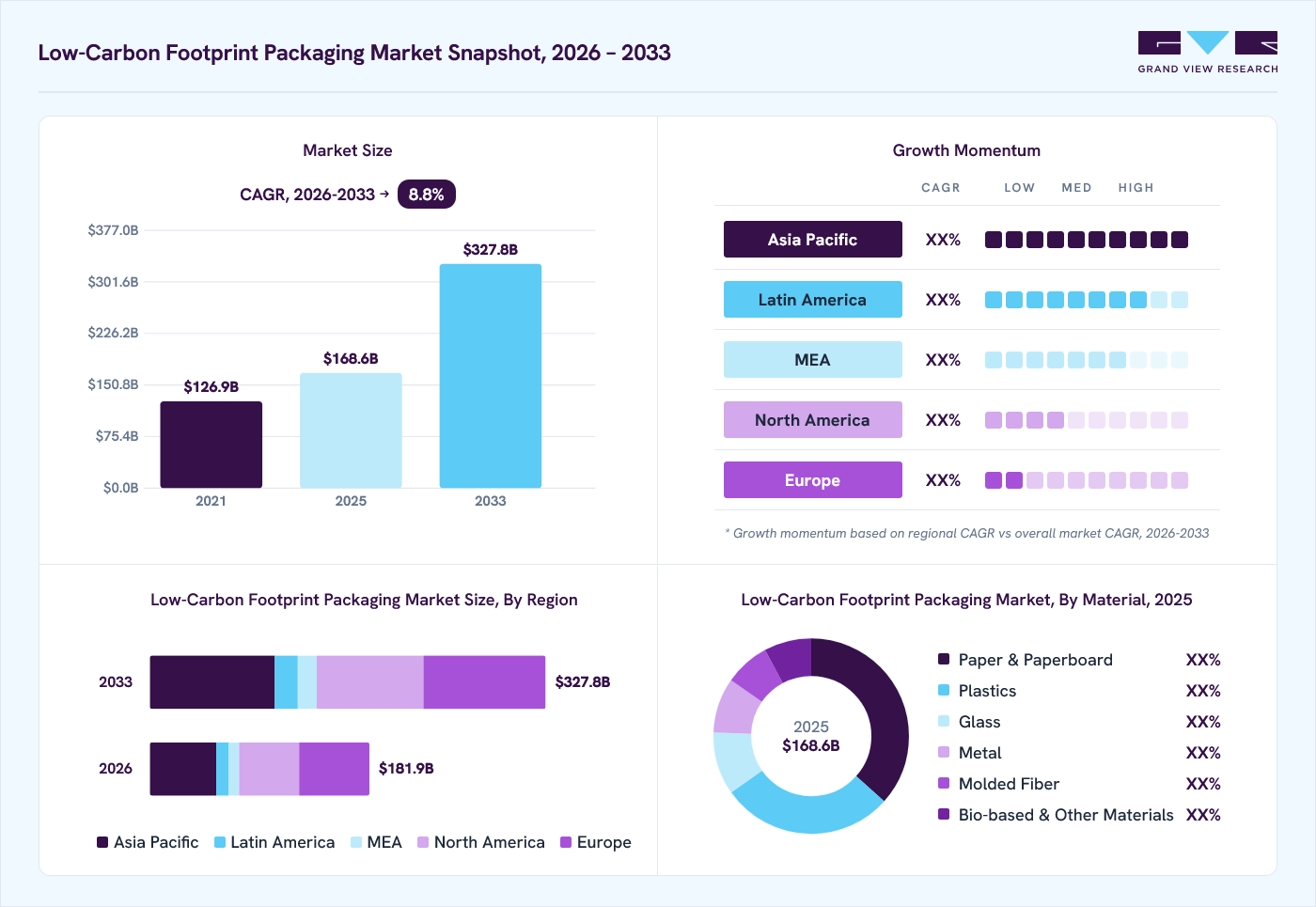
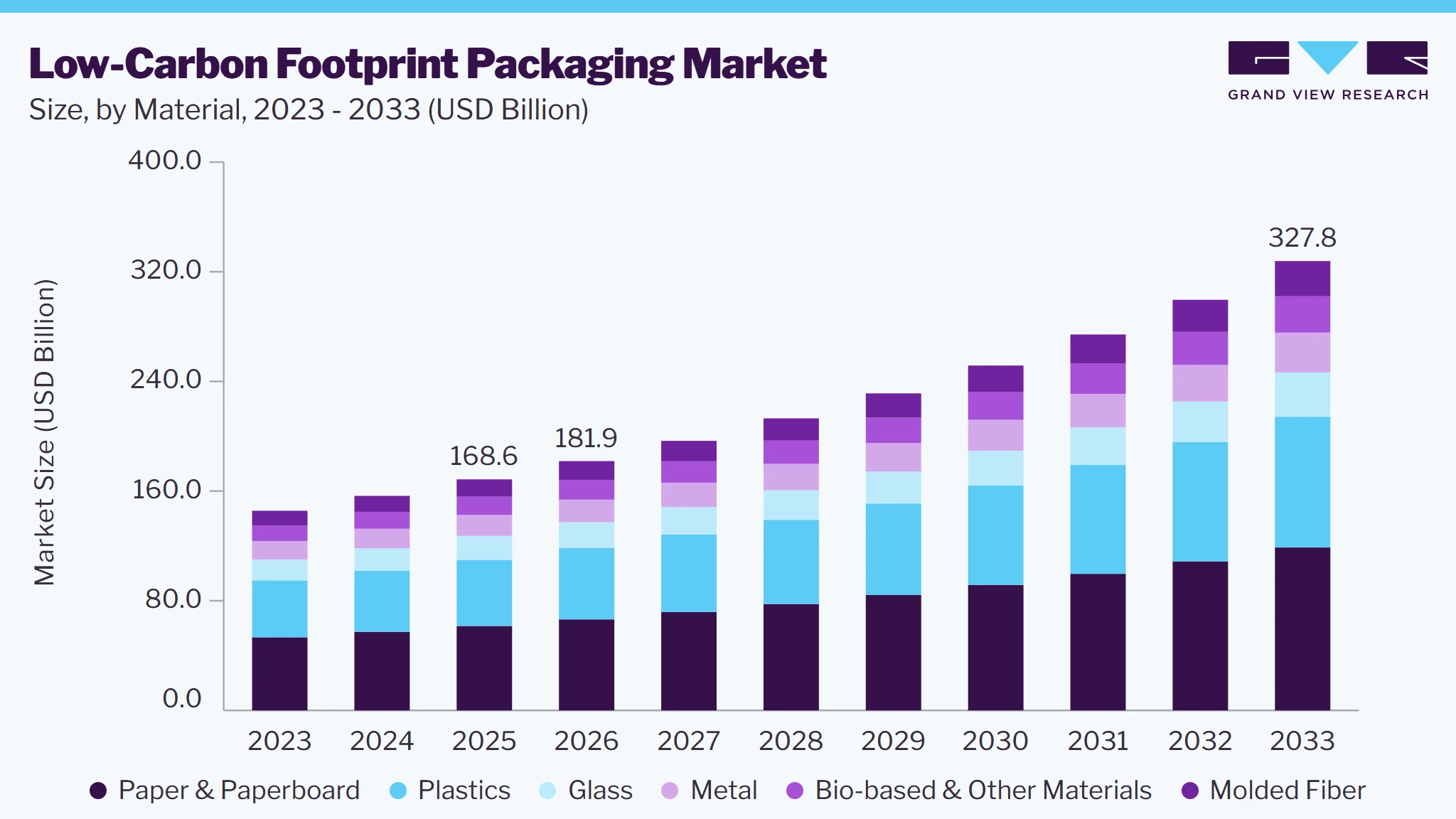
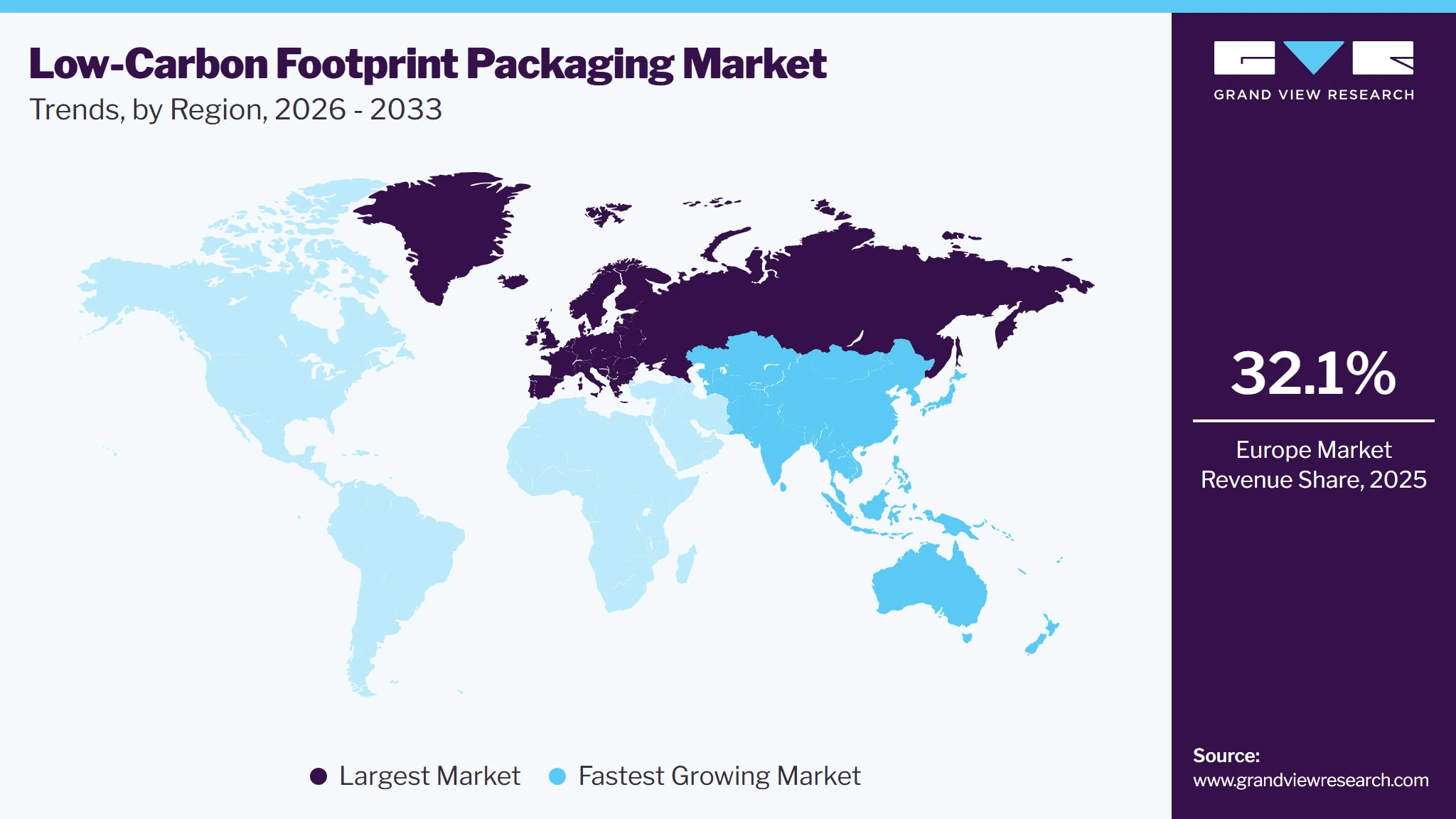
The global low-carbon footprint packaging market size was valued at USD 168.6 billion in 2025 and is projected to reach USD 181.9 billion in 2026 to USD 327.8 billion by 2033, at a CAGR of 8.8% from 2026 to 2033. Europe accounted for the largest revenue share of 32.1% in 2025. The market is primarily driven by the increasing adoption of sustainable packaging materials, stringent environmental regulations, corporate commitments to reduce carbon emissions, and growing demand for recyclable, reusable, lightweight, and bio-based packaging solutions across food and beverage, consumer goods, healthcare, and e-commerce industries.
 Source: Grand View Research, IR Documents, Primary Interviews, Paid DatabasesTo learn more about this report,
 Download Free Sample Report
Key Market Trends & Insights
- By packaging format: Rigid packaging segment held the largest market share of 42.9% in 2025.
- By material: Paper & paperboard segment held the largest market share of 36.6% in 2025.
- By primary approach: Recycled-content packaging segment held the largest market share of 27.5% in 2025.
- By end use industry: Food & beverage segment held the largest market share of 37.6% in 2025.
Regional Highlights
- Largest regional market: Europe (32.1% revenue share, 2025)
- Fastest-growing regional market: Asia Pacific (highest CAGR, 2026-2033)
- By country: Germany held the largest market share in 2025
Market Size & Forecast
- Market size in 2025: USD 168.6 Billion
- Estimated market size in 2026: USD 181.9 Billion
- Projected market size by 2033: USD 327.8 Billion
- CAGR (2026-2033): 8.8%
Prism AI by Grand View Research Free to tryAsk a question about the Low-Carbon footprint packaging marketTry asking✓Every figure cited from GVR research Prefer the report? Download free sample →Europe accounted for the largest regional share in 2025 and Asia-pacific is expected to grow at the fastest rate, supported by expanding manufacturing activities, rising sustainability awareness, and increasing investments in environmentally responsible packaging. The low-carbon footprint packaging market is driven by the growing need to reduce greenhouse gas emissions across packaging production, distribution, and end-of-life management. As brand owners and manufacturers strengthen sustainability commitments, demand is increasing for packaging solutions that combine lower material consumption, recyclability, recycled content, and reduced production-related emissions. Paper and paperboard remain important alternatives across food and beverage, e-commerce, and consumer goods applications, while lightweight plastics and mono-material formats continue to support material efficiency and product protection. The expansion of online retail and global distribution networks is further encouraging companies to evaluate packaging based on its overall environmental footprint, including material sourcing, transportation, durability, and recyclability.
 To learn more about this report, Download Free Sample Report
An increasing focus on packaging waste reduction, recycling, and extended producer responsibility is expected to support market growth in the coming years. Governments and regulators are introducing policies that encourage recyclable packaging, higher recycled-material utilization, and reduced reliance on difficult-to-recover packaging formats. In response, manufacturers are redesigning packs to improve material recovery, simplify material structures, and increase the use of recycled paper, plastics, and other lower-impact inputs. Paper and paperboard accounted for the largest material share in 2025, at 36.6%, reflecting their established use in cartons, corrugated boxes, and other fiber-based packaging formats. However, material selection increasingly depends on the product’s barrier and protection requirements, since lightweighting and recyclability must be balanced with food safety, shelf life, and damage prevention.
Sustainability initiatives and the transition toward circular packaging systems are also contributing to market growth. A key trend is the shift toward packaging made with recycled content, renewable feedstocks, molded fiber, and bio-based materials, alongside investments in lightweight designs and lower-carbon manufacturing processes. These approaches help reduce reliance on virgin fossil-based resources and improve the environmental performance of packaging across its life cycle. For instance, in February 2025, Tetra Pak announced the introduction of carton packaging material containing 5% certified recycled polymers in India, supporting compliance with recycled-content requirements under the Plastic Waste Management Rules. The company also highlighted that the recycled polymers were sourced in India and that the packaging material was produced at its ISCC PLUS-certified facility in Chakan, Maharashtra. Such initiatives illustrate how material innovation and regulatory requirements are accelerating the adoption of lower-carbon packaging solutions.
Market Dynamics
The low-carbon footprint packaging market is expanding as manufacturers and brand owners seek to reduce emissions associated with raw material extraction, packaging conversion, transportation, and end-of-life disposal. Growing corporate decarbonization commitments, packaging-waste regulations, and demand for more resource-efficient designs are encouraging the adoption of recycled-content materials, lightweight formats, recyclable structures, molded fiber, and bio-based alternatives. While paper and paperboard accounted for the largest material share in 2025, the market is also evolving through innovations in plastic recycling, reusable packaging systems, and lower-emission manufacturing. Adoption, however, varies by application because packaging must still meet requirements for product protection, barrier performance, hygiene, cost, and supply reliability.
Corporate efforts to reduce value-chain greenhouse gas emissions are a key driver of the low-carbon footprint packaging market. Packaging contributes to companies’ indirect emissions through the production of virgin materials, energy-intensive conversion processes, transport weight, and waste management. As businesses measure and address these impacts, they are increasingly evaluating packaging designs based on material intensity, recycled content, recyclability, and life-cycle performance rather than relying solely on conventional cost and functionality criteria.
This shift is encouraging investment in lightweight packaging, recycled paper and plastics, mono-material structures, molded fiber, and packaging designs that use fewer resources without compromising product protection. Food and beverage companies are seeking to reduce packaging material use across high-volume product lines, while e-commerce and retail businesses are prioritizing right-sized boxes and reduced void fill to improve material and transport efficiency. These changes support demand for packaging solutions that can contribute to emissions-reduction targets while maintaining operational performance across supply chains.
A major restraint for the low-carbon footprint packaging market is the higher cost and technical complexity of adopting sustainable alternatives. Recycled polymers, certified fiber inputs, molded fiber, and bio-based materials may involve higher procurement costs, inconsistent feedstock quality, and specialized processing requirements. In addition, paper-based packaging may require barrier coatings for moisture and grease resistance, while some compostable materials need specialized waste-management conditions. These challenges can increase testing, redesign, and manufacturing costs, making adoption more difficult for price-sensitive applications and manufacturers seeking to maintain packaging performance, product safety, and shelf life.
The transition toward circular packaging systems creates opportunities for manufacturers to expand recycled-content, recyclable, reusable, refillable, and bio-based packaging solutions. Improvements in recycling technologies, molded-fiber products, lightweight designs, and lower-carbon manufacturing processes can help reduce virgin material consumption and emissions across packaging life cycles. Growing interest in bio-based and compostable materials also creates opportunities for material developers and packaging converters to offer alternatives to conventional fossil-based inputs. Companies that align packaging designs with existing waste-management infrastructure and substantiate environmental claims through credible life-cycle assessments can strengthen their market position while meeting customers’ sustainability objectives.
Market Concentration & Characteristics
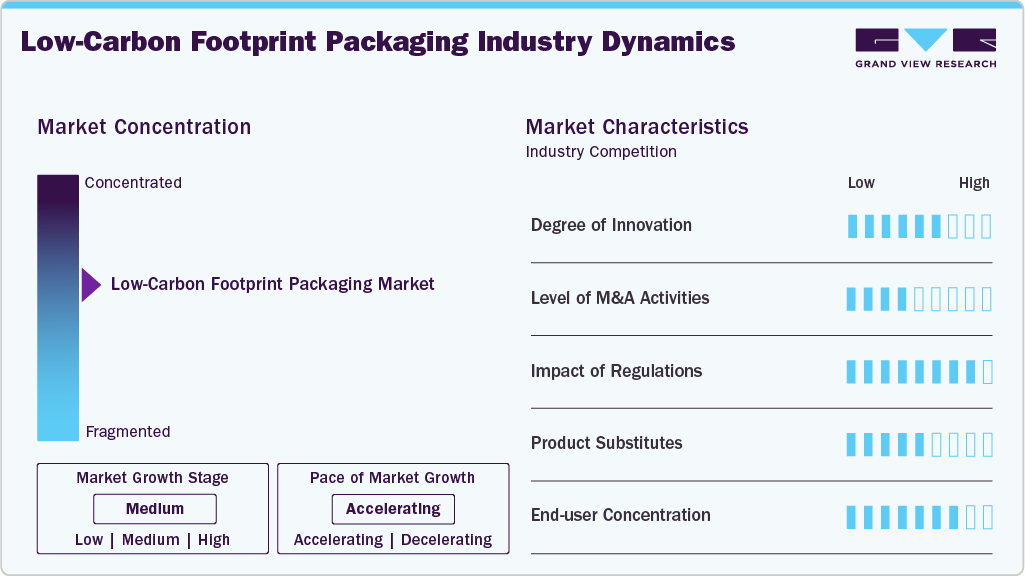
The low-carbon footprint packaging market is characterized by increasing emphasis on carbon emission reduction, material efficiency, and circular packaging design. Manufacturers are adopting lightweight packaging, recycled-content materials, recyclable structures, molded fiber, and bio-based alternatives to reduce dependence on virgin resources and improve life-cycle environmental performance. Demand from food and beverage, e-commerce, healthcare, and consumer goods industries is encouraging packaging producers to balance sustainability with product protection, cost efficiency, and supply-chain performance.
 To learn more about this report, Download Free Sample Report
A defining industry characteristic is the growing shift toward recyclable mono-materials, recycled polymers, fiber-based packaging, and reusable formats. Material selection increasingly depends on carbon footprint, barrier performance, durability, recyclability, and local waste-management infrastructure. At the same time, corporate decarbonization targets, packaging-waste regulations, and demand for credible environmental claims are accelerating innovation in low-carbon materials, resource-efficient manufacturing, and packaging designs that support circularity.
Analyst Perspective
The global low-carbon footprint packaging market has evolved from conventional packaging solutions toward more sustainable alternatives, driven by growing environmental awareness, corporate decarbonization goals, and stricter packaging regulations. Currently, manufacturers are prioritizing recycled materials, lightweight designs, recyclable structures, and resource-efficient production while maintaining product protection and cost competitiveness. Looking ahead, the market is expected to expand steadily as sustainability becomes a core consideration in packaging procurement and product development. Growth will increasingly depend on advancements in material technology, improved recycling infrastructure, and the commercial viability of circular packaging solutions, positioning low-carbon packaging as an important component of long-term industry transformation.
Material Insights
Based on material, the paper and paperboard segment dominated the low-carbon footprint packaging market, accounting for the largest revenue share of 36.6% in 2025. Paper and paperboard are widely used in corrugated boxes, cartons, folding cartons, and paper-based protective packaging due to their versatility, established recycling streams, and compatibility with renewable fiber sourcing. Their adoption is supported by growing demand for recyclable transport packaging, e-commerce shipping materials, and alternatives to conventional plastic formats. Manufacturers are also improving fiber recovery, lightweight designs, and barrier technologies to enhance packaging performance while reducing material consumption and environmental impact.
The molded fiber segment is projected to grow at the fastest CAGR of 9.4% during the forecast period. Molded fiber packaging is gaining traction as an alternative to selected plastic protective components, trays, inserts, and cushioning materials, particularly in food service, consumer electronics, and e-commerce applications. Produced using fiber-based feedstocks, these formats can offer lightweight protection and compatibility with paper-recycling systems, depending on product design, coatings, and local recycling infrastructure. Growth is supported by brand owners seeking to reduce conventional plastic use and improve packaging circularity, alongside advances in molded-fiber design that enable better fit, cushioning, and functional performance.
Primary Approach Insights
Based on primary approach, the recycled-content packaging segment dominated the low-carbon footprint packaging market, accounting for the largest revenue share of 27.5% in 2025. This approach incorporates recycled paper, recovered plastics, and other secondary raw materials to reduce dependence on virgin resources and support circular material flows. Adoption is increasing as brand owners seek to lower packaging-related emissions, improve resource efficiency, and meet recycled-content targets. Advances in material recovery, sorting, and recycling technologies are further supporting the use of recycled inputs in packaging while helping manufacturers balance sustainability objectives with quality, durability, and product protection requirements.
The bio-based and compostable packaging segment is projected to grow at the fastest CAGR of 9.5% during the forecast period. These packaging solutions are gaining interest as companies explore renewable feedstocks and alternatives to conventional fossil-based materials. Applications include selected food-service items, flexible packaging, protective packaging, and consumer-goods formats, depending on material performance and disposal requirements. Growth is supported by corporate sustainability commitments, efforts to reduce reliance on virgin fossil resources, and innovation in bio-based polymers and compostable materials. However, the environmental benefits depend on feedstock sourcing, product design, and access to suitable collection and composting infrastructure.
Packaging Format Insights
Based on packaging format, the rigid packaging segment dominated the low-carbon footprint packaging market, accounting for the largest revenue share of 42.9% in 2025. Rigid packaging formats, including cartons, corrugated boxes, molded-fiber containers, and selected rigid plastic packs, are widely used because they provide structural strength, stacking stability, and product protection during storage and transportation. Adoption of recycled-content materials, lightweight designs, and recyclable packaging structures is helping manufacturers reduce material consumption and improve resource efficiency. Demand from food and beverage, healthcare, consumer goods, and e-commerce applications continues to support the segment, particularly where packaging durability and supply-chain protection are essential.
The protective and transit packaging segment is projected to grow at the fastest CAGR of 9.3% during the forecast period. This segment includes cushioning, inserts, protective wraps, and transport packaging designed to minimize product damage during handling, warehousing, and delivery. Demand is increasing as e-commerce fulfillment and direct-to-consumer distribution expand, creating a need for protective solutions that combine product safety with lower material usage. Manufacturers are increasingly adopting molded fiber, recyclable paper-based cushioning, recycled-content materials, and right-sized packaging to reduce reliance on conventional plastic foams and excess void fill. Innovations in lightweight protective designs are expected to support adoption while helping businesses improve shipping efficiency and packaging sustainability.
End-use Industry Insights
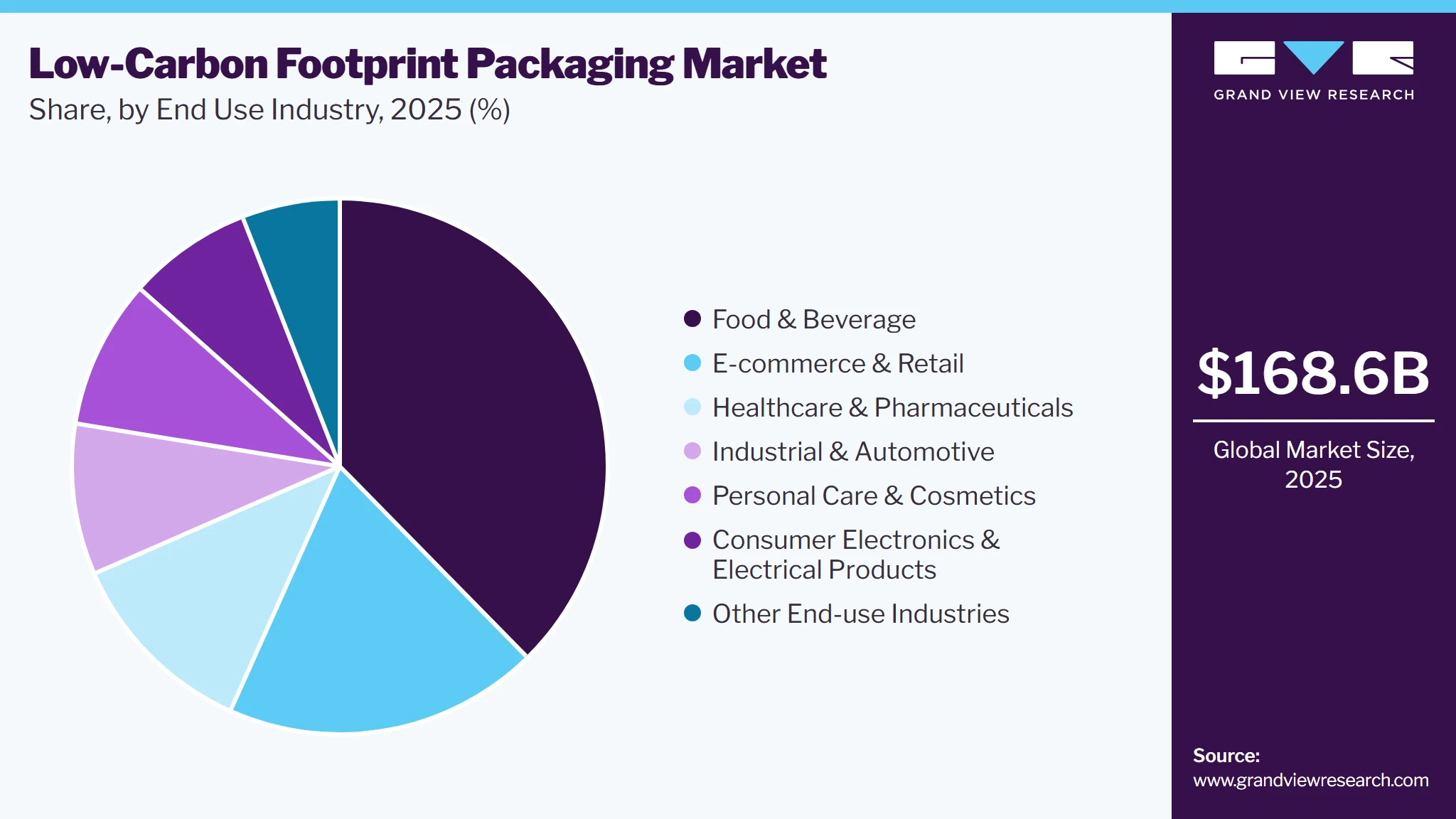
Based on end-use industry, the food and beverage segment dominated the low-carbon footprint packaging market, accounting for the largest revenue share of 37.6% in 2025. The sector relies on packaging that preserves product freshness, maintains food safety, and withstands storage and transportation requirements while reducing environmental impact. Adoption of recyclable paperboard cartons, recycled-content plastics, lightweight containers, and fiber-based packaging is increasing as manufacturers seek to reduce virgin material consumption and packaging waste. Growing sustainability commitments among food producers and retailers are further encouraging packaging redesigns that balance barrier performance, shelf life, recyclability, and resource efficiency.
 To learn more about this report, Download Free Sample Report
The e-commerce and retail segment is projected to grow at the fastest CAGR of 9.4% during the forecast period. The expansion of online shopping and direct-to-consumer distribution is increasing demand for shipping boxes, protective inserts, mailers, and right-sized packaging that minimizes excess material without compromising product protection. Retailers and logistics providers are increasingly adopting recycled-content corrugated packaging, paper-based cushioning, recyclable mailers, and optimized package dimensions to reduce packaging waste and improve shipping efficiency. The shift toward circular fulfillment systems and sustainability-focused purchasing policies is expected to further support demand for low-carbon packaging solutions across online retail supply chains.
Regional Insights
The North America low-carbon footprint packaging market is expected to grow steadily during the forecast period, supported by increasing adoption of sustainable packaging across food and beverage, e-commerce, healthcare, and consumer goods industries. Growing emphasis on packaging lightweighting, recycled-content materials, recyclable structures, and waste reduction is encouraging manufacturers to redesign conventional packaging formats. Corporate decarbonization commitments and demand for packaging solutions that balance product protection with material efficiency are also supporting market expansion. The region accounted for 27.4% of global market revenue in 2025 and is projected to grow at a CAGR of 8.6% from 2026 to 2033.
U.S. Low-Carbon Footprint Packaging Market Trends
The U.S. low-carbon footprint packaging market is expected to benefit from ongoing changes in packaging procurement, product design, and materials selection. Food producers, retailers, and e-commerce companies are increasingly evaluating recycled-content packaging, right-sized shipping boxes, paper-based protective materials, and recyclable flexible packaging to reduce material use and packaging waste. Investments in recycling infrastructure and packaging innovation are also creating opportunities for suppliers capable of delivering consistent quality and functional performance. Demand is further supported by corporate sustainability targets and the need to align packaging design with evolving waste-management requirements.
Europe Low-Carbon Footprint Packaging Market Trends
The Europe low-carbon footprint packaging market held the largest regional revenue share of 32.1% in 2025, reflecting the region's established packaging industry and strong emphasis on resource efficiency and circular material use. Demand is supported by the adoption of recyclable paperboard, recycled plastics, reusable packaging systems, and packaging designs that reduce material consumption. Food and beverage producers, retailers, and consumer goods manufacturers are increasingly incorporating sustainability considerations into packaging development and sourcing decisions. Continued attention to packaging waste prevention, recyclability, and environmental performance is expected to sustain the region's leading market position, although growth is projected at a comparatively moderate CAGR of 8.2% from 2026 to 2033.
 To learn more about this report, Download Free Sample Report
The Germany low-carbon footprint packaging market is supported by the country's strong manufacturing base, advanced packaging-conversion capabilities, and demand for resource-efficient industrial and consumer packaging. Automotive suppliers, manufacturers, food companies, and retailers are potential users of lightweight transport packaging, recycled-content corrugated materials, reusable transit solutions, and recyclable protective formats. The importance of packaging durability and supply-chain efficiency also encourages the development of solutions that reduce material consumption while maintaining performance. Ongoing packaging redesign and circular-economy initiatives are expected to support demand across industrial and consumer applications.
The UK low-carbon footprint packaging market is expected to expand as retailers, e-commerce operators, and consumer goods companies place greater emphasis on packaging waste reduction and circularity. Demand is being shaped by the use of recyclable paper-based packaging, recycled-content materials, lightweight formats, and designs that facilitate sorting and recovery after use. Retail distribution and direct-to-consumer fulfillment provide opportunities for right-sized boxes, paper cushioning, and recyclable mailers that minimize unnecessary packaging. Brand sustainability commitments and efforts to improve packaging collection and recycling are expected to influence future product development and purchasing decisions.
Asia Pacific Low-Carbon Footprint Packaging Market Trends
The Asia Pacific low-carbon footprint packaging market is projected to register the fastest regional growth, with a CAGR of 9.4% from 2026 to 2033. The region accounted for 30.1% of global market revenue in 2025 and is expected to increase its contribution as manufacturing activity, consumer markets, and e-commerce networks continue to expand. Rising demand for packaged food, personal care products, electronics, and online retail shipments is creating opportunities for recyclable, lightweight, recycled-content, and fiber-based packaging. The region's broad packaging manufacturing base also supports the scaling of alternative materials and redesigned packaging formats, although adoption varies according to recycling infrastructure, material availability, and end-user requirements.
The China low-carbon footprint packaging market is supported by its extensive packaging manufacturing industry, large consumer market, and substantial demand from e-commerce, electronics, food and beverage, and personal care sectors. High-volume distribution creates opportunities for lightweight corrugated packaging, recyclable mailers, paper-based protective inserts, and packaging that incorporates recycled materials. Manufacturers are also positioned to respond to brand-owner requirements for material efficiency and improved packaging recovery. Continued development of packaging technologies and circular material supply chains is expected to support the market, with progress influenced by the economics of recycled feedstocks and the availability of effective collection and processing systems.
The India low-carbon footprint packaging market is expected to record strong growth during the forecast period, supported by expanding organized retail, e-commerce, food processing, and consumer goods manufacturing. Rising demand for shipping cartons, paper-based cushioning, recyclable flexible packaging, and packaging made with recycled or renewable feedstocks is creating opportunities for domestic converters and material suppliers. Businesses are increasingly considering packaging redesign to reduce material use while maintaining shelf life, product safety, and transportation performance. Improvements in collection, sorting, recycling, and waste-management systems could further support adoption of low-carbon packaging solutions across both established and emerging end-use industries.
Latin America Low-Carbon Footprint Packaging Market Trends
The Latin America low-carbon footprint packaging market is projected to grow steadily, with a forecast CAGR of 9.1% from 2026 to 2033. The region represented 5.7% of global market revenue in 2025. Demand is supported by packaged food and beverage consumption, retail distribution, and the need for cost-effective packaging that combines product protection with improved material efficiency. Recycled paperboard, recyclable plastic formats, lightweight containers, and reusable transport packaging offer potential applications across consumer and industrial supply chains. Market development will depend on the availability of recovered materials, recycling infrastructure, and the ability of packaging suppliers to meet performance requirements at competitive costs.
The Brazil low-carbon footprint packaging market is supported by demand from food and beverage producers, retailers, personal care companies, and other consumer goods manufacturers. Corrugated boxes, paperboard cartons, recyclable plastic packaging, and packaging incorporating recovered materials offer opportunities for reducing virgin material consumption and improving resource efficiency. The country's established packaging and converting activities provide a base for the development of alternative formats, while consumer-facing brands increasingly consider packaging sustainability as part of product and supply-chain decisions. Progress will depend on the economics of material recovery and the suitability of available collection and recycling systems.
The Argentina low-carbon footprint packaging market is expected to develop gradually as food processing, beverage production, retail, and other consumer industries seek packaging that improves material efficiency and supports waste reduction. Recyclable cartons, corrugated transport packaging, lightweight containers, and packaging incorporating recovered materials represent relevant areas of adoption. For manufacturers and brand owners, the key consideration is balancing environmental objectives with packaging costs, product protection, and local material availability. Further improvements in collection and recycling capabilities could support broader use of circular packaging formats across domestic supply chains.
Middle East & Africa Low-Carbon Footprint Packaging Market Trends
The Middle East & Africa low-carbon footprint packaging market is expected to grow at a CAGR of 9.0% from 2026 to 2033, making it one of the faster-growing regional markets. It accounted for 4.7% of global revenue in 2025. Market expansion is expected to be supported by urbanization, retail and food-sector development, investment in manufacturing, and growing interest in packaging solutions that reduce material use and waste. Demand opportunities include lightweight transport packaging, recyclable cartons, recycled-content materials, and packaging systems designed for more efficient distribution. The pace of adoption will vary across countries depending on recycling infrastructure, access to suitable feedstocks, regulatory requirements, and the cost of sustainable alternatives.
Key Low-Carbon Footprint Packaging Company Insights
Some key companies in the Low-Carbon Footprint Packaging Market include Amcor plc, Mondi, Smurfit Westrock, International Paper, Stora Enso, Metsä Group, DS Smith, Sealed Air, Tetra Pak International S.A., Huhtamaki, Hartmann Packaging A/S, Fibmold Packaging Pvt. Ltd., EcoEnclose, TCPL Packaging, and PAPACKS Sales GmbH. The market is characterized by the development of recyclable packaging structures, recycled-content materials, fiber-based alternatives, lightweight designs, reusable formats, and packaging solutions manufactured with lower environmental impact. Key participants are focusing on material innovation, circular packaging systems, resource efficiency, and packaging redesign to help brand owners reduce virgin material consumption, packaging waste, and lifecycle carbon emissions while maintaining product protection and functional performance.
-
Amcor plc is a global packaging company offering flexible and rigid packaging solutions for food and beverage, healthcare, personal care, and other consumer markets. Its packaging portfolio includes solutions incorporating recycled materials, recyclable designs, and material-reduction approaches, supporting customers seeking to improve packaging sustainability while maintaining product safety and performance.
-
Mondi is a global packaging and paper manufacturer with a portfolio spanning corrugated packaging, flexible packaging, and paper-based solutions. The company focuses on recyclable packaging design, lightweight structures, and paper-based alternatives for applications such as e-commerce, food, and industrial transport, helping customers improve material efficiency and packaging circularity.
Key Low-Carbon Footprint Packaging Companies
The following key companies have been profiled for this study on the low-carbon footprint packaging market
-
Amcor plc
-
Mondi
-
Smurfit Westrock
-
International Paper
-
Stora Enso
-
Metsä Group
-
DS Smith
-
Sealed Air
-
Tetra Pak International S.A.
-
Huhtamaki
-
Hartmann Packaging A/S
-
Fibmold Packaging Pvt. Ltd.
-
EcoEnclose
-
TCPL Packaging
-
PAPACKS Sales GmbH
Competitive Benchmarking
Category
Operating Strategies
Competitive Edge
Weakness
Established Players (Amcor plc; Mondi; Smurfit Westrock; International Paper; Stora Enso; Metsä Group; DS Smith; Sealed Air; Tetra Pak International S.A.; Huhtamaki)
Focus on expanding sustainable packaging portfolios through recycled-content materials, recyclable packaging structures, lightweight designs, renewable fiber-based materials, and material-efficient manufacturing. Invest in circular packaging innovation, product protection, and partnerships with brand owners across food and beverage, e-commerce, healthcare, and consumer goods.
Strong global manufacturing capabilities, established customer relationships, extensive distribution networks, broad packaging portfolios, and technical expertise support large-scale adoption of low-carbon packaging solutions. Established procurement and recycling partnerships also strengthen material sourcing and circularity initiatives.
High investment requirements for sustainable materials and manufacturing upgrades, exposure to fluctuations in recycled feedstock costs, and challenges in balancing recyclability with barrier performance and product protection can affect profitability. Recycling infrastructure and regional packaging regulations may also influence implementation.
Emerging and Specialized Players (Hartmann Packaging A/S; Fibmold Packaging Pvt. Ltd.; EcoEnclose; TCPL Packaging; PAPACKS Sales GmbH)
Focus on specialized solutions such as molded-fiber packaging, recycled-content shipping materials, paper-based protective packaging, sustainable folding cartons, and fiber-based alternatives to selected plastic formats. Emphasize customized packaging design, material efficiency, and solutions for e-commerce, food packaging, and consumer goods.
Greater specialization in niche packaging applications, flexibility in product customization, and focused expertise in molded fiber, paper-based formats, and sustainable shipping solutions support differentiation. Targeted product development can help address specific customer requirements for recyclable and resource-efficient packaging.
Comparatively narrower product portfolios and geographic reach may limit large-scale market penetration. Dependence on fiber quality, recycled-material availability, cost competitiveness, and suitable collection and recycling infrastructure can constrain adoption across certain applications.
Recent Development
-
In September 2026, Amcor announced plans to showcase packaging technologies at PACK EXPO International 2026, highlighting solutions designed to improve recyclability, reduce packaging waste, and increase recycled-content use. Its featured innovations included recycle-ready refill pouches and packaging technologies focused on material reduction, supporting brand owners' efforts to improve packaging circularity.
-
In May 2026, Smurfit Westrock introduced ActiBlu, a prototype paper-based packaging solution designed to eliminate the need for conventional glue application during box closure. The water-activated technology uses up to 60% less adhesive than traditional hot-melt gluing and is being tested with partners, with the aim of improving packaging recyclability and operational efficiency
Low-Carbon Footprint Packaging Market Report Scope
Report Attribute
Details
Market size in 2025
USD 168.6 billion
Estimated market size in 2026
USD 181.9 billion
Projected market size by 2033
USD 327.8 billion
Growth Rate
CAGR of 8.8% from 2026 to 2033
Base year for estimation
2025
Historical data
2021 - 2024
Forecast period
2026 - 2033
Quantitative units
Revenue in USD Million/Billion and CAGR from 2026 to 2033
Report coverage
Revenue forecast, company ranking, competitive landscape, growth factors, and trends
Segments covered
Material, primary approach, packaging format, end-use industry, and region
Regional Scope
North America, Europe, Asia Pacific, Latin America, Middle East & Africa
Country Scope
U.S.; Canada; Mexico; Germany; France; UK; Italy; Spain; China; India; Japan; South Korea; Australia; Brazil; Argentina; Saudi Arabia; UAE; South Africa
Key companies profiled
Amcor plc, Mondi, Smurfit Westrock, International Paper, Stora Enso, Metsä Group, DS Smith, Sealed Air, Tetra Pak International S.A., Huhtamaki, Hartmann Packaging A/S, Fibmold Packaging Pvt. Ltd., EcoEnclose, TCPL Packaging, PAPACKS Sales GmbH
Customization scope
Free report customization (equivalent up to 8 analysts working days) with purchase. Addition or alteration to country, regional & segment scope.
Pricing and purchase options
Avail of customized purchase options to meet your exact research needs. Explore purchase options
Global Low-Carbon Footprint Packaging Market Report Segmentation
This report forecasts revenue growth at the regional, and country levels and provides an analysis on the latest industry trends and opportunities in each of the sub-segments from 2021 to 2033. For the purpose of this study, Grand View Research has segmented the global low-carbon footprint packaging market report on the basis of material, end-use industry, packaging format, primary approach, and region:
-
Material Outlook (Revenue, USD Million, 2021 - 2033)
-
Plastic
-
Paper & Paperboard
-
Glass
-
Metal
-
Molded Fiber
-
Bio-based & Other Materials
-
-
Primary Approach Outlook (Revenue, USD Million, 2021 - 2033)
-
Recycled-Content Packaging
-
Lightweight & Material-Reduced Packaging
-
Recyclable & Mono-Material Packaging
-
Reusable & Refillable Packaging
-
Bio-based & Compostable Packaging
-
Packaging Using Lower-Carbon Manufacturing
-
-
Packaging Format Outlook (Revenue, USD Million, 2021 - 2033)
-
Rigid Packaging
-
Flexible Packaging
-
Semi-Rigid Packaging
-
Protective & Transit Packaging
-
-
End-use Industry Outlook (Revenue, USD Million, 2021 - 2033)
-
Food & Beverages
-
E-commerce & Retail
-
Healthcare & Pharmaceuticals
-
Personal Care & Cosmetics
-
Consumer Electronics & Electrical Products
-
Industrial & Automotive
-
Other End-use Industries
-
-
Regional Outlook (Revenue, USD Million, 2021 - 2033)
-
North America
-
U.S.
-
Canada
-
Mexico
-
-
Europe
-
Germany
-
France
-
UK
-
Italy
-
Spain
-
-
Asia Pacific
-
China
-
India
-
Japan
-
South Korea
-
Australia
-
-
Latin America
-
Brazil
-
Argentina
-
-
Middle East & Africa
-
Saudi Arabia
-
UAE
-
South Africa
-
-
Research Methodology
The low-carbon footprint packaging market figures in this report are based on a proven research process that combines executive interviews with secondary research from proprietary databases, company filings, and recognized regulatory and institutional sources. Market size is built through value-chain sizing-reconciling supply-side and demand-side estimates-and triangulated with bottom-up and top-down approaches. Every estimate passes multiple levels of expert validation before publication, with each low-carbon footprint packaging segment quantified using the revenue-capture definitions in the table below.
Segment Definition
Material Type
Revenue capture definition
Paper & Paperboard
Revenue generated from paper and paperboard packaging, including cartons, corrugated boxes, paper bags, and protective packaging incorporating recycled fibers, renewable materials, or lightweight designs.
Plastics
Revenue generated from plastic packaging incorporating recycled-content polymers, recyclable structures, mono-material designs, and lightweight formats that reduce virgin material use and environmental impact.
Glass
Revenue generated from glass packaging, including bottles and jars, incorporating recycled glass, lightweight designs, and energy-efficient manufacturing processes.
Metal
Revenue generated from metal packaging, including aluminum cans, steel containers, and closures, using recycled materials, lightweight designs, or lower-carbon manufacturing processes.
Molded Fiber
Revenue generated from molded fiber packaging, including trays, protective inserts, cushioning, and containers made from recycled paper, cellulose, or other suitable fiber feedstocks.
Bio-based & Other Materials
Revenue generated from packaging made using renewable, bio-based, compostable, or other alternative materials designed to reduce fossil-resource dependence and environmental impact.
Primary Approach
Revenue capture definition
Recycled-Content Packaging
Revenue generated from packaging incorporating recycled materials, including recovered paper, recycled plastics, glass, and metals, to reduce virgin material consumption and support circularity.
Lightweight &
Material-Reduced Packaging
Revenue generated from packaging designed with reduced material usage, optimized dimensions, or lower weight while maintaining product protection and functional performance.
Recyclable &
Mono-Material Packaging
Revenue generated from packaging designed for recycling, including mono-material structures and formats that facilitate material recovery and reduce waste.
Reusable &
Refillable Packaging
Revenue generated from packaging designed for multiple uses or refilling, including reusable containers, refillable packs, and returnable transport packaging.
Bio-based &
Compostable Packaging
Revenue generated from packaging made using renewable biological feedstocks or materials designed to biodegrade under specified composting conditions.
Packaging Using
Lower-Carbon Manufacturing
Revenue generated from packaging manufactured through processes that reduce greenhouse gas emissions, including energy-efficient production, renewable energy use, and lower-emission material processing.
Packaging Format
Revenue capture definition
Rigid Packaging
Revenue generated from rigid packaging, including bottles, jars, containers, cans, cartons, and boxes incorporating recycled materials, lightweight designs, or lower-carbon production methods.
Flexible Packaging
Revenue generated from flexible packaging, including films, pouches, wraps, and bags designed with recycled content, recyclable structures, mono-materials, or reduced material usage.
Semi-Rigid Packaging
Revenue generated from semi-rigid packaging, including trays, tubs, cups, and molded containers designed to improve material efficiency through lightweight construction, recycled content, or recyclable materials.
Protective & Transit Packaging
Revenue generated from protective and transport packaging, including corrugated boxes, cushioning, inserts, mailers, and shipping materials designed to reduce material consumption, incorporate recycled content, or improve recyclability.
End-use Industry
Revenue capture definition
Food & Beverage
Revenue generated from low-carbon footprint packaging used for food and beverage products, including cartons, bottles, cans, trays, pouches, and containers made with recycled, renewable, lightweight, or recyclable materials.
E-commerce & Retail
Revenue generated from sustainable shipping and retail packaging, including corrugated boxes, mailers, paper-based cushioning, and protective packaging designed to reduce material use and improve recyclability.
Healthcare & Pharmaceuticals
Revenue generated from low-carbon footprint packaging used for medicines, medical devices, and healthcare products, incorporating material-efficient, recyclable, or lower-carbon solutions while meeting product safety and protection requirements.
Personal Care & Cosmetics
Revenue generated from sustainable packaging for skincare, cosmetics, toiletries, and personal care products, including recyclable containers, refillable packs, recycled-content plastics, and paper-based packaging.
Consumer Electronics &
Electrical Products
Revenue generated from packaging for electronics and electrical goods, including molded fiber inserts, recycled corrugated boxes, protective cushioning, and lightweight materials designed to reduce packaging waste while ensuring product protection.
Industrial & Automotive
Revenue generated from low-carbon footprint packaging used for industrial components, automotive parts, and equipment, including reusable transport packaging, recyclable containers, corrugated packaging, and material-efficient protective solutions.
Other End-use Industries
Revenue generated from low-carbon footprint packaging used across other sectors, including agriculture, household products, logistics, and specialized commercial applications, incorporating recycled, renewable, reusable, or material-reduced packaging solutions.
Estimation Model
Layer Name
Key Question
Description
End-use Industry Layer
What drives demand?
Estimate demand for low-carbon footprint packaging across food and beverage, e-commerce and retail, healthcare and pharmaceuticals, personal care and cosmetics, consumer electronics, and industrial applications, based on the shift toward resource-efficient and environmentally preferable packaging solutions.
Packaging Sustainability Approach Layer
How is the carbon footprint reduced?
Assess the adoption of recycled-content materials, lightweight packaging, recyclable and mono-material structures, reusable and refillable formats, bio-based and compostable materials, and lower-carbon manufacturing processes according to sustainability objectives and packaging performance requirements.
Material and Format Consumption Layer
Which packaging solutions generate demand?
Evaluate consumption of paper and paperboard, plastics, glass, metal, molded fiber, and other alternative materials across rigid, flexible, semi-rigid, and protective and transit packaging formats, considering material efficiency, product protection, recyclability, and suitability for end-use applications.
Revenue Layer
How is revenue generated?
Revenue is generated through the sale of packaging products designed to reduce lifecycle environmental impacts, including recycled-content cartons and containers, lightweight flexible packs, recyclable mono-material packaging, molded fiber protective solutions, reusable transport packaging, and packaging manufactured using lower-carbon processes.
Delivered Customizations
We have successfully delivered the following deep-dive customizations
Client Request
Customization Delivered
Value Adds
Regional Segmentation Analysis
Detailed assessment of the low-carbon footprint packaging market across North America, Europe, Asia Pacific, Latin America, and the Middle East & Africa, covering regional adoption of recycled-content materials, recyclable packaging formats, lightweight designs, sustainability regulations, manufacturing capabilities, and growth outlook across key end-use industries.
Identifies high-growth regions, differences in sustainability adoption, and strategic opportunities for regional market expansion.
Cross-Segmentation Analysis
Comprehensive analysis of market opportunities across combinations of Material (Paper & Paperboard, Plastics, Glass, Metal, Molded Fiber, and Bio-based & Other Materials), Primary Approach (Recycled-Content, Lightweight & Material-Reduced, Recyclable & Mono-Material, Reusable & Refillable, Bio-based & Compostable, and Lower-Carbon Manufacturing), Packaging Format, End-use Industry, and regional markets.
Reveals attractive segment combinations, emerging demand pockets, and end-use preferences to support targeted product development and market-entry strategies.
Competitive Benchmarking
Comparative assessment of leading low-carbon footprint packaging companies based on sustainable material portfolios, recycled-content capabilities, packaging design innovation, carbon-reduction initiatives, manufacturing footprint, geographic presence, strategic partnerships, and recent product developments.
Clarifies competitor positioning, innovation strengths, differentiation opportunities, and potential gaps across sustainable packaging materials and applications.
About the Author(s)
Plastics, Polymers & Resins Research Team
Bulk Chemicals · Plastics, Polymers & ResinsThis report was authored by the plastics, polymers & resins research team at Grand View Research - comprising two research analysts, one senior research analyst, and one industry expert - with specialized expertise in the plastics, polymers & resins segment of the bulk chemicals industry. All findings are based on proprietary bulk chemicals databases, executive interviews, and regulatory analysis, subject to internal peer review prior to publication.
Last Updated:
Speak to Analyst

Customize this report to your needs - add regions, segments, or data points, with 20% free customization.
Or view our licence options:


ISO 9001:2015 & 27001:2022 Certified
We are GDPR and CCPA compliant! Your transaction & personal information is safe and secure. For more details, please read our privacy policy.


