
- Home
- »
- Plastics, Polymers & Resins
- »
-
Recyclable Packaging Market Size, Share Report 2026-2033GVR Report cover

Recyclable Packaging Market (2026 - 2033)
Size, Share & Trends Analysis Report By Material (Plastics, Paper & Paperboard, Glass, Metal), By Product (Bottles & Jars, Bags & Pouches, Boxes & Cartons, Trays & Containers), By Application, By Region, And Segment Forecasts
Market Size, 2025
$222.0BMarket Estimate, 2026
$235.7BMarket Forecast, 2033
$359.1BCAGR, 2026–2033
6.2%Recyclable Packaging Market Summary
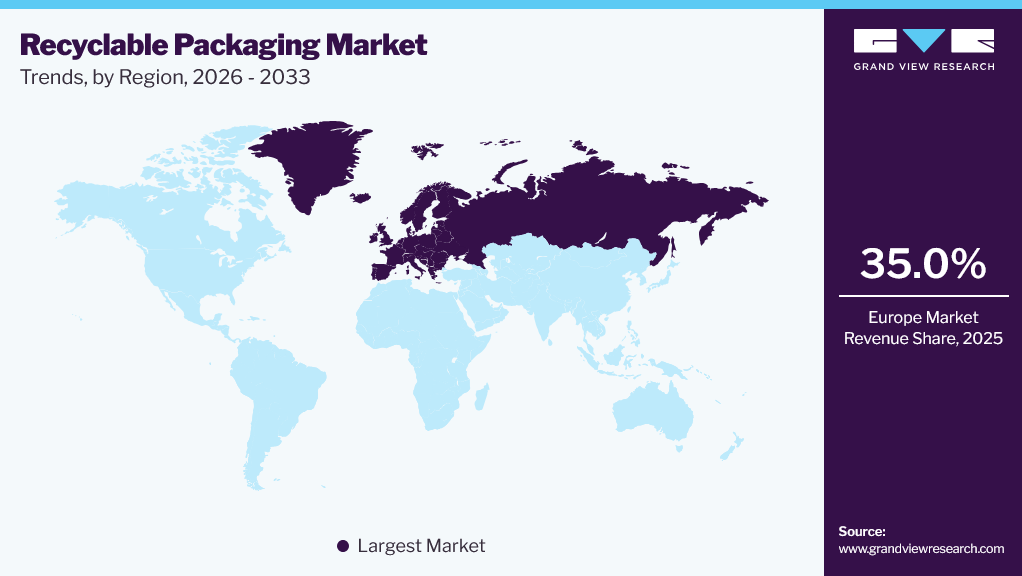
The global recyclable packaging market size was valued at USD 222.0 billion in 2025 and is projected to grow from USD 235.7 billion in 2026 to USD 359.1 billion by 2033, at a CAGR of 6.2% from 2026 to 2033. Europe dominated the market, accounting for a revenue share of 35.0% in 2025. Rising awareness among consumers of environmentally friendly packaging has led to a surge in demand for recyclable packaging solutions globally. Furthermore, government regulations & initiatives focused on waste reduction and recycling promotion have significantly contributed to market growth
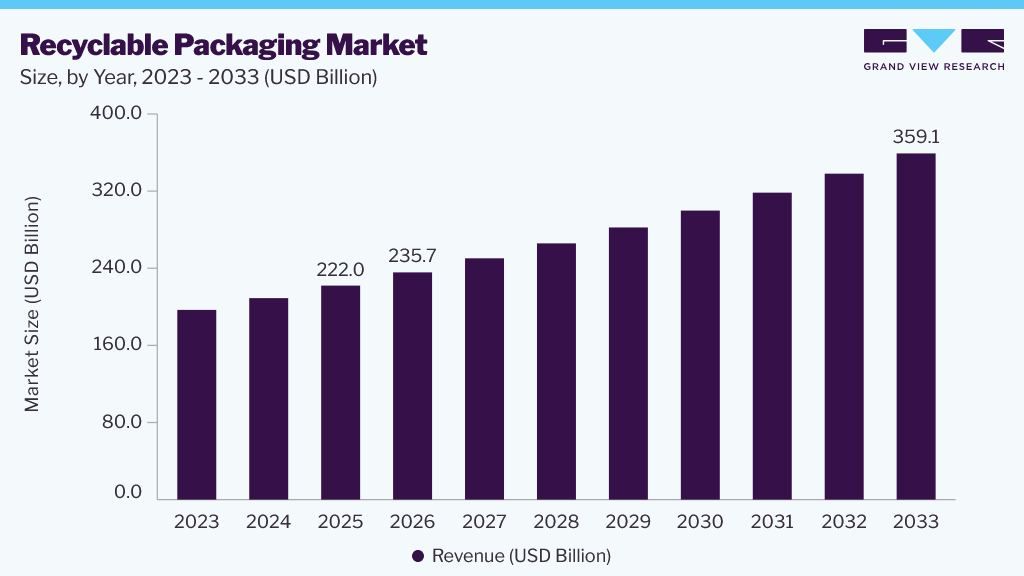 Source: Grand View Research, IR Documents, Primary Interviews, Paid DatabasesTo learn more about this report,
 Download Free Sample Report
Key Market Trends & Insights
- By material: The plastics segment held the largest market share of 39.0% in 2025.
- By application: The food & beverages segment held the largest market share of over 28.0% in 2025.
- By product: The bottles & jars segment held the largest market share of over 31.0% in 2025.
Regional Highlights
- Largest regional market: Europe (35.0% revenue share, 2025)
- Fastest-growing regional market: Asia Pacific (highest CAGR, 2026-2033)
Market Size & Forecast
- Market size in 2025: USD 222.0 Billion
- Estimated market size in 2026: USD 235.7 Billion
- Projected market size by 2033: USD 359.1 Billion
- CAGR (2026-2033): 6.2%
Three ways to get this report
Buy it, customize it, or ask a question.Ask an Analyst
Analyst response in 1 business day
- AccessReport author, directly
- Reply timeWithin 1 working day
- No sales callDirect answer only
- FormatEmail reply
- CostFree, no cost
Get the Full Report
What the study covers
- FormatsPDF · Excel · Dashboard
- Timeline2026–2033 annual, 2025 base
- Coverage20+ countries, 5 regions
- Companies10+ key players profiled
Customize the Report
20% free customization
- IncludeCountries, segments, points
- TailorTo your product definition
- ExtendDeeper competitor detail
- OrA fully bespoke study
- Turnaround5–10 working days
Rising environmental concerns and the subsequent push toward sustainability are the primary factors driving the growth of the recyclable packaging market. Consumers, businesses, and governments are becoming increasingly aware of the detrimental effects of plastic waste on the environment, leading to a concerted effort to reduce the carbon footprint of packaging materials and solutions. This has prompted a surge in demand for eco-friendly alternatives, such as paper, cardboard, and bioplastics, which are easily recyclable and biodegradable.
Stringent regulations & government initiatives played a pivotal role in fueling market growth. Many countries have implemented laws and policies that mandate the use of recyclable packaging materials or impose penalties for non-compliance. For instance, the European Union has set ambitious targets for recycling packaging waste, while several states in the U.S. have implemented bottle deposit schemes to incentivize recycling. These regulatory measures have compelled manufacturers to adopt recyclable packaging solutions to remain compliant and avoid hefty fines.
Moreover, shifting consumer preferences and growing demand for sustainable products have significantly influenced the recyclable packaging industry. Consumers, particularly millennials and Generation Z, are increasingly becoming conscious of their environmental impact and are actively seeking out products that align with their eco-friendly values. This has created a ripple effect, with brands and manufacturers recognizing the need to incorporate recyclable packaging into their product offerings to cater to this growing consumer segment and maintain a competitive edge.
Investments made by packaging companies in material processing and recycling to secure a steady supply of recycled materials are benefiting the overall recyclable packaging ecosystem. For instance, in September 2025, Amcor plc announced a strategic collaboration with recycling technology providers and brand owners to increase the availability of recycled content for packaging applications and support the development of circular packaging solutions. The initiative highlights the growing investments being made by packaging companies to strengthen recycling infrastructure, secure sustainable raw material supply, and accelerate the transition toward a circular packaging economy.
Analyst Perspective
The market is supported by environmental priorities, regulatory mandates, and evolving consumer expectations that increasingly influence packaging decisions across industries. Governments increased their efforts to develop new recycling objectives and policies aimed at pushing companies to adopt packaging that is recyclable and efficient in utilizing resources. The increasing desire of consumers to use eco-friendly products has pushed brands to use sustainable packaging to boost their branding efforts. Market development is also being reinforced by the investments made by the industry in the development of recycling technology and other processes.
Material Insights
The plastics segment dominated the overall market with a share of over 39.0% in 2025. Plastic packaging materials are generally lightweight, reducing transportation costs & carbon emissions associated with shipping. Additionally, plastics are relatively inexpensive to produce compared to other materials such as glass or metal. For instance, in February 2025, Tetra Pak introduced packaging materials incorporating certified recycled polymers in India, becoming the first food and beverage packaging company in the country to do so. The company highlighted that plastic-based polymer layers remain essential due to their lightweight characteristics, material efficiency, and ability to maintain product protection while reducing overall packaging weight and transportation-related emissions. This development underscores the continued preference for plastics in packaging applications where cost-effectiveness, low weight, and supply chain efficiency are critical considerations.
The paper & paperboard material segment, on the other hand, is expected to witness robust growth at a CAGR of approximately 7.0% over the forecast period. Paper & paperboard are highly recyclable materials, with well-established recycling infrastructure and processes in place globally. This aligns with the principles of sustainability and the circular economy. For instance, in May 2025, Mondi Group partnered with ZARELO GmbH to replace plastic packaging for fire logs and barbecue products with recyclable paper-based packaging solutions. The new packaging is produced using Kraft paper and is designed for recycling within existing paper recovery streams, supporting circular economy objectives and reducing dependence on plastic materials. This development highlights the growing industry preference for paper and paperboard packaging due to their high recyclability, established collection and recycling infrastructure, and alignment with sustainability goals, reinforcing the strong growth outlook for the paper & paperboard segment.
Application Insights
The food & beverages segment accounted for the largest revenue share of over 28.0% in 2025 and is anticipated to grow at the fastest CAGR of over 7.0% during the forecast period. Regulatory pressure and consumer demand for sustainable and environmentally friendly packaging solutions are increasing in the food & beverage industry. This has led to a shift toward recyclable packaging materials to reduce plastic waste and environmental impact. For instance, in August 2025, SIG partnered with leading Australian wine producers, including Hill-Smith Family Estates, Vinarchy, De Bortoli Wines, and Calabria Family Wines, to launch Australia's first fully recyclable bag-in-box wine packaging solution. The new packaging features recyclable bags, tap, and carton components, enabling easier material recovery through existing recycling streams. This development reflects the growing response of food and beverage companies to regulatory requirements and consumer demand for sustainable packaging solutions, while demonstrating the industry's commitment to reducing packaging waste and advancing circular economy objectives.
Healthcare & pharmaceutical sectors are heavily regulated and have strict guidelines in place regarding the packaging of drugs, medical devices, and other healthcare products. Many regulatory bodies, such as the FDA and EMA, encourage or mandate the use of environmentally friendly and sustainable packaging solutions, including recyclable materials. Furthermore, the personal care & cosmetics industry extensively uses packaging materials, such as plastic bottles, jars, and tubes, which can be easily made from recycled materials or designed for recyclability.
Product Insights
The bottles & jars segment dominated the market and accounted for the largest revenue share of over 31.0% in 2025. Glass, PolyEthylene Terephthalate (PET), and High Density Polyethylene (HDPE) bottles & jars are 100% recyclable, making them an attractive, eco-friendly option compared to non-recyclable plastics. For instance, in October 2023, The Coca‑Cola Company announced that its Coca-Cola, Diet Coke, Coke Zero Sugar, and Dasani bottles sold in Canada would be packaged in 100% recycled PET (rPET) plastic, excluding caps and labels. The initiative was introduced to increase the use of fully recyclable packaging materials, reduce reliance on virgin plastic, and strengthen circular packaging systems. This development highlights the growing preference for PET bottles in the packaging industry, as they are widely recyclable, supported by established collection infrastructure, and contribute to sustainability objectives while maintaining product performance and consumer convenience.
The bags & pouches product segment is expected to register the fastest CAGR of over 7.0% over the forecast period. Bags & pouches offer convenience in terms of portability, ease of handling, and storage. They are lightweight and take up less space compared to rigid containers or bottles, making them a practical & suitable choice for packaging various products.
Regional Insights
The North America recyclable packaging market is influenced by stringent environmental regulations and policies that encourage the use of sustainable and recyclable packaging materials. Companies, such as Coca-Cola, PepsiCo, Unilever, and Procter & Gamble, have implemented significant initiatives to increase the use of recyclable packaging materials in North America, driven by consumer demand, sustainability goals, and regulatory requirements. This outlook is expected to provide growth opportunities for the market within North America.
U.S. Recyclable Packaging Market Trends
The recyclable packaging market in the U.S. is anticipated to experience significant growth due to the introduction of new recyclable packaging products by companies operating in the country. In February 2024, American Packaging Corporation (APC) announced the commercial launch of a new sustainable offering for frozen food applications, introducing a "Design for Recycle" flexible packaging technology. This initiative is part of its RE sustainable packaging portfolio, which includes various environmentally friendly packaging options, such as Design for Compost, Circular Content, and Renewable Content. The newly launched package is a PE flexible package designed to be recycle-ready and compliant with the Association of Plastic Recyclers' guidelines for PE films.
The Canada recyclable packaging market held a significant revenue share in 2025, due to its commitment to the use of recycled content in its packaging. The Canadian Federal Government is engaging the public to develop a Pollution Prevention Plan to reduce plastic pollution, focusing on primary food plastic packaging. This initiative aims to shift toward a circular economy by reducing single-use plastics and increasing recycled content targets. The plan includes efforts to replace single-use packaging with reuse-refill systems and design plastics for safe reuse, recycling, or composting.
Europe Recyclable Packaging Market Trends
The recyclable packaging market in Europe held the largest revenue share of over 35% in 2025, owing to the continuous promotion of recyclability and sustainability across the region. According to the European Parliament, EU member states are mandated to reduce packaging waste by 5% by 2030, 10% by 2035, and 15% by 2040. Besides, all packaging must be recyclable by 2030 and systematically recycled by 2035. Member states need to ensure a separate collection of at least 90% of single-use plastic bottles and metal beverage containers by 2029, as per the European Parliament.
 To learn more about this report, Download Free Sample Report
The UK recyclable packaging market is primarily driven by increasing efforts made by packaging companies to launch environmentally friendly packaging to meet the increasing demand for recyclable packaging in various end-use industries, including food & beverages. In March 2024, DS Smith partnered with seafood brand Seafood by Sykes in the UK to introduce a fully recyclable fiber-based packaging solution for frozen seafood products. The packaging was developed to replace difficult-to-recycle plastic formats while maintaining product protection and shelf appeal. This initiative reflects the increasing investments being made by packaging manufacturers to expand sustainable packaging offerings and address rising demand from food and beverage companies for environmentally responsible packaging solutions. The development also supports the UK's broader circular economy and packaging waste reduction objectives.
The new paper-based packaging offers excellent barrier properties to protect rice while aligning with Veetee's goals to reduce plastic usage. The new packs have been certified for kerbside recycling in the UK. This initiative reflects both companies' commitment to sustainability, with Veetee targeting net zero carbon emissions and increased recycling, while Mondi aims to make all its packaging reusable, recyclable, or compostable by 2030.
Asia Pacific Recyclable Packaging Market Trends
The recyclable packaging market in Asia Pacific is anticipated to grow at the fastest CAGR of approximately 7.0% during the forecast period. Asia Pacific is home to some of the world's most populous countries, such as China, India, and Indonesia. The region has experienced rapid urbanization and population growth, leading to increased demand for packaged goods and, consequently, recyclable packaging solutions.
The Japan recyclable packaging market is expected to grow during the forecast period. In February 2024, Oji Holdings and Tetra Pak collaborated to establish Japan’s first recycling system for aseptic carton packages. This initiative involves collecting aseptic carton packages from various sources, including retail and municipal collections, to promote recycling and sustainability. Tetra Pak emphasizes the recyclability of its cartons, which are made of about 70% paperboard, 25% plastic, and 5% aluminum, highlighting the potential for these cartons to be transformed into various products through proper recycling processes. Such strategic efforts related to the recycling of packaging by various players are expected to drive the market growth.
Central & South America Recyclable Packaging Market Trends
The recyclable packaging market in Central & South America is projected to expand at a moderate CAGR from 2026 to 2033, due to government regulations & policies regarding sustainability. Many governments in Central & South America implemented regulations and initiatives to promote sustainable practices, including the use of recyclable packaging materials. For example, Brazil has implemented the National Solid Waste Policy, which encourages recycling and the use of recyclable materials in packaging.
The Brazil recyclable packaging market is expected to register a healthy growth rate over the forecast period. Companies, such as Heinz Brazil, Tesco, and Clover Sonoma, are making strides in recyclable packaging. Heinz Brazil is moving its sauces to bottles containing 30% recycled PET material, Tesco is introducing chilled meal trays with 30% PCR content, and Clover Sonoma shifted its organic milk jugs to contain 30% rHDPE material. Hence, these strategic efforts by companies in Brazil regarding the recyclability & sustainability of their packaging products are anticipated to aid market growth.
Middle East & Africa Recyclable Packaging Market Trends
The recyclable packaging market in the Middle East & Africa is influenced by government regulations related to plastic packaging. Expanding retail and e-commerce sectors in the region have increased the demand for packaging solutions, including recyclable packaging options. Moreover, many countries in the region are witnessing rapid urbanization and population growth, leading to increased consumption of packaged goods. This has driven the demand for recyclable packaging options to manage the resulting waste.
The UAE recyclable packaging market is growing due to initiatives taken by UAE-based companies to achieve their sustainability goals. For instance, in November 2023, Spinneys, a UAE-based supermarket chain, became the first UAE retailer to transition to recycled plastic packaging in partnership with Al Bayader International. This move represents a significant step toward environmental sustainability, with Spinneys using rPET packaging that significantly reduces CO2 emissions. The transition involves the use of recycled packs containing 30% rPET, initially in Spinneys' bakery products, contributing to a reduction of six metric tons of annual emissions.
Key Recyclable Packaging Companies Insights
The market consists of a significant number of companies producing recyclable packaging products.
- Amcor plc is a global leader in responsible packaging solutions and has a strong focus on developing recyclable, reusable, and lightweight packaging materials. The company is advancing mono-material flexible packaging technologies and investing in circular economy initiatives to help brand owners meet sustainability targets while reducing packaging waste across food, beverage, healthcare, and personal care applications.
- Mondi is a leading packaging and paper company headquartered in the United Kingdom and Austria, with a strong emphasis on sustainable and recyclable packaging solutions. The company is expanding its portfolio of paper-based and mono-material packaging products designed to replace difficult-to-recycle materials, supporting the transition toward a circular packaging economy and helping customers achieve their environmental goals.
Key Recyclable Packaging Companies
The following are the leading companies in the recyclable packaging market. These companies collectively hold the largest market share and dictate industry trends.
-
Amcor plc
-
Sealed Air
-
Tetra Pak
-
Huhtamaki Oyj
-
Mondi
-
DS Smith
-
Atlantic Packaging
-
ProAmpac
-
Constantia Flexibles
-
Genpak
-
Crown Holdings, Inc.
-
Gerresheimer AG
-
Stora Enso
-
WestRock Company
-
NEFAB GROUP
-
Scholle IPN
-
Greiner Packaging
-
Ball Corporation
-
Oji Holdings Corporation
-
Ardagh Group S.A.
-
RAFESA
-
Trivium Packaging
-
Envases Group
Recent Developments
-
In September 2025, Amcor plc entered into a strategic collaboration with recycling technology providers and brand owners to increase the availability of recycled content for packaging applications and support the development of circular packaging solutions.
-
In May 2025, Mondi Group partnered with ZARELO GmbH to replace plastic packaging for fire logs and barbecue products with recyclable paper-based packaging solutions.
Recyclable Packaging Market Report Scope
Report Attribute
Details
Market size in 2025
USD 222.0 billion
Estimated market size in 2026
USD 235.7 billion
Projected market size by 2033
USD 359.1 billion
Growth rate
CAGR of 6.2% from 2026 to 2033
Base year for estimation
2025
Actual data
2021 – 2024
Forecast period
2026 – 2033
Quantitative units
Volume in kilotons; revenue in USD billion, and CAGR from 2026 to 2033
Report coverage
Volume & revenue forecast, company ranking, competitive landscape, growth factors, and trends
Segments covered
Material, product, application, region
Regional scope
North America; Europe; Asia Pacific; Central & South America; Middle East & Africa
Country scope
U.S.; Canada; Mexico; Germany; France; UK; Italy; Spain; China; India; Japan; South Korea; Australia; Southeast Asia; Brazil; Argentina; Saudi Arabia; South Africa; UAE
Key companies profiled
Amcor plc; Sealed Air; Smurfit Kappa; Berry Global Inc.; Tetra Pak; Huhtamaki Oyj; Mondi; DS Smith; Atlantic Packaging; ProAmpac; Constantia Flexibles; Genpak; Crown Holdings, Inc.; Gerresheimer AG; Stora Enso; WestRock Company; NEFAB GROUP; Scholle IPN; Greiner Packaging; Ball Corporation; Oji Holdings Corporation; Ardagh Group S.A.; RAFESA; Trivium Packaging; Envases Group
Customization scope
Free report customization (equivalent up to 8 analysts working days) with purchase. Addition or alteration to country, regional & segment scope.
Pricing and purchase options
Avail of customized purchase options to meet your exact research needs. Explore purchase options
Recyclable Packaging Market Report Segmentation
This report forecasts volume & revenue growth at global, regional, and country levels and provides an analysis of the latest industry trends in each of the sub-segments from 2021 to 2033. For this study, Grand View Research has segmented the global recyclable packaging market report based on material, product, application, and region:
-
Material Outlook (Volume, Kilotons; Revenue, USD Billion, 2021 - 2033)
-
Plastics
-
Paper & Paperboard
-
Glass
-
Metal
-
Others
-
-
Product Outlook (Volume, Kilotons; Revenue, USD Billion, 2021 - 2033)
-
Bottles & Jars
-
Bags & Pouches
-
Boxes & Cartons
-
Trays & Containers
-
Drums & Cans
-
Others
-
-
Application Outlook (Volume, Kilotons; Revenue, USD Billion, 2021 - 2033)
-
Food & Beverages
-
Healthcare & Pharmaceuticals
-
Personal Care & Cosmetics
-
Industrial & Chemical
-
Consumer Goods
-
Others
-
-
Regional Outlook (Volume, Kilotons; Revenue, USD Billion, 2021 - 2033)
-
North America
-
U.S.
-
Canada
-
Mexico
-
-
Europe
-
Germany
-
UK
-
France
-
Italy
-
Spain
-
-
Asia Pacific
-
China
-
India
-
Japan
-
South Korea
-
Australia
-
Southeast Asia
-
-
Central & South America
-
Brazil
-
Argentina
-
-
Middle East & Africa
-
Saudi Arabia
-
UAE
-
South Africa
-
-
Frequently Asked Questions About This Report
The plastics segment accounted for the largest revenue share of approximately 39.0% in 2025.
Europe dominated with approximately 35.0% revenue share in 2025.
The recyclable packaging market was estimated at around USD 222.0 billion in the year 2025 and is expected to reach around USD 235.7 billion in 2026.
The recyclable packaging market is expected to grow at a compound annual growth rate of 6.2% from 2026 to 2033 to reach around USD 359.1 billion by 2033.
The key player in the recyclable packaging market includes Amcor plc, Sealed Air, Smurfit Kappa, Berry Global Inc., Tetra Pak, Huhtamaki Oyj, Mondi, DS Smith, Atlantic Packaging, ProAmpac, Constantia Flexibles, Genpak, Crown Holdings, Inc., Gerresheimer AG, Stora Enso, WestRock Company, NEFAB GROUP, Scholle IPN, Greiner Packaging, Ball Corporation, Oji Holdings Corporation, Ardagh Group S.A., RAFESA, Trivium Packaging, Envases Group, and others.
About the Author(s)
Plastics, Polymers & Resins Research Team
Bulk Chemicals · Plastics, Polymers & ResinsThis report was authored by the plastics, polymers & resins research team at Grand View Research - comprising two research analysts, one senior research analyst, and one industry expert - with specialized expertise in the plastics, polymers & resins segment of the bulk chemicals industry. All findings are based on proprietary bulk chemicals databases, executive interviews, and regulatory analysis, subject to internal peer review prior to publication.
Last Updated:
Speak to Analyst

Customize this report to your needs - add regions, segments, or data points, with 20% free customization.
Or view our licence options:


ISO 9001:2015 & 27001:2022 Certified
We are GDPR and CCPA compliant! Your transaction & personal information is safe and secure. For more details, please read our privacy policy.


