
- Home
- »
- Homecare & Decor
- »
-
Luxury Resort Market Size, Share, Growth Report 2026-2033GVR Report cover

Luxury Resort Market (2026 - 2033)
Size, Share & Trends Analysis Report By Resort Type (Urban Resorts, Destination Resorts), By Ownership Model (Independent Resorts, Chain Resorts), By Tourist Type, By Purpose Of Visit, By Booking Mode, By Region, And Segment Forecasts
Market Size, 2025
$115.8BMarket Estimate, 2026
$122.5BMarket Forecast, 2033
$203.1BCAGR, 2026–2033
7.5%Luxury Resort Market Summary
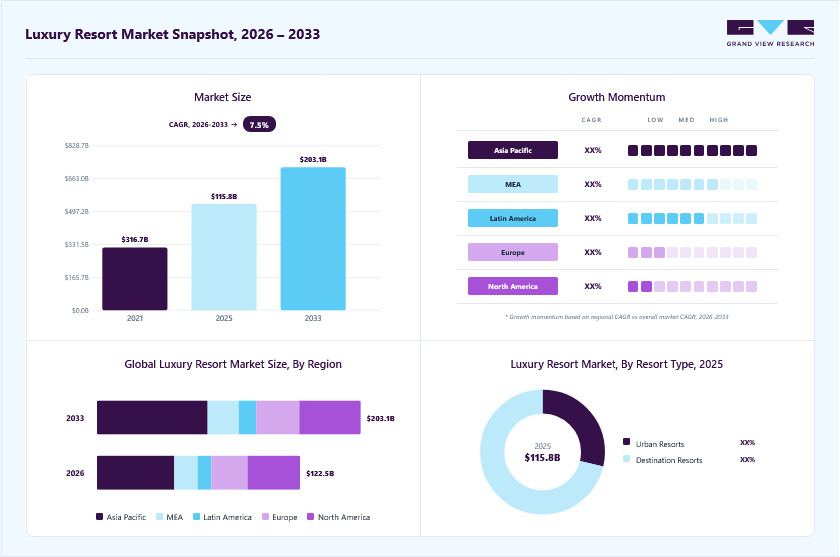
The global luxury resort market size was valued at USD 115.8 billion in 2025 and is projected to grow from USD 122.5 billion in 2026 to USD 203.1 billion by 2033, at a CAGR of 7.5% from 2026 to 2033. Europe dominated the market with a 29.3% share in 2025. The global market has evolved from a seasonal leisure-accommodation business into a diversified, experience-driven hospitality ecosystem encompassing ski and golf resorts, eco-resorts, wellness retreats, and ultra-luxury private island properties.
 Source: Grand View Research, IR Documents, Primary Interviews, Paid DatabasesTo learn more about this report,
 Download Free Sample Report
Key Market Trends & Insights
- By resort type: Destination resorts held the largest market share of 72.8% in 2025
- By ownership model: Chain resorts held the largest market share of 56.8% in 2025
- By tourist type: International tourists held the largest market share of 51.8% in 2025
- By purpose of visit: Leisure & vacation held the largest market share of 70.7% in 2025
- By booking mode: Online travel agencies held the largest market share of 30.6% in 2025
Regional Highlights
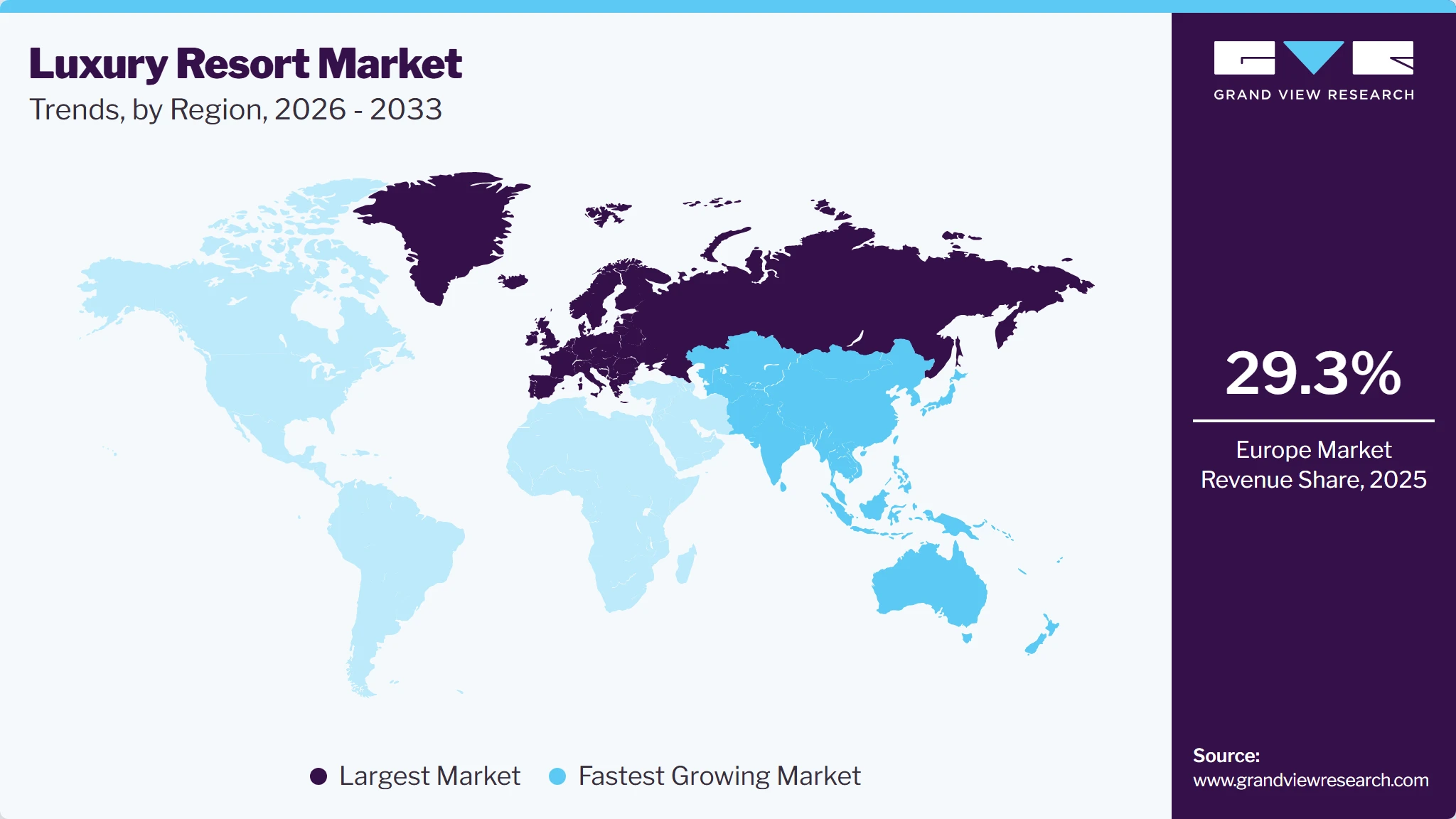
- Largest regional market: Europe (29.3% revenue share, 2025)
- Fastest-growing regional market: Asia Pacific (highest CAGR, 2026-2033)
- By country: Spain held the largest revenue share of Europe in 2025
Market Size & Forecast
- Market Size in 2025: USD 115.8 Billion
- Estimated Market Size in 2026: USD 122.5 Billion
- Projected Market Size by 2033: USD 203.1 Billion
- CAGR (2026-2033): 7.5%
Three ways to get this report
Buy it, customize it, or ask a question.Ask an Analyst
Analyst response in 1 business day
- AccessReport author, directly
- Reply timeWithin 1 working day
- No sales callDirect answer only
- FormatEmail reply
- CostFree, no cost
Get the Full Report
What the study covers
- FormatsPDF · Excel · Dashboard
- Timeline2026–2033 annual, 2025 base
- Coverage20+ countries, 5 regions
- Companies10+ key players profiled
Customize the Report
20% free customization
- IncludeCountries, segments, points
- TailorTo your product definition
- ExtendDeeper competitor detail
- OrA fully bespoke study
- Turnaround5–10 working days
Growth is no longer driven solely by higher tourist arrivals but by changing traveler expectations for longer stays, curated experiences, digital convenience, and destination-centric vacations. According to the World Travel & Tourism Council (WTTC), the future of the travel and tourism industry is being shaped by rapid technological innovation, evolving traveler demographics, and growing demand for more sustainable travel experiences. At the same time, WTTC highlights the rising influence of younger travelers, the expanding Asian middle class, and increasing outbound travel from Asia, all of which are reshaping tourism demand and encouraging hospitality companies to adapt their products and guest experiences to evolving consumer expectations.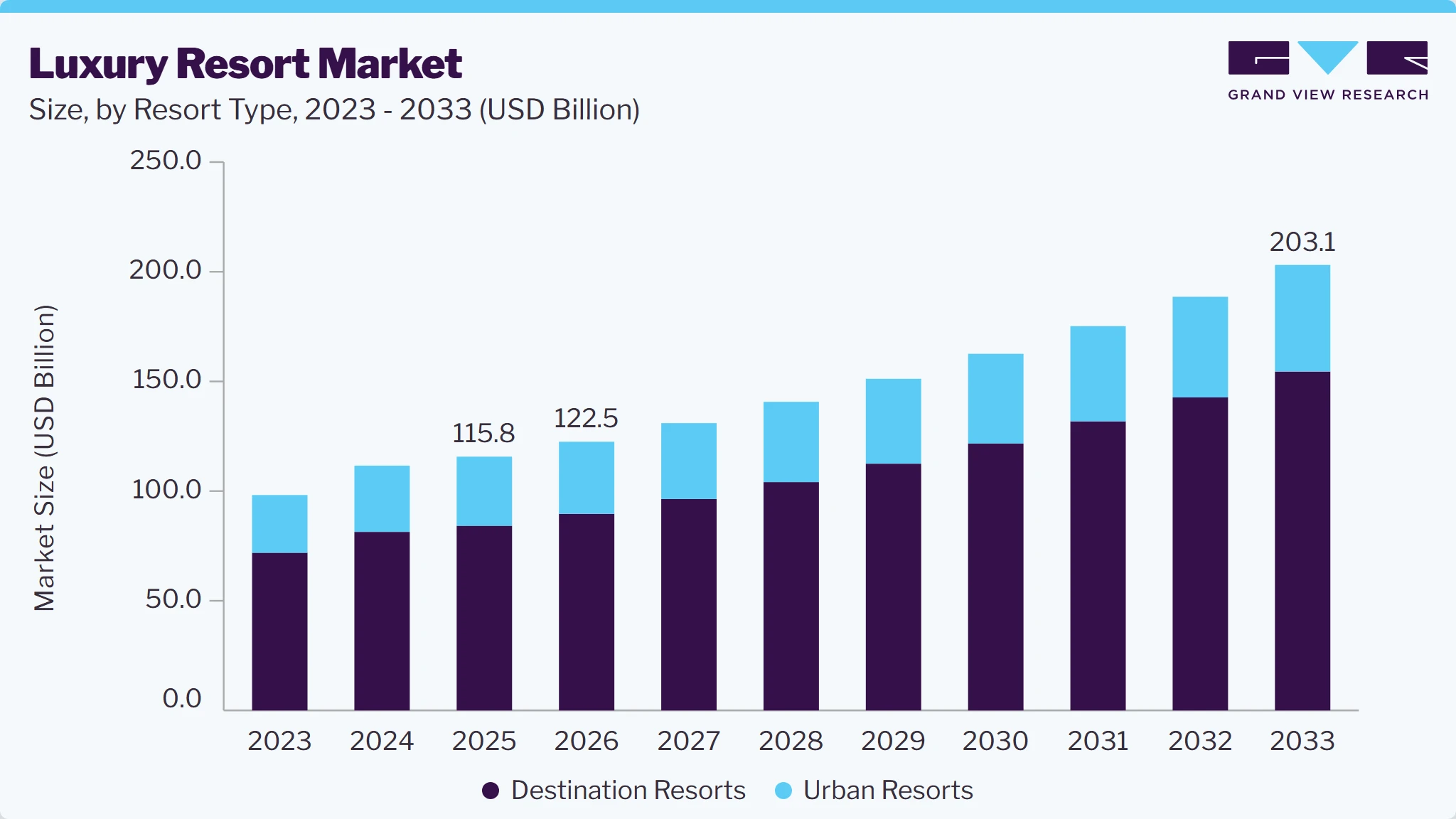 To learn more about this report, Download Free Sample Report
Competition in the resort industry has intensified as global hospitality companies race to build larger resort ecosystems rather than standalone properties. Major operators are aggressively expanding all-inclusive, lifestyle, and destination resorts while strengthening loyalty platforms to capture repeat travelers. Hyatt continues to position itself as a global leader in resort hospitality through its Inclusive Collection and, in 2026, reported a record development pipeline of approximately 148,000 rooms, equivalent to nearly 40% of its existing room base, reflecting strong investor confidence in resort and leisure-focused developments. Similarly, Marriott International has expanded its all-inclusive portfolio across the Caribbean, Europe, and Latin America, while Hilton continues scaling luxury resort brands such as Waldorf Astoria, Conrad, and LXR. Industry investment is also shifting toward integrated resort communities combining hotels, branded residences, retail, wellness centers, and entertainment venues, enabling operators to diversify revenue beyond room bookings.
The luxury resort industry is a specialized sub-segment of the luxury hotels market, comprising premium destination-based properties that combine upscale accommodations with integrated leisure, wellness, and recreation, as well as personalized hospitality experiences. Unlike luxury hotels, which are predominantly located in urban centers and cater to business and short-stay travelers, luxury resorts are designed as self-contained destinations in which the property itself is the primary travel experience. These resorts typically feature private villas and residences, beachfront or island locations, championship golf courses, destination spas, fine dining, adventure activities, marinas, and curated cultural experiences, enabling guests to engage in extended leisure stays. As luxury hospitality continues to evolve, resort operators are increasingly differentiating themselves through exclusivity, experiential offerings, and destination-specific programming rather than conventional accommodation alone.
According to the Preferred Hotels & Resorts Luxury Travel Report 2025, affluent travelers plan to take an average of eight leisure trips annually, including three international vacations, while 54% intend to increase their luxury travel spending in 2025, underscoring sustained demand for premium resort experiences. The report also indicates that 74% of affluent travelers prioritize accommodations that offer highly personalized experiences, reinforcing the growing preference for luxury resorts that provide bespoke services, private villas, dedicated butlers, and customized itineraries.
The luxury resort market is undergoing a significant transformation as guest preferences evolve from conventional luxury toward experience-led, wellness-centric, and destination-focused hospitality. According to the Preferred Hotels & Resorts Luxury Travel Report 2025, 67% of affluent travelers prioritize authentic local experiences when selecting accommodations, 65% seek destination-specific culinary experiences, and 63% consider wellness amenities an important factor in choosing luxury properties.
This shift is encouraging resort operators to integrate immersive cultural programming, wellness retreats, preventive healthcare, longevity therapies, outdoor recreation, and locally inspired gastronomy into their offerings. Supporting this trend, the Global Wellness Institute estimated the global wellness tourism economy at approximately USD 830 billion in 2023, with wellness tourism continuing to outpace the growth of the broader tourism industry. As a result, luxury resorts are increasingly positioning wellness as a core brand differentiator through integrated spas, sleep recovery programs, fitness retreats, thermal facilities, and holistic health experiences rather than standalone spa services.
Market Dynamics
The expansion of global private wealth and sustained growth in discretionary travel expenditure have become two of the strongest structural demand drivers for the luxury resort market. Unlike traditional hotel segments that primarily compete on price, luxury resorts increasingly benefit from affluent travelers prioritizing exclusivity, privacy, wellness, personalized services, and destination-led experiences over conventional sightseeing. According to UN Tourism, international tourist arrivals reached approximately 1.4 billion in 2024, representing around 99% of pre-pandemic levels, while international tourism receipts exceeded USD 1.9 trillion, reflecting resilient demand for premium travel experiences. Complementing this trend, the World Travel & Tourism Council (WTTC) estimates that the global Travel & Tourism sector contributed approximately USD 10.9 trillion to global GDP in 2024, accounting for nearly 10% of the global economy. Changing consumer preferences are further reinforcing this demand. Rather than standardized hotel stays, affluent travelers increasingly seek immersive, experienced-led vacations centered on wellness, privacy, cultural authenticity, culinary exploration, and personalized services.
Luxury resorts are among the most capital-intensive assets in the hospitality industry, requiring significantly higher investments than conventional hotels due to their expansive land requirements, low-density layouts, private villas, signature restaurants, destination spas, golf courses, marinas, wellness centers, staff accommodation, and supporting infrastructure. Unlike urban luxury hotels that leverage existing utilities and transport networks, luxury resorts are often developed in remote islands, beaches, mountains, deserts, or protected natural areas where developers must first invest in roads, renewable energy systems, water treatment plants, wastewater management, employee housing, and transport connectivity before constructing guest facilities. According to UN Tourism (UNWTO), tourism infrastructure projects are among the most capital-intensive investments in the service sector because destination infrastructure and environmental compliance account for a substantial portion of total project expenditure. Additionally, the World Bank noted that global construction material prices remain well above pre-pandemic levels, while elevated financing costs continue to increase hospitality development expenses.
Analyst Perspective
The luxury resort market is transitioning from traditional high-end accommodation toward an experience-driven hospitality sector fueled by rising global tourism, increasing disposable incomes, and growing demand for personalized travel. Affluent travelers increasingly prioritize wellness, privacy, cultural immersion, and sustainable tourism, prompting resort operators to expand offerings beyond accommodation with spa retreats, adventure activities, gourmet dining, and destination-specific experiences. Leading hospitality brands are investing in branded residences, eco-friendly developments, digital guest engagement, and AI-enabled personalization to enhance guest satisfaction and strengthen customer loyalty. Expansion into emerging tourism destinations, coupled with renovations of existing luxury properties, is creating new growth opportunities. As international travel continues to recover and demand for premium leisure experiences rises, luxury resorts are expected to benefit from sustained investments, operational innovation, and evolving consumer preferences for exclusive, experience-centric vacations.
Brand Market Share Insights
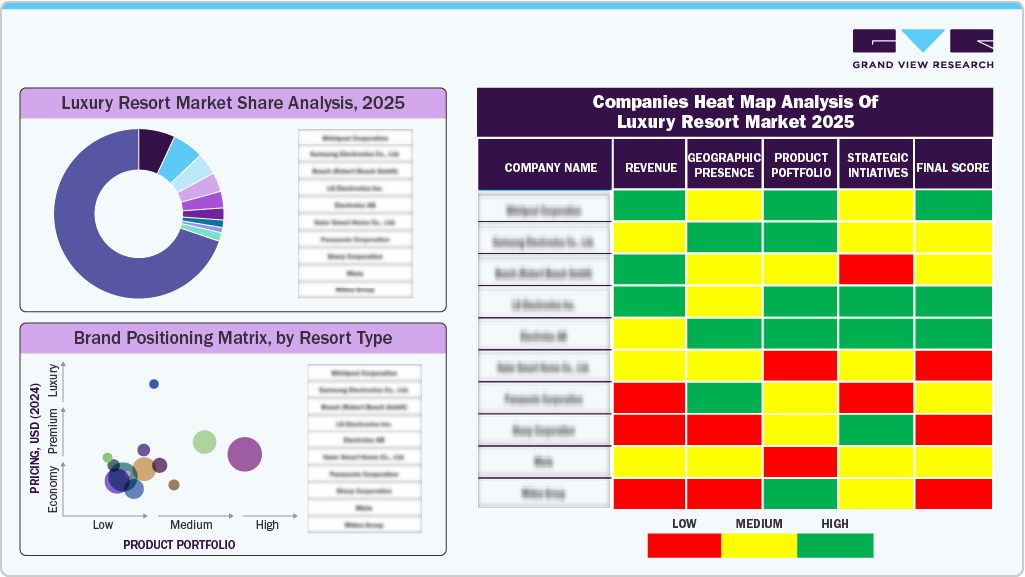
The global luxury resort industry is highly competitive, driven by continuous portfolio expansion, property renovations, wellness-focused offerings, and experience-led hospitality strategies. Leading companies such as Four Seasons Hotels Limited, Aman Group S.à r.l., The Ritz-Carlton Hotel Company, L.L.C., Mandarin Oriental International Limited, and St. Regis Hotels & Resorts compete by developing luxury resorts in high-demand leisure destinations, enhancing branded residences, expanding wellness and culinary offerings, and strengthening direct booking and loyalty programs. Competition is increasingly centered on delivering personalized guest experiences, integrating sustainability initiatives, adopting digital guest engagement technologies, and offering destination-specific luxury experiences to strengthen brand loyalty.
 To learn more about this report, Download Free Sample Report
The market is also witnessing growing investment in ultra-luxury resorts, eco-conscious developments, wellness retreats, and mixed-use hospitality projects that cater to affluent global travelers. Companies including Six Senses Hotels Resorts Spas, Rosewood Hotel Group, Belmond Management Limited, Kerzner International Limited, and Banyan Tree Holdings Limited are focusing on exclusive resort concepts, regenerative tourism, private villas, and culturally immersive experiences to differentiate their portfolios. In addition, strategic expansion into emerging luxury tourism destinations, renovation of flagship properties, AI-enabled guest personalization, and partnerships with premium lifestyle and wellness brands are strengthening competitive positioning and supporting long-term growth across the global market.
Consumer Insights
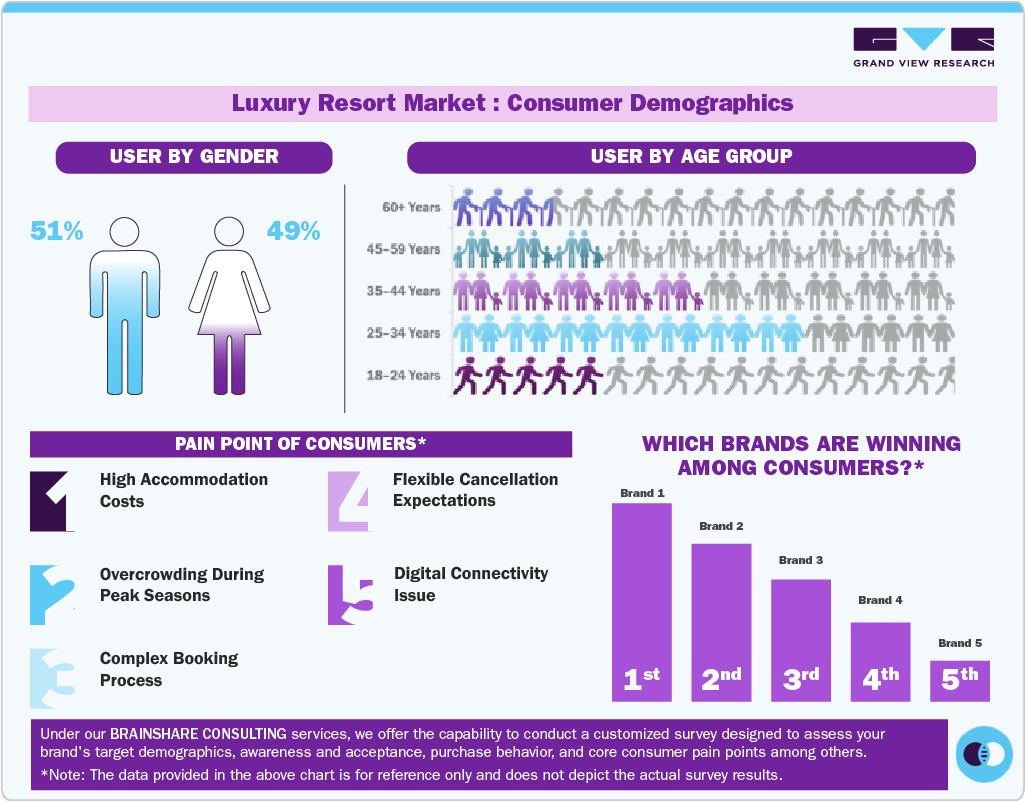
Consumer behavior in the global luxury resort market is increasingly centered on personalized, experience-driven travel, where guests prioritize privacy, wellness, exclusivity, and authentic destination experiences over traditional luxury accommodation. Travelers are seeking resorts that combine premium accommodation with spa and wellness programs, fine dining, outdoor recreation, cultural immersion, and customized itineraries. Growing environmental awareness is also influencing purchasing decisions, with consumers showing a stronger preference for eco-friendly resorts, sustainable operations, and properties that support local communities. This shift is reinforcing luxury resorts as premium lifestyle destinations that deliver memorable and meaningful travel experiences.
 To learn more about this report, Download Free Sample Report
At the same time, purchasing behavior is increasingly shaped by digital convenience, loyalty benefits, and repeat travel. Consumers actively compare resorts across online travel agencies, direct booking platforms, and travel advisors while valuing flexible booking policies, exclusive member benefits, and personalized offers. High-net-worth travelers are extending their stays, combining leisure with wellness or remote work, and returning to trusted luxury brands for consistent service quality. Social media influence, user-generated content, and destination marketing are further accelerating resort discovery and booking decisions, supporting higher guest retention, premium spending, and sustained demand across the global market. Women influence nearly 70-80% of leisure travel purchasing decisions, making them the primary decision-makers for luxury family holidays and wellness vacations.
Resort Type Insights
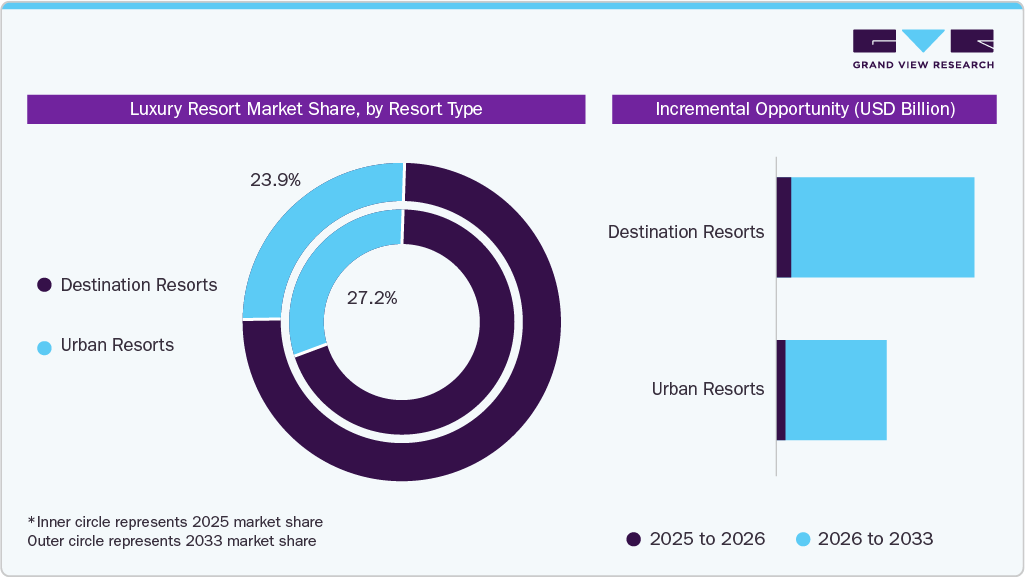
The luxury destination resort accounted for the largest market share, at 72.8% in 2025. The destination resorts segment remains a key component of the luxury resorts market, supported by growing consumer preference for experiential travel, nature-based vacations, and integrated leisure experiences, driven by rising demand for immersive travel, premium leisure tourism, and experiential hospitality. These resorts are typically located on beaches, islands, mountains, lakes, ski destinations, and other scenic locations, where the resort itself is the primary reason for travel. Destination resorts offer a comprehensive guest experience through luxury accommodations, fine dining, wellness facilities, recreational activities, adventure sports, and personalized services, enabling visitors to spend the majority of their stay within the property.
 To learn more about this report, Download Free Sample Report
The luxury urban resorts segment is anticipated to grow at a CAGR of 5.8% from 2026 to 2033. The urban resorts segment caters to travelers seeking luxury accommodations and resort-style amenities within or near major metropolitan areas. Unlike destination resorts, urban resorts offer convenient access to business districts, cultural attractions, shopping centers, entertainment venues, and transportation hubs, while providing premium facilities such as wellness spas, rooftop pools, fine-dining restaurants, fitness centers, and personalized concierge services. The segment serves a diverse customer base, including leisure travelers, business executives, and participants attending meetings, incentives, conferences, and exhibitions (MICE).
Ownership Model Insights
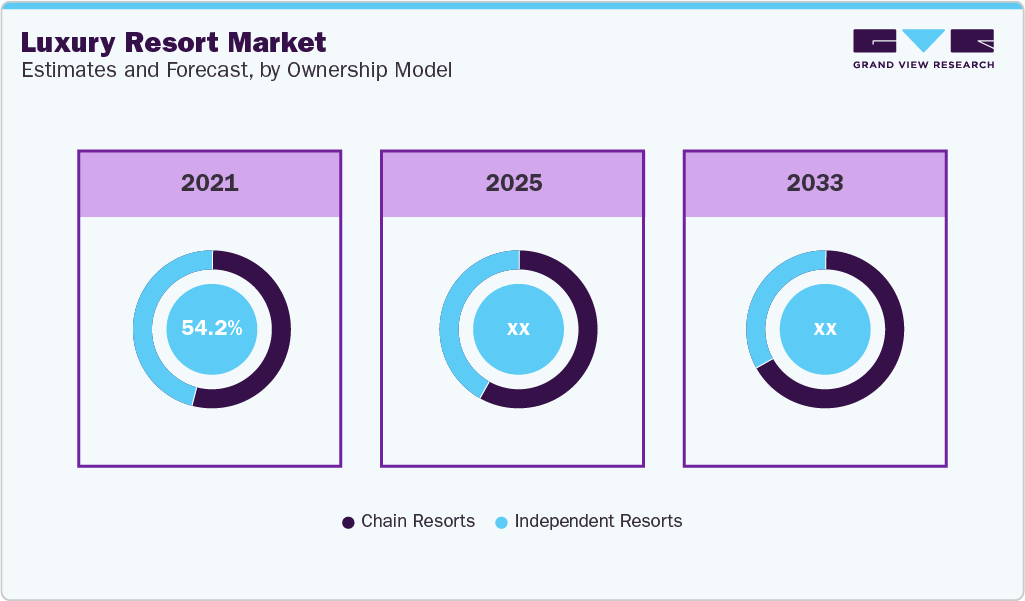
The chain resort market segment accounted for the largest share of 56.8% in 2025. The chain resorts segment comprises properties operating under established hospitality brands and resort management companies, including Marriott International, Hilton Worldwide, Hyatt Hotels Corporation, Four Seasons, Accor, IHG Hotels & Resorts, and Mandarin Oriental. These resorts benefit from global brand recognition, centralized reservation systems, loyalty programs, standardized service quality, and extensive marketing networks. Chain resorts continue to expand through new developments, management agreements, and brand extensions across key leisure destinations worldwide. Increasing demand for trusted hospitality brands, premium guest experiences, and integrated resort offerings is encouraging global operators to invest in luxury beachside and island destinations, golf, wellness, and integrated destination resorts. In addition, loyalty programs and cross-brand customer retention strategies are helping chain resorts attract both leisure and business travelers.
 To learn more about this report, Download Free Sample Report
The independent resorts market segment is anticipated to grow at a CAGR of 3.6% from 2026 to 2033. The independent resorts segment comprises properties that operate independently, without being part of a large hospitality chain or global brand network. These resorts typically focus on delivering unique experiences through personalized services, local cultural integration, distinctive architecture, and destination-specific offerings. Independent resorts often attract travelers seeking authenticity, exclusivity, and customized hospitality experiences that differ from standardized branded accommodations. Growing demand for experiential travel, boutique luxury stays, and culturally immersive vacations is supporting the growth of independent resorts across beach, island, mountain, and heritage destinations. Many independent luxury resorts also emphasize sustainability, wellness, and local partnerships to differentiate themselves within the competitive hospitality landscape.
Tourist Type Insights
The international tourists segment dominated the luxury resort industry, accounting for the largest share of 51.8% in 2025. The international tourist segment comprises travelers visiting luxury resorts outside their home country for leisure vacations, honeymoons, wellness retreats, cultural experiences, and adventure tourism. This segment is driven by rising cross-border travel, improved air connectivity, premium destination experiences, and growing demand for personalized luxury hospitality. International tourists generally contribute higher average spending per trip and longer lengths of stay, making them a key revenue source for luxury resorts in destinations such as the Maldives, Seychelles, Mauritius, Bali, and the Caribbean. Resort operators continue to invest in premium accommodations, multilingual services, wellness offerings, and curated destination experiences to attract affluent international travelers.
 To learn more about this report, Download Free Sample Report
The domestic tourism segment is anticipated to grow at a CAGR of 5.7% from 2026 to 2033. The segment is witnessing strong growth as affluent travelers increasingly prefer luxury vacations within their home country. Factors such as geopolitical uncertainty, higher international travel costs, and the availability of premium destination experiences have accelerated demand for domestic luxury resorts. Leading hospitality operators, including ITC Hotels, Radisson Hotel Group, and The Leela, have reported robust bookings and rising demand for domestic leisure travel, particularly for wellness retreats, nature-based escapes, and culturally immersive experiences.
Purpose of Visit Insights
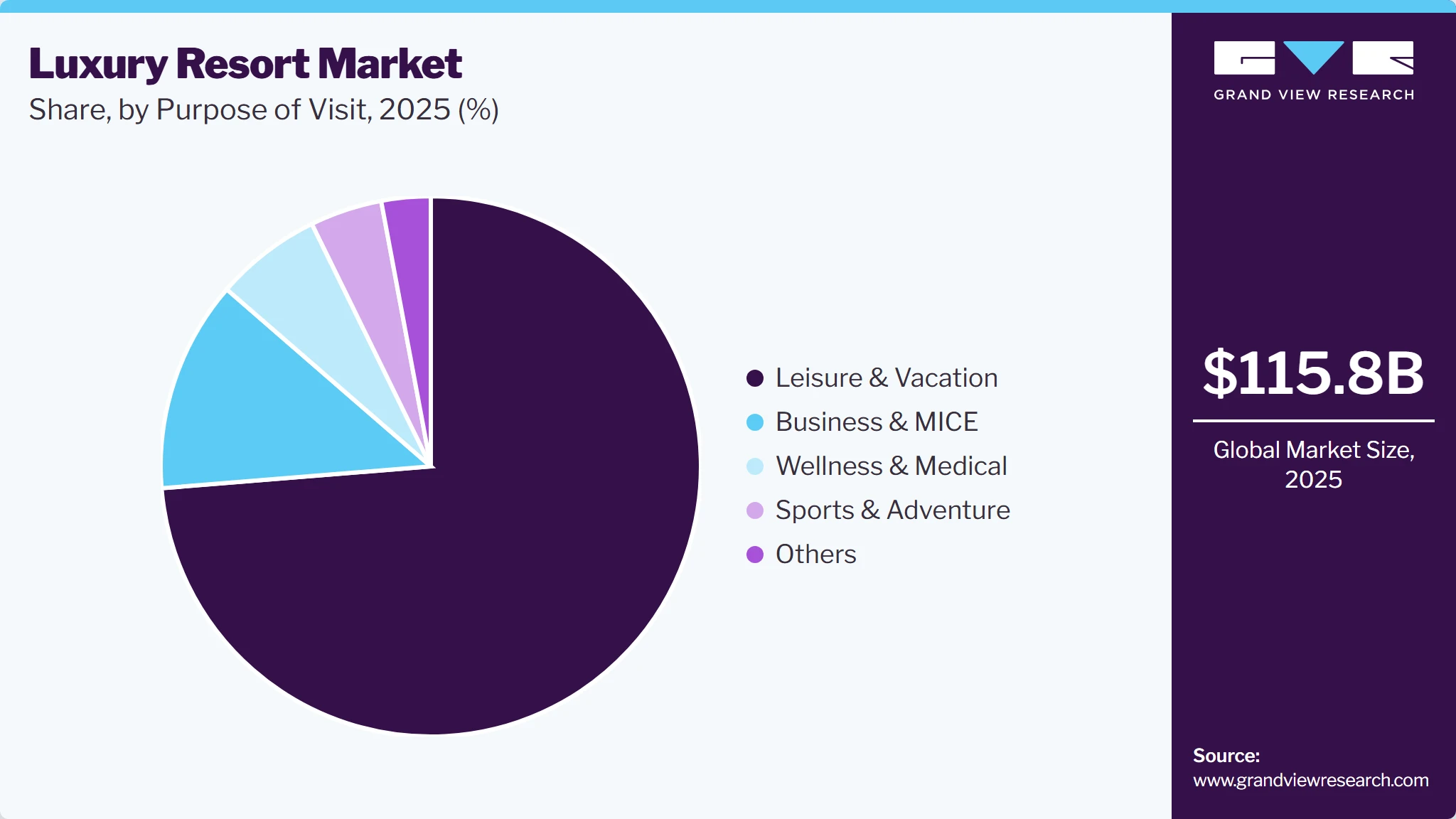
The purpose of leisure & vacation dominated the luxury resort industry, accounting for the largest share of 70.7% in 2025. The leisure & vacation segment comprises travelers who visit luxury resorts for relaxation, family holidays, romantic escapes, honeymoons, cultural exploration, and destination-based experiences. The increasing preference for experiential travel and the growing demand for personalized hospitality are driving growth in this segment. Luxury resorts are enhancing their offerings through private villas, wellness experiences, gourmet dining, curated excursions, and family-oriented amenities to cater to evolving traveler preferences. The increasing popularity of premium leisure travel and destination vacations continues to support demand for luxury resorts across beach, island, mountain, and nature-based destinations.
 To learn more about this report, Download Free Sample Report
The wellness & medical sector is anticipated to grow at a CAGR of 11.6% from 2026 to 2033. The wellness & medical segment comprises travelers visiting luxury resorts to improve physical health, mental well-being, and overall quality of life through wellness-focused experiences and specialized health programs. Demand is driven by increasing awareness of preventive healthcare, stress management, healthy aging, fitness, and holistic wellness. Luxury resorts are expanding their offerings through world-class spas, personalized wellness retreats, nutrition programs, fitness coaching, sleep therapies, mindfulness sessions, and integrative health treatments. The growing preference for transformative travel experiences and self-care-focused vacations continues to support demand for luxury wellness and medical resorts globally.
Booking Mode Insights
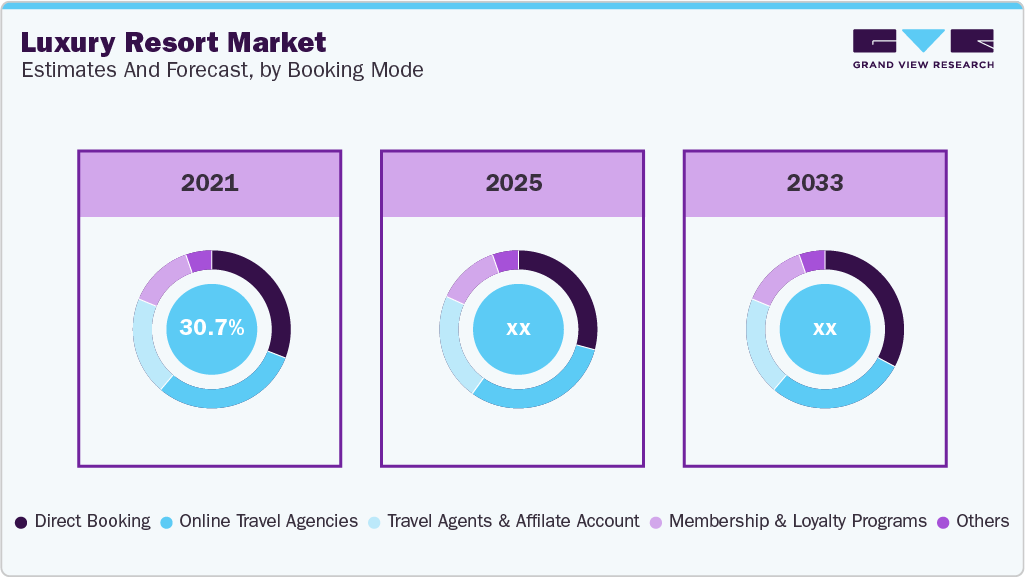
The Online Travel Agencies (OTAs) segment dominated the luxury resort market, accounting for the largest share of 30.6% in 2025. The online travel agencies (OTAs) segment comprises third-party digital booking platforms that enable travelers to search, compare, and book luxury resort accommodations online. Platforms such as Booking.com, Expedia, Agoda, and Trip.com provide luxury resorts with global distribution reach, access to international travelers, and greater visibility among customers seeking premium vacation experiences. OTAs are particularly important for independent luxury resorts and international destinations, where travelers often rely on online platforms for destination discovery, reviews, price comparison, and convenient booking options.
 To learn more about this report, Download Free Sample Report
The direct bookings segment is anticipated to grow at a CAGR of 9.2% from 2026 to 2033. The segment comprises reservations made directly through a luxury resort's official website, mobile application, call centers, email channels, or direct communication with the property. Luxury resorts are increasingly focusing on direct booking channels to strengthen customer relationships, reduce reliance on third-party distribution platforms, and improve profitability by minimizing intermediary commissions. Direct booking strategies are supported by personalized offers, exclusive member benefits, flexible cancellation policies, customized packages, and seamless digital booking experiences.
Regional Insights
The European luxury resort market accounted for the largest revenue share, at 29.3%, in 2025. Europe remains one of the world's leading markets, driven by its diverse leisure destinations, well-developed tourism infrastructure, and strong international visitor arrivals. Italy, France, and Spain are among the region's primary luxury resort destinations, offering Mediterranean beach resorts, countryside estates, wellness retreats, ski resorts, and vineyard experiences. At the same time, the UK and Germany represent two of Europe's largest outbound travel markets, generating substantial demand for luxury resort holidays across Southern Europe.
 To learn more about this report, Download Free Sample Report
Luxury travelers in Europe are increasingly seeking experience-led vacations, including wellness retreats, culinary tourism, vineyard stays, heritage estates, and private villa accommodations. Sustainability has also become a key purchasing factor, with luxury resorts investing in environmentally responsible operations, locally sourced cuisine, biodiversity conservation, and eco-certified hospitality. In addition, many hospitality groups are restoring historic castles, palaces, and country estates into luxury resorts, combining cultural heritage with modern luxury experiences.
Spain Luxury Resort Market Trends
The luxury resort market in Spain accounted for around 15.9% of Europe's revenue share in 2025. Spain is one of Europe's leading luxury resort destinations, supported by its Mediterranean coastline, year-round favorable climate, and globally recognized leisure tourism. Destinations such as Mallorca, Ibiza, Marbella, Costa del Sol, Costa Brava, and the Canary Islands attract affluent domestic and international travelers seeking beachfront resorts, wellness retreats, golf resorts, and exclusive villa experiences. Luxury travelers increasingly prefer wellness-focused stays, Michelin-starred dining, private yacht experiences, cultural immersion, and sustainable luxury hospitality, prompting international hotel brands to expand their presence across the country. Spain also benefits from strong air connectivity and a high volume of international visitors, reinforcing demand for premium resort accommodations and personalized guest experiences.
The Italy luxury resort market is expected to grow at a CAGR of 6.4% from 2026 to 2033. In July 2026, Travel + Leisure ranked Castiglion del Bosco, A Rosewood Hotel, located in Montalcino, Tuscany, Italy, as the No. 1 Resort in Europe in its World's Best Awards 2026, based on readers' evaluations of luxury hospitality experiences. Situated on a 5,000-acre historic estate within the UNESCO-listed Val d'Orcia region, the luxury resort features elegant suites, private villas, an 18-hole championship golf course, the Rosewood Spa, a Brunello di Montalcino winery and vineyards, and curated experiences such as wine tastings, truffle hunting, cooking classes, and cycling tours. The recognition highlights the growing preference among affluent travelers for destination resorts that combine authentic cultural heritage, wellness, gastronomy, outdoor recreation, and personalized luxury experiences.
Asia Pacific Luxury Resort Market Trends
The Asia Pacific luxury resort industry is expected to grow at a CAGR of 9.9% from 2026 to 2033. Asia Pacific is a significant market for luxury resorts, with a growing high-net-worth population and strong domestic and international tourism. Countries including China, India, Japan, South Korea, Australia, and New Zealand continue to witness increasing demand for premium leisure travel, wellness retreats, private villas, island resorts, and immersive cultural experiences. Luxury travelers across the region are increasingly seeking wellness-focused stays, eco-luxury accommodations, destination dining, nature-based tourism, and personalized hospitality, encouraging both international and domestic hospitality brands to expand their luxury resort portfolios. In addition, government investments in tourism infrastructure and improved international air connectivity continue to support the development of luxury resort destinations across the region.
The luxury resort market in China accounted for around 22.8% of Asia Pacific's revenue share in 2025. China remains one of Asia Pacific's largest luxury travel markets, supported by a growing affluent population, rising domestic tourism, and increasing demand for premium leisure experiences. Luxury travelers increasingly prefer wellness retreats, island resorts, private villas, family luxury vacations, and personalized hospitality. Destinations such as Hainan, Sanya, Hangzhou, and Yunnan continue to attract investments from global luxury hospitality brands, while sustainability, wellness, and cultural immersion remain key preferences among high-end travelers.
The India luxury resort market is expected to grow at a CAGR of 12.9% from 2026 to 2033. India's market continues to expand, driven by rising disposable incomes, a growing number of high-net-worth individuals, and increasing demand for destination weddings, wellness tourism, and heritage hospitality. Destinations including Rajasthan, Goa, Kerala, Uttarakhand, and Madhya Pradesh are witnessing increasing investments in luxury resorts offering wellness, cultural immersion, wildlife experiences, and personalized services.
In March 2025, The Oberoi Group officially opened The Oberoi Vindhyavilas Wildlife Resort in Bandhavgarh, Madhya Pradesh, India, just minutes from Bandhavgarh National Park, one of India's premier tiger reserves. Inspired by the Vindhya mountain ranges and the region's tribal heritage, the luxury resort offers elegantly designed luxury tents and villas, signature dining experiences, wellness facilities, and curated wildlife safaris. The property was also featured in TIME Magazine's "World's Greatest Places 2025", highlighting its exceptional design, immersive guest experiences, and unique natural setting. The opening reflects the growing demand for luxury wildlife tourism and experiential resort stays in India.
North America Luxury Resort Market Trends
The North America luxury resort industry accounted for 27.7% in 2025. North America remains one of the leading markets for luxury resorts, driven by high consumer spending, a mature luxury hospitality sector, and strong demand for premium leisure experiences. The U.S. accounts for one of the largest shares of regional demand, supported by affluent domestic travelers seeking beach, mountain, golf, wellness, and nature-based resorts. Consumers increasingly prefer experience-led luxury, with resorts offering personalized itineraries, wellness programs, culinary experiences, outdoor recreation, and family-oriented luxury vacations. The growing popularity of branded residences, private villas, and direct booking through loyalty ecosystems is further reshaping the market. Luxury travelers are also placing greater emphasis on sustainability, privacy, and exclusive destination experiences.
The U.S. luxury resort industry accounted for 73.6% of North America's revenue in 2025. In June 2025, Four Seasons announced that reservations were officially open for Naples Beach Club, A Four Seasons Resort, located in Naples, Florida, U.S., ahead of its October 2025 opening. Situated along 1,000 feet of white-sand beachfront on Florida's Gulf Coast, the luxury resort marks Four Seasons' first resort in this destination. The property features luxury guestrooms and suites, multiple oceanfront dining venues, an expansive spa and wellness center, beach club amenities, racquet sports facilities, and a Tom Fazio-designed championship golf course (opening later), in addition to branded residences. The development reflects the growing demand in North America for integrated luxury resort destinations that combine beachfront leisure, wellness, golf, residential living, and personalized guest experiences, catering to affluent domestic and international travelers.
The Mexico luxury resort market is expected to grow at a CAGR of 8.2% from 2026 to 2033. Mexico is one of North America's leading luxury resort destinations, supported by its world-renowned beach tourism, strong international visitor arrivals, and continued investments by global hospitality brands. Destinations such as Los Cabos, Riviera Maya, Cancún, Costa Mujeres, Riviera Nayarit, and Punta Mita attract affluent travelers seeking beachfront villas, wellness retreats, golf resorts, all-inclusive luxury experiences, and personalized hospitality. The market is witnessing increasing demand for private villas, wellness-focused stays, culinary experiences, eco-luxury accommodations, and experiential travel, particularly among visitors from the United States and Canada. International luxury hotel operators continue expanding their resort portfolios across Mexico's coastal destinations, supported by the country's robust tourism infrastructure and growing appeal as a premium leisure destination.
Central & South America Luxury Resort Market Trends
The Central & South America luxury resort industry is expected to grow at a CAGR of 8.2% from 2026 to 2033. Central & South America are emerging markets for luxury resorts, supported by their rich biodiversity, tropical coastlines, and growing appeal among international high-end travelers seeking nature-based and experiential vacations. Brazil, Costa Rica, Chile, Peru, Argentina, and the Caribbean islands continue to attract affluent visitors with beachfront resorts, rainforest retreats, wellness escapes, and eco-luxury lodges. Travelers increasingly prefer sustainable luxury, wellness experiences, wildlife encounters, private villas, adventure tourism, and immersive cultural experiences, encouraging global luxury hospitality brands to expand their presence across the region. Improved international connectivity and continued tourism investments are further strengthening the luxury resort landscape in Central & South America.
The luxury resort market in Brazil accounted for approximately 23.9% of revenue in 2025. Brazil's market is supported by its extensive coastline, diverse natural landscapes, and growing appeal among domestic and international leisure travelers seeking premium beach, eco-tourism, and wellness experiences. Destinations such as Bahia, Rio de Janeiro, and the northeastern coastal region continue to attract investment in high-end resorts offering all-inclusive services, luxury villas, wellness retreats, and nature-based experiences. Rising disposable incomes among affluent domestic travelers, coupled with increasing international tourism and improved air connectivity, are supporting market growth. Luxury resort operators are expanding experiential offerings through sustainable hospitality practices, cultural immersion programs, gourmet dining, and adventure tourism.
Middle East & Africa Luxury Resort Market Trends
The Middle East & Africa luxury resort industry is expected to grow at a CAGR of 9.9% from 2026 to 2033. The market growth is driven by increasing investments in high-end tourism infrastructure, government-led tourism diversification initiatives, and rising demand for premium leisure and wellness experiences. Countries including Saudi Arabia, the UAE, South Africa, Seychelles, Mauritius, and Oman are expanding their luxury resort offerings through beachfront developments, desert retreats, island resorts, wildlife lodges, and wellness destinations. Affluent travelers increasingly seek private villas, personalized hospitality, wellness retreats, eco-luxury experiences, marine tourism, and adventure-based stays, encouraging international luxury hospitality brands to strengthen their presence across the region.
The luxury resort market in South Africa accounted for approximately 9.5% of revenue in 2025. South Africa is one of Africa's leading luxury resort destinations, driven by its diverse landscapes, world-renowned wildlife reserves, pristine coastlines, and established tourism infrastructure. The country attracts affluent domestic and international travelers seeking luxury safari lodges, beachfront resorts, wellness retreats, wine estate resorts, and adventure-based experiences. Destinations such as Greater Kruger National Park, KwaZulu-Natal, Cape Town, the Garden Route, and the Eastern Cape continue to witness investment in premium hospitality offerings that combine personalized service with nature and conservation.
Key Luxury Resort Companies
The following key companies have been profiled for this study of the luxury resort market.
-
Four Seasons Hotels Limited
-
Aman Group S.à r.l.
-
Six Senses Hotels Resorts Spas
-
Rosewood Hotel Group
-
Belmond Management Limited
-
Mandarin Oriental International Limited
-
The Ritz-Carlton Hotel Company, L.L.C.
-
St. Regis Hotels & Resorts
-
Kerzner International Limited
-
Banyan Tree Holdings Limited
Competitive Benchmarking
Category
Operating Strategies
Competitive Edge
Weakness
Established Players (Four Seasons Hotels Limited, The Ritz-Carlton Hotel Company, L.L.C., St. Regis Hotels & Resorts, Mandarin Oriental International Limited, Banyan Tree Holdings Limited
Expand luxury resort portfolios through new openings and management contracts in high-growth leisure destinations, invest in branded residences and wellness offerings, strengthen direct booking and loyalty programs, renovate flagship resorts, and integrate digital guest services and sustainability initiatives.
Globally recognized luxury brands, extensive international presence, strong customer loyalty and repeat guests, premium service standards, broad distribution networks, access to Marriott Bonvoy and other loyalty ecosystems, and strong financial resources for expansion and asset enhancement.
High capital investment requirements, dependence on international leisure travel, premium pricing that limits the customer base during economic downturns, long development timelines, and rising operating costs associated with luxury service standards.
Emerging & Boutique Luxury Players (Aman Group S.à r.l., Six Senses Hotels Resorts Spas, Rosewood Hotel Group, Belmond Management Limited, Kerzner International Limited)
Focus on ultra-luxury experiential travel, wellness retreats, eco-conscious developments, destination-specific resorts, personalized guest experiences, limited-key exclusive properties, and expansion into emerging luxury tourism markets through selective developments and partnerships.
Strong differentiation through exclusivity and personalized service, high average daily rates (ADR), leadership in wellness and experiential hospitality, unique destination portfolios, strong appeal among high-net-worth travelers, and premium brand positioning.
Smaller property portfolios than those of global hotel chains, limited geographic reach, dependence on affluent international travelers, slower scalability due to an exclusive development strategy, and greater exposure to geopolitical and luxury travel demand fluctuations.
Recent Developments
-
In July 2026, Six Senses officially opened Six Senses AMAALA, marking the brand's second resort in Saudi Arabia. Located along the Red Sea coast, the luxury wellness resort features 100 suites and villas, 25 branded residences, and immersive nature- and wellness-focused experiences, reinforcing AMAALA's position as a premier regenerative luxury tourism destination.
-
In June 2026, Four Seasons launched the Four Seasons Resort and Residences AMAALA at Triple Bay in Saudi Arabia, marking the opening of AMAALA, Red Sea Global's second flagship destination. The ultra-luxury wellness resort features 202 guestrooms and 26 branded residences, strengthening the Kingdom's premium luxury tourism and wellness hospitality offerings.
-
In June 2026, Mandarin Oriental launched Mandarin Oriental Punta Negra, Mallorca, its first resort in the Balearic Islands, featuring 131 guestrooms and suites, six dining venues, a signature wellness sanctuary, and direct access to two secluded coves. The resort blends Mediterranean-inspired design with luxury wellness and leisure experiences, strengthening the brand's resort portfolio in Southern Europe.
Luxury Resort Market Report Scope
Report Attribute
Details
Market size in 2025
USD 115.8 billion
Estimated market size in 2026
USD 122.5 billion
Projected market size by 2033
USD 203.1 billion
Growth rate
CAGR of 7.5% from 2026 to 2033
Base year for estimation
2025
Historical data
2021 - 2025
Forecast period
2026 - 2033
Quantitative units
Revenue in USD billion, volume in number of occupied rooms in thousands, and CAGR from 2026 to 2033
Report coverage
Revenue forecast, volume forecast in terms of number of occupied rooms, company ranking, competitive landscape, growth factors, and trends
Segments covered
Resort type, ownership model, tourist type, purpose of visit, booking mode, region
Regional scope
North America; Europe; Asia Pacific; Central & South America; and Middle East & Africa
Country scope
U.S.; Canada; Mexico; UK; Germany; France; Italy; Spain; China; India; Japan; South Korea; Australia & New Zealand; Brazil; South Africa
Key companies profiled
Four Seasons Hotels Limited; Aman Group S.à r.l.; Six Senses Hotels Resorts Spas; Rosewood Hotel Group; Belmond Management Limited; Mandarin Oriental International Limited; The Ritz-Carlton Hotel Company, L.L.C.; St. Regis Hotels & Resorts; Kerzner International Limited; Banyan Tree Holdings Limited
Customization scope
Free report customization (equivalent up to 8 analysts working days) with purchase. Addition or alteration to country, regional & segment scope.
Pricing and purchase options
Avail customized purchase options to meet your exact research needs. Explore purchase options
Global Luxury Resort Market Report Segmentation
This report forecasts volume & revenue growth at the global, regional & country levels and provides an analysis of the latest trends and opportunities in each of the sub-segments from 2021 to 2033. For this study, Grand View Research has segmented the luxury resort market based on resort type, ownership model, tourist type, purpose of visit, booking mode, and region:
-
Resort Type Outlook (Volume, Number of Occupied Rooms, Thousands; Revenue, USD Billion, 2021 - 2033)
-
Urban Resorts
-
Destination Resorts
-
Golf Resorts
-
Beach Resorts
-
Island Resorts
-
Lake Resorts
-
Mountain Resorts
-
Ski Resorts
-
Eco-Resorts
-
Others (Heritage Resorts, Casino Resorts, etc.)
-
-
-
Ownership Model Outlook (Volume, Number of Occupied Rooms, Thousands; Revenue, USD Billion, 2021 - 2033)
-
Independent Resorts
-
Chain Resorts
-
-
Tourist Type Outlook (Volume, Number of Occupied Rooms, Thousands; Revenue, USD Billion, 2021 - 2033)
-
Domestic
-
International
-
-
Purpose of Visit Outlook (Volume, Number of Occupied Rooms, Thousands; Revenue, USD Billion, 2021 - 2033)
-
Leisure & Vacation
-
Business & MICE
-
Wellness & Medical
-
Sports & Adventure
-
Others
-
-
Booking Mode Outlook (Volume, Number of Occupied Rooms, Thousands; Revenue, USD Billion, 2021 - 2033)
-
Direct Bookings
-
Online Travel Agencies (OTAs)
-
Travel Agents & Affiliate Accounts
-
Membership & Loyalty Programs
-
Others (Concierge Services, etc.)
-
-
Regional Outlook (Volume, Number of Occupied Rooms, Thousands; Revenue, USD Billion, 2021 - 2033
-
North America
-
U.S.
-
Canada
-
Mexico
-
-
Europe
-
UK
-
Germany
-
France
-
Italy
-
Spain
-
-
Asia Pacific
-
China
-
India
-
Japan
-
South Korea
-
Australia & New Zealand
-
-
Central & South America
-
Brazil
-
-
Middle East & Africa
-
South Africa
-
-
Research Methodology
The luxury resort market figures in this report are based on a proven research process that combines executive interviews with secondary research from proprietary databases, company filings, and recognized regulatory and institutional sources. Market size is built through value-chain sizing—reconciling supply-side and demand-side estimates—and triangulated with bottom-up and top-down approaches. Every estimate passes multiple levels of expert validation before publication, with each luxury resort segment quantified using the revenue-capture definitions in the table below.
Segment Definition
Segment - Ownership Model
Revenue capture definition
Independent Resorts
Luxury resorts operating without affiliation to a multi-property hotel or resort brand, chain, franchise network, or branded management platform. The property retains independent branding and operating identity.
Chain Resort
Luxury resorts affiliated with a multi-property hotel or resort group through ownership, management, franchise, lease, or brand licensing arrangements and operating under a recognized chain or portfolio brand
Estimation Model
Layer Name
Key Question
Description / Methodology
Luxury Travel Consumer Base Layer
Who has the potential to stay at luxury resorts?
Begin with the global leisure travel population, including high-net-worth individuals (HNWIs), affluent households, premium business travelers, honeymooners, wellness tourists, and experiential travelers. Apply international and domestic travel participation rates, tourism expenditure, disposable income, and luxury travel preferences to estimate the total addressable luxury resort consumer base.
Destination Accessibility & Resort Supply Layer
Who has access to luxury resort destinations?
Filter the eligible traveler base using the availability of luxury resorts, international air connectivity, tourism infrastructure, visa accessibility, destination attractiveness, and the presence of premium hospitality infrastructure. Account for resort density, transportation accessibility, and luxury tourism development to estimate the addressable luxury resort market.
Active Booking & Stay Layer
Who actively books and stays at luxury resorts?
Apply booking conversion and travel frequency among affluent travelers based on vacation patterns, average length of stay, wellness travel demand, honeymoon tourism, family vacations, repeat visits, corporate retreats, and seasonal occupancy variations. Consider direct booking, OTAs, travel advisors, and loyalty program participation to estimate active luxury resort guests.
Revenue Generation Layer
How much revenue is generated?
Multiply annual occupied room nights by Average Daily Rate (ADR), occupancy levels, and ancillary guest spending across food & beverage, recreational activities, private residences, event-based experiences, and premium amenities. Include revenue generated through accommodation, dining, wellness, entertainment, memberships, and other resort services to estimate the total luxury resort market revenue.
Delivered Customizations
This report has been delivered with the following In-depth customizations
CLIENT REQUEST
CUSTOMIZATION DELIVERED
VALUE ADDS
Resort Type Analysis
Developed a comprehensive assessment of demand across luxury resort types, including beach, island, mountain, ski, golf, eco, urban, and wellness resorts. The study evaluated traveler preferences, occupancy trends, seasonal demand, destination attractiveness, and revenue contribution by resort category while assessing investment opportunities across mature and emerging luxury tourism destinations.
Enables stakeholders to identify high-growth resort segments, optimize portfolio allocation, evaluate investment opportunities across destination types, and align development strategies with evolving traveler preferences and tourism demand.
Purpose of Visit Analysis
Delivered a detailed evaluation of consumer travel behavior across leisure & vacation, business & MICE, wellness & medical tourism, sports & adventure, and other travel purposes. The analysis assessed booking frequency, average length of stay, seasonal travel patterns, guest spending, and demand drivers influencing resort selection and revenue generation.
Provides actionable insights into changing traveler behavior, high-value customer segments, seasonal demand fluctuations, and premium service opportunities, supporting targeted marketing, product development, and long-term revenue optimization.
Booking Mode Analysis
Conducted an in-depth assessment of booking channels, including direct bookings, online travel agencies (OTAs), travel agents, membership & loyalty programs, and other reservation platforms. The study analyzed channel performance, customer acquisition costs, booking conversion rates, digital adoption, and guest preferences to evaluate distribution efficiency and revenue contribution.
Supports strategic planning by identifying the most effective distribution channels, improving direct booking performance, optimizing digital marketing investments, strengthening loyalty programs, and enhancing profitability through efficient channel management.
Frequently Asked Questions About This Report
Luxury chain resorts accounted for the largest market share of 56.8% in 2025.
International tourists accounted for the largest market share of 51.8% in 2025.
Online travel agencies (OTAs) accounted for the largest market share of 30.6% in 2025.
The luxury resort market size was estimated at USD 115.8 billion in 2025 and is expected to reach USD 122.5 billion in 2026.
The luxury resort market is expected to grow at a compound annual growth rate of 7.5% from 2026 to 2033, reaching USD 203.1 billion by 2033.
The luxury destination resorts accounted for the largest market share of 72.8% in 2025.
Europe regional market accounted for the largest market share, with a revenue share of 29.3% in 2025.
Rising affluent travel spending and premium leisure demand. The expansion of global private wealth and sustained growth in discretionary travel expenditure have become two of the strongest structural demand drivers for the luxury resort market. Luxury resorts increasingly benefit from affluent travellers prioritizing exclusivity, privacy, wellness, personalized services, and destination-led experiences over conventional sightseeing.
Key players in the luxury resort market: Four Seasons Hotels Limited, Aman Group S.à r.l., Six Senses Hotels Resorts Spas, Rosewood Hotel Group, Belmond Management Limited, Mandarin Oriental International Limited, The Ritz-Carlton Hotel Company, L.L.C., St. Regis Hotels & Resorts, Kerzner International Limited, Banyan Tree Holdings Limited.
About the Author(s)
Homecare & Decor Research Team
Consumer Goods · Homecare & DecorThis report was authored by the homecare & decor research team at Grand View Research - comprising two research analysts, one senior research analyst, and one industry expert - with specialized expertise in the homecare & decor segment of the consumer goods industry. All findings are based on proprietary consumer goods databases, executive interviews, and regulatory analysis, subject to internal peer review prior to publication.
Last Updated:
Speak to Analyst

Customize this report to your needs - add regions, segments, or data points, with 20% free customization.
Or view our licence options:


ISO 9001:2015 & 27001:2022 Certified
We are GDPR and CCPA compliant! Your transaction & personal information is safe and secure. For more details, please read our privacy policy.


