
- Home
- »
- Clothing, Footwear & Accessories
- »
-
Luxury Watch Market Size And Share Report, 2026-2033GVR Report cover

Luxury Watch Market (2026 - 2033)
Size, Share & Trends Analysis Report By Product (Electronic, Mechanical), By Distribution Channel (Online, Offline), By Region (North America, Europe, Asia Pacific, Central & South America, Middle East & Africa), And Segment Forecasts
Market Size, 2025
$16.9BMarket Estimate, 2026
$17.6BMarket Forecast, 2033
$24.5BCAGR, 2026–2033
4.8%Luxury Watch Market Summary
The global luxury watch market size was valued at USD 16.9 billion in 2025 and is projected to grow from USD 17.6 billion in 2026 to USD 24.5 billion by 2033, at a CAGR of 4.8% from 2026 to 2033. Asia Pacific held the largest market share of 54.3% in 2025. Limited editions, exclusive boutique experiences, and the perception of watches as both status symbols and long-term investments reinforce consumer willingness to spend, supporting moderate yet sustained growth.
 Source: Grand View Research, IR Documents, Primary Interviews, Paid DatabasesTo learn more about this report,
 Download Free Sample Report
 Key Market Trends & Insights
- By product: Electronic luxury watch segment led the market and accounted for a share of 63.0% in 2025.
- By product: Mechanical luxury watch segment is anticipated to grow at a CAGR of 5.2% from 2026 to 2033.
- By distribution channel: Offline sales segment held a market share of 69.1% in 2025.
Regional Highlights
- Largest regional market: Asia Pacific (54.3% revenue share, 2025)
- By country: China luxury watch market accounted for a share of 43.0% in 2025 in APAC.
Market Size & Forecast
- Market size in 2025: USD 16.9 Billion
- Estimated market size in 2026: USD 17.6 Billion
- Projected market size by 2033: USD 24.5 Billion
- CAGR (2026-2033): 4.8%
Three ways to get this report
Buy it, customize it, or ask a question.Ask an Analyst
Analyst response in 1 business day
- AccessReport author, directly
- Reply timeWithin 1 working day
- No sales callDirect answer only
- FormatEmail reply
- CostFree, no cost
Get the Full Report
What the study covers
- FormatsPDF · Excel · Dashboard
- Timeline2026–2033 annual, 2025 base
- Coverage20+ countries, 5 regions
- Companies10+ key players profiled
Customize the Report
20% free customization
- IncludeCountries, segments, points
- TailorTo your product definition
- ExtendDeeper competitor detail
- OrA fully bespoke study
- Turnaround5–10 working days
A key trend in the luxury watch industry is the sharp shift toward scarcity-driven buying, where consumers prioritize limited-production steel sports models and high-complication watches from a few heritage brands, driven by strong resale values and visible secondary-market premiums. Watches are increasingly purchased as assets and status symbols, while mid-tier luxury brands face slower sell-through and higher inventory pressure.A primary driver of the global luxury watches market is the heritage and reputation of established brands. Consumers across regions such as North America, Europe, and Asia often choose watches from Rolex, Omega, and TAG Heuer because of their proven craftsmanship, iconic designs, and historical significance. Retailers report that buyers are willing to wait for allocations and limited editions, indicating that brand credibility and legacy strongly influence purchase decisions.
 To learn more about this report, Download Free Sample Report
 In April 2025, Rolex launched the Oyster Perpetual Land-Dweller collection, featuring a modern Flat Jubilee bracelet and the new calibre 7135 movement, which incorporates a high-frequency escapement for enhanced precision. Offered in steel, Everose gold, and platinum, the collection combines contemporary design with Rolex heritage, drawing strong interest from collectors and enthusiasts worldwide.
Limited editions, boutique-only releases, and region-specific models further stimulate demand worldwide. Ground-level observations show that consumers often target specific references, with scarcity creating urgency and enhancing desirability. This controlled availability encourages purchases through authorized channels, reinforcing both sales and brand prestige in markets such as the U.S., Europe, and the Middle East.
In addition, vintage-inspired luxury designs have found strong appeal among consumers who value both fashion and affordability, offering a stylish yet accessible option. These developments reflect luxury’s transformation from its earlier perception as a basic alternative to mechanical watches into a technologically sophisticated, sustainable, and aesthetically versatile choice.
For instance, in November 2024, Tissot added a new 25 mm luxury model to its PRX collection. This watch combines the brand’s 1970s integrated-bracelet design with a modern touch. The watch includes a Swiss luxury movement with an End-of-Life indicator and is water-resistant up to 100 m. Available in several finishes, including carnation-gold PVD, it appeals to those looking for an elegant, vintage-inspired timepiece that is also compact and durable.
Brand Share Analysis
 To learn more about this report, Download Free Sample Report
 Consumer Insights
A mix of heritage brands, innovative high-end players, and accessible luxury or regional specialists shapes the global luxury watches industry, each catering to distinct consumer preferences and income tiers.
-
Heritage global players: Rolex, Patek Philippe, Audemars Piguet - dominate the ultra-luxury segment with iconic designs, strong resale value, and unmatched brand prestige, appealing to collectors and affluent buyers worldwide.
-
Premium and niche innovators: Hublot, Richard Mille, MB&F - focus on avant-garde designs, technical complexity, and limited editions, targeting connoisseurs and younger high-net-worth consumers seeking exclusivity and statement pieces.
-
Lifestyle and fashion-oriented brands: TAG Heuer, Omega, Breitling - blend functionality with aspirational branding, offering sporty, elegant, and heritage-inspired models for style-conscious professionals and aspirational buyers.
-
Regional or accessible luxury players: Seiko Presage, Longines, Frederique Constant - provide premium craftsmanship at lower price points, capturing first-time luxury watch buyers and expanding appeal in emerging markets like India, China, and Southeast Asia.
 To learn more about this report, Download Free Sample Report
 Consumer demographics skew male and mature
-
The luxury watch market remains male dominated, with men accounting for the clear majority of buyers, reflecting traditional positioning of mechanical watches as status and achievement symbols.
-
Female participation, while smaller, is growing steadily, driven by rising demand for iconic unisex designs and jewelry inspired luxury watches rather than pure tool watches.
Core demand concentrated in 25-44 age group
-
Consumers aged 25-44 form the strongest buying cohort, combining rising disposable income with brand aspiration and investment driven purchase behavior.
-
Buyers above 45 tend to prioritize heritage, complications, and long term value, while the 18-24 segment shows lower penetration due to high entry prices and preference for digital or smart alternatives.
Key consumer pain points reflect real purchase barriers
-
Price sensitivity remains significant even in luxury, especially as retail prices rise faster than income growth.
-
Brand perception and design limitations affect mid-tier players, while concerns around durability and upkeep costs influence first-time luxury buyers more than seasoned collectors.
Product Insights
Electronic luxury watches accounted for a 63.0% share of the global revenue in 2025, mainly driven by consumer demand for convenience, multi-functionality, and connectivity features such as smart notifications, health tracking, and hybrid mechanical-electronic designs. Established brands and tech-forward entrants are leveraging this trend to attract younger, urban professionals who value both status and practicality.
The demand for mechanical luxury watches is anticipated to grow at a CAGR of 5.2% from 2026 to 2033, fueled by collectors and enthusiasts seeking craftsmanship, heritage, and tangible luxury experiences. Factors driving this include limited editions, artisanal finishing, and rising interest in tangible assets as status symbols, particularly in markets like China, the Middle East, and Europe, where owning a mechanical timepiece signals both wealth and connoisseurship.
Distribution Channel Insights
The sale of luxury watches through offline channels accounted for 69.1% of the market, as consumers continue to prefer the tactile experience of trying watches in person, personalized service from boutique staff, and the prestige of purchasing from high-end stores, particularly for gifting or high-value investments.
For instance, in February 2025, India’s leading luxury watch retailer, Kapoor Watch Co, historically dominant in the North Indian market, announced plans to expand nationally with the opening of a new boutique in Pune, marking its first major move beyond its home region.
 To learn more about this report, Download Free Sample Report
 The sale of luxury watches through the online channel is expected to grow at a CAGR of 5.3% from 2026 to 2033, driven by younger affluent buyers comfortable with digital shopping, the rise of brand-owned e-commerce platforms offering curated collections and authentication guarantees, and increasing internet penetration in regions with limited physical store access.
Regional Insights
North America Luxury Watch Market Trends
The North America luxury watch industry is projected to grow at a CAGR of 5.0% from 2026 to 2033. One key factor driving the North American luxury watch market is deep, regionally concentrated purchasing power across the U.S. and Canada, supported by stable high-income demographics rather than tourism-led demand. Major metros such as New York, Los Angeles, Miami, Toronto, Vancouver, Houston, and San Francisco account for a disproportionate share of luxury watch sales, with buyers typically purchasing through authorized dealers and brand boutiques.
U.S. Luxury Watch Market Trends
The U.S. luxury watch industry is expected to see a CAGR of 5.2% from 2026 to 2033. The market is driven by concentrated high-income consumers in major metros, strong brand-controlled retail networks, and demand for reference-specific models purchased through authorized dealers for status, gifting, and milestone spending rather than mass luxury consumption.
In October 2025, JCK and Luxury announced the launch of Timepieces at Luxury, a dedicated watch-focused showcase set to debut at The Venetian in Las Vegas in 2026, aimed at giving retailers a more structured and premium platform to source established and independent watch brands within North America’s leading jewelry trade event.
The luxury watch market in Canada is expected to see a CAGR of 4.7% from 2026 to 2033. Canada’s luxury watch growth is steady rather than explosive, driven by a small but high-income consumer base concentrated in Toronto, Vancouver, and Montreal. Demand is largely driven by immigration-related wealth creation (tech, finance, and real estate entrepreneurs) and by cross-border brand awareness from the U.S. market. Sales are heavily skewed toward authorized dealers and luxury mall retailers, with limited grey-market influence compared to Asia. Growth is also supported by increasing preference for entry-level Swiss luxury watches as “status diversification” among professionals, rather than ultra-high-end collector demand.
Asia Pacific Luxury Watch Market Trends
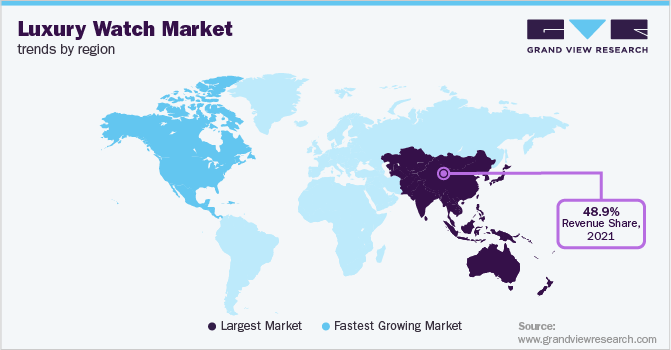
The Asia Pacific Luxury watch industry accounted for a 54.3% of the global market in 2025. Asia Pacific dominated the global market primarily as it combines the world’s fastest-growing wealth creation base with strong cultural demand for visible status goods. The region’s performance is driven by concentrated luxury consumption in major urban hubs like China’s tier-1 cities, India’s metros, Japan’s mature luxury buyers, and Southeast Asia’s tourism-driven retail centers.
A key ground reality is that luxury watches here are not just accessories but wealth-signaling assets tied to gifting, weddings, and business relationships. In addition, retail expansion in high-end malls and airport luxury zones has significantly increased accessibility, making Asia the central global demand engine.
 To learn more about this report, Download Free Sample Report
 China Luxury watch market accounted for a share of 43.0% in 2025. China is one of the single largest contributors to global luxury watch demand, driven by rising HNWI density, strong gifting culture in business environments, and status signaling. Purchases are heavily concentrated in tier-1 cities like Shanghai, Beijing, Shenzhen, and Guangzhou, with rapid expansion into tier-2 cities. A key factor is the shift from overseas buying (Hong Kong, Switzerland, Europe) to domestic purchasing, driven by anti-corruption policies, travel normalization, and improved local retail presence. Grey markets and online resale platforms also significantly influence pricing dynamics.
India luxury watch market is expected to witness a CAGR of 4.8% from 2026 to 2033. India’s luxury watch industry is growing steadily from a smaller base, driven by rising high-net-worth individuals, startup wealth, and wedding-related luxury gifting. Demand is highly urban-centric, concentrated in Mumbai, Delhi NCR, Bengaluru, and Hyderabad. Purchases are often milestone-driven (weddings, promotions, inheritance wealth events) rather than frequent upgrades. Growth is also supported by the expansion of luxury retail malls and authorized brand stores, although price sensitivity still leads many buyers toward entry-level Swiss luxury or premium fashion watches.
The luxury watch market in Japan is expected to witness a CAGR of 4.5% from 2026 to 2033. Japan’s market is mature but stable, with strong domestic appreciation for craftsmanship and mechanical precision. Consumers often have deep knowledge of watchmaking, leading to high demand for mid- to high-tier Swiss brands and strong domestic competition in the high-end luxury watch segment (Seiko, Citizen, Casio). The market is also influenced by inbound tourism, in which visitors purchase luxury watches at favorable prices. However, domestic growth is moderate because of an aging population and already high penetration.
Europe Luxury Watch Market Trends
The Europe Luxury watch industry is anticipated to grow with a CAGR of 4.7% from 2026 to 2033. Europe’s growth is stable because it is both a production hub (Switzerland, France, Germany) and a mature consumption market. Heritage appreciation, strong secondary/collector markets, and tourism purchases in cities like Paris, Milan, Zurich, and London drive demand. However, growth is moderated by saturation in core Western European markets and high baseline penetration. Replacement demand, vintage collecting, and limited-edition releases are key drivers, not first-time buyers. Currency fluctuations and VAT refund shopping for tourists also materially influence sales patterns.
Germany luxury watch market accounted for a share of 23.4% in 2025. Germany’s large share reflects its strong domestic appetite for precision engineering and mechanical watches, particularly in the mid- to high-end luxury segments. Buyers tend to prefer functional, understated luxury (brands like chronograph and tool-watch segments) rather than highly flamboyant designs. Specialist retailers and established jewelers, rather than aggressive mall expansion, dominate distribution. The market is also supported by high disposable incomes in industrial and engineering-heavy cities like Munich, Hamburg, and Frankfurt, where luxury watches are seen as long-term investments rather than fashion accessories.
The UK luxury watch market is expected to witness a CAGR growth of 4.8% from 2026 to 2033. The UK luxury watch industry is heavily driven by London, a global wealth hub where finance professionals, entrepreneurs, and international buyers drive demand. A key ground reality is the strong role of tourism shopping and VAT refund incentives, which historically boosted Swiss watch purchases.
The luxury watch market in France is expected to grow at a CAGR of 4.5% from 2026 to 2033. Paris as both a luxury tourism capital and a domestic high-income consumption center, anchors France’s market. Demand is strongly influenced by global tourists purchasing Swiss and French luxury brands during travel, especially in flagship boutiques along Avenue Montaigne and Rue du Faubourg Saint-Honoré. Domestic buyers show steady but selective demand, with a preference for heritage and design-oriented watches. The market also benefits from its proximity to Switzerland, which strengthens distribution and brand visibility.
Central & South America Luxury Watch Market Trends
The Central & South America Luxury watch industry is anticipated to grow with a CAGR of 3.7% from 2026 to 2033. Luxury watch demand is concentrated in Brazil, Argentina, and Chile, primarily in major cities such as São Paulo and Mexico City. Purchases are heavily influenced by import duties, currency volatility, and limited retail penetration, making luxury watches significantly more expensive than in North America or Europe. As a result, demand is more niche and concentrated among elites, business owners, and collectors.
Middle East & Africa Luxury Watch Market Trends
The Middle East & Africa Luxury watch industry is anticipated to grow with a CAGR of 4.2% from 2026 to 2033, driven by high per-capita wealth in Gulf countries such as the UAE, Saudi Arabia, and Qatar, where luxury watches are commonly purchased as status symbols and gifting items. Dubai and Riyadh act as major retail hubs with strong luxury mall ecosystems and duty-free shopping advantages. Africa’s contribution is smaller and concentrated in South Africa, Nigeria, and Kenya, where demand is limited to ultra-wealthy segments. Tourism, expatriate populations, and a strong cultural preference for visible luxury ownership support the region’s growth.
Key Luxury Watch Companies:
The following key companies have been profiled for this study on the luxury watch market.
- Rolex
- Patek Philippe
- Audemars Piguet
- Vacheron Constantin
- Omega
- TAG Heuer
- Hublot
- Longines
- Jaeger-LeCoultre
- Breitling
Recent Developments
-
In April 2026, Grand Seiko unveiled new Watches and Wonders 2026 launches, including Spring Drive U.F.A. models such as compact Evolution 9 dive watches with ultra-high accuracy and 300m water resistance, along with new Masterpiece and Elegance collection dress watches featuring refined, nature-inspired designs.
-
In February 2026, Indian luxury watch startup Rotoris launched its official website, marking its entry into the premium mechanical luxury watch segment with a direct-to-consumer model focused on limited-edition, handcrafted timepieces. The launch introduced collections like Monarch, Astonia, Arvion, Auriqua, and Manifesta, all positioned in the luxury space with emphasis on exclusivity, design-led storytelling, and Swiss-inspired mechanical craftsmanship, offered in highly restricted production batches.
-
In November 2025, Infinity Group expanded into luxury watch and jewelry retail with the launch of Infinity Timeless, marking its entry as an authorized retailer for leading global brands including Rolex. The group opened boutiques in Chennai and Ahmedabad, offering a curated portfolio of high-end watches and fine jewelry with a focus on personalized, premium retail experiences.
-
In December 2025, New York-based luxury brand Tiffany & Co. introduced its Eternity by Tiffany watch collection in India, bringing a refined range of diamond-set timepieces inspired by the brand’s jewelry heritage. The collection features elegant gold cases, distinctive diamond hour markers, and signature Tiffany Blue dials, targeting affluent Indian consumers seeking jewelry-led luxury watches.
Luxury Watch Market Report Scope
Report Attribute
Details
Market size in 2025
USD 16.9 billion
Estimated Market size in 2026
USD 17.6 billion
Projected Market size by 2033
USD 24.5 billion
Growth rate (Revenue)
CAGR of 4.8% from 2026 to 2033
Base year for estimation
2025
Historical Data
2021 - 2024
Forecast period
2026 - 2033
Quantitative units
Revenue in USD million/ billion, and CAGR from 2026 to 2033
Report coverage
Revenue forecast, company ranking, competitive landscape, growth factors, and trends
Segments covered
Product, distribution channel, region
Regional scope
North America; Europe; Asia Pacific; Central & South America; Middle East & Africa
Country scope
U.S.; Canada; Mexico; UK; Germany; France; Italy; Spain; China; Japan; India; Australia & New Zealand ; South Korea; Hong Kong; Brazil; South Africa
Key companies profiled
Rolex; Patek Philippe; Audemars Piguet; Vacheron Constantin; Omega; TAG Heuer; Hublot; Longines; Jaeger-LeCoultre; Breitling
Customization scope
Free report customization (equivalent up to 8 analysts working days) with purchase. Addition or alteration to country, regional & segment scope.
Pricing and purchase options
Avail customized purchase options to meet your exact research needs. Explore purchase options
Global Luxury Watch Market Report Segmentation
This report forecasts revenue growth at the global, regional, and country levels and provides an analysis of the latest industry trends and opportunities in each of the sub-segments from 2021 to 2033. For this study, Grand View Research has segmented the global luxury watch market report based on product, distribution channel, and region.
 To learn more about this report, Download Free Sample Report
 -
Product Mode Outlook (Revenue, USD Million, 2021 - 2033)
-
Electronic
-
Mechanical
-
-
Distribution Channel (Revenue, USD Million, 2021 - 2033)
-
Online
-
Offline
-
-
Regional Outlook (Revenue, USD Million, 2021 - 2033)
-
North America
-
U.S.
-
Canada
-
Mexico
-
-
Europe
-
UK
-
Germany
-
France
-
Italy
-
Spain
-
-
Asia Pacific
-
China
-
Japan
-
India
-
Australia & New Zealand
-
South Korea
-
Hong Kong
-
-
Central & South America
-
Brazil
-
-
Middle East & Africa
-
South Africa
-
-
Frequently Asked Questions About This Report
The global luxury watch market size was valued at USD 16.9 billion in 2025 and is expected to reach USD 17.6 billion in 2026.
The global luxury watch market is expected to grow at a compound annual growth rate (CAGR) of 4.8% from 2026 to 2033 to reach USD 24.5 billion by 2033.
Electronic luxury watch accounted for a 63.0% share of the global revenue in 2025, mainly driven by consumer demand for convenience, multi-functionality, and connectivity features such as smart notifications, health tracking, and hybrid mechanical-electronic designs.
Some key players in the luxury watch market include Rolex; Patek Philippe; Audemars Piguet; Vacheron Constantin; Omega; TAG Heuer; Hublot; Longines; Jaeger-LeCoultre; Breitling
Key factors include strong brand heritage, and consistent demand for premium timepieces. Limited editions, exclusive boutique experiences, and the perception of watches as both status symbols and long-term investments reinforce consumer willingness to spend, supporting moderate yet sustained growth.
Asia Pacific dominated the global luxury watch market in 2025, accounting for 54.3% of the market.
Electronic luxury watches accounted for 63.0% of global revenue in 2025.
The sale of luxury watches through offline channels accounted for 69.1% of the market share in 2025.
About the Author(s)
Clothing, Footwear & Accessories Research Team
Consumer Goods · Clothing, Footwear & AccessoriesThis report was authored by the clothing, footwear & accessories research team at Grand View Research - comprising two research analysts, one senior research analyst, and one industry expert - with specialized expertise in the clothing, footwear & accessories segment of the consumer goods industry. All findings are based on proprietary consumer goods databases, executive interviews, and regulatory analysis, subject to internal peer review prior to publication.
Last Updated:
Speak to Analyst

Customize this report to your needs - add regions, segments, or data points, with 20% free customization.
Or view our licence options:


ISO 9001:2015 & 27001:2022 Certified
We are GDPR and CCPA compliant! Your transaction & personal information is safe and secure. For more details, please read our privacy policy.


